ANNOTATED BIBLIOGRAPHY
(A Presentation)


By Shirin Eugenio
DBA720D - Advanced Research Method
April 12, 2010
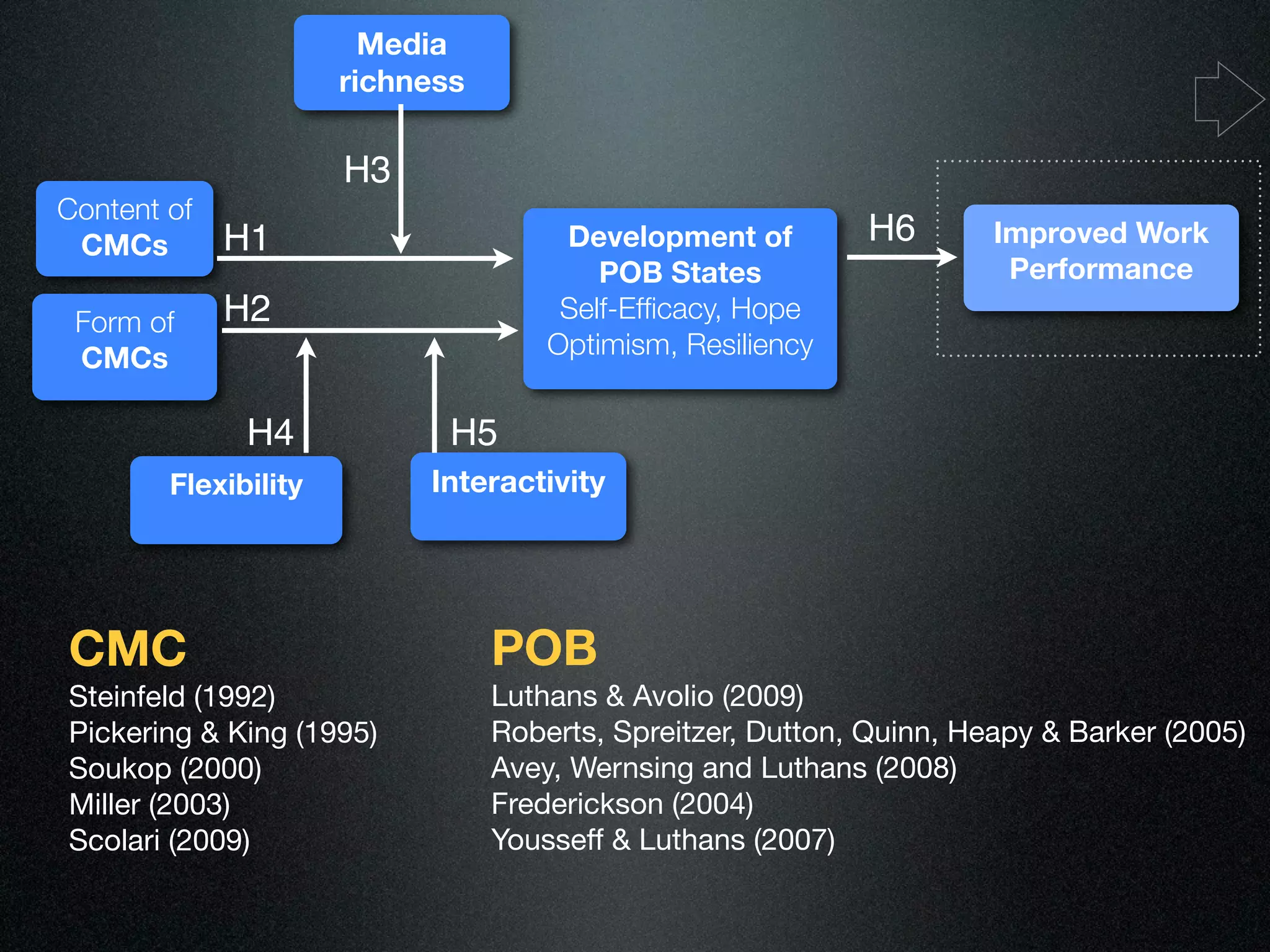
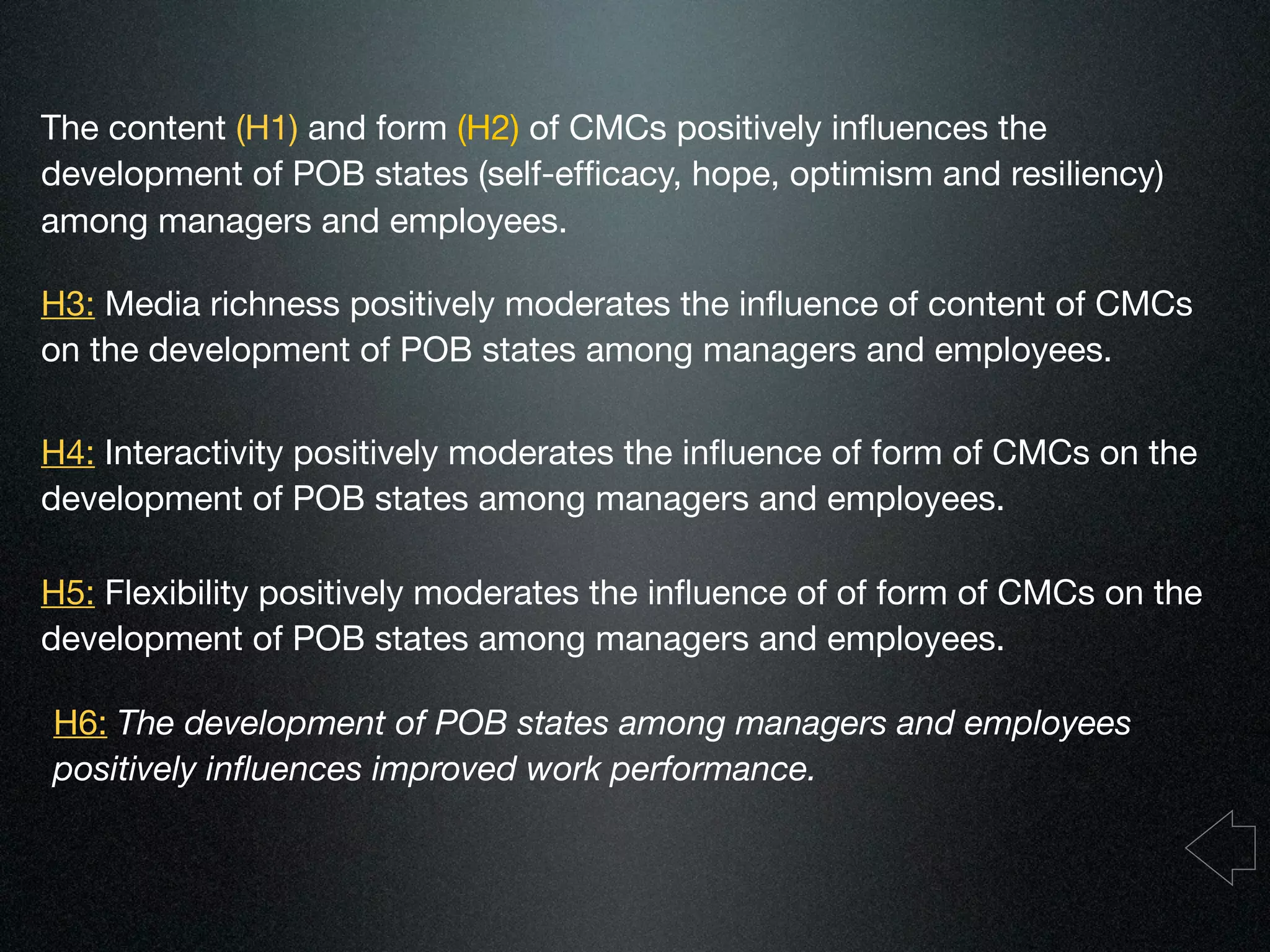
Media
                      richness

                      H3
Content of
 CMCs        H1                       Development of        H6        Improved Work
                                         POB States                    Performance
 Form of     H2                       Self-Efficacy, Hope
 CMCs                                Optimism, Resiliency


              H4             H5
        Flexibility        Interactivity


CMC                              POB
Steinfeld (1992)                 Luthans & Avolio (2009)
Pickering & King (1995)          Roberts, Spreitzer, Dutton, Quinn, Heapy & Barker (2005)
Soukop (2000)                    Avey, Wernsing and Luthans (2008)
Miller (2003)                    Frederickson (2004)
Scolari (2009)                   Yousseff & Luthans (2007)
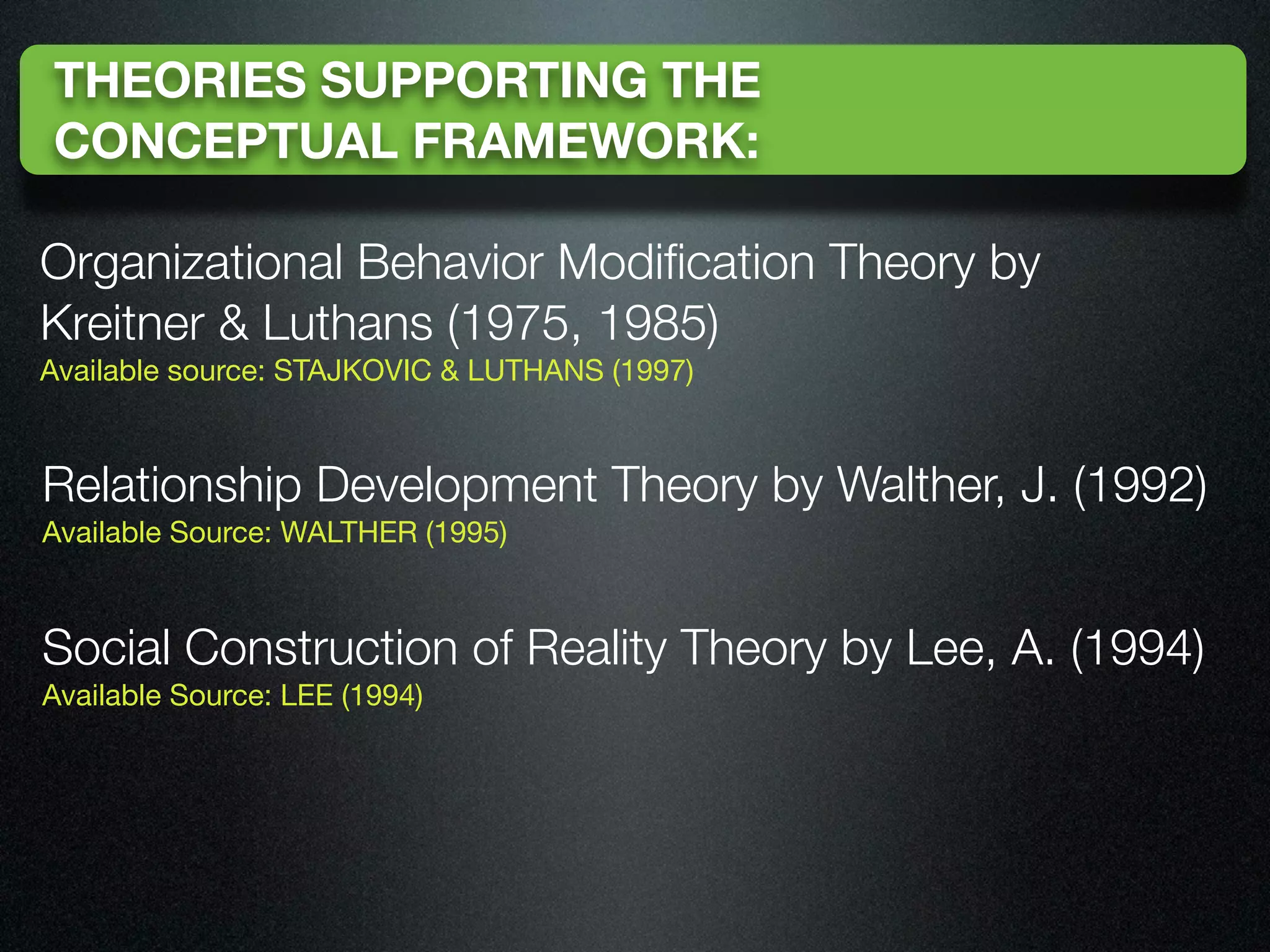
THEORIES SUPPORTING THE
CONCEPTUAL FRAMEWORK:

Organizational Behavior Modification Theory by
Kreitner & Luthans (1975, 1985)
Available source: STAJKOVIC & LUTHANS (1997)


Relationship Development Theory by Walther, J. (1992)
Available Source: WALTHER (1995)


Social Construction of Reality Theory by Lee, A. (1994)
Available Source: LEE (1994)
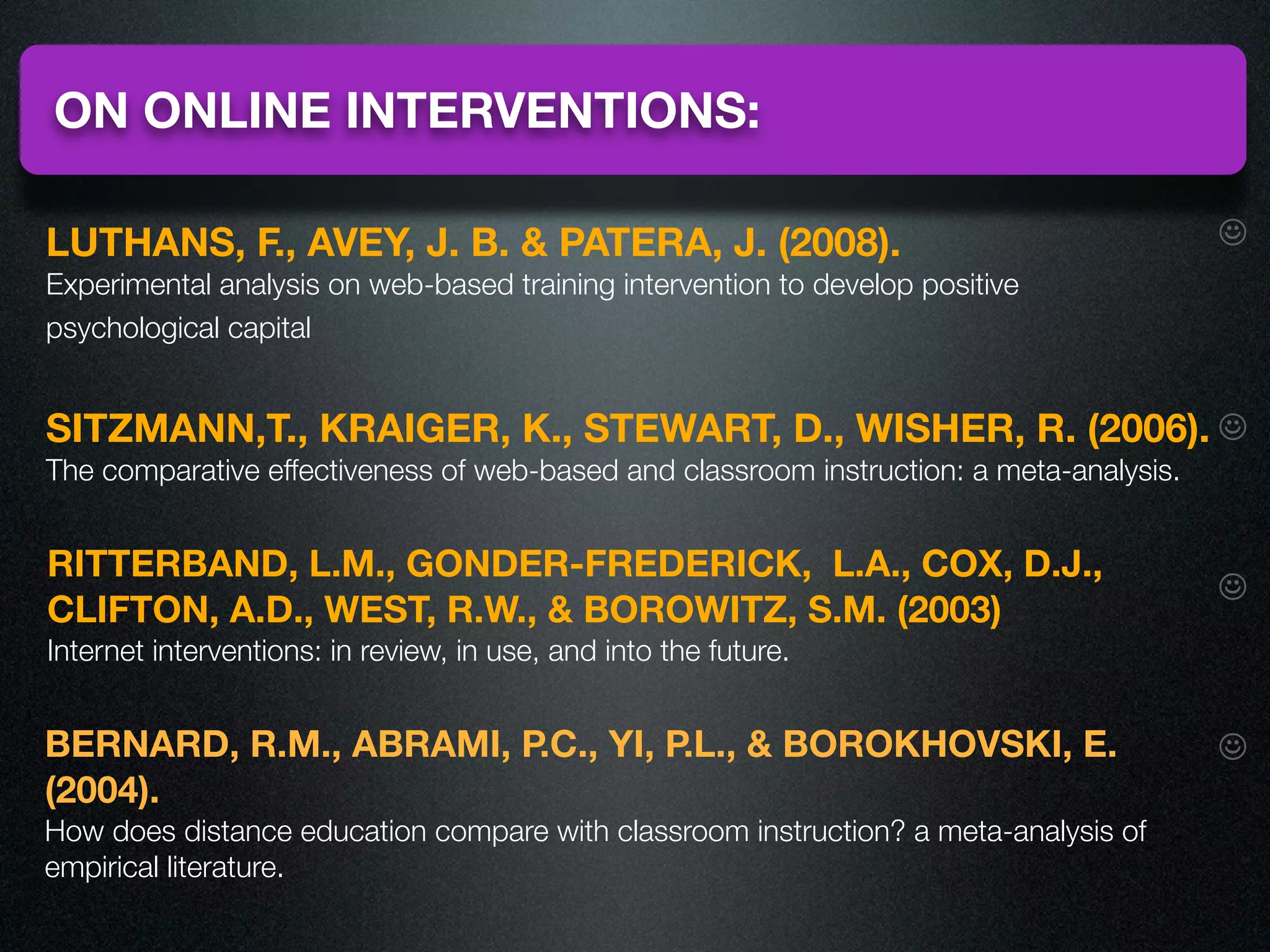
ON ONLINE INTERVENTIONS:

LUTHANS, F., AVEY, J. B. & PATERA, J. (2008).                                            ☺
Experimental analysis on web-based training intervention to develop positive
psychological capital


SITZMANN,T., KRAIGER, K., STEWART, D., WISHER, R. (2006). ☺
The comparative effectiveness of web-based and classroom instruction: a meta-analysis.


RITTERBAND, L.M., GONDER-FREDERICK, L.A., COX, D.J.,
                                                                                         ☺
CLIFTON, A.D., WEST, R.W., & BOROWITZ, S.M. (2003)
Internet interventions: in review, in use, and into the future.


BERNARD, R.M., ABRAMI, P.C., YI, P.L., & BOROKHOVSKI, E.                                 ☺
(2004).
How does distance education compare with classroom instruction? a meta-analysis of
empirical literature.
ON ONLINE INTERVENTIONS:

LUTHANS, F., AVEY, J. B. & PATERA, J. (2008).                                        ☺
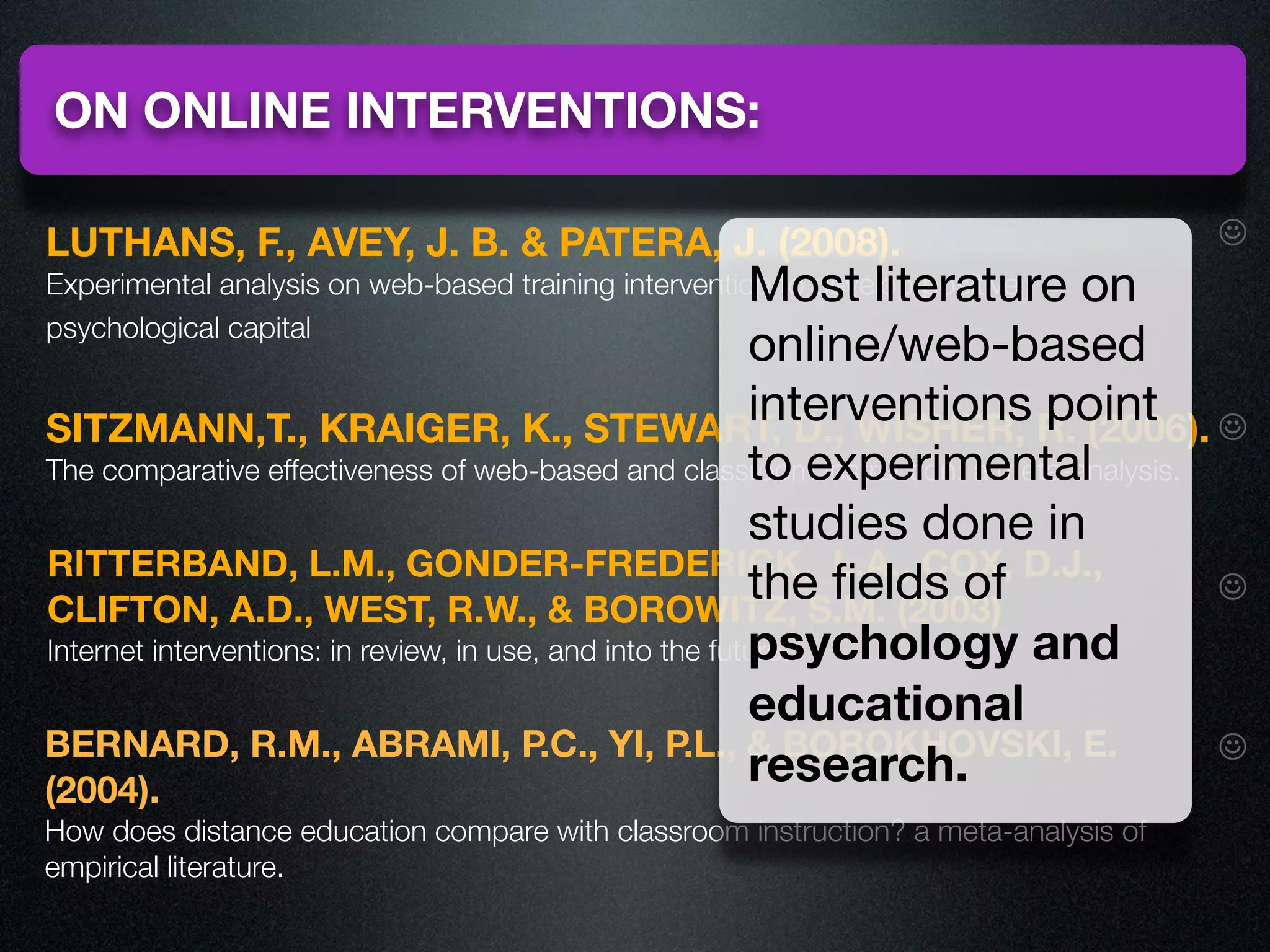
                                                           Most literature on
Experimental analysis on web-based training intervention to develop positive
psychological capital
                                                           online/web-based
SITZMANN,T., KRAIGER, K., STEWART, D., WISHER,
                                                           interventions R. (2006). ☺
                                                                           point
                                                           to experimental
The comparative effectiveness of web-based and classroom instruction: a meta-analysis.
                                                           studies done in
RITTERBAND, L.M., GONDER-FREDERICK, L.A., COX, D.J.,
CLIFTON, A.D., WEST, R.W., & BOROWITZ, S.M. (2003)
                                                           the fields of                ☺
                                                           psychology and
Internet interventions: in review, in use, and into the future.

                                                           educational
BERNARD, R.M., ABRAMI, P.C., YI, P.L., & BOROKHOVSKI, E.                               ☺
(2004).
                                                           research.
How does distance education compare with classroom instruction? a meta-analysis of
empirical literature.
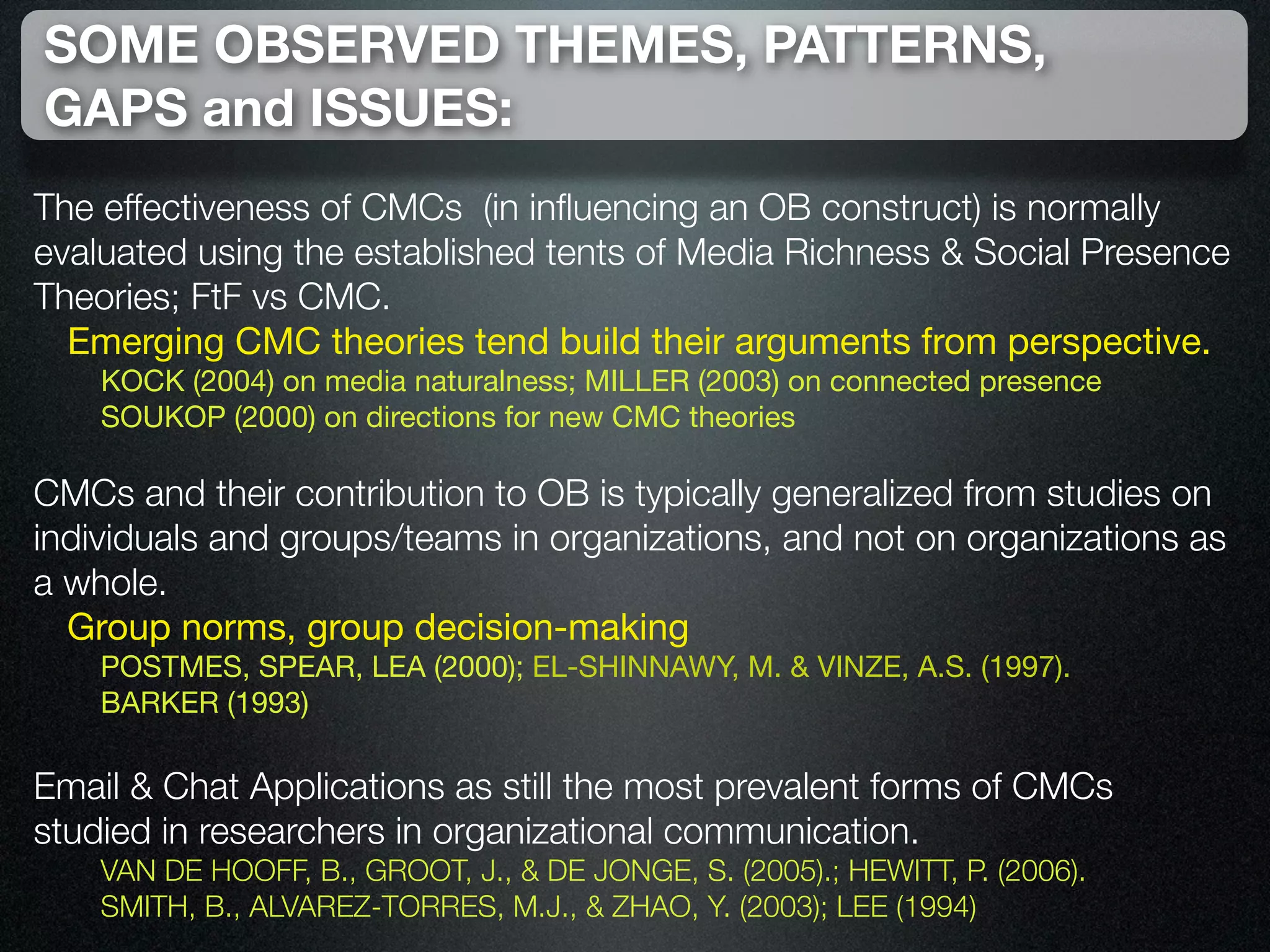
SOME OBSERVED THEMES, PATTERNS,
GAPS and ISSUES:
The effectiveness of CMCs (in influencing an OB construct) is normally
evaluated using the established tents of Media Richness & Social Presence
Theories; FtF vs CMC.
  Emerging CMC theories tend build their arguments from perspective.
    KOCK (2004) on media naturalness; MILLER (2003) on connected presence
    SOUKOP (2000) on directions for new CMC theories

CMCs and their contribution to OB is typically generalized from studies on
individuals and groups/teams in organizations, and not on organizations as
a whole.
  Group norms, group decision-making
    POSTMES, SPEAR, LEA (2000); EL-SHINNAWY, M. & VINZE, A.S. (1997).
    BARKER (1993)

Email & Chat Applications as still the most prevalent forms of CMCs
studied in researchers in organizational communication.
    VAN DE HOOFF, B., GROOT, J., & DE JONGE, S. (2005).; HEWITT, P. (2006).
    SMITH, B., ALVAREZ-TORRES, M.J., & ZHAO, Y. (2003); LEE (1994)
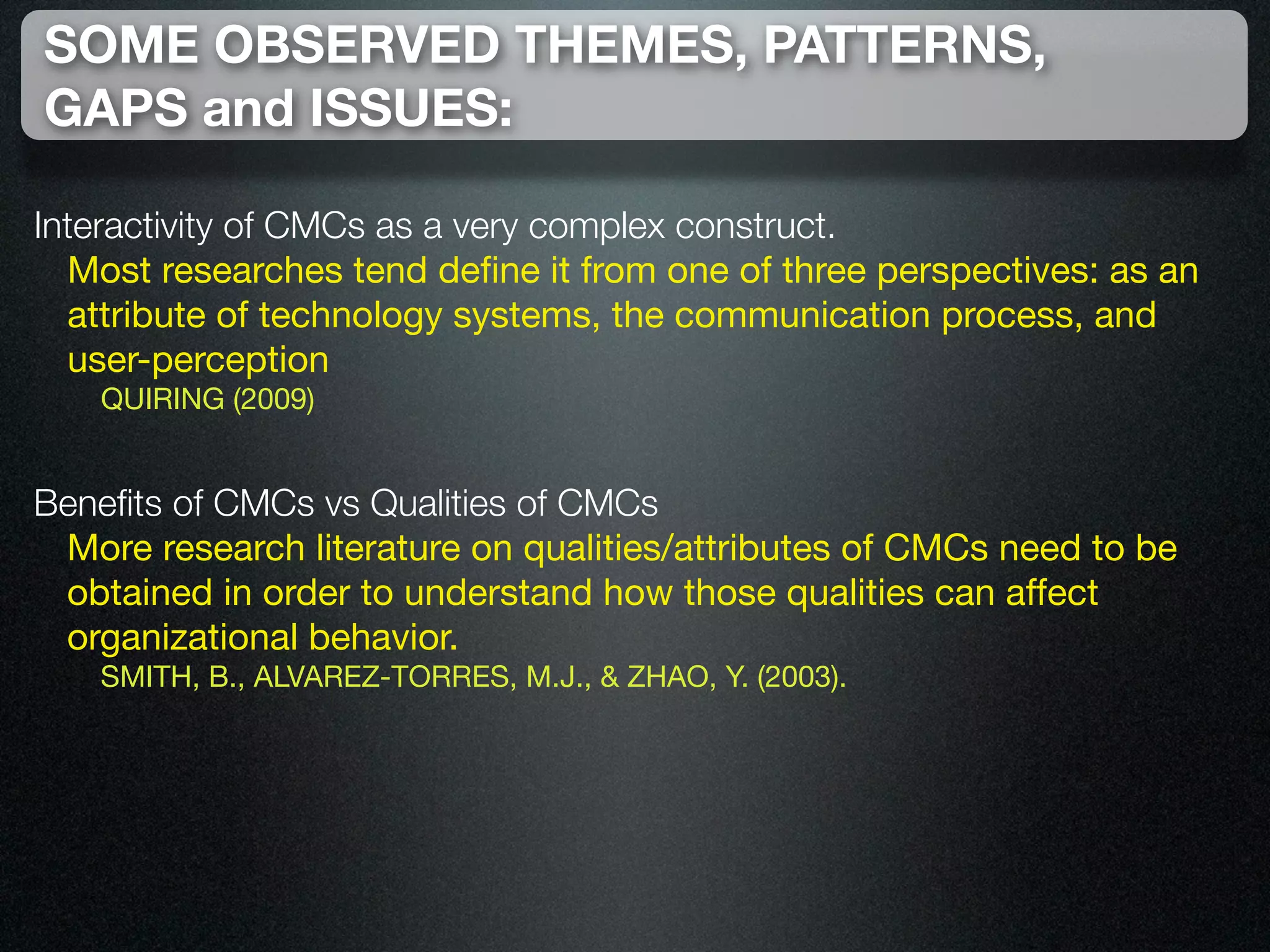
SOME OBSERVED THEMES, PATTERNS,
GAPS and ISSUES:

Interactivity of CMCs as a very complex construct.
  Most researches tend define it from one of three perspectives: as an
  attribute of technology systems, the communication process, and
  user-perception
   QUIRING (2009)


Benefits of CMCs vs Qualities of CMCs
 More research literature on qualities/attributes of CMCs need to be
 obtained in order to understand how those qualities can affect
 organizational behavior.
   SMITH, B., ALVAREZ-TORRES, M.J., & ZHAO, Y. (2003).
SOME OBSERVED THEMES, PATTERNS,
GAPS and ISSUES:

Interactivity of CMCs as a very complex construct.
  Most researches tend define it from one of three perspectives: as an
  attribute of technology systems, the communication process, and
  user-perception
   QUIRING (2009)


Benefits of CMCs vs Qualities of CMCs
 More research literature on qualities/attributes of CMCs need to be
 obtained in order to understand how those qualities can affect
 organizational behavior.
   SMITH, B., ALVAREZ-TORRES, M.J., & ZHAO, Y. (2003).


                                                                   Thank
                                                                   you for
                                                                    your
                                                                    time.
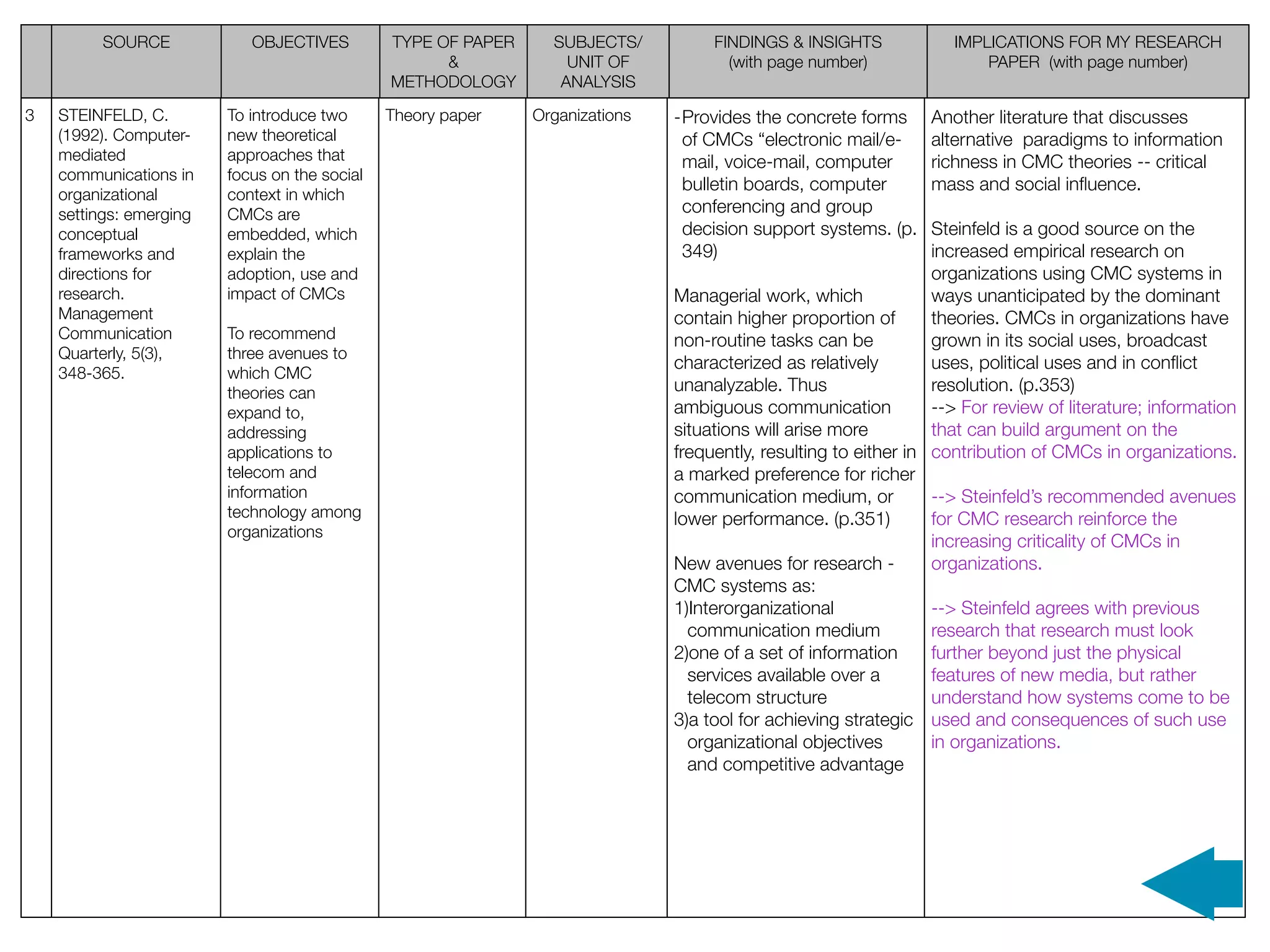
SOURCE             OBJECTIVES         TYPE OF PAPER     SUBJECTS/          FINDINGS & INSIGHTS             IMPLICATIONS FOR MY RESEARCH
                                                     &             UNIT OF            (with page number)                PAPER (with page number)
                                               METHODOLOGY        ANALYSIS

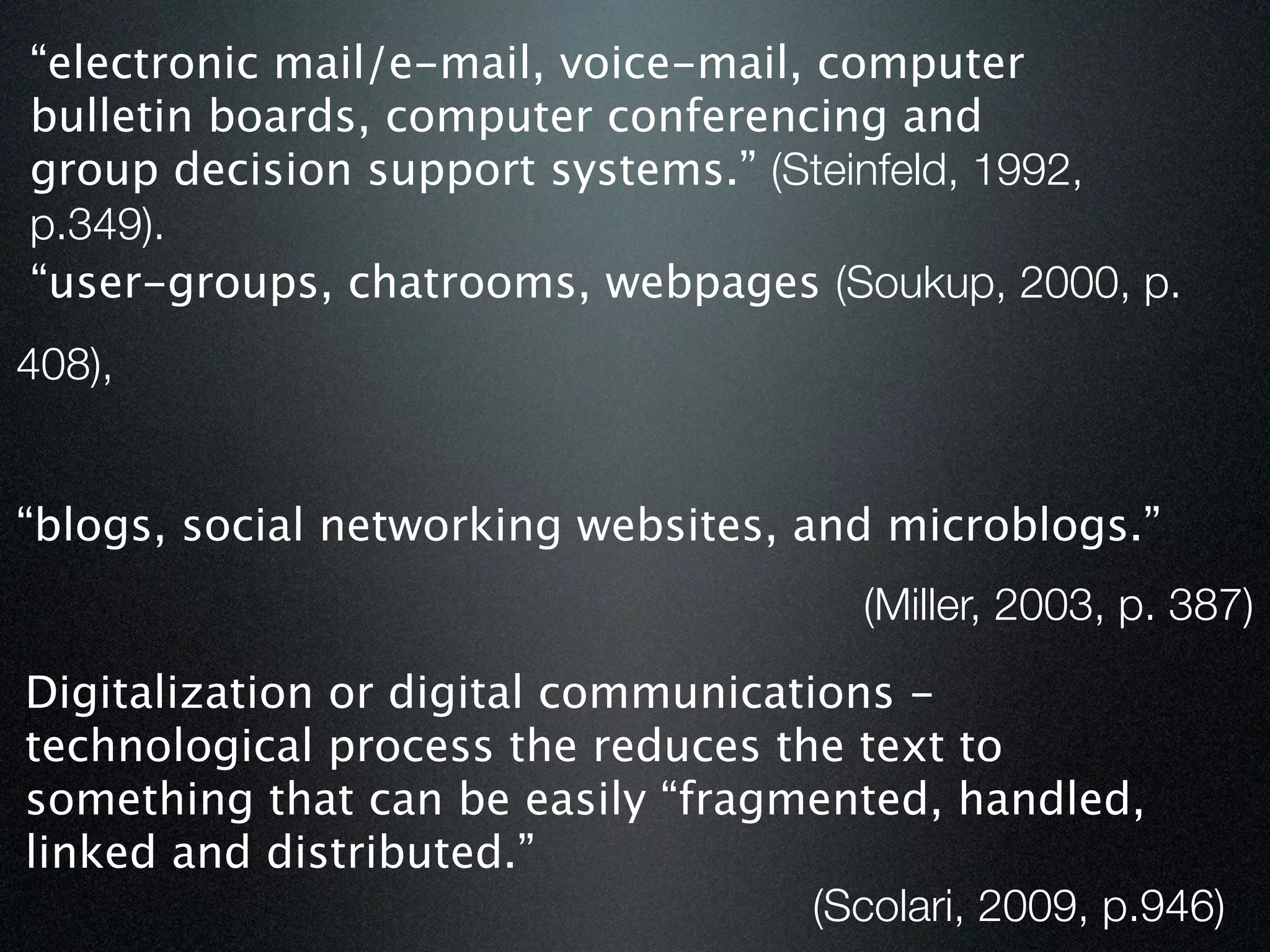
3   STEINFELD, C.        To introduce two      Theory paper    Organizations   -Provides the concrete forms      Another literature that discusses
    (1992). Computer-    new theoretical                                        of CMCs “electronic mail/e-      alternative paradigms to information
    mediated             approaches that                                        mail, voice-mail, computer       richness in CMC theories -- critical
    communications in    focus on the social
                                                                                bulletin boards, computer        mass and social influence.
    organizational       context in which
    settings: emerging   CMCs are                                               conferencing and group
    conceptual           embedded, which                                        decision support systems. (p.     Steinfeld is a good source on the
    frameworks and       explain the                                            349)                              increased empirical research on
    directions for       adoption, use and                                                                        organizations using CMC systems in
    research.            impact of CMCs                                        Managerial work, which             ways unanticipated by the dominant
    Management                                                                 contain higher proportion of       theories. CMCs in organizations have
    Communication        To recommend                                          non-routine tasks can be           grown in its social uses, broadcast
    Quarterly, 5(3),     three avenues to
                                                                               characterized as relatively        uses, political uses and in conflict
    348-365.             which CMC
                         theories can                                          unanalyzable. Thus                 resolution. (p.353)
                         expand to,                                            ambiguous communication            --> For review of literature; information
                         addressing                                            situations will arise more         that can build argument on the
                         applications to                                       frequently, resulting to either in contribution of CMCs in organizations.
                         telecom and                                           a marked preference for richer
                         information                                           communication medium, or           --> Steinfeld’s recommended avenues
                         technology among                                      lower performance. (p.351)         for CMC research reinforce the
                         organizations
                                                                                                                  increasing criticality of CMCs in
                                                                               New avenues for research -         organizations.
                                                                               CMC systems as:
                                                                               1)Interorganizational              --> Steinfeld agrees with previous
                                                                                 communication medium             research that research must look
                                                                               2)one of a set of information      further beyond just the physical
                                                                                 services available over a        features of new media, but rather
                                                                                 telecom structure                understand how systems come to be
                                                                               3)a tool for achieving strategic used and consequences of such use
                                                                                 organizational objectives        in organizations.
                                                                                 and competitive advantage
SOURCE              OBJECTIVES        TYPE OF PAPER      SUBJECTS/          FINDINGS & INSIGHTS                IMPLICATIONS FOR MY RESEARCH
                                                      &              UNIT OF            (with page number)                   PAPER (with page number)
                                                METHODOLOGY         ANALYSIS

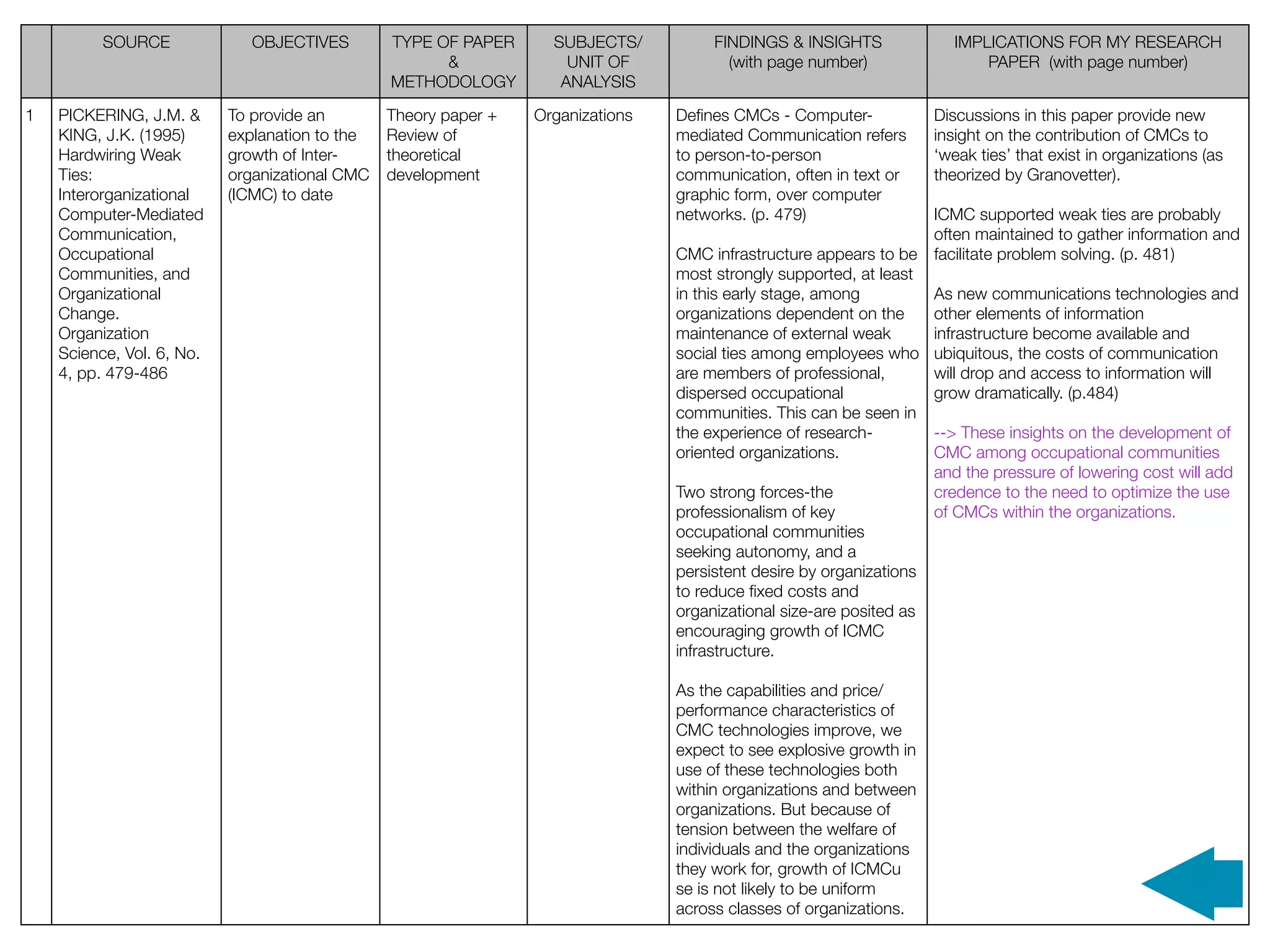
1   PICKERING, J.M. &      To provide an        Theory paper +   Organizations   Defines CMCs - Computer-              Discussions in this paper provide new
    KING, J.K. (1995)      explanation to the   Review of                        mediated Communication refers        insight on the contribution of CMCs to
    Hardwiring Weak        growth of Inter-     theoretical                      to person-to-person                  ‘weak ties’ that exist in organizations (as
    Ties:                  organizational CMC   development                      communication, often in text or      theorized by Granovetter).
    Interorganizational    (ICMC) to date                                        graphic form, over computer
    Computer-Mediated                                                            networks. (p. 479)                   ICMC supported weak ties are probably
    Communication,                                                                                                    often maintained to gather information and
    Occupational                                                                 CMC infrastructure appears to be     facilitate problem solving. (p. 481)
    Communities, and                                                             most strongly supported, at least
    Organizational                                                               in this early stage, among           As new communications technologies and
    Change.                                                                      organizations dependent on the       other elements of information
    Organization                                                                 maintenance of external weak         infrastructure become available and
    Science, Vol. 6, No.                                                         social ties among employees who      ubiquitous, the costs of communication
    4, pp. 479-486                                                               are members of professional,         will drop and access to information will
                                                                                 dispersed occupational               grow dramatically. (p.484)
                                                                                 communities. This can be seen in
                                                                                 the experience of research-          --> These insights on the development of
                                                                                 oriented organizations.              CMC among occupational communities
                                                                                                                      and the pressure of lowering cost will add
                                                                                 Two strong forces-the                credence to the need to optimize the use
                                                                                 professionalism of key               of CMCs within the organizations.
                                                                                 occupational communities
                                                                                 seeking autonomy, and a
                                                                                 persistent desire by organizations
                                                                                 to reduce fixed costs and
                                                                                 organizational size-are posited as
                                                                                 encouraging growth of ICMC
                                                                                 infrastructure.

                                                                                 As the capabilities and price/
                                                                                 performance characteristics of
                                                                                 CMC technologies improve, we
                                                                                 expect to see explosive growth in
                                                                                 use of these technologies both
                                                                                 within organizations and between
                                                                                 organizations. But because of
                                                                                 tension between the welfare of
                                                                                 individuals and the organizations
                                                                                 they work for, growth of ICMCu
                                                                                 se is not likely to be uniform
                                                                                 across classes of organizations.
SOURCE                OBJECTIVES          TYPE OF PAPER      SUBJECTS/              FINDINGS & INSIGHTS          IMPLICATIONS FOR MY RESEARCH
                                                          &              UNIT OF                (with page number)             PAPER (with page number)
                                                    METHODOLOGY         ANALYSIS

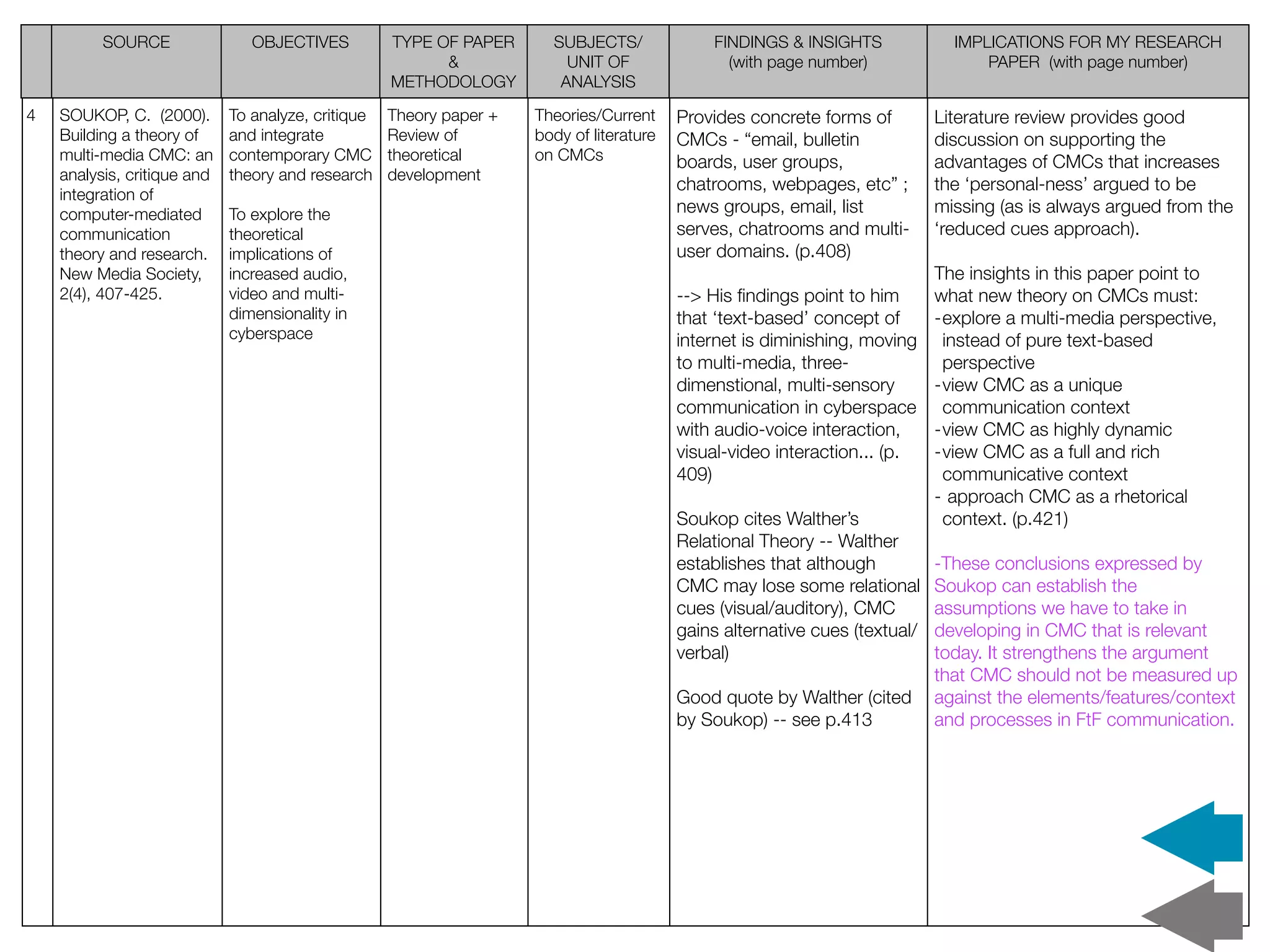
4   SOUKOP, C. (2000).       To analyze, critique   Theory paper +   Theories/Current     Provides concrete forms of     Literature review provides good
    Building a theory of     and integrate          Review of        body of literature   CMCs - “email, bulletin        discussion on supporting the
    multi-media CMC: an      contemporary CMC       theoretical      on CMCs              boards, user groups,           advantages of CMCs that increases
    analysis, critique and   theory and research    development
                                                                                          chatrooms, webpages, etc” ;    the ‘personal-ness’ argued to be
    integration of
    computer-mediated        To explore the                                               news groups, email, list       missing (as is always argued from the
    communication            theoretical                                                  serves, chatrooms and multi-   ‘reduced cues approach).
    theory and research.     implications of                                              user domains. (p.408)
    New Media Society,       increased audio,                                                                              The insights in this paper point to
    2(4), 407-425.           video and multi-                                             --> His findings point to him     what new theory on CMCs must:
                             dimensionality in                                            that ‘text-based’ concept of     -explore a multi-media perspective,
                             cyberspace                                                   internet is diminishing, moving instead of pure text-based
                                                                                          to multi-media, three-            perspective
                                                                                          dimenstional, multi-sensory      -view CMC as a unique
                                                                                          communication in cyberspace communication context
                                                                                          with audio-voice interaction,    -view CMC as highly dynamic
                                                                                          visual-video interaction... (p.  -view CMC as a full and rich
                                                                                          409)                              communicative context
                                                                                                                           - approach CMC as a rhetorical
                                                                                          Soukop cites Walther’s            context. (p.421)
                                                                                          Relational Theory -- Walther
                                                                                          establishes that although        -These conclusions expressed by
                                                                                          CMC may lose some relational Soukop can establish the
                                                                                          cues (visual/auditory), CMC      assumptions we have to take in
                                                                                          gains alternative cues (textual/ developing in CMC that is relevant
                                                                                          verbal)                          today. It strengthens the argument
                                                                                                                           that CMC should not be measured up
                                                                                          Good quote by Walther (cited against the elements/features/context
                                                                                          by Soukop) -- see p.413          and processes in FtF communication.
SOURCE           OBJECTIVES     TYPE OF PAPER    SUBJECTS/        FINDINGS & INSIGHTS            IMPLICATIONS FOR MY RESEARCH
                                              &            UNIT OF          (with page number)               PAPER (with page number)
                                        METHODOLOGY       ANALYSIS

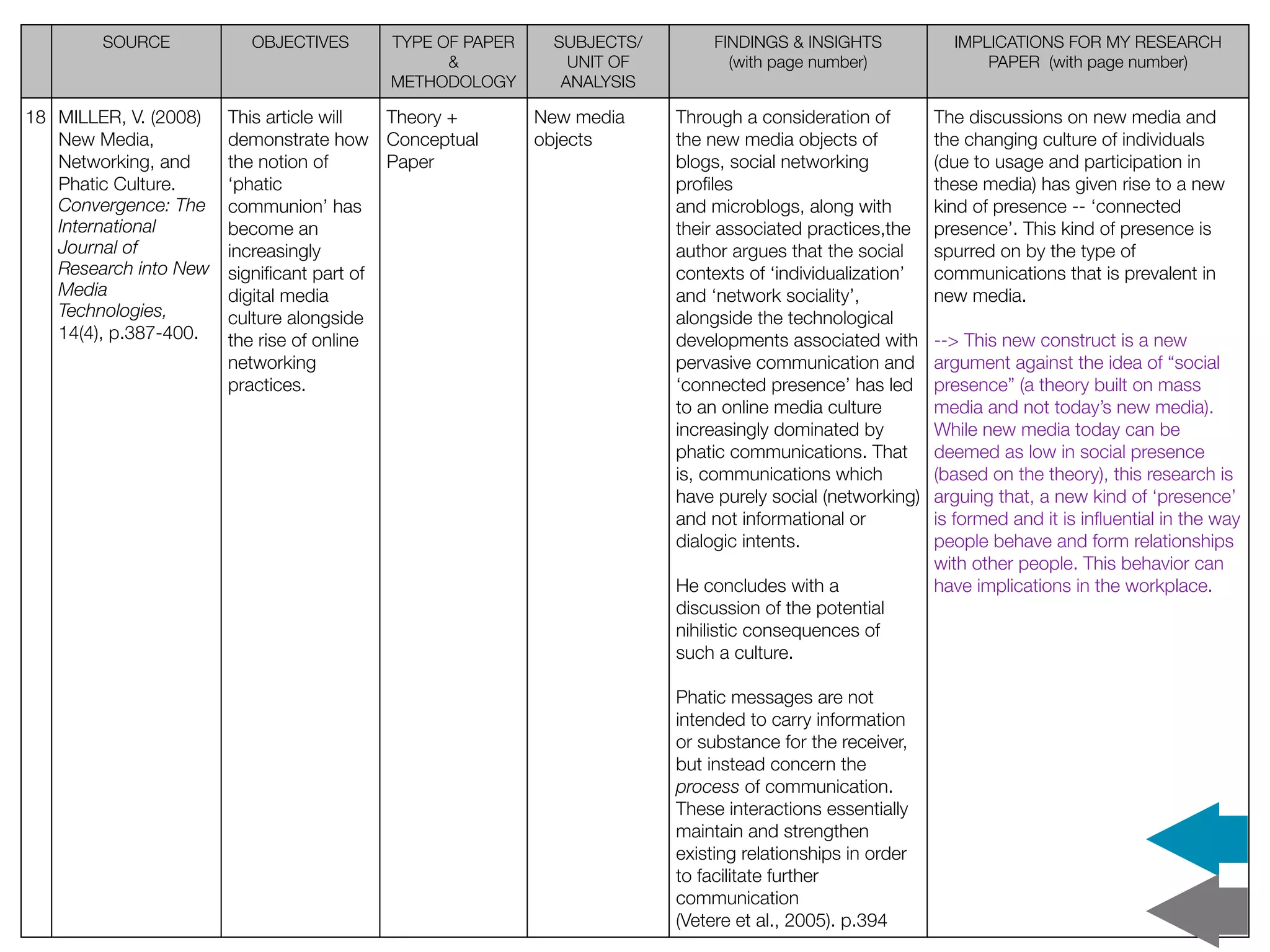
18 MILLER, V. (2008)   This article will  Theory +      New media    Through a consideration of        The discussions on new media and
   New Media,          demonstrate how Conceptual       objects      the new media objects of          the changing culture of individuals
   Networking, and     the notion of      Paper                      blogs, social networking          (due to usage and participation in
   Phatic Culture.     ‘phatic                                       profiles                           these media) has given rise to a new
   Convergence: The    communion’ has                                and microblogs, along with        kind of presence -- ‘connected
   International       become an                                     their associated practices,the    presence’. This kind of presence is
   Journal of          increasingly                                  author argues that the social     spurred on by the type of
   Research into New   significant part of                            contexts of ‘individualization’   communications that is prevalent in
   Media               digital media                                 and ‘network sociality’,          new media.
   Technologies,       culture alongside                             alongside the technological
   14(4), p.387-400.   the rise of online                            developments associated with      --> This new construct is a new
                       networking                                    pervasive communication and       argument against the idea of “social
                       practices.                                    ‘connected presence’ has led      presence” (a theory built on mass
                                                                     to an online media culture        media and not today’s new media).
                                                                     increasingly dominated by         While new media today can be
                                                                     phatic communications. That       deemed as low in social presence
                                                                     is, communications which          (based on the theory), this research is
                                                                     have purely social (networking)   arguing that, a new kind of ‘presence’
                                                                     and not informational or          is formed and it is influential in the way
                                                                     dialogic intents.                 people behave and form relationships
                                                                                                       with other people. This behavior can
                                                                     He concludes with a               have implications in the workplace.
                                                                     discussion of the potential
                                                                     nihilistic consequences of
                                                                     such a culture.

                                                                     Phatic messages are not
                                                                     intended to carry information
                                                                     or substance for the receiver,
                                                                     but instead concern the
                                                                     process of communication.
                                                                     These interactions essentially
                                                                     maintain and strengthen
                                                                     existing relationships in order
                                                                     to facilitate further
                                                                     communication
                                                                     (Vetere et al., 2005). p.394
SOURCE              OBJECTIVES        TYPE OF PAPER      SUBJECTS/         FINDINGS & INSIGHTS         IMPLICATIONS FOR MY RESEARCH
                                                     &              UNIT OF           (with page number)            PAPER (with page number)
                                               METHODOLOGY         ANALYSIS

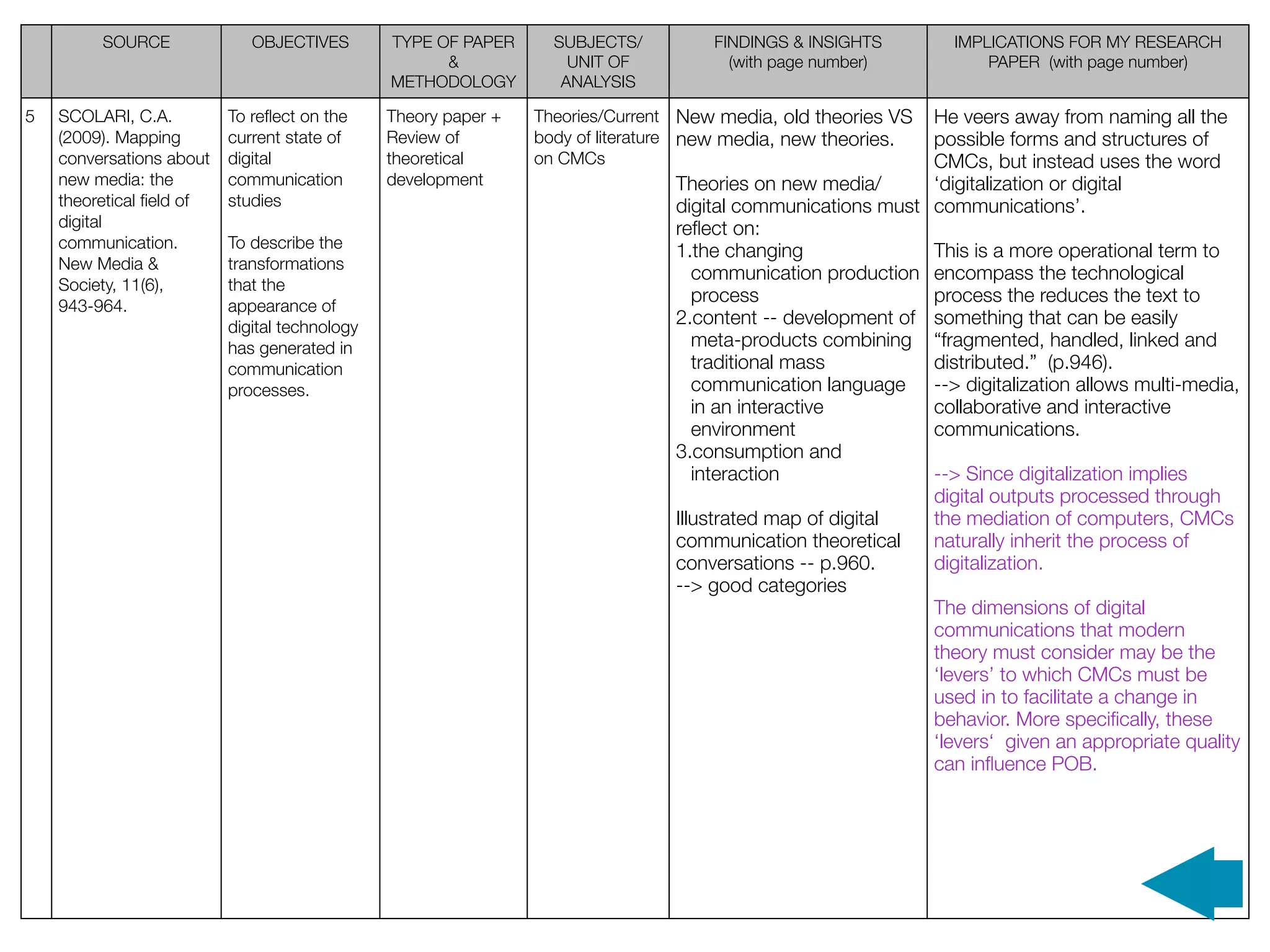
5   SCOLARI, C.A.         To reflect on the     Theory paper +   Theories/Current New media, old theories VS He veers away from naming all the
    (2009). Mapping       current state of     Review of        body of literature new media, new theories. possible forms and structures of
    conversations about   digital              theoretical      on CMCs                                     CMCs, but instead uses the word
    new media: the        communication        development                      Theories on new media/      ‘digitalization or digital
    theoretical field of   studies                                               digital communications must communications’.
    digital                                                                     reflect on:
    communication.        To describe the                                       1.the changing              This is a more operational term to
    New Media &           transformations
                                                                                   communication production encompass the technological
    Society, 11(6),       that the
                                                                                   process                  process the reduces the text to
    943-964.              appearance of
                          digital technology                                    2.content -- development of something that can be easily
                          has generated in                                         meta-products combining “fragmented, handled, linked and
                          communication                                            traditional mass         distributed.” (p.946).
                          processes.                                               communication language --> digitalization allows multi-media,
                                                                                   in an interactive        collaborative and interactive
                                                                                   environment              communications.
                                                                                3.consumption and
                                                                                   interaction              --> Since digitalization implies
                                                                                                            digital outputs processed through
                                                                                Illustrated map of digital  the mediation of computers, CMCs
                                                                                communication theoretical   naturally inherit the process of
                                                                                conversations -- p.960.     digitalization.
                                                                                --> good categories
                                                                                                            The dimensions of digital
                                                                                                            communications that modern
                                                                                                            theory must consider may be the
                                                                                                            ‘levers’ to which CMCs must be
                                                                                                            used in to facilitate a change in
                                                                                                            behavior. More specifically, these
                                                                                                            ‘levers‘ given an appropriate quality
                                                                                                            can influence POB.
SOURCE              OBJECTIVES        TYPE OF PAPER    SUBJECTS/        FINDINGS & INSIGHTS               IMPLICATIONS FOR MY RESEARCH
                                                     &            UNIT OF          (with page number)                  PAPER (with page number)
                                               METHODOLOGY       ANALYSIS
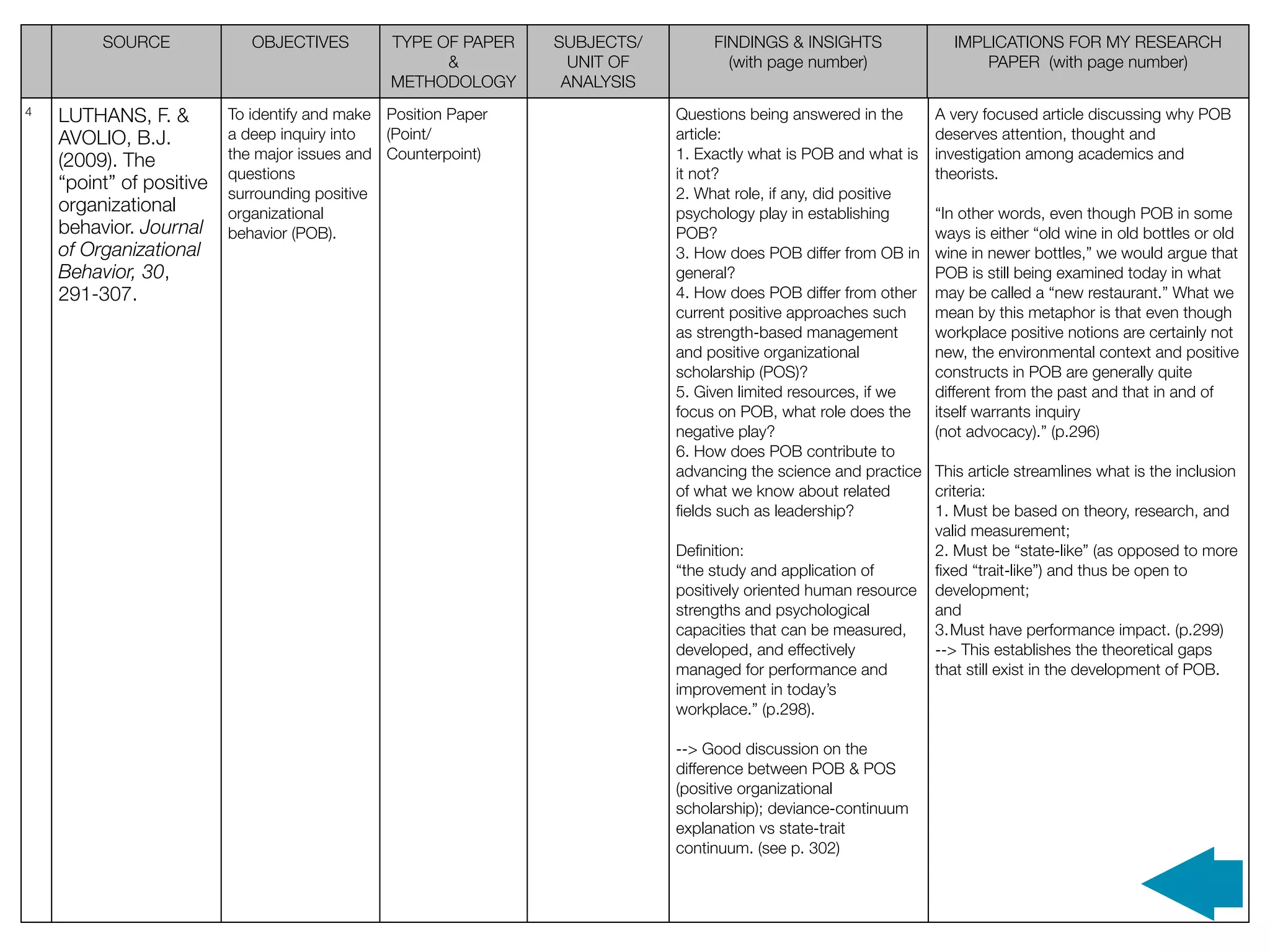
4   LUTHANS, F. &         To identify and make Position Paper               Questions being answered in the      A very focused article discussing why POB
    AVOLIO, B.J.          a deep inquiry into  (Point/                      article:                             deserves attention, thought and
    (2009). The           the major issues and Counterpoint)                1. Exactly what is POB and what is   investigation among academics and
                          questions                                         it not?                              theorists.
    “point” of positive   surrounding positive                              2. What role, if any, did positive
    organizational        organizational                                    psychology play in establishing      “In other words, even though POB in some
    behavior. Journal     behavior (POB).                                   POB?                                 ways is either “old wine in old bottles or old
    of Organizational                                                       3. How does POB differ from OB in    wine in newer bottles,” we would argue that
    Behavior, 30,                                                           general?                             POB is still being examined today in what
    291-307.                                                                4. How does POB differ from other    may be called a “new restaurant.” What we
                                                                            current positive approaches such     mean by this metaphor is that even though
                                                                            as strength-based management         workplace positive notions are certainly not
                                                                            and positive organizational          new, the environmental context and positive
                                                                            scholarship (POS)?                   constructs in POB are generally quite
                                                                            5. Given limited resources, if we    different from the past and that in and of
                                                                            focus on POB, what role does the     itself warrants inquiry
                                                                            negative play?                       (not advocacy).” (p.296)
                                                                            6. How does POB contribute to
                                                                            advancing the science and practice   This article streamlines what is the inclusion
                                                                            of what we know about related        criteria:
                                                                            fields such as leadership?            1. Must be based on theory, research, and
                                                                                                                 valid measurement;
                                                                            Definition:                           2. Must be “state-like” (as opposed to more
                                                                            “the study and application of        fixed “trait-like”) and thus be open to
                                                                            positively oriented human resource   development;
                                                                            strengths and psychological          and
                                                                            capacities that can be measured,     3.Must have performance impact. (p.299)
                                                                            developed, and effectively           --> This establishes the theoretical gaps
                                                                            managed for performance and          that still exist in the development of POB.
                                                                            improvement in today’s
                                                                            workplace.” (p.298).

                                                                            --> Good discussion on the
                                                                            difference between POB & POS
                                                                            (positive organizational
                                                                            scholarship); deviance-continuum
                                                                            explanation vs state-trait
                                                                            continuum. (see p. 302)
SOURCE           OBJECTIVES    TYPE OF PAPER    SUBJECTS/       FINDINGS & INSIGHTS           IMPLICATIONS FOR MY RESEARCH
                                            &            UNIT OF         (with page number)              PAPER (with page number)
                                      METHODOLOGY       ANALYSIS

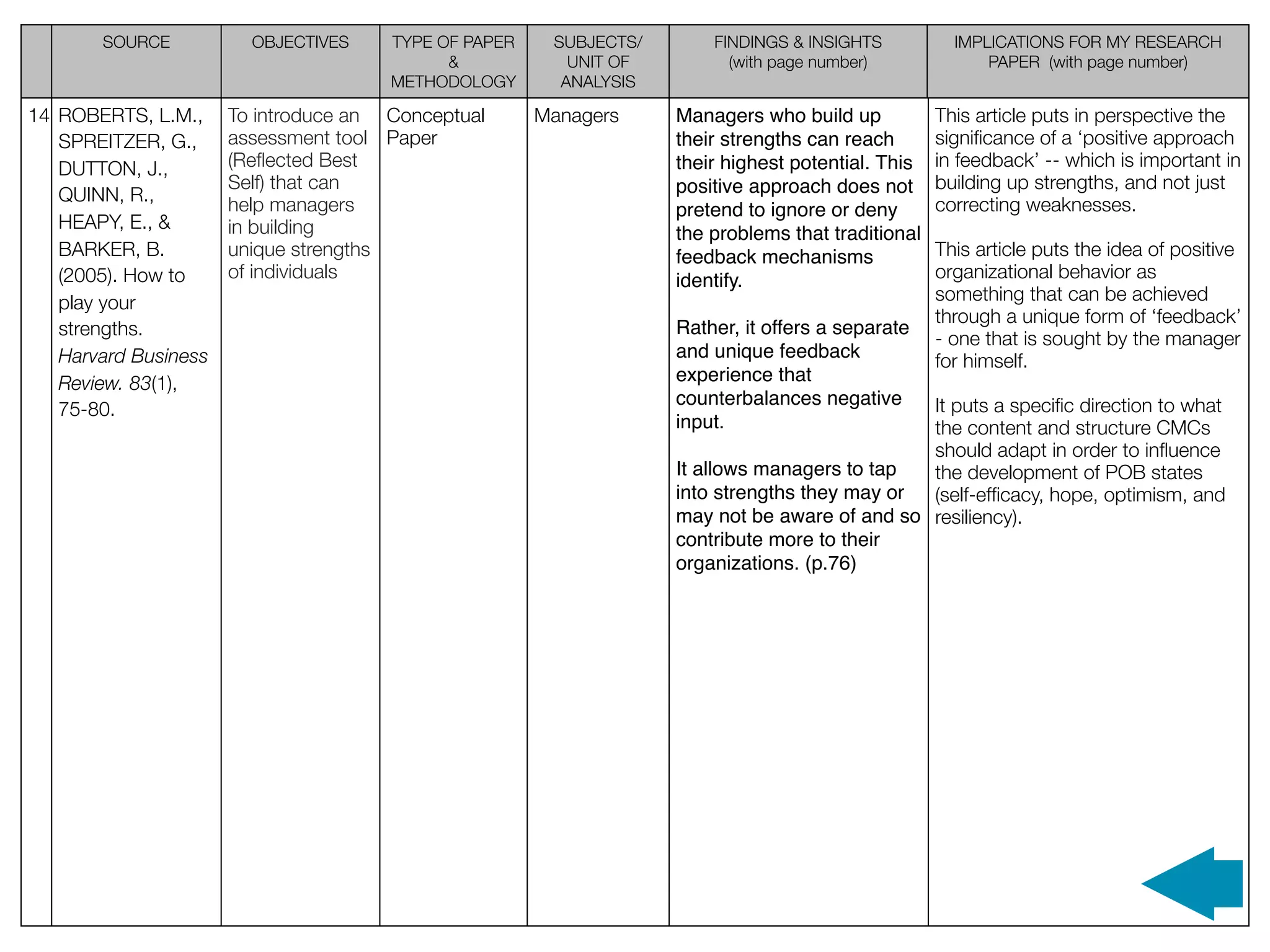
14 ROBERTS, L.M.,     To introduce an Conceptual      Managers     Managers who build up           This article puts in perspective the
   SPREITZER, G.,     assessment tool Paper                        their strengths can reach       significance of a ‘positive approach
   DUTTON, J.,        (Reflected Best                               their highest potential. This   in feedback’ -- which is important in
                      Self) that can                               positive approach does not      building up strengths, and not just
   QUINN, R.,         help managers                                pretend to ignore or deny       correcting weaknesses.
   HEAPY, E., &       in building                                  the problems that traditional
   BARKER, B.         unique strengths                             feedback mechanisms             This article puts the idea of positive
   (2005). How to     of individuals                               identify.                       organizational behavior as
   play your                                                                                       something that can be achieved
                                                                                                   through a unique form of ‘feedback’
   strengths.                                                      Rather, it offers a separate
                                                                                                   - one that is sought by the manager
   Harvard Business                                                and unique feedback             for himself.
   Review. 83(1),                                                  experience that
                                                                   counterbalances negative   It puts a specific direction to what
   75-80.
                                                                   input.                     the content and structure CMCs
                                                                                              should adapt in order to influence
                                                                   It allows managers to tap  the development of POB states
                                                                   into strengths they may or (self-efficacy, hope, optimism, and
                                                                   may not be aware of and so resiliency).
                                                                   contribute more to their
                                                                   organizations. (p.76)
SOURCE             OBJECTIVES       TYPE OF PAPER     SUBJECTS/         FINDINGS & INSIGHTS         IMPLICATIONS FOR MY RESEARCH
                                                   &             UNIT OF           (with page number)            PAPER (with page number)
                                             METHODOLOGY        ANALYSIS

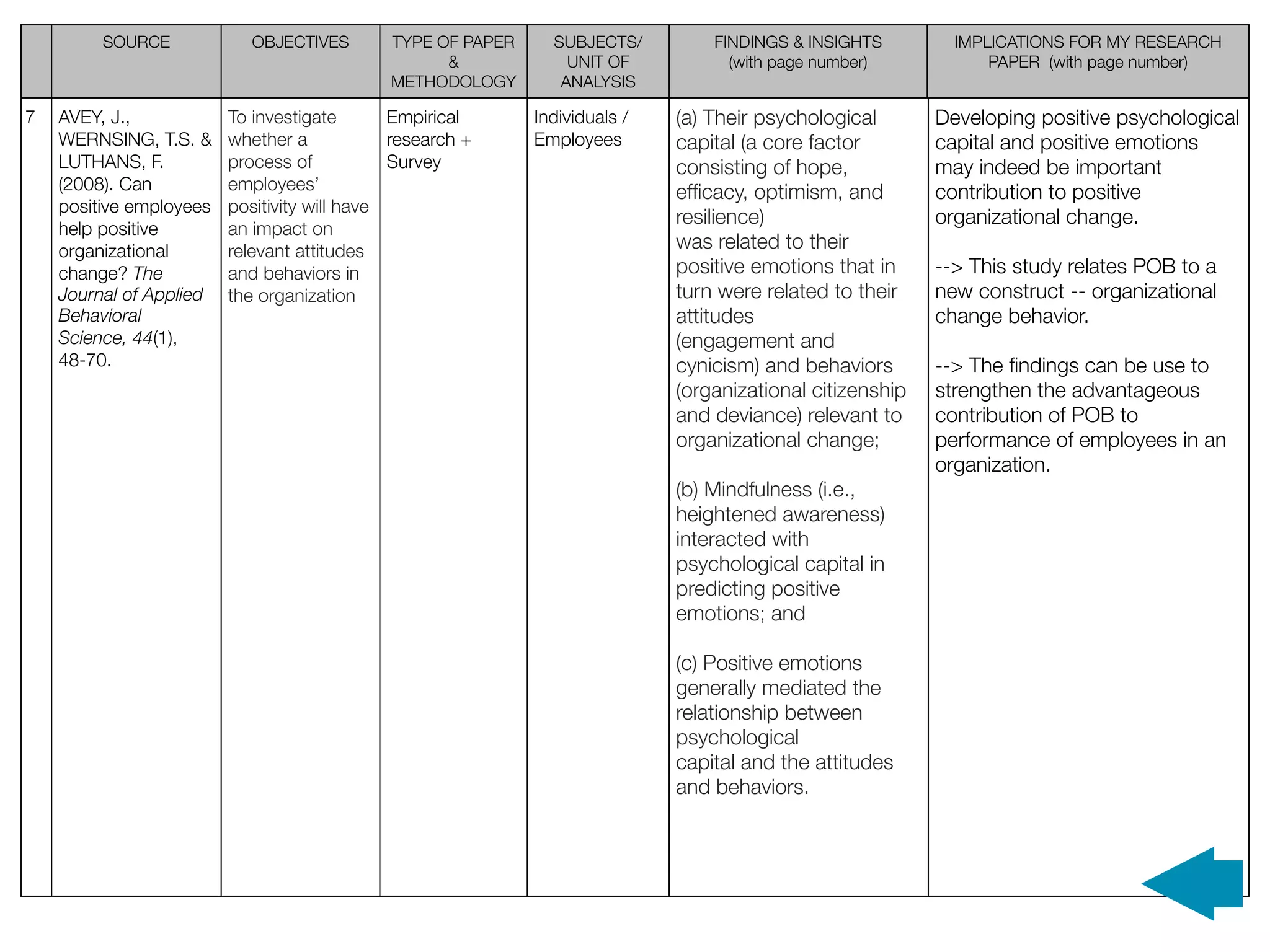
7   AVEY, J.,            To investigate       Empirical      Individuals /   (a) Their psychological       Developing positive psychological
    WERNSING, T.S. &     whether a            research +     Employees       capital (a core factor        capital and positive emotions
    LUTHANS, F.          process of           Survey                         consisting of hope,           may indeed be important
    (2008). Can          employees’                                          efficacy, optimism, and        contribution to positive
    positive employees   positivity will have
                                                                             resilience)                   organizational change.
    help positive        an impact on
    organizational       relevant attitudes                                  was related to their
    change? The          and behaviors in                                    positive emotions that in     --> This study relates POB to a
    Journal of Applied   the organization                                    turn were related to their    new construct -- organizational
    Behavioral                                                               attitudes                     change behavior.
    Science, 44(1),                                                          (engagement and
    48-70.                                                                   cynicism) and behaviors       --> The findings can be use to
                                                                             (organizational citizenship   strengthen the advantageous
                                                                             and deviance) relevant to     contribution of POB to
                                                                             organizational change;        performance of employees in an
                                                                                                           organization.
                                                                             (b) Mindfulness (i.e.,
                                                                             heightened awareness)
                                                                             interacted with
                                                                             psychological capital in
                                                                             predicting positive
                                                                             emotions; and

                                                                             (c) Positive emotions
                                                                             generally mediated the
                                                                             relationship between
                                                                             psychological
                                                                             capital and the attitudes
                                                                             and behaviors.
SOURCE             OBJECTIVES       TYPE OF PAPER         SUBJECTS/         FINDINGS & INSIGHTS                  IMPLICATIONS FOR MY RESEARCH
                                                  &                 UNIT OF           (with page number)                     PAPER (with page number)
                                            METHODOLOGY            ANALYSIS

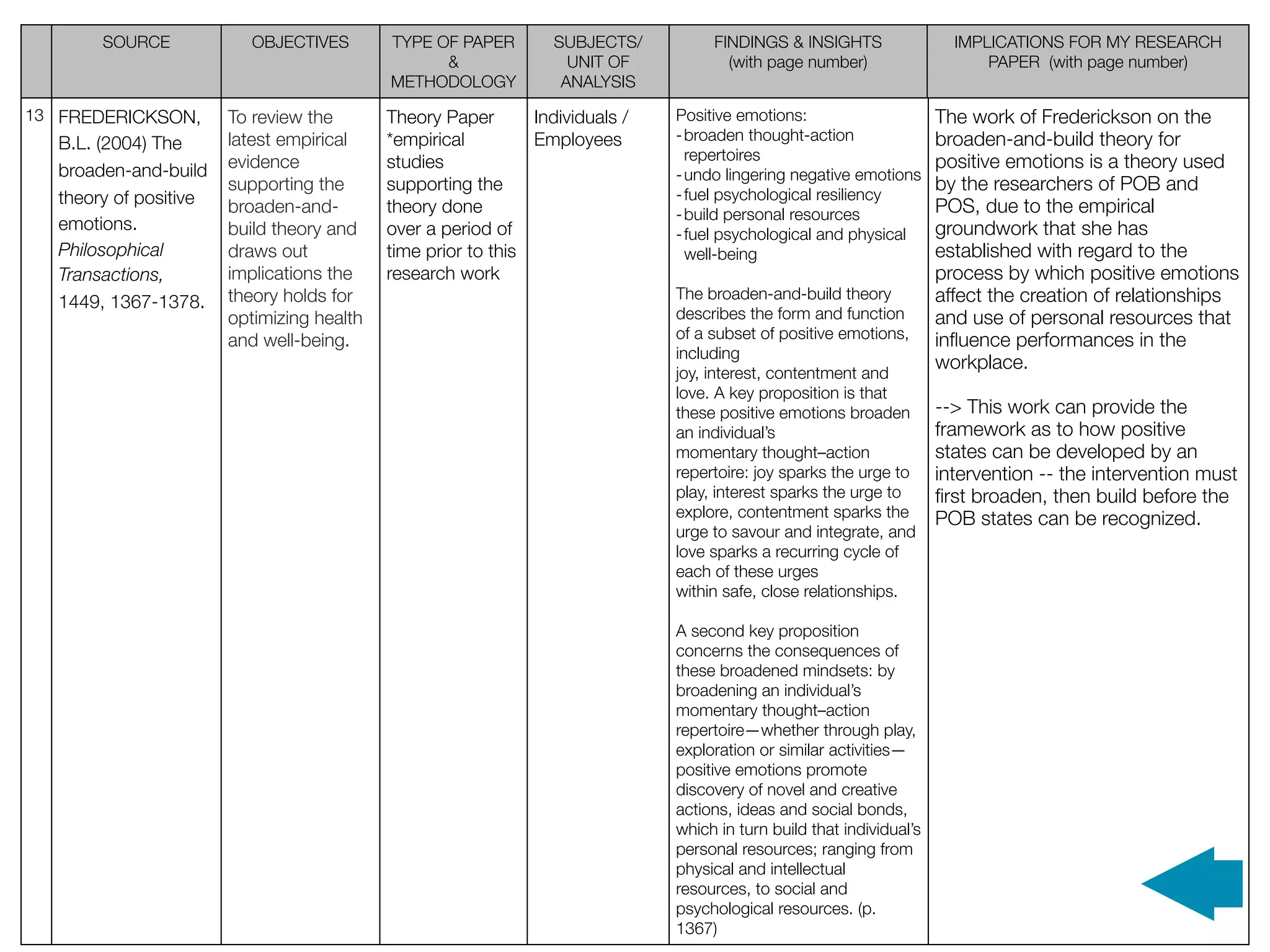
13 FREDERICKSON,        To review the       Theory Paper       Individuals /   Positive emotions:                      The work of Frederickson on the
                        latest empirical    *empirical         Employees       - broaden thought-action                broaden-and-build theory for
   B.L. (2004) The
                        evidence            studies                              repertoires                           positive emotions is a theory used
   broaden-and-build                                                           - undo lingering negative emotions
                        supporting the      supporting the                                                             by the researchers of POB and
   theory of positive                                                          - fuel psychological resiliency
                        broaden-and-        theory done                        - build personal resources              POS, due to the empirical
   emotions.            build theory and    over a period of                                                           groundwork that she has
                                                                               - fuel psychological and physical
   Philosophical        draws out           time prior to this                   well-being                            established with regard to the
   Transactions,        implications the    research work                                                              process by which positive emotions
   1449, 1367-1378.     theory holds for                                       The broaden-and-build theory            affect the creation of relationships
                        optimizing health                                      describes the form and function         and use of personal resources that
                        and well-being.                                        of a subset of positive emotions,       influence performances in the
                                                                               including
                                                                                                                       workplace.
                                                                               joy, interest, contentment and
                                                                               love. A key proposition is that
                                                                               these positive emotions broaden         --> This work can provide the
                                                                               an individual’s                         framework as to how positive
                                                                               momentary thought–action                states can be developed by an
                                                                               repertoire: joy sparks the urge to      intervention -- the intervention must
                                                                               play, interest sparks the urge to       first broaden, then build before the
                                                                               explore, contentment sparks the         POB states can be recognized.
                                                                               urge to savour and integrate, and
                                                                               love sparks a recurring cycle of
                                                                               each of these urges
                                                                               within safe, close relationships.

                                                                               A second key proposition
                                                                               concerns the consequences of
                                                                               these broadened mindsets: by
                                                                               broadening an individual’s
                                                                               momentary thought–action
                                                                               repertoire—whether through play,
                                                                               exploration or similar activities—
                                                                               positive emotions promote
                                                                               discovery of novel and creative
                                                                               actions, ideas and social bonds,
                                                                               which in turn build that individual’s
                                                                               personal resources; ranging from
                                                                               physical and intellectual
                                                                               resources, to social and
                                                                               psychological resources. (p.
                                                                               1367)
SOURCE                OBJECTIVES         TYPE OF PAPER      SUBJECTS/        FINDINGS & INSIGHTS            IMPLICATIONS FOR MY RESEARCH
                                                         &              UNIT OF          (with page number)               PAPER (with page number)
                                                   METHODOLOGY         ANALYSIS

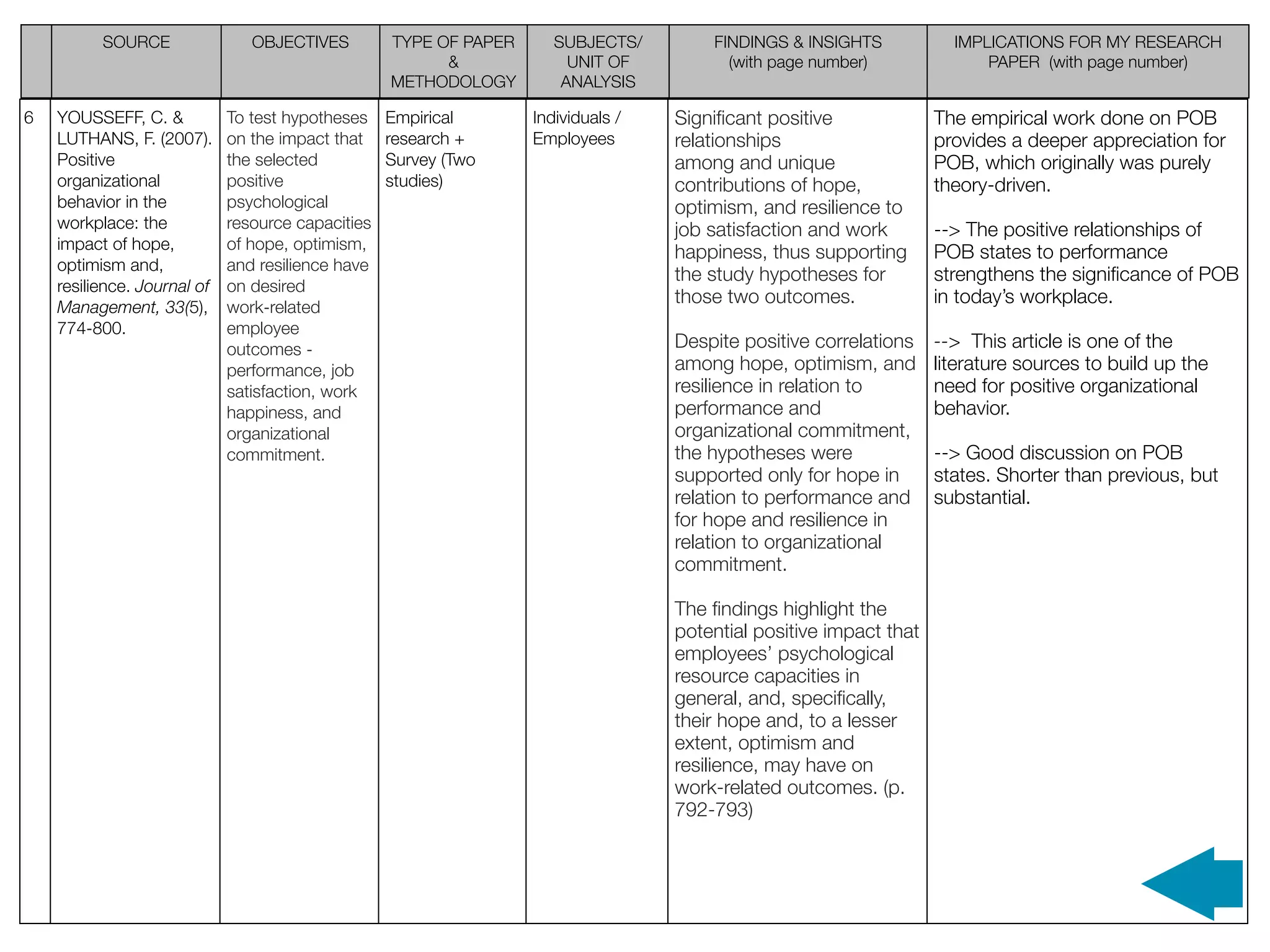
6   YOUSSEFF, C. &           To test hypotheses    Empirical       Individuals /   Significant positive              The empirical work done on POB
    LUTHANS, F. (2007).      on the impact that    research +      Employees       relationships                    provides a deeper appreciation for
    Positive                 the selected          Survey (Two                     among and unique                 POB, which originally was purely
    organizational           positive              studies)                        contributions of hope,           theory-driven.
    behavior in the          psychological                                         optimism, and resilience to
    workplace: the           resource capacities                                   job satisfaction and work        --> The positive relationships of
    impact of hope,          of hope, optimism,                                    happiness, thus supporting       POB states to performance
    optimism and,            and resilience have
                                                                                   the study hypotheses for         strengthens the significance of POB
    resilience. Journal of   on desired
                                                                                   those two outcomes.              in today’s workplace.
    Management, 33(5),       work-related
    774-800.                 employee
                             outcomes -                                            Despite positive correlations    --> This article is one of the
                             performance, job                                      among hope, optimism, and        literature sources to build up the
                             satisfaction, work                                    resilience in relation to        need for positive organizational
                             happiness, and                                        performance and                  behavior.
                             organizational                                        organizational commitment,
                             commitment.                                           the hypotheses were              --> Good discussion on POB
                                                                                   supported only for hope in       states. Shorter than previous, but
                                                                                   relation to performance and      substantial.
                                                                                   for hope and resilience in
                                                                                   relation to organizational
                                                                                   commitment.

                                                                                   The findings highlight the
                                                                                   potential positive impact that
                                                                                   employees’ psychological
                                                                                   resource capacities in
                                                                                   general, and, specifically,
                                                                                   their hope and, to a lesser
                                                                                   extent, optimism and
                                                                                   resilience, may have on
                                                                                   work-related outcomes. (p.
                                                                                   792-793)
SOURCE               OBJECTIVES          TYPE OF PAPER         SUBJECTS/             FINDINGS & INSIGHTS                 IMPLICATIONS FOR MY RESEARCH
                                                        &                 UNIT OF               (with page number)                    PAPER (with page number)
                                                  METHODOLOGY            ANALYSIS

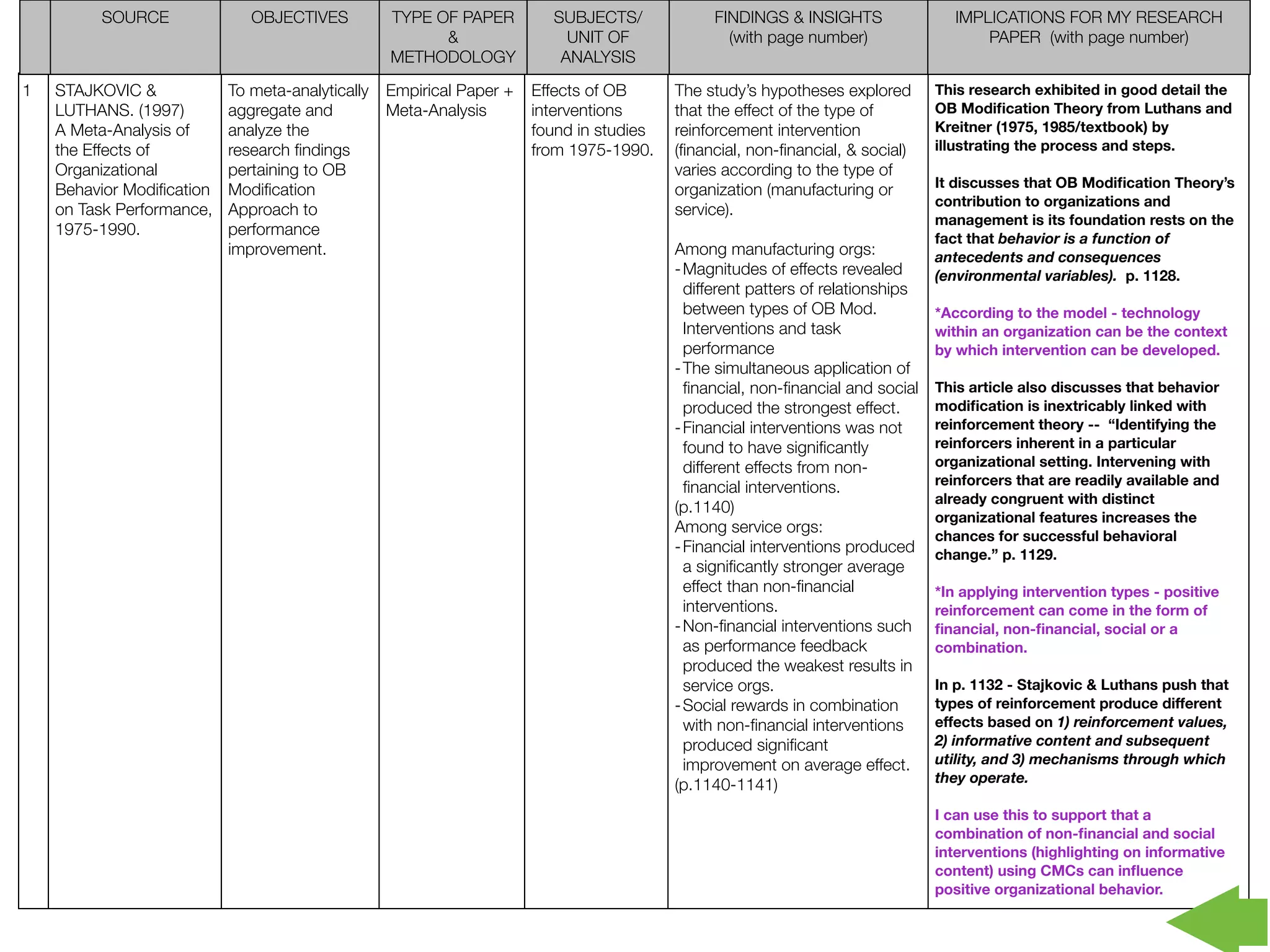
1   STAJKOVIC &            To meta-analytically   Empirical Paper +   Effects of OB      The study’s hypotheses explored        This research exhibited in good detail the
    LUTHANS. (1997)        aggregate and          Meta-Analysis       interventions      that the effect of the type of         OB Modification Theory from Luthans and
    A Meta-Analysis of     analyze the                                found in studies   reinforcement intervention             Kreitner (1975, 1985/textbook) by
    the Effects of         research findings                           from 1975-1990.    (financial, non-financial, & social)     illustrating the process and steps.
    Organizational         pertaining to OB                                              varies according to the type of
                                                                                                                                It discusses that OB Modification Theory’s
    Behavior Modification   Modification                                                   organization (manufacturing or
                                                                                                                                contribution to organizations and
    on Task Performance,   Approach to                                                   service).
                                                                                                                                management is its foundation rests on the
    1975-1990.             performance
                                                                                                                                fact that behavior is a function of
                           improvement.                                                  Among manufacturing orgs:              antecedents and consequences
                                                                                         - Magnitudes of effects revealed       (environmental variables). p. 1128.
                                                                                           different patters of relationships
                                                                                           between types of OB Mod.             *According to the model - technology
                                                                                           Interventions and task               within an organization can be the context
                                                                                           performance                          by which intervention can be developed.
                                                                                         - The simultaneous application of
                                                                                           financial, non-financial and social    This article also discusses that behavior
                                                                                           produced the strongest effect.       modification is inextricably linked with
                                                                                         - Financial interventions was not      reinforcement theory -- “Identifying the
                                                                                           found to have significantly           reinforcers inherent in a particular
                                                                                           different effects from non-          organizational setting. Intervening with
                                                                                                                                reinforcers that are readily available and
                                                                                           financial interventions.
                                                                                                                                already congruent with distinct
                                                                                         (p.1140)
                                                                                                                                organizational features increases the
                                                                                         Among service orgs:
                                                                                                                                chances for successful behavioral
                                                                                         - Financial interventions produced     change.” p. 1129.
                                                                                           a significantly stronger average
                                                                                           effect than non-financial             *In applying intervention types - positive
                                                                                           interventions.                       reinforcement can come in the form of
                                                                                         - Non-financial interventions such      financial, non-financial, social or a
                                                                                           as performance feedback              combination.
                                                                                           produced the weakest results in
                                                                                           service orgs.                        In p. 1132 - Stajkovic & Luthans push that
                                                                                         - Social rewards in combination        types of reinforcement produce different
                                                                                           with non-financial interventions      effects based on 1) reinforcement values,
                                                                                           produced significant                  2) informative content and subsequent
                                                                                           improvement on average effect.       utility, and 3) mechanisms through which
                                                                                                                                they operate.
                                                                                         (p.1140-1141)
                                                                                                                                I can use this to support that a
                                                                                                                                combination of non-financial and social
                                                                                                                                interventions (highlighting on informative
                                                                                                                                content) using CMCs can influence
                                                                                                                                positive organizational behavior.
SOURCE             OBJECTIVES         TYPE OF PAPER       SUBJECTS/ UNIT                    FINDINGS                       IMPLICATIONS FOR MY RESEARCH
                                                    &              OF ANALYSIS                 (with page number)                      PAPER (with page number)
                                              METHODOLOGY
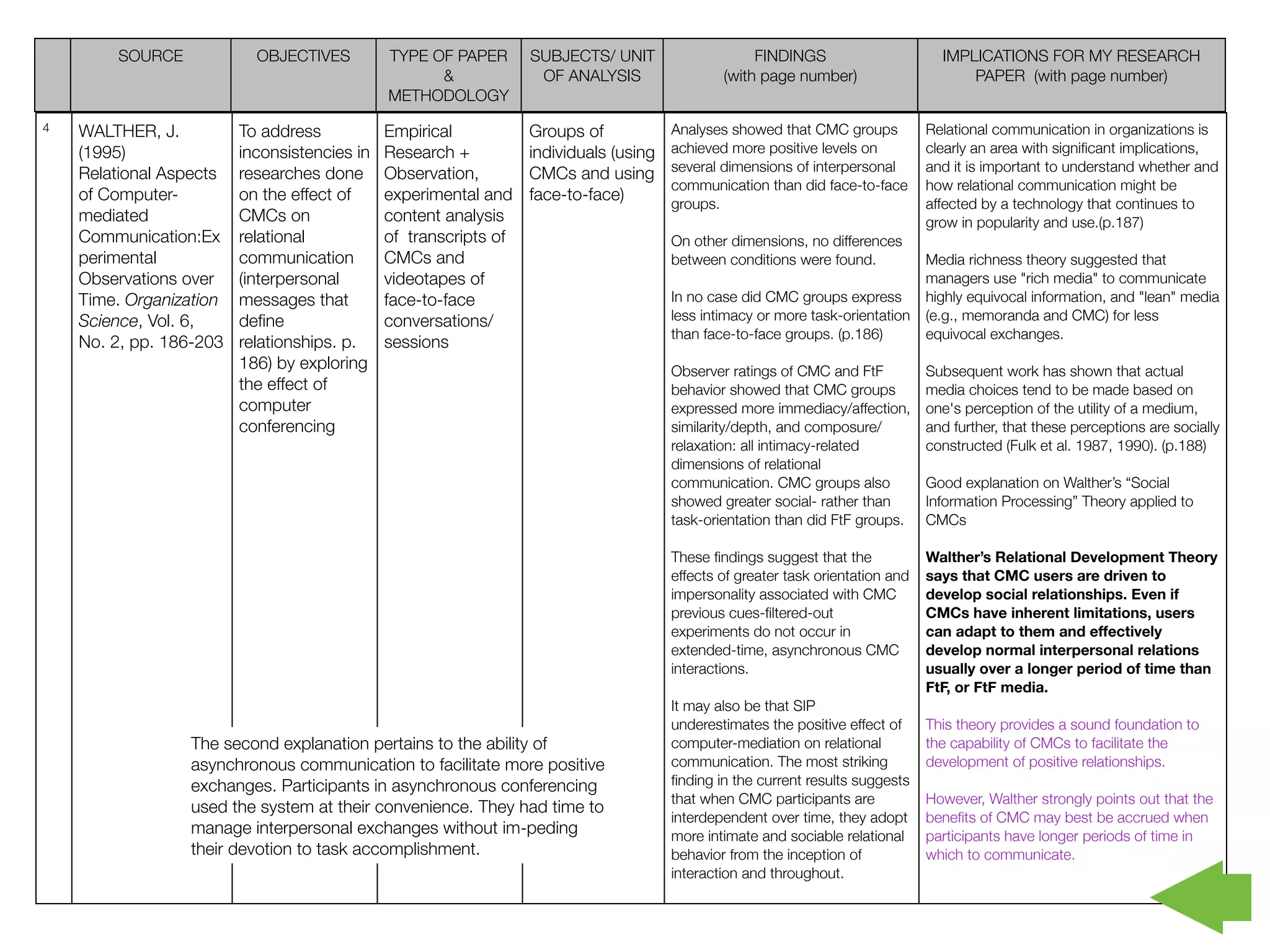
4   WALTHER, J.          To address           Empirical           Groups of            Analyses showed that CMC groups           Relational communication in organizations is
    (1995)               inconsistencies in   Research +          individuals (using   achieved more positive levels on          clearly an area with significant implications,
                                                                                       several dimensions of interpersonal       and it is important to understand whether and
    Relational Aspects   researches done      Observation,        CMCs and using
                                                                                       communication than did face-to-face       how relational communication might be
    of Computer-         on the effect of     experimental and    face-to-face)        groups.                                   affected by a technology that continues to
    mediated             CMCs on              content analysis                                                                   grow in popularity and use.(p.187)
    Communication:Ex     relational           of transcripts of                        On other dimensions, no differences
    perimental           communication        CMCs and                                 between conditions were found.            Media richness theory suggested that
    Observations over    (interpersonal       videotapes of                                                                      managers use "rich media" to communicate
    Time. Organization   messages that        face-to-face                             In no case did CMC groups express         highly equivocal information, and "lean" media
    Science, Vol. 6,     define                conversations/                           less intimacy or more task-orientation    (e.g., memoranda and CMC) for less
                                                                                       than face-to-face groups. (p.186)         equivocal exchanges.
    No. 2, pp. 186-203   relationships. p.    sessions
                         186) by exploring                                             Observer ratings of CMC and FtF           Subsequent work has shown that actual
                         the effect of                                                 behavior showed that CMC groups           media choices tend to be made based on
                         computer                                                      expressed more immediacy/affection,       one's perception of the utility of a medium,
                         conferencing                                                  similarity/depth, and composure/          and further, that these perceptions are socially
                                                                                       relaxation: all intimacy-related          constructed (Fulk et al. 1987, 1990). (p.188)
                                                                                       dimensions of relational
                                                                                       communication. CMC groups also            Good explanation on Walther’s “Social
                                                                                       showed greater social- rather than        Information Processing” Theory applied to
                                                                                       task-orientation than did FtF groups.     CMCs

                                                                                       These findings suggest that the            Walther’s Relational Development Theory
                                                                                       effects of greater task orientation and   says that CMC users are driven to
                                                                                       impersonality associated with CMC         develop social relationships. Even if
                                                                                       previous cues-filtered-out                 CMCs have inherent limitations, users
                                                                                       experiments do not occur in               can adapt to them and effectively
                                                                                       extended-time, asynchronous CMC           develop normal interpersonal relations
                                                                                       interactions.                             usually over a longer period of time than
                                                                                                                                 FtF, or FtF media.
                                                                                       It may also be that SIP
                                                                                       underestimates the positive effect of     This theory provides a sound foundation to
                 The second explanation pertains to the ability of                     computer-mediation on relational          the capability of CMCs to facilitate the
                 asynchronous communication to facilitate more positive                communication. The most striking          development of positive relationships.
                 exchanges. Participants in asynchronous conferencing                  finding in the current results suggests
                                                                                       that when CMC participants are            However, Walther strongly points out that the
                 used the system at their convenience. They had time to
                                                                                       interdependent over time, they adopt      benefits of CMC may best be accrued when
                 manage interpersonal exchanges without im-peding                      more intimate and sociable relational     participants have longer periods of time in
                 their devotion to task accomplishment.                                behavior from the inception of            which to communicate.
                                                                                       interaction and throughout.
SOURCE              OBJECTIVES          TYPE OF PAPER        SUBJECTS/ UNIT               FINDINGS                IMPLICATIONS FOR MY RESEARCH
                                                       &               OF ANALYSIS            (with page number)               PAPER (with page number)
                                                 METHODOLOGY

5   LEE, A. S. (1994).     To describe how       Empirical            Email          Richness’ is not an invariant       Simpler, straightforward discussion of
    Electronic mail as a   ‘richness’ occurs     Research +           correspondence property of a communication         the information/media richness theory
    medium for rich        in a                  Textual Analysis &   among managers medium -- instead it is an          of Daft & Lengel (1986), as well as
    communication: An      communication         Interpretation                      emergent property of the            Fulk’s core premises regarding
    empirical              medium                (Hermeneutics)                      interaction between the             information richness theory.
    investigation using    (specifically email,                                       communication medium and the
                           a ‘lean’ medium’                                          organizational context.              Relevant conclusions:
    hermeneutic
                                                                                                                          The best medium for a
    interpretation. MIS
                           To highlight the                                            Communicating using email does communication transaction depends
    Quarterly, 18(2)       value of an                                                 not lose its richness. In fact, it more than just the features of the
    143-157.               interpretative                                              can retain and gain its richness   medium.
                           perspective on                                              through distanciation,
                           the managerial of                                           automization, social construction, The best/appropriate medium also
                           email                                                       appropriation and enactment [the depends on the manager’s familiarity
                           communication                                               5 steps of hermeneutic analysis] and existing skills with the different
                                                                                       (p 151)                            media, the manager’s willingness,
                                                                                                                          opportunities, resources, learning the
                                                                                       The managers who received          capabilities of the media (to explore,
                                                                                       email are not passive recipients   innovate and interact).
                                                                                       of data, but active producers of
                                                                                       meaning.                           The best/appropriate medium for
                                                                                       -They transform the data into      communication transaction would not
                                                                                       information they find meaningful. be identified by an individual manager
                                                                                       - The users themselves join the    through an exercise of rational-
                                                                                         hardware and software of the     decision making, but would emerge
                                                                                         email systems as processors of as best or appropriate over the
                                                                                         the data. (p.154)                course of its interactions with its
                                                                                                                          many users, through the users’
                                                                                       This interaction facilitates the   adaptation or reinvention of the
                                                                                       emergence of communication         medium to suit their own purposes.
                                                                                       richness.                          ---> Social influence Model. (p.
                                                                                                                          154-155)

                                       The findings from this paper aid in building the argument that despite the ‘leanest’ form of a CMC, it is
                                       the ‘richness’ that emerges from the use, adaptation and reinvention of the communication medium
                                       following constant social interactions that allows the construction of meaning from information
                                       received from CMCs.
                                       --> Meaning that allows for decision-making among managers, that affect how managers think or feel
                                       is created when richness in the medium emerges.
SOURCE            OBJECTIVES       TYPE OF PAPER     SUBJECTS/ UNIT               FINDINGS                   IMPLICATIONS FOR MY RESEARCH
                                                   &            OF ANALYSIS            (with page number)                  PAPER (with page number)
                                             METHODOLOGY

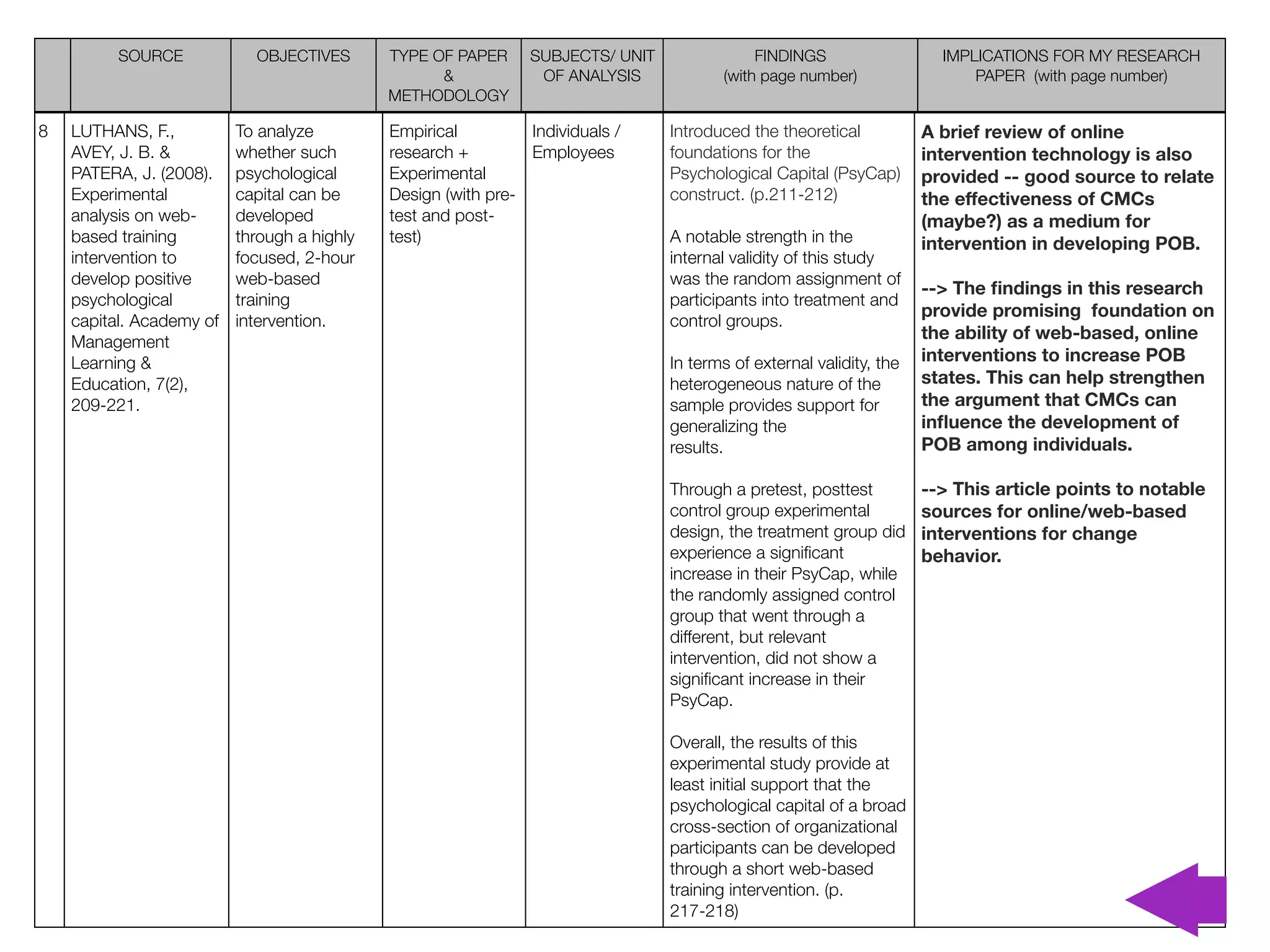
8   LUTHANS, F.,          To analyze         Empirical         Individuals /    Introduced the theoretical           A brief review of online
    AVEY, J. B. &         whether such       research +        Employees        foundations for the                  intervention technology is also
    PATERA, J. (2008).    psychological      Experimental                       Psychological Capital (PsyCap)       provided -- good source to relate
    Experimental          capital can be     Design (with pre-                  construct. (p.211-212)               the effectiveness of CMCs
    analysis on web-      developed          test and post-                                                          (maybe?) as a medium for
    based training        through a highly   test)                              A notable strength in the            intervention in developing POB.
    intervention to       focused, 2-hour                                       internal validity of this study
    develop positive      web-based                                             was the random assignment of
                                                                                                                     --> The findings in this research
    psychological         training                                              participants into treatment and
                                                                                                                     provide promising foundation on
    capital. Academy of   intervention.                                         control groups.
    Management                                                                                                       the ability of web-based, online
    Learning &                                                                  In terms of external validity, the   interventions to increase POB
    Education, 7(2),                                                            heterogeneous nature of the          states. This can help strengthen
    209-221.                                                                    sample provides support for          the argument that CMCs can
                                                                                generalizing the                     influence the development of
                                                                                results.                             POB among individuals.

                                                                                Through a pretest, posttest          --> This article points to notable
                                                                                control group experimental           sources for online/web-based
                                                                                design, the treatment group did      interventions for change
                                                                                experience a significant              behavior.
                                                                                increase in their PsyCap, while
                                                                                the randomly assigned control
                                                                                group that went through a
                                                                                different, but relevant
                                                                                intervention, did not show a
                                                                                significant increase in their
                                                                                PsyCap.

                                                                                Overall, the results of this
                                                                                experimental study provide at
                                                                                least initial support that the
                                                                                psychological capital of a broad
                                                                                cross-section of organizational
                                                                                participants can be developed
                                                                                through a short web-based
                                                                                training intervention. (p.
                                                                                217-218)
SOURCE              OBJECTIVES          TYPE OF PAPER    SUBJECTS/ UNIT                  FINDINGS                       IMPLICATIONS FOR MY RESEARCH
                                                        &           OF ANALYSIS               (with page number)                      PAPER (with page number)
                                                  METHODOLOGY

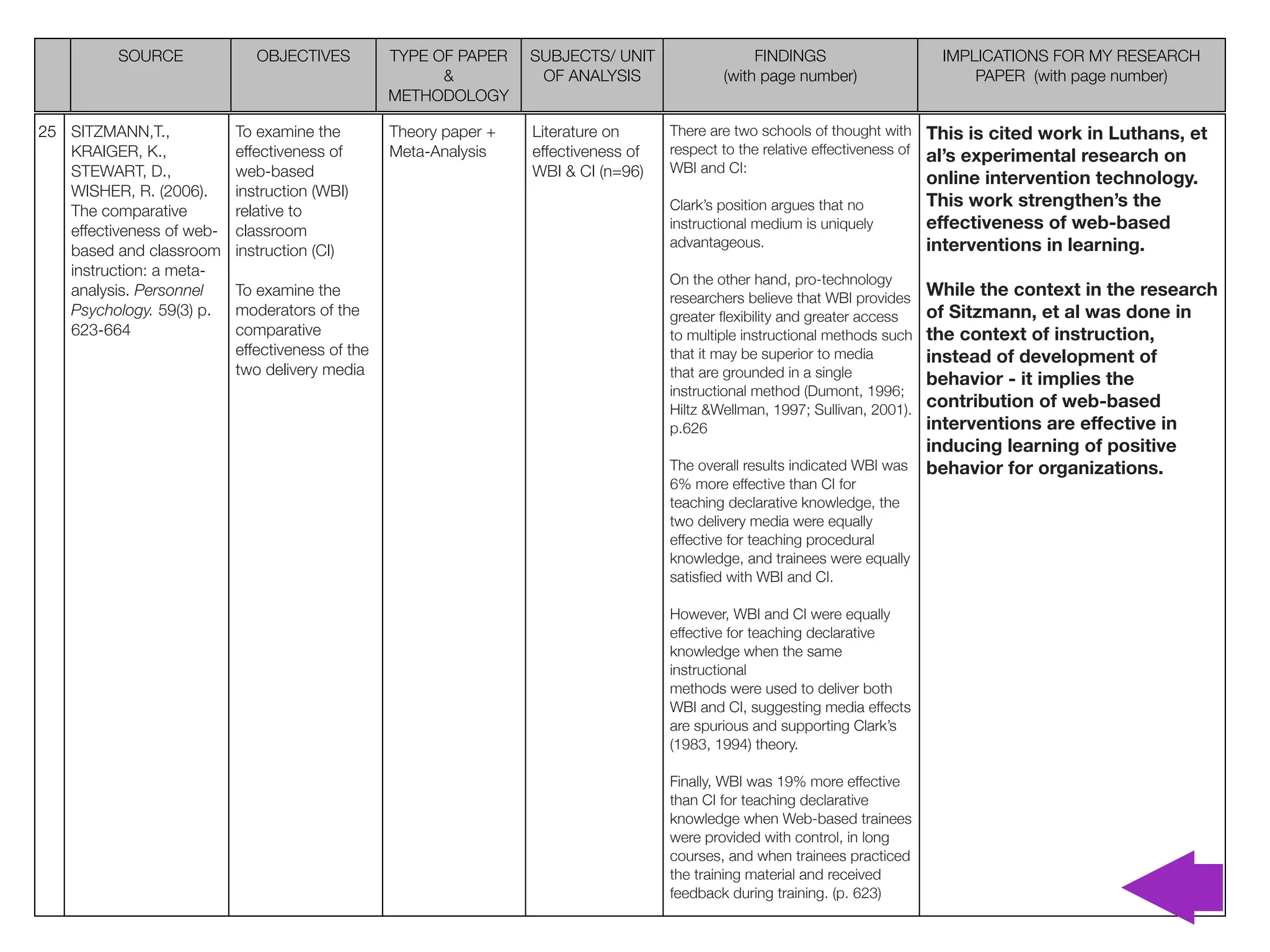
25 SITZMANN,T.,            To examine the         Theory paper +   Literature on      There are two schools of thought with      This is cited work in Luthans, et
   KRAIGER, K.,            effectiveness of       Meta-Analysis    effectiveness of   respect to the relative effectiveness of   al’s experimental research on
   STEWART, D.,            web-based                               WBI & CI (n=96)    WBI and CI:
                                                                                                                                 online intervention technology.
   WISHER, R. (2006).      instruction (WBI)
                                                                                      Clark’s position argues that no            This work strengthen’s the
   The comparative         relative to
   effectiveness of web-   classroom                                                  instructional medium is uniquely           effectiveness of web-based
   based and classroom     instruction (CI)
                                                                                      advantageous.                              interventions in learning.
   instruction: a meta-
                                                                                      On the other hand, pro-technology
   analysis. Personnel     To examine the                                             researchers believe that WBI provides      While the context in the research
   Psychology. 59(3) p.    moderators of the                                          greater flexibility and greater access      of Sitzmann, et al was done in
   623-664                 comparative                                                to multiple instructional methods such     the context of instruction,
                           effectiveness of the                                       that it may be superior to media           instead of development of
                           two delivery media                                         that are grounded in a single              behavior - it implies the
                                                                                      instructional method (Dumont, 1996;
                                                                                      Hiltz &Wellman, 1997; Sullivan, 2001).     contribution of web-based
                                                                                      p.626                                      interventions are effective in
                                                                                                                                 inducing learning of positive
                                                                                      The overall results indicated WBI was      behavior for organizations.
                                                                                      6% more effective than CI for
                                                                                      teaching declarative knowledge, the
                                                                                      two delivery media were equally
                                                                                      effective for teaching procedural
                                                                                      knowledge, and trainees were equally
                                                                                      satisfied with WBI and CI.

                                                                                      However, WBI and CI were equally
                                                                                      effective for teaching declarative
                                                                                      knowledge when the same
                                                                                      instructional
                                                                                      methods were used to deliver both
                                                                                      WBI and CI, suggesting media effects
                                                                                      are spurious and supporting Clark’s
                                                                                      (1983, 1994) theory.

                                                                                      Finally, WBI was 19% more effective
                                                                                      than CI for teaching declarative
                                                                                      knowledge when Web-based trainees
                                                                                      were provided with control, in long
                                                                                      courses, and when trainees practiced
                                                                                      the training material and received
                                                                                      feedback during training. (p. 623)
SOURCE              OBJECTIVES         TYPE OF PAPER     SUBJECTS/ UNIT               FINDINGS           IMPLICATIONS FOR MY RESEARCH
                                                        &            OF ANALYSIS            (with page number)          PAPER (with page number)
                                                  METHODOLOGY

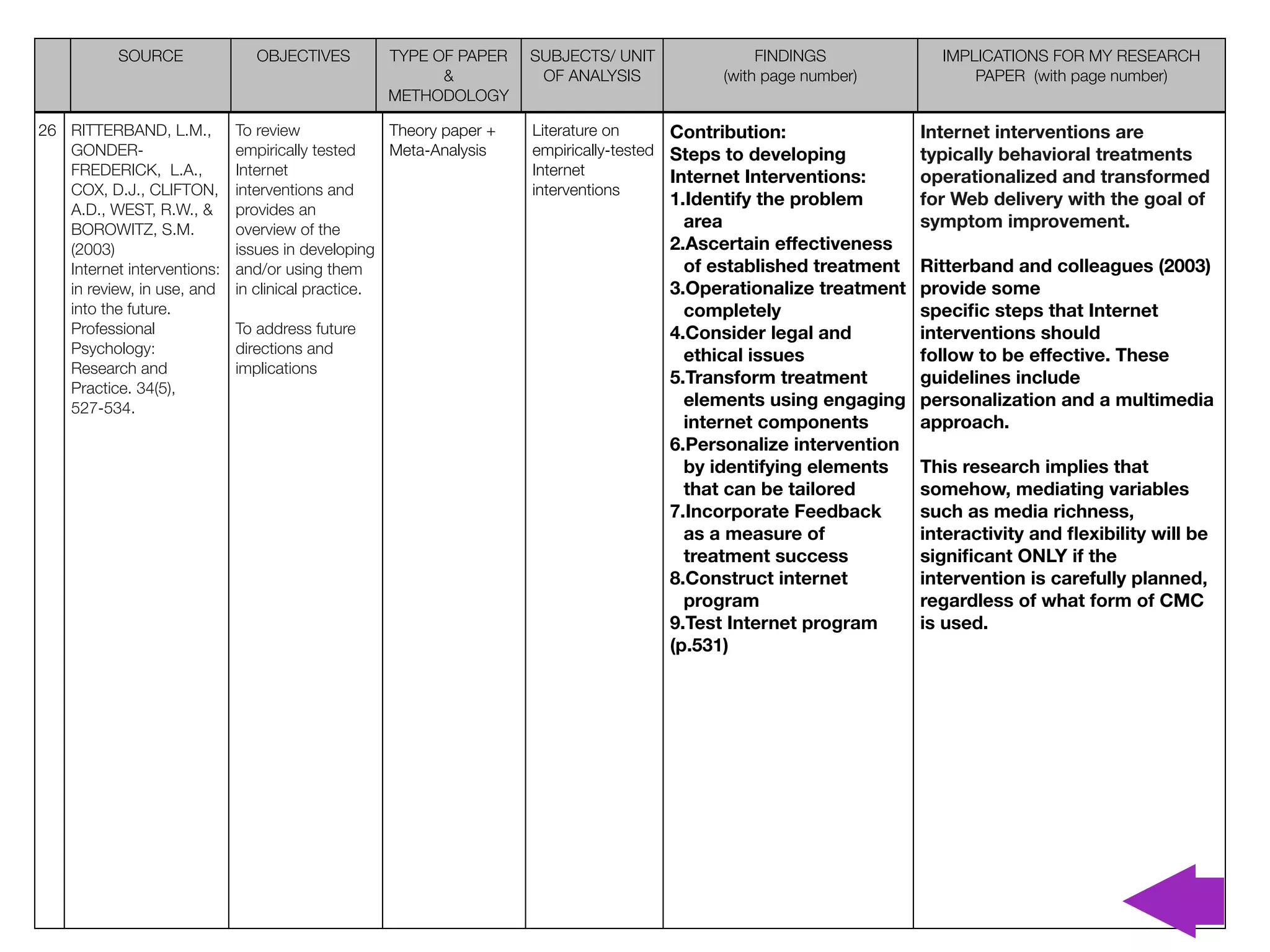
26 RITTERBAND, L.M.,         To review             Theory paper +   Literature on      Contribution:              Internet interventions are
   GONDER-                   empirically tested    Meta-Analysis    empirically-tested Steps to developing        typically behavioral treatments
   FREDERICK, L.A.,          Internet                               Internet           Internet Interventions:    operationalized and transformed
   COX, D.J., CLIFTON,       interventions and                      interventions
                                                                                     1.Identify the problem       for Web delivery with the goal of
   A.D., WEST, R.W., &       provides an
   BOROWITZ, S.M.            overview of the                                           area                       symptom improvement.
   (2003)                    issues in developing                                    2.Ascertain effectiveness
   Internet interventions:   and/or using them                                         of established treatment   Ritterband and colleagues (2003)
   in review, in use, and    in clinical practice.                                   3.Operationalize treatment   provide some
   into the future.                                                                    completely                 specific steps that Internet
   Professional              To address future                                       4.Consider legal and         interventions should
   Psychology:               directions and                                            ethical issues             follow to be effective. These
   Research and              implications
                                                                                     5.Transform treatment        guidelines include
   Practice. 34(5),
   527-534.                                                                            elements using engaging    personalization and a multimedia
                                                                                       internet components        approach.
                                                                                     6.Personalize intervention
                                                                                       by identifying elements    This research implies that
                                                                                       that can be tailored       somehow, mediating variables
                                                                                     7.Incorporate Feedback       such as media richness,
                                                                                       as a measure of            interactivity and flexibility will be
                                                                                       treatment success          significant ONLY if the
                                                                                     8.Construct internet         intervention is carefully planned,
                                                                                       program                    regardless of what form of CMC
                                                                                     9.Test Internet program      is used.
                                                                                     (p.531)
SOURCE             OBJECTIVES       TYPE OF PAPER       SUBJECTS/ UNIT                FINDINGS                    IMPLICATIONS FOR MY RESEARCH
                                                      &              OF ANALYSIS             (with page number)                   PAPER (with page number)
                                                METHODOLOGY
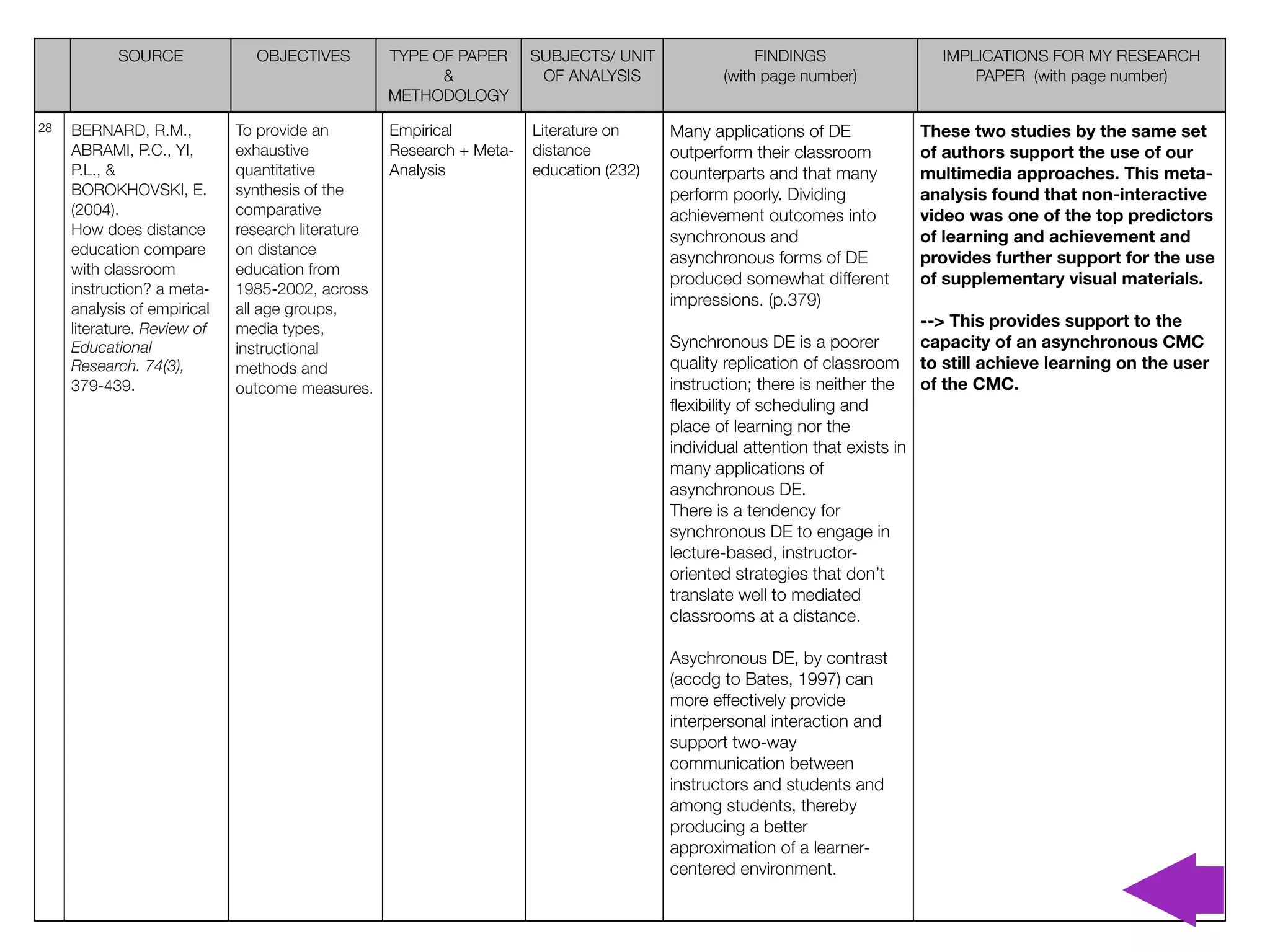
28   BERNARD, R.M.,          To provide an       Empirical          Literature on     Many applications of DE               These two studies by the same set
     ABRAMI, P.C., YI,       exhaustive          Research + Meta-   distance          outperform their classroom            of authors support the use of our
     P.L., &                 quantitative        Analysis           education (232)   counterparts and that many            multimedia approaches. This meta-
     BOROKHOVSKI, E.         synthesis of the                                         perform poorly. Dividing              analysis found that non-interactive
     (2004).                 comparative                                              achievement outcomes into             video was one of the top predictors
     How does distance       research literature                                      synchronous and                       of learning and achievement and
     education compare       on distance
                                                                                      asynchronous forms of DE              provides further support for the use
     with classroom          education from
                                                                                      produced somewhat different           of supplementary visual materials.
     instruction? a meta-    1985-2002, across
                                                                                      impressions. (p.379)
     analysis of empirical   all age groups,
     literature. Review of   media types,                                                                                   --> This provides support to the
     Educational             instructional                                            Synchronous DE is a poorer            capacity of an asynchronous CMC
     Research. 74(3),        methods and                                              quality replication of classroom      to still achieve learning on the user
     379-439.                outcome measures.                                        instruction; there is neither the     of the CMC.
                                                                                      flexibility of scheduling and
                                                                                      place of learning nor the
                                                                                      individual attention that exists in
                                                                                      many applications of
                                                                                      asynchronous DE.
                                                                                      There is a tendency for
                                                                                      synchronous DE to engage in
                                                                                      lecture-based, instructor-
                                                                                      oriented strategies that don’t
                                                                                      translate well to mediated
                                                                                      classrooms at a distance.

                                                                                      Asychronous DE, by contrast
                                                                                      (accdg to Bates, 1997) can
                                                                                      more effectively provide
                                                                                      interpersonal interaction and
                                                                                      support two-way
                                                                                      communication between
                                                                                      instructors and students and
                                                                                      among students, thereby
                                                                                      producing a better
                                                                                      approximation of a learner-
                                                                                      centered environment.
SOURCE              OBJECTIVES          TYPE OF PAPER   SUBJECTS/ UNIT                FINDINGS                   IMPLICATIONS FOR MY RESEARCH
                                                       &          OF ANALYSIS             (with page number)                  PAPER (with page number)
                                                 METHODOLOGY

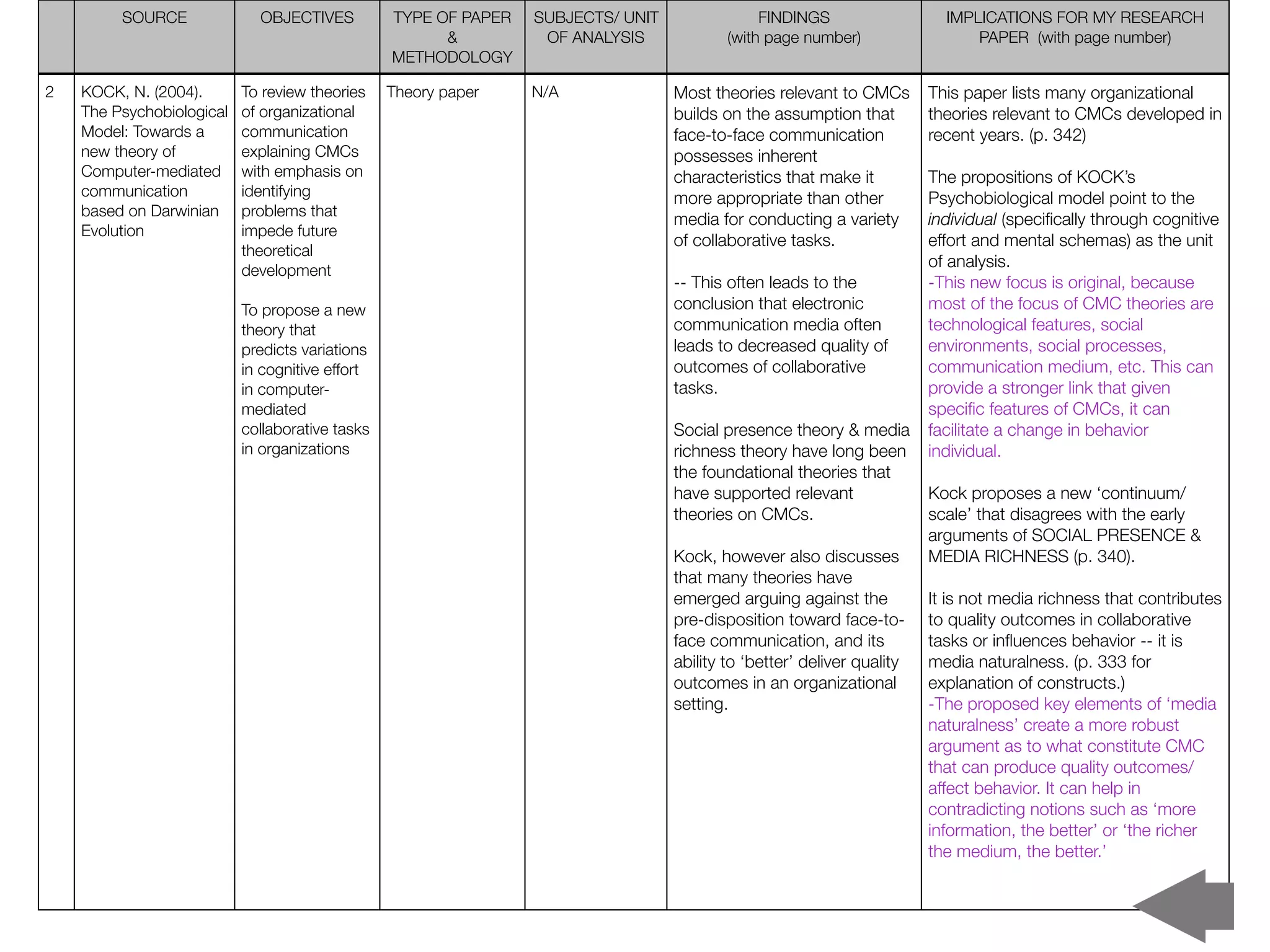
2   KOCK, N. (2004).       To review theories    Theory paper    N/A              Most theories relevant to CMCs        This paper lists many organizational
    The Psychobiological   of organizational                                      builds on the assumption that         theories relevant to CMCs developed in
    Model: Towards a       communication                                          face-to-face communication            recent years. (p. 342)
    new theory of          explaining CMCs                                        possesses inherent
    Computer-mediated      with emphasis on                                       characteristics that make it          The propositions of KOCK’s
    communication          identifying                                            more appropriate than other           Psychobiological model point to the
    based on Darwinian     problems that
                                                                                  media for conducting a variety        individual (specifically through cognitive
    Evolution              impede future
                                                                                  of collaborative tasks.               effort and mental schemas) as the unit
                           theoretical
                                                                                                                        of analysis.
                           development
                                                                                  -- This often leads to the            -This new focus is original, because
                           To propose a new                                       conclusion that electronic            most of the focus of CMC theories are
                           theory that                                            communication media often             technological features, social
                           predicts variations                                    leads to decreased quality of         environments, social processes,
                           in cognitive effort                                    outcomes of collaborative             communication medium, etc. This can
                           in computer-                                           tasks.                                provide a stronger link that given
                           mediated                                                                                     specific features of CMCs, it can
                           collaborative tasks                                    Social presence theory & media        facilitate a change in behavior
                           in organizations                                       richness theory have long been        individual.
                                                                                  the foundational theories that
                                                                                  have supported relevant               Kock proposes a new ‘continuum/
                                                                                  theories on CMCs.                     scale’ that disagrees with the early
                                                                                                                        arguments of SOCIAL PRESENCE &
                                                                                  Kock, however also discusses          MEDIA RICHNESS (p. 340).
                                                                                  that many theories have
                                                                                  emerged arguing against the           It is not media richness that contributes
                                                                                  pre-disposition toward face-to-       to quality outcomes in collaborative
                                                                                  face communication, and its           tasks or influences behavior -- it is
                                                                                  ability to ‘better’ deliver quality   media naturalness. (p. 333 for
                                                                                  outcomes in an organizational         explanation of constructs.)
                                                                                  setting.                              -The proposed key elements of ‘media
                                                                                                                        naturalness’ create a more robust
                                                                                                                        argument as to what constitute CMC
                                                                                                                        that can produce quality outcomes/
                                                                                                                        affect behavior. It can help in
                                                                                                                        contradicting notions such as ‘more
                                                                                                                        information, the better’ or ‘the richer
                                                                                                                        the medium, the better.’
SOURCE           OBJECTIVES         TYPE OF PAPER      SUBJECTS/ UNIT              FINDINGS             IMPLICATIONS FOR MY RESEARCH
                                                   &             OF ANALYSIS           (with page number)            PAPER (with page number)
                                             METHODOLOGY

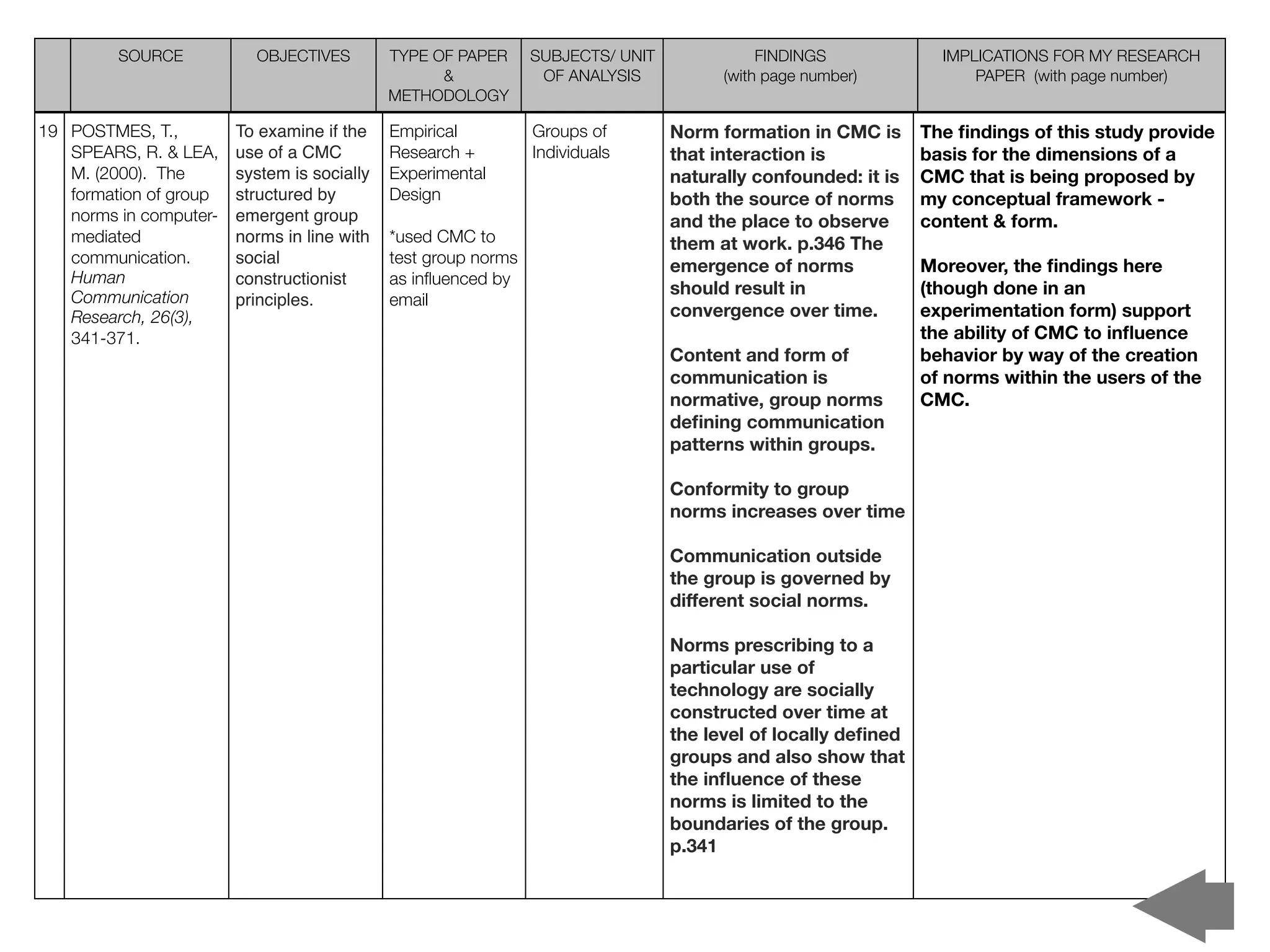
19 POSTMES, T.,         To examine if the    Empirical          Groups of        Norm formation in CMC is      The findings of this study provide
   SPEARS, R. & LEA,    use of a CMC         Research +         Individuals      that interaction is           basis for the dimensions of a
   M. (2000). The       system is socially   Experimental                        naturally confounded: it is   CMC that is being proposed by
   formation of group   structured by        Design                              both the source of norms      my conceptual framework -
   norms in computer-   emergent group                                           and the place to observe      content & form.
   mediated             norms in line with   *used CMC to                        them at work. p.346 The
   communication.       social               test group norms                    emergence of norms            Moreover, the findings here
   Human                constructionist      as influenced by
   Communication                                                                 should result in              (though done in an
                        principles.          email
   Research, 26(3),                                                              convergence over time.        experimentation form) support
   341-371.                                                                                                    the ability of CMC to influence
                                                                                 Content and form of           behavior by way of the creation
                                                                                 communication is              of norms within the users of the
                                                                                 normative, group norms        CMC.
                                                                                 defining communication
                                                                                 patterns within groups.

                                                                                 Conformity to group
                                                                                 norms increases over time

                                                                                 Communication outside
                                                                                 the group is governed by
                                                                                 different social norms.

                                                                                 Norms prescribing to a
                                                                                 particular use of
                                                                                 technology are socially
                                                                                 constructed over time at
                                                                                 the level of locally defined
                                                                                 groups and also show that
                                                                                 the influence of these
                                                                                 norms is limited to the
                                                                                 boundaries of the group.
                                                                                 p.341
SOURCE            OBJECTIVES        TYPE OF PAPER      SUBJECTS/ UNIT               FINDINGS                 IMPLICATIONS FOR MY RESEARCH
                                                   &             OF ANALYSIS            (with page number)                PAPER (with page number)
                                             METHODOLOGY

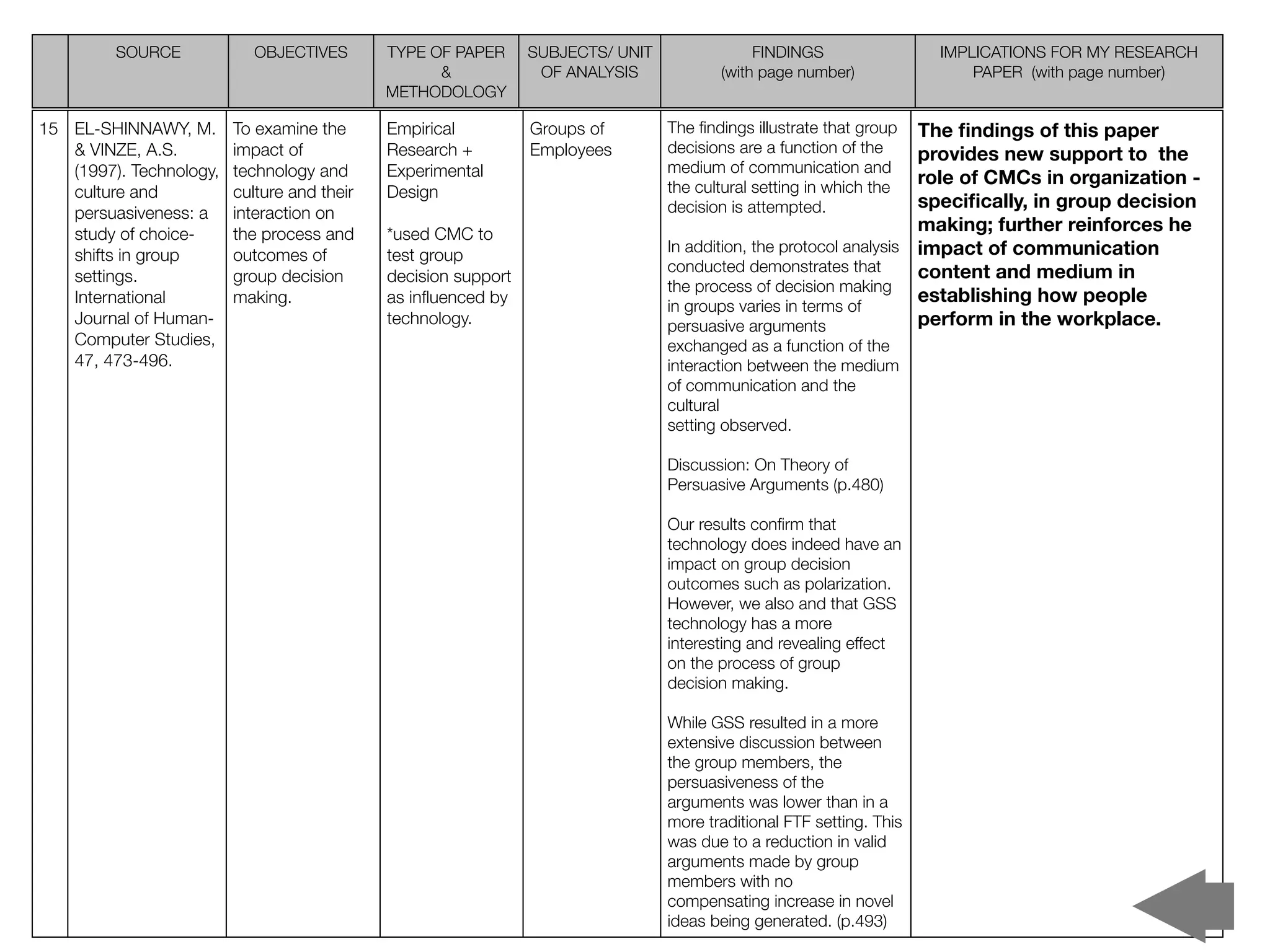
15 EL-SHINNAWY, M.       To examine the      Empirical          Groups of        The findings illustrate that group  The findings of this paper
   & VINZE, A.S.         impact of           Research +         Employees        decisions are a function of the    provides new support to the
   (1997). Technology,   technology and      Experimental                        medium of communication and
                                                                                 the cultural setting in which the
                                                                                                                    role of CMCs in organization -
   culture and           culture and their   Design
                                                                                 decision is attempted.             specifically, in group decision
   persuasiveness: a     interaction on
   study of choice-      the process and     *used CMC to                                                           making; further reinforces he
                                                                                 In addition, the protocol analysis impact of communication
   shifts in group       outcomes of         test group
                                                                                 conducted demonstrates that        content and medium in
   settings.             group decision      decision support
                                                                                 the process of decision making
   International         making.             as influenced by                                                        establishing how people
                                                                                 in groups varies in terms of
   Journal of Human-                         technology.                         persuasive arguments               perform in the workplace.
   Computer Studies,                                                             exchanged as a function of the
   47, 473-496.                                                                  interaction between the medium
                                                                                 of communication and the
                                                                                 cultural
                                                                                 setting observed.

                                                                                 Discussion: On Theory of
                                                                                 Persuasive Arguments (p.480)

                                                                                 Our results confirm that
                                                                                 technology does indeed have an
                                                                                 impact on group decision
                                                                                 outcomes such as polarization.
                                                                                 However, we also and that GSS
                                                                                 technology has a more
                                                                                 interesting and revealing effect
                                                                                 on the process of group
                                                                                 decision making.

                                                                                 While GSS resulted in a more
                                                                                 extensive discussion between
                                                                                 the group members, the
                                                                                 persuasiveness of the
                                                                                 arguments was lower than in a
                                                                                 more traditional FTF setting. This
                                                                                 was due to a reduction in valid
                                                                                 arguments made by group
                                                                                 members with no
                                                                                 compensating increase in novel
                                                                                 ideas being generated. (p.493)
SOURCE           OBJECTIVES         TYPE OF PAPER   SUBJECTS/ UNIT               FINDINGS                   IMPLICATIONS FOR MY RESEARCH
                                                    &          OF ANALYSIS            (with page number)                  PAPER (with page number)
                                              METHODOLOGY

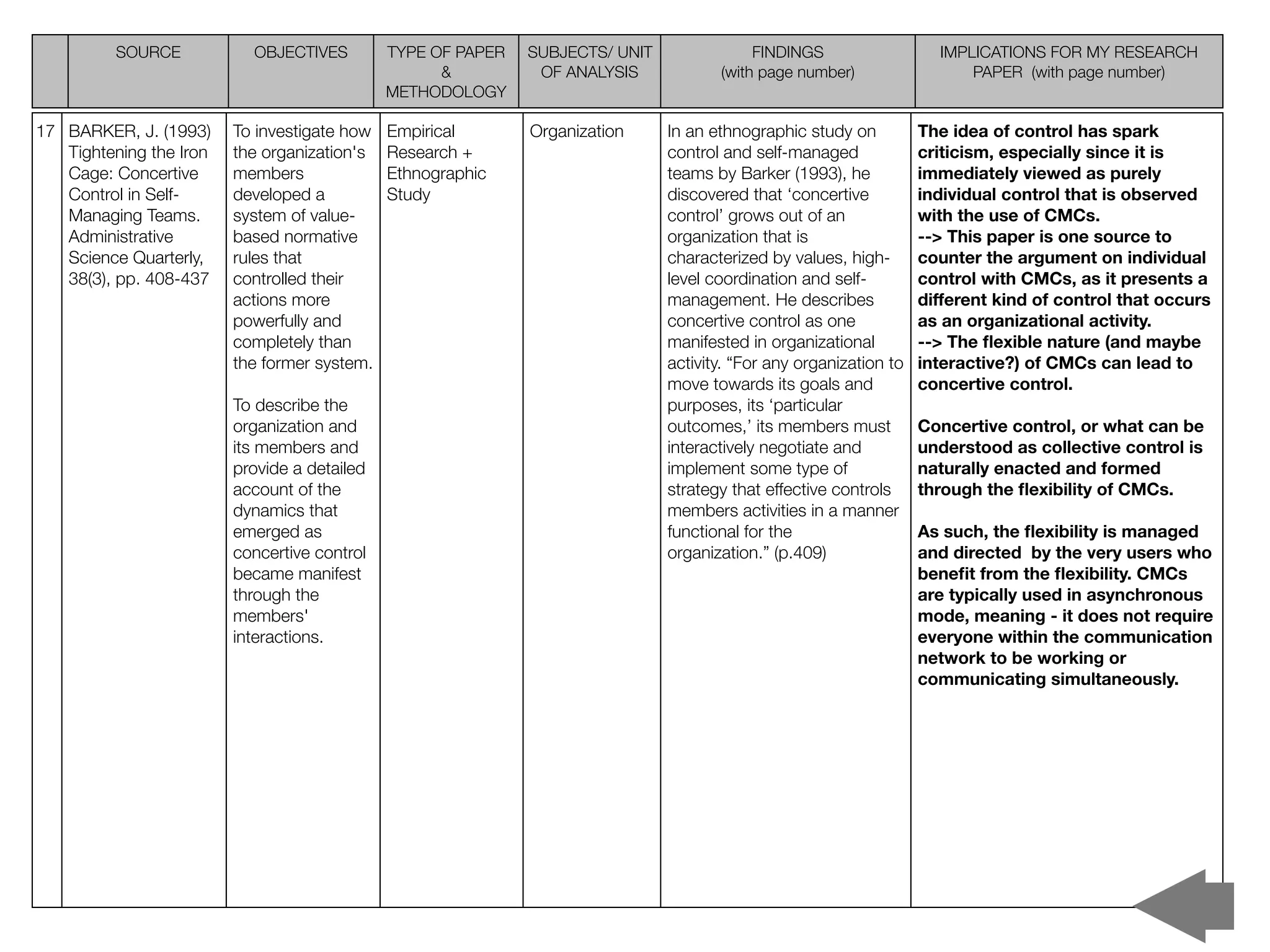
17 BARKER, J. (1993)     To investigate how   Empirical       Organization     In an ethnographic study on          The idea of control has spark
   Tightening the Iron   the organization's   Research +                       control and self-managed             criticism, especially since it is
   Cage: Concertive      members              Ethnographic                     teams by Barker (1993), he           immediately viewed as purely
   Control in Self-      developed a          Study                            discovered that ‘concertive          individual control that is observed
   Managing Teams.       system of value-                                      control’ grows out of an             with the use of CMCs.
   Administrative        based normative                                       organization that is                 --> This paper is one source to
   Science Quarterly,    rules that                                            characterized by values, high-       counter the argument on individual
   38(3), pp. 408-437    controlled their                                      level coordination and self-         control with CMCs, as it presents a
                         actions more                                          management. He describes             different kind of control that occurs
                         powerfully and                                        concertive control as one            as an organizational activity.
                         completely than                                       manifested in organizational         --> The flexible nature (and maybe
                         the former system.                                    activity. “For any organization to   interactive?) of CMCs can lead to
                                                                               move towards its goals and           concertive control.
                         To describe the                                       purposes, its ‘particular
                         organization and                                      outcomes,’ its members must          Concertive control, or what can be
                         its members and                                       interactively negotiate and          understood as collective control is
                         provide a detailed                                    implement some type of               naturally enacted and formed
                         account of the                                        strategy that effective controls     through the flexibility of CMCs.
                         dynamics that                                         members activities in a manner
                         emerged as                                            functional for the                   As such, the flexibility is managed
                         concertive control                                    organization.” (p.409)               and directed by the very users who
                         became manifest                                                                            benefit from the flexibility. CMCs
                         through the                                                                                are typically used in asynchronous
                         members'                                                                                   mode, meaning - it does not require
                         interactions.                                                                              everyone within the communication
                                                                                                                    network to be working or
                                                                                                                    communicating simultaneously.
SOURCE            OBJECTIVES      TYPE OF PAPER      SUBJECTS/ UNIT               FINDINGS                  IMPLICATIONS FOR MY RESEARCH
                                                 &             OF ANALYSIS            (with page number)                 PAPER (with page number)
                                           METHODOLOGY

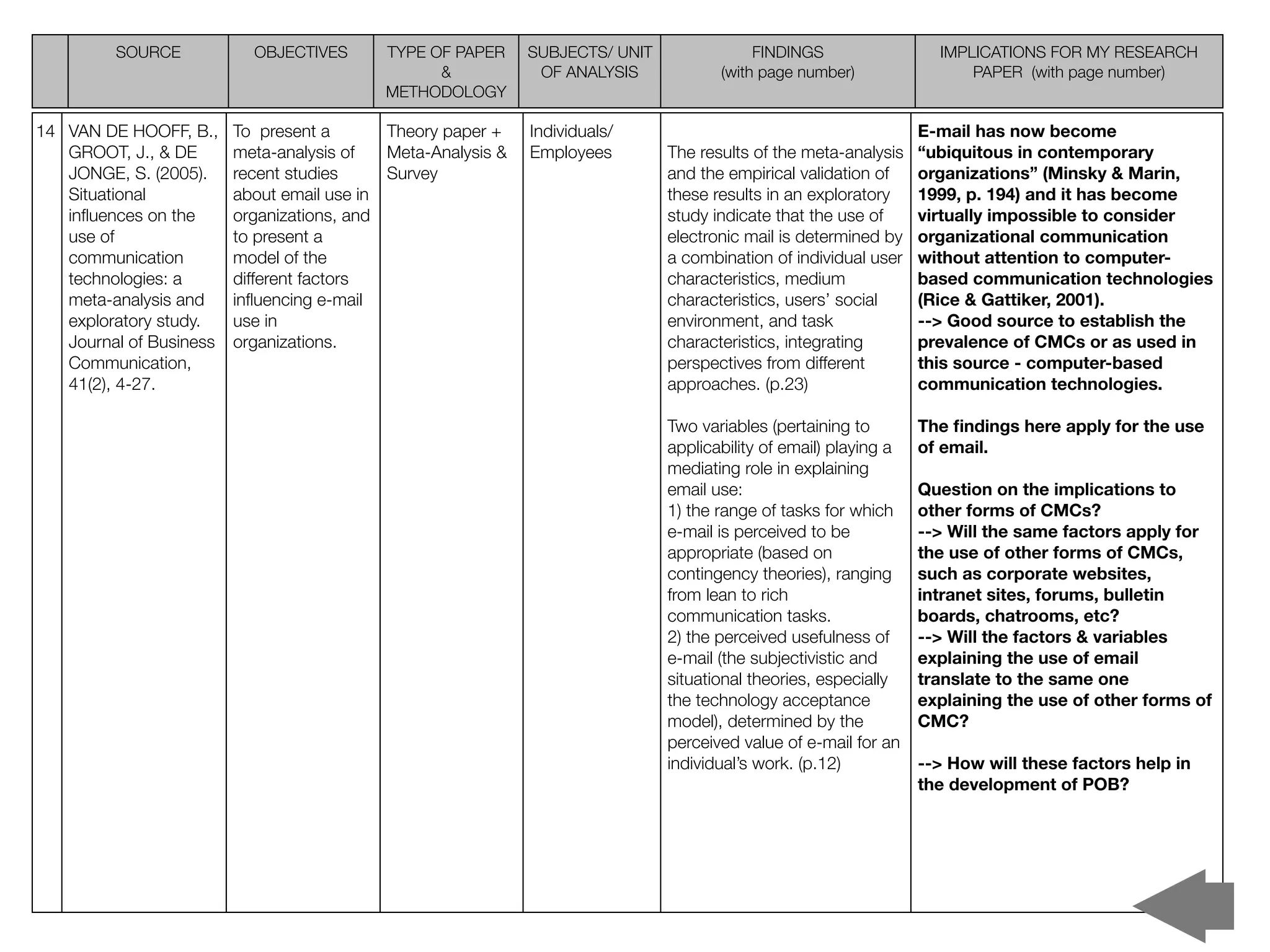
14 VAN DE HOOFF, B.,     To present a       Theory paper +    Individuals/                                      E-mail has now become
   GROOT, J., & DE       meta-analysis of   Meta-Analysis &   Employees        The results of the meta-analysis “ubiquitous in contemporary
   JONGE, S. (2005).     recent studies     Survey                             and the empirical validation of  organizations” (Minsky & Marin,
   Situational           about email use in                                    these results in an exploratory  1999, p. 194) and it has become
   influences on the      organizations, and                                    study indicate that the use of   virtually impossible to consider
   use of                to present a                                          electronic mail is determined by organizational communication
   communication         model of the                                          a combination of individual user without attention to computer-
   technologies: a       different factors                                     characteristics, medium          based communication technologies
   meta-analysis and     influencing e-mail                                     characteristics, users’ social   (Rice & Gattiker, 2001).
   exploratory study.    use in                                                environment, and task            --> Good source to establish the
   Journal of Business   organizations.                                        characteristics, integrating     prevalence of CMCs or as used in
   Communication,                                                              perspectives from different      this source - computer-based
   41(2), 4-27.                                                                approaches. (p.23)               communication technologies.

                                                                               Two variables (pertaining to        The findings here apply for the use
                                                                               applicability of email) playing a   of email.
                                                                               mediating role in explaining
                                                                               email use:                          Question on the implications to
                                                                               1) the range of tasks for which     other forms of CMCs?
                                                                               e-mail is perceived to be           --> Will the same factors apply for
                                                                               appropriate (based on               the use of other forms of CMCs,
                                                                               contingency theories), ranging      such as corporate websites,
                                                                               from lean to rich                   intranet sites, forums, bulletin
                                                                               communication tasks.                boards, chatrooms, etc?
                                                                               2) the perceived usefulness of      --> Will the factors & variables
                                                                               e-mail (the subjectivistic and      explaining the use of email
                                                                               situational theories, especially    translate to the same one
                                                                               the technology acceptance           explaining the use of other forms of
                                                                               model), determined by the           CMC?
                                                                               perceived value of e-mail for an
                                                                               individual’s work. (p.12)           --> How will these factors help in
                                                                                                                   the development of POB?
SOURCE           OBJECTIVES        TYPE OF PAPER     SUBJECTS/ UNIT               FINDINGS                   IMPLICATIONS FOR MY RESEARCH
                                                   &            OF ANALYSIS            (with page number)                  PAPER (with page number)
                                             METHODOLOGY

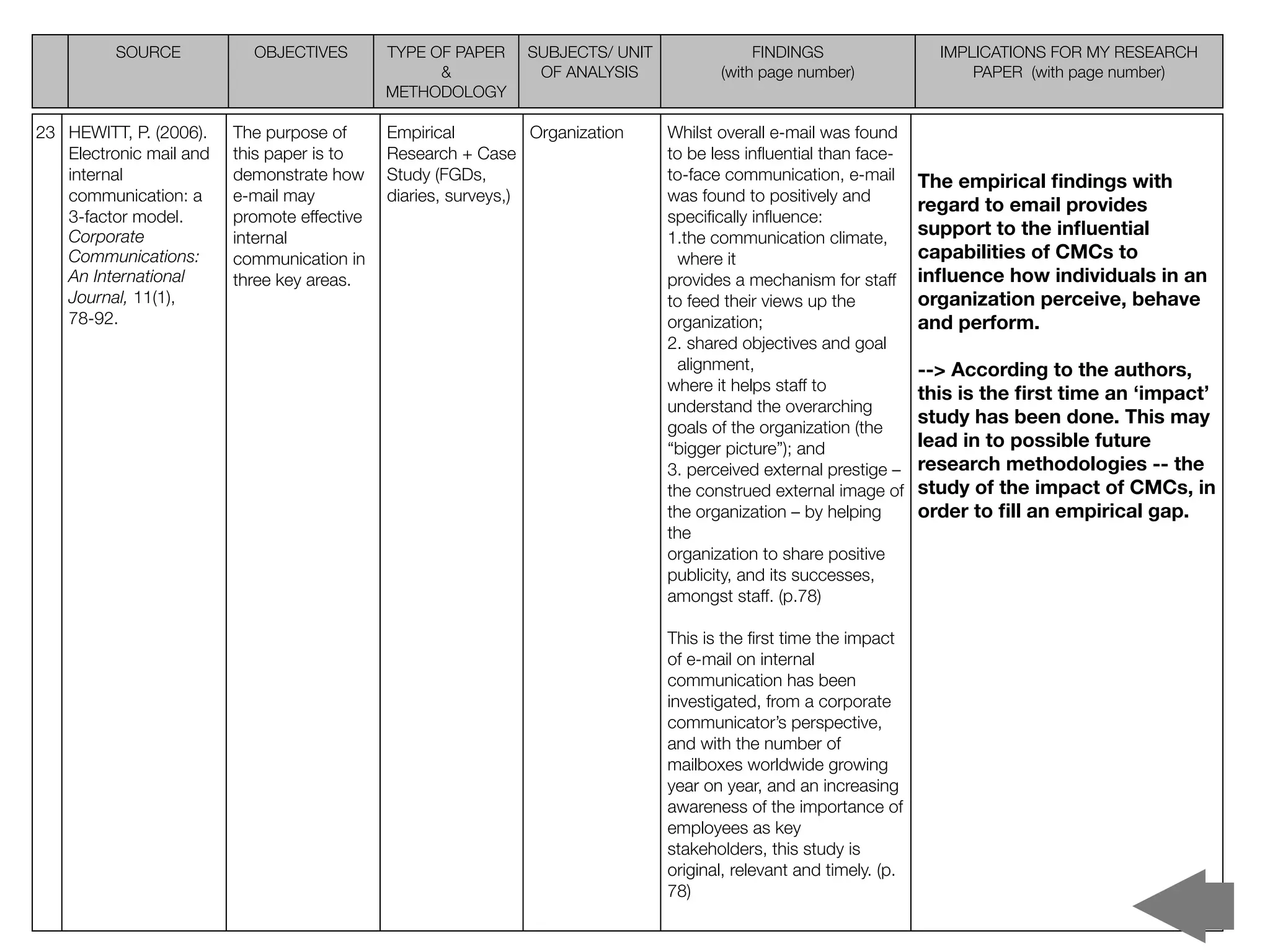
23 HEWITT, P. (2006).    The purpose of      Empirical          Organization    Whilst overall e-mail was found
   Electronic mail and   this paper is to    Research + Case                    to be less influential than face-
   internal              demonstrate how     Study (FGDs,                       to-face communication, e-mail        The empirical findings with
   communication: a      e-mail may          diaries, surveys,)                 was found to positively and
                                                                                                                     regard to email provides
   3-factor model.       promote effective                                      specifically influence:
   Corporate             internal                                               1.the communication climate,         support to the influential
   Communications:       communication in                                         where it                           capabilities of CMCs to
   An International      three key areas.                                       provides a mechanism for staff       influence how individuals in an
   Journal, 11(1),                                                              to feed their views up the           organization perceive, behave
   78-92.                                                                       organization;                        and perform.
                                                                                2. shared objectives and goal
                                                                                  alignment,                         --> According to the authors,
                                                                                where it helps staff to              this is the first time an ‘impact’
                                                                                understand the overarching
                                                                                                                     study has been done. This may
                                                                                goals of the organization (the
                                                                                “bigger picture”); and               lead in to possible future
                                                                                3. perceived external prestige –     research methodologies -- the
                                                                                the construed external image of      study of the impact of CMCs, in
                                                                                the organization – by helping        order to fill an empirical gap.
                                                                                the
                                                                                organization to share positive
                                                                                publicity, and its successes,
                                                                                amongst staff. (p.78)

                                                                                This is the first time the impact
                                                                                of e-mail on internal
                                                                                communication has been
                                                                                investigated, from a corporate
                                                                                communicator’s perspective,
                                                                                and with the number of
                                                                                mailboxes worldwide growing
                                                                                year on year, and an increasing
                                                                                awareness of the importance of
                                                                                employees as key
                                                                                stakeholders, this study is
                                                                                original, relevant and timely. (p.
                                                                                78)
SOURCE            OBJECTIVES          TYPE OF PAPER    SUBJECTS/ UNIT               FINDINGS                IMPLICATIONS FOR MY RESEARCH
                                                     &           OF ANALYSIS            (with page number)               PAPER (with page number)
                                               METHODOLOGY

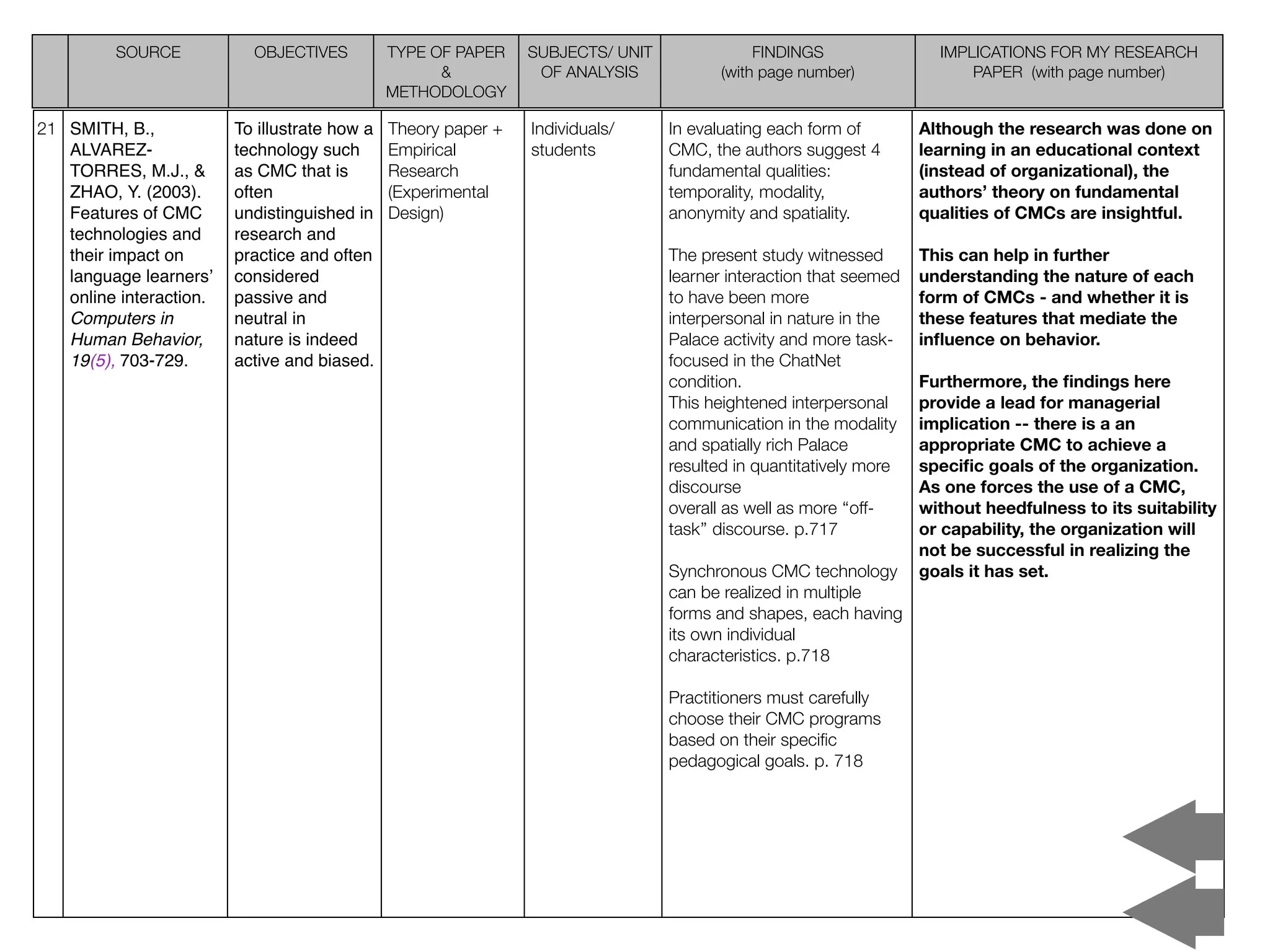
21 SMITH, B.,            To illustrate how a   Theory paper +   Individuals/     In evaluating each form of        Although the research was done on
   ALVAREZ-              technology such       Empirical        students         CMC, the authors suggest 4        learning in an educational context
   TORRES, M.J., &       as CMC that is        Research                          fundamental qualities:            (instead of organizational), the
   ZHAO, Y. (2003).      often                 (Experimental                     temporality, modality,            authors’ theory on fundamental
   Features of CMC       undistinguished in    Design)                           anonymity and spatiality.         qualities of CMCs are insightful.
   technologies and      research and
   their impact on       practice and often                                      The present study witnessed       This can help in further
   language learnersʼ    considered                                              learner interaction that seemed   understanding the nature of each
   online interaction.   passive and                                             to have been more                 form of CMCs - and whether it is
   Computers in          neutral in                                              interpersonal in nature in the    these features that mediate the
   Human Behavior,       nature is indeed                                        Palace activity and more task-    influence on behavior.
   19(5), 703-729.       active and biased.                                      focused in the ChatNet
                                                                                 condition.                        Furthermore, the findings here
                                                                                 This heightened interpersonal     provide a lead for managerial
                                                                                 communication in the modality     implication -- there is a an
                                                                                 and spatially rich Palace         appropriate CMC to achieve a
                                                                                 resulted in quantitatively more   specific goals of the organization.
                                                                                 discourse                         As one forces the use of a CMC,
                                                                                 overall as well as more ‘‘off-    without heedfulness to its suitability
                                                                                 task’’ discourse. p.717           or capability, the organization will
                                                                                                                   not be successful in realizing the
                                                                                 Synchronous CMC technology        goals it has set.
                                                                                 can be realized in multiple
                                                                                 forms and shapes, each having
                                                                                 its own individual
                                                                                 characteristics. p.718

                                                                                 Practitioners must carefully
                                                                                 choose their CMC programs
                                                                                 based on their specific
                                                                                 pedagogical goals. p. 718
SOURCE            OBJECTIVES         TYPE OF PAPER    SUBJECTS/ UNIT               FINDINGS                 IMPLICATIONS FOR MY RESEARCH
                                                   &           OF ANALYSIS            (with page number)                PAPER (with page number)
                                             METHODOLOGY

22 QUIRING, O.         To explore the      Empirical          Individuals/     The phenomenon                     Continuation:
   (2009). What do     concept of          Research + In-     Users            is basically observed from three   The results indicate that ‘ordinary’
   users associate     interactivity among depth Interviews                    different perspectives:            users think foremost of their own
   with                ‘ordinary’ users                                        interactivity as an attribute of   actions, sensory input, control over
   ‘interactivity’?:   and determine if                                        technological systems,             the communication process and the
   a qualitative study such users                                              communication processes and        exchange of meaning when asked
                                                                                                                  for their
   on user schemata. associate the                                             user perceptions.
                       foremost social                                                                            perception of interactivity
   New Media
                       and individual                                          As an attribute of technological   (Morrison, 1998)
   Society, 11(6),
                       issues with the                                         systems, it is associated with:
   899-920.
                       term interactivity.                                     responsiveness, real-time          The results of our study offer an
                                                                               speed                              explanation for this result: large
                                                                               flexibility, options for the        proportions of user schemata are
                                                                               selection and modification of       not covered by technological
                       Which media                                             content and allow users to         aspects but by aspects of individual
                       services and                                            communicate directly,              action, social influence
                       technical devices                                       independent of time and place.     and relationships. (p.915)
                       do users believe                                        (p.901)
                       to be ‘interactive’                                                                       This article includes a lengthy
                       and why?                                                As an attribute of                discussion on various literature on
                                                                               communication process,            the understanding of ‘interactivity’.
                                                                               interactivity is associated with: It turns out there are many ways to
                                                                               exchange communication,           interpreting interactivity. The
                                                                               dialogue and discourse, gaining implication to my research is that, it
                                                                               of more control over the          is a construct that can yet be
                                                                               communication process,            narrowed down in definition,
                                                                               promotes two-way                  association or even context -- in a
                                                                               communication, third-order        way that is relevant for the
                                                                               dependency                        influence to POB.

                                                                               As an attribute of user-           However - the literature shared with
                                                                               perception, associations are:      regard to the perception of
                                                                               perceived responsiveness,          ‘ordinary’ users by Morrison-- this
                                                                               perceived navigation, perceived    has implications on the key
                                                                               speed, sensory activation,         determinants of an interactive
                                                                               playfulness, connectedness,        experience in a CMC, which
                                                                               proximity and presence             organizations must know when
                                                                                                                  enforcing CMC for change
                                                                                                                  behavior.
The content (H1) and form (H2) of CMCs positively influences the
development of POB states (self-efficacy, hope, optimism and resiliency)
among managers and employees.

H3: Media richness positively moderates the influence of content of CMCs
on the development of POB states among managers and employees.

H4: Interactivity positively moderates the influence of form of CMCs on the
development of POB states among managers and employees.

H5: Flexibility positively moderates the influence of of form of CMCs on the
development of POB states among managers and employees.

H6: The development of POB states among managers and employees
positively influences improved work performance.
“electronic mail/e-mail, voice-mail, computer
bulletin boards, computer conferencing and
group decision support systems.” (Steinfeld, 1992,
p.349).
“user-groups, chatrooms, webpages (Soukup, 2000, p.
408),


“blogs, social networking websites, and microblogs.”
                                         (Miller, 2003, p. 387)
Digitalization or digital communications -
technological process the reduces the text to
something that can be easily “fragmented, handled,
linked and distributed.”
                                     (Scolari, 2009, p.946)

Eugenio S Final Presentation Material Results Of Annotated Bibliography Apr12

  • 1.
    ANNOTATED BIBLIOGRAPHY (A Presentation) ByShirin Eugenio DBA720D - Advanced Research Method April 12, 2010
  • 2.
    Media richness H3 Content of CMCs H1 Development of H6 Improved Work POB States Performance Form of H2 Self-Efficacy, Hope CMCs Optimism, Resiliency H4 H5 Flexibility Interactivity CMC POB Steinfeld (1992) Luthans & Avolio (2009) Pickering & King (1995) Roberts, Spreitzer, Dutton, Quinn, Heapy & Barker (2005) Soukop (2000) Avey, Wernsing and Luthans (2008) Miller (2003) Frederickson (2004) Scolari (2009) Yousseff & Luthans (2007)
  • 3.
    THEORIES SUPPORTING THE CONCEPTUALFRAMEWORK: Organizational Behavior Modification Theory by Kreitner & Luthans (1975, 1985) Available source: STAJKOVIC & LUTHANS (1997) Relationship Development Theory by Walther, J. (1992) Available Source: WALTHER (1995) Social Construction of Reality Theory by Lee, A. (1994) Available Source: LEE (1994)
  • 4.
    ON ONLINE INTERVENTIONS: LUTHANS,F., AVEY, J. B. & PATERA, J. (2008). ☺ Experimental analysis on web-based training intervention to develop positive psychological capital SITZMANN,T., KRAIGER, K., STEWART, D., WISHER, R. (2006). ☺ The comparative effectiveness of web-based and classroom instruction: a meta-analysis. RITTERBAND, L.M., GONDER-FREDERICK, L.A., COX, D.J., ☺ CLIFTON, A.D., WEST, R.W., & BOROWITZ, S.M. (2003) Internet interventions: in review, in use, and into the future. BERNARD, R.M., ABRAMI, P.C., YI, P.L., & BOROKHOVSKI, E. ☺ (2004). How does distance education compare with classroom instruction? a meta-analysis of empirical literature.
  • 5.
    ON ONLINE INTERVENTIONS: LUTHANS,F., AVEY, J. B. & PATERA, J. (2008). ☺ Most literature on Experimental analysis on web-based training intervention to develop positive psychological capital online/web-based SITZMANN,T., KRAIGER, K., STEWART, D., WISHER, interventions R. (2006). ☺ point to experimental The comparative effectiveness of web-based and classroom instruction: a meta-analysis. studies done in RITTERBAND, L.M., GONDER-FREDERICK, L.A., COX, D.J., CLIFTON, A.D., WEST, R.W., & BOROWITZ, S.M. (2003) the fields of ☺ psychology and Internet interventions: in review, in use, and into the future. educational BERNARD, R.M., ABRAMI, P.C., YI, P.L., & BOROKHOVSKI, E. ☺ (2004). research. How does distance education compare with classroom instruction? a meta-analysis of empirical literature.
  • 6.
    SOME OBSERVED THEMES,PATTERNS, GAPS and ISSUES: The effectiveness of CMCs (in influencing an OB construct) is normally evaluated using the established tents of Media Richness & Social Presence Theories; FtF vs CMC. Emerging CMC theories tend build their arguments from perspective. KOCK (2004) on media naturalness; MILLER (2003) on connected presence SOUKOP (2000) on directions for new CMC theories CMCs and their contribution to OB is typically generalized from studies on individuals and groups/teams in organizations, and not on organizations as a whole. Group norms, group decision-making POSTMES, SPEAR, LEA (2000); EL-SHINNAWY, M. & VINZE, A.S. (1997). BARKER (1993) Email & Chat Applications as still the most prevalent forms of CMCs studied in researchers in organizational communication. VAN DE HOOFF, B., GROOT, J., & DE JONGE, S. (2005).; HEWITT, P. (2006). SMITH, B., ALVAREZ-TORRES, M.J., & ZHAO, Y. (2003); LEE (1994)
  • 7.
    SOME OBSERVED THEMES,PATTERNS, GAPS and ISSUES: Interactivity of CMCs as a very complex construct. Most researches tend define it from one of three perspectives: as an attribute of technology systems, the communication process, and user-perception QUIRING (2009) Benefits of CMCs vs Qualities of CMCs More research literature on qualities/attributes of CMCs need to be obtained in order to understand how those qualities can affect organizational behavior. SMITH, B., ALVAREZ-TORRES, M.J., & ZHAO, Y. (2003).
  • 8.
    SOME OBSERVED THEMES,PATTERNS, GAPS and ISSUES: Interactivity of CMCs as a very complex construct. Most researches tend define it from one of three perspectives: as an attribute of technology systems, the communication process, and user-perception QUIRING (2009) Benefits of CMCs vs Qualities of CMCs More research literature on qualities/attributes of CMCs need to be obtained in order to understand how those qualities can affect organizational behavior. SMITH, B., ALVAREZ-TORRES, M.J., & ZHAO, Y. (2003). Thank you for your time.
  • 9.
    SOURCE OBJECTIVES TYPE OF PAPER SUBJECTS/ FINDINGS & INSIGHTS IMPLICATIONS FOR MY RESEARCH & UNIT OF (with page number) PAPER (with page number) METHODOLOGY ANALYSIS 3 STEINFELD, C. To introduce two Theory paper Organizations -Provides the concrete forms Another literature that discusses (1992). Computer- new theoretical of CMCs “electronic mail/e- alternative paradigms to information mediated approaches that mail, voice-mail, computer richness in CMC theories -- critical communications in focus on the social bulletin boards, computer mass and social influence. organizational context in which settings: emerging CMCs are conferencing and group conceptual embedded, which decision support systems. (p. Steinfeld is a good source on the frameworks and explain the 349) increased empirical research on directions for adoption, use and organizations using CMC systems in research. impact of CMCs Managerial work, which ways unanticipated by the dominant Management contain higher proportion of theories. CMCs in organizations have Communication To recommend non-routine tasks can be grown in its social uses, broadcast Quarterly, 5(3), three avenues to characterized as relatively uses, political uses and in conflict 348-365. which CMC theories can unanalyzable. Thus resolution. (p.353) expand to, ambiguous communication --> For review of literature; information addressing situations will arise more that can build argument on the applications to frequently, resulting to either in contribution of CMCs in organizations. telecom and a marked preference for richer information communication medium, or --> Steinfeld’s recommended avenues technology among lower performance. (p.351) for CMC research reinforce the organizations increasing criticality of CMCs in New avenues for research - organizations. CMC systems as: 1)Interorganizational --> Steinfeld agrees with previous communication medium research that research must look 2)one of a set of information further beyond just the physical services available over a features of new media, but rather telecom structure understand how systems come to be 3)a tool for achieving strategic used and consequences of such use organizational objectives in organizations. and competitive advantage
  • 10.
    SOURCE OBJECTIVES TYPE OF PAPER SUBJECTS/ FINDINGS & INSIGHTS IMPLICATIONS FOR MY RESEARCH & UNIT OF (with page number) PAPER (with page number) METHODOLOGY ANALYSIS 1 PICKERING, J.M. & To provide an Theory paper + Organizations Defines CMCs - Computer- Discussions in this paper provide new KING, J.K. (1995) explanation to the Review of mediated Communication refers insight on the contribution of CMCs to Hardwiring Weak growth of Inter- theoretical to person-to-person ‘weak ties’ that exist in organizations (as Ties: organizational CMC development communication, often in text or theorized by Granovetter). Interorganizational (ICMC) to date graphic form, over computer Computer-Mediated networks. (p. 479) ICMC supported weak ties are probably Communication, often maintained to gather information and Occupational CMC infrastructure appears to be facilitate problem solving. (p. 481) Communities, and most strongly supported, at least Organizational in this early stage, among As new communications technologies and Change. organizations dependent on the other elements of information Organization maintenance of external weak infrastructure become available and Science, Vol. 6, No. social ties among employees who ubiquitous, the costs of communication 4, pp. 479-486 are members of professional, will drop and access to information will dispersed occupational grow dramatically. (p.484) communities. This can be seen in the experience of research- --> These insights on the development of oriented organizations. CMC among occupational communities and the pressure of lowering cost will add Two strong forces-the credence to the need to optimize the use professionalism of key of CMCs within the organizations. occupational communities seeking autonomy, and a persistent desire by organizations to reduce fixed costs and organizational size-are posited as encouraging growth of ICMC infrastructure. As the capabilities and price/ performance characteristics of CMC technologies improve, we expect to see explosive growth in use of these technologies both within organizations and between organizations. But because of tension between the welfare of individuals and the organizations they work for, growth of ICMCu se is not likely to be uniform across classes of organizations.
  • 11.
    SOURCE OBJECTIVES TYPE OF PAPER SUBJECTS/ FINDINGS & INSIGHTS IMPLICATIONS FOR MY RESEARCH & UNIT OF (with page number) PAPER (with page number) METHODOLOGY ANALYSIS 4 SOUKOP, C. (2000). To analyze, critique Theory paper + Theories/Current Provides concrete forms of Literature review provides good Building a theory of and integrate Review of body of literature CMCs - “email, bulletin discussion on supporting the multi-media CMC: an contemporary CMC theoretical on CMCs boards, user groups, advantages of CMCs that increases analysis, critique and theory and research development chatrooms, webpages, etc” ; the ‘personal-ness’ argued to be integration of computer-mediated To explore the news groups, email, list missing (as is always argued from the communication theoretical serves, chatrooms and multi- ‘reduced cues approach). theory and research. implications of user domains. (p.408) New Media Society, increased audio, The insights in this paper point to 2(4), 407-425. video and multi- --> His findings point to him what new theory on CMCs must: dimensionality in that ‘text-based’ concept of -explore a multi-media perspective, cyberspace internet is diminishing, moving instead of pure text-based to multi-media, three- perspective dimenstional, multi-sensory -view CMC as a unique communication in cyberspace communication context with audio-voice interaction, -view CMC as highly dynamic visual-video interaction... (p. -view CMC as a full and rich 409) communicative context - approach CMC as a rhetorical Soukop cites Walther’s context. (p.421) Relational Theory -- Walther establishes that although -These conclusions expressed by CMC may lose some relational Soukop can establish the cues (visual/auditory), CMC assumptions we have to take in gains alternative cues (textual/ developing in CMC that is relevant verbal) today. It strengthens the argument that CMC should not be measured up Good quote by Walther (cited against the elements/features/context by Soukop) -- see p.413 and processes in FtF communication.
  • 12.
    SOURCE OBJECTIVES TYPE OF PAPER SUBJECTS/ FINDINGS & INSIGHTS IMPLICATIONS FOR MY RESEARCH & UNIT OF (with page number) PAPER (with page number) METHODOLOGY ANALYSIS 18 MILLER, V. (2008) This article will Theory + New media Through a consideration of The discussions on new media and New Media, demonstrate how Conceptual objects the new media objects of the changing culture of individuals Networking, and the notion of Paper blogs, social networking (due to usage and participation in Phatic Culture. ‘phatic profiles these media) has given rise to a new Convergence: The communion’ has and microblogs, along with kind of presence -- ‘connected International become an their associated practices,the presence’. This kind of presence is Journal of increasingly author argues that the social spurred on by the type of Research into New significant part of contexts of ‘individualization’ communications that is prevalent in Media digital media and ‘network sociality’, new media. Technologies, culture alongside alongside the technological 14(4), p.387-400. the rise of online developments associated with --> This new construct is a new networking pervasive communication and argument against the idea of “social practices. ‘connected presence’ has led presence” (a theory built on mass to an online media culture media and not today’s new media). increasingly dominated by While new media today can be phatic communications. That deemed as low in social presence is, communications which (based on the theory), this research is have purely social (networking) arguing that, a new kind of ‘presence’ and not informational or is formed and it is influential in the way dialogic intents. people behave and form relationships with other people. This behavior can He concludes with a have implications in the workplace. discussion of the potential nihilistic consequences of such a culture. Phatic messages are not intended to carry information or substance for the receiver, but instead concern the process of communication. These interactions essentially maintain and strengthen existing relationships in order to facilitate further communication (Vetere et al., 2005). p.394
  • 13.
    SOURCE OBJECTIVES TYPE OF PAPER SUBJECTS/ FINDINGS & INSIGHTS IMPLICATIONS FOR MY RESEARCH & UNIT OF (with page number) PAPER (with page number) METHODOLOGY ANALYSIS 5 SCOLARI, C.A. To reflect on the Theory paper + Theories/Current New media, old theories VS He veers away from naming all the (2009). Mapping current state of Review of body of literature new media, new theories. possible forms and structures of conversations about digital theoretical on CMCs CMCs, but instead uses the word new media: the communication development Theories on new media/ ‘digitalization or digital theoretical field of studies digital communications must communications’. digital reflect on: communication. To describe the 1.the changing This is a more operational term to New Media & transformations communication production encompass the technological Society, 11(6), that the process process the reduces the text to 943-964. appearance of digital technology 2.content -- development of something that can be easily has generated in meta-products combining “fragmented, handled, linked and communication traditional mass distributed.” (p.946). processes. communication language --> digitalization allows multi-media, in an interactive collaborative and interactive environment communications. 3.consumption and interaction --> Since digitalization implies digital outputs processed through Illustrated map of digital the mediation of computers, CMCs communication theoretical naturally inherit the process of conversations -- p.960. digitalization. --> good categories The dimensions of digital communications that modern theory must consider may be the ‘levers’ to which CMCs must be used in to facilitate a change in behavior. More specifically, these ‘levers‘ given an appropriate quality can influence POB.
  • 14.
    SOURCE OBJECTIVES TYPE OF PAPER SUBJECTS/ FINDINGS & INSIGHTS IMPLICATIONS FOR MY RESEARCH & UNIT OF (with page number) PAPER (with page number) METHODOLOGY ANALYSIS 4 LUTHANS, F. & To identify and make Position Paper Questions being answered in the A very focused article discussing why POB AVOLIO, B.J. a deep inquiry into (Point/ article: deserves attention, thought and (2009). The the major issues and Counterpoint) 1. Exactly what is POB and what is investigation among academics and questions it not? theorists. “point” of positive surrounding positive 2. What role, if any, did positive organizational organizational psychology play in establishing “In other words, even though POB in some behavior. Journal behavior (POB). POB? ways is either “old wine in old bottles or old of Organizational 3. How does POB differ from OB in wine in newer bottles,” we would argue that Behavior, 30, general? POB is still being examined today in what 291-307. 4. How does POB differ from other may be called a “new restaurant.” What we current positive approaches such mean by this metaphor is that even though as strength-based management workplace positive notions are certainly not and positive organizational new, the environmental context and positive scholarship (POS)? constructs in POB are generally quite 5. Given limited resources, if we different from the past and that in and of focus on POB, what role does the itself warrants inquiry negative play? (not advocacy).” (p.296) 6. How does POB contribute to advancing the science and practice This article streamlines what is the inclusion of what we know about related criteria: fields such as leadership? 1. Must be based on theory, research, and valid measurement; Definition: 2. Must be “state-like” (as opposed to more “the study and application of fixed “trait-like”) and thus be open to positively oriented human resource development; strengths and psychological and capacities that can be measured, 3.Must have performance impact. (p.299) developed, and effectively --> This establishes the theoretical gaps managed for performance and that still exist in the development of POB. improvement in today’s workplace.” (p.298). --> Good discussion on the difference between POB & POS (positive organizational scholarship); deviance-continuum explanation vs state-trait continuum. (see p. 302)
  • 15.
    SOURCE OBJECTIVES TYPE OF PAPER SUBJECTS/ FINDINGS & INSIGHTS IMPLICATIONS FOR MY RESEARCH & UNIT OF (with page number) PAPER (with page number) METHODOLOGY ANALYSIS 14 ROBERTS, L.M., To introduce an Conceptual Managers Managers who build up This article puts in perspective the SPREITZER, G., assessment tool Paper their strengths can reach significance of a ‘positive approach DUTTON, J., (Reflected Best their highest potential. This in feedback’ -- which is important in Self) that can positive approach does not building up strengths, and not just QUINN, R., help managers pretend to ignore or deny correcting weaknesses. HEAPY, E., & in building the problems that traditional BARKER, B. unique strengths feedback mechanisms This article puts the idea of positive (2005). How to of individuals identify. organizational behavior as play your something that can be achieved through a unique form of ‘feedback’ strengths. Rather, it offers a separate - one that is sought by the manager Harvard Business and unique feedback for himself. Review. 83(1), experience that counterbalances negative It puts a specific direction to what 75-80. input. the content and structure CMCs should adapt in order to influence It allows managers to tap the development of POB states into strengths they may or (self-efficacy, hope, optimism, and may not be aware of and so resiliency). contribute more to their organizations. (p.76)
  • 16.
    SOURCE OBJECTIVES TYPE OF PAPER SUBJECTS/ FINDINGS & INSIGHTS IMPLICATIONS FOR MY RESEARCH & UNIT OF (with page number) PAPER (with page number) METHODOLOGY ANALYSIS 7 AVEY, J., To investigate Empirical Individuals / (a) Their psychological Developing positive psychological WERNSING, T.S. & whether a research + Employees capital (a core factor capital and positive emotions LUTHANS, F. process of Survey consisting of hope, may indeed be important (2008). Can employees’ efficacy, optimism, and contribution to positive positive employees positivity will have resilience) organizational change. help positive an impact on organizational relevant attitudes was related to their change? The and behaviors in positive emotions that in --> This study relates POB to a Journal of Applied the organization turn were related to their new construct -- organizational Behavioral attitudes change behavior. Science, 44(1), (engagement and 48-70. cynicism) and behaviors --> The findings can be use to (organizational citizenship strengthen the advantageous and deviance) relevant to contribution of POB to organizational change; performance of employees in an organization. (b) Mindfulness (i.e., heightened awareness) interacted with psychological capital in predicting positive emotions; and (c) Positive emotions generally mediated the relationship between psychological capital and the attitudes and behaviors.
  • 17.
    SOURCE OBJECTIVES TYPE OF PAPER SUBJECTS/ FINDINGS & INSIGHTS IMPLICATIONS FOR MY RESEARCH & UNIT OF (with page number) PAPER (with page number) METHODOLOGY ANALYSIS 13 FREDERICKSON, To review the Theory Paper Individuals / Positive emotions: The work of Frederickson on the latest empirical *empirical Employees - broaden thought-action broaden-and-build theory for B.L. (2004) The evidence studies repertoires positive emotions is a theory used broaden-and-build - undo lingering negative emotions supporting the supporting the by the researchers of POB and theory of positive - fuel psychological resiliency broaden-and- theory done - build personal resources POS, due to the empirical emotions. build theory and over a period of groundwork that she has - fuel psychological and physical Philosophical draws out time prior to this well-being established with regard to the Transactions, implications the research work process by which positive emotions 1449, 1367-1378. theory holds for The broaden-and-build theory affect the creation of relationships optimizing health describes the form and function and use of personal resources that and well-being. of a subset of positive emotions, influence performances in the including workplace. joy, interest, contentment and love. A key proposition is that these positive emotions broaden --> This work can provide the an individual’s framework as to how positive momentary thought–action states can be developed by an repertoire: joy sparks the urge to intervention -- the intervention must play, interest sparks the urge to first broaden, then build before the explore, contentment sparks the POB states can be recognized. urge to savour and integrate, and love sparks a recurring cycle of each of these urges within safe, close relationships. A second key proposition concerns the consequences of these broadened mindsets: by broadening an individual’s momentary thought–action repertoire—whether through play, exploration or similar activities— positive emotions promote discovery of novel and creative actions, ideas and social bonds, which in turn build that individual’s personal resources; ranging from physical and intellectual resources, to social and psychological resources. (p. 1367)
  • 18.
    SOURCE OBJECTIVES TYPE OF PAPER SUBJECTS/ FINDINGS & INSIGHTS IMPLICATIONS FOR MY RESEARCH & UNIT OF (with page number) PAPER (with page number) METHODOLOGY ANALYSIS 6 YOUSSEFF, C. & To test hypotheses Empirical Individuals / Significant positive The empirical work done on POB LUTHANS, F. (2007). on the impact that research + Employees relationships provides a deeper appreciation for Positive the selected Survey (Two among and unique POB, which originally was purely organizational positive studies) contributions of hope, theory-driven. behavior in the psychological optimism, and resilience to workplace: the resource capacities job satisfaction and work --> The positive relationships of impact of hope, of hope, optimism, happiness, thus supporting POB states to performance optimism and, and resilience have the study hypotheses for strengthens the significance of POB resilience. Journal of on desired those two outcomes. in today’s workplace. Management, 33(5), work-related 774-800. employee outcomes - Despite positive correlations --> This article is one of the performance, job among hope, optimism, and literature sources to build up the satisfaction, work resilience in relation to need for positive organizational happiness, and performance and behavior. organizational organizational commitment, commitment. the hypotheses were --> Good discussion on POB supported only for hope in states. Shorter than previous, but relation to performance and substantial. for hope and resilience in relation to organizational commitment. The findings highlight the potential positive impact that employees’ psychological resource capacities in general, and, specifically, their hope and, to a lesser extent, optimism and resilience, may have on work-related outcomes. (p. 792-793)
  • 19.
    SOURCE OBJECTIVES TYPE OF PAPER SUBJECTS/ FINDINGS & INSIGHTS IMPLICATIONS FOR MY RESEARCH & UNIT OF (with page number) PAPER (with page number) METHODOLOGY ANALYSIS 1 STAJKOVIC & To meta-analytically Empirical Paper + Effects of OB The study’s hypotheses explored This research exhibited in good detail the LUTHANS. (1997) aggregate and Meta-Analysis interventions that the effect of the type of OB Modification Theory from Luthans and A Meta-Analysis of analyze the found in studies reinforcement intervention Kreitner (1975, 1985/textbook) by the Effects of research findings from 1975-1990. (financial, non-financial, & social) illustrating the process and steps. Organizational pertaining to OB varies according to the type of It discusses that OB Modification Theory’s Behavior Modification Modification organization (manufacturing or contribution to organizations and on Task Performance, Approach to service). management is its foundation rests on the 1975-1990. performance fact that behavior is a function of improvement. Among manufacturing orgs: antecedents and consequences - Magnitudes of effects revealed (environmental variables). p. 1128. different patters of relationships between types of OB Mod. *According to the model - technology Interventions and task within an organization can be the context performance by which intervention can be developed. - The simultaneous application of financial, non-financial and social This article also discusses that behavior produced the strongest effect. modification is inextricably linked with - Financial interventions was not reinforcement theory -- “Identifying the found to have significantly reinforcers inherent in a particular different effects from non- organizational setting. Intervening with reinforcers that are readily available and financial interventions. already congruent with distinct (p.1140) organizational features increases the Among service orgs: chances for successful behavioral - Financial interventions produced change.” p. 1129. a significantly stronger average effect than non-financial *In applying intervention types - positive interventions. reinforcement can come in the form of - Non-financial interventions such financial, non-financial, social or a as performance feedback combination. produced the weakest results in service orgs. In p. 1132 - Stajkovic & Luthans push that - Social rewards in combination types of reinforcement produce different with non-financial interventions effects based on 1) reinforcement values, produced significant 2) informative content and subsequent improvement on average effect. utility, and 3) mechanisms through which they operate. (p.1140-1141) I can use this to support that a combination of non-financial and social interventions (highlighting on informative content) using CMCs can influence positive organizational behavior.
  • 20.
    SOURCE OBJECTIVES TYPE OF PAPER SUBJECTS/ UNIT FINDINGS IMPLICATIONS FOR MY RESEARCH & OF ANALYSIS (with page number) PAPER (with page number) METHODOLOGY 4 WALTHER, J. To address Empirical Groups of Analyses showed that CMC groups Relational communication in organizations is (1995) inconsistencies in Research + individuals (using achieved more positive levels on clearly an area with significant implications, several dimensions of interpersonal and it is important to understand whether and Relational Aspects researches done Observation, CMCs and using communication than did face-to-face how relational communication might be of Computer- on the effect of experimental and face-to-face) groups. affected by a technology that continues to mediated CMCs on content analysis grow in popularity and use.(p.187) Communication:Ex relational of transcripts of On other dimensions, no differences perimental communication CMCs and between conditions were found. Media richness theory suggested that Observations over (interpersonal videotapes of managers use "rich media" to communicate Time. Organization messages that face-to-face In no case did CMC groups express highly equivocal information, and "lean" media Science, Vol. 6, define conversations/ less intimacy or more task-orientation (e.g., memoranda and CMC) for less than face-to-face groups. (p.186) equivocal exchanges. No. 2, pp. 186-203 relationships. p. sessions 186) by exploring Observer ratings of CMC and FtF Subsequent work has shown that actual the effect of behavior showed that CMC groups media choices tend to be made based on computer expressed more immediacy/affection, one's perception of the utility of a medium, conferencing similarity/depth, and composure/ and further, that these perceptions are socially relaxation: all intimacy-related constructed (Fulk et al. 1987, 1990). (p.188) dimensions of relational communication. CMC groups also Good explanation on Walther’s “Social showed greater social- rather than Information Processing” Theory applied to task-orientation than did FtF groups. CMCs These findings suggest that the Walther’s Relational Development Theory effects of greater task orientation and says that CMC users are driven to impersonality associated with CMC develop social relationships. Even if previous cues-filtered-out CMCs have inherent limitations, users experiments do not occur in can adapt to them and effectively extended-time, asynchronous CMC develop normal interpersonal relations interactions. usually over a longer period of time than FtF, or FtF media. It may also be that SIP underestimates the positive effect of This theory provides a sound foundation to The second explanation pertains to the ability of computer-mediation on relational the capability of CMCs to facilitate the asynchronous communication to facilitate more positive communication. The most striking development of positive relationships. exchanges. Participants in asynchronous conferencing finding in the current results suggests that when CMC participants are However, Walther strongly points out that the used the system at their convenience. They had time to interdependent over time, they adopt benefits of CMC may best be accrued when manage interpersonal exchanges without im-peding more intimate and sociable relational participants have longer periods of time in their devotion to task accomplishment. behavior from the inception of which to communicate. interaction and throughout.
  • 21.
    SOURCE OBJECTIVES TYPE OF PAPER SUBJECTS/ UNIT FINDINGS IMPLICATIONS FOR MY RESEARCH & OF ANALYSIS (with page number) PAPER (with page number) METHODOLOGY 5 LEE, A. S. (1994). To describe how Empirical Email Richness’ is not an invariant Simpler, straightforward discussion of Electronic mail as a ‘richness’ occurs Research + correspondence property of a communication the information/media richness theory medium for rich in a Textual Analysis & among managers medium -- instead it is an of Daft & Lengel (1986), as well as communication: An communication Interpretation emergent property of the Fulk’s core premises regarding empirical medium (Hermeneutics) interaction between the information richness theory. investigation using (specifically email, communication medium and the a ‘lean’ medium’ organizational context. Relevant conclusions: hermeneutic The best medium for a interpretation. MIS To highlight the Communicating using email does communication transaction depends Quarterly, 18(2) value of an not lose its richness. In fact, it more than just the features of the 143-157. interpretative can retain and gain its richness medium. perspective on through distanciation, the managerial of automization, social construction, The best/appropriate medium also email appropriation and enactment [the depends on the manager’s familiarity communication 5 steps of hermeneutic analysis] and existing skills with the different (p 151) media, the manager’s willingness, opportunities, resources, learning the The managers who received capabilities of the media (to explore, email are not passive recipients innovate and interact). of data, but active producers of meaning. The best/appropriate medium for -They transform the data into communication transaction would not information they find meaningful. be identified by an individual manager - The users themselves join the through an exercise of rational- hardware and software of the decision making, but would emerge email systems as processors of as best or appropriate over the the data. (p.154) course of its interactions with its many users, through the users’ This interaction facilitates the adaptation or reinvention of the emergence of communication medium to suit their own purposes. richness. ---> Social influence Model. (p. 154-155) The findings from this paper aid in building the argument that despite the ‘leanest’ form of a CMC, it is the ‘richness’ that emerges from the use, adaptation and reinvention of the communication medium following constant social interactions that allows the construction of meaning from information received from CMCs. --> Meaning that allows for decision-making among managers, that affect how managers think or feel is created when richness in the medium emerges.
  • 22.
    SOURCE OBJECTIVES TYPE OF PAPER SUBJECTS/ UNIT FINDINGS IMPLICATIONS FOR MY RESEARCH & OF ANALYSIS (with page number) PAPER (with page number) METHODOLOGY 8 LUTHANS, F., To analyze Empirical Individuals / Introduced the theoretical A brief review of online AVEY, J. B. & whether such research + Employees foundations for the intervention technology is also PATERA, J. (2008). psychological Experimental Psychological Capital (PsyCap) provided -- good source to relate Experimental capital can be Design (with pre- construct. (p.211-212) the effectiveness of CMCs analysis on web- developed test and post- (maybe?) as a medium for based training through a highly test) A notable strength in the intervention in developing POB. intervention to focused, 2-hour internal validity of this study develop positive web-based was the random assignment of --> The findings in this research psychological training participants into treatment and provide promising foundation on capital. Academy of intervention. control groups. Management the ability of web-based, online Learning & In terms of external validity, the interventions to increase POB Education, 7(2), heterogeneous nature of the states. This can help strengthen 209-221. sample provides support for the argument that CMCs can generalizing the influence the development of results. POB among individuals. Through a pretest, posttest --> This article points to notable control group experimental sources for online/web-based design, the treatment group did interventions for change experience a significant behavior. increase in their PsyCap, while the randomly assigned control group that went through a different, but relevant intervention, did not show a significant increase in their PsyCap. Overall, the results of this experimental study provide at least initial support that the psychological capital of a broad cross-section of organizational participants can be developed through a short web-based training intervention. (p. 217-218)
  • 23.
    SOURCE OBJECTIVES TYPE OF PAPER SUBJECTS/ UNIT FINDINGS IMPLICATIONS FOR MY RESEARCH & OF ANALYSIS (with page number) PAPER (with page number) METHODOLOGY 25 SITZMANN,T., To examine the Theory paper + Literature on There are two schools of thought with This is cited work in Luthans, et KRAIGER, K., effectiveness of Meta-Analysis effectiveness of respect to the relative effectiveness of al’s experimental research on STEWART, D., web-based WBI & CI (n=96) WBI and CI: online intervention technology. WISHER, R. (2006). instruction (WBI) Clark’s position argues that no This work strengthen’s the The comparative relative to effectiveness of web- classroom instructional medium is uniquely effectiveness of web-based based and classroom instruction (CI) advantageous. interventions in learning. instruction: a meta- On the other hand, pro-technology analysis. Personnel To examine the researchers believe that WBI provides While the context in the research Psychology. 59(3) p. moderators of the greater flexibility and greater access of Sitzmann, et al was done in 623-664 comparative to multiple instructional methods such the context of instruction, effectiveness of the that it may be superior to media instead of development of two delivery media that are grounded in a single behavior - it implies the instructional method (Dumont, 1996; Hiltz &Wellman, 1997; Sullivan, 2001). contribution of web-based p.626 interventions are effective in inducing learning of positive The overall results indicated WBI was behavior for organizations. 6% more effective than CI for teaching declarative knowledge, the two delivery media were equally effective for teaching procedural knowledge, and trainees were equally satisfied with WBI and CI. However, WBI and CI were equally effective for teaching declarative knowledge when the same instructional methods were used to deliver both WBI and CI, suggesting media effects are spurious and supporting Clark’s (1983, 1994) theory. Finally, WBI was 19% more effective than CI for teaching declarative knowledge when Web-based trainees were provided with control, in long courses, and when trainees practiced the training material and received feedback during training. (p. 623)
  • 24.
    SOURCE OBJECTIVES TYPE OF PAPER SUBJECTS/ UNIT FINDINGS IMPLICATIONS FOR MY RESEARCH & OF ANALYSIS (with page number) PAPER (with page number) METHODOLOGY 26 RITTERBAND, L.M., To review Theory paper + Literature on Contribution: Internet interventions are GONDER- empirically tested Meta-Analysis empirically-tested Steps to developing typically behavioral treatments FREDERICK, L.A., Internet Internet Internet Interventions: operationalized and transformed COX, D.J., CLIFTON, interventions and interventions 1.Identify the problem for Web delivery with the goal of A.D., WEST, R.W., & provides an BOROWITZ, S.M. overview of the area symptom improvement. (2003) issues in developing 2.Ascertain effectiveness Internet interventions: and/or using them of established treatment Ritterband and colleagues (2003) in review, in use, and in clinical practice. 3.Operationalize treatment provide some into the future. completely specific steps that Internet Professional To address future 4.Consider legal and interventions should Psychology: directions and ethical issues follow to be effective. These Research and implications 5.Transform treatment guidelines include Practice. 34(5), 527-534. elements using engaging personalization and a multimedia internet components approach. 6.Personalize intervention by identifying elements This research implies that that can be tailored somehow, mediating variables 7.Incorporate Feedback such as media richness, as a measure of interactivity and flexibility will be treatment success significant ONLY if the 8.Construct internet intervention is carefully planned, program regardless of what form of CMC 9.Test Internet program is used. (p.531)
  • 25.
    SOURCE OBJECTIVES TYPE OF PAPER SUBJECTS/ UNIT FINDINGS IMPLICATIONS FOR MY RESEARCH & OF ANALYSIS (with page number) PAPER (with page number) METHODOLOGY 28 BERNARD, R.M., To provide an Empirical Literature on Many applications of DE These two studies by the same set ABRAMI, P.C., YI, exhaustive Research + Meta- distance outperform their classroom of authors support the use of our P.L., & quantitative Analysis education (232) counterparts and that many multimedia approaches. This meta- BOROKHOVSKI, E. synthesis of the perform poorly. Dividing analysis found that non-interactive (2004). comparative achievement outcomes into video was one of the top predictors How does distance research literature synchronous and of learning and achievement and education compare on distance asynchronous forms of DE provides further support for the use with classroom education from produced somewhat different of supplementary visual materials. instruction? a meta- 1985-2002, across impressions. (p.379) analysis of empirical all age groups, literature. Review of media types, --> This provides support to the Educational instructional Synchronous DE is a poorer capacity of an asynchronous CMC Research. 74(3), methods and quality replication of classroom to still achieve learning on the user 379-439. outcome measures. instruction; there is neither the of the CMC. flexibility of scheduling and place of learning nor the individual attention that exists in many applications of asynchronous DE. There is a tendency for synchronous DE to engage in lecture-based, instructor- oriented strategies that don’t translate well to mediated classrooms at a distance. Asychronous DE, by contrast (accdg to Bates, 1997) can more effectively provide interpersonal interaction and support two-way communication between instructors and students and among students, thereby producing a better approximation of a learner- centered environment.
  • 26.
    SOURCE OBJECTIVES TYPE OF PAPER SUBJECTS/ UNIT FINDINGS IMPLICATIONS FOR MY RESEARCH & OF ANALYSIS (with page number) PAPER (with page number) METHODOLOGY 2 KOCK, N. (2004). To review theories Theory paper N/A Most theories relevant to CMCs This paper lists many organizational The Psychobiological of organizational builds on the assumption that theories relevant to CMCs developed in Model: Towards a communication face-to-face communication recent years. (p. 342) new theory of explaining CMCs possesses inherent Computer-mediated with emphasis on characteristics that make it The propositions of KOCK’s communication identifying more appropriate than other Psychobiological model point to the based on Darwinian problems that media for conducting a variety individual (specifically through cognitive Evolution impede future of collaborative tasks. effort and mental schemas) as the unit theoretical of analysis. development -- This often leads to the -This new focus is original, because To propose a new conclusion that electronic most of the focus of CMC theories are theory that communication media often technological features, social predicts variations leads to decreased quality of environments, social processes, in cognitive effort outcomes of collaborative communication medium, etc. This can in computer- tasks. provide a stronger link that given mediated specific features of CMCs, it can collaborative tasks Social presence theory & media facilitate a change in behavior in organizations richness theory have long been individual. the foundational theories that have supported relevant Kock proposes a new ‘continuum/ theories on CMCs. scale’ that disagrees with the early arguments of SOCIAL PRESENCE & Kock, however also discusses MEDIA RICHNESS (p. 340). that many theories have emerged arguing against the It is not media richness that contributes pre-disposition toward face-to- to quality outcomes in collaborative face communication, and its tasks or influences behavior -- it is ability to ‘better’ deliver quality media naturalness. (p. 333 for outcomes in an organizational explanation of constructs.) setting. -The proposed key elements of ‘media naturalness’ create a more robust argument as to what constitute CMC that can produce quality outcomes/ affect behavior. It can help in contradicting notions such as ‘more information, the better’ or ‘the richer the medium, the better.’
  • 27.
    SOURCE OBJECTIVES TYPE OF PAPER SUBJECTS/ UNIT FINDINGS IMPLICATIONS FOR MY RESEARCH & OF ANALYSIS (with page number) PAPER (with page number) METHODOLOGY 19 POSTMES, T., To examine if the Empirical Groups of Norm formation in CMC is The findings of this study provide SPEARS, R. & LEA, use of a CMC Research + Individuals that interaction is basis for the dimensions of a M. (2000). The system is socially Experimental naturally confounded: it is CMC that is being proposed by formation of group structured by Design both the source of norms my conceptual framework - norms in computer- emergent group and the place to observe content & form. mediated norms in line with *used CMC to them at work. p.346 The communication. social test group norms emergence of norms Moreover, the findings here Human constructionist as influenced by Communication should result in (though done in an principles. email Research, 26(3), convergence over time. experimentation form) support 341-371. the ability of CMC to influence Content and form of behavior by way of the creation communication is of norms within the users of the normative, group norms CMC. defining communication patterns within groups. Conformity to group norms increases over time Communication outside the group is governed by different social norms. Norms prescribing to a particular use of technology are socially constructed over time at the level of locally defined groups and also show that the influence of these norms is limited to the boundaries of the group. p.341
  • 28.
    SOURCE OBJECTIVES TYPE OF PAPER SUBJECTS/ UNIT FINDINGS IMPLICATIONS FOR MY RESEARCH & OF ANALYSIS (with page number) PAPER (with page number) METHODOLOGY 15 EL-SHINNAWY, M. To examine the Empirical Groups of The findings illustrate that group The findings of this paper & VINZE, A.S. impact of Research + Employees decisions are a function of the provides new support to the (1997). Technology, technology and Experimental medium of communication and the cultural setting in which the role of CMCs in organization - culture and culture and their Design decision is attempted. specifically, in group decision persuasiveness: a interaction on study of choice- the process and *used CMC to making; further reinforces he In addition, the protocol analysis impact of communication shifts in group outcomes of test group conducted demonstrates that content and medium in settings. group decision decision support the process of decision making International making. as influenced by establishing how people in groups varies in terms of Journal of Human- technology. persuasive arguments perform in the workplace. Computer Studies, exchanged as a function of the 47, 473-496. interaction between the medium of communication and the cultural setting observed. Discussion: On Theory of Persuasive Arguments (p.480) Our results confirm that technology does indeed have an impact on group decision outcomes such as polarization. However, we also and that GSS technology has a more interesting and revealing effect on the process of group decision making. While GSS resulted in a more extensive discussion between the group members, the persuasiveness of the arguments was lower than in a more traditional FTF setting. This was due to a reduction in valid arguments made by group members with no compensating increase in novel ideas being generated. (p.493)
  • 29.
    SOURCE OBJECTIVES TYPE OF PAPER SUBJECTS/ UNIT FINDINGS IMPLICATIONS FOR MY RESEARCH & OF ANALYSIS (with page number) PAPER (with page number) METHODOLOGY 17 BARKER, J. (1993) To investigate how Empirical Organization In an ethnographic study on The idea of control has spark Tightening the Iron the organization's Research + control and self-managed criticism, especially since it is Cage: Concertive members Ethnographic teams by Barker (1993), he immediately viewed as purely Control in Self- developed a Study discovered that ‘concertive individual control that is observed Managing Teams. system of value- control’ grows out of an with the use of CMCs. Administrative based normative organization that is --> This paper is one source to Science Quarterly, rules that characterized by values, high- counter the argument on individual 38(3), pp. 408-437 controlled their level coordination and self- control with CMCs, as it presents a actions more management. He describes different kind of control that occurs powerfully and concertive control as one as an organizational activity. completely than manifested in organizational --> The flexible nature (and maybe the former system. activity. “For any organization to interactive?) of CMCs can lead to move towards its goals and concertive control. To describe the purposes, its ‘particular organization and outcomes,’ its members must Concertive control, or what can be its members and interactively negotiate and understood as collective control is provide a detailed implement some type of naturally enacted and formed account of the strategy that effective controls through the flexibility of CMCs. dynamics that members activities in a manner emerged as functional for the As such, the flexibility is managed concertive control organization.” (p.409) and directed by the very users who became manifest benefit from the flexibility. CMCs through the are typically used in asynchronous members' mode, meaning - it does not require interactions. everyone within the communication network to be working or communicating simultaneously.
  • 30.
    SOURCE OBJECTIVES TYPE OF PAPER SUBJECTS/ UNIT FINDINGS IMPLICATIONS FOR MY RESEARCH & OF ANALYSIS (with page number) PAPER (with page number) METHODOLOGY 14 VAN DE HOOFF, B., To present a Theory paper + Individuals/ E-mail has now become GROOT, J., & DE meta-analysis of Meta-Analysis & Employees The results of the meta-analysis “ubiquitous in contemporary JONGE, S. (2005). recent studies Survey and the empirical validation of organizations” (Minsky & Marin, Situational about email use in these results in an exploratory 1999, p. 194) and it has become influences on the organizations, and study indicate that the use of virtually impossible to consider use of to present a electronic mail is determined by organizational communication communication model of the a combination of individual user without attention to computer- technologies: a different factors characteristics, medium based communication technologies meta-analysis and influencing e-mail characteristics, users’ social (Rice & Gattiker, 2001). exploratory study. use in environment, and task --> Good source to establish the Journal of Business organizations. characteristics, integrating prevalence of CMCs or as used in Communication, perspectives from different this source - computer-based 41(2), 4-27. approaches. (p.23) communication technologies. Two variables (pertaining to The findings here apply for the use applicability of email) playing a of email. mediating role in explaining email use: Question on the implications to 1) the range of tasks for which other forms of CMCs? e-mail is perceived to be --> Will the same factors apply for appropriate (based on the use of other forms of CMCs, contingency theories), ranging such as corporate websites, from lean to rich intranet sites, forums, bulletin communication tasks. boards, chatrooms, etc? 2) the perceived usefulness of --> Will the factors & variables e-mail (the subjectivistic and explaining the use of email situational theories, especially translate to the same one the technology acceptance explaining the use of other forms of model), determined by the CMC? perceived value of e-mail for an individual’s work. (p.12) --> How will these factors help in the development of POB?
  • 31.
    SOURCE OBJECTIVES TYPE OF PAPER SUBJECTS/ UNIT FINDINGS IMPLICATIONS FOR MY RESEARCH & OF ANALYSIS (with page number) PAPER (with page number) METHODOLOGY 23 HEWITT, P. (2006). The purpose of Empirical Organization Whilst overall e-mail was found Electronic mail and this paper is to Research + Case to be less influential than face- internal demonstrate how Study (FGDs, to-face communication, e-mail The empirical findings with communication: a e-mail may diaries, surveys,) was found to positively and regard to email provides 3-factor model. promote effective specifically influence: Corporate internal 1.the communication climate, support to the influential Communications: communication in where it capabilities of CMCs to An International three key areas. provides a mechanism for staff influence how individuals in an Journal, 11(1), to feed their views up the organization perceive, behave 78-92. organization; and perform. 2. shared objectives and goal alignment, --> According to the authors, where it helps staff to this is the first time an ‘impact’ understand the overarching study has been done. This may goals of the organization (the “bigger picture”); and lead in to possible future 3. perceived external prestige – research methodologies -- the the construed external image of study of the impact of CMCs, in the organization – by helping order to fill an empirical gap. the organization to share positive publicity, and its successes, amongst staff. (p.78) This is the first time the impact of e-mail on internal communication has been investigated, from a corporate communicator’s perspective, and with the number of mailboxes worldwide growing year on year, and an increasing awareness of the importance of employees as key stakeholders, this study is original, relevant and timely. (p. 78)
  • 32.
    SOURCE OBJECTIVES TYPE OF PAPER SUBJECTS/ UNIT FINDINGS IMPLICATIONS FOR MY RESEARCH & OF ANALYSIS (with page number) PAPER (with page number) METHODOLOGY 21 SMITH, B., To illustrate how a Theory paper + Individuals/ In evaluating each form of Although the research was done on ALVAREZ- technology such Empirical students CMC, the authors suggest 4 learning in an educational context TORRES, M.J., & as CMC that is Research fundamental qualities: (instead of organizational), the ZHAO, Y. (2003). often (Experimental temporality, modality, authors’ theory on fundamental Features of CMC undistinguished in Design) anonymity and spatiality. qualities of CMCs are insightful. technologies and research and their impact on practice and often The present study witnessed This can help in further language learnersʼ considered learner interaction that seemed understanding the nature of each online interaction. passive and to have been more form of CMCs - and whether it is Computers in neutral in interpersonal in nature in the these features that mediate the Human Behavior, nature is indeed Palace activity and more task- influence on behavior. 19(5), 703-729. active and biased. focused in the ChatNet condition. Furthermore, the findings here This heightened interpersonal provide a lead for managerial communication in the modality implication -- there is a an and spatially rich Palace appropriate CMC to achieve a resulted in quantitatively more specific goals of the organization. discourse As one forces the use of a CMC, overall as well as more ‘‘off- without heedfulness to its suitability task’’ discourse. p.717 or capability, the organization will not be successful in realizing the Synchronous CMC technology goals it has set. can be realized in multiple forms and shapes, each having its own individual characteristics. p.718 Practitioners must carefully choose their CMC programs based on their specific pedagogical goals. p. 718
  • 33.
    SOURCE OBJECTIVES TYPE OF PAPER SUBJECTS/ UNIT FINDINGS IMPLICATIONS FOR MY RESEARCH & OF ANALYSIS (with page number) PAPER (with page number) METHODOLOGY 22 QUIRING, O. To explore the Empirical Individuals/ The phenomenon Continuation: (2009). What do concept of Research + In- Users is basically observed from three The results indicate that ‘ordinary’ users associate interactivity among depth Interviews different perspectives: users think foremost of their own with ‘ordinary’ users interactivity as an attribute of actions, sensory input, control over ‘interactivity’?: and determine if technological systems, the communication process and the a qualitative study such users communication processes and exchange of meaning when asked for their on user schemata. associate the user perceptions. foremost social perception of interactivity New Media and individual As an attribute of technological (Morrison, 1998) Society, 11(6), issues with the systems, it is associated with: 899-920. term interactivity. responsiveness, real-time The results of our study offer an speed explanation for this result: large flexibility, options for the proportions of user schemata are selection and modification of not covered by technological Which media content and allow users to aspects but by aspects of individual services and communicate directly, action, social influence technical devices independent of time and place. and relationships. (p.915) do users believe (p.901) to be ‘interactive’ This article includes a lengthy and why? As an attribute of discussion on various literature on communication process, the understanding of ‘interactivity’. interactivity is associated with: It turns out there are many ways to exchange communication, interpreting interactivity. The dialogue and discourse, gaining implication to my research is that, it of more control over the is a construct that can yet be communication process, narrowed down in definition, promotes two-way association or even context -- in a communication, third-order way that is relevant for the dependency influence to POB. As an attribute of user- However - the literature shared with perception, associations are: regard to the perception of perceived responsiveness, ‘ordinary’ users by Morrison-- this perceived navigation, perceived has implications on the key speed, sensory activation, determinants of an interactive playfulness, connectedness, experience in a CMC, which proximity and presence organizations must know when enforcing CMC for change behavior.
  • 34.
    The content (H1)and form (H2) of CMCs positively influences the development of POB states (self-efficacy, hope, optimism and resiliency) among managers and employees. H3: Media richness positively moderates the influence of content of CMCs on the development of POB states among managers and employees. H4: Interactivity positively moderates the influence of form of CMCs on the development of POB states among managers and employees. H5: Flexibility positively moderates the influence of of form of CMCs on the development of POB states among managers and employees. H6: The development of POB states among managers and employees positively influences improved work performance.
  • 35.
    “electronic mail/e-mail, voice-mail,computer bulletin boards, computer conferencing and group decision support systems.” (Steinfeld, 1992, p.349). “user-groups, chatrooms, webpages (Soukup, 2000, p. 408), “blogs, social networking websites, and microblogs.” (Miller, 2003, p. 387) Digitalization or digital communications - technological process the reduces the text to something that can be easily “fragmented, handled, linked and distributed.” (Scolari, 2009, p.946)