S
Ethics
The difference between
what you have a right to do and what is right to do. –Potter Stewart
Ethos
S Credibility as a speaker
S Aristotle defined it as “good sense and good will but also
good morals.”
S How important is ethos?
S How is it created?
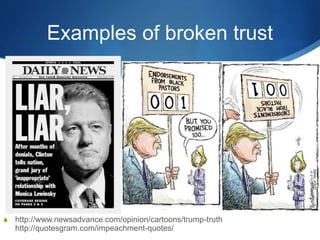
Examples of broken trust
S http://www.newsadvance.com/opinion/cartoons/trump-truth
http://quotesgram.com/impeachment-quotes/
Pros and Cons of Ethical Speaking
S Responsible decision making
S Relationship building
S Truthfulness
S Respect
S Accuracy
S Poor decision making
S Lack of respect
S Lack of trust
S Broken relationships
individually and societally
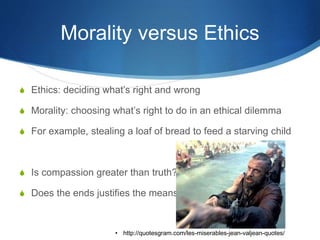
Morality versus Ethics
S Ethics: deciding what’s right and wrong
S Morality: choosing what’s right to do in an ethical dilemma
S For example, stealing a loaf of bread to feed a starving child
S Is compassion greater than truth?
S Does the ends justifies the means?
• http://quotesgram.com/les-miserables-jean-valjean-quotes/
Most important aspects of
ethical speaking
S Honesty while avoiding plagiarism
S Setting and meeting responsible speech goals
Honesty
S Identify sources
S 3 different types of plagiarism
S Global: direct copy without attribution
S Patchwork: a few key words changed but essentially same
S Incremental: no citation or recognition of quoted info
S Citation guidelines Purdue OWL
Ways to use sources
S Summarize: general gist. Most general.
S Paraphrase: focusing on specific passage or information.
Rewrite with own words and sentence structure
S Direct quotation: when exact words matter
Practice
S Read the article and do the following:
S Write a summary of 50 words or less
S Paragraphrase this passage of paragraph 5:
S This inequity matters, the report concludes, because
“new research suggests that people are significantly happier living
in societies where there is less inequality of happiness.” In other
words, we can achieve only so much happiness if our neighbors
are miserable. Which raises an intriguing question: Can you
redistribute happiness?
S Find a direct quote and pretend you are giving a speech
where you can include it. Provide enough info so audience
can locate source if needed
Responsible Speech Goals
S Promote diversity: use gender-neutral language
S Use inclusive language: “you” versus “we”
S Avoid hate speech
S Raise social awareness
S Use respectful free speech
Ethical listening and feedback
S Non-verbals: respectful
posture, eye contact,
S Critical mindset: absorb and
analyze
S Fair-minded: listen to whole
argument without pre-judging
S Respect author’s position while
politely and honestly voicing own
beliefs
S Includes praise and constructive
feedback
S Use “I” statements:
S “You’re speech was too short.”
S “I would’ve liked to know more
about that moment when…”
S http://www.smudailycampus.com/lifest
yle/health/college-students-and-
sleeping-problems
Ethical
communication dilemmas
S Pick on of the following scenarios below and discuss with your group.
What are the ethical issues? How should you react?
S #1. You and your partners have been working on your final presentation
for weeks. It is due the next day when you find out that some of the data
you included is wrong. It’s unlikely anyone, including your group members
or the professor, will notice. What should you do?
S #2. You attend a political debate on campus. The candidate’s speech
contains many ideas that you don’t agree with. How can you be an ethical
listener during the speech?
S #3. You are preparing to give a speech on a topic and realize that you
have lost the citation information for one of your important sources. You
can’t seem to find this source again. What would you do to ethically
prepare for the speech?
S #4. When practicing your speech on influential sports figures, you realize
that you refer to the audience, your co-ed classmates, quite often as “you
guys.” Is this ethical language use? What changes would you make?

Ethics ch 3

  • 1.
    S Ethics The difference between whatyou have a right to do and what is right to do. –Potter Stewart
  • 2.
    Ethos S Credibility asa speaker S Aristotle defined it as “good sense and good will but also good morals.” S How important is ethos? S How is it created?
  • 3.
    Examples of brokentrust S http://www.newsadvance.com/opinion/cartoons/trump-truth http://quotesgram.com/impeachment-quotes/
  • 4.
    Pros and Consof Ethical Speaking S Responsible decision making S Relationship building S Truthfulness S Respect S Accuracy S Poor decision making S Lack of respect S Lack of trust S Broken relationships individually and societally
  • 5.
    Morality versus Ethics SEthics: deciding what’s right and wrong S Morality: choosing what’s right to do in an ethical dilemma S For example, stealing a loaf of bread to feed a starving child S Is compassion greater than truth? S Does the ends justifies the means? • http://quotesgram.com/les-miserables-jean-valjean-quotes/
  • 6.
    Most important aspectsof ethical speaking S Honesty while avoiding plagiarism S Setting and meeting responsible speech goals
  • 7.
    Honesty S Identify sources S3 different types of plagiarism S Global: direct copy without attribution S Patchwork: a few key words changed but essentially same S Incremental: no citation or recognition of quoted info S Citation guidelines Purdue OWL
  • 8.
    Ways to usesources S Summarize: general gist. Most general. S Paraphrase: focusing on specific passage or information. Rewrite with own words and sentence structure S Direct quotation: when exact words matter
  • 9.
    Practice S Read thearticle and do the following: S Write a summary of 50 words or less S Paragraphrase this passage of paragraph 5: S This inequity matters, the report concludes, because “new research suggests that people are significantly happier living in societies where there is less inequality of happiness.” In other words, we can achieve only so much happiness if our neighbors are miserable. Which raises an intriguing question: Can you redistribute happiness? S Find a direct quote and pretend you are giving a speech where you can include it. Provide enough info so audience can locate source if needed
  • 10.
    Responsible Speech Goals SPromote diversity: use gender-neutral language S Use inclusive language: “you” versus “we” S Avoid hate speech S Raise social awareness S Use respectful free speech
  • 11.
    Ethical listening andfeedback S Non-verbals: respectful posture, eye contact, S Critical mindset: absorb and analyze S Fair-minded: listen to whole argument without pre-judging S Respect author’s position while politely and honestly voicing own beliefs S Includes praise and constructive feedback S Use “I” statements: S “You’re speech was too short.” S “I would’ve liked to know more about that moment when…” S http://www.smudailycampus.com/lifest yle/health/college-students-and- sleeping-problems
  • 12.
    Ethical communication dilemmas S Pickon of the following scenarios below and discuss with your group. What are the ethical issues? How should you react? S #1. You and your partners have been working on your final presentation for weeks. It is due the next day when you find out that some of the data you included is wrong. It’s unlikely anyone, including your group members or the professor, will notice. What should you do? S #2. You attend a political debate on campus. The candidate’s speech contains many ideas that you don’t agree with. How can you be an ethical listener during the speech? S #3. You are preparing to give a speech on a topic and realize that you have lost the citation information for one of your important sources. You can’t seem to find this source again. What would you do to ethically prepare for the speech? S #4. When practicing your speech on influential sports figures, you realize that you refer to the audience, your co-ed classmates, quite often as “you guys.” Is this ethical language use? What changes would you make?