Estrous cycle in mare
By: Mohammad
Sangary
Kabul University
Veterinary Science Faculty
Master Program of Veterinary
Medicine
Date: Saturday, November 2,
2024
11/14/2024 2
Topics to be discussed
Reproductive organs of a mare
Introduction to reproductive cycle in animals
Estrous cycle in mare
 Estrus phase
 Nonestrus/ Diestrus phase
Hormonal changes during mare estrous cycle
Reference
11/14/2024 3
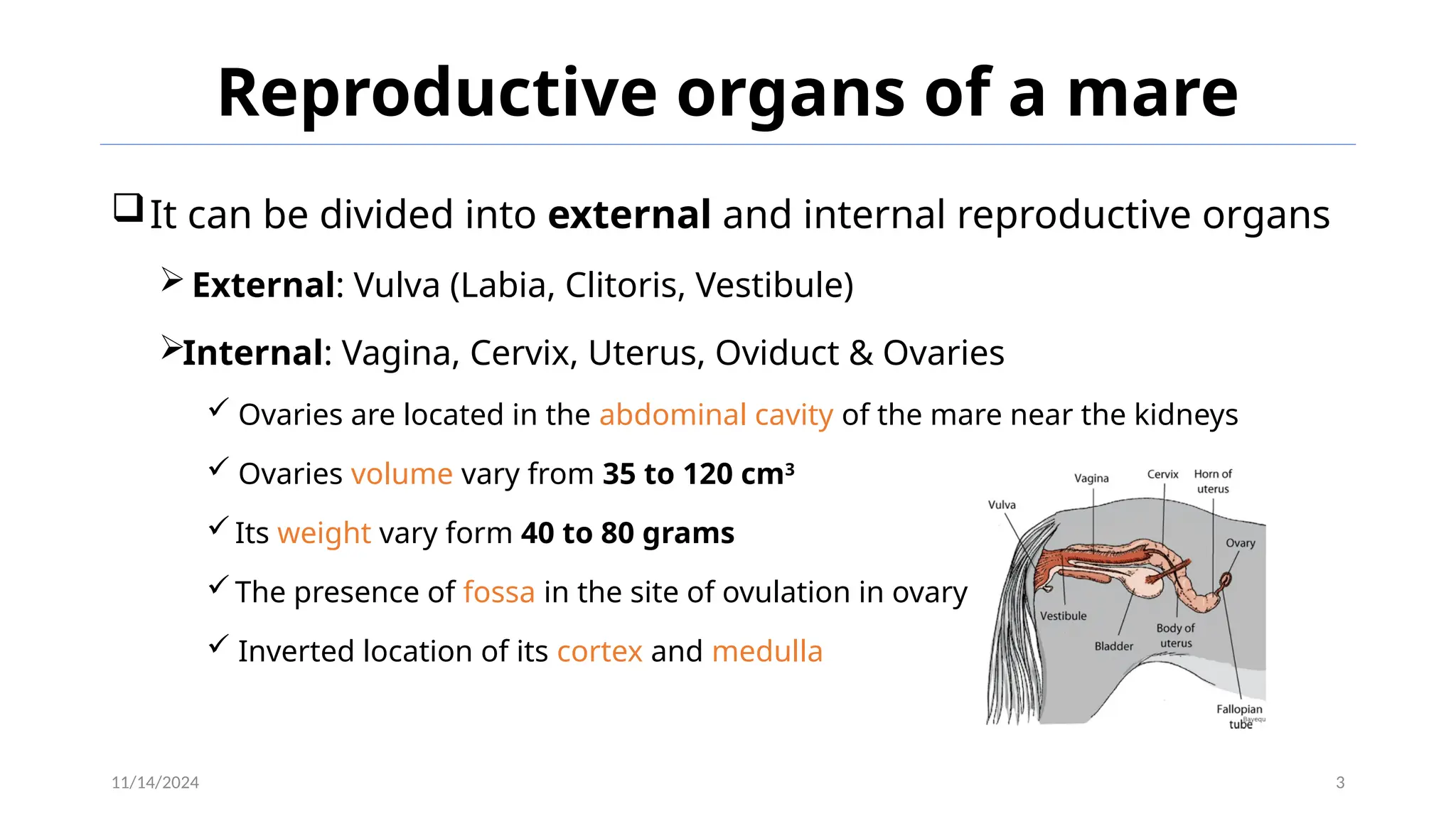
Reproductive organs of a mare
It can be divided into external and internal reproductive organs
 External: Vulva (Labia, Clitoris, Vestibule)
Internal: Vagina, Cervix, Uterus, Oviduct & Ovaries
 Ovaries are located in the abdominal cavity of the mare near the kidneys
 Ovaries volume vary from 35 to 120 cm3
Its weight vary form 40 to 80 grams
The presence of fossa in the site of ovulation in ovary
 Inverted location of its cortex and medulla
11/14/2024 4
Reproductive cycle
Two types of ovarian cycles are recognized:
I. Estrual cycle
II. Menstrual cycle
 They are recognized based on the external characteristic to
identify a particular stage of reproductive cycle (ovulation).
 Domestic animals have limited periods of estrus (sexual
receptivity), thus, the term estrous cycle in used.
 The proestrus is the onset of cycle.
11/14/2024 5
Reproductive cycle
 Primates are sexually receptive during most of
the reproductive cycle.
Thus, the only stage of the reproductive cycle that can be
recognized is the menstruation (vaginal discharge of
blood-tinged fluids).
 That's why we use the term menstrual cycle in these
animals.
11/14/2024 6
Reproductive cycle
 Estrous cycle: Is the interval between two successive ovulation
(estrus)

The estrous cycle has been classically divided into two stages:
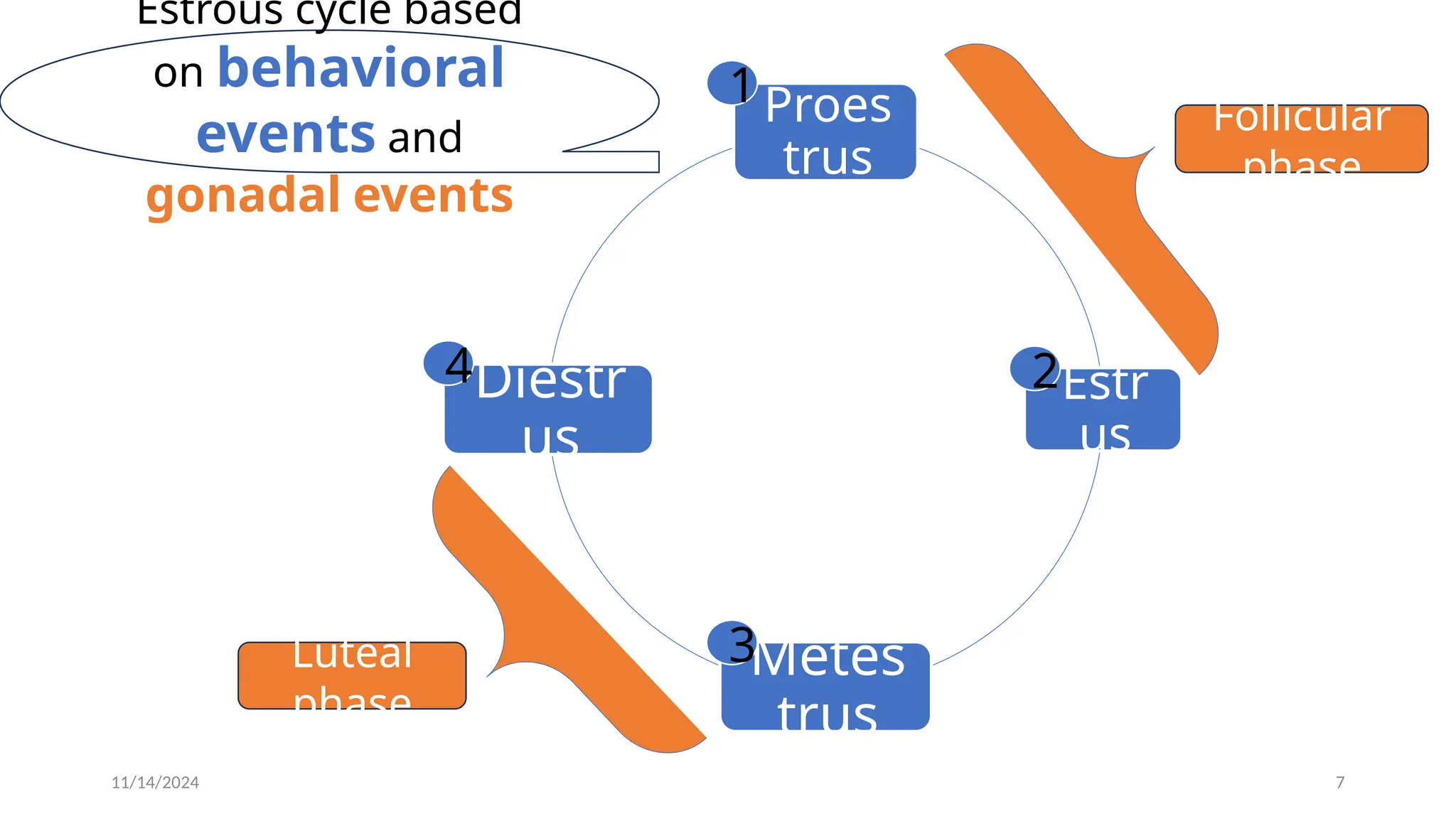
 Based on the behavioral events:
1) Animal is in estrus (sexually receptive)
2) Animal in not in estrus (Proestrus, Metestrus, Diestrus)
 Based on the gonadal events (dominant structure in the ovary)
1) Follicular phase
2) Luteal phase
11/14/2024 7
Proes
trus
Estr
us
Metes
trus
Diestr
us
Follicular
phase
Luteal
phase
Estrous cycle based
on behavioral
events and
gonadal events
4
3
1
2
11/14/2024 9
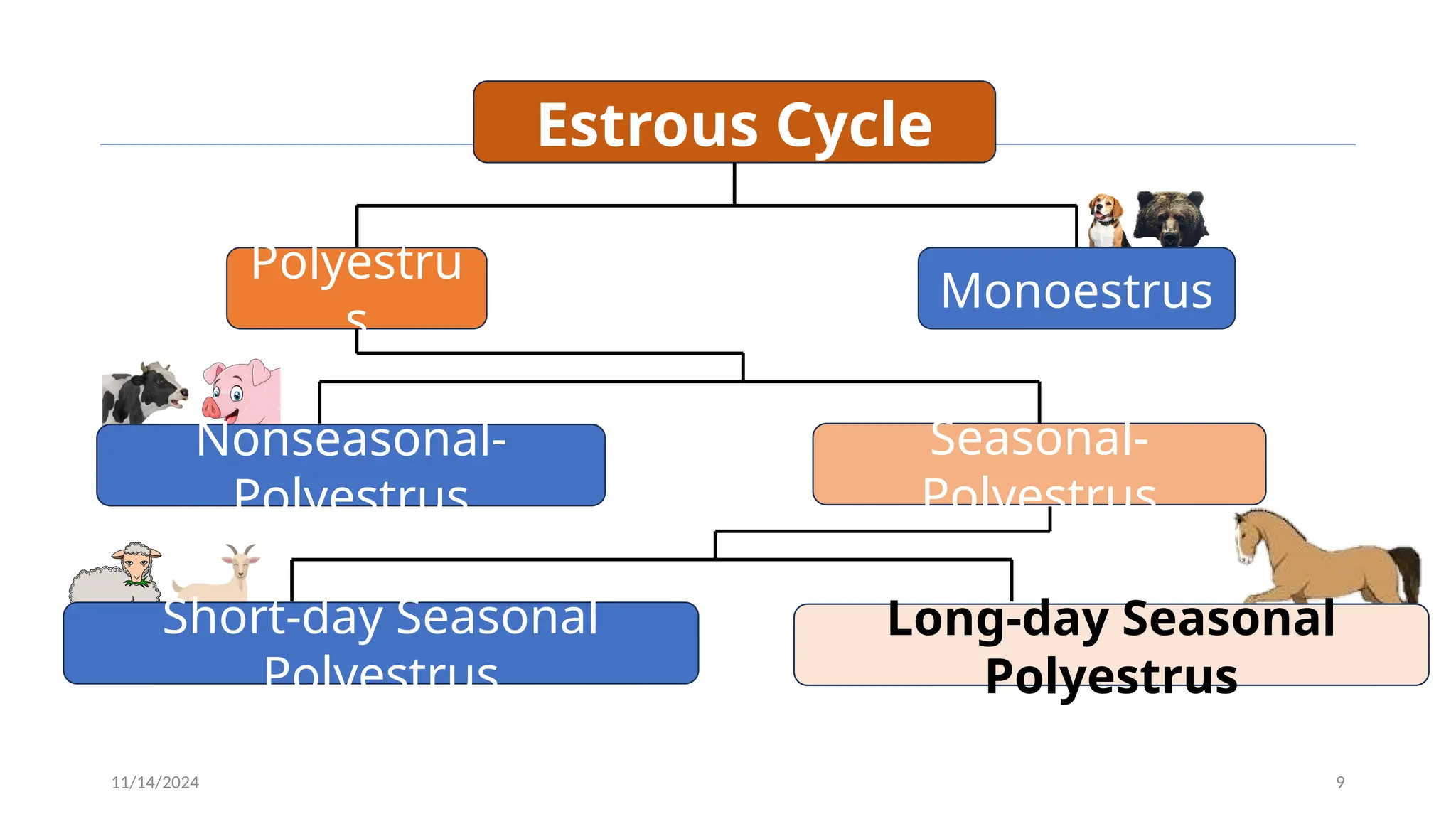
Estrous Cycle
Polyestru
s
Monoestrus
Seasonal-
Polyestrus
Nonseasonal-
Polyestrus
Short-day Seasonal
Polyestrus
Long-day Seasonal
Polyestrus
11/14/2024 10
Estrous cycle in mare
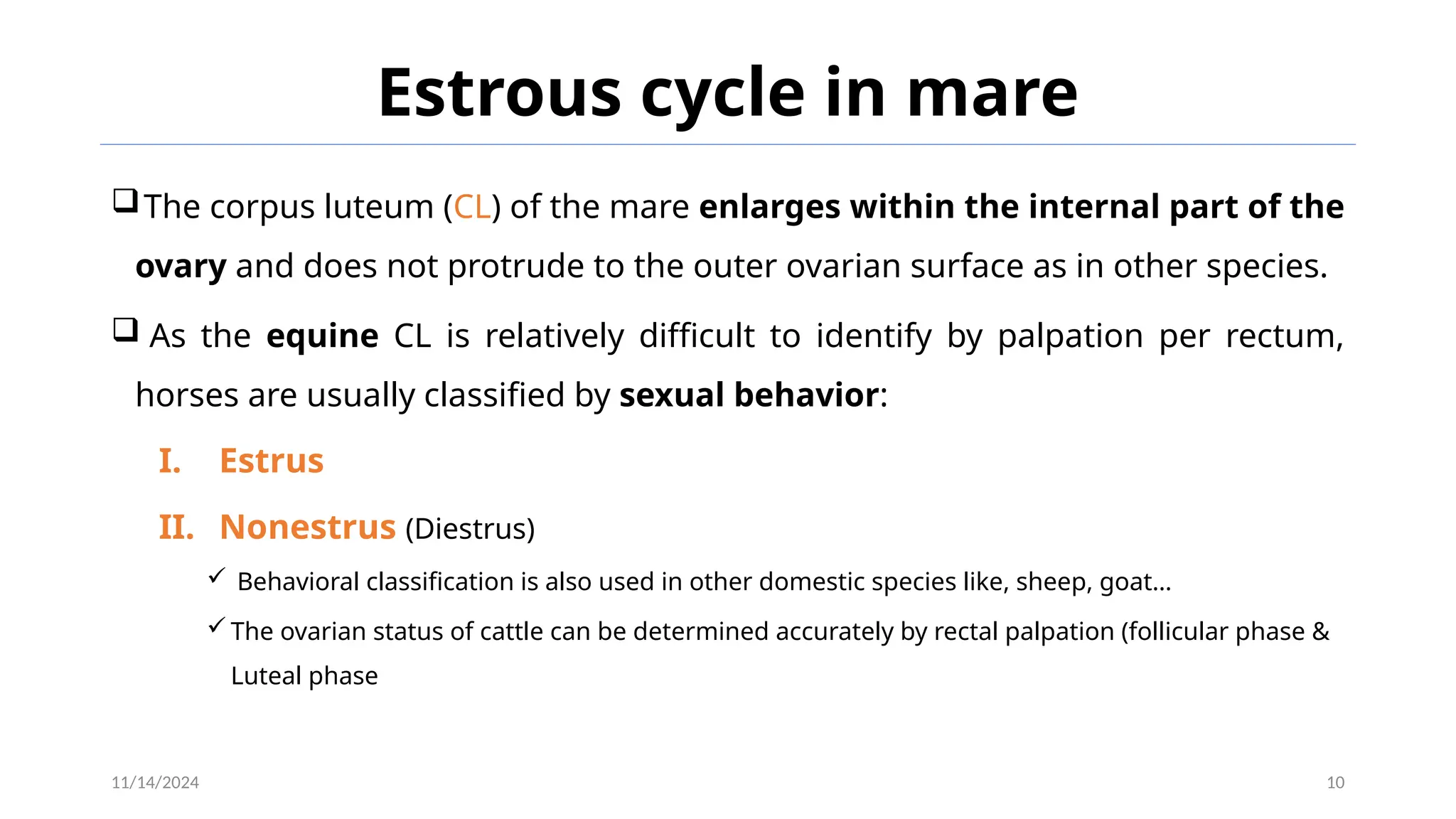
The corpus luteum (CL) of the mare enlarges within the internal part of the
ovary and does not protrude to the outer ovarian surface as in other species.
 As the equine CL is relatively difficult to identify by palpation per rectum,
horses are usually classified by sexual behavior:
I. Estrus
II. Nonestrus (Diestrus)
 Behavioral classification is also used in other domestic species like, sheep, goat…
The ovarian status of cattle can be determined accurately by rectal palpation (follicular phase &
Luteal phase
11/14/2024 11
Estrous cycle in mare
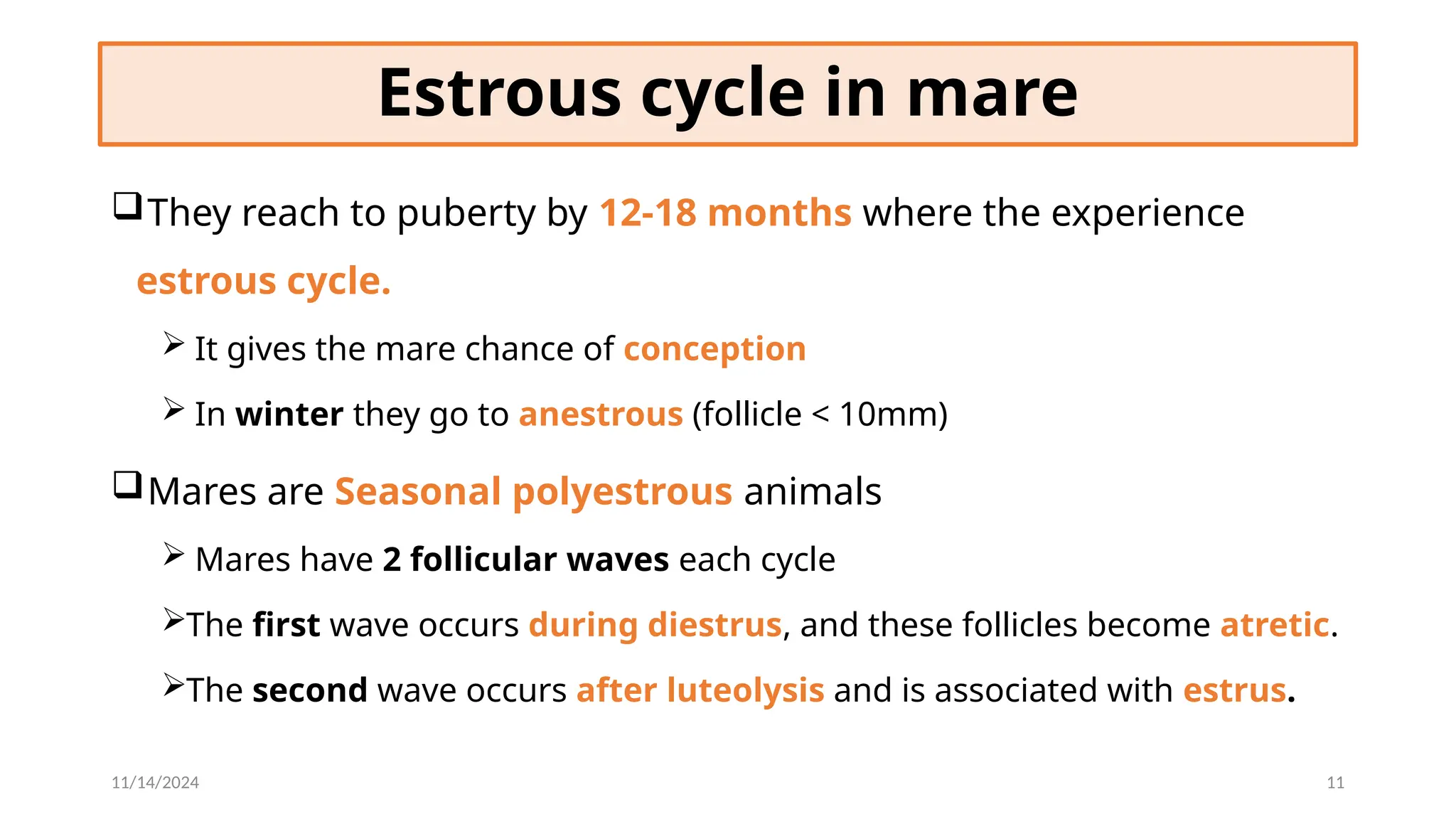
They reach to puberty by 12-18 months where the experience
estrous cycle.
 It gives the mare chance of conception
 In winter they go to anestrous (follicle < 10mm)
Mares are Seasonal polyestrous animals
 Mares have 2 follicular waves each cycle
The first wave occurs during diestrus, and these follicles become atretic.
The second wave occurs after luteolysis and is associated with estrus.
11/14/2024 12
Estrus in mare
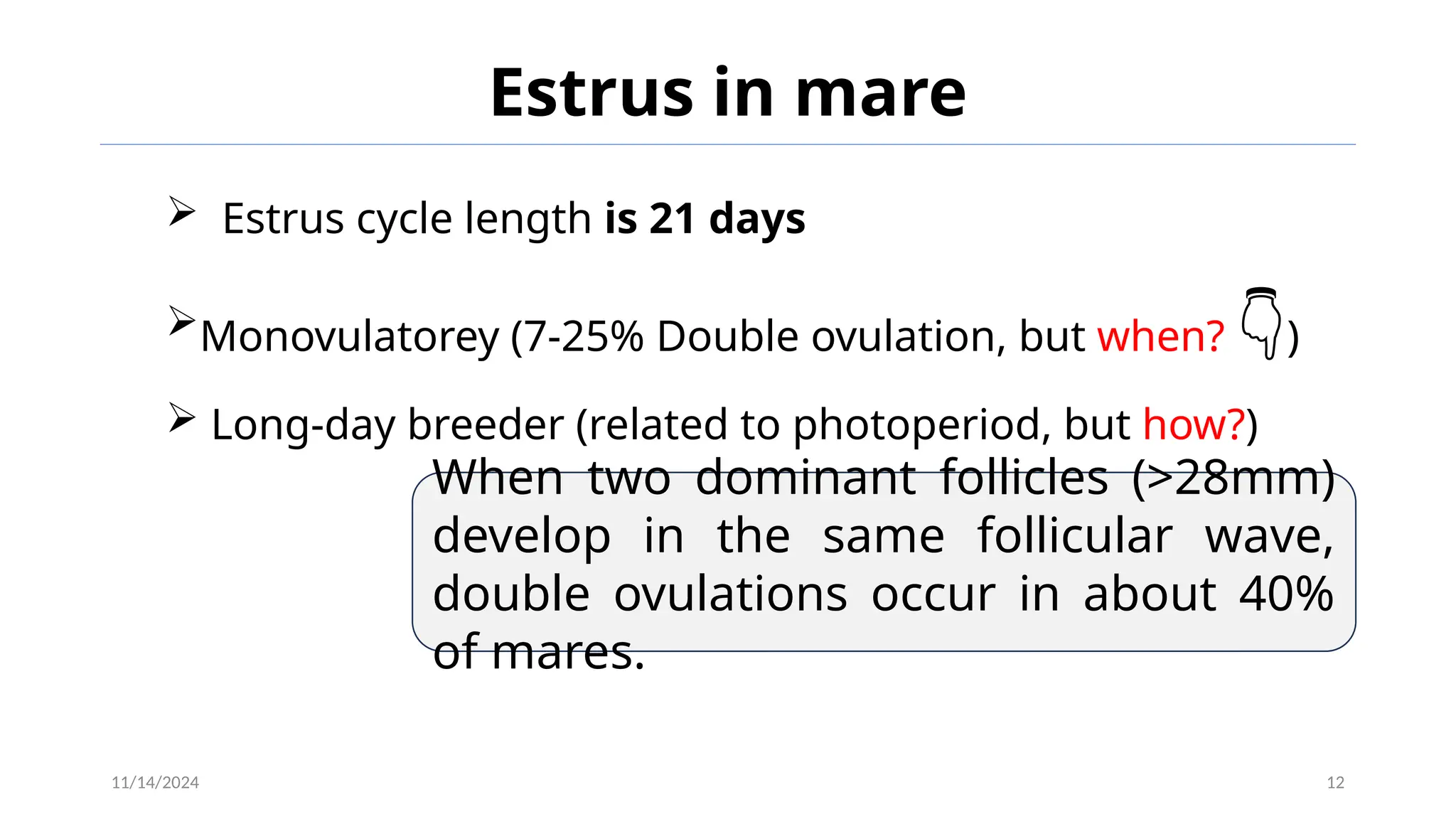
 Estrus cycle length is 21 days
Monovulatorey (7-25% Double ovulation, but when? 👇)
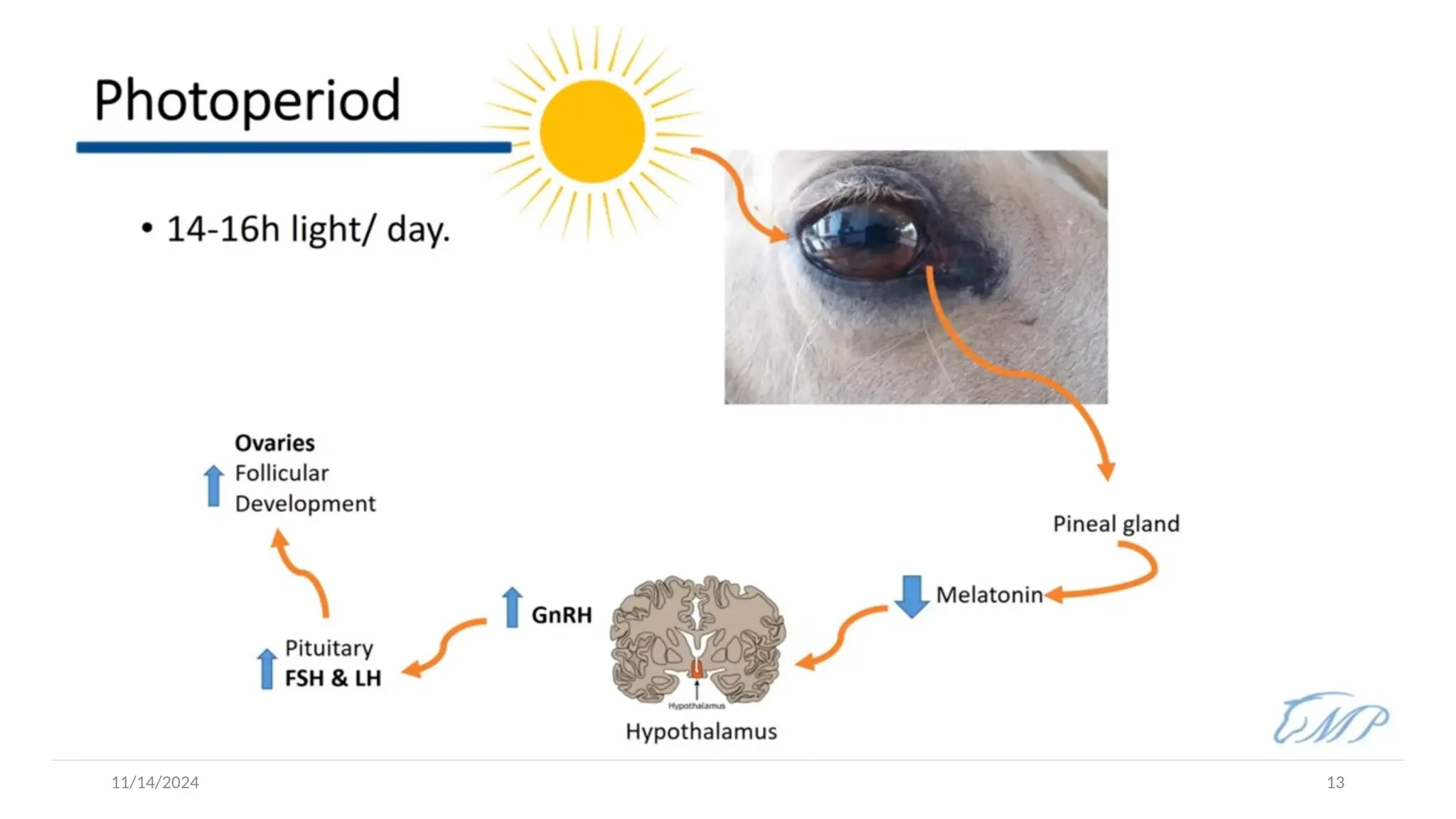
 Long-day breeder (related to photoperiod, but how?)
When two dominant follicles (>28mm)
develop in the same follicular wave,
double ovulations occur in about 40%
of mares.
11/14/2024 13
11/14/2024 14
Estrus in mare
 The length of this phase is 5-7 days
 The graafian follicle produce large amount of Estrogen
 Mare has interest to stallion (sexual receptivity of stallion)
 Because of high level of the estrogen
 Relaxed facial muscles
 Ears turned to side and a lowered head
11/14/2024 15
Estrus in mare
 Turn hind quarter towards the stallion
 Lower the pelvis & straddled hinds
 Deviation of the tail
 Frequent urination in small quantities
 Winking (eversion of the clitoris)
 Mucous secretion is seen under the tail
11/14/2024 16
Estrus in mare
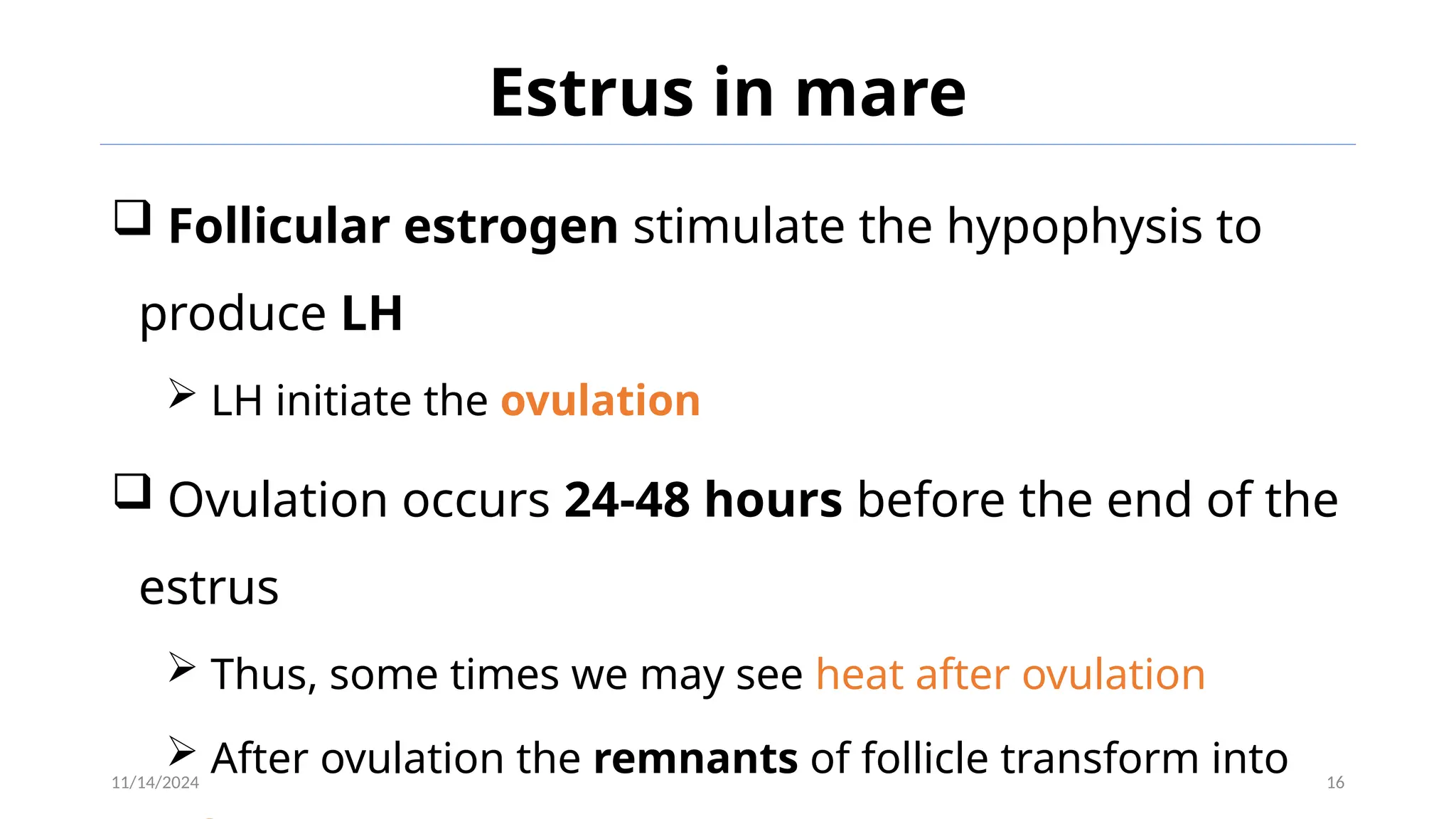
 Follicular estrogen stimulate the hypophysis to
produce LH
 LH initiate the ovulation
 Ovulation occurs 24-48 hours before the end of the
estrus
 Thus, some times we may see heat after ovulation
 After ovulation the remnants of follicle transform into
11/14/2024 17
Diestrus in mare
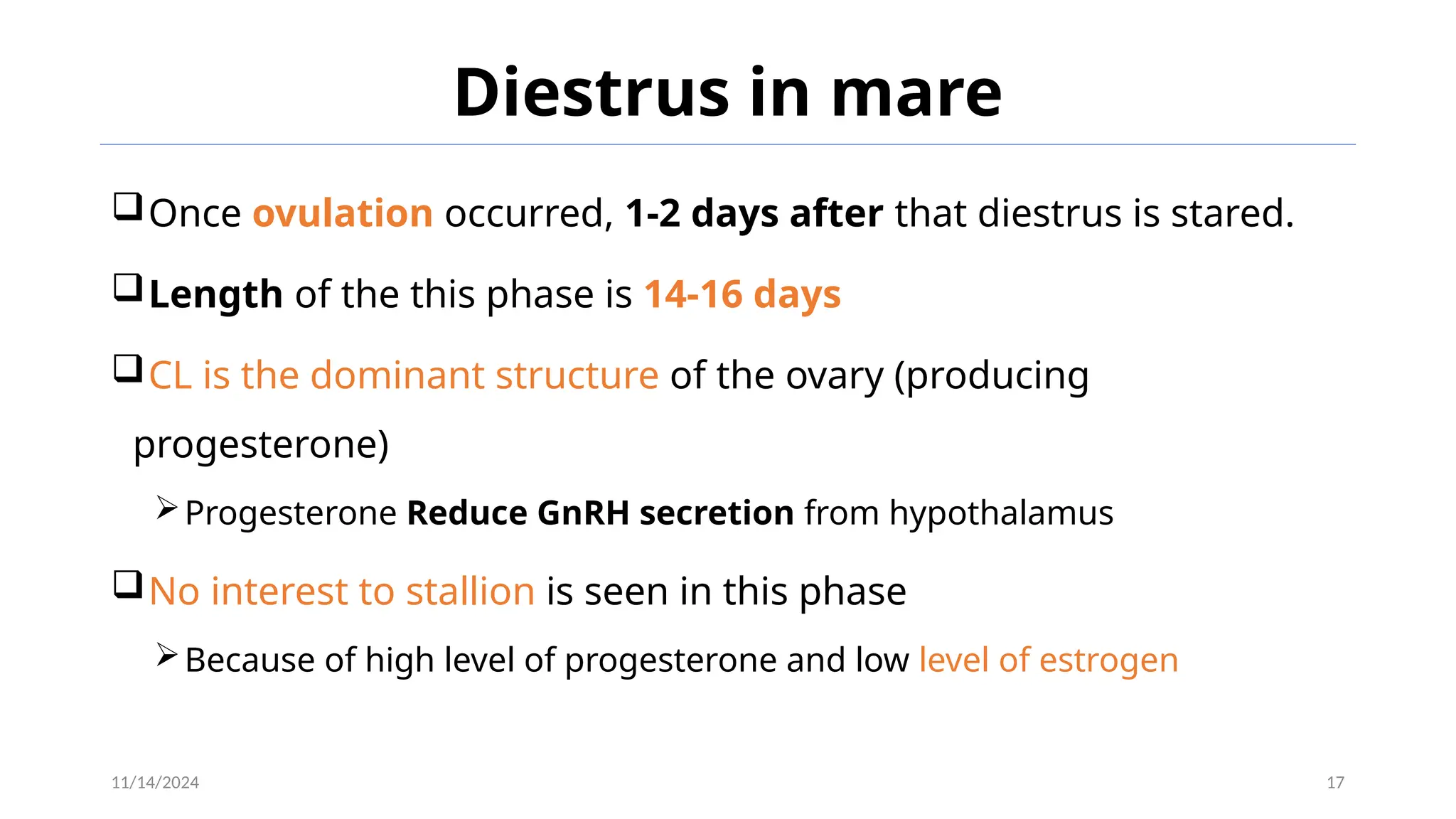
Once ovulation occurred, 1-2 days after that diestrus is stared.
Length of the this phase is 14-16 days
CL is the dominant structure of the ovary (producing
progesterone)
Progesterone Reduce GnRH secretion from hypothalamus
No interest to stallion is seen in this phase
Because of high level of progesterone and low level of estrogen
11/14/2024 18
Diestrus in mare
 If the egg is not fertilized with a sperm the CL begins to
lyse (Luteolysis).
 It is mainly lysed by the PGF2 produced by the uterus.
 After luteolysis, proestrus in started and mare enter another
estrous cycle.
 There is no uterine edema
 Cervix is now tightly closed
11/14/2024 19
Proes
trus
Estr
us
Metes
trus
Diestr
us
Primordial Follicles
Primary Follicles
Secondary Follicles
Tertiary Follicles (FSH dependent)
Graafian Follicles
Estrogen and Inhibin
producing follicle
C
H
Ovulatio
n
CL
C
A
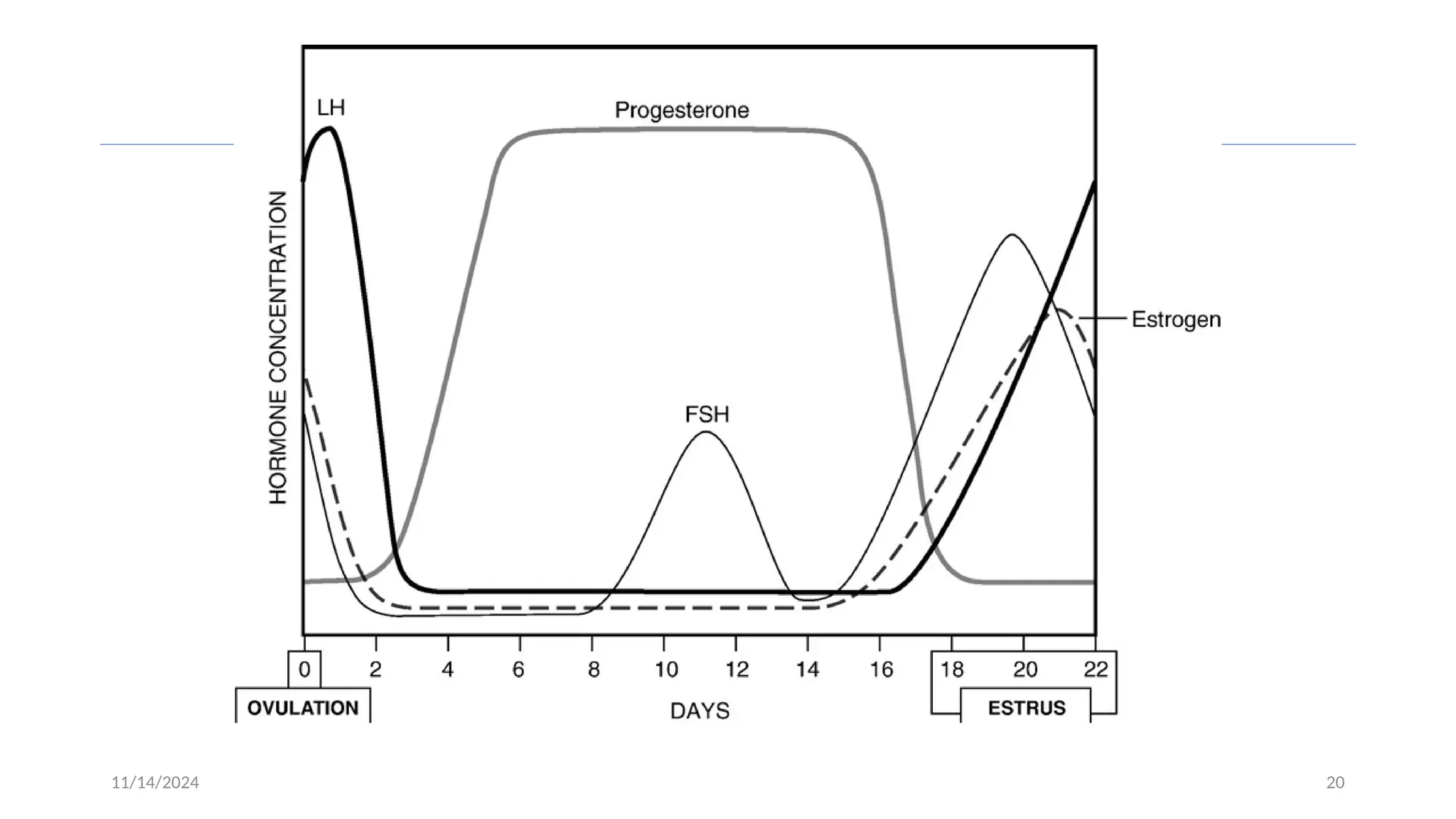
FSH
LH
Progesterone
GnRH
FSH
FSH
11/14/2024 20
11/14/2024 21
‫منابع‬
Cortés-Vidauri, Z., Carlos , A.-F., Melba , R.-D., Rochín-Berumen, F., López-Carlos, M., &
Flores-Flores, G. (2018). Mare Reproductive Cycle: A Review. 8(3), ABANICO VETERINARIO.
Aurich, C. (2011). Reproductive cycles of horses. Animal Reproduction Science, Animal
Reproduction Science, 200-228. doi:doi:10.1016/j.anireprosci.2011.02.005
Nagy, P., Guillaume, D., & Daels, P. (20000). Seasonality in mares. Animal Reproduction
Science, 60(61), 245-262. Retrieved from www.elsevier.comrlocateranireprosci
Pryor, P. (2005). Management of Estrus in the Performance Mare. Clinical Technique in Equine
Practice. doi:doi:10.1053/j.ctep.2005.07.001
11/14/2024 22
Thanks for your attention!
?

Estrus cycle in mare and its different phases.pptx

  • 1.
    Estrous cycle inmare By: Mohammad Sangary Kabul University Veterinary Science Faculty Master Program of Veterinary Medicine Date: Saturday, November 2, 2024
  • 2.
    11/14/2024 2 Topics tobe discussed Reproductive organs of a mare Introduction to reproductive cycle in animals Estrous cycle in mare  Estrus phase  Nonestrus/ Diestrus phase Hormonal changes during mare estrous cycle Reference
  • 3.
    11/14/2024 3 Reproductive organsof a mare It can be divided into external and internal reproductive organs  External: Vulva (Labia, Clitoris, Vestibule) Internal: Vagina, Cervix, Uterus, Oviduct & Ovaries  Ovaries are located in the abdominal cavity of the mare near the kidneys  Ovaries volume vary from 35 to 120 cm3 Its weight vary form 40 to 80 grams The presence of fossa in the site of ovulation in ovary  Inverted location of its cortex and medulla
  • 4.
    11/14/2024 4 Reproductive cycle Twotypes of ovarian cycles are recognized: I. Estrual cycle II. Menstrual cycle  They are recognized based on the external characteristic to identify a particular stage of reproductive cycle (ovulation).  Domestic animals have limited periods of estrus (sexual receptivity), thus, the term estrous cycle in used.  The proestrus is the onset of cycle.
  • 5.
    11/14/2024 5 Reproductive cycle Primates are sexually receptive during most of the reproductive cycle. Thus, the only stage of the reproductive cycle that can be recognized is the menstruation (vaginal discharge of blood-tinged fluids).  That's why we use the term menstrual cycle in these animals.
  • 6.
    11/14/2024 6 Reproductive cycle Estrous cycle: Is the interval between two successive ovulation (estrus)  The estrous cycle has been classically divided into two stages:  Based on the behavioral events: 1) Animal is in estrus (sexually receptive) 2) Animal in not in estrus (Proestrus, Metestrus, Diestrus)  Based on the gonadal events (dominant structure in the ovary) 1) Follicular phase 2) Luteal phase
  • 7.
  • 8.
  • 9.
    11/14/2024 10 Estrous cyclein mare The corpus luteum (CL) of the mare enlarges within the internal part of the ovary and does not protrude to the outer ovarian surface as in other species.  As the equine CL is relatively difficult to identify by palpation per rectum, horses are usually classified by sexual behavior: I. Estrus II. Nonestrus (Diestrus)  Behavioral classification is also used in other domestic species like, sheep, goat… The ovarian status of cattle can be determined accurately by rectal palpation (follicular phase & Luteal phase
  • 10.
    11/14/2024 11 Estrous cyclein mare They reach to puberty by 12-18 months where the experience estrous cycle.  It gives the mare chance of conception  In winter they go to anestrous (follicle < 10mm) Mares are Seasonal polyestrous animals  Mares have 2 follicular waves each cycle The first wave occurs during diestrus, and these follicles become atretic. The second wave occurs after luteolysis and is associated with estrus.
  • 11.
    11/14/2024 12 Estrus inmare  Estrus cycle length is 21 days Monovulatorey (7-25% Double ovulation, but when? 👇)  Long-day breeder (related to photoperiod, but how?) When two dominant follicles (>28mm) develop in the same follicular wave, double ovulations occur in about 40% of mares.
  • 12.
  • 13.
    11/14/2024 14 Estrus inmare  The length of this phase is 5-7 days  The graafian follicle produce large amount of Estrogen  Mare has interest to stallion (sexual receptivity of stallion)  Because of high level of the estrogen  Relaxed facial muscles  Ears turned to side and a lowered head
  • 14.
    11/14/2024 15 Estrus inmare  Turn hind quarter towards the stallion  Lower the pelvis & straddled hinds  Deviation of the tail  Frequent urination in small quantities  Winking (eversion of the clitoris)  Mucous secretion is seen under the tail
  • 15.
    11/14/2024 16 Estrus inmare  Follicular estrogen stimulate the hypophysis to produce LH  LH initiate the ovulation  Ovulation occurs 24-48 hours before the end of the estrus  Thus, some times we may see heat after ovulation  After ovulation the remnants of follicle transform into
  • 16.
    11/14/2024 17 Diestrus inmare Once ovulation occurred, 1-2 days after that diestrus is stared. Length of the this phase is 14-16 days CL is the dominant structure of the ovary (producing progesterone) Progesterone Reduce GnRH secretion from hypothalamus No interest to stallion is seen in this phase Because of high level of progesterone and low level of estrogen
  • 17.
    11/14/2024 18 Diestrus inmare  If the egg is not fertilized with a sperm the CL begins to lyse (Luteolysis).  It is mainly lysed by the PGF2 produced by the uterus.  After luteolysis, proestrus in started and mare enter another estrous cycle.  There is no uterine edema  Cervix is now tightly closed
  • 18.
    11/14/2024 19 Proes trus Estr us Metes trus Diestr us Primordial Follicles PrimaryFollicles Secondary Follicles Tertiary Follicles (FSH dependent) Graafian Follicles Estrogen and Inhibin producing follicle C H Ovulatio n CL C A FSH LH Progesterone GnRH FSH FSH
  • 19.
  • 20.
    11/14/2024 21 ‫منابع‬ Cortés-Vidauri, Z.,Carlos , A.-F., Melba , R.-D., Rochín-Berumen, F., López-Carlos, M., & Flores-Flores, G. (2018). Mare Reproductive Cycle: A Review. 8(3), ABANICO VETERINARIO. Aurich, C. (2011). Reproductive cycles of horses. Animal Reproduction Science, Animal Reproduction Science, 200-228. doi:doi:10.1016/j.anireprosci.2011.02.005 Nagy, P., Guillaume, D., & Daels, P. (20000). Seasonality in mares. Animal Reproduction Science, 60(61), 245-262. Retrieved from www.elsevier.comrlocateranireprosci Pryor, P. (2005). Management of Estrus in the Performance Mare. Clinical Technique in Equine Practice. doi:doi:10.1053/j.ctep.2005.07.001
  • 21.
    11/14/2024 22 Thanks foryour attention! ?

Editor's Notes