
Optimize Portfolio Performance
with Simple Agile Techniques
and Jira – Part 1
Anthony Crain, Blue Agility (a cPrime Company)
acrain@blue-agility.com
With Simone Chen, cPrime
Simone.chen@cprime.com
Agenda – Part 1
1. Purpose of Portfolio management
2. Create your historical baseline
3. Estimate your future state portfolio
4. Validate your current state portfolio
2
1. Purpose of Portfolio Management
• Maximize ROI of IT Resources
• What to work on
• Who will do the work
• When to abandon bad work
• Anthony’s QPPE “kewpee” measures for all things
• Quality: value, defects, compliance, customer satisfaction
• Predictability: accuracy, time to accuracy
• Productivity: time, cost, scope
• Engagement: skill growth, satisfaction, retention, overtime, successes, innovation effectiveness
• QPPE for Portfolio Management
• Quality: Business alignment, production defects
• Predictability: Estimation accuracy, cost of estimation, initiative success profiling
• Productivity: initiative time, cost, scope, throughput; cost of development
• Engagement: innovation effectiveness
3
2. Create Your Historical Baseline 1 of 2
• Productivity: Initiative Throughput
• Question: Can you show us a report on productivity over the last five years?
• Make it happen
• Create a list of historical initiatives
• Sort from smallest to largest
• Assign Fibonacci numbers to historical initiatives
• 1, 3, 5, 8, 13, 20, 40, 60, 100
• Results: You can now determine:
• If you're productivity is getting better or worse over time
4
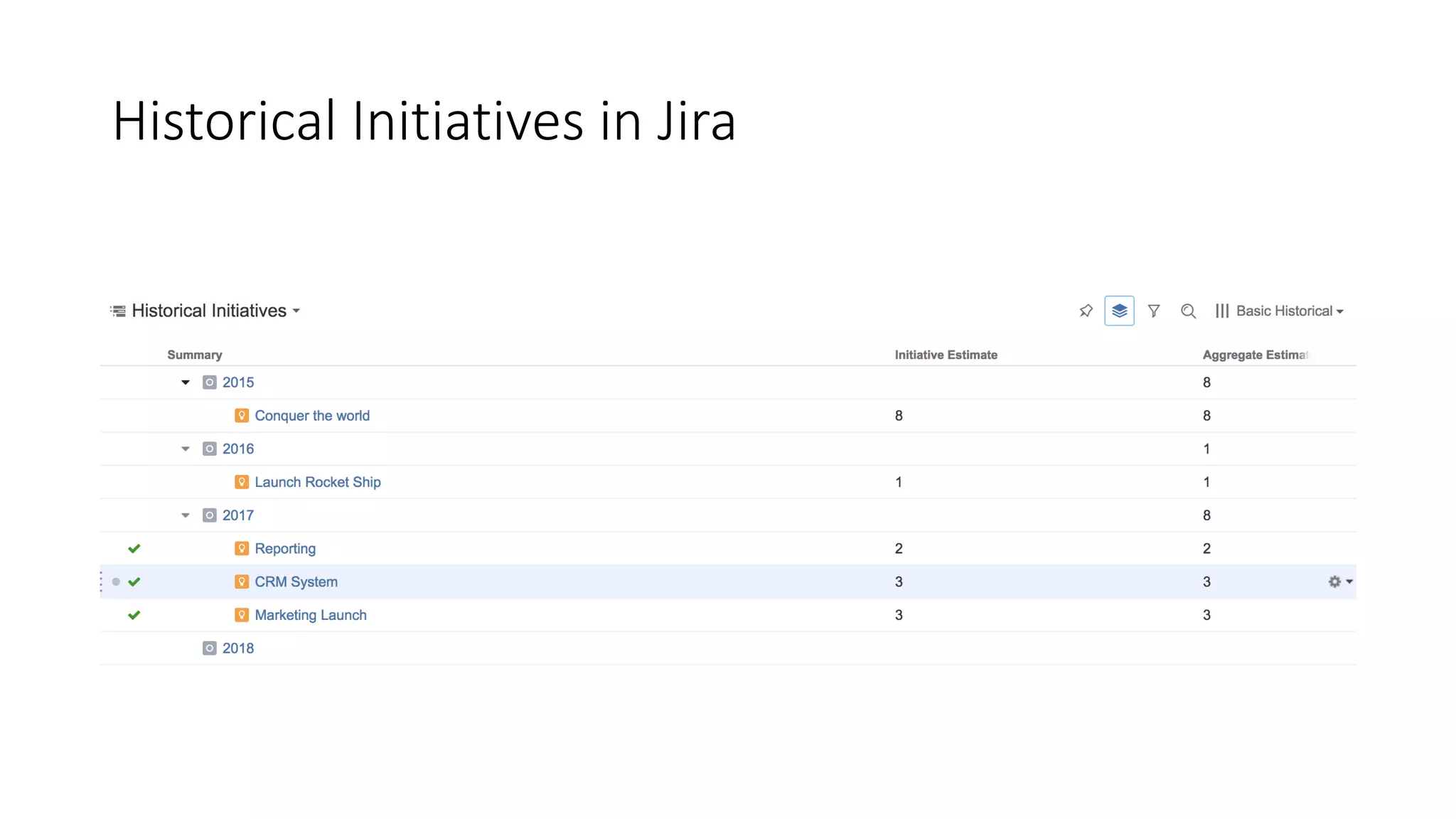
Historical Initiatives in Jira
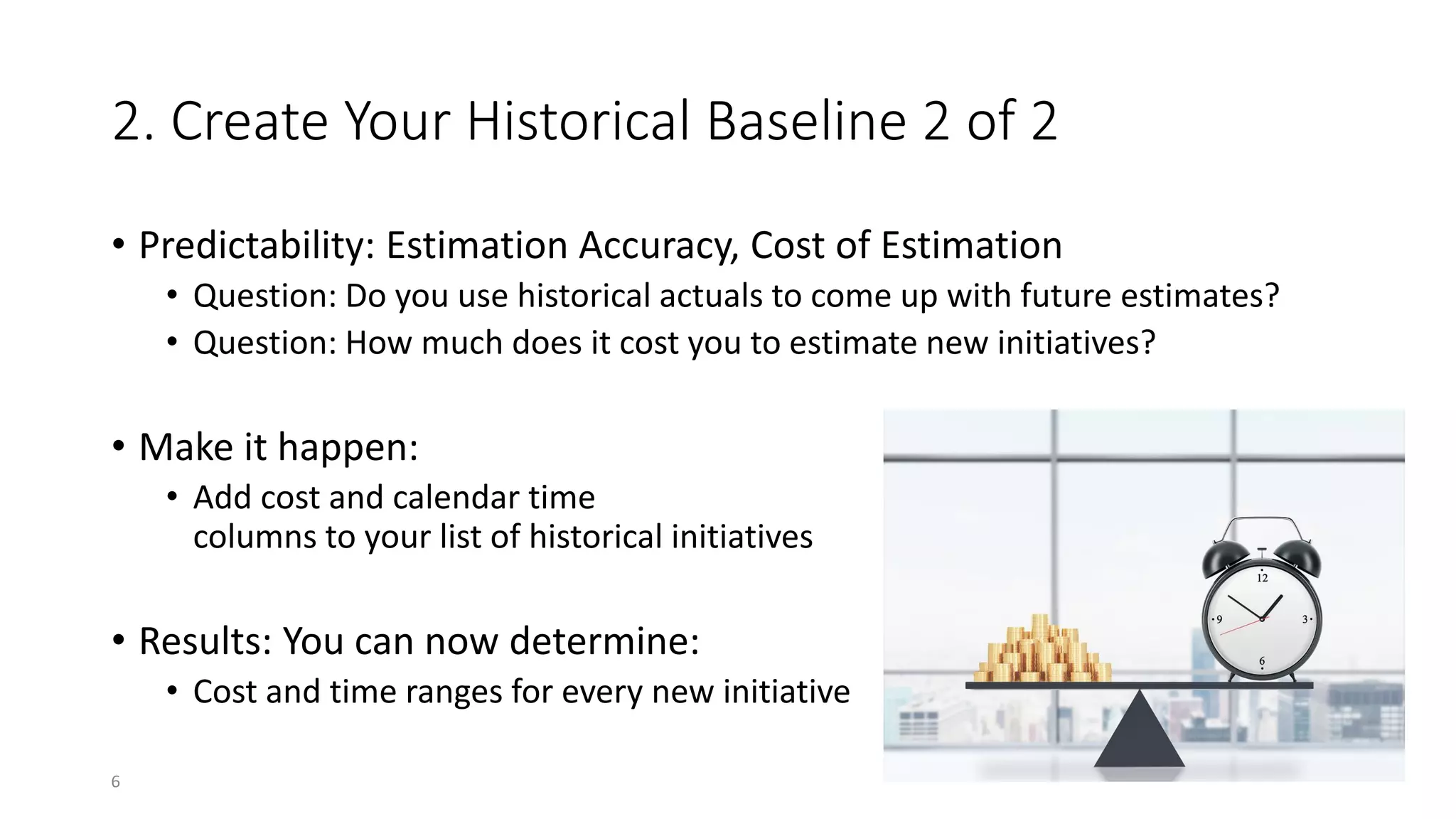
2. Create Your Historical Baseline 2 of 2
• Predictability: Estimation Accuracy, Cost of Estimation
• Question: Do you use historical actuals to come up with future estimates?
• Question: How much does it cost you to estimate new initiatives?
• Make it happen:
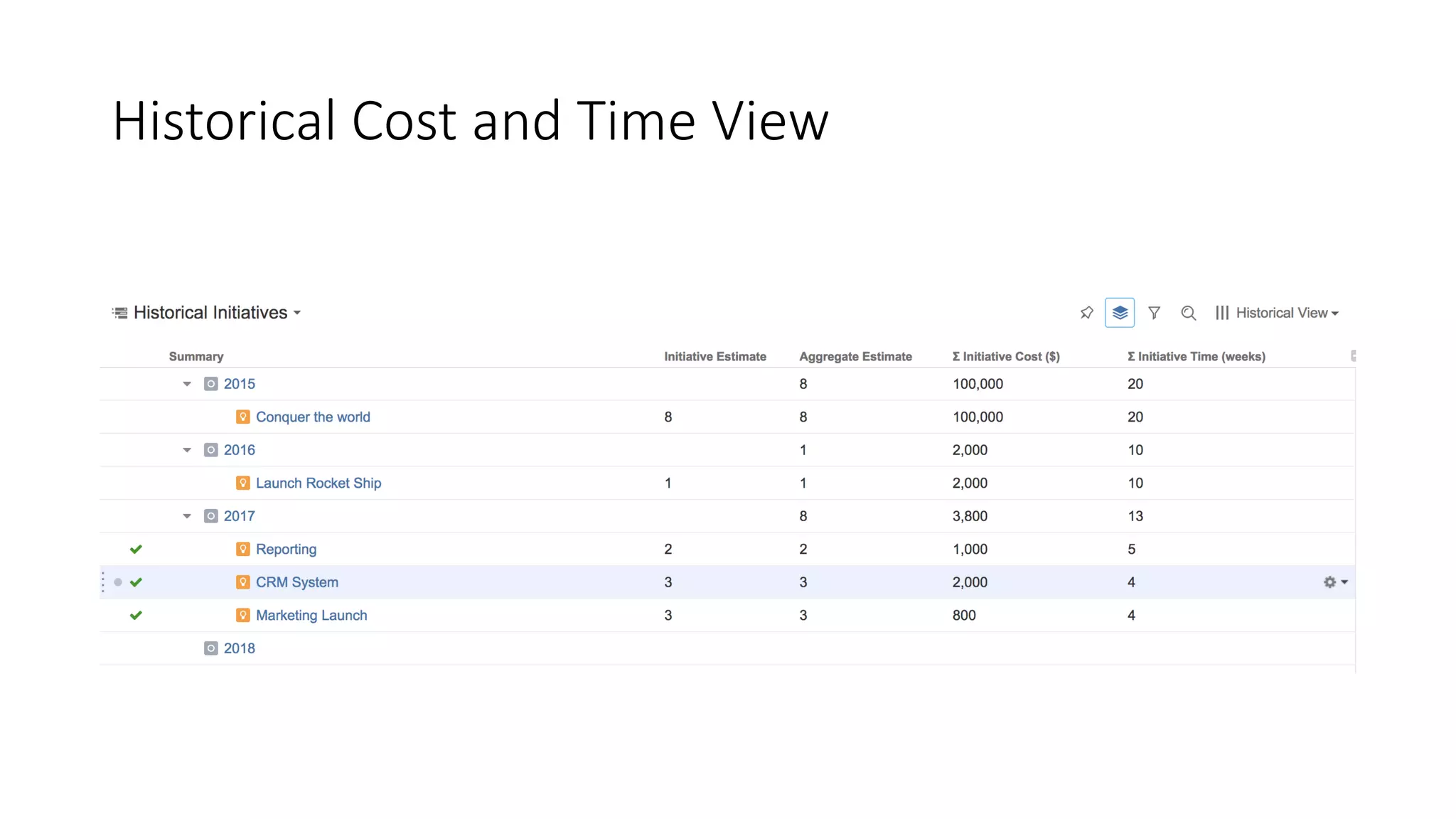
• Add cost and calendar time
columns to your list of historical initiatives
• Results: You can now determine:
• Cost and time ranges for every new initiative
6
Historical Cost and Time View
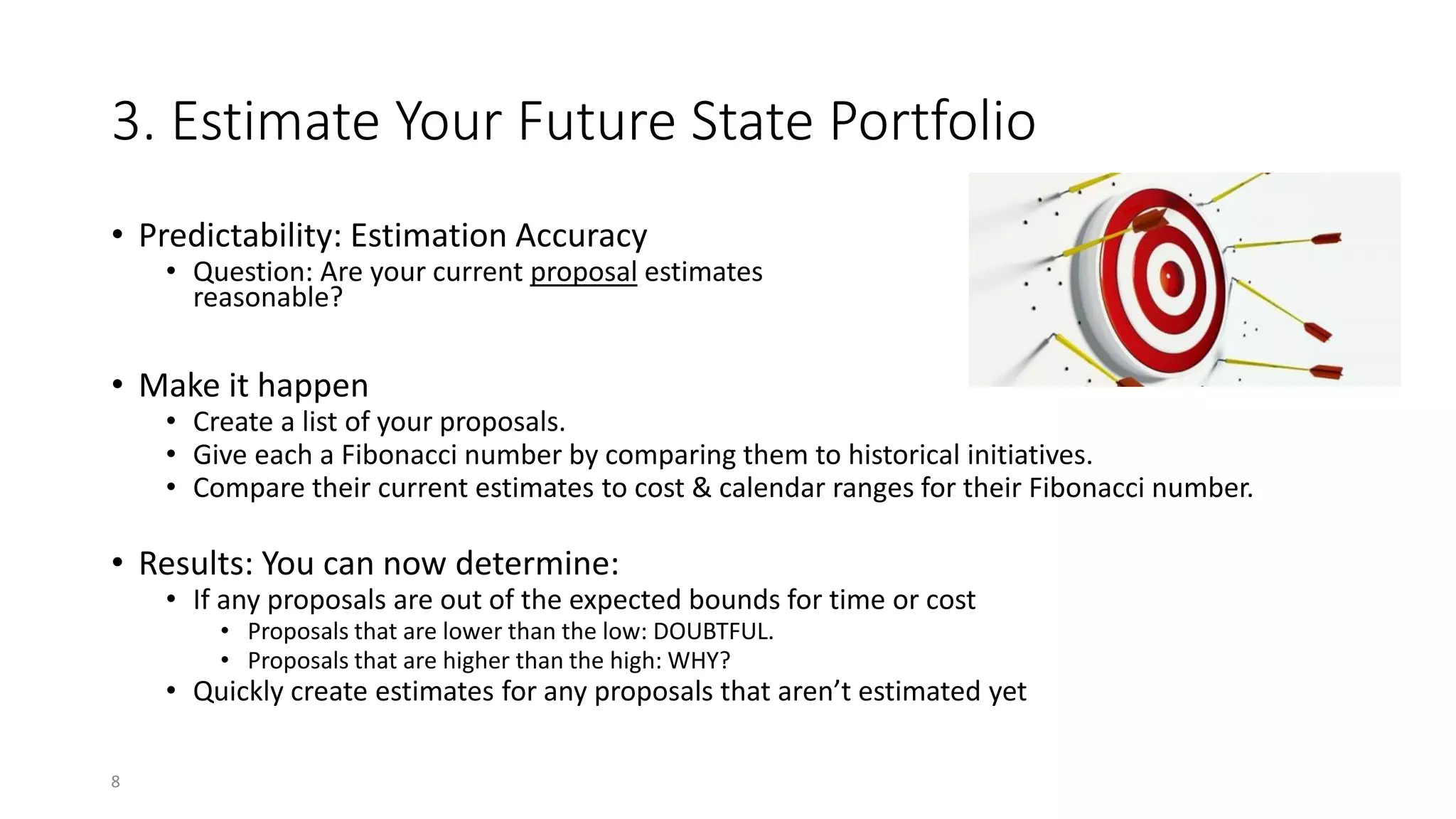
3. Estimate Your Future State Portfolio
• Predictability: Estimation Accuracy
• Question: Are your current proposal estimates
reasonable?
• Make it happen
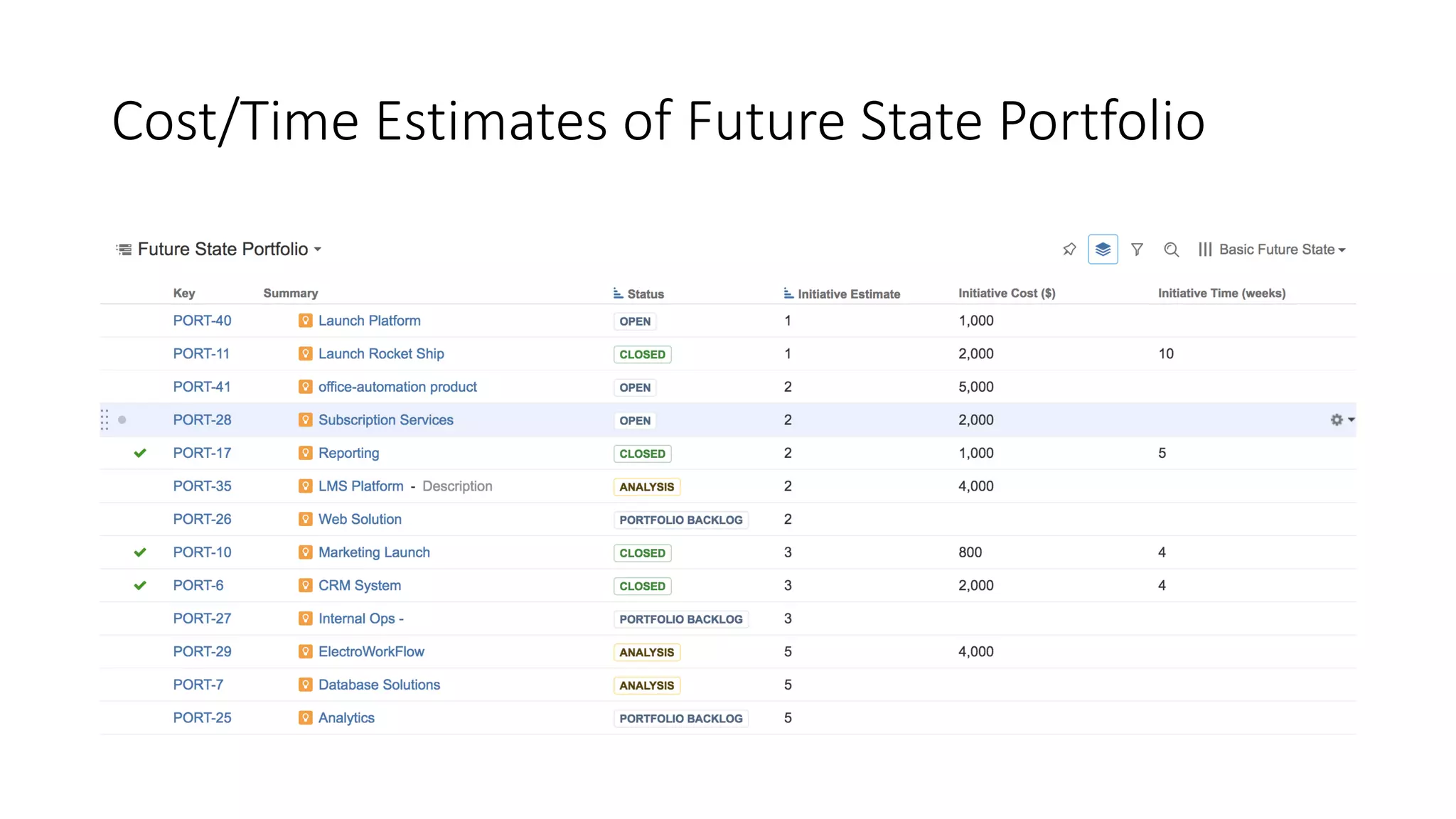
• Create a list of your proposals.
• Give each a Fibonacci number by comparing them to historical initiatives.
• Compare their current estimates to cost & calendar ranges for their Fibonacci number.
• Results: You can now determine:
• If any proposals are out of the expected bounds for time or cost
• Proposals that are lower than the low: DOUBTFUL.
• Proposals that are higher than the high: WHY?
• Quickly create estimates for any proposals that aren’t estimated yet
8
Cost/Time Estimates of Future State Portfolio
4. Validate Your Current State Portfolio
• Predictability: Estimation Accuracy, Time to Accuracy
• Question: Are your current initiative estimates reasonable?
• Make it happen
• Do the same for your current initiatives.
• Also keep track of changes to estimates.
• Results: You can now determine:
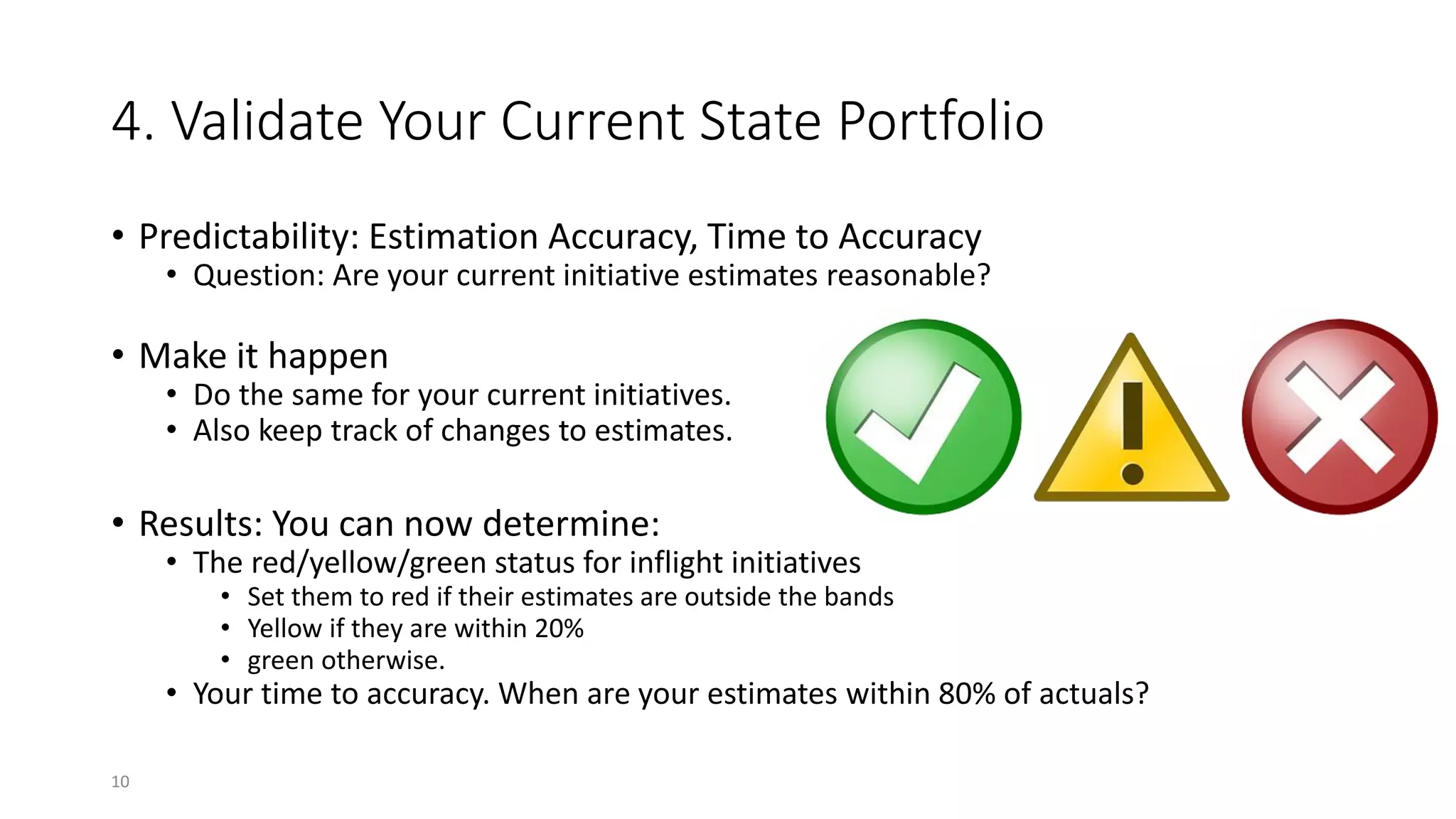
• The red/yellow/green status for inflight initiatives
• Set them to red if their estimates are outside the bands
• Yellow if they are within 20%
• green otherwise.
• Your time to accuracy. When are your estimates within 80% of actuals?
10
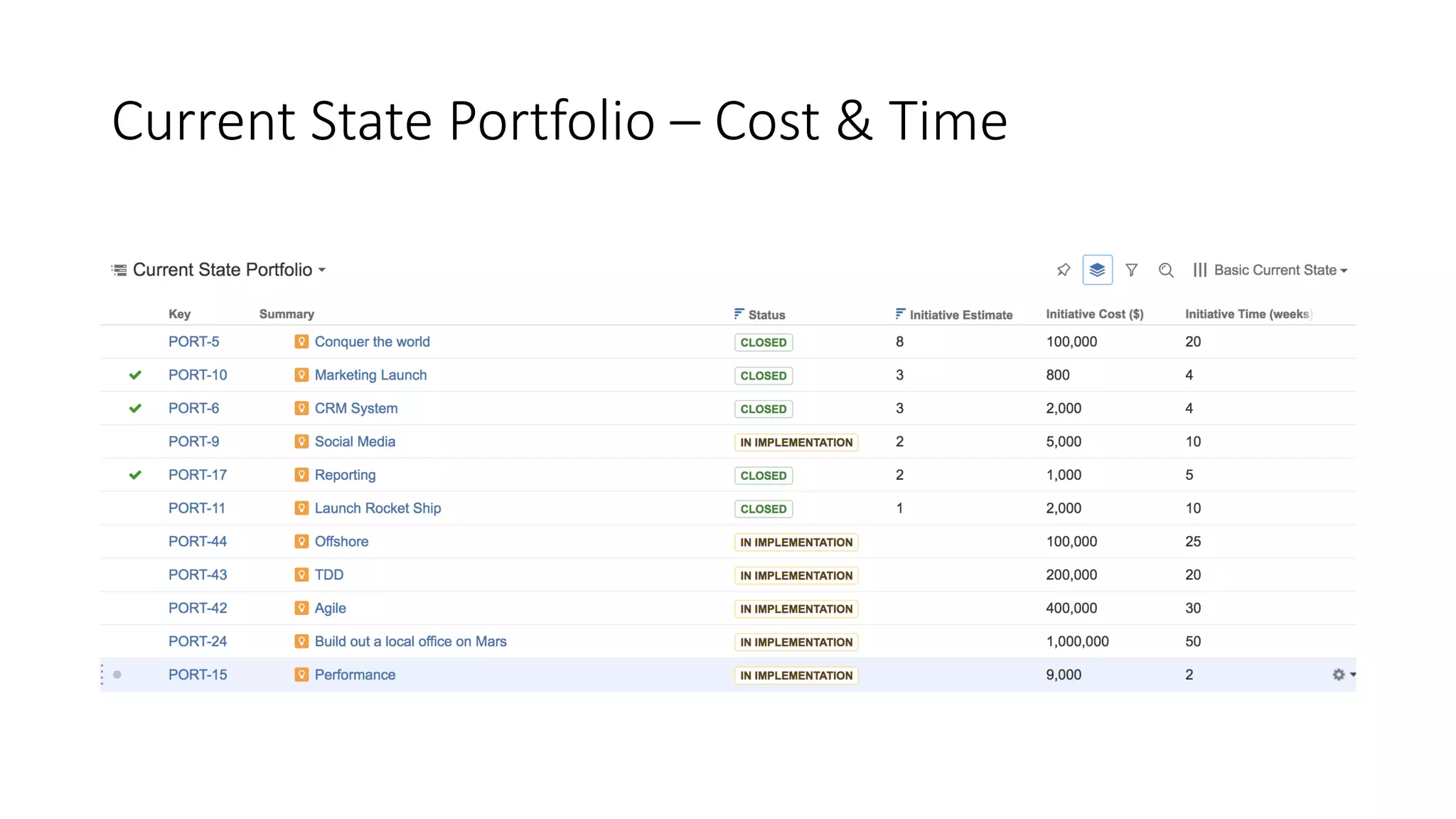
Current State Portfolio – Cost & Time
Real Results
• Cost of Estimation for a large international bank:
• Decreased time for level 1 estimates by 99.8% (from 5 days to 5 min)
• Decreased cost for level 1 estimates by 98.0% (from $388 to $8, $76k/year)
• assuming 200 initiatives/year
12
Thank You! Any Final Questions?
1. Purpose of portfolio management
2. Create your historical baseline
3. Estimate your future state portfolio
4. Validate your current state portfolio
13

Optimize Portfolio Performance with Simple Agile Techniques and Jira - Part 1

  • 1.
    Optimize Portfolio Performance withSimple Agile Techniques and Jira – Part 1 Anthony Crain, Blue Agility (a cPrime Company) acrain@blue-agility.com With Simone Chen, cPrime Simone.chen@cprime.com
  • 2.
    Agenda – Part1 1. Purpose of Portfolio management 2. Create your historical baseline 3. Estimate your future state portfolio 4. Validate your current state portfolio 2
  • 3.
    1. Purpose ofPortfolio Management • Maximize ROI of IT Resources • What to work on • Who will do the work • When to abandon bad work • Anthony’s QPPE “kewpee” measures for all things • Quality: value, defects, compliance, customer satisfaction • Predictability: accuracy, time to accuracy • Productivity: time, cost, scope • Engagement: skill growth, satisfaction, retention, overtime, successes, innovation effectiveness • QPPE for Portfolio Management • Quality: Business alignment, production defects • Predictability: Estimation accuracy, cost of estimation, initiative success profiling • Productivity: initiative time, cost, scope, throughput; cost of development • Engagement: innovation effectiveness 3
  • 4.
    2. Create YourHistorical Baseline 1 of 2 • Productivity: Initiative Throughput • Question: Can you show us a report on productivity over the last five years? • Make it happen • Create a list of historical initiatives • Sort from smallest to largest • Assign Fibonacci numbers to historical initiatives • 1, 3, 5, 8, 13, 20, 40, 60, 100 • Results: You can now determine: • If you're productivity is getting better or worse over time 4
  • 5.
  • 6.
    2. Create YourHistorical Baseline 2 of 2 • Predictability: Estimation Accuracy, Cost of Estimation • Question: Do you use historical actuals to come up with future estimates? • Question: How much does it cost you to estimate new initiatives? • Make it happen: • Add cost and calendar time columns to your list of historical initiatives • Results: You can now determine: • Cost and time ranges for every new initiative 6
  • 7.
  • 8.
    3. Estimate YourFuture State Portfolio • Predictability: Estimation Accuracy • Question: Are your current proposal estimates reasonable? • Make it happen • Create a list of your proposals. • Give each a Fibonacci number by comparing them to historical initiatives. • Compare their current estimates to cost & calendar ranges for their Fibonacci number. • Results: You can now determine: • If any proposals are out of the expected bounds for time or cost • Proposals that are lower than the low: DOUBTFUL. • Proposals that are higher than the high: WHY? • Quickly create estimates for any proposals that aren’t estimated yet 8
  • 9.
    Cost/Time Estimates ofFuture State Portfolio
  • 10.
    4. Validate YourCurrent State Portfolio • Predictability: Estimation Accuracy, Time to Accuracy • Question: Are your current initiative estimates reasonable? • Make it happen • Do the same for your current initiatives. • Also keep track of changes to estimates. • Results: You can now determine: • The red/yellow/green status for inflight initiatives • Set them to red if their estimates are outside the bands • Yellow if they are within 20% • green otherwise. • Your time to accuracy. When are your estimates within 80% of actuals? 10
  • 11.
    Current State Portfolio– Cost & Time
  • 12.
    Real Results • Costof Estimation for a large international bank: • Decreased time for level 1 estimates by 99.8% (from 5 days to 5 min) • Decreased cost for level 1 estimates by 98.0% (from $388 to $8, $76k/year) • assuming 200 initiatives/year 12
  • 13.
    Thank You! AnyFinal Questions? 1. Purpose of portfolio management 2. Create your historical baseline 3. Estimate your future state portfolio 4. Validate your current state portfolio 13