
SOME ISSUES IN MEASURING TOURIST SATISFACTION assist. prof. Ilinka Terziyska South-West University of Neophyte Rilski
Defining satisfaction Transaction-oriented approach Cumulative approach “ psychological outcome which emerges from experiencing the service ” [1]   [1]  MacKay, K. J., & Crompton, J. L. ( 1990 ). Measuring the quality of recreation services.  Journal of Park and Recreation Administration , 8(3), 47-56
Key issues in studying tourist satisfaction: the antecedents and consequences of tourist satisfaction; how do we measure tourist satisfaction, which poses two more questions – about its determinants and their relative weight.
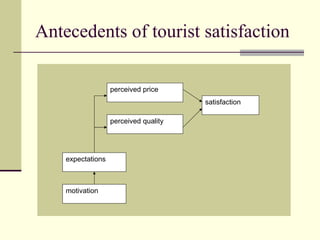
Antecedents of tourist satisfaction satisfaction motivation expectations perceived quality perceived price
Measuring tourist satisfaction The determinants are identified Each determinant is ascribed a relative weight A survey among tourists is carried out Overall level of satisfaction is determined Analysis and elaboration of a strategy
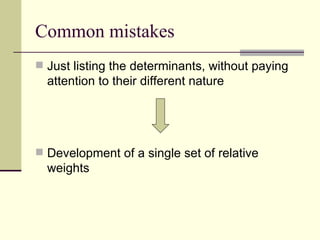
Common mistakes Just listing the determinants, without paying attention to their different nature Development of a single set of relative weights
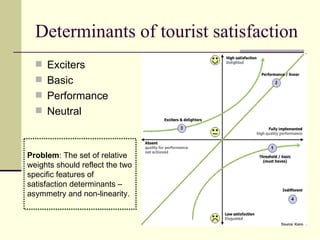
Determinants of tourist satisfaction Exciters Basic Performance Neutral Problem : The set of relative weights should reflect the two specific features of satisfaction determinants – asymmetry and non-linearity.
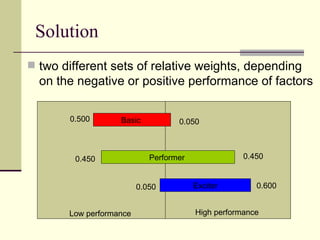
Solution two different sets of relative weights, depending on the negative or positive performance of factors   Low performance High performance Exciter Performer  Basic  0.500 0.450 0.050 0.600 0.450 0.050
Methods of determining relative weight Respondents’ stated importance – not reliable; Dummy variables regression method; AHP, using expert opinion  BUT taking into consideration the performance level of the determinants.
Conclusions Determinants impact on the overall level of satisfaction is asymmetric and sometimes non-linear; Knowing customer motivation and expectations is essential for identifying determinants; Stated importance alone is not reliable Ascription of relative weights should follow, not precede customer judgment of performance.
Thank you for your attention!

Relative weight of determinants of destination attractiveness

  • 1.
    SOME ISSUES INMEASURING TOURIST SATISFACTION assist. prof. Ilinka Terziyska South-West University of Neophyte Rilski
  • 2.
    Defining satisfaction Transaction-orientedapproach Cumulative approach “ psychological outcome which emerges from experiencing the service ” [1] [1] MacKay, K. J., & Crompton, J. L. ( 1990 ). Measuring the quality of recreation services. Journal of Park and Recreation Administration , 8(3), 47-56
  • 3.
    Key issues instudying tourist satisfaction: the antecedents and consequences of tourist satisfaction; how do we measure tourist satisfaction, which poses two more questions – about its determinants and their relative weight.
  • 4.
    Antecedents of touristsatisfaction satisfaction motivation expectations perceived quality perceived price
  • 5.
    Measuring tourist satisfactionThe determinants are identified Each determinant is ascribed a relative weight A survey among tourists is carried out Overall level of satisfaction is determined Analysis and elaboration of a strategy
  • 6.
    Common mistakes Justlisting the determinants, without paying attention to their different nature Development of a single set of relative weights
  • 7.
    Determinants of touristsatisfaction Exciters Basic Performance Neutral Problem : The set of relative weights should reflect the two specific features of satisfaction determinants – asymmetry and non-linearity.
  • 8.
    Solution two differentsets of relative weights, depending on the negative or positive performance of factors Low performance High performance Exciter Performer Basic 0.500 0.450 0.050 0.600 0.450 0.050
  • 9.
    Methods of determiningrelative weight Respondents’ stated importance – not reliable; Dummy variables regression method; AHP, using expert opinion BUT taking into consideration the performance level of the determinants.
  • 10.
    Conclusions Determinants impacton the overall level of satisfaction is asymmetric and sometimes non-linear; Knowing customer motivation and expectations is essential for identifying determinants; Stated importance alone is not reliable Ascription of relative weights should follow, not precede customer judgment of performance.
  • 11.
    Thank you foryour attention!