Making the web an
exploratory place
for geospatial data
1
ESTA-LD: Exploring Spatio-Temporal Linked
Statistical Data
Vuk Mijović,Valentina Janev, Dejan Paunović
Mihajlo Pupin Institute
Outline
• Introduction
• Modelling
• ESTA-LD
• FutureWork
1 5 S e p t e m b e r 2 0 1 5 2
Motivation
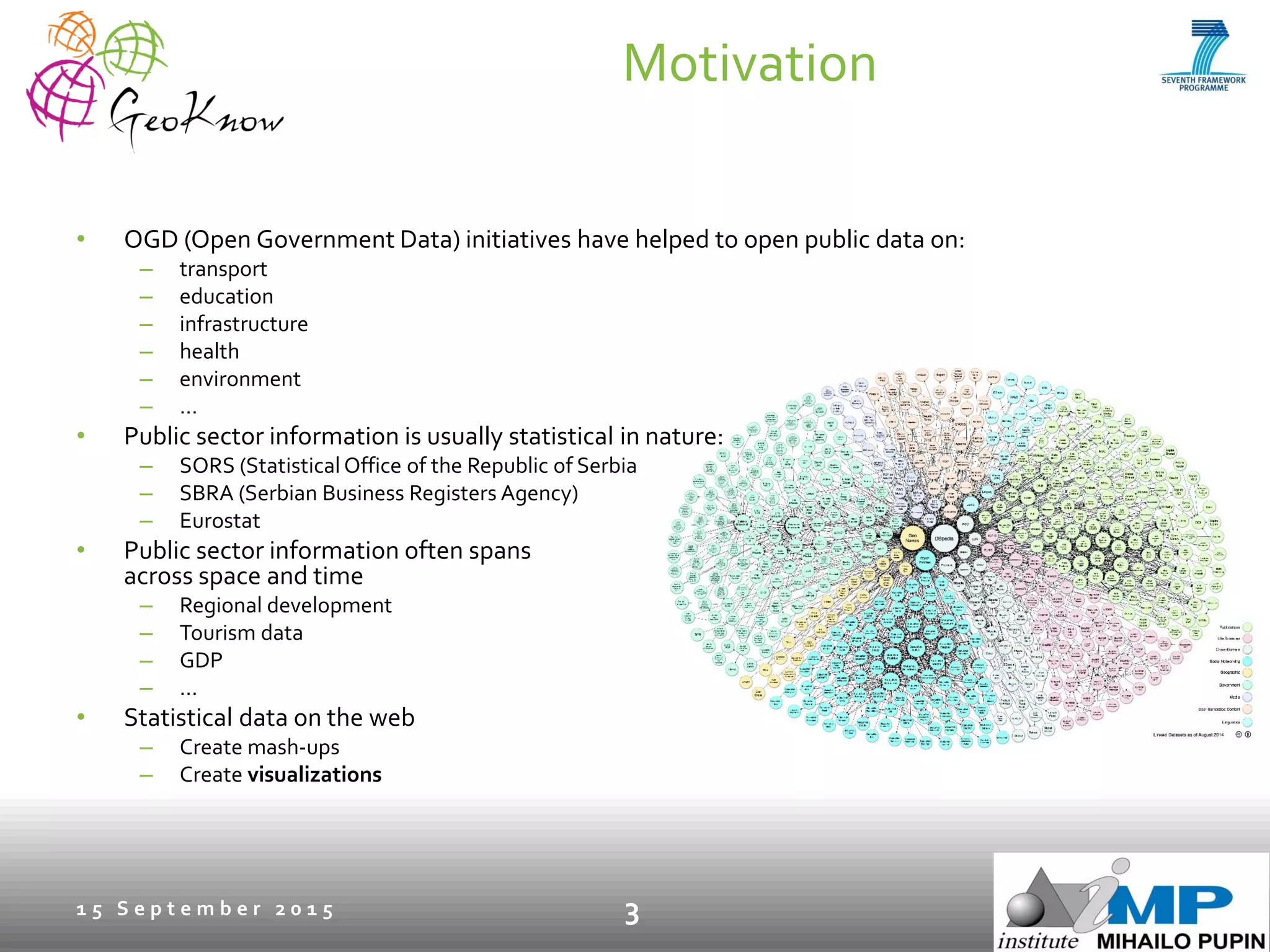
• OGD (Open Government Data) initiatives have helped to open public data on:
– transport
– education
– infrastructure
– health
– environment
– …
• Public sector information is usually statistical in nature:
– SORS (Statistical Office of the Republic of Serbia
– SBRA (Serbian Business Registers Agency)
– Eurostat
• Public sector information often spans
across space and time
– Regional development
– Tourism data
– GDP
– …
• Statistical data on the web
– Create mash-ups
– Create visualizations
1 5 S e p t e m b e r 2 0 1 5 3
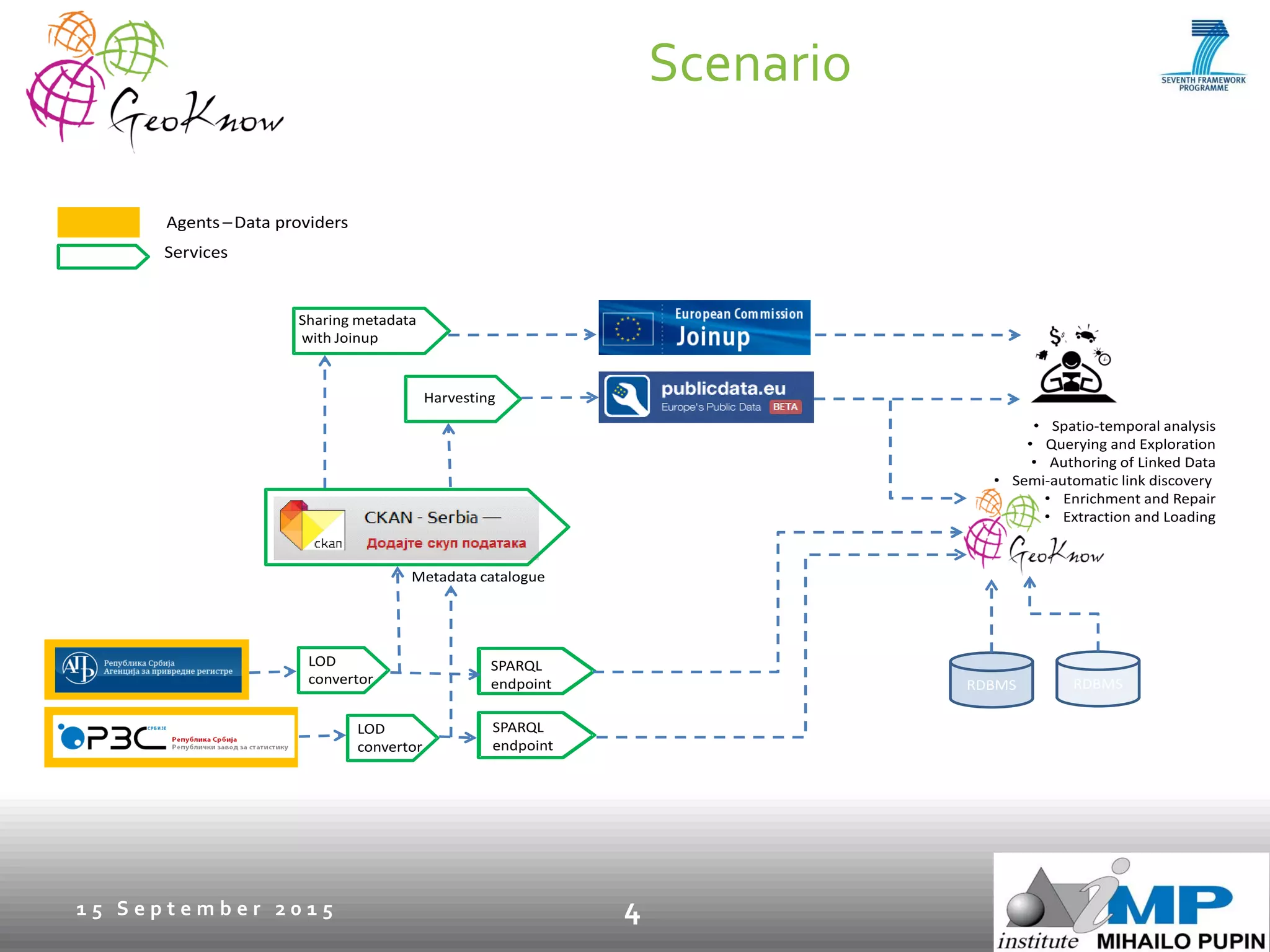
Scenario
1 5 S e p t e m b e r 2 0 1 5 4
Agents –Data providers
Services
LOD
convertor
LOD
convertor
Harvesting
Sharing metadata
with Joinup
Metadata catalogue
SPARQL
endpoint
SPARQL
endpoint
RDBMS RDBMS
• Spatio-temporal analysis
• Querying and Exploration
• Authoring of Linked Data
• Semi-automatic link discovery
• Enrichment and Repair
• Extraction and Loading
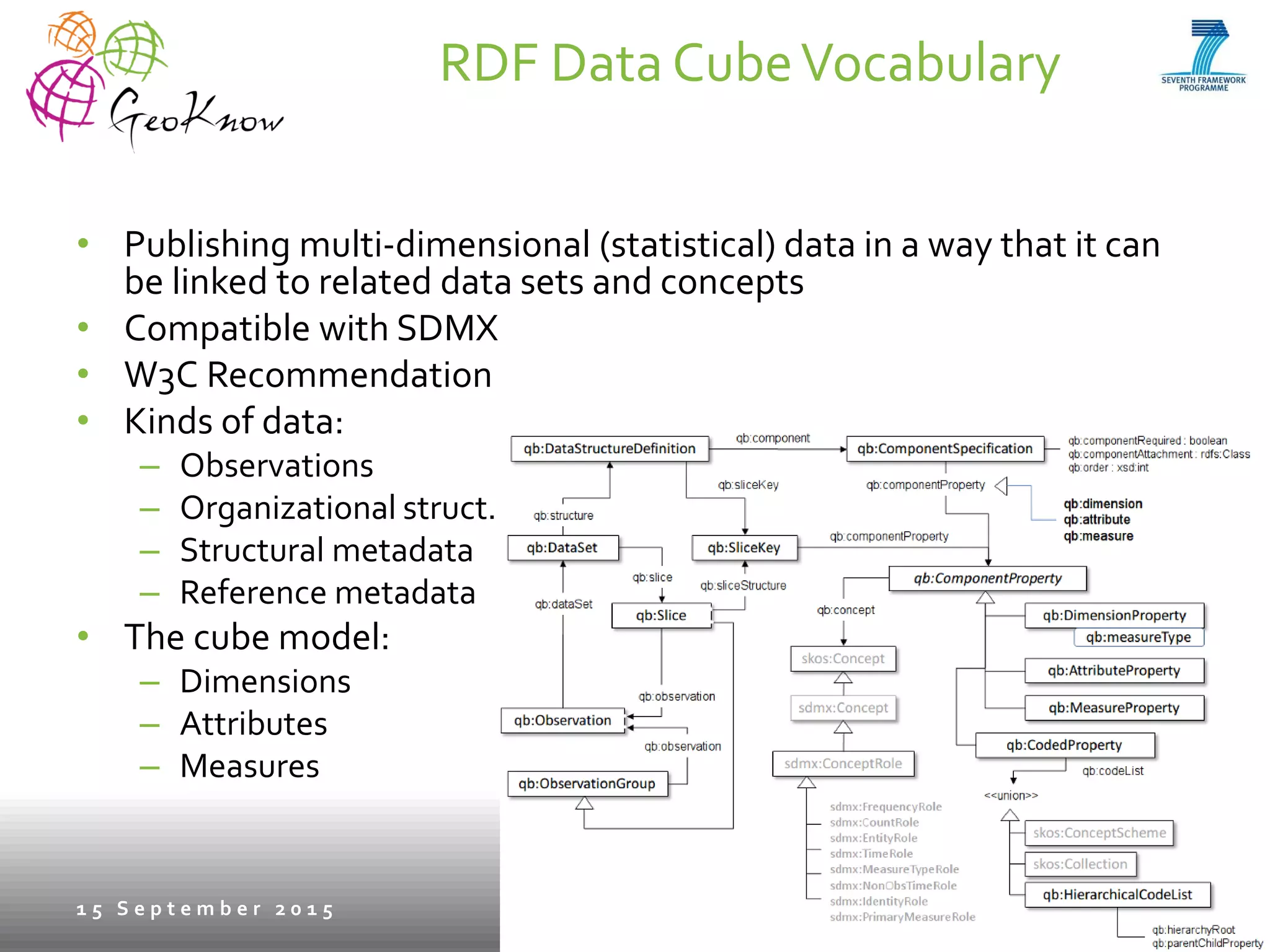
RDF Data CubeVocabulary
• Publishing multi-dimensional (statistical) data in a way that it can
be linked to related data sets and concepts
• Compatible with SDMX
• W3C Recommendation
• Kinds of data:
– Observations
– Organizational struct.
– Structural metadata
– Reference metadata
• The cube model:
– Dimensions
– Attributes
– Measures
1 5 S e p t e m b e r 2 0 1 5 5
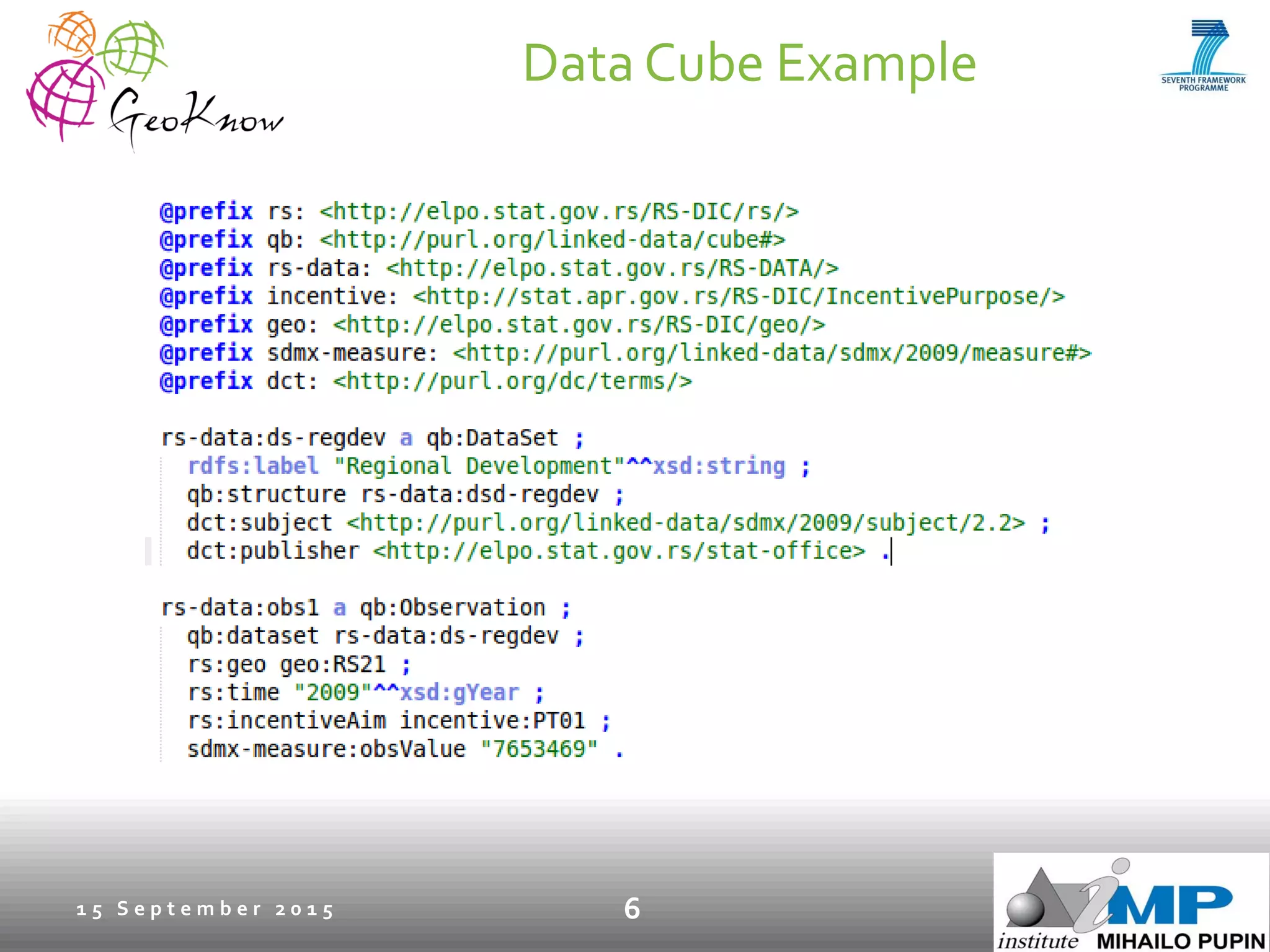
Data Cube Example
1 5 S e p t e m b e r 2 0 1 5 6
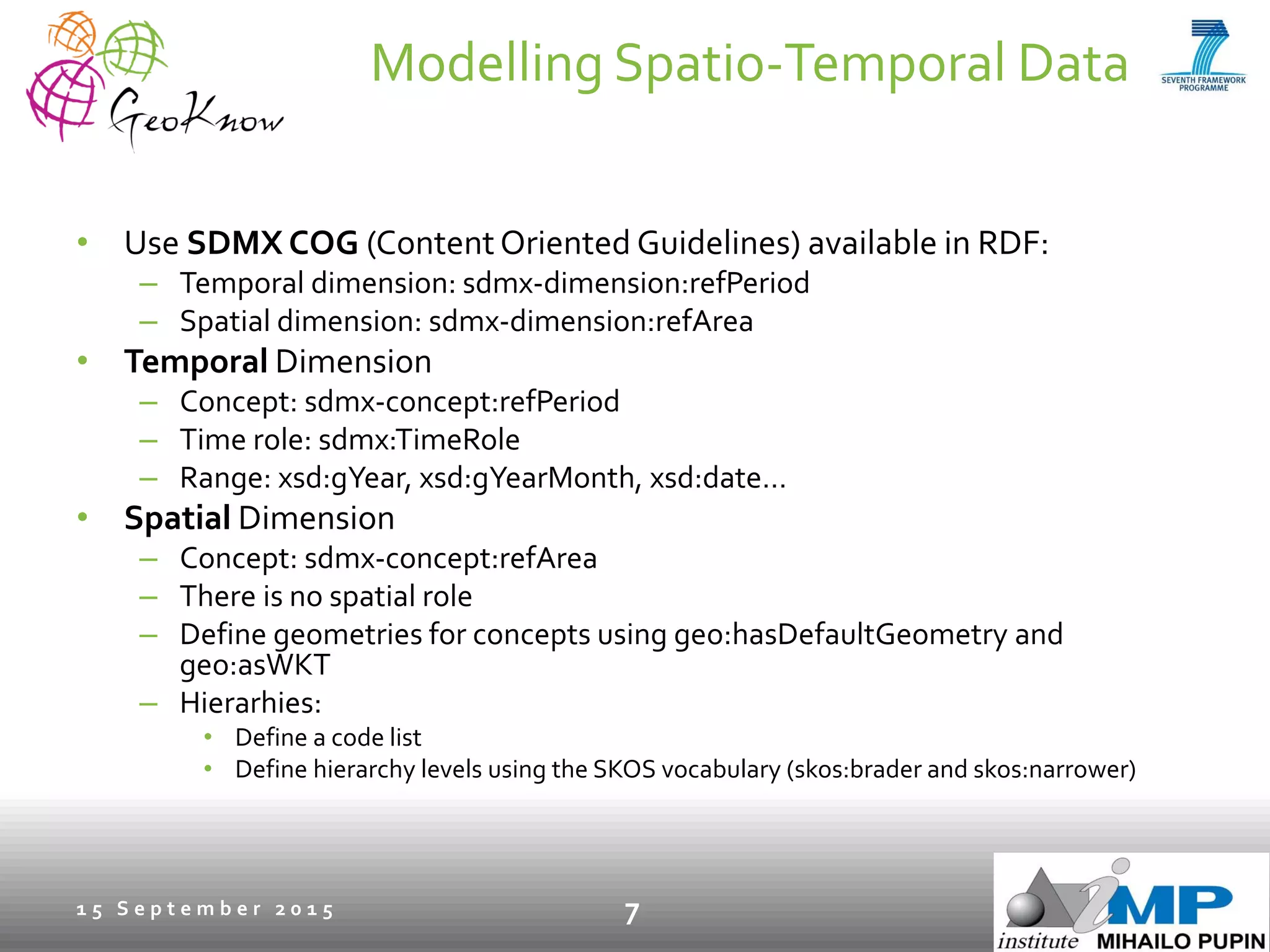
Modelling Spatio-Temporal Data
• Use SDMX COG (ContentOriented Guidelines) available in RDF:
– Temporal dimension: sdmx-dimension:refPeriod
– Spatial dimension: sdmx-dimension:refArea
• Temporal Dimension
– Concept: sdmx-concept:refPeriod
– Time role: sdmx:TimeRole
– Range: xsd:gYear, xsd:gYearMonth, xsd:date…
• Spatial Dimension
– Concept: sdmx-concept:refArea
– There is no spatial role
– Define geometries for concepts using geo:hasDefaultGeometry and
geo:asWKT
– Hierarhies:
• Define a code list
• Define hierarchy levels using the SKOS vocabulary (skos:brader and skos:narrower)
1 5 S e p t e m b e r 2 0 1 5 7
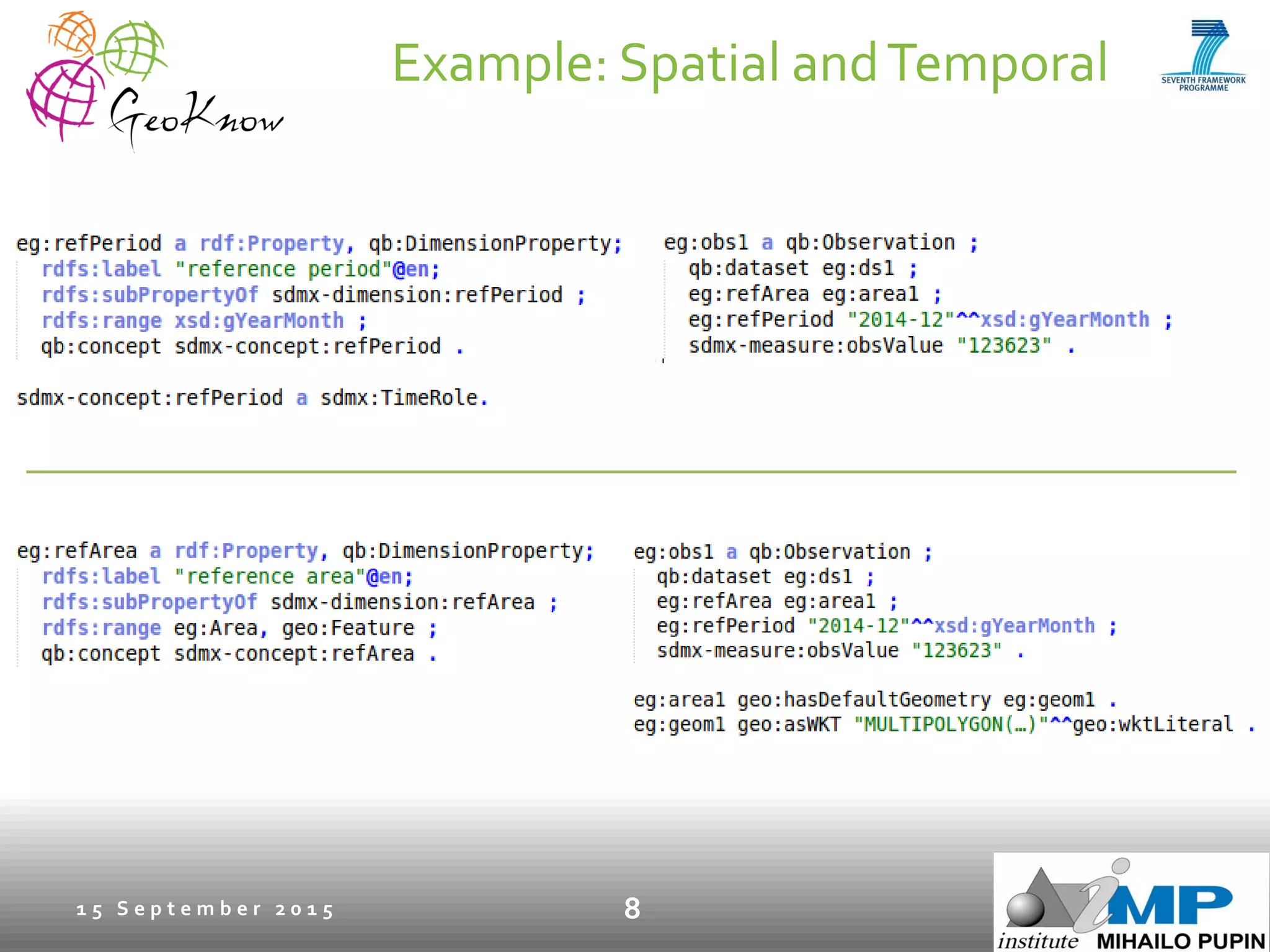
Example: Spatial andTemporal
1 5 S e p t e m b e r 2 0 1 5 8
ESTA-LD
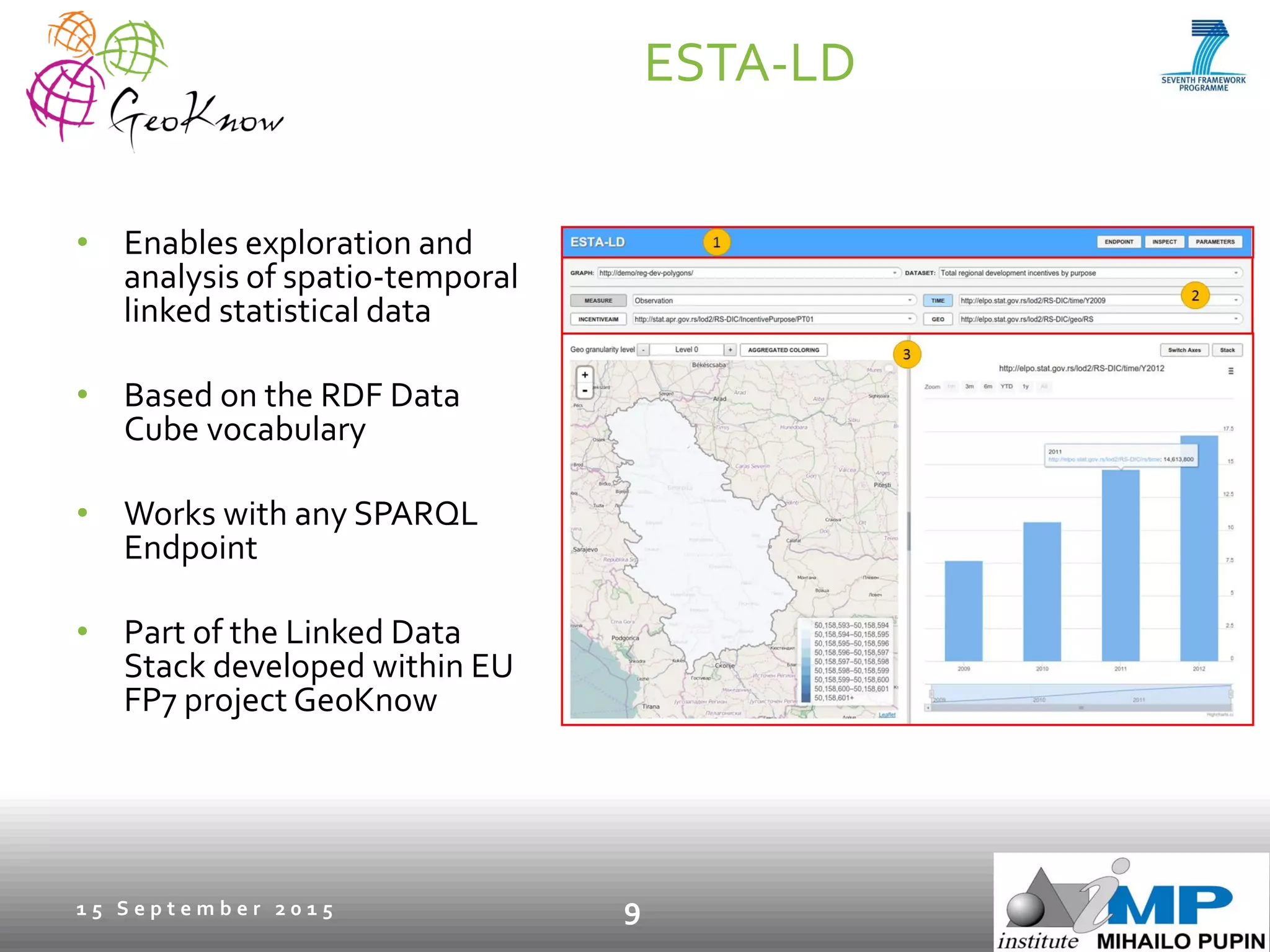
• Enables exploration and
analysis of spatio-temporal
linked statistical data
• Based on the RDF Data
Cube vocabulary
• Works with any SPARQL
Endpoint
• Part of the Linked Data
Stack developed within EU
FP7 project GeoKnow
1 5 S e p t e m b e r 2 0 1 5 9
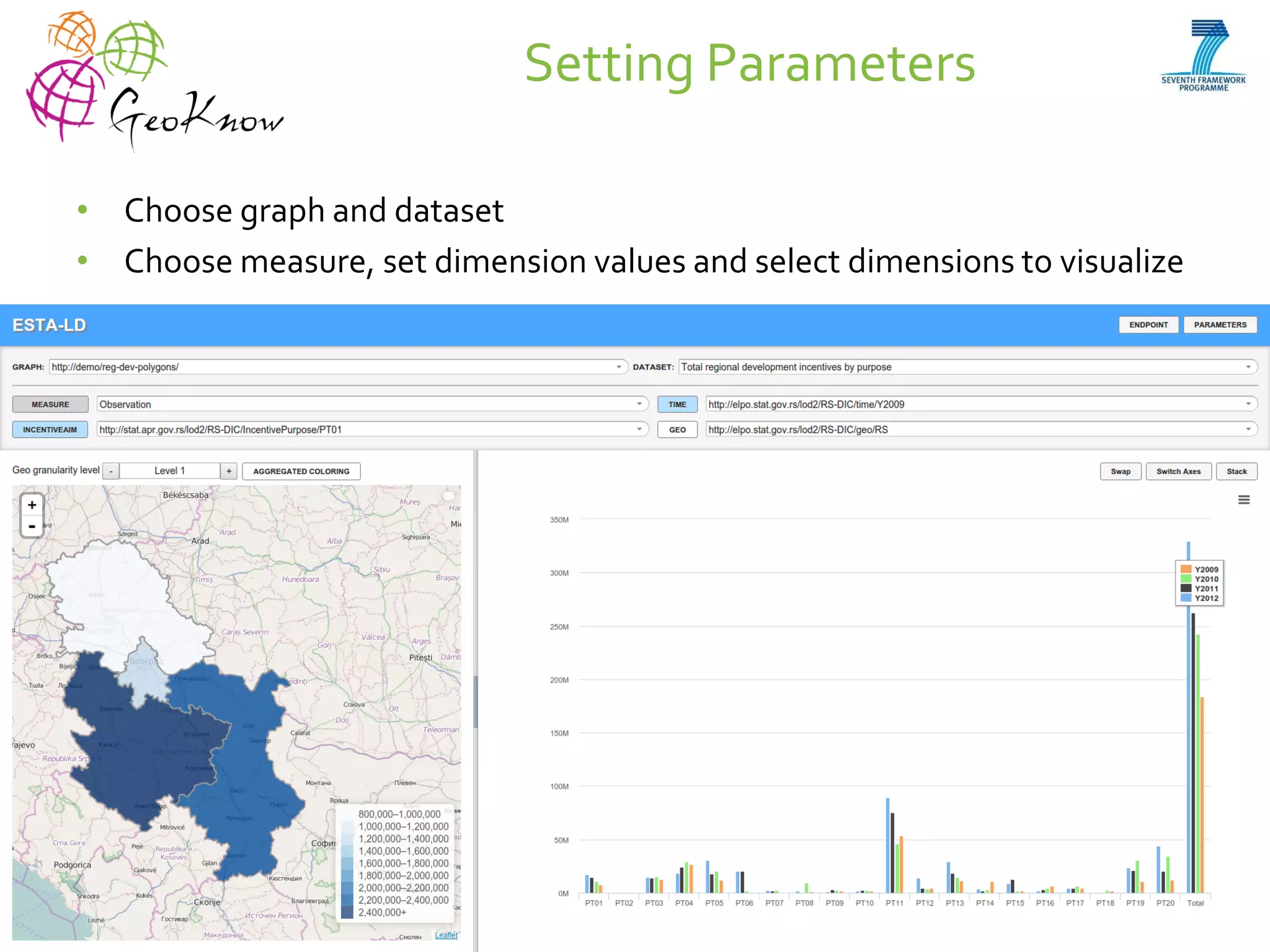
Setting Parameters
• Choose graph and dataset
• Choose measure, set dimension values and select dimensions to visualize
1 5 S e p t e m b e r 2 0 1 5 1 0
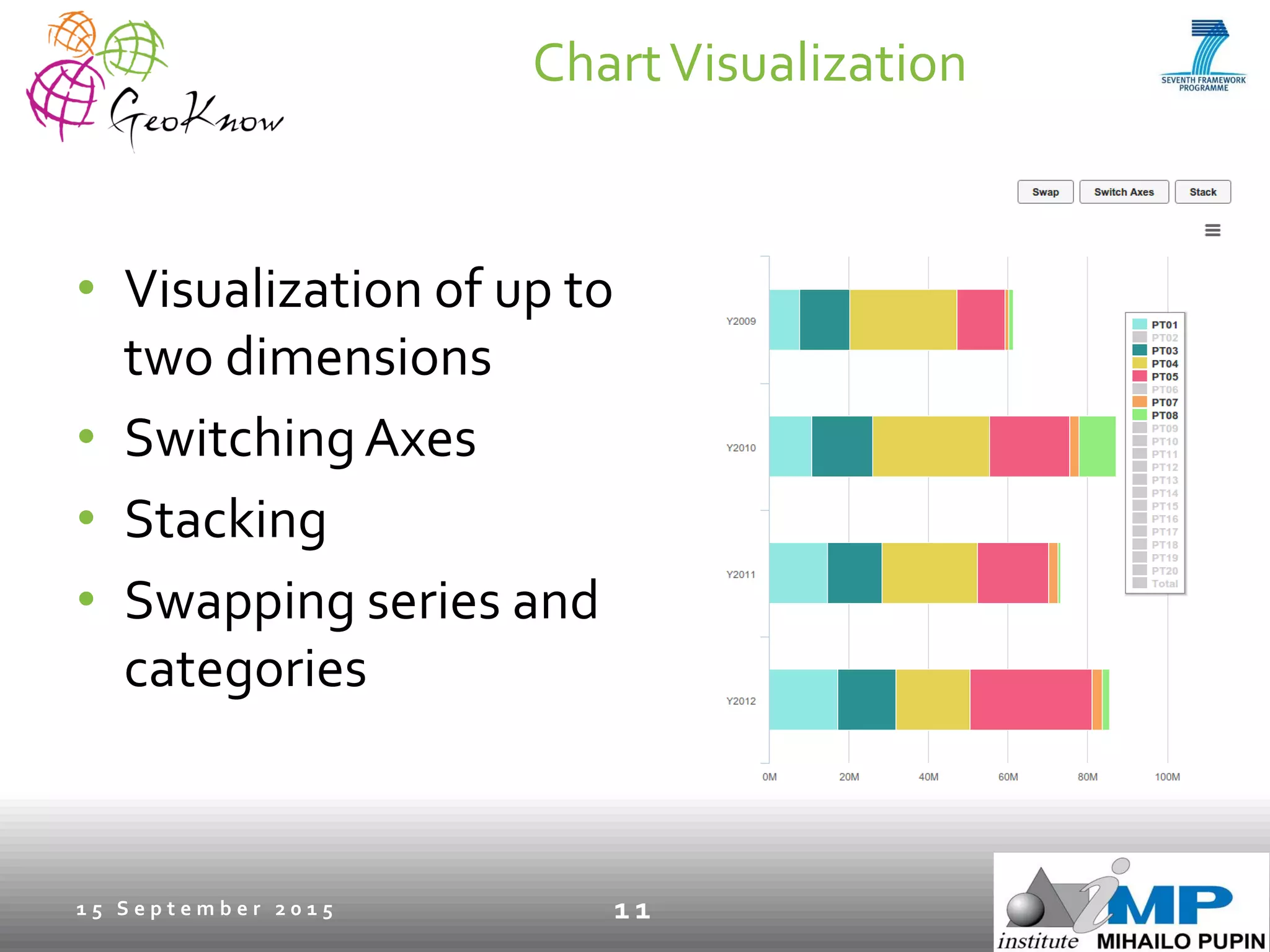
ChartVisualization
• Visualization of up to
two dimensions
• SwitchingAxes
• Stacking
• Swapping series and
categories
1 5 S e p t e m b e r 2 0 1 5 1 1
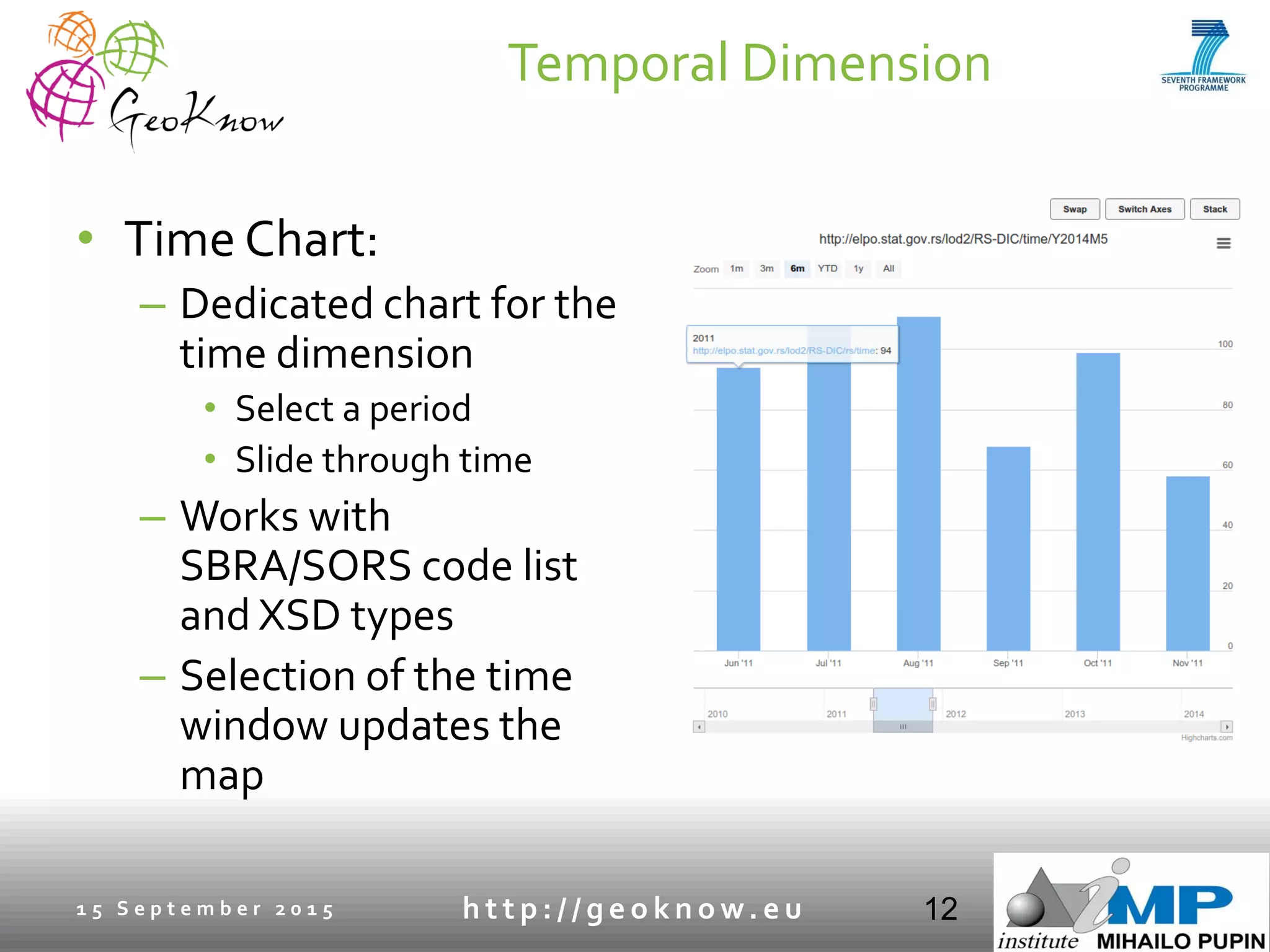
Temporal Dimension
• Time Chart:
– Dedicated chart for the
time dimension
• Select a period
• Slide through time
– Works with
SBRA/SORS code list
and XSD types
– Selection of the time
window updates the
map
1 5 S e p t e m b e r 2 0 1 5 h t t p : / / g e o k n o w. e u 12
Spatial Dimension
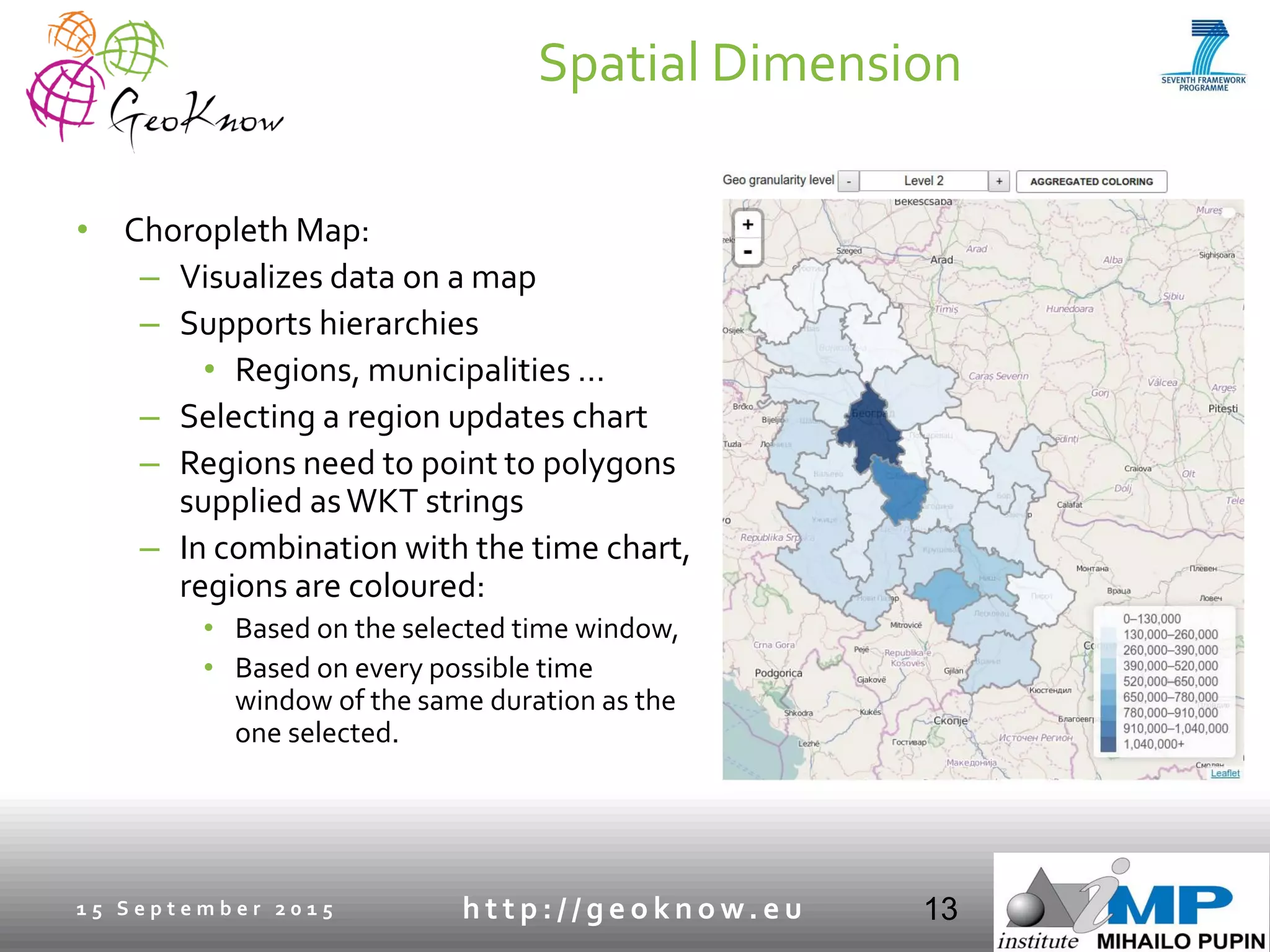
• Choropleth Map:
– Visualizes data on a map
– Supports hierarchies
• Regions, municipalities …
– Selecting a region updates chart
– Regions need to point to polygons
supplied asWKT strings
– In combination with the time chart,
regions are coloured:
• Based on the selected time window,
• Based on every possible time
window of the same duration as the
one selected.
1 5 S e p t e m b e r 2 0 1 5 h t t p : / / g e o k n o w. e u 13
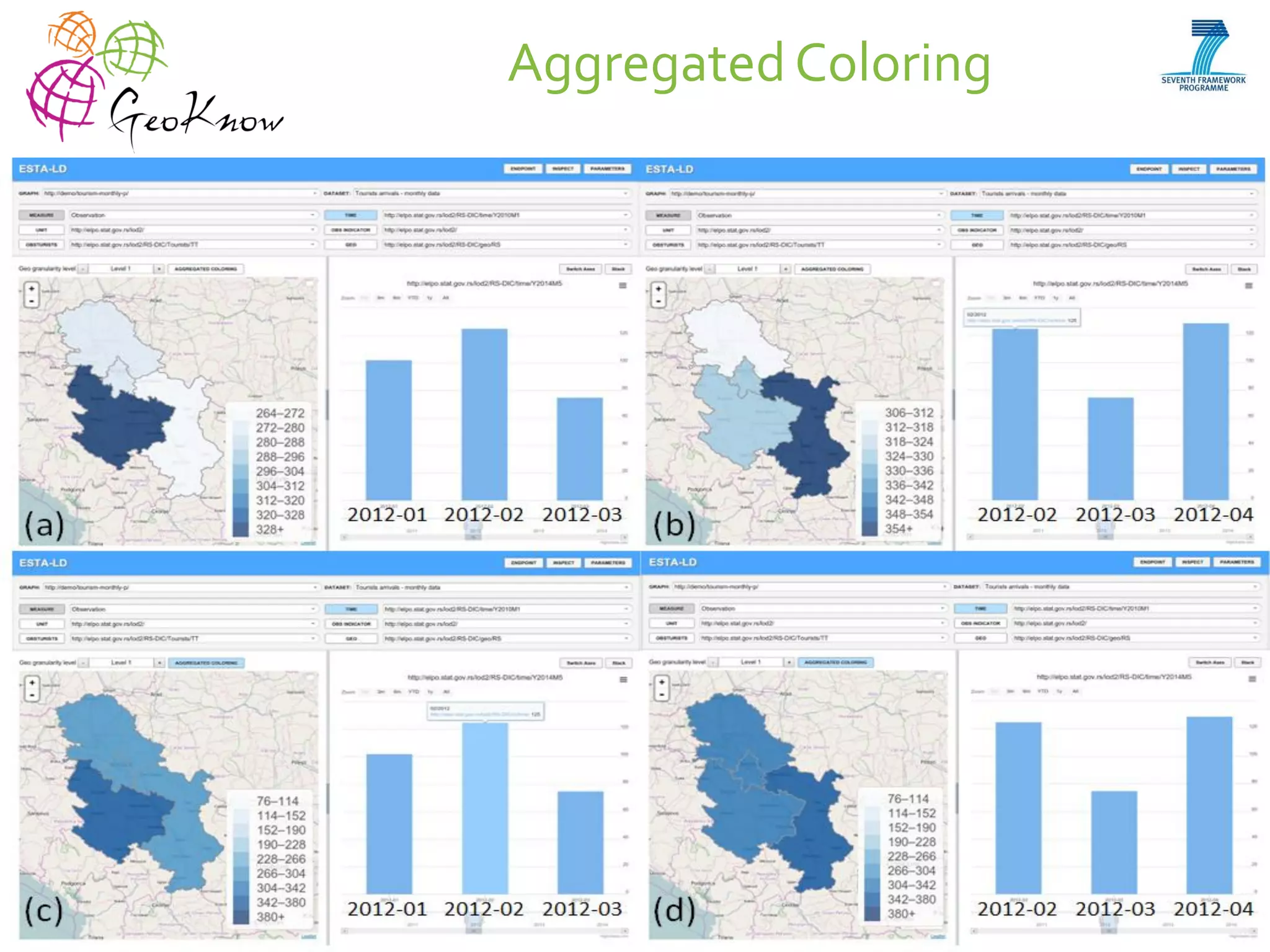
AggregatedColoring
1 5 S e p t e m b e r 2 0 1 5 1 4
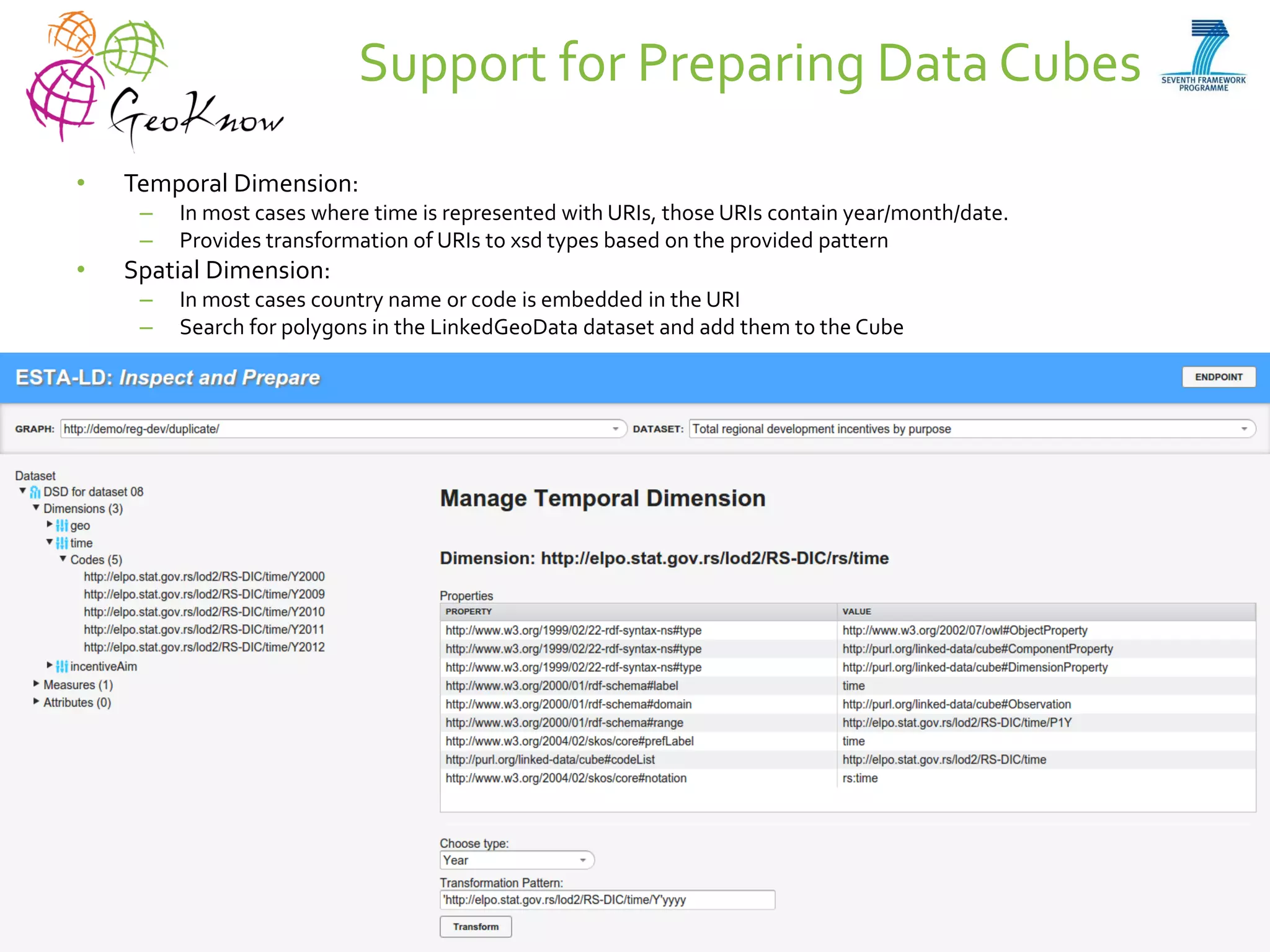
Support for Preparing Data Cubes
• Temporal Dimension:
– In most cases where time is represented with URIs, those URIs contain year/month/date.
– Provides transformation of URIs to xsd types based on the provided pattern
• Spatial Dimension:
– In most cases country name or code is embedded in the URI
– Search for polygons in the LinkedGeoData dataset and add them to the Cube
1 5 S e p t e m b e r 2 0 1 5 h t t p : / / g e o k n o w. e u 15
Final Remarks
• Try ESTA-LD:
– GitHub: https://github.com/GeoKnow/ESTA-LD
– Demo: http://geoknow.imp.bg.ac.rs/ESTA-LD
• Future Work:
– Add more chart types
– Enable comparisons, merging, slicing, etc.
– Reducing the need for replication (DSDs, polygons…)
– Advanced search and filtering capabilities
1 5 S e p t e m b e r 2 0 1 5 1 6
Making the web an
exploratory place
for geospatial data
17
Thank you for your attention!
Questions?

ESTA-LD exploring spatio-temporal linked statistical data

  • 1.
    Making the weban exploratory place for geospatial data 1 ESTA-LD: Exploring Spatio-Temporal Linked Statistical Data Vuk Mijović,Valentina Janev, Dejan Paunović Mihajlo Pupin Institute
  • 2.
    Outline • Introduction • Modelling •ESTA-LD • FutureWork 1 5 S e p t e m b e r 2 0 1 5 2
  • 3.
    Motivation • OGD (OpenGovernment Data) initiatives have helped to open public data on: – transport – education – infrastructure – health – environment – … • Public sector information is usually statistical in nature: – SORS (Statistical Office of the Republic of Serbia – SBRA (Serbian Business Registers Agency) – Eurostat • Public sector information often spans across space and time – Regional development – Tourism data – GDP – … • Statistical data on the web – Create mash-ups – Create visualizations 1 5 S e p t e m b e r 2 0 1 5 3
  • 4.
    Scenario 1 5 Se p t e m b e r 2 0 1 5 4 Agents –Data providers Services LOD convertor LOD convertor Harvesting Sharing metadata with Joinup Metadata catalogue SPARQL endpoint SPARQL endpoint RDBMS RDBMS • Spatio-temporal analysis • Querying and Exploration • Authoring of Linked Data • Semi-automatic link discovery • Enrichment and Repair • Extraction and Loading
  • 5.
    RDF Data CubeVocabulary •Publishing multi-dimensional (statistical) data in a way that it can be linked to related data sets and concepts • Compatible with SDMX • W3C Recommendation • Kinds of data: – Observations – Organizational struct. – Structural metadata – Reference metadata • The cube model: – Dimensions – Attributes – Measures 1 5 S e p t e m b e r 2 0 1 5 5
  • 6.
    Data Cube Example 15 S e p t e m b e r 2 0 1 5 6
  • 7.
    Modelling Spatio-Temporal Data •Use SDMX COG (ContentOriented Guidelines) available in RDF: – Temporal dimension: sdmx-dimension:refPeriod – Spatial dimension: sdmx-dimension:refArea • Temporal Dimension – Concept: sdmx-concept:refPeriod – Time role: sdmx:TimeRole – Range: xsd:gYear, xsd:gYearMonth, xsd:date… • Spatial Dimension – Concept: sdmx-concept:refArea – There is no spatial role – Define geometries for concepts using geo:hasDefaultGeometry and geo:asWKT – Hierarhies: • Define a code list • Define hierarchy levels using the SKOS vocabulary (skos:brader and skos:narrower) 1 5 S e p t e m b e r 2 0 1 5 7
  • 8.
    Example: Spatial andTemporal 15 S e p t e m b e r 2 0 1 5 8
  • 9.
    ESTA-LD • Enables explorationand analysis of spatio-temporal linked statistical data • Based on the RDF Data Cube vocabulary • Works with any SPARQL Endpoint • Part of the Linked Data Stack developed within EU FP7 project GeoKnow 1 5 S e p t e m b e r 2 0 1 5 9
  • 10.
    Setting Parameters • Choosegraph and dataset • Choose measure, set dimension values and select dimensions to visualize 1 5 S e p t e m b e r 2 0 1 5 1 0
  • 11.
    ChartVisualization • Visualization ofup to two dimensions • SwitchingAxes • Stacking • Swapping series and categories 1 5 S e p t e m b e r 2 0 1 5 1 1
  • 12.
    Temporal Dimension • TimeChart: – Dedicated chart for the time dimension • Select a period • Slide through time – Works with SBRA/SORS code list and XSD types – Selection of the time window updates the map 1 5 S e p t e m b e r 2 0 1 5 h t t p : / / g e o k n o w. e u 12
  • 13.
    Spatial Dimension • ChoroplethMap: – Visualizes data on a map – Supports hierarchies • Regions, municipalities … – Selecting a region updates chart – Regions need to point to polygons supplied asWKT strings – In combination with the time chart, regions are coloured: • Based on the selected time window, • Based on every possible time window of the same duration as the one selected. 1 5 S e p t e m b e r 2 0 1 5 h t t p : / / g e o k n o w. e u 13
  • 14.
    AggregatedColoring 1 5 Se p t e m b e r 2 0 1 5 1 4
  • 15.
    Support for PreparingData Cubes • Temporal Dimension: – In most cases where time is represented with URIs, those URIs contain year/month/date. – Provides transformation of URIs to xsd types based on the provided pattern • Spatial Dimension: – In most cases country name or code is embedded in the URI – Search for polygons in the LinkedGeoData dataset and add them to the Cube 1 5 S e p t e m b e r 2 0 1 5 h t t p : / / g e o k n o w. e u 15
  • 16.
    Final Remarks • TryESTA-LD: – GitHub: https://github.com/GeoKnow/ESTA-LD – Demo: http://geoknow.imp.bg.ac.rs/ESTA-LD • Future Work: – Add more chart types – Enable comparisons, merging, slicing, etc. – Reducing the need for replication (DSDs, polygons…) – Advanced search and filtering capabilities 1 5 S e p t e m b e r 2 0 1 5 1 6
  • 17.
    Making the weban exploratory place for geospatial data 17 Thank you for your attention! Questions?