Creating and Utilizing Linked Open Statistical 
Data for the Development of Advanced 
Analytics Services 
E. Kalampokis, A. Karamanou, A. Nikolov, P. Haase, R. Cyganiak, B. Roberts, P. 
Hermans, E. Tambouris, K. Tarabanis
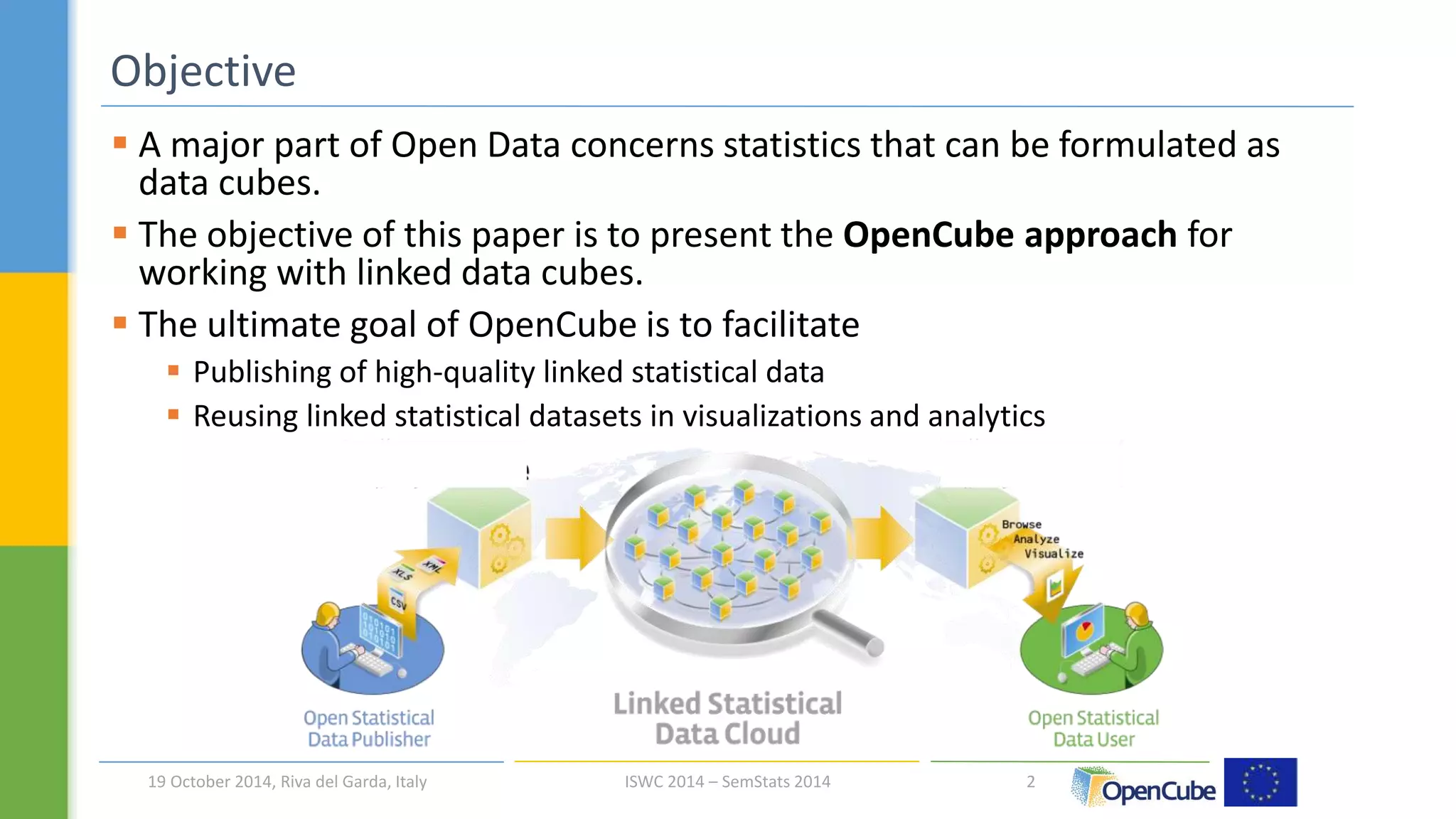
 A major part of Open Data concerns statistics that can be formulated as 
data cubes. 
 The objective of this paper is to present the OpenCube approach for 
working with linked data cubes. 
 The ultimate goal of OpenCube is to facilitate 
 Publishing of high-quality linked statistical data 
 Reusing linked statistical datasets in visualizations and analytics 
2 
Objective 
19 October 2014, Riva del Garda, Italy ISWC 2014 – SemStats 2014
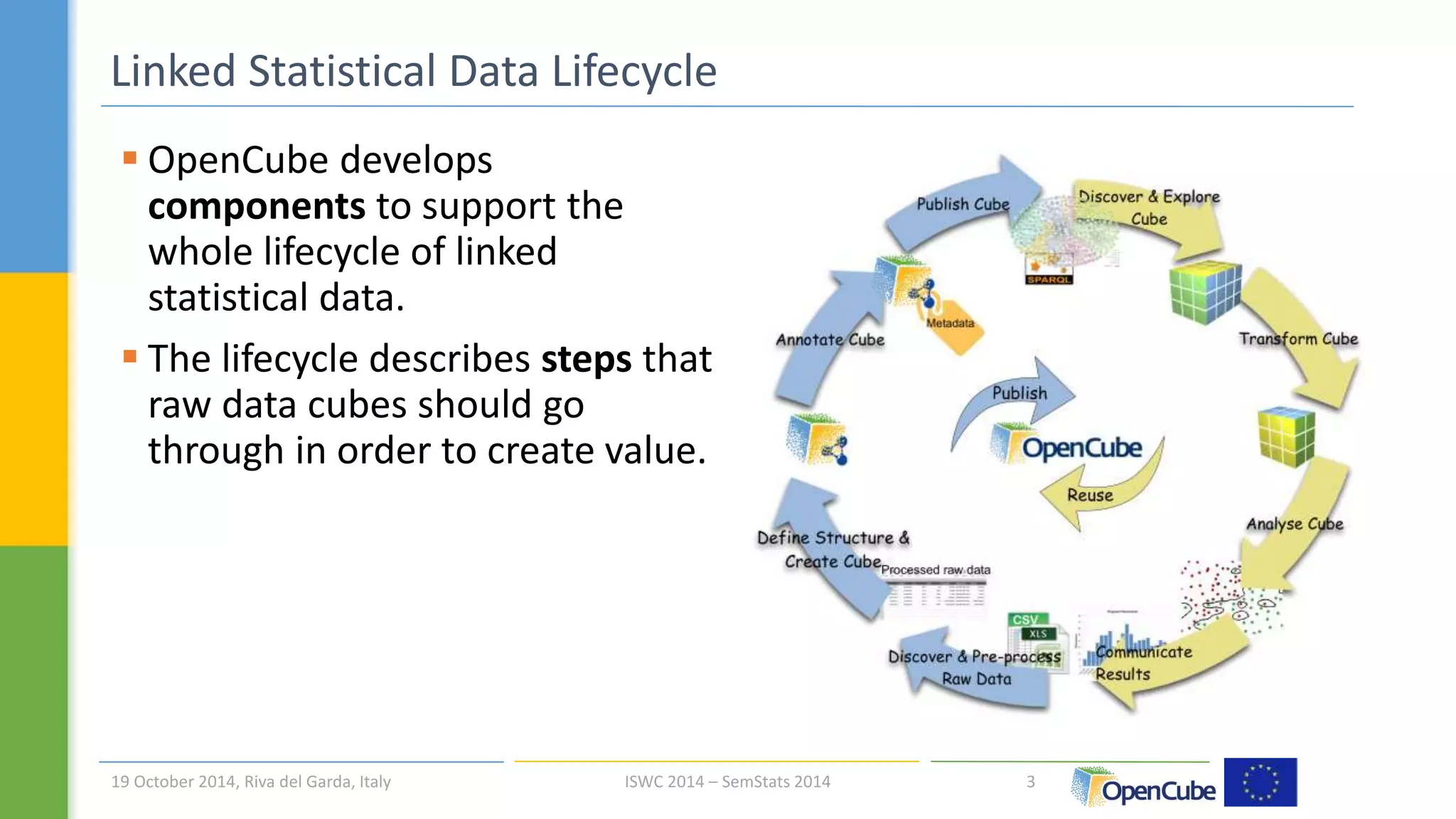
Linked Statistical Data Lifecycle 
 OpenCube develops 
components to support the 
whole lifecycle of linked 
statistical data. 
 The lifecycle describes steps that 
raw data cubes should go 
through in order to create value. 
19 October 2014, Riva del Garda, Italy ISWC 2014 – SemStats 2014 
3
 Different steps of the lifecycle are realized by separate components. 
 Two different implementation approaches are considered based on 
the underlying platform. 
 fluidOps’ Information Workbench 
 Swirrl’s PublishMyData 
 Extensions for the commercial platforms and an Open-Source toolkit. 
4 
Implementation 
19 October 2014, Riva del Garda, Italy ISWC 2014 – SemStats 2014
 Publishing components 
 TARQL extension 
 D2RQ /R2RML-QB extension 
 JSON-stat 
 Grafter 
 Consuming components 
 Data catalogue 
 OpenCube Browser 
 OpenCube MapView 
 R Analysis Chart 
 Aggregation component 
5 
Components 
19 October 2014, Riva del Garda, Italy ISWC 2014 – SemStats 2014
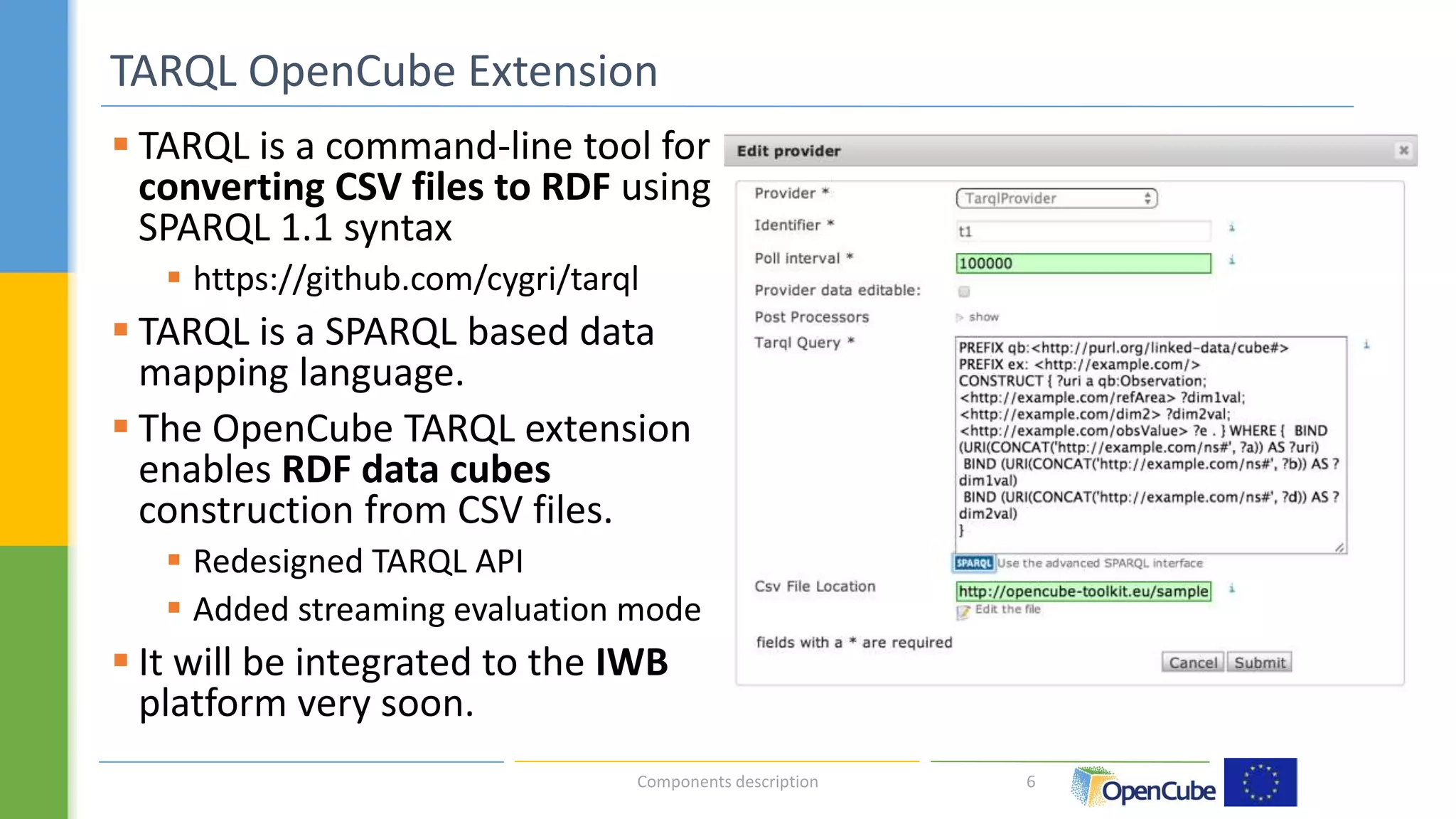
 TARQL is a command-line tool for 
converting CSV files to RDF using 
SPARQL 1.1 syntax 
 https://github.com/cygri/tarql 
 TARQL is a SPARQL based data 
mapping language. 
 The OpenCube TARQL extension 
enables RDF data cubes 
construction from CSV files. 
 Redesigned TARQL API 
 Added streaming evaluation mode 
 It will be integrated to the IWB 
platform very soon. 
6 
TARQL OpenCube Extension 
Components description
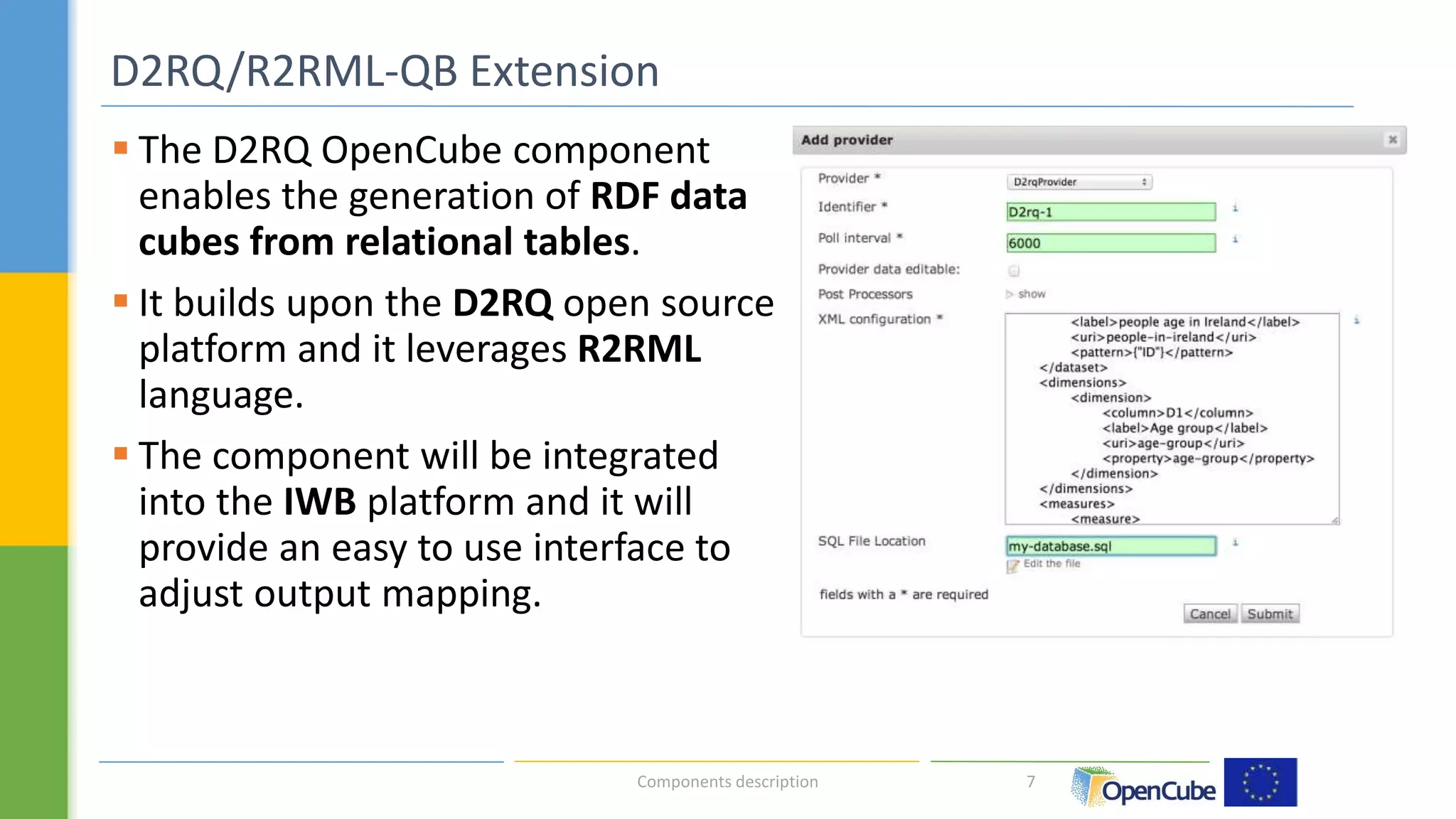
 The D2RQ OpenCube component 
enables the generation of RDF data 
cubes from relational tables. 
 It builds upon the D2RQ open source 
platform and it leverages R2RML 
language. 
 The component will be integrated 
into the IWB platform and it will 
provide an easy to use interface to 
adjust output mapping. 
7 
D2RQ/R2RML-QB Extension 
Components description
 The JSON-stat format is a simple lightweight JSON format for 
multidimensional data. 
 http://json-stat.org/format/ 
 A JSON-stat file can contain one or more datasets. 
 Multiple datasets responses allow a provider to disseminate 
information with few common dimensions in a single response. 
8 
JSON-stat 
Components description
 Open source software framework for transforming tabular data (CSV 
or XLS) to RDF 
 http://grafter.org 
 Automatable/works with API 
 Designed to support a graphical user interface (work in progress) 
 Performs well with large datasets 
9 
Grafter 
19 October 2014, Riva del Garda, Italy ISWC 2014 – SemStats 2014
WORLD BANK 
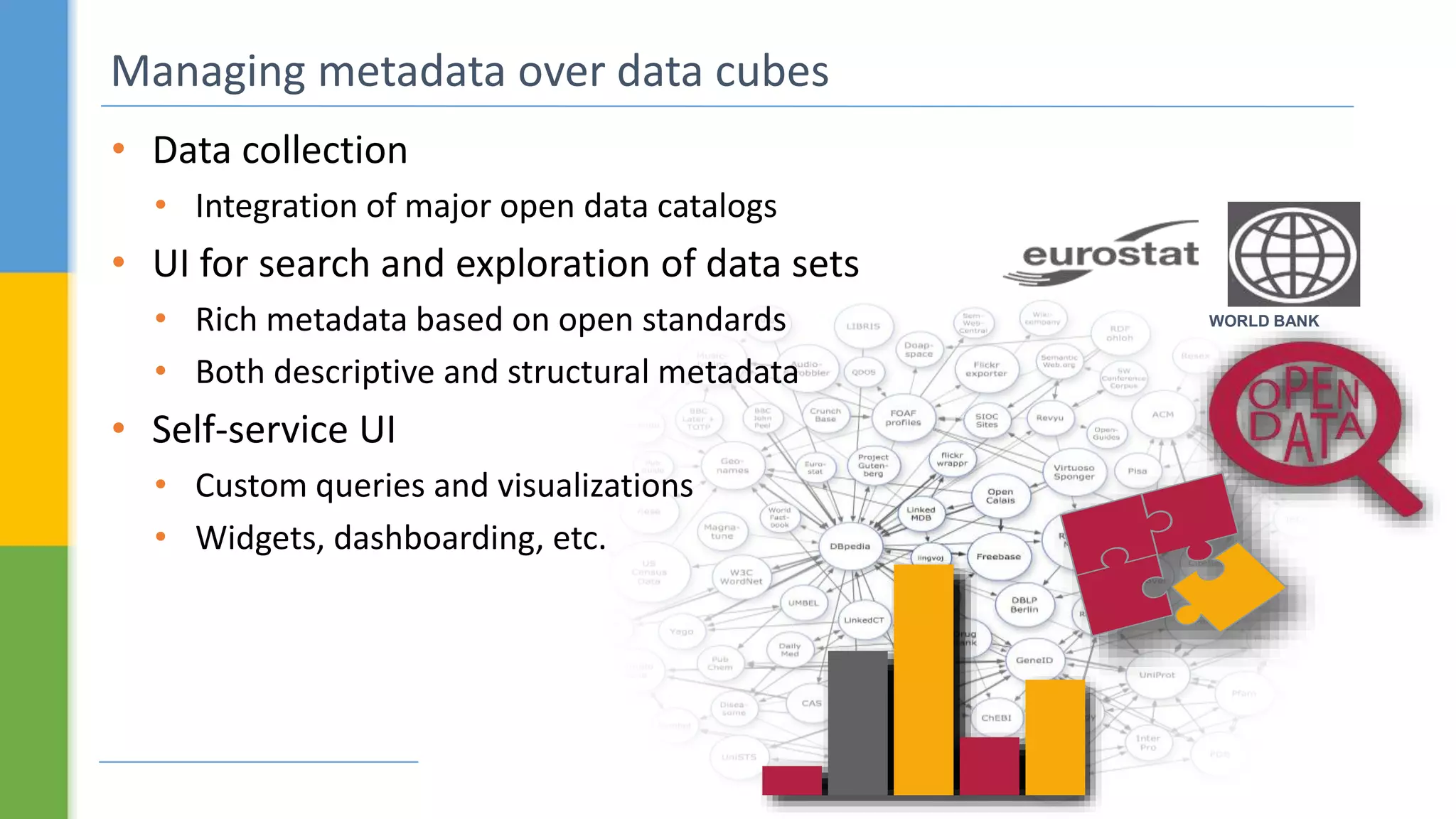
Managing metadata over data cubes 
• Data collection 
• Integration of major open data catalogs 
• UI for search and exploration of data sets 
• Rich metadata based on open standards 
• Both descriptive and structural metadata 
• Self-service UI 
• Custom queries and visualizations 
• Widgets, dashboarding, etc.
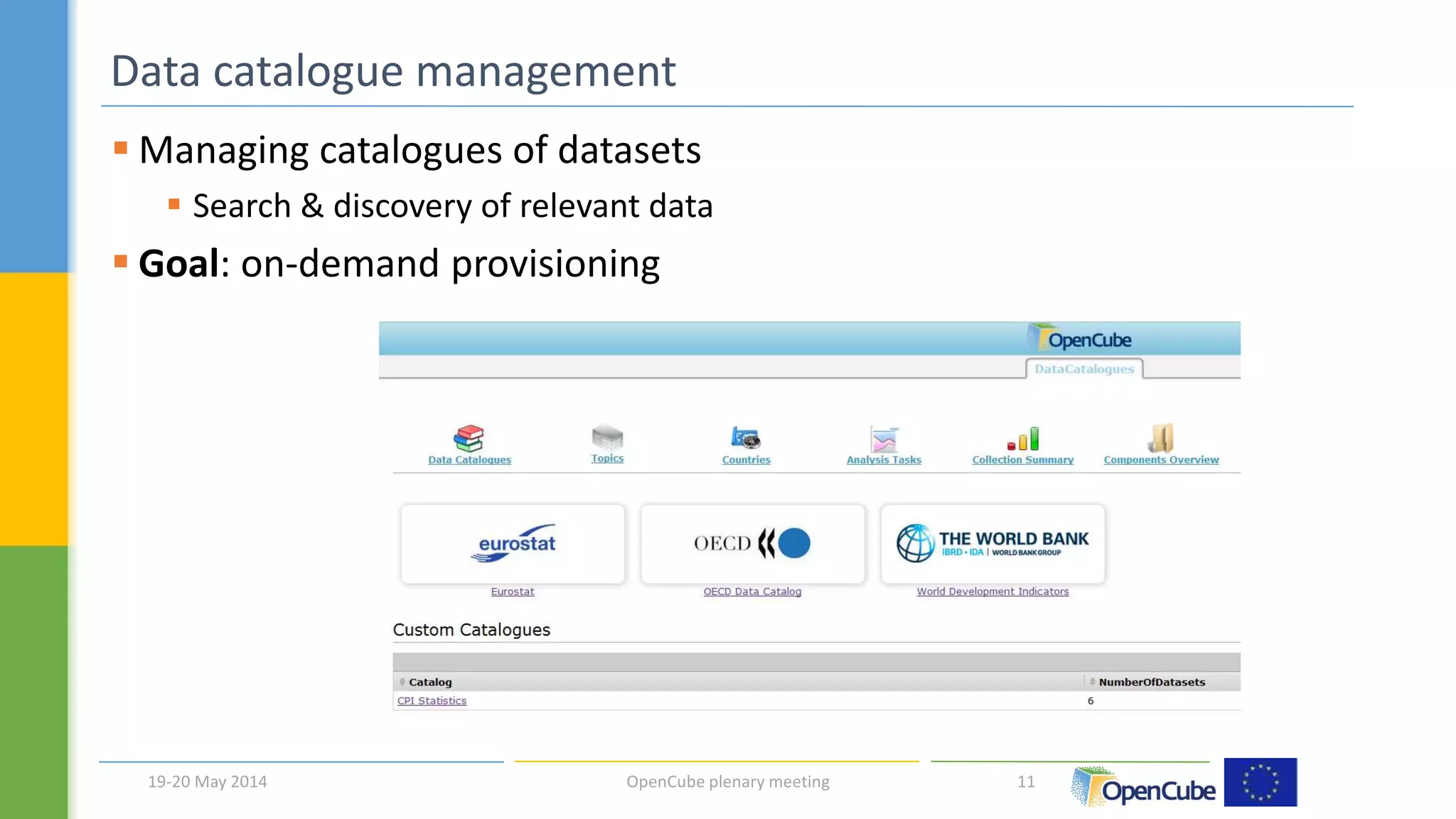
Data catalogue management 
 Managing catalogues of datasets 
 Search & discovery of relevant data 
 Goal: on-demand provisioning 
19-20 May 2014 OpenCube plenary meeting 11
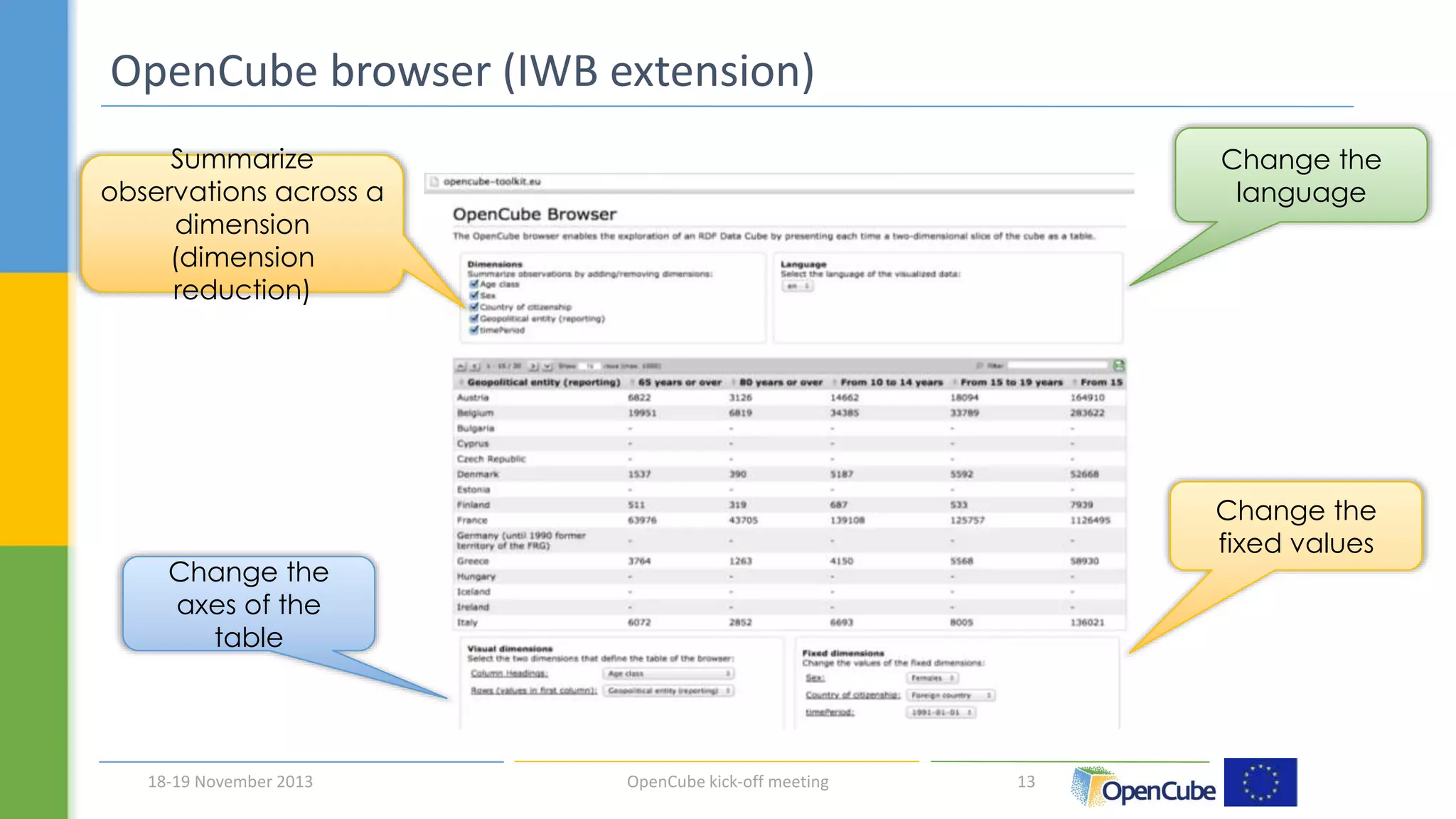
 It enables the exploration of an RDF data cube by presenting a two-dimensional 
slice of the cube as a table. 
 The slice is created by setting a fixed values for each dimension that 
is not presented in the table. 
 The browser is integrated in both IWB and PublishMyData platform. 
12 
OpenCube browser 
19 October 2014, Riva del Garda, Italy ISWC 2014 – SemStats 2014
13 
OpenCube browser (IWB extension) 
Summarize 
observations across a 
dimension 
(dimension 
reduction) 
Change the 
axes of the 
table 
18-19 November 2013 OpenCube kick-off meeting 
Change the 
language 
Change the 
fixed values
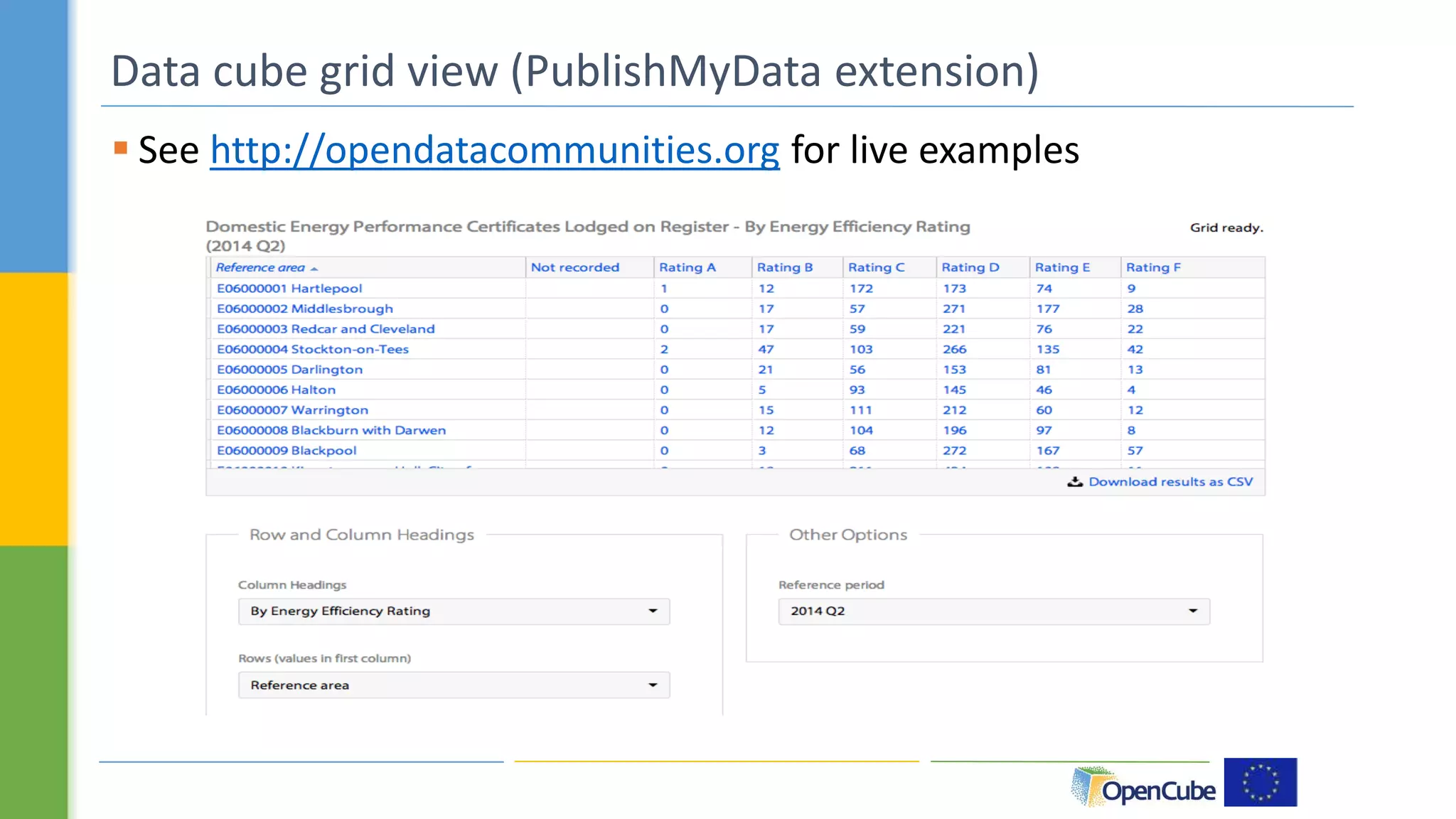
Data cube grid view (PublishMyData extension) 
 See http://opendatacommunities.org for live examples
Data cube grid view 
 Shows two dimensional slice of data 
 Controls to set values of other dimensions 
 Download chosen slice as CSV 
 Performs well with large datasets by loading data asynchronously as 
users scrolls through 
 See http://opendatacommunities.org for live examples
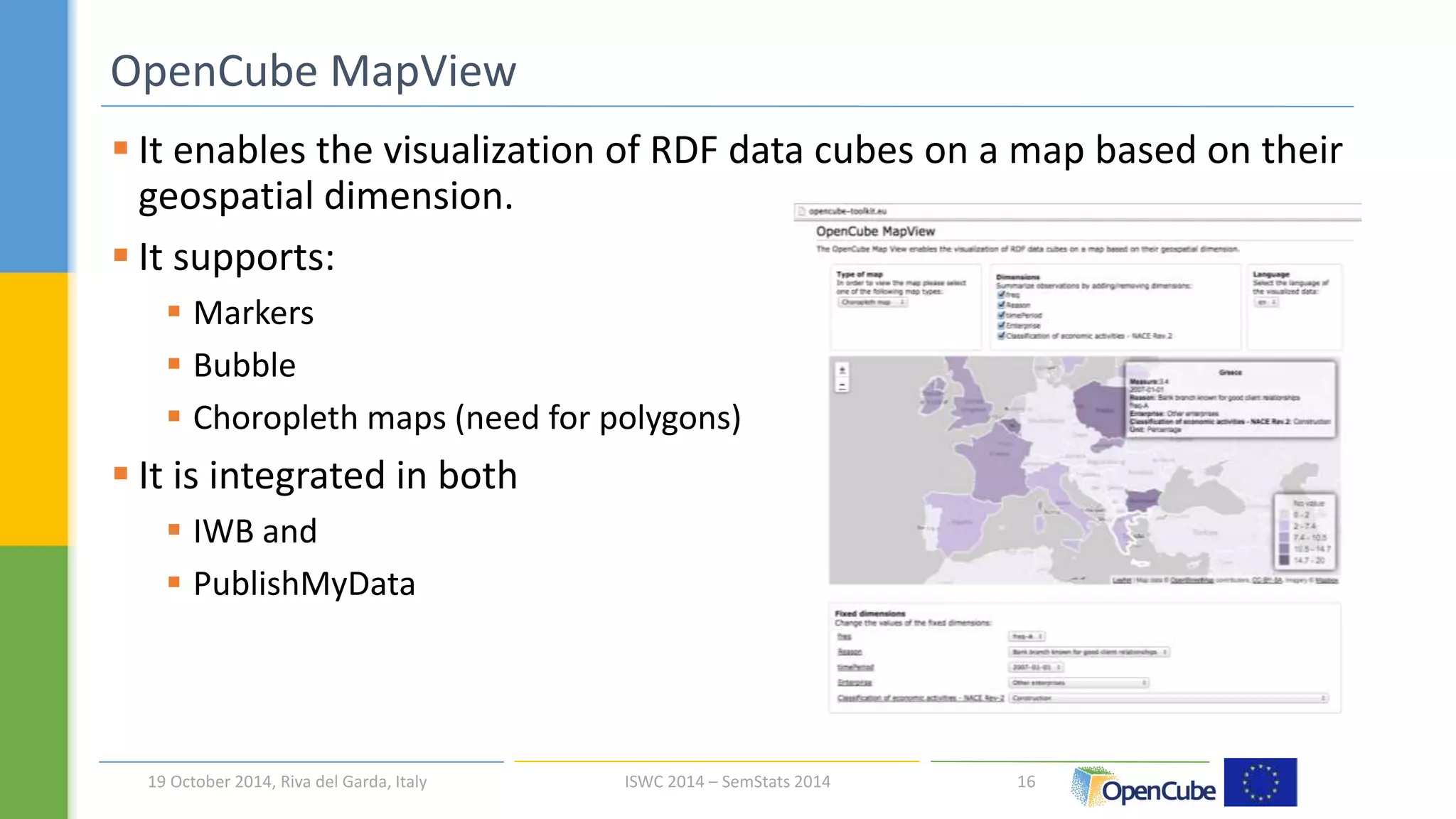
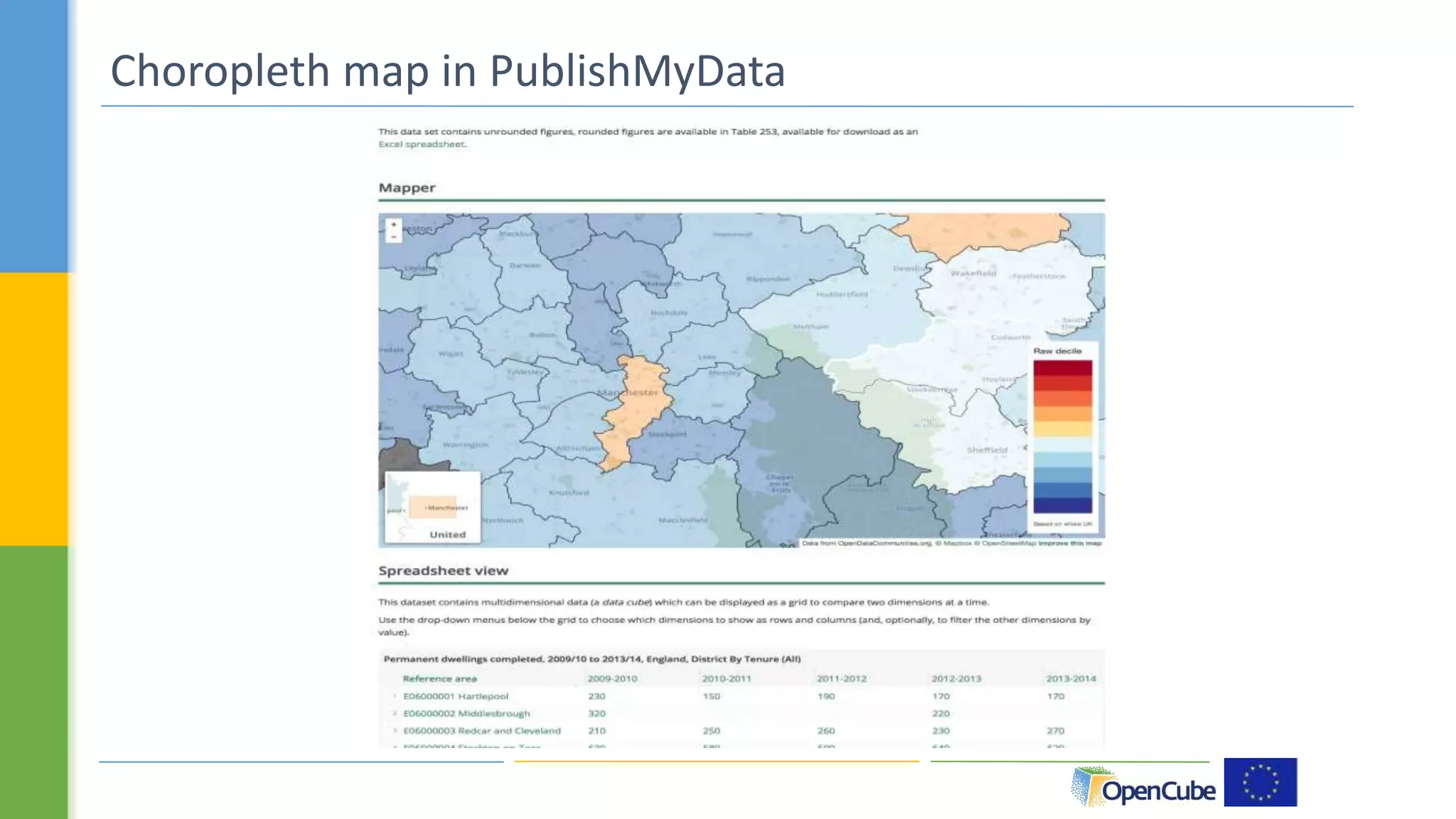
 It enables the visualization of RDF data cubes on a map based on their 
geospatial dimension. 
 It supports: 
 Markers 
 Bubble 
 Choropleth maps (need for polygons) 
 It is integrated in both 
 IWB and 
 PublishMyData 
16 
OpenCube MapView 
19 October 2014, Riva del Garda, Italy ISWC 2014 – SemStats 2014
Choropleth map in PublishMyData
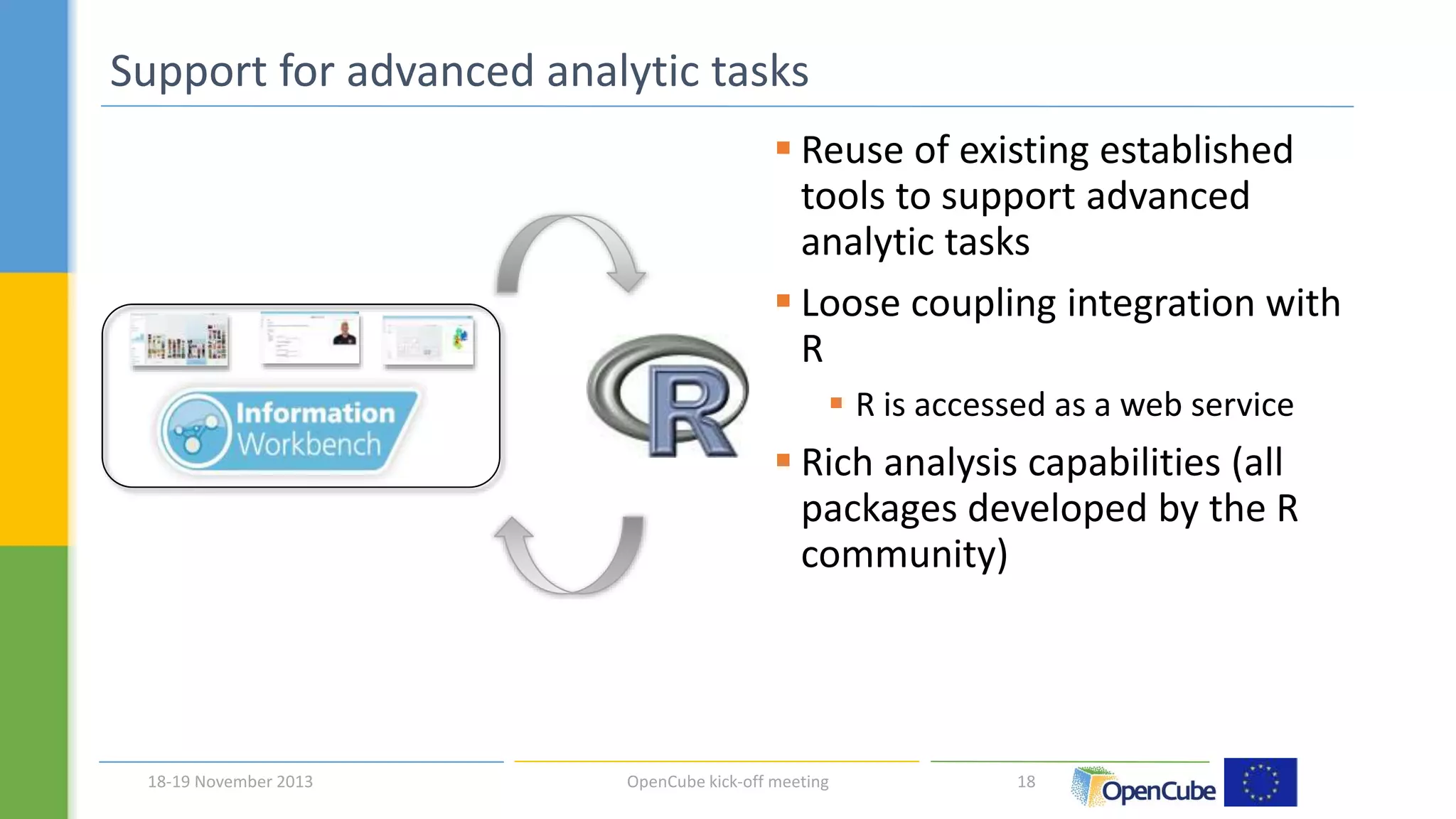
Support for advanced analytic tasks 
 Reuse of existing established 
tools to support advanced 
analytic tasks 
 Loose coupling integration with 
R 
 R is accessed as a web service 
 Rich analysis capabilities (all 
packages developed by the R 
community) 
18-19 November 2013 OpenCube kick-off meeting 18
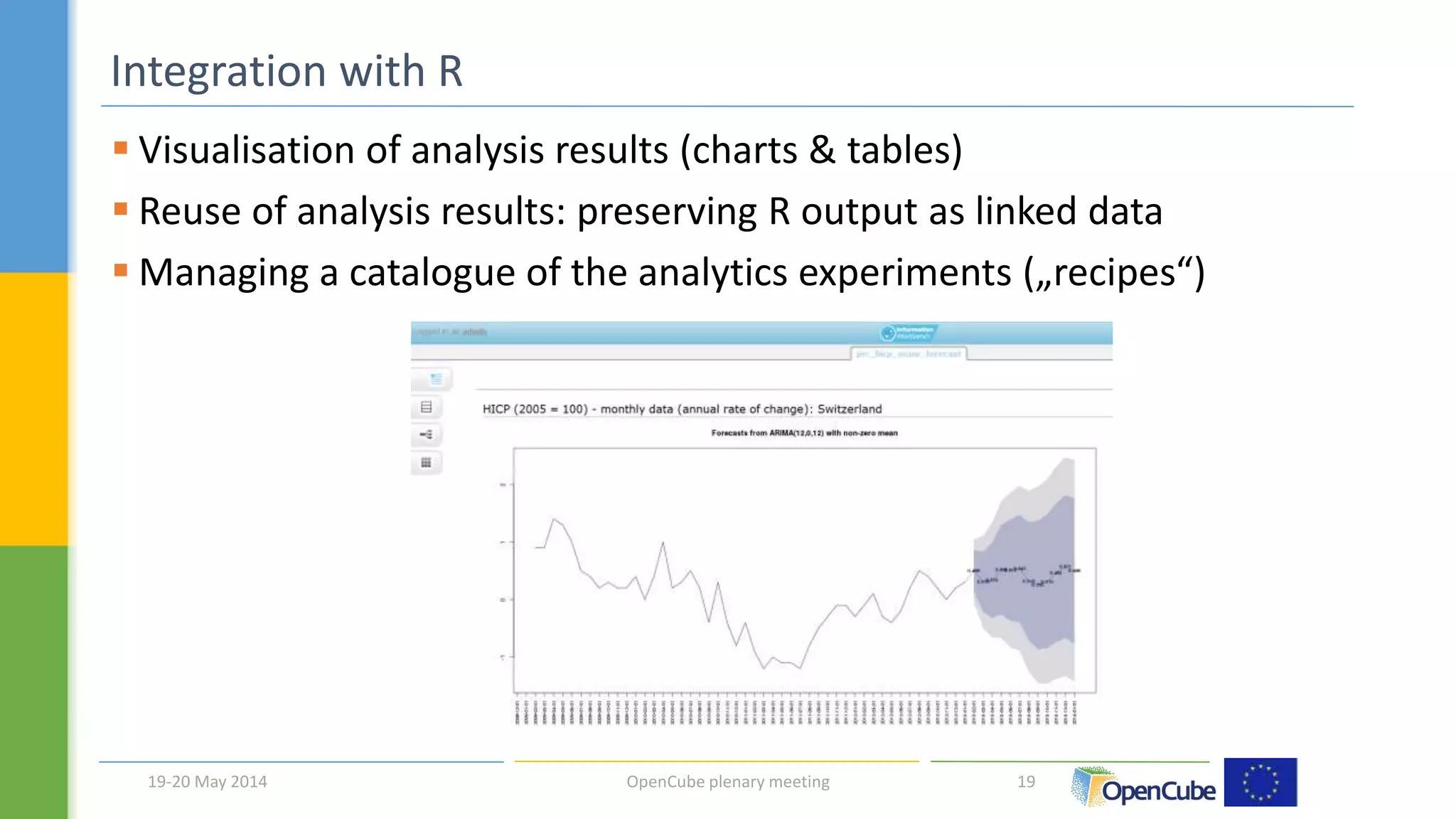
Integration with R 
 Visualisation of analysis results (charts & tables) 
 Reuse of analysis results: preserving R output as linked data 
 Managing a catalogue of the analytics experiments („recipes“) 
19-20 May 2014 OpenCube plenary meeting 19
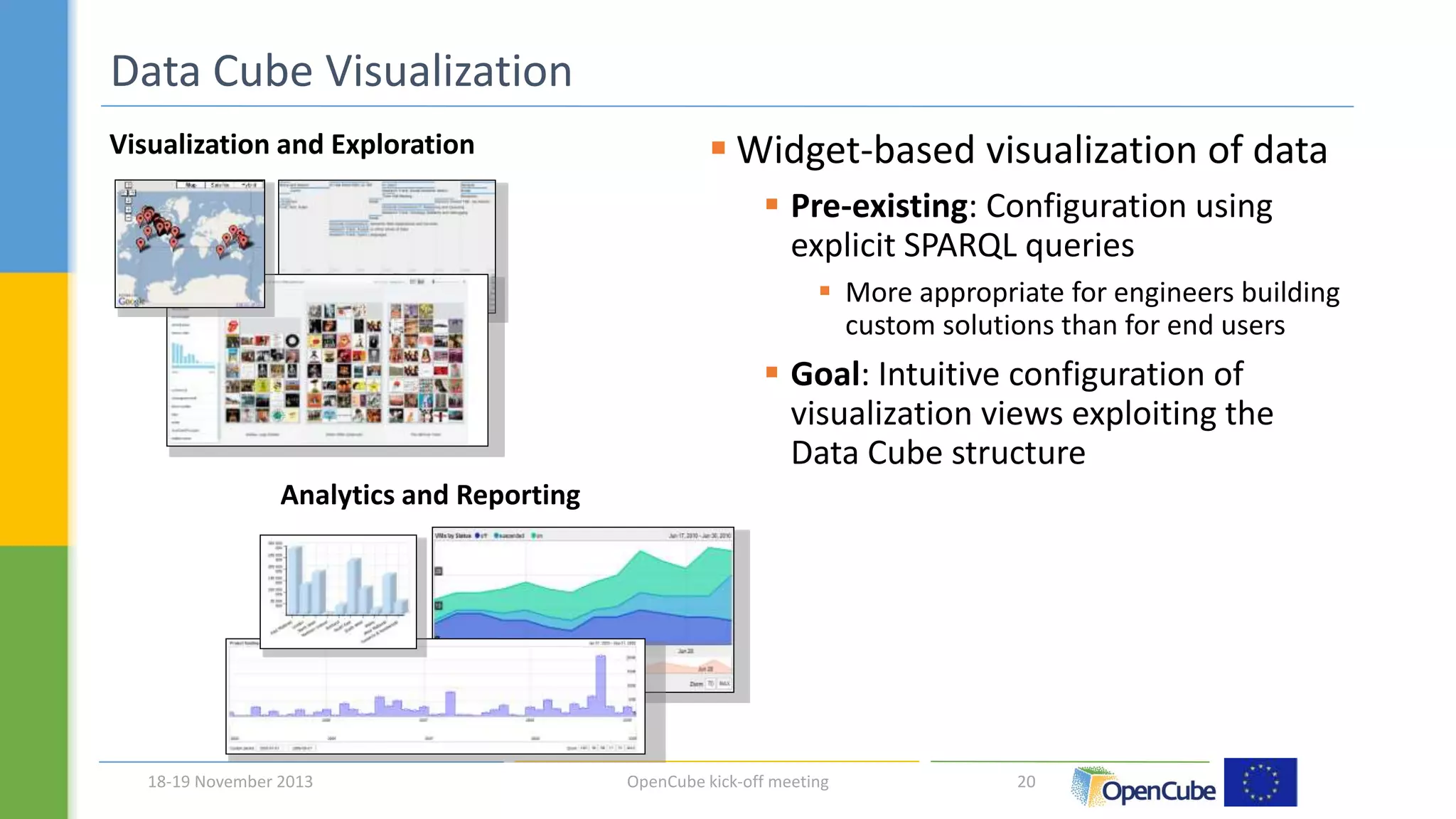
 Widget-based visualization of data 
 Pre-existing: Configuration using 
explicit SPARQL queries 
 More appropriate for engineers building 
custom solutions than for end users 
 Goal: Intuitive configuration of 
visualization views exploiting the 
Data Cube structure 
Data Cube Visualization 
Visualization and Exploration 
Analytics and Reporting 
18-19 November 2013 OpenCube kick-off meeting 20
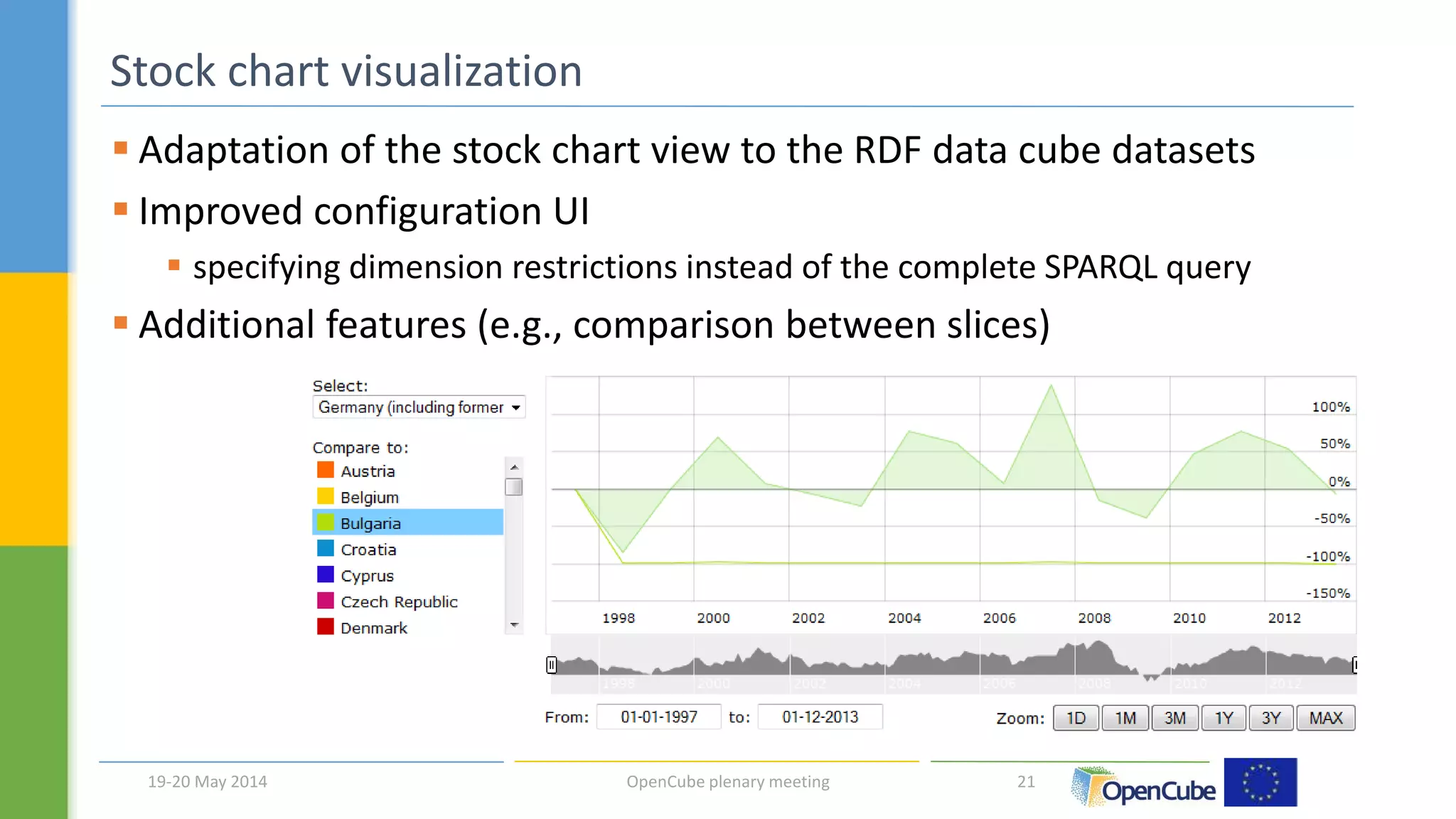
Stock chart visualization 
 Adaptation of the stock chart view to the RDF data cube datasets 
 Improved configuration UI 
 specifying dimension restrictions instead of the complete SPARQL query 
 Additional features (e.g., comparison between slices) 
19-20 May 2014 OpenCube plenary meeting 21
We currently perform evaluations of the components in four pilots 
 Department for Communities and Local Government (UK) 
 Central Statistics Office (Ireland) 
 Flemish Government (Belgium) 
 Swiss Banks 
 Some interesting findings 
 Why to use linked data 
 Performance issues with large data sets 
 Noisy data 
22 
Initial Evaluation Results 
19 October 2014, Riva del Garda, Italy ISWC 2014 – SemStats 2014
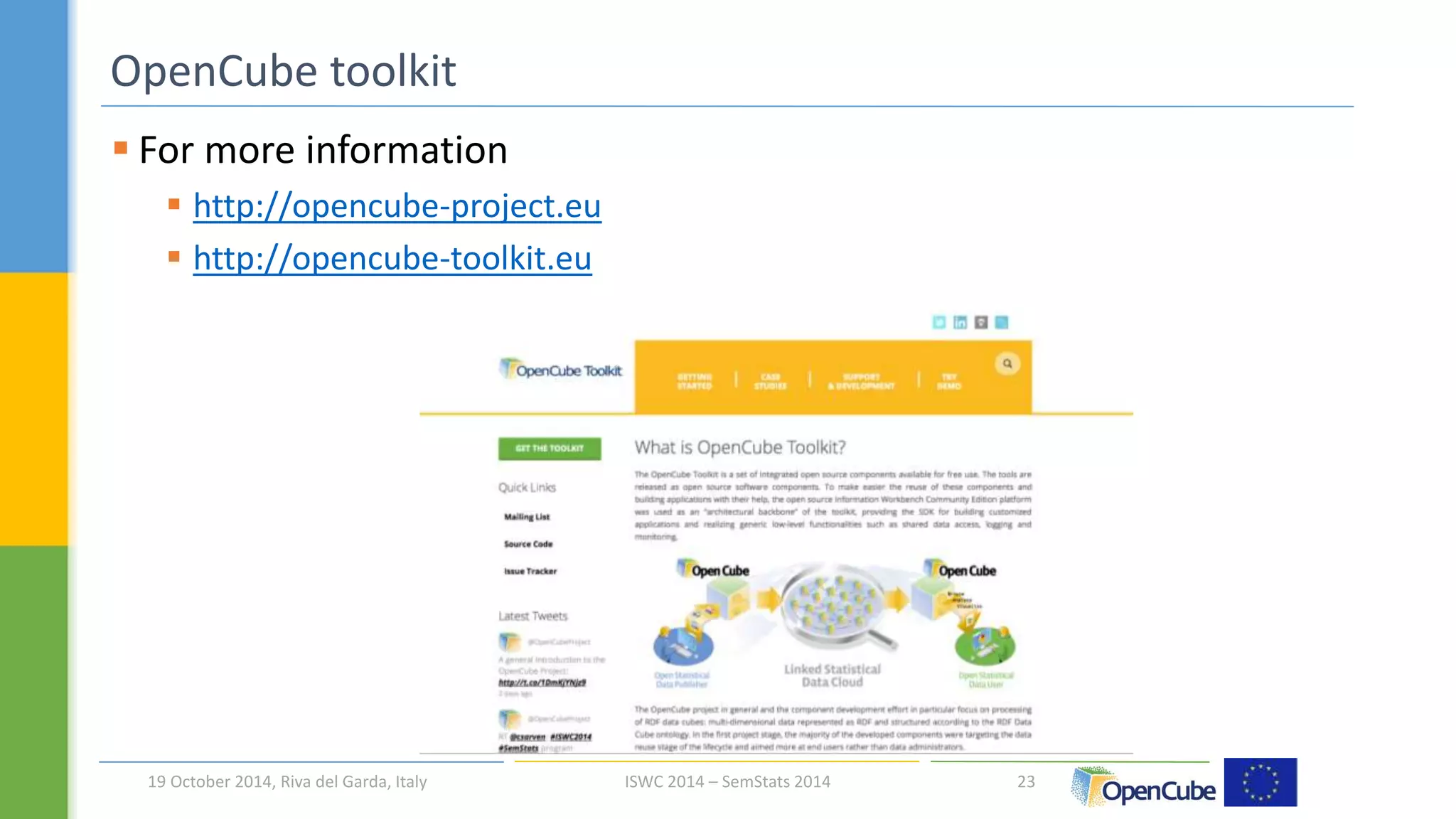
 For more information 
 http://opencube-project.eu 
 http://opencube-toolkit.eu 
23 
OpenCube toolkit 
19 October 2014, Riva del Garda, Italy ISWC 2014 – SemStats 2014

Creating and Utilizing Linked Open Statistical Data for the Development of Advanced Analytics Services

  • 1.
    Creating and UtilizingLinked Open Statistical Data for the Development of Advanced Analytics Services E. Kalampokis, A. Karamanou, A. Nikolov, P. Haase, R. Cyganiak, B. Roberts, P. Hermans, E. Tambouris, K. Tarabanis
  • 2.
     A majorpart of Open Data concerns statistics that can be formulated as data cubes.  The objective of this paper is to present the OpenCube approach for working with linked data cubes.  The ultimate goal of OpenCube is to facilitate  Publishing of high-quality linked statistical data  Reusing linked statistical datasets in visualizations and analytics 2 Objective 19 October 2014, Riva del Garda, Italy ISWC 2014 – SemStats 2014
  • 3.
    Linked Statistical DataLifecycle  OpenCube develops components to support the whole lifecycle of linked statistical data.  The lifecycle describes steps that raw data cubes should go through in order to create value. 19 October 2014, Riva del Garda, Italy ISWC 2014 – SemStats 2014 3
  • 4.
     Different stepsof the lifecycle are realized by separate components.  Two different implementation approaches are considered based on the underlying platform.  fluidOps’ Information Workbench  Swirrl’s PublishMyData  Extensions for the commercial platforms and an Open-Source toolkit. 4 Implementation 19 October 2014, Riva del Garda, Italy ISWC 2014 – SemStats 2014
  • 5.
     Publishing components  TARQL extension  D2RQ /R2RML-QB extension  JSON-stat  Grafter  Consuming components  Data catalogue  OpenCube Browser  OpenCube MapView  R Analysis Chart  Aggregation component 5 Components 19 October 2014, Riva del Garda, Italy ISWC 2014 – SemStats 2014
  • 6.
     TARQL isa command-line tool for converting CSV files to RDF using SPARQL 1.1 syntax  https://github.com/cygri/tarql  TARQL is a SPARQL based data mapping language.  The OpenCube TARQL extension enables RDF data cubes construction from CSV files.  Redesigned TARQL API  Added streaming evaluation mode  It will be integrated to the IWB platform very soon. 6 TARQL OpenCube Extension Components description
  • 7.
     The D2RQOpenCube component enables the generation of RDF data cubes from relational tables.  It builds upon the D2RQ open source platform and it leverages R2RML language.  The component will be integrated into the IWB platform and it will provide an easy to use interface to adjust output mapping. 7 D2RQ/R2RML-QB Extension Components description
  • 8.
     The JSON-statformat is a simple lightweight JSON format for multidimensional data.  http://json-stat.org/format/  A JSON-stat file can contain one or more datasets.  Multiple datasets responses allow a provider to disseminate information with few common dimensions in a single response. 8 JSON-stat Components description
  • 9.
     Open sourcesoftware framework for transforming tabular data (CSV or XLS) to RDF  http://grafter.org  Automatable/works with API  Designed to support a graphical user interface (work in progress)  Performs well with large datasets 9 Grafter 19 October 2014, Riva del Garda, Italy ISWC 2014 – SemStats 2014
  • 10.
    WORLD BANK Managingmetadata over data cubes • Data collection • Integration of major open data catalogs • UI for search and exploration of data sets • Rich metadata based on open standards • Both descriptive and structural metadata • Self-service UI • Custom queries and visualizations • Widgets, dashboarding, etc.
  • 11.
    Data catalogue management  Managing catalogues of datasets  Search & discovery of relevant data  Goal: on-demand provisioning 19-20 May 2014 OpenCube plenary meeting 11
  • 12.
     It enablesthe exploration of an RDF data cube by presenting a two-dimensional slice of the cube as a table.  The slice is created by setting a fixed values for each dimension that is not presented in the table.  The browser is integrated in both IWB and PublishMyData platform. 12 OpenCube browser 19 October 2014, Riva del Garda, Italy ISWC 2014 – SemStats 2014
  • 13.
    13 OpenCube browser(IWB extension) Summarize observations across a dimension (dimension reduction) Change the axes of the table 18-19 November 2013 OpenCube kick-off meeting Change the language Change the fixed values
  • 14.
    Data cube gridview (PublishMyData extension)  See http://opendatacommunities.org for live examples
  • 15.
    Data cube gridview  Shows two dimensional slice of data  Controls to set values of other dimensions  Download chosen slice as CSV  Performs well with large datasets by loading data asynchronously as users scrolls through  See http://opendatacommunities.org for live examples
  • 16.
     It enablesthe visualization of RDF data cubes on a map based on their geospatial dimension.  It supports:  Markers  Bubble  Choropleth maps (need for polygons)  It is integrated in both  IWB and  PublishMyData 16 OpenCube MapView 19 October 2014, Riva del Garda, Italy ISWC 2014 – SemStats 2014
  • 17.
    Choropleth map inPublishMyData
  • 18.
    Support for advancedanalytic tasks  Reuse of existing established tools to support advanced analytic tasks  Loose coupling integration with R  R is accessed as a web service  Rich analysis capabilities (all packages developed by the R community) 18-19 November 2013 OpenCube kick-off meeting 18
  • 19.
    Integration with R  Visualisation of analysis results (charts & tables)  Reuse of analysis results: preserving R output as linked data  Managing a catalogue of the analytics experiments („recipes“) 19-20 May 2014 OpenCube plenary meeting 19
  • 20.
     Widget-based visualizationof data  Pre-existing: Configuration using explicit SPARQL queries  More appropriate for engineers building custom solutions than for end users  Goal: Intuitive configuration of visualization views exploiting the Data Cube structure Data Cube Visualization Visualization and Exploration Analytics and Reporting 18-19 November 2013 OpenCube kick-off meeting 20
  • 21.
    Stock chart visualization  Adaptation of the stock chart view to the RDF data cube datasets  Improved configuration UI  specifying dimension restrictions instead of the complete SPARQL query  Additional features (e.g., comparison between slices) 19-20 May 2014 OpenCube plenary meeting 21
  • 22.
    We currently performevaluations of the components in four pilots  Department for Communities and Local Government (UK)  Central Statistics Office (Ireland)  Flemish Government (Belgium)  Swiss Banks  Some interesting findings  Why to use linked data  Performance issues with large data sets  Noisy data 22 Initial Evaluation Results 19 October 2014, Riva del Garda, Italy ISWC 2014 – SemStats 2014
  • 23.
     For moreinformation  http://opencube-project.eu  http://opencube-toolkit.eu 23 OpenCube toolkit 19 October 2014, Riva del Garda, Italy ISWC 2014 – SemStats 2014