CASE STUDY
STARRING SEAN BEAN
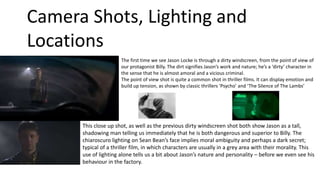
The first time we see Jason Locke is through a dirty windscreen, from the point of view of
our protagonist Billy. The dirt signifies Jason’s work and nature; he’s a ‘dirty’ character in
the sense that he is almost amoral and a vicious criminal.
The point of view shot is quite a common shot in thriller films. It can display emotion and
build up tension, as shown by classic thrillers ‘Psycho’ and ‘The Silence of The Lambs’
This close up shot, as well as the previous dirty windscreen shot both show Jason as a tall,
shadowing man telling us immediately that he is both dangerous and superior to Billy. The
chiaroscuro lighting on Sean Bean’s face implies moral ambiguity and perhaps a dark secret;
typical of a thriller film, in which characters are usually in a grey area with their morality. This
use of lighting alone tells us a bit about Jason’s nature and personality – before we even see his
behaviour in the factory.
Camera Shots, Lighting and
Locations
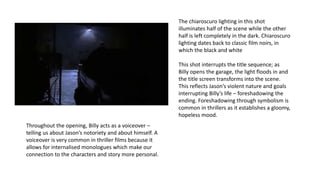
The chiaroscuro lighting in this shot
illuminates half of the scene while the other
half is left completely in the dark. Chiaroscuro
lighting dates back to classic film noirs, in
which the black and white
This shot interrupts the title sequence; as
Billy opens the garage, the light floods in and
the title screen transforms into the scene.
This reflects Jason’s violent nature and goals
interrupting Billy’s life – foreshadowing the
ending. Foreshadowing through symbolism is
common in thrillers as it establishes a gloomy,
hopeless mood.
Throughout the opening, Billy acts as a voiceover –
telling us about Jason’s notoriety and about himself. A
voiceover is very common in thriller films because it
allows for internalised monologues which make our
connection to the characters and story more personal.
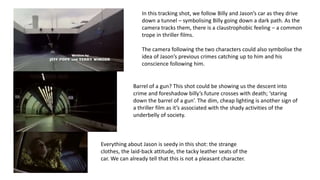
In this tracking shot, we follow Billy and Jason’s car as they drive
down a tunnel – symbolising Billy going down a dark path. As the
camera tracks them, there is a claustrophobic feeling – a common
trope in thriller films.
The camera following the two characters could also symbolise the
idea of Jason’s previous crimes catching up to him and his
conscience following him.
Barrel of a gun? This shot could be showing us the descent into
crime and foreshadow billy’s future crosses with death; ‘staring
down the barrel of a gun’. The dim, cheap lighting is another sign of
a thriller film as it’s associated with the shady activities of the
underbelly of society.
Everything about Jason is seedy in this shot: the strange
clothes, the laid-back attitude, the tacky leather seats of the
car. We can already tell that this is not a pleasant character.
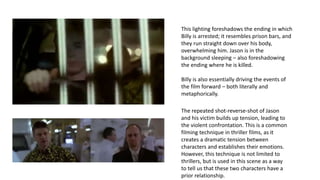
This lighting foreshadows the ending in which
Billy is arrested; it resembles prison bars, and
they run straight down over his body,
overwhelming him. Jason is in the
background sleeping – also foreshadowing
the ending where he is killed.
Billy is also essentially driving the events of
the film forward – both literally and
metaphorically.
The repeated shot-reverse-shot of Jason
and his victim builds up tension, leading to
the violent confrontation. This is a common
filming technique in thriller films, as it
creates a dramatic tension between
characters and establishes their emotions.
However, this technique is not limited to
thrillers, but is used in this scene as a way
to tell us that these two characters have a
prior relationship.
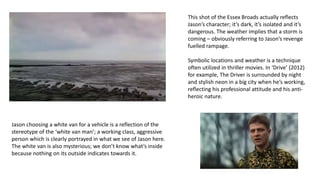
This shot of the Essex Broads actually reflects
Jason’s character; it’s dark, it’s isolated and it’s
dangerous. The weather implies that a storm is
coming – obviously referring to Jason’s revenge
fuelled rampage.
Symbolic locations and weather is a technique
often utilized in thriller movies. In ‘Drive’ (2012)
for example, The Driver is surrounded by night
and stylish neon in a big city when he’s working,
reflecting his professional attitude and his anti-
heroic nature.
Jason choosing a white van for a vehicle is a reflection of the
stereotype of the ‘white van man’; a working class, aggressive
person which is clearly portrayed in what we see of Jason here.
The white van is also mysterious; we don’t know what’s inside
because nothing on its outside indicates towards it.

Essex boys case study

  • 1.
  • 2.
    The first timewe see Jason Locke is through a dirty windscreen, from the point of view of our protagonist Billy. The dirt signifies Jason’s work and nature; he’s a ‘dirty’ character in the sense that he is almost amoral and a vicious criminal. The point of view shot is quite a common shot in thriller films. It can display emotion and build up tension, as shown by classic thrillers ‘Psycho’ and ‘The Silence of The Lambs’ This close up shot, as well as the previous dirty windscreen shot both show Jason as a tall, shadowing man telling us immediately that he is both dangerous and superior to Billy. The chiaroscuro lighting on Sean Bean’s face implies moral ambiguity and perhaps a dark secret; typical of a thriller film, in which characters are usually in a grey area with their morality. This use of lighting alone tells us a bit about Jason’s nature and personality – before we even see his behaviour in the factory. Camera Shots, Lighting and Locations
  • 3.
    The chiaroscuro lightingin this shot illuminates half of the scene while the other half is left completely in the dark. Chiaroscuro lighting dates back to classic film noirs, in which the black and white This shot interrupts the title sequence; as Billy opens the garage, the light floods in and the title screen transforms into the scene. This reflects Jason’s violent nature and goals interrupting Billy’s life – foreshadowing the ending. Foreshadowing through symbolism is common in thrillers as it establishes a gloomy, hopeless mood. Throughout the opening, Billy acts as a voiceover – telling us about Jason’s notoriety and about himself. A voiceover is very common in thriller films because it allows for internalised monologues which make our connection to the characters and story more personal.
  • 4.
    In this trackingshot, we follow Billy and Jason’s car as they drive down a tunnel – symbolising Billy going down a dark path. As the camera tracks them, there is a claustrophobic feeling – a common trope in thriller films. The camera following the two characters could also symbolise the idea of Jason’s previous crimes catching up to him and his conscience following him. Barrel of a gun? This shot could be showing us the descent into crime and foreshadow billy’s future crosses with death; ‘staring down the barrel of a gun’. The dim, cheap lighting is another sign of a thriller film as it’s associated with the shady activities of the underbelly of society. Everything about Jason is seedy in this shot: the strange clothes, the laid-back attitude, the tacky leather seats of the car. We can already tell that this is not a pleasant character.
  • 5.
    This lighting foreshadowsthe ending in which Billy is arrested; it resembles prison bars, and they run straight down over his body, overwhelming him. Jason is in the background sleeping – also foreshadowing the ending where he is killed. Billy is also essentially driving the events of the film forward – both literally and metaphorically. The repeated shot-reverse-shot of Jason and his victim builds up tension, leading to the violent confrontation. This is a common filming technique in thriller films, as it creates a dramatic tension between characters and establishes their emotions. However, this technique is not limited to thrillers, but is used in this scene as a way to tell us that these two characters have a prior relationship.
  • 6.
    This shot ofthe Essex Broads actually reflects Jason’s character; it’s dark, it’s isolated and it’s dangerous. The weather implies that a storm is coming – obviously referring to Jason’s revenge fuelled rampage. Symbolic locations and weather is a technique often utilized in thriller movies. In ‘Drive’ (2012) for example, The Driver is surrounded by night and stylish neon in a big city when he’s working, reflecting his professional attitude and his anti- heroic nature. Jason choosing a white van for a vehicle is a reflection of the stereotype of the ‘white van man’; a working class, aggressive person which is clearly portrayed in what we see of Jason here. The white van is also mysterious; we don’t know what’s inside because nothing on its outside indicates towards it.