Essential Routine Health
Checks and Practices
Dr Bertha Chioma Ekeh
A Health Talk given at SUN NEWSPAPERS on Sept 28th 2022
Disclosure
 Associate Professor/Consultant Neurologist Dr Bertha Chioma Ekeh; B, Med Pharmacology,
MBBS, FMCP (Neuro)
 University of Uyo/University of Uyo Teaching Hospital
 Adjunct Consultant Neurologist, Ibom Specialist Hospital Uyo
 Nigeria
 Author of 7 books
 Public Speaker
 webpage https://www.amazon.com/Dr-Bertha-Chioma-Ekeh/e/B07D442KRX
 Blog https://medicalinfoblog.net
 I HAVE NO CONFLICTS OF INTEREST
Content
 Introduction
 Health Promotion
 Screening
 Cancer Screening
 Life Style Modifications
Introduction
 "The doctor of the future will give no
medicine, but will interest his
patients in the care of human frame,
and in the cause and prevention of
disease."

- T. A. Edison
Health promotion
 Defined by the World Health Organization's (WHO) 2005 Bangkok Charter for
Health Promotion in a Globalized World as
"the process of enabling people to
increase control over their health and its
determinants, and thereby improve their
health".
Principles of health promotion
 Includes five domains:
 Screening for disease at an early stage
 Counseling about a healthy lifestyle (e.g., diet, exercise, smoking cessation, falls prevention, safe
driving)
 Immunizations (pneumococcal, influenza, tetanus vaccines)
 Chemoprophylaxis (aspirin, statins, bisphosphonates)
 System changes to promote patient safety
Importance of Screening
 A primary goal of screening
 The early detection of a risk factor or disease at a stage when it can be corrected or
cured
 Early identification of hypertension or hyperlipidemia allows therapeutic
interventions that reduce the risk of cardiovascular or cerebrovascular events
 Routine antenatal checks
Commonly screened diseases
 Breast cancer and cervical cancer in women
 Colorectal cancer
 Diabetes
 High blood pressure
 High cholesterol
 Osteoporosis
 Overweight and obesity
 Prostate cancer in men
 HIV Screening
Cancer Screening
 Prostate cancer
 Breast cancer
 Cervical cancer
Prostate Gland
 The prostate sits deep in the pelvis, beneath the bladder
 It’s a small, soft organ: size of a walnut or a ping-pong ball about 30g in weight.
 The most important is producing seminal fluid: a component of semen
 Plays a role in hormone production
 Helps regulate urine flow
 The urethra, a tube that carries urine and semen out of the body, passes through
the prostate.
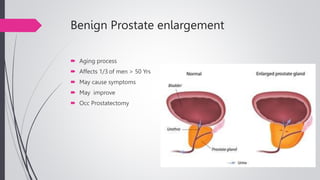
Benign Prostate enlargement
 Aging process
 Affects 1/3 of men > 50 Yrs
 May cause symptoms
 May improve
 Occ Prostatectomy
Symptoms of prostate enlargement
 Frequent urge to urinate especially in the night
 Difficulty in starting and maintaining urination
 Blood in urine or semen
 Pain or burning urination
 Painful ejaculation
 Frequent pain or stiffness in lower back, hips, pelvic or rectal area, or upper thighs
 Dribbling of urine or weak stream
 Incomplete emptying
Prostate Cancer
 Commoner in men older than 60 years: most often diagnosed in men aged 65-74
years
 Seen in men as young as 17 years
 Mortality over 2-fold higher in Blacks than in Whites
 Incidence is highest in Blacks and Caribbean men of African descent
 Risk factors include ethnicity, age, and country of residence.
Prostate Cancer
 There are often “NO Symptoms” during the early stages
 Advanced symptoms
 May still also show no symptoms
 Advanced prostate cancer present with the following:
 Bone pains
 Unexplained weight loss
 Fatigue
Screening for Prostate cancer
 Prostate Specific Antigen (PSA) Test
 PSA is a substance made by the prostate
 High levels of PSA in the blood that cancer may be present
 PSA levels also can be affected by—Certain medical procedures, medications, An
enlarged prostate or A prostate infection
Breast Cancer
 It is the most frequently diagnosed life-threatening cancer in women
 It is the leading cause of cancer death in women in less developed countries
 It has been surpassed by lung cancer as a cause of cancer death in women in
developed countries.
 Early breast cancers are asymptomatic; No pain or discomfort
 Breast cancer is often first detected as an abnormality on a mammogram before it
is felt by the patient or healthcare provider.
Risk Factors
 Risk factors you cannot change
 Increasing age especially after the age of 50 years
 Inherited genes like BRCA1 and BRCA2 have a higher risk of breast and ovarian
cancers
 Early menarche (<12 years) and late menopause (>55years) high levels of
hormones
 Previous history of breast cancer
 Family history; first degree relatives or multiple family members
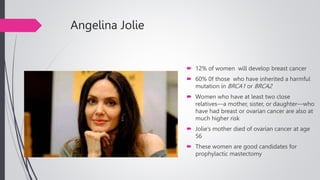
Angelina Jolie
 12% of women will develop breast cancer
 60% 0f those who have inherited a harmful
mutation in BRCA1 or BRCA2
 Women who have at least two close
relatives—a mother, sister, or daughter—who
have had breast or ovarian cancer are also at
much higher risk
 Jolie’s mother died of ovarian cancer at age
56
 These women are good candidates for
prophylactic mastectomy
Contd
 Risk Factors You Can Change
 Physically inactivity
 Obesity especially after menopause
 Hormones like oral contraceptives and hormone replacement after menopause
 1st pregnancy after the age of 30 years, not breastfeeding
 Drinking Alcohol
 Smoking
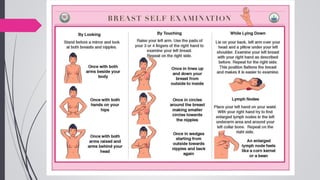
Symptoms of Breast cancer
 New lump in the breast or armpit
 Thickening or swelling of part of the breast
 Irritation or dimpling of the skin of the breast
 Redness or flaky skin in the nipple area or the breast
 Nipple pain
 Discharge other than breast milk, including blood
 Any change in the size or the shape of the breast
 Pain in any area of the breast
Screening for Breast cancer
 Women in their 20s and 30s should have a clinical breast exam (CBE)
 This should be part of a periodic (regular) health exam by a health professional
preferably every 3 years
 Starting at age 40, women should have a CBE by a health professional every year
 Women age 40 and older should have a mammogram every year
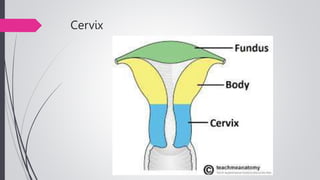
Cervix
Symptoms of cervical cancer
 Bleeding between periods
 Bleeding after sexual intercourse
 Bleeding in post-menopausal women
 Discomfort during sexual intercourse
 Vaginal discharge with a strong odor
 Vaginal discharge tinged with blood
 Pelvic pain
Cervical cancer
 There are 2 types of tests used for cervical cancer screening.
 The Pap test
 The HPV (human papilloma virus) test
 All women should begin cervical cancer screening at age 21.
 Women between the ages of 21 and 29 should have a Pap test every 3 years.
They should not be tested for HPV unless it is needed after an abnormal Pap
test result.
 Women between the ages of 30 and 65 should have both a Pap test and an
HPV test every 5 years
 This is the preferred approach, but it is also OK to have a Pap test alone every
3 years.
Watchword
Early diagnosis makes a
“world of difference”
Eye Examination
 18-60 years Every 2 years
 ≥ 60 years Annually
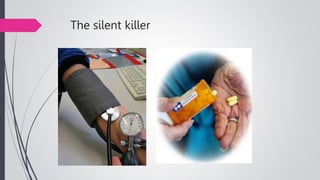
The silent killer
Triple Curse
 This was actually defined in African Americans
 More likely to be hypertensive
 Less likely to have their blood pressure controlled
 Once it's not controlled, it's 3 times worse" in terms of stroke risk
 George Howard, Dr PH, professor, biostatistics, School of Public Health, University of Alabama at Birmingham
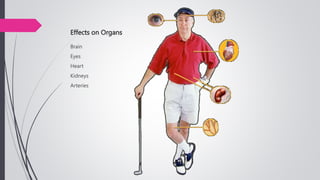
Effects on Organs
Brain
Eyes
Heart
Kidneys
Arteries
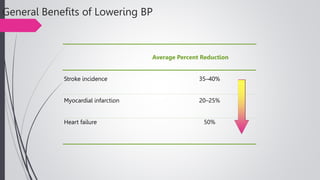
General Benefits of Lowering BP
Average Percent Reduction
Stroke incidence 35–40%
Myocardial infarction 20–25%
Heart failure 50%
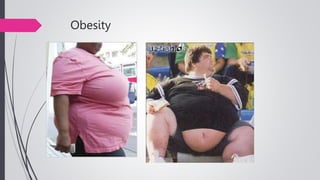
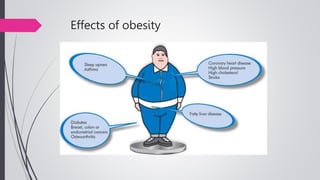
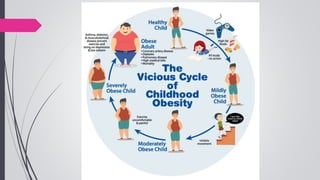
Obesity
Effects of obesity
Prevention
 Healthy Food
 Avoid fast foods
 Exercise
 Healthy School environment
 Reduce the menace of social media
 Occupy them positively
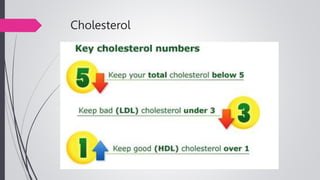
Cholesterol
 Note
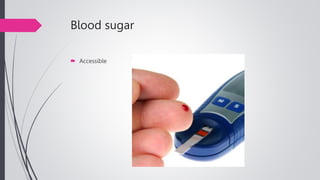
Blood sugar
 Accessible
Complications of Diabetes
 Brain
 Heart
 Eyes
 Kidneys
 Nerves
 Foot ulcer
Good health seeking behaviour
 See your Doctor
 May need some investigations
 Take your medications as prescribed by your Doctor
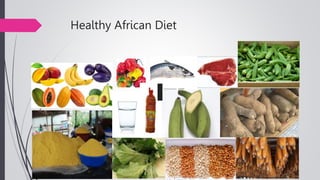
Healthy African Diet
Qualities of Healthy Food
 Fresh food
 Unprocessed/minimally processed food
 Plant oils
 Fruits and vegetables
 Drink water
Cooking Methods
Boil
Steam
Roast
Grill without oil
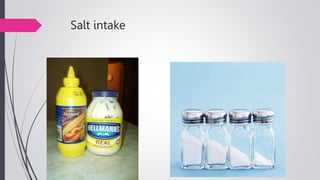
Salt intake
Reduce Alcohol Intake
French Paradox
Drink Water
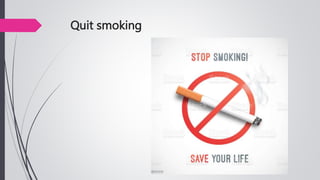
Quit smoking
Exercise
NEAT
Sitting is the New Smoking!!!!
Beauty Products
Why skin products?
 The skin is the largest organ in the body
 Absorption from all the pores of the body
 Dangerous substances include: Hydroquinone, Mercury
 Dangers range from destruction of the skin, kidneys, liver
 Skin cancer
Safe Sex
 Death Toll from HIV
 WHO estimates that as of 2021HIV/AIDS has killed approximately 40.1 million
people
 Approx 38.4 million people are infected with HIV globally
 700,000 still die from HIV every year
 Hepatitis B/Liver cancer
 Other Sexually transmitted Diseases
 Cervical Cancer
Safety Tips
Good Hygiene
 Hand washing
 Clean your house
 Food hygiene
 Mosquito treated nets
Good Sleep
Pray
Essential Routine Health Checks and Practices.pptx

Essential Routine Health Checks and Practices.pptx

  • 1.
    Essential Routine Health Checksand Practices Dr Bertha Chioma Ekeh A Health Talk given at SUN NEWSPAPERS on Sept 28th 2022
  • 2.
    Disclosure  Associate Professor/ConsultantNeurologist Dr Bertha Chioma Ekeh; B, Med Pharmacology, MBBS, FMCP (Neuro)  University of Uyo/University of Uyo Teaching Hospital  Adjunct Consultant Neurologist, Ibom Specialist Hospital Uyo  Nigeria  Author of 7 books  Public Speaker  webpage https://www.amazon.com/Dr-Bertha-Chioma-Ekeh/e/B07D442KRX  Blog https://medicalinfoblog.net  I HAVE NO CONFLICTS OF INTEREST
  • 3.
    Content  Introduction  HealthPromotion  Screening  Cancer Screening  Life Style Modifications
  • 4.
    Introduction  "The doctorof the future will give no medicine, but will interest his patients in the care of human frame, and in the cause and prevention of disease."  - T. A. Edison
  • 6.
    Health promotion  Definedby the World Health Organization's (WHO) 2005 Bangkok Charter for Health Promotion in a Globalized World as "the process of enabling people to increase control over their health and its determinants, and thereby improve their health".
  • 7.
    Principles of healthpromotion  Includes five domains:  Screening for disease at an early stage  Counseling about a healthy lifestyle (e.g., diet, exercise, smoking cessation, falls prevention, safe driving)  Immunizations (pneumococcal, influenza, tetanus vaccines)  Chemoprophylaxis (aspirin, statins, bisphosphonates)  System changes to promote patient safety
  • 8.
    Importance of Screening A primary goal of screening  The early detection of a risk factor or disease at a stage when it can be corrected or cured  Early identification of hypertension or hyperlipidemia allows therapeutic interventions that reduce the risk of cardiovascular or cerebrovascular events  Routine antenatal checks
  • 9.
    Commonly screened diseases Breast cancer and cervical cancer in women  Colorectal cancer  Diabetes  High blood pressure  High cholesterol  Osteoporosis  Overweight and obesity  Prostate cancer in men  HIV Screening
  • 10.
    Cancer Screening  Prostatecancer  Breast cancer  Cervical cancer
  • 11.
    Prostate Gland  Theprostate sits deep in the pelvis, beneath the bladder  It’s a small, soft organ: size of a walnut or a ping-pong ball about 30g in weight.  The most important is producing seminal fluid: a component of semen  Plays a role in hormone production  Helps regulate urine flow  The urethra, a tube that carries urine and semen out of the body, passes through the prostate.
  • 12.
    Benign Prostate enlargement Aging process  Affects 1/3 of men > 50 Yrs  May cause symptoms  May improve  Occ Prostatectomy
  • 13.
    Symptoms of prostateenlargement  Frequent urge to urinate especially in the night  Difficulty in starting and maintaining urination  Blood in urine or semen  Pain or burning urination  Painful ejaculation  Frequent pain or stiffness in lower back, hips, pelvic or rectal area, or upper thighs  Dribbling of urine or weak stream  Incomplete emptying
  • 14.
    Prostate Cancer  Commonerin men older than 60 years: most often diagnosed in men aged 65-74 years  Seen in men as young as 17 years  Mortality over 2-fold higher in Blacks than in Whites  Incidence is highest in Blacks and Caribbean men of African descent  Risk factors include ethnicity, age, and country of residence.
  • 15.
    Prostate Cancer  Thereare often “NO Symptoms” during the early stages  Advanced symptoms  May still also show no symptoms  Advanced prostate cancer present with the following:  Bone pains  Unexplained weight loss  Fatigue
  • 16.
    Screening for Prostatecancer  Prostate Specific Antigen (PSA) Test  PSA is a substance made by the prostate  High levels of PSA in the blood that cancer may be present  PSA levels also can be affected by—Certain medical procedures, medications, An enlarged prostate or A prostate infection
  • 17.
    Breast Cancer  Itis the most frequently diagnosed life-threatening cancer in women  It is the leading cause of cancer death in women in less developed countries  It has been surpassed by lung cancer as a cause of cancer death in women in developed countries.  Early breast cancers are asymptomatic; No pain or discomfort  Breast cancer is often first detected as an abnormality on a mammogram before it is felt by the patient or healthcare provider.
  • 18.
    Risk Factors  Riskfactors you cannot change  Increasing age especially after the age of 50 years  Inherited genes like BRCA1 and BRCA2 have a higher risk of breast and ovarian cancers  Early menarche (<12 years) and late menopause (>55years) high levels of hormones  Previous history of breast cancer  Family history; first degree relatives or multiple family members
  • 19.
    Angelina Jolie  12%of women will develop breast cancer  60% 0f those who have inherited a harmful mutation in BRCA1 or BRCA2  Women who have at least two close relatives—a mother, sister, or daughter—who have had breast or ovarian cancer are also at much higher risk  Jolie’s mother died of ovarian cancer at age 56  These women are good candidates for prophylactic mastectomy
  • 20.
    Contd  Risk FactorsYou Can Change  Physically inactivity  Obesity especially after menopause  Hormones like oral contraceptives and hormone replacement after menopause  1st pregnancy after the age of 30 years, not breastfeeding  Drinking Alcohol  Smoking
  • 21.
    Symptoms of Breastcancer  New lump in the breast or armpit  Thickening or swelling of part of the breast  Irritation or dimpling of the skin of the breast  Redness or flaky skin in the nipple area or the breast  Nipple pain  Discharge other than breast milk, including blood  Any change in the size or the shape of the breast  Pain in any area of the breast
  • 23.
    Screening for Breastcancer  Women in their 20s and 30s should have a clinical breast exam (CBE)  This should be part of a periodic (regular) health exam by a health professional preferably every 3 years  Starting at age 40, women should have a CBE by a health professional every year  Women age 40 and older should have a mammogram every year
  • 24.
  • 25.
    Symptoms of cervicalcancer  Bleeding between periods  Bleeding after sexual intercourse  Bleeding in post-menopausal women  Discomfort during sexual intercourse  Vaginal discharge with a strong odor  Vaginal discharge tinged with blood  Pelvic pain
  • 26.
    Cervical cancer  Thereare 2 types of tests used for cervical cancer screening.  The Pap test  The HPV (human papilloma virus) test  All women should begin cervical cancer screening at age 21.  Women between the ages of 21 and 29 should have a Pap test every 3 years. They should not be tested for HPV unless it is needed after an abnormal Pap test result.  Women between the ages of 30 and 65 should have both a Pap test and an HPV test every 5 years  This is the preferred approach, but it is also OK to have a Pap test alone every 3 years.
  • 27.
    Watchword Early diagnosis makesa “world of difference”
  • 28.
    Eye Examination  18-60years Every 2 years  ≥ 60 years Annually
  • 29.
  • 30.
    Triple Curse  Thiswas actually defined in African Americans  More likely to be hypertensive  Less likely to have their blood pressure controlled  Once it's not controlled, it's 3 times worse" in terms of stroke risk  George Howard, Dr PH, professor, biostatistics, School of Public Health, University of Alabama at Birmingham
  • 31.
  • 32.
    General Benefits ofLowering BP Average Percent Reduction Stroke incidence 35–40% Myocardial infarction 20–25% Heart failure 50%
  • 33.
  • 34.
  • 36.
    Prevention  Healthy Food Avoid fast foods  Exercise  Healthy School environment  Reduce the menace of social media  Occupy them positively
  • 37.
  • 38.
  • 39.
    Complications of Diabetes Brain  Heart  Eyes  Kidneys  Nerves  Foot ulcer
  • 40.
    Good health seekingbehaviour  See your Doctor  May need some investigations  Take your medications as prescribed by your Doctor
  • 41.
  • 42.
    Qualities of HealthyFood  Fresh food  Unprocessed/minimally processed food  Plant oils  Fruits and vegetables  Drink water
  • 43.
  • 44.
  • 45.
  • 46.
  • 47.
  • 48.
  • 49.
  • 50.
  • 51.
    Sitting is theNew Smoking!!!!
  • 52.
  • 53.
    Why skin products? The skin is the largest organ in the body  Absorption from all the pores of the body  Dangerous substances include: Hydroquinone, Mercury  Dangers range from destruction of the skin, kidneys, liver  Skin cancer
  • 54.
    Safe Sex  DeathToll from HIV  WHO estimates that as of 2021HIV/AIDS has killed approximately 40.1 million people  Approx 38.4 million people are infected with HIV globally  700,000 still die from HIV every year  Hepatitis B/Liver cancer  Other Sexually transmitted Diseases  Cervical Cancer
  • 55.
  • 56.
    Good Hygiene  Handwashing  Clean your house  Food hygiene  Mosquito treated nets
  • 57.
  • 58.