Essential Principles of
Security
ashokveda.com
• Introduction to Security Principles
• Confidentiality
• Integrity
• Availability
• Non-repudiation
• Authentication
• Authorization
• Accountability
Agenda
• Least Privilege
• Defense in Depth
• Security by Design
• Risk Management
• Incident Response
• Continuous Improvement
• Conclusion
ashokveda.com
Introduction to Security Principles
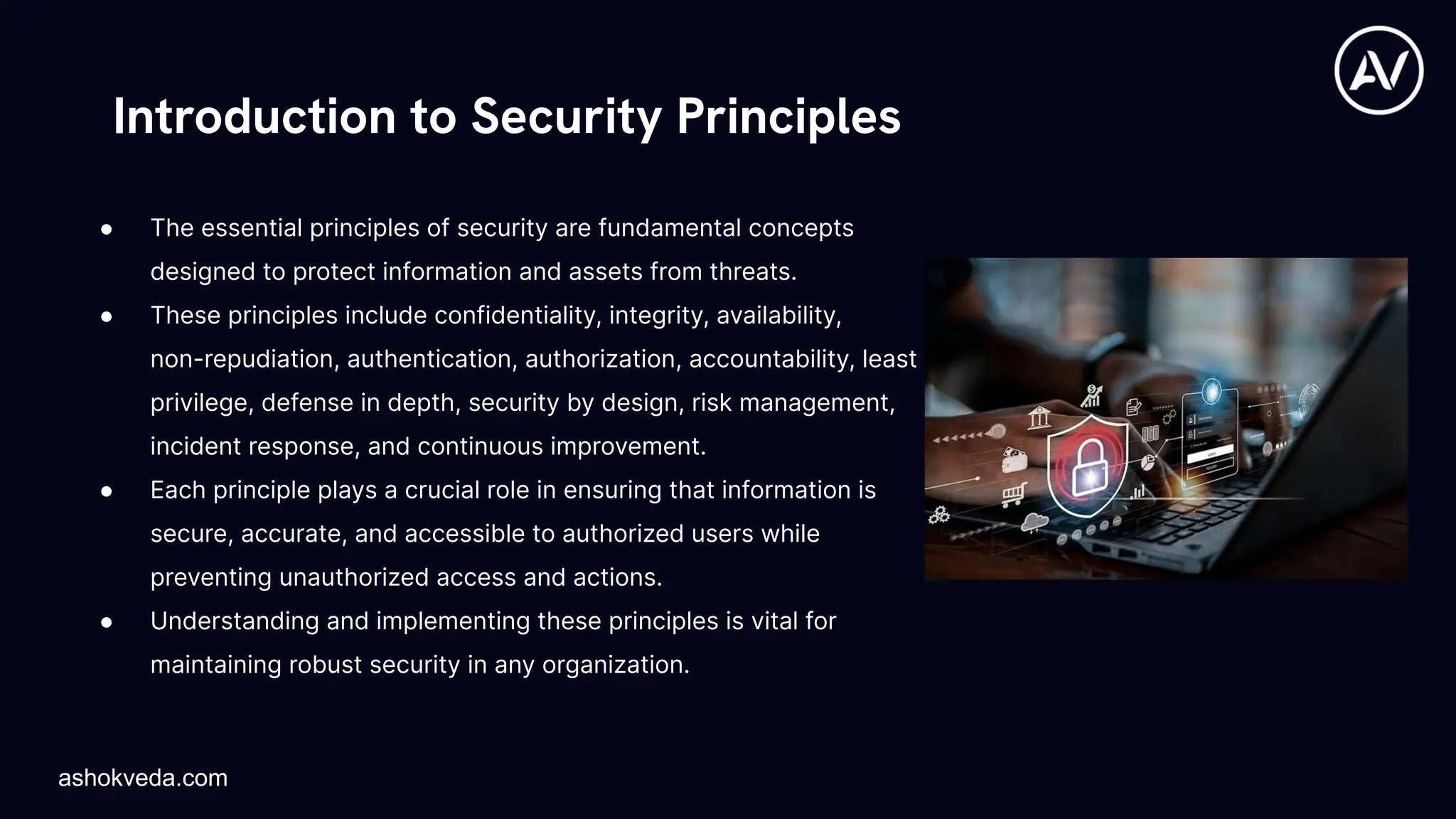
● The essential principles of security are fundamental concepts
designed to protect information and assets from threats.
● These principles include confidentiality, integrity, availability,
non-repudiation, authentication, authorization, accountability, least
privilege, defense in depth, security by design, risk management,
incident response, and continuous improvement.
● Each principle plays a crucial role in ensuring that information is
secure, accurate, and accessible to authorized users while
preventing unauthorized access and actions.
● Understanding and implementing these principles is vital for
maintaining robust security in any organization.
ashokveda.com
Confidentiality
Confidentiality ensures that sensitive information is accessible only to
those authorized to have access. It prevents unauthorized disclosure of
information.
Methods to ensure confidentiality include encryption, access control
mechanisms, and secure communication channels. These methods protect
data from unauthorized access.
Definition
Methods
Importance
Maintaining confidentiality is crucial to protect personal privacy,
intellectual property, and sensitive organizational information, thereby
preventing data breaches and loss of trust.
ashokveda.com
Making certain that all required data
is present and has not been omitted
or tampered with, ensuring the
reliability of the information.
Implementing controls such as
checksums, hashes, and digital
signatures to detect and prevent
unauthorized changes to information.
Ensuring that information remains
unaltered during storage,
transmission, or processing, except
by authorized individuals or
processes.
Validation Mechanisms
Accuracy Maintenance Completeness Assurance
Integrity
ashokveda.com
Scalability
Implementing redundant
systems and backups to prevent
downtime. Regularly testing
disaster recovery plans to
ensure swift restoration of
services.
Ensuring Accessibility Uptime Monitoring
Availability
Utilizing monitoring tools to track
system performance and identify
issues before they cause service
interruptions. Ensuring 24/7
availability for critical systems.
Designing systems that can
scale to handle increased load
without compromising
performance. Planning for future
growth to maintain availability as
demand increases.
ashokveda.com
• Non-repudiation ensures that a party cannot deny
the authenticity of their actions.
• It is critical in legal and financial transactions to
prevent fraud and disputes.
• Achieved through mechanisms like digital
signatures and audit logs.
Definition and Importance
• Digital signatures provide proof of origin and
integrity of messages.
• Audit logs record the sequence of actions for
accountability.
• Examples include signed emails and blockchain
transactions.
Mechanisms and Examples
Non-repudiation
ashokveda.com
1 2 3
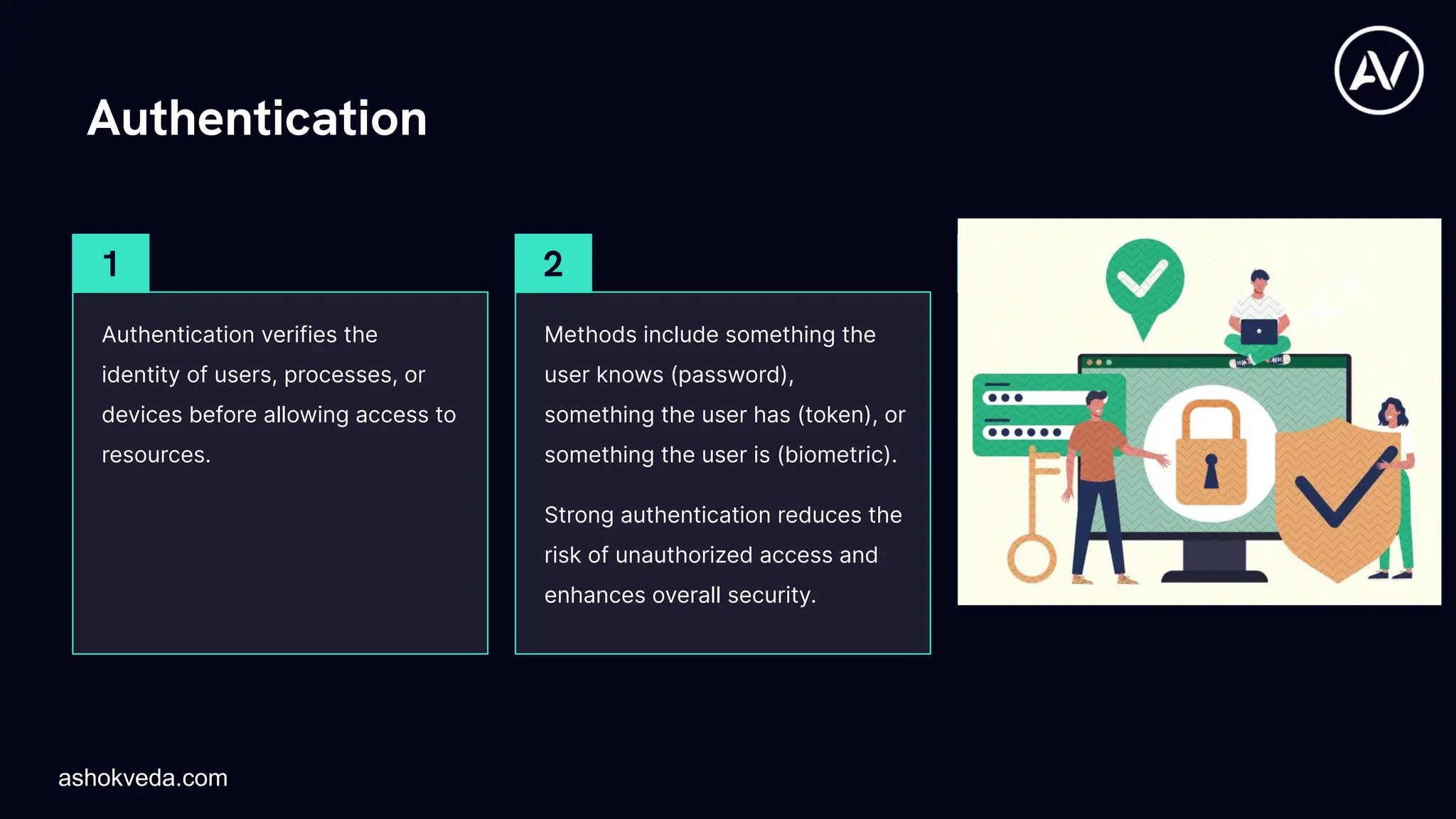
Methods include something the
user knows (password),
something the user has (token), or
something the user is (biometric).
Strong authentication reduces the
risk of unauthorized access and
enhances overall security.
Authentication verifies the
identity of users, processes, or
devices before allowing access to
resources.
Authentication
1 2
ashokveda.com
1 2 3
It involves implementing policies
and controls to prevent
unauthorized actions and data
breaches by limiting user
permissions.
Role-based access control (RBAC)
is a common method used in
authorization to assign
permissions based on user roles
within an organization.
Authorization determines the
access levels and permissions
granted to authenticated users,
ensuring they only access
resources necessary for their
roles.
Authorization
1 2 3
ashokveda.com
Monitoring and logging
mechanisms are essential for
tracking user actions and
system processes.
Accountability helps in
investigating incidents and
enforcing policies by identifying
responsible parties.
Accountability
Actions are logged to create an
audit trail that links activities to
specific entities.
3
2
1
ashokveda.com
Least Privilege
Least privilege means granting users the minimum levels of
access—or permissions—needed to perform their job functions.
This reduces the risk of misuse or accidental damage.
To implement least privilege, regularly review and adjust user
permissions, ensure role-based access control (RBAC), and
employ tools that monitor access levels.
Definition
Implementatio
n
Benefits
Adhering to the principle of least privilege minimizes potential
attack vectors, limits the spread of malware, and enhances overall
security posture.
ashokveda.com
Defense in Depth
Implementing various security controls at different layers to create a
robust defense, such as firewalls, intrusion detection systems, and
antivirus software.
Ensuring that if one security control fails, others will continue to protect
the system. This includes using backup systems and multiple
authentication methods.
Multiple
Layers
Redundancy
Comprehensiv
e Protection
Addressing security at all levels, including network, application, and
physical security, to provide a holistic approach to safeguarding assets.
ashokveda.com
Security by Design
Integrating security from the initial stages of development ensures
vulnerabilities are addressed early, reducing the risk of breaches and
costly fixes later.
Security considerations are embedded into every phase of the
development lifecycle, from design and coding to testing and deployment,
ensuring comprehensive protection.
Proactive
Approach
Holistic
Integration
Collaboration
Close collaboration between developers, security experts, and
stakeholders ensures that security requirements are well-understood and
effectively implemented.
ashokveda.com
Risk Management
Identifying potential threats and vulnerabilities that could harm the
organization's information and assets. This includes assessing the likelihood
and impact of different risks.
Evaluating the identified risks to determine their potential impact on the
organization. This involves prioritizing risks based on their severity and
likelihood of occurrence.
Risk
Identification
Risk Assessment
Risk Mitigation
Implementing measures to reduce the identified risks to an acceptable level.
This can include technical controls, policies, and procedures aimed at
minimizing risk exposure.
ashokveda.com
Incident Response
Preparation Detection Response Recovery
Establish and maintain an
incident response capability,
including policies, procedures,
and resources. Conduct
regular training and
simulations to ensure
readiness.
Monitor systems and
networks to identify potential
security incidents. Implement
tools and processes to detect
and report anomalies and
breaches promptly.
Take immediate action to
contain and mitigate the
impact of the incident.
Coordinate with internal and
external stakeholders to
manage the situation
effectively.
Restore affected systems and
data to normal operation.
Conduct a post-incident
analysis to identify lessons
learned and improve future
incident response efforts.
ashokveda.com
Establish mechanisms to gather
feedback from security incidents,
user experiences, and threat
intelligence. Use this information to
refine and improve security protocols.
Develop adaptive strategies that
evolve with emerging threats. This
involves incorporating new
technologies and methodologies to
stay ahead of potential security risks.
Conduct periodic reviews of security
measures to identify vulnerabilities
and areas for enhancement.
Implementing routine audits ensures
the current defenses are effective.
Adaptive Strategies
Regular Assessments Feedback Loops
Continuous Improvement
ashokveda.com
Conclusion ● The essential principles of security—confidentiality,
integrity, availability, non-repudiation, authentication,
authorization, accountability, least privilege, defense
in depth, security by design, risk management,
incident response, and continuous
improvement—form the foundation of a robust
security posture.
● These principles work synergistically to protect
information and assets from unauthorized access,
alteration, and destruction.
● By adhering to these principles, organizations can
ensure the confidentiality, integrity, and availability
of their critical information and systems, thus
safeguarding against potential threats and
vulnerabilities.
ashokveda.com

Essential Principles of Security|ashokveda.pdf

  • 1.
  • 2.
    • Introduction toSecurity Principles • Confidentiality • Integrity • Availability • Non-repudiation • Authentication • Authorization • Accountability Agenda • Least Privilege • Defense in Depth • Security by Design • Risk Management • Incident Response • Continuous Improvement • Conclusion ashokveda.com
  • 3.
    Introduction to SecurityPrinciples ● The essential principles of security are fundamental concepts designed to protect information and assets from threats. ● These principles include confidentiality, integrity, availability, non-repudiation, authentication, authorization, accountability, least privilege, defense in depth, security by design, risk management, incident response, and continuous improvement. ● Each principle plays a crucial role in ensuring that information is secure, accurate, and accessible to authorized users while preventing unauthorized access and actions. ● Understanding and implementing these principles is vital for maintaining robust security in any organization. ashokveda.com
  • 4.
    Confidentiality Confidentiality ensures thatsensitive information is accessible only to those authorized to have access. It prevents unauthorized disclosure of information. Methods to ensure confidentiality include encryption, access control mechanisms, and secure communication channels. These methods protect data from unauthorized access. Definition Methods Importance Maintaining confidentiality is crucial to protect personal privacy, intellectual property, and sensitive organizational information, thereby preventing data breaches and loss of trust. ashokveda.com
  • 5.
    Making certain thatall required data is present and has not been omitted or tampered with, ensuring the reliability of the information. Implementing controls such as checksums, hashes, and digital signatures to detect and prevent unauthorized changes to information. Ensuring that information remains unaltered during storage, transmission, or processing, except by authorized individuals or processes. Validation Mechanisms Accuracy Maintenance Completeness Assurance Integrity ashokveda.com
  • 6.
    Scalability Implementing redundant systems andbackups to prevent downtime. Regularly testing disaster recovery plans to ensure swift restoration of services. Ensuring Accessibility Uptime Monitoring Availability Utilizing monitoring tools to track system performance and identify issues before they cause service interruptions. Ensuring 24/7 availability for critical systems. Designing systems that can scale to handle increased load without compromising performance. Planning for future growth to maintain availability as demand increases. ashokveda.com
  • 7.
    • Non-repudiation ensuresthat a party cannot deny the authenticity of their actions. • It is critical in legal and financial transactions to prevent fraud and disputes. • Achieved through mechanisms like digital signatures and audit logs. Definition and Importance • Digital signatures provide proof of origin and integrity of messages. • Audit logs record the sequence of actions for accountability. • Examples include signed emails and blockchain transactions. Mechanisms and Examples Non-repudiation ashokveda.com
  • 8.
    1 2 3 Methodsinclude something the user knows (password), something the user has (token), or something the user is (biometric). Strong authentication reduces the risk of unauthorized access and enhances overall security. Authentication verifies the identity of users, processes, or devices before allowing access to resources. Authentication 1 2 ashokveda.com
  • 9.
    1 2 3 Itinvolves implementing policies and controls to prevent unauthorized actions and data breaches by limiting user permissions. Role-based access control (RBAC) is a common method used in authorization to assign permissions based on user roles within an organization. Authorization determines the access levels and permissions granted to authenticated users, ensuring they only access resources necessary for their roles. Authorization 1 2 3 ashokveda.com
  • 10.
    Monitoring and logging mechanismsare essential for tracking user actions and system processes. Accountability helps in investigating incidents and enforcing policies by identifying responsible parties. Accountability Actions are logged to create an audit trail that links activities to specific entities. 3 2 1 ashokveda.com
  • 11.
    Least Privilege Least privilegemeans granting users the minimum levels of access—or permissions—needed to perform their job functions. This reduces the risk of misuse or accidental damage. To implement least privilege, regularly review and adjust user permissions, ensure role-based access control (RBAC), and employ tools that monitor access levels. Definition Implementatio n Benefits Adhering to the principle of least privilege minimizes potential attack vectors, limits the spread of malware, and enhances overall security posture. ashokveda.com
  • 12.
    Defense in Depth Implementingvarious security controls at different layers to create a robust defense, such as firewalls, intrusion detection systems, and antivirus software. Ensuring that if one security control fails, others will continue to protect the system. This includes using backup systems and multiple authentication methods. Multiple Layers Redundancy Comprehensiv e Protection Addressing security at all levels, including network, application, and physical security, to provide a holistic approach to safeguarding assets. ashokveda.com
  • 13.
    Security by Design Integratingsecurity from the initial stages of development ensures vulnerabilities are addressed early, reducing the risk of breaches and costly fixes later. Security considerations are embedded into every phase of the development lifecycle, from design and coding to testing and deployment, ensuring comprehensive protection. Proactive Approach Holistic Integration Collaboration Close collaboration between developers, security experts, and stakeholders ensures that security requirements are well-understood and effectively implemented. ashokveda.com
  • 14.
    Risk Management Identifying potentialthreats and vulnerabilities that could harm the organization's information and assets. This includes assessing the likelihood and impact of different risks. Evaluating the identified risks to determine their potential impact on the organization. This involves prioritizing risks based on their severity and likelihood of occurrence. Risk Identification Risk Assessment Risk Mitigation Implementing measures to reduce the identified risks to an acceptable level. This can include technical controls, policies, and procedures aimed at minimizing risk exposure. ashokveda.com
  • 15.
    Incident Response Preparation DetectionResponse Recovery Establish and maintain an incident response capability, including policies, procedures, and resources. Conduct regular training and simulations to ensure readiness. Monitor systems and networks to identify potential security incidents. Implement tools and processes to detect and report anomalies and breaches promptly. Take immediate action to contain and mitigate the impact of the incident. Coordinate with internal and external stakeholders to manage the situation effectively. Restore affected systems and data to normal operation. Conduct a post-incident analysis to identify lessons learned and improve future incident response efforts. ashokveda.com
  • 16.
    Establish mechanisms togather feedback from security incidents, user experiences, and threat intelligence. Use this information to refine and improve security protocols. Develop adaptive strategies that evolve with emerging threats. This involves incorporating new technologies and methodologies to stay ahead of potential security risks. Conduct periodic reviews of security measures to identify vulnerabilities and areas for enhancement. Implementing routine audits ensures the current defenses are effective. Adaptive Strategies Regular Assessments Feedback Loops Continuous Improvement ashokveda.com
  • 17.
    Conclusion ● Theessential principles of security—confidentiality, integrity, availability, non-repudiation, authentication, authorization, accountability, least privilege, defense in depth, security by design, risk management, incident response, and continuous improvement—form the foundation of a robust security posture. ● These principles work synergistically to protect information and assets from unauthorized access, alteration, and destruction. ● By adhering to these principles, organizations can ensure the confidentiality, integrity, and availability of their critical information and systems, thus safeguarding against potential threats and vulnerabilities. ashokveda.com