Domain 1: SecurityPrinciples 1
⚖️
Domain 1: Security Principles
Learning Objectives:
Discuss the foundational concepts of cybersecurity principles.
Recognize foundational security concepts of information assurance.
Define risk management terminology and summarize the process.
Relate risk management to personal or professional practices.
Classify types of security controls.
Distinguish between policies, procedures, standards, regulations and
laws.
Demonstrate the relationship among governance elements.
Analyze appropriate outcomes according to the canons of the ISC2
Code of Ethics when given examples.
Practice the terminology and review security principles.
Module 1: Understand the Security
Concepts of Information Assurance
CIA Triad
The CIA triad is the cornerstone of information security, and as a
security professional you will use all its components to protect the
information in your charge.
2.
Domain 1: SecurityPrinciples 2
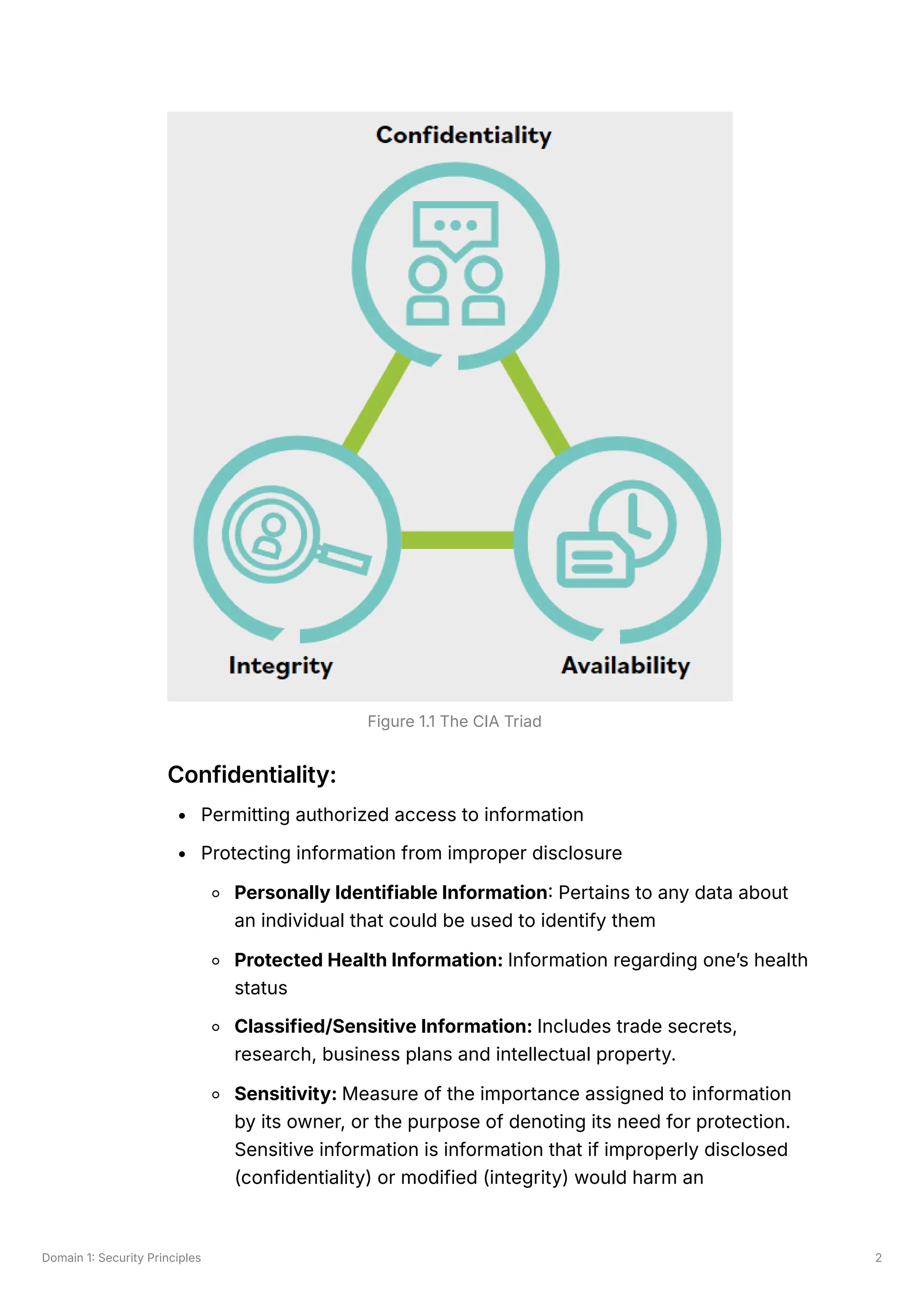
Confidentiality:
Permitting authorized access to information
Protecting information from improper disclosure
Personally Identifiable Information: Pertains to any data about
an individual that could be used to identify them
Protected Health Information: Information regarding one’s health
status
Classified/Sensitive Information: Includes trade secrets,
research, business plans and intellectual property.
Sensitivity: Measure of the importance assigned to information
by its owner, or the purpose of denoting its need for protection.
Sensitive information is information that if improperly disclosed
(confidentiality) or modified (integrity) would harm an
Figure 1.1 The CIA Triad
3.
Domain 1: SecurityPrinciples 3
organization or individual. In many cases, sensitivity is related to
the harm to external stakeholders; that is, people or organizations
that may not be a part of the organization that processes or uses
the information
Integrity:
Data/Information is not modified by unauthorized means - It
measures the degree to which something is whole and complete,
internally consistent and correct.
Integrity is a property of information which refers it it being recorded,
used, and maintained in a manner which ensures its completeness,
accuracy, internal consistency, and usefulness for a specified
purpose
Primary factor in the reliability of information and systems
Data Integrity - Assurance data has not been modified in an
unauthorized manner
Protection of data in systems and during processing to prevent
improper modification, errors, or loss.
Ensure data is recorded, used, and maintained in a way that
ensures completeness.
Covers data in storage, during processing, and while in transit.
Information must be accurate, internally consistent and useful for
a stated purpose.
Internal Consistency
Ensures information is correct on all related systems such
that it is stored and displayed in the same way on all the
systems
Consistency as part of data integrity requires that all
instances of the data be identical in form, content and
meaning.
System Integrity - The quality a system has when it performs its
intended function in an unimpaired manner, free from unauthorized
manipulation of the system, whether intentional or accidental
4.
Domain 1: SecurityPrinciples 4
Maintenance of a known good configuration and expected
operational function as the system processes the information.
Ensuring integrity begins with an awareness of state (which is
the current condition of the system)
Awareness includes the ability to document and understand
the state of data or a system at a specific point, creating a
baseline.
Baseline - A documented lowest level of security
configuration allowed by a standard or organization
The integrity of the system can be ascertained
Compare baseline with the current state
If they match integrity of the system is intact
If they do not match the integrity of the system has been
compromised
The need to safeguard information and system integrity may be
dictated by laws; regulations; needs of the organization to access
and use reliable, accurate information.
Availability:
Ensuring timely and reliable access to and use of information,
information services, data, by authorized users
The core concept of availability is that data is accessible to
authorized users when and where it is needed and in the form and
format required.
Availability is associated with criticality - A measure of the degree to
which an organization depends on information/information system for
the success of a mission or business function
Some systems and data are more critical than other so
appropriate levels of availability are provided
Authentication
What is Authentication
5.
Domain 1: SecurityPrinciples 5
The act of identifying/verifying the eligibility of a station, originator,
or individual to access specific categories of information
Typically a measure designed to validate the rightful owner of a
stated identity
Three common methods of authentication
Something you know/Knowledge-based: Passwords, passphrases,
or secret code to differentiate between authorized and unauthorized
user
Something you have/Token-based: Tokens (Physical object(s) a
user possesses and controls that is used to authenticate a users
identity), memory cards, smart cards
Something you are/Characteristic-based: Biometrics (Biological
characteristics of an individual), measurable characteristics
Methods of Authentication
Single-Factor Authentication (SFA) - Use of only one of the three
available factors to carry out authentication for identity verification
Multi-Factor Authentication (MFA) - Use of two or more distinct
instances of the three available factors of authentication for identity
verification
Multiple (distinct) instances of the same method of authentication
does not count as MFA (e.g. a username and password does not
count as MFA because they are both forms of things that are
known)
Non-Repudiation
Defined as the protection against an individual falsely denying having
performed a particular action
It provides the capability to determine whether a given individual took
a particular action, such as created information, approved
information or sent or received a message.
Non-repudiation methodologies ensure that people are held
responsible for the actions they conducted.
Privacy
6.
Domain 1: SecurityPrinciples 6
Is the right of an individual to control the distribution of information
about themselves.
Module 2: Understand the Risk
Management Process
Introduction to Risk
Risk is a measure of the extent to which an organization/entity is
threatened by a potential circumstance or event.
Expressed as a combination of:
The adverse impact that would occur if the circumstance/event
occurred
The likelihood of the circumstance/event occurring
Information Security Risk is the potential adverse impact as a result
of (possible) unauthorized access, use, disclosure, disruption,
modification or destruction of information and/or information
systems.
Risk is associated with threat(s), impact, and likelihood.
IT risk is a subset of business risk
Level of cybersecurity depends on the level of risk an entity is willing
to accept
Potential consequences of what is happing in the entity’s
environment - Risk appetite/Risk tolerance
Once risk is evaluated, security controls are implemented to mitigate
the risk to an acceptable level
With well designed risk management technologies we can recognize
vulnerabilities and threats and calculate the likelihood and the
potential impact of each threat
Asset
Anything of value owned by an entity
7.
Domain 1: SecurityPrinciples 7
Includes tangibles and intangibles
Vulnerability
Vulnerability is a weakness in a information system, system security
procedures, internal controls or implementation, which if triggered or
acted upon, exploited, by a threat source could cause a risk event to
occur.
Threat
A threat is a person or thing that takes action to exploit (or make use
of) a target organization’s system vulnerabilities, as part of achieving
or furthering its goal or objectives.
Threat actor is an individual or group that attempts to exploit
vulnerabilities to cause or force a threat to occur
Typical threat actors include the following:
Insiders (either deliberately, by simple human error, or by
gross incompetence).
Outside individuals or informal groups (either planned or
opportunistic, discovering vulnerability).
Formal entities that are nonpolitical (such as business
competitors and cybercriminals).
Formal entities that are political (such as terrorists, nation-
states, and hacktivists).
Intelligence or information gatherers (could be any of the
above).
Technology (such as free-running bots and artificial
intelligence , which could be part of any of the above).
Threat vector is the means by which a threat actor carriers out their
objective(s)
Likelihood
When determining an organization’s vulnerabilities, the security team
will consider the probability, or likelihood, of a potential vulnerability
being exploited within the construct of the organization’s threat
environment
8.
Domain 1: SecurityPrinciples 8
Probability is the chances, or likelihood that a given threat is capable
of exploiting a given vulnerability or a set of vulnerabilities.
Likelihood is the probability that a potential vulnerability may be
exercised (exploited) within the constructs of the associated threat
environment.
Likelihood of occurrence is a weighted factor based on a subjective
analysis of the probability that a given threat or set of threats is
capable of exploiting a given vulnerability or set of vulnerabilities
Security team will consider the likely results if a threat is realized and
an event occurs.
Impact is the magnitude of the harm that could be caused by a
threat’s exercise/exploitation of a vulnerability
Impact does not stop with the incident itself.
The chain of reactions that can result when a threat is realized
and an event occurs also need to be considered as part of risk
management.
Risk Identification
Risk identification is a recurring process of identifying different
possible risks, characterizing them and then estimating their potential
for disrupting the organization.
It involves looking an entity and their unique situation. Security
professionals know their entity’s strategic, tactical, and operational
plans
Takeaways to remember about risk identification:
Identify risk to communicate it clearly.
Employees at all levels of the organization are responsible for
identifying risk.
Identify risk to protect against it.
Security professional assist in risk assessment at a system level,
focusing on process, control, monitoring or incident response and
recovery activities.
Risk Assessment
9.
Domain 1: SecurityPrinciples 9
Risk assessment is the analysis performed as part of risk
management which incorporates threat an vulnerability analysis and
considers mitigation provided by security controls in planned or in
place
Risk assessment is is defined as the process of systematically
identifying, analyzing estimating and prioritizing risks to an
organization’s operations (including its mission, functions, image and
reputation), assets, individuals, other organizations and even the
nation.
Risk assessment should result in aligning (or associating) of each
identified risk (resulting from the operation of an information system)
with specific aspects of the organization (such as the goals,
objectives, assets or processes that the organization uses) -
understanding how the identified risk could potentially impact the
organization
The ultimate aim of this alignment is to ensure that the
organization's risk management efforts are directly tied to its
broader goals and objectives.
By doing so, the organization can prioritize risks based on their
potential impact on achieving these goals and objectives.
By aligning risks with organizational goals, the organization can
prioritize and address the most critical risks that could hinder
achieving these goals.
It helps in efficient allocation of resources to manage and
mitigate the most significant risks.
Provides a clear picture of how risks could impact strategic
decisions and long-term planning.
Ensures that risk management is integrated into the broader
strategic framework of the organization.
The primary goal of a risk assessment is to estimate and prioritize
risks.
Risk Treatment
Risk treatment is the determination of the best actions to take in
order to address the identified and prioritized risk(s)
10.
Domain 1: SecurityPrinciples 10
The decisions made are dependent on the attitude of management
toward risk; the availability; cost of risk mitigation.
Risk treatment options include:
Risk Avoidance:
Risk avoidance is the decision to attempt to eliminate the risk
entirely.
This could include ceasing operation for some or all of the
activities of the organization that are exposed to a particular
risk.
This option may be exercised/considered when the potential
impact of a given risk is too high or if the likelihood of the risk
being realized is simply too great.
Risk Acceptance:
Risk acceptance is taking no (significant) action to reduce the
likelihood of a risk occurring.
This option may be considered when the impact or likelihood
of occurrence is negligible or the benefit is sufficient to
offset/outweigh the risk
Risk mitigation:
Risk mitigation involves taking actions to reduce or prevent
the possibility of a risk event or its impact
Can involve remediation measures, or controls (such as
security controls, establishing policies, procedures, and
standards) to minimize adverse risk.
Risk may not always be mitigated but mitigations should
always be in place
Risk transference:
Risk transference is the practice of passing the risk to
another party, who will accept the financial impact of the
harm resulting from a risk being realized in exchange for
payment.
Typically this is an insurance policy
11.
Domain 1: SecurityPrinciples 11
Risk Priorities
Once risks are identified they need to be prioritized and analyzed,
this is done through qualitative risk analysis and/or quantitative risk
analysis.
This is necessary to determine root cause and narrow down apparent
risks and core risks.
Qualitative risk analysis is a method of risk analysis that is based on
the assignment of a descriptor (such as low, medium, high)
Quantitative risk analysis is a method for risk analysis where
numerical values are assigned to both impact and likelihood based on
statistical probabilities and monetarized valuation of loss or gain
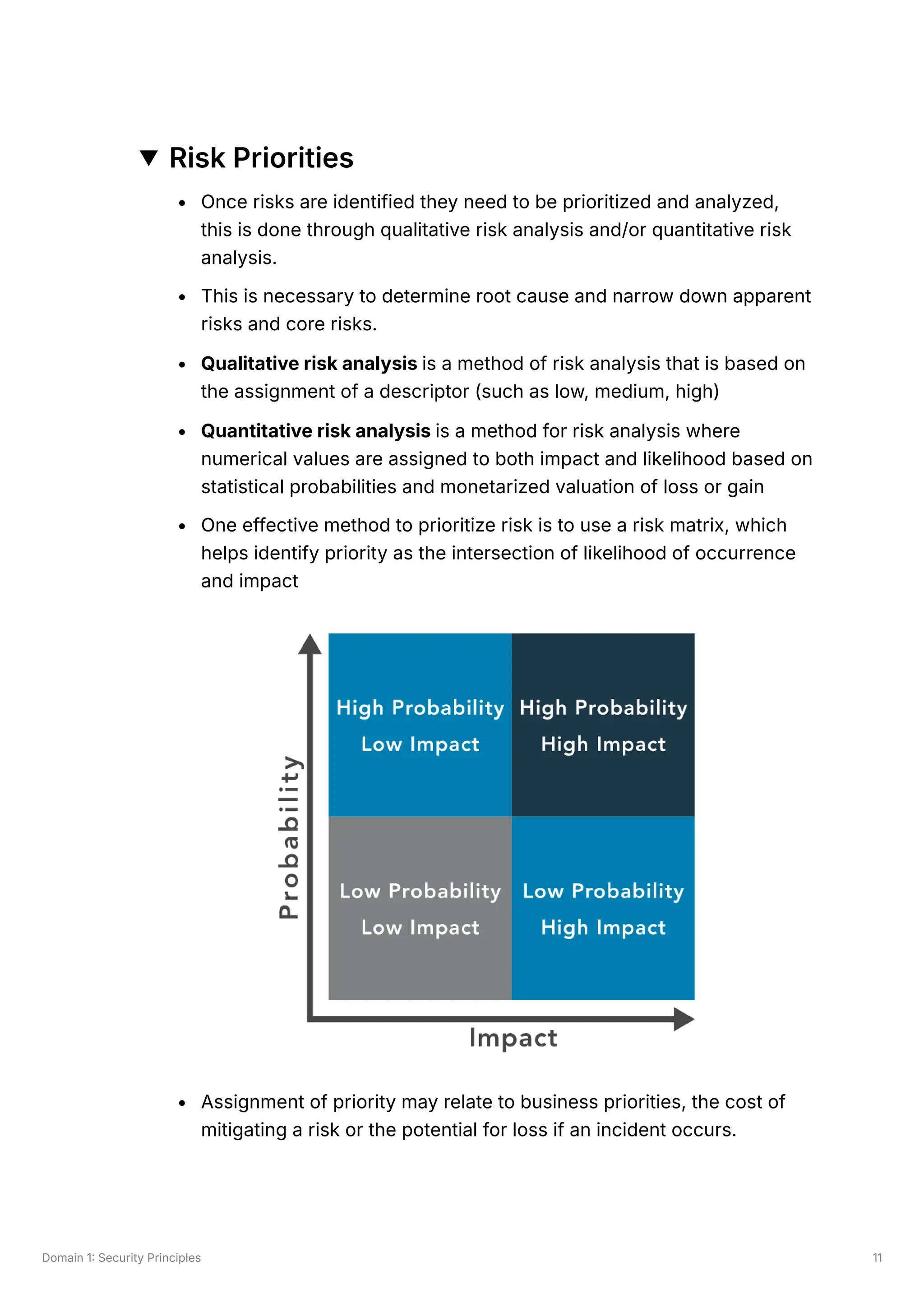
One effective method to prioritize risk is to use a risk matrix, which
helps identify priority as the intersection of likelihood of occurrence
and impact
Assignment of priority may relate to business priorities, the cost of
mitigating a risk or the potential for loss if an incident occurs.
12.
Domain 1: SecurityPrinciples 12
Decision Making Based on Risk Priorities
When making decisions based on risk priorities, organizations must
evaluate the likelihood and impact of the risk as well as their
tolerance for different sorts of risk.
Risk Tolerance
Risk Tolerance/Risk appetite/Acceptable risk is the level of risk an
entity is willing to assume (in order to achieve a potential desired
result)
Module 3: Understand Security
Controls
Security Controls:
Security controls - Management, operational, and technical controls
prescribed for an information system to protect the confidentiality,
availability, and integrity of the system and its information
Security controls pertain to the physical, technical, and administrative
mechanisms that act as safeguards or countermeasures
Implementation of security controls should mitigate risk to an
acceptable level.
Physical Controls are controls implemented through tangible
mechanisms
Physical controls address process-based security needs using
physical hardware devices
They typically provide ways of controlling, directing or preventing
the movement of people and equipment throughout a specific
physical location
Physical controls also provide protection and control over entry
onto the land within the organization’s control.
Supported by technical controls as a means of incorporating
them into an overall security system.
13.
Domain 1: SecurityPrinciples 13
Technical Controls/Logical Controls are security controls for an
information system that are primarily implemented and executed by
the information system through mechanisms contained in the
hardware, software or firmware components of the system
Technical controls can be configuration settings or parameters
stored as data, managed through a software graphical user
interface (GUI), or they can be hardware settings done with
switches, jumper plugs or other means
Implementation of technical controls always requires significant
operational considerations and should be consistent with the
management of security within the organization.
Administrative Controls (aka directives, guidelines, advisories) are
controls implemented through procedure and policy.
In modern environments are often enforced in conjunction with
physical and/or technical controls
Aimed at the people within an organization
They provide frameworks, constraints and standards for human
behavior, and should cover the entire scope of the organization’s
activities and its interactions with external parties and
stakeholders.
Administrative controls are being integrated into task-level
activities and operational decision processes that an
organization’s workforce uses throughout the day.
As a result policies are brought to a more neutral level, away
from only senior-executives making decisions
Thus it (also) makes them (policies) immediate, useful and
operational on a daily and per-task basis
Module 4: Understand Governance
Elements and Processes
Governance Elements
When leaders and management implement the systems and structures
that the organization will use to achieve its goals, they are guided by laws
and regulations created by governments to enact public policy.
14.
Domain 1: SecurityPrinciples 14
Laws and regulations guide the development of standards, which
cultivate policies, which result in procedures.
Procedures
Procedures are the detailed steps to complete a task that
support departmental or organizational policies.
Procedures define the explicit, repeatable activities necessary to
accomplish a specific task or set of tasks.
They provide supporting data, decision criteria or other explicit
knowledge needed to perform each task.
In addition, procedures establish the measurement criteria and
methods to use to determine whether a task has been
successfully completed
Policies
Policies are put in place by organizational governance, to provide
guidance in all activities to ensure that the organization supports
industry standards and regulations.
Policy is informed by applicable law(s) and specifies which
standards and guidelines the organization will follow.
Policy is broad and it establishes context and sets out strategic
direction and priorities.
Governance policies are used to moderate and control decision-
making, to ensure compliance when necessary and to guide the
creation and implementation of other policies.
Policies are implemented, or carried out, by people; so they are
expanded from statements of intent and direction into step-by-
step instructions, or procedures.
Standards
Standards are often used by governance teams to provide a
framework to introduce policies and procedures in support of
regulations.
Standards cover a broad range of issues and ideas and may
provide assurance that an organization is operating with policies
15.
Domain 1: SecurityPrinciples 15
and procedures that support regulations and are widely accepted
best practices.
Regulations
Regulations are commonly issued in the form of laws, usually
from government (not to be confused with governance) and
typically carry penalties for noncompliance.
Information security is based on trust and credibility. If something goes
wrong, the stakeholders’ trust evaporates, and organizations credibility is
damaged. Not only this if the fault is in violation of a law/Regulation then
the organization/individuals involved may be facing legal consequences
for their non-compliance.