Module 1 : Security Principles
Security Principles
Security Concepts
Risk Management
Process
Security Controls
Governance Elements
and Process
Security
Concepts
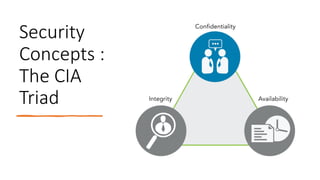
• The CIA Triad
• CIA Triad Deep Dive
• Authentication
• Methods of Authentication
• Non-repudiation
• Privacy
Security
Concepts :
The CIA
Triad
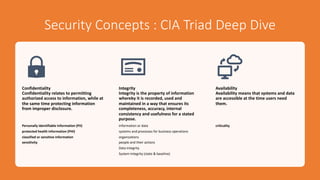
Security Concepts : CIA Triad Deep Dive
Confidentiality
Confidentiality relates to permitting
authorized access to information, while at
the same time protecting information
from improper disclosure.
Personally Identifiable Information (PII)
protected health information (PHI)
classified or sensitive information
sensitivity
Integrity
Integrity is the property of information
whereby it is recorded, used and
maintained in a way that ensures its
completeness, accuracy, internal
consistency and usefulness for a stated
purpose.
information or data
systems and processes for business operations
organizations
people and their actions
Data Integrity
System Integrity (state & baseline)
Availability
Availability means that systems and data
are accessible at the time users need
them.
criticality
Security
Concepts :
Authentication
There are three common methods
of authentication:
Something you
know: Passwords
or passphrases
Something you
have: Tokens,
memory cards,
smart cards
Something you
are: Biometrics ,
measurable
characteristics
This process of verifying or
proving the user’s identification is
known as authentication. Simply put,
authentication is a process to prove
the identity of the requestor.
Security Concepts : Methods of
Authentication
• Single-factor authentication
• Multi-factor authentication
• Common best practice is to implement at least
two of the three common techniques for
authentication:
o Knowledge-based
o Token-based
o Characteristic-based
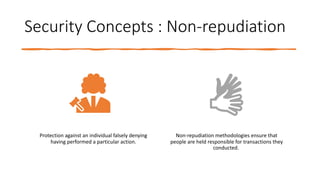
Security Concepts : Non-repudiation
Protection against an individual falsely denying
having performed a particular action.
Non-repudiation methodologies ensure that
people are held responsible for transactions they
conducted.
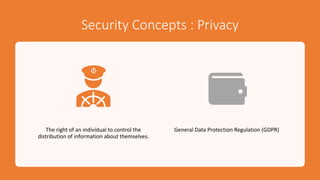
Security Concepts : Privacy
The right of an individual to control the
distribution of information about themselves.
General Data Protection Regulation (GDPR)
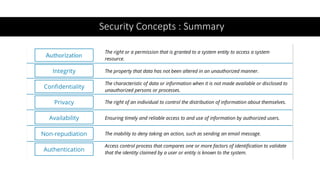
Security Concepts : Summary
Risk
Management
Process :
Risk
Management
Terminology
Asset : something in need of
protection.
Vulnerability : a gap or weakness
in those protection efforts.
Threat : something or someone
that aims to exploit a vulnerability
to thwart protection efforts.
RISK
MANAGEMENT
PROCESS :
RISK
IDENTIFICATION
a recurring process of identifying different possible
risks, characterizing them and then estimating their
potential for disrupting the organization.
Identify risk to communicate it clearly.
Employees at all levels of the organization are
responsible for identifying risk.
Identify risk to protect against it.
RISK MANAGEMENT PROCESS :
RISK ASSESSMENT
• The process of identifying, estimating
and prioritizing risks to an
organization’s operations (including its
mission, functions, image and
reputation), assets, individuals, other
organizations and even the nation.
RISK MANAGEMENT PROCESS :
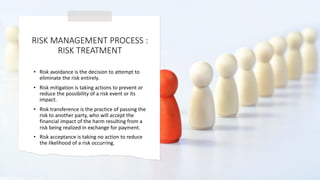
RISK TREATMENT
• Risk avoidance is the decision to attempt to
eliminate the risk entirely.
• Risk mitigation is taking actions to prevent or
reduce the possibility of a risk event or its
impact.
• Risk transference is the practice of passing the
risk to another party, who will accept the
financial impact of the harm resulting from a
risk being realized in exchange for payment.
• Risk acceptance is taking no action to reduce
the likelihood of a risk occurring.
RISK MANAGEMENT PROCESS :
RISK PRIORITIES
• Qualitative risk analysis
• Quantitative risk analysis
Risk Term Review
SECURITY CONTROL :
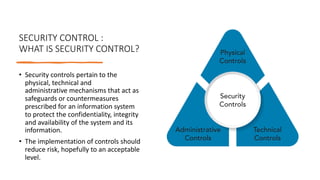
WHAT IS SECURITY CONTROL?
• Security controls pertain to the
physical, technical and
administrative mechanisms that act as
safeguards or countermeasures
prescribed for an information system
to protect the confidentiality, integrity
and availability of the system and its
information.
• The implementation of controls should
reduce risk, hopefully to an acceptable
level.
SECURITY CONTROL : PHYSICAL CONTROL
Physical controls address process-based security needs using physical hardware devices, such as badge readers,
architectural features of buildings and facilities, and specific security actions to be taken by people.
Controlling, directing or preventing the movement of people and equipment throughout a specific physical
location
Protection and control over entry onto the land surrounding the buildings, parking lots or other areas that are
within the organization’s control
Physical controls are supported by technical controls as a means of incorporating them into an overall security
system.
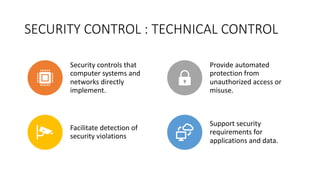
SECURITY CONTROL : TECHNICAL CONTROL
Security controls that
computer systems and
networks directly
implement.
Provide automated
protection from
unauthorized access or
misuse.
Facilitate detection of
security violations
Support security
requirements for
applications and data.
SECURITY
CONTROL :
ADMINISTRATIVE
CONTROL
Directives, guidelines or advisories
aimed at the people within the
organization
Provide frameworks, constraints and
standards for human behavior
Cover the entire scope of the
organization’s activities and its
interactions
• External parties
• Stakeholders
GOVERNANCE ELEMENTS
o REGULATIONS
§ commonly issued in the form of laws, usually from
government (not to be confused with governance) and
typically carry financial penalties for noncompliance.
o STANDARD
§ provide a framework to introduce policies and procedures in
support of regulations.
o POLICIES
§ guidance in all activities to ensure that the organization
supports industry standards and regulations.
o PROCEDURES
§ detailed steps to complete a task that support departmental
or organizational policies.
GOVERNANCE
PROCESS
STANDARDS
The International Organization for Standardization (ISO) develops and publishes international standards on a variety of technical
subjects, including information systems and information security, as well as encryption standards. ISO solicits input from the
international community of experts to provide input on its standards prior to publishing.
The National Institute of Standards and Technology (NIST) is a United States government agency under the Department of
Commerce and publishes a variety of technical standards in addition to information technology and information security
standards. Many of the standards issued by NIST are requirements for U.S. government agencies and are considered
recommended standards by industries worldwide.
From Internet Engineering Task Force (IETF), there are standards in communication protocols that ensure all computers can
connect with each other across borders, even when the operators do not speak the same language.
The Institute of Electrical and Electronics Engineers (IEEE) also sets standards for telecommunications, computer engineering and
similar disciplines.

001_Cybersecurity Fundamentals Security Principles.pdf

  • 1.
    Module 1 :Security Principles
  • 2.
    Security Principles Security Concepts RiskManagement Process Security Controls Governance Elements and Process
  • 3.
    Security Concepts • The CIATriad • CIA Triad Deep Dive • Authentication • Methods of Authentication • Non-repudiation • Privacy
  • 4.
  • 5.
    Security Concepts :CIA Triad Deep Dive Confidentiality Confidentiality relates to permitting authorized access to information, while at the same time protecting information from improper disclosure. Personally Identifiable Information (PII) protected health information (PHI) classified or sensitive information sensitivity Integrity Integrity is the property of information whereby it is recorded, used and maintained in a way that ensures its completeness, accuracy, internal consistency and usefulness for a stated purpose. information or data systems and processes for business operations organizations people and their actions Data Integrity System Integrity (state & baseline) Availability Availability means that systems and data are accessible at the time users need them. criticality
  • 6.
    Security Concepts : Authentication There arethree common methods of authentication: Something you know: Passwords or passphrases Something you have: Tokens, memory cards, smart cards Something you are: Biometrics , measurable characteristics This process of verifying or proving the user’s identification is known as authentication. Simply put, authentication is a process to prove the identity of the requestor.
  • 7.
    Security Concepts :Methods of Authentication • Single-factor authentication • Multi-factor authentication • Common best practice is to implement at least two of the three common techniques for authentication: o Knowledge-based o Token-based o Characteristic-based
  • 8.
    Security Concepts :Non-repudiation Protection against an individual falsely denying having performed a particular action. Non-repudiation methodologies ensure that people are held responsible for transactions they conducted.
  • 9.
    Security Concepts :Privacy The right of an individual to control the distribution of information about themselves. General Data Protection Regulation (GDPR)
  • 10.
  • 11.
    Risk Management Process : Risk Management Terminology Asset :something in need of protection. Vulnerability : a gap or weakness in those protection efforts. Threat : something or someone that aims to exploit a vulnerability to thwart protection efforts.
  • 12.
    RISK MANAGEMENT PROCESS : RISK IDENTIFICATION a recurringprocess of identifying different possible risks, characterizing them and then estimating their potential for disrupting the organization. Identify risk to communicate it clearly. Employees at all levels of the organization are responsible for identifying risk. Identify risk to protect against it.
  • 13.
    RISK MANAGEMENT PROCESS: RISK ASSESSMENT • The process of identifying, estimating and prioritizing risks to an organization’s operations (including its mission, functions, image and reputation), assets, individuals, other organizations and even the nation.
  • 14.
    RISK MANAGEMENT PROCESS: RISK TREATMENT • Risk avoidance is the decision to attempt to eliminate the risk entirely. • Risk mitigation is taking actions to prevent or reduce the possibility of a risk event or its impact. • Risk transference is the practice of passing the risk to another party, who will accept the financial impact of the harm resulting from a risk being realized in exchange for payment. • Risk acceptance is taking no action to reduce the likelihood of a risk occurring.
  • 15.
    RISK MANAGEMENT PROCESS: RISK PRIORITIES • Qualitative risk analysis • Quantitative risk analysis
  • 16.
  • 17.
    SECURITY CONTROL : WHATIS SECURITY CONTROL? • Security controls pertain to the physical, technical and administrative mechanisms that act as safeguards or countermeasures prescribed for an information system to protect the confidentiality, integrity and availability of the system and its information. • The implementation of controls should reduce risk, hopefully to an acceptable level.
  • 18.
    SECURITY CONTROL :PHYSICAL CONTROL Physical controls address process-based security needs using physical hardware devices, such as badge readers, architectural features of buildings and facilities, and specific security actions to be taken by people. Controlling, directing or preventing the movement of people and equipment throughout a specific physical location Protection and control over entry onto the land surrounding the buildings, parking lots or other areas that are within the organization’s control Physical controls are supported by technical controls as a means of incorporating them into an overall security system.
  • 19.
    SECURITY CONTROL :TECHNICAL CONTROL Security controls that computer systems and networks directly implement. Provide automated protection from unauthorized access or misuse. Facilitate detection of security violations Support security requirements for applications and data.
  • 20.
    SECURITY CONTROL : ADMINISTRATIVE CONTROL Directives, guidelinesor advisories aimed at the people within the organization Provide frameworks, constraints and standards for human behavior Cover the entire scope of the organization’s activities and its interactions • External parties • Stakeholders
  • 21.
    GOVERNANCE ELEMENTS o REGULATIONS §commonly issued in the form of laws, usually from government (not to be confused with governance) and typically carry financial penalties for noncompliance. o STANDARD § provide a framework to introduce policies and procedures in support of regulations. o POLICIES § guidance in all activities to ensure that the organization supports industry standards and regulations. o PROCEDURES § detailed steps to complete a task that support departmental or organizational policies.
  • 22.
  • 23.
    STANDARDS The International Organizationfor Standardization (ISO) develops and publishes international standards on a variety of technical subjects, including information systems and information security, as well as encryption standards. ISO solicits input from the international community of experts to provide input on its standards prior to publishing. The National Institute of Standards and Technology (NIST) is a United States government agency under the Department of Commerce and publishes a variety of technical standards in addition to information technology and information security standards. Many of the standards issued by NIST are requirements for U.S. government agencies and are considered recommended standards by industries worldwide. From Internet Engineering Task Force (IETF), there are standards in communication protocols that ensure all computers can connect with each other across borders, even when the operators do not speak the same language. The Institute of Electrical and Electronics Engineers (IEEE) also sets standards for telecommunications, computer engineering and similar disciplines.