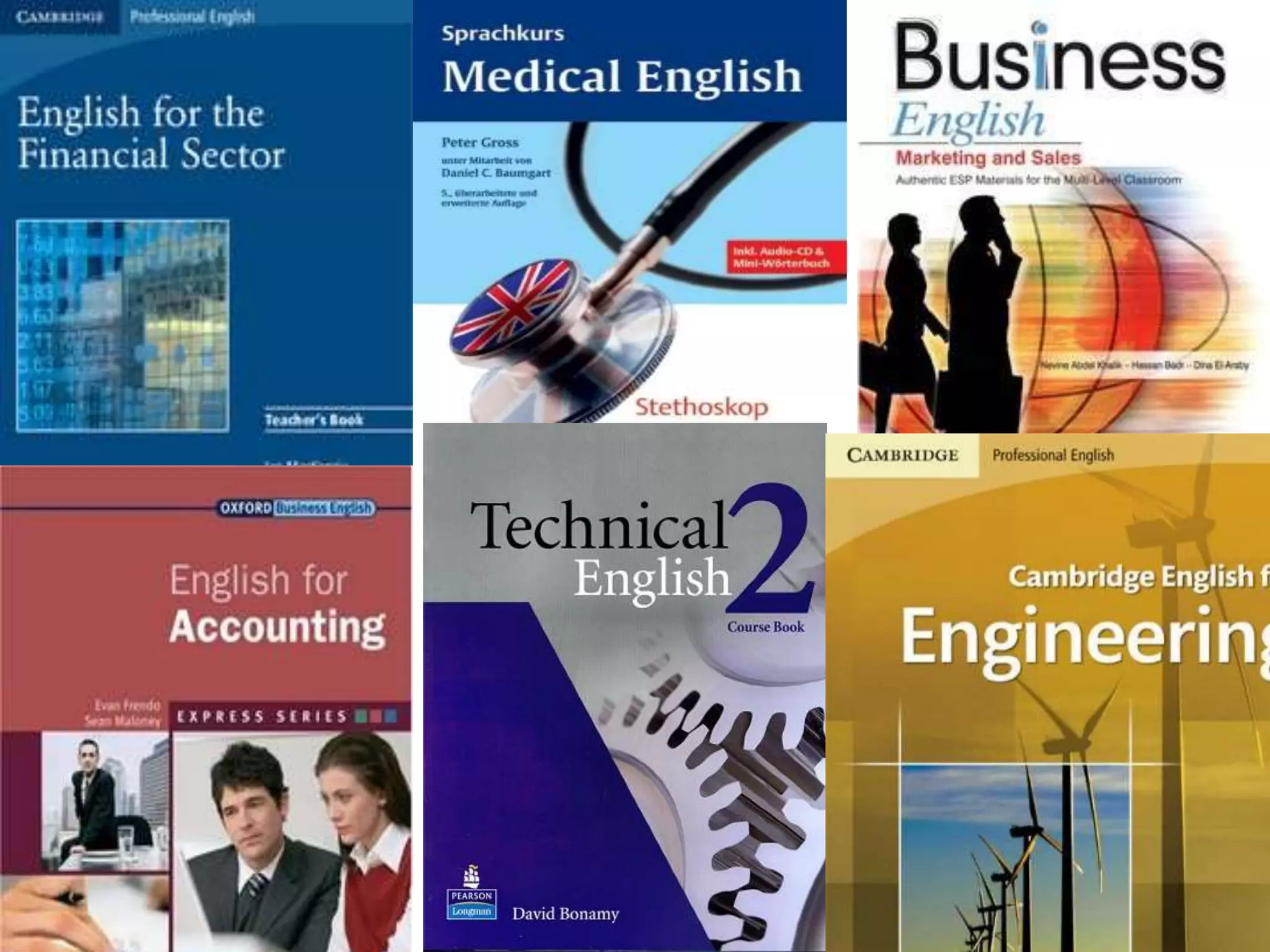
Presented by:
1. Đoàn Nguyễn Phương Thái
2. Trương Nguyễn Ngọc Thy
OPEN UNIVERSITY
CURRICULUM DESIGN
Lecturer in charge: Dr. Đặng Tấn Tín
The concern to make language courses more
relevant to learners’ needs led to the
emergence of the Languages for Specific
Purposes (LSP) movement, known in English-
language teaching circles as English for Specific
Purposes (ESP) (Richards, 2001, p. 28)
 the need for Non-English background students.
 the need for employment
 the need for business purpose
 the need for immigrants
University of Michigan
 language patterns and vocabulary
(Darian, 1972)
“for learners in situations such as these, what
was needed was not more and more lessons in
“advanced English” or “colloquial English”
but
training in the kinds of English learners would
use or encounter in their specific occupations
and situations”.
 1/
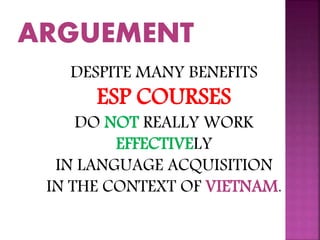
DESPITE MANY BENEFITS
ESP COURSES
DO NOT REALLY WORK
EFFECTIVELY
IN LANGUAGE ACQUISITION
IN THE CONTEXT OF VIETNAM.
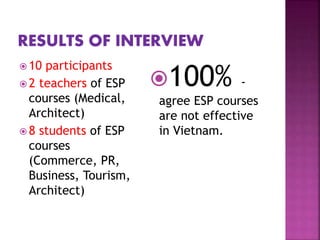
 10 participants
 2 teachers of ESP
courses (Medical,
Architect)
 8 students of ESP
courses
(Commerce, PR,
Business, Tourism,
Architect)
100% -
agree ESP courses
are not effective
in Vietnam.
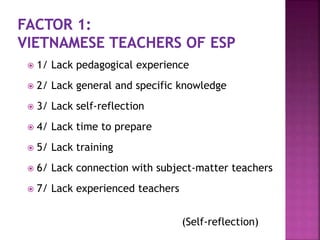
 1/ Lack pedagogical experience
 2/ Lack general and specific knowledge
 3/ Lack self-reflection
 4/ Lack time to prepare
 5/ Lack training
 6/ Lack connection with subject-matter teachers
 7/ Lack experienced teachers
(Self-reflection)
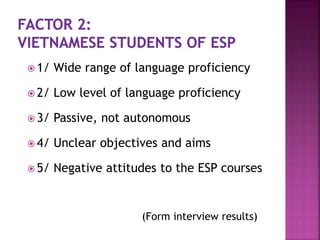
 1/ Wide range of language proficiency
 2/ Low level of language proficiency
 3/ Passive, not autonomous
 4/ Unclear objectives and aims
 5/ Negative attitudes to the ESP courses
(Form interview results)
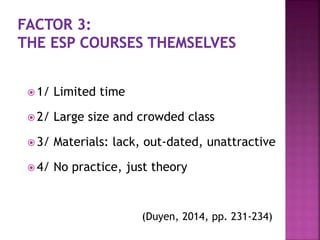
 1/ Limited time
 2/ Large size and crowded class
 3/ Materials: lack, out-dated, unattractive
 4/ No practice, just theory
(Duyen, 2014, pp. 231-234)
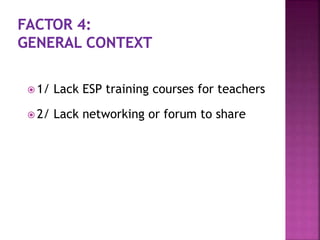
 1/ Lack ESP training courses for teachers
 2/ Lack networking or forum to share
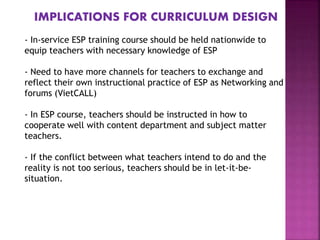
IMPLICATIONS FOR CURRICULUM DESIGN
- In-service ESP training course should be held nationwide to
equip teachers with necessary knowledge of ESP
- Need to have more channels for teachers to exchange and
reflect their own instructional practice of ESP as Networking and
forums (VietCALL)
- In ESP course, teachers should be instructed in how to
cooperate well with content department and subject matter
teachers.
- If the conflict between what teachers intend to do and the
reality is not too serious, teachers should be in let-it-be-
situation.
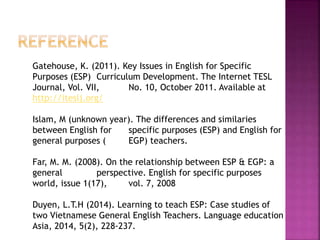
Gatehouse, K. (2011). Key Issues in English for Specific
Purposes (ESP) Curriculum Development. The Internet TESL
Journal, Vol. VII, No. 10, October 2011. Available at
http://iteslj.org/
Islam, M (unknown year). The differences and similaries
between English for specific purposes (ESP) and English for
general purposes ( EGP) teachers.
Far, M. M. (2008). On the relationship between ESP & EGP: a
general perspective. English for specific purposes
world, issue 1(17), vol. 7, 2008
Duyen, L.T.H (2014). Learning to teach ESP: Case studies of
two Vietnamese General English Teachers. Language education
Asia, 2014, 5(2), 228-237.
 Thanks for listening
 Especially Dr. Đặng Tấn Tín

ESP is not effective in Vietnam

  • 2.
    Presented by: 1. ĐoànNguyễn Phương Thái 2. Trương Nguyễn Ngọc Thy OPEN UNIVERSITY CURRICULUM DESIGN Lecturer in charge: Dr. Đặng Tấn Tín
  • 3.
    The concern tomake language courses more relevant to learners’ needs led to the emergence of the Languages for Specific Purposes (LSP) movement, known in English- language teaching circles as English for Specific Purposes (ESP) (Richards, 2001, p. 28)  the need for Non-English background students.  the need for employment  the need for business purpose  the need for immigrants
  • 4.
    University of Michigan language patterns and vocabulary (Darian, 1972) “for learners in situations such as these, what was needed was not more and more lessons in “advanced English” or “colloquial English” but training in the kinds of English learners would use or encounter in their specific occupations and situations”.
  • 5.
  • 6.
    DESPITE MANY BENEFITS ESPCOURSES DO NOT REALLY WORK EFFECTIVELY IN LANGUAGE ACQUISITION IN THE CONTEXT OF VIETNAM.
  • 7.
     10 participants 2 teachers of ESP courses (Medical, Architect)  8 students of ESP courses (Commerce, PR, Business, Tourism, Architect) 100% - agree ESP courses are not effective in Vietnam.
  • 8.
     1/ Lackpedagogical experience  2/ Lack general and specific knowledge  3/ Lack self-reflection  4/ Lack time to prepare  5/ Lack training  6/ Lack connection with subject-matter teachers  7/ Lack experienced teachers (Self-reflection)
  • 9.
     1/ Widerange of language proficiency  2/ Low level of language proficiency  3/ Passive, not autonomous  4/ Unclear objectives and aims  5/ Negative attitudes to the ESP courses (Form interview results)
  • 10.
     1/ Limitedtime  2/ Large size and crowded class  3/ Materials: lack, out-dated, unattractive  4/ No practice, just theory (Duyen, 2014, pp. 231-234)
  • 11.
     1/ LackESP training courses for teachers  2/ Lack networking or forum to share
  • 12.
    IMPLICATIONS FOR CURRICULUMDESIGN - In-service ESP training course should be held nationwide to equip teachers with necessary knowledge of ESP - Need to have more channels for teachers to exchange and reflect their own instructional practice of ESP as Networking and forums (VietCALL) - In ESP course, teachers should be instructed in how to cooperate well with content department and subject matter teachers. - If the conflict between what teachers intend to do and the reality is not too serious, teachers should be in let-it-be- situation.
  • 13.
    Gatehouse, K. (2011).Key Issues in English for Specific Purposes (ESP) Curriculum Development. The Internet TESL Journal, Vol. VII, No. 10, October 2011. Available at http://iteslj.org/ Islam, M (unknown year). The differences and similaries between English for specific purposes (ESP) and English for general purposes ( EGP) teachers. Far, M. M. (2008). On the relationship between ESP & EGP: a general perspective. English for specific purposes world, issue 1(17), vol. 7, 2008 Duyen, L.T.H (2014). Learning to teach ESP: Case studies of two Vietnamese General English Teachers. Language education Asia, 2014, 5(2), 228-237.
  • 14.
     Thanks forlistening  Especially Dr. Đặng Tấn Tín