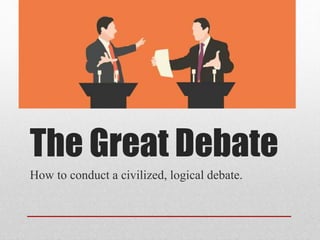
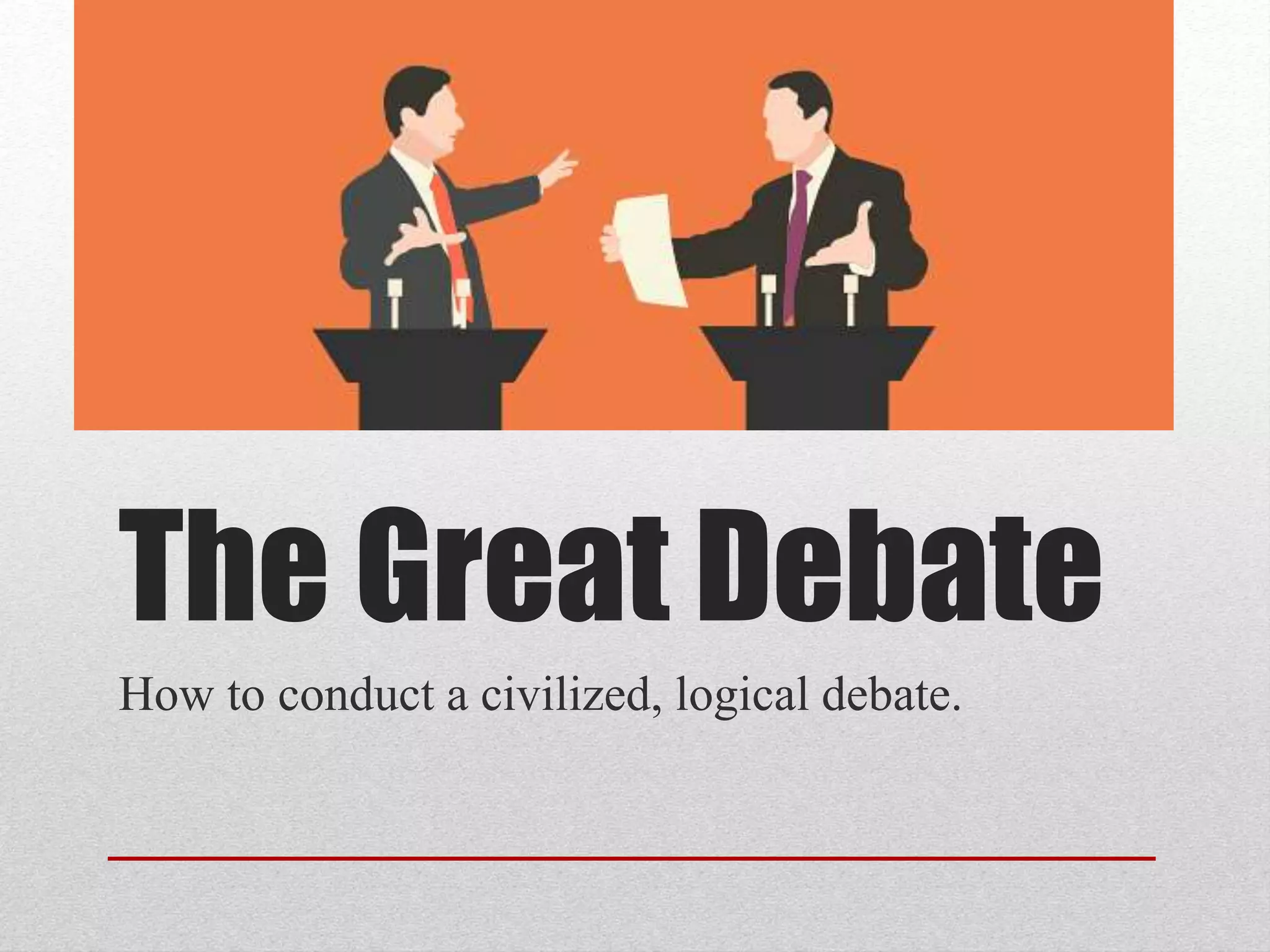
The Great Debate
How to conduct a civilized, logical debate.
What’s a Debate?
• A discussion between people in which they express different
opinions about something
• A debate can be an organized event, an informal discussion
between two or more people, or a general discussion that
involves many people.
Examples:
• The candidates participated in several debates before the
election was held.
• Our polite chat about politics slowly turned into a
heated debate.
How to Use?
Debate can be a verb or noun
• Usually collocated with +on/about/over
• The university is hosting a debate on gun control.
• Current debates about the value of public schools…
• The town held a debate over what to do about the recent
traffic problems.
• As a verb +object or nothing:
• The students debated for an hour.
• The President debated his challenger.
Discuss?
• Why do people hold debates? Give examples.
• What sort of things do people commonly debate?
• Why is it important to develop debating skills?
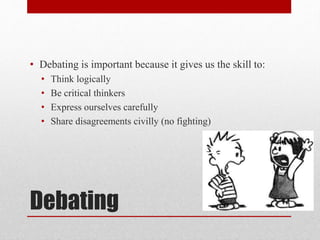
Debating
• Debating is important because it gives us the skill to:
• Think logically
• Be critical thinkers
• Express ourselves carefully
• Share disagreements civilly (no fighting)
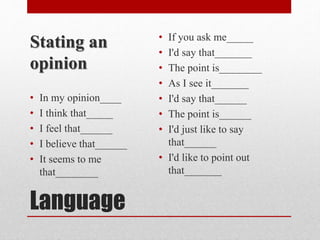
Language
Stating an
opinion
• In my opinion____
• I think that_____
• I feel that______
• I believe that______
• It seems to me
that________
• If you ask me_____
• I'd say that_______
• The point is________
• As I see it_______
• I'd say that______
• The point is______
• I'd just like to say
that______
• I'd like to point out
that_______
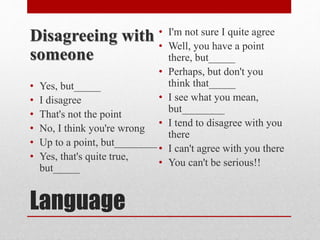
Language
Disagreeing with
someone
• Yes, but_____
• I disagree
• That's not the point
• No, I think you're wrong
• Up to a point, but________
• Yes, that's quite true,
but_____
• I'm not sure I quite agree
• Well, you have a point
there, but_____
• Perhaps, but don't you
think that_____
• I see what you mean,
but________
• I tend to disagree with you
there
• I can't agree with you there
• You can't be serious!!
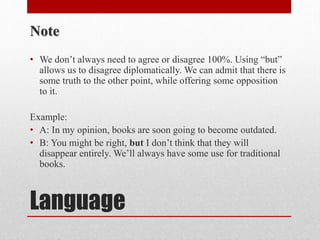
Language
Note
• We don’t always need to agree or disagree 100%. Using “but”
allows us to disagree diplomatically. We can admit that there is
some truth to the other point, while offering some opposition
to it.
Example:
• A: In my opinion, books are soon going to become outdated.
• B: You might be right, but I don’t think that they will
disappear entirely. We’ll always have some use for traditional
books.
Language
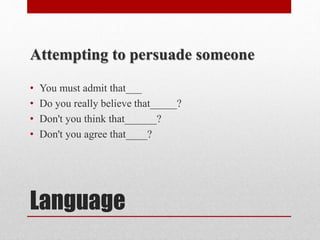
Attempting to persuade someone
• You must admit that___
• Do you really believe that_____?
• Don't you think that______?
• Don't you agree that____?
Language
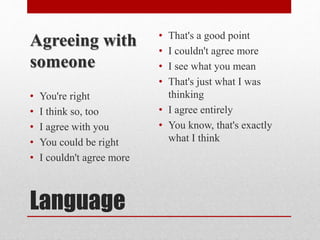
Agreeing with
someone
• You're right
• I think so, too
• I agree with you
• You could be right
• I couldn't agree more
• That's a good point
• I couldn't agree more
• I see what you mean
• That's just what I was
thinking
• I agree entirely
• You know, that's exactly
what I think
Language
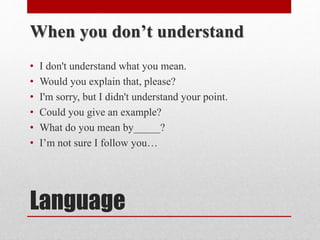
When you don’t understand
• I don't understand what you mean.
• Would you explain that, please?
• I'm sorry, but I didn't understand your point.
• Could you give an example?
• What do you mean by_____?
• I’m not sure I follow you…
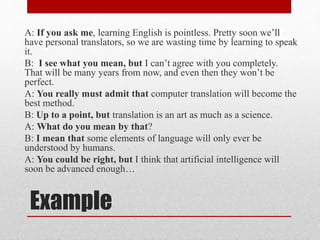
Example
A: If you ask me, learning English is pointless. Pretty soon we’ll
have personal translators, so we are wasting time by learning to speak
it.
B: I see what you mean, but I can’t agree with you completely.
That will be many years from now, and even then they won’t be
perfect.
A: You really must admit that computer translation will become the
best method.
B: Up to a point, but translation is an art as much as a science.
A: What do you mean by that?
B: I mean that some elements of language will only ever be
understood by humans.
A: You could be right, but I think that artificial intelligence will
soon be advanced enough…
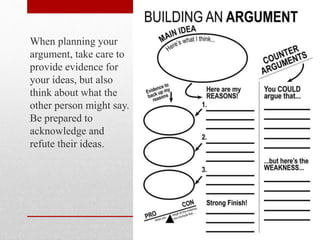
When planning your
argument, take care to
provide evidence for
your ideas, but also
think about what the
other person might say.
Be prepared to
acknowledge and
refute their ideas.
Task
“The Internet is making face-to-face communication
obsolete”
• How can we support this idea?
• What are your reasons?
• How can you deal with arguments from the opposite
position?
Lesson by David S. Wills
Task
Group A:
Fireworks should be banned
in China except for during
special occasions because
they are loud, dangerous,
and cause pollution.
Group B:
Fireworks should not be
banned because they are part
of the culture/
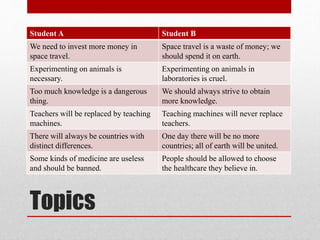
Topics
Student A Student B
We need to invest more money in
space travel.
Space travel is a waste of money; we
should spend it on earth.
Experimenting on animals is
necessary.
Experimenting on animals in
laboratories is cruel.
Too much knowledge is a dangerous
thing.
We should always strive to obtain
more knowledge.
Teachers will be replaced by teaching
machines.
Teaching machines will never replace
teachers.
There will always be countries with
distinct differences.
One day there will be no more
countries; all of earth will be united.
Some kinds of medicine are useless
and should be banned.
People should be allowed to choose
the healthcare they believe in.
For more teaching resources, visit my website:
www.davidteaching.blogspot.com
Or
www.ted-ielts.com

ESL Debate Lesson

  • 1.
    The Great Debate Howto conduct a civilized, logical debate.
  • 2.
    What’s a Debate? •A discussion between people in which they express different opinions about something • A debate can be an organized event, an informal discussion between two or more people, or a general discussion that involves many people. Examples: • The candidates participated in several debates before the election was held. • Our polite chat about politics slowly turned into a heated debate.
  • 3.
    How to Use? Debatecan be a verb or noun • Usually collocated with +on/about/over • The university is hosting a debate on gun control. • Current debates about the value of public schools… • The town held a debate over what to do about the recent traffic problems. • As a verb +object or nothing: • The students debated for an hour. • The President debated his challenger.
  • 4.
    Discuss? • Why dopeople hold debates? Give examples. • What sort of things do people commonly debate? • Why is it important to develop debating skills?
  • 5.
    Debating • Debating isimportant because it gives us the skill to: • Think logically • Be critical thinkers • Express ourselves carefully • Share disagreements civilly (no fighting)
  • 6.
    Language Stating an opinion • Inmy opinion____ • I think that_____ • I feel that______ • I believe that______ • It seems to me that________ • If you ask me_____ • I'd say that_______ • The point is________ • As I see it_______ • I'd say that______ • The point is______ • I'd just like to say that______ • I'd like to point out that_______
  • 7.
    Language Disagreeing with someone • Yes,but_____ • I disagree • That's not the point • No, I think you're wrong • Up to a point, but________ • Yes, that's quite true, but_____ • I'm not sure I quite agree • Well, you have a point there, but_____ • Perhaps, but don't you think that_____ • I see what you mean, but________ • I tend to disagree with you there • I can't agree with you there • You can't be serious!!
  • 8.
    Language Note • We don’talways need to agree or disagree 100%. Using “but” allows us to disagree diplomatically. We can admit that there is some truth to the other point, while offering some opposition to it. Example: • A: In my opinion, books are soon going to become outdated. • B: You might be right, but I don’t think that they will disappear entirely. We’ll always have some use for traditional books.
  • 9.
    Language Attempting to persuadesomeone • You must admit that___ • Do you really believe that_____? • Don't you think that______? • Don't you agree that____?
  • 10.
    Language Agreeing with someone • You'reright • I think so, too • I agree with you • You could be right • I couldn't agree more • That's a good point • I couldn't agree more • I see what you mean • That's just what I was thinking • I agree entirely • You know, that's exactly what I think
  • 11.
    Language When you don’tunderstand • I don't understand what you mean. • Would you explain that, please? • I'm sorry, but I didn't understand your point. • Could you give an example? • What do you mean by_____? • I’m not sure I follow you…
  • 12.
    Example A: If youask me, learning English is pointless. Pretty soon we’ll have personal translators, so we are wasting time by learning to speak it. B: I see what you mean, but I can’t agree with you completely. That will be many years from now, and even then they won’t be perfect. A: You really must admit that computer translation will become the best method. B: Up to a point, but translation is an art as much as a science. A: What do you mean by that? B: I mean that some elements of language will only ever be understood by humans. A: You could be right, but I think that artificial intelligence will soon be advanced enough…
  • 13.
    When planning your argument,take care to provide evidence for your ideas, but also think about what the other person might say. Be prepared to acknowledge and refute their ideas.
  • 14.
    Task “The Internet ismaking face-to-face communication obsolete” • How can we support this idea? • What are your reasons? • How can you deal with arguments from the opposite position? Lesson by David S. Wills
  • 15.
    Task Group A: Fireworks shouldbe banned in China except for during special occasions because they are loud, dangerous, and cause pollution. Group B: Fireworks should not be banned because they are part of the culture/
  • 16.
    Topics Student A StudentB We need to invest more money in space travel. Space travel is a waste of money; we should spend it on earth. Experimenting on animals is necessary. Experimenting on animals in laboratories is cruel. Too much knowledge is a dangerous thing. We should always strive to obtain more knowledge. Teachers will be replaced by teaching machines. Teaching machines will never replace teachers. There will always be countries with distinct differences. One day there will be no more countries; all of earth will be united. Some kinds of medicine are useless and should be banned. People should be allowed to choose the healthcare they believe in.
  • 17.
    For more teachingresources, visit my website: www.davidteaching.blogspot.com Or www.ted-ielts.com