BY: RASHI SHUKLA.
M.S.W. (III SEMESTER)
DEPARTMENT OF SOCIAL WORK.
INSTITUTE OF SOCIAL SCIENCES, AGRA.
DR. B.R. AMBEDKAR UNIVERSITY, INDIA.
SUBMITTED TO: PROF. DR. R.K. BHARTI.
Maternity Benefit Act, 1961
Labour Legislation in India
 The term ‘Labour Legislation’ is used to cover all the laws which
have been enacted to deal with employment and non-employment,
wages, working conditions, industrial relations, social security and
welfare of persons employed in industries.
 Labour Legislation refers to all laws of the government to provide
social and economic security to the workers.
 Labour Legislation maintain the dignity of employees in their
organization.
Introduction
 Title: The maternity benefit act, 1961.
 Extend: Whole of the India (Including J&K from 1970)
 Total Sections: 30 Sections.
 This act is enacted on the basis of Article 39(e) & (f) of the
Constitution:
“ State shall, in particular, direct its policy towards securing
the health & strength of workers, men & women.’’
Objective
This act:
• Regulates the employment of women.
• In certain establishments for a certain period.
• Before & after child birth.
Further,
• It provides for maternity & other benefits.
‘‘Maternity benefits are aimed to provide for the maintenance of woman
& her child, when she is not working.’’
Applicability of the act
 Where 10 or more workers are employed.
 Every establishment being a factory, mine or plantation.
 Every establishment where persons are employed for the exhibition of
equestrian, acrobatic & other performances.
‘ The State Government with the approval of Central
Government may extend it to other establishments after
giving 2 months notice.’
Eligibility for maternity benefit
 Must have worked in the establishment for 80 days in 12 months before
her date of Delivery.
 Woman earning less than 15,000 may be offered ESI scheme by her
employer and will not be eligible for maternity benefit but will receive the
maternity benefit under ESI scheme.
Nothing contained in this act shall apply to any factory,
establishment, to which the provisions of the Employee’s
State Insurance Act, 1948 apply for the time being.
Definitions
 Child : Includes a still-born child.
 Delivery: The birth of a child.
 Appropriate Government includes:
 Establishment being a mine or establishment for the exhibition of
equestrian, acrobatic & other performances, THE CENTRAL
GOVERNMENT.
 Any other establishment, THE STATE GOVERNMENT.
Continued…
 Miscarriage: Expulsion of the contents of a pregnant uterus at any
period prior to or during the twenty-sixth week of pregnancy.
 Does not include any miscarriage which is punishable under Indian
Penal Code.
 Commissioning Mother: Biological mother who uses her eggs(ovum)
to create an embryo, implanted in any other woman.
Continued…
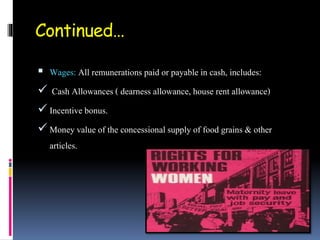
 Wages: All remunerations paid or payable in cash, includes:
 Cash Allowances ( dearness allowance, house rent allowance)
 Incentive bonus.
 Money value of the concessional supply of food grains & other
articles.
Duties of Employee for
Maternity Benefit
• Ten weeks before the expected delivery date, she may ask
employer to give her light work after producing certificate of
pregnancy.
• She should inform the employer seven weeks prior to the date of
delivery, about the leave period.
• Name the person to whom the payment will be made in case she
cannot take herself.
• Any woman who has not given the notice when she was pregnant
may give such notice as soon as possible after the delivery.
Cash
Benefits
Non-cash
Benefits
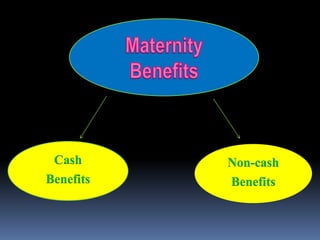
Cash Benefits
 Leave of 26 weeks (8 weeks before expected
date of delivery & 18 weeks after expected date of delivery)
 A medical bonus of Rs. 3500/- (minimum amount)
 In case of miscarriage: Leave of 8 weeks, immediately after the date of
miscarriage.
 An additional leave with pay up to one month. [Proof of illness]
 Tubectomy operation: Leave with wages for a period of 2 weeks.
Non-Cash Benefits
 No discharge or dismissal while on maternity leave.
 Light work for 10 weeks (6 weeks plus 1 month) before delivery.
 No charge to her disadvantage in any conditions of her
employment while on maternity leave.
 2 Nursing breaks of 15 Minutes until the child is 15 months old.
 Pregnant women discharged or dismissed ( in the case of gross
misconduct ) may still claim maternity benefit from employer.
Continued…
 Every establishment having 50 or more employees shall have the
facility of crèche.
 Employer shall allow 4 visits a day to the crèche by the woman, which
shall also include the interval for rest allowed to her.
Legal Obligations under this Act
 No employer shall knowingly employ a woman in establishmentduring 6 weeks
following date of her deliveryor miscarriage.
 No woman shall work in any establishment during the6 weeks immediately theday
following her delivery.
 It shall be unlawful for her employerto discharge ordismiss her on account of such
absence.
 In case of Gross misconduct, the employerin writing can communicate about depriving
such benefit.
 Within 60 days from date of deprivationof maternitybenefit, any woman can appeal to
the authorityprescribedby law.
Duties and Penalty for Employer
Record Management
• Every employer shall prepare and maintain registers, records,
muster-rolls.
Penalty for Contravention of Act
• Imprisonment with minimum period of 3 months to maximum
period 01 year.
• Fine from Rupees Two Thousand to Rupees Five Thousand.
Conclusion
After analyzing various provisions of the Act, it can be
concluded that Maternity Benefit Act, 1961 is a boon
for the working women in the sense that they don’t
have job insecurity during their maternity period. This
act regulate the employment of women & provide
maternity & other benefits to them.
Thank you !

The Maternity Benefit Act, 1961 (with latest amendments)

  • 1.
    BY: RASHI SHUKLA. M.S.W.(III SEMESTER) DEPARTMENT OF SOCIAL WORK. INSTITUTE OF SOCIAL SCIENCES, AGRA. DR. B.R. AMBEDKAR UNIVERSITY, INDIA. SUBMITTED TO: PROF. DR. R.K. BHARTI. Maternity Benefit Act, 1961
  • 2.
    Labour Legislation inIndia  The term ‘Labour Legislation’ is used to cover all the laws which have been enacted to deal with employment and non-employment, wages, working conditions, industrial relations, social security and welfare of persons employed in industries.  Labour Legislation refers to all laws of the government to provide social and economic security to the workers.  Labour Legislation maintain the dignity of employees in their organization.
  • 4.
    Introduction  Title: Thematernity benefit act, 1961.  Extend: Whole of the India (Including J&K from 1970)  Total Sections: 30 Sections.  This act is enacted on the basis of Article 39(e) & (f) of the Constitution: “ State shall, in particular, direct its policy towards securing the health & strength of workers, men & women.’’
  • 5.
    Objective This act: • Regulatesthe employment of women. • In certain establishments for a certain period. • Before & after child birth. Further, • It provides for maternity & other benefits. ‘‘Maternity benefits are aimed to provide for the maintenance of woman & her child, when she is not working.’’
  • 6.
    Applicability of theact  Where 10 or more workers are employed.  Every establishment being a factory, mine or plantation.  Every establishment where persons are employed for the exhibition of equestrian, acrobatic & other performances. ‘ The State Government with the approval of Central Government may extend it to other establishments after giving 2 months notice.’
  • 7.
    Eligibility for maternitybenefit  Must have worked in the establishment for 80 days in 12 months before her date of Delivery.  Woman earning less than 15,000 may be offered ESI scheme by her employer and will not be eligible for maternity benefit but will receive the maternity benefit under ESI scheme.
  • 8.
    Nothing contained inthis act shall apply to any factory, establishment, to which the provisions of the Employee’s State Insurance Act, 1948 apply for the time being.
  • 9.
    Definitions  Child :Includes a still-born child.  Delivery: The birth of a child.  Appropriate Government includes:  Establishment being a mine or establishment for the exhibition of equestrian, acrobatic & other performances, THE CENTRAL GOVERNMENT.  Any other establishment, THE STATE GOVERNMENT.
  • 10.
    Continued…  Miscarriage: Expulsionof the contents of a pregnant uterus at any period prior to or during the twenty-sixth week of pregnancy.  Does not include any miscarriage which is punishable under Indian Penal Code.  Commissioning Mother: Biological mother who uses her eggs(ovum) to create an embryo, implanted in any other woman.
  • 11.
    Continued…  Wages: Allremunerations paid or payable in cash, includes:  Cash Allowances ( dearness allowance, house rent allowance)  Incentive bonus.  Money value of the concessional supply of food grains & other articles.
  • 12.
    Duties of Employeefor Maternity Benefit • Ten weeks before the expected delivery date, she may ask employer to give her light work after producing certificate of pregnancy. • She should inform the employer seven weeks prior to the date of delivery, about the leave period. • Name the person to whom the payment will be made in case she cannot take herself. • Any woman who has not given the notice when she was pregnant may give such notice as soon as possible after the delivery.
  • 13.
  • 14.
    Cash Benefits  Leaveof 26 weeks (8 weeks before expected date of delivery & 18 weeks after expected date of delivery)  A medical bonus of Rs. 3500/- (minimum amount)  In case of miscarriage: Leave of 8 weeks, immediately after the date of miscarriage.  An additional leave with pay up to one month. [Proof of illness]  Tubectomy operation: Leave with wages for a period of 2 weeks.
  • 15.
    Non-Cash Benefits  Nodischarge or dismissal while on maternity leave.  Light work for 10 weeks (6 weeks plus 1 month) before delivery.  No charge to her disadvantage in any conditions of her employment while on maternity leave.  2 Nursing breaks of 15 Minutes until the child is 15 months old.  Pregnant women discharged or dismissed ( in the case of gross misconduct ) may still claim maternity benefit from employer.
  • 16.
    Continued…  Every establishmenthaving 50 or more employees shall have the facility of crèche.  Employer shall allow 4 visits a day to the crèche by the woman, which shall also include the interval for rest allowed to her.
  • 17.
    Legal Obligations underthis Act  No employer shall knowingly employ a woman in establishmentduring 6 weeks following date of her deliveryor miscarriage.  No woman shall work in any establishment during the6 weeks immediately theday following her delivery.  It shall be unlawful for her employerto discharge ordismiss her on account of such absence.  In case of Gross misconduct, the employerin writing can communicate about depriving such benefit.  Within 60 days from date of deprivationof maternitybenefit, any woman can appeal to the authorityprescribedby law.
  • 18.
    Duties and Penaltyfor Employer Record Management • Every employer shall prepare and maintain registers, records, muster-rolls. Penalty for Contravention of Act • Imprisonment with minimum period of 3 months to maximum period 01 year. • Fine from Rupees Two Thousand to Rupees Five Thousand.
  • 19.
    Conclusion After analyzing variousprovisions of the Act, it can be concluded that Maternity Benefit Act, 1961 is a boon for the working women in the sense that they don’t have job insecurity during their maternity period. This act regulate the employment of women & provide maternity & other benefits to them.
  • 20.