According to British Council of the
Institution of Public Relations, “PR is the
deliberate, planned and sustained effort to
establish and maintain mutual understanding
between an organization and its public.”
JAWAHARLAL NEHRU
TECHNOLOGICAL
UNIVERSITY
KAKINADA
Subject :MANAGEMENT OF INDUSTRIAL
RELATIONS
Topic : Employees' State Insurance
Submitted by
G.BALAGI
14021E0026
Employees' State Insurance
Employees' State Insurance is a self-financing social security and
health insurance scheme for Indian workers.
For all employees earning ₹15000 (US$220) or less per month as
wages, the employer contributes 4.75 percent and employee
contributes 1.75 percent, total share 6.5 percent.
Employees' State Insurance
.
This fund is managed by the ESI Corporation (ESIC) according to
rules and regulations stipulated there in the ESI Act 1948.
 which oversees the provision of medical and cash benefits to the
employees and their family through its large network of branch
offices, dispensaries and hospitals throughout India.
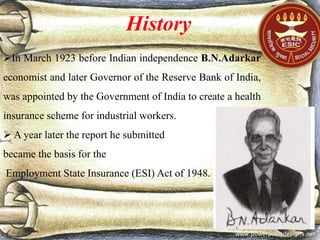
History
In March 1923 before Indian independence B.N.Adarkar
economist and later Governor of the Reserve Bank of India,
was appointed by the Government of India to create a health
insurance scheme for industrial workers.
 A year later the report he submitted
became the basis for the
Employment State Insurance (ESI) Act of 1948.
History
 The ESI Act was enacted in India in 1948, but come into
reality from 25 February 1952, established in Kanpur and Delhi.
It is now applicable to all establishments having 10 or more
workers including educational institutions, hospitals, etc.,
covering 15.5 million employees working with about 450,000
employers.
In ESI scheme, a worker in insurable employment is called
insured person (IP).
 Insured persons and their family are entitled to different types of
benefits.
 The benefits are broadly classified into two:
(1) Medical benefits and
(2) cash benefits
Benefits
Recent years have seen an increasing role of information
technology in ESI, with the introduction of Pehchan smart cards
in 'Project Panchdeep‘.
 India's largest e-governance project. In addition to insured
workers, poor families eligible under the can also avail facilities
in ESI hospitals and dispensaries.
ESI
ESI

ESI

  • 1.
    According to BritishCouncil of the Institution of Public Relations, “PR is the deliberate, planned and sustained effort to establish and maintain mutual understanding between an organization and its public.” JAWAHARLAL NEHRU TECHNOLOGICAL UNIVERSITY KAKINADA Subject :MANAGEMENT OF INDUSTRIAL RELATIONS Topic : Employees' State Insurance Submitted by G.BALAGI 14021E0026
  • 2.
    Employees' State Insurance Employees'State Insurance is a self-financing social security and health insurance scheme for Indian workers. For all employees earning ₹15000 (US$220) or less per month as wages, the employer contributes 4.75 percent and employee contributes 1.75 percent, total share 6.5 percent.
  • 3.
    Employees' State Insurance . Thisfund is managed by the ESI Corporation (ESIC) according to rules and regulations stipulated there in the ESI Act 1948.  which oversees the provision of medical and cash benefits to the employees and their family through its large network of branch offices, dispensaries and hospitals throughout India.
  • 4.
    History In March 1923before Indian independence B.N.Adarkar economist and later Governor of the Reserve Bank of India, was appointed by the Government of India to create a health insurance scheme for industrial workers.  A year later the report he submitted became the basis for the Employment State Insurance (ESI) Act of 1948.
  • 5.
    History  The ESIAct was enacted in India in 1948, but come into reality from 25 February 1952, established in Kanpur and Delhi. It is now applicable to all establishments having 10 or more workers including educational institutions, hospitals, etc., covering 15.5 million employees working with about 450,000 employers.
  • 6.
    In ESI scheme,a worker in insurable employment is called insured person (IP).  Insured persons and their family are entitled to different types of benefits.  The benefits are broadly classified into two: (1) Medical benefits and (2) cash benefits Benefits
  • 7.
    Recent years haveseen an increasing role of information technology in ESI, with the introduction of Pehchan smart cards in 'Project Panchdeep‘.  India's largest e-governance project. In addition to insured workers, poor families eligible under the can also avail facilities in ESI hospitals and dispensaries.