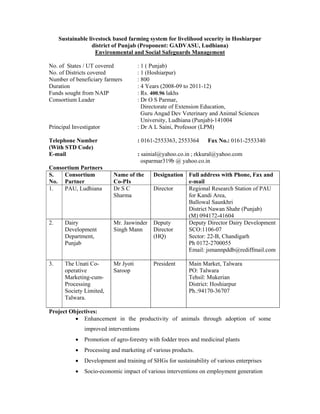
Sustainable livestock based farming system for livelihood security in Hoshiarpur
                   district of Punjab (Proponent: GADVASU, Ludhiana)
                    Environmental and Social Safeguards Management

No. of States / UT covered            : 1 ( Punjab)
No. of Districts covered              : 1 (Hoshiarpur)
Number of beneficiary farmers         : 800
Duration                              : 4 Years (2008-09 to 2011-12)
Funds sought from NAIP                : Rs. 400.96 lakhs
Consortium Leader                     : Dr O S Parmar,
                                        Directorate of Extension Education,
                                        Guru Angad Dev Veterinary and Animal Sciences
                                        University, Ludhiana (Punjab)-141004
Principal Investigator                : Dr A L Saini, Professor (LPM)

Telephone Number                      : 0161-2553363, 2553364     Fax No.: 0161-2553340
(With STD Code)
E-mail                                : sainial@yahoo.co.in ; rkkural@yahoo.com
                                        osparmar319b @ yahoo.co.in
Consortium Partners
S.   Consortium            Name of the      Designation Full address with Phone, Fax and
No. Partner                Co-PIs                       e-mail
1.   PAU, Ludhiana         Dr S C           Director    Regional Research Station of PAU
                           Sharma                       for Kandi Area,
                                                        Ballowal Saunkhri
                                                        District Nawan Shahr (Punjab)
                                                        (M) 094172-41604
2.     Dairy               Mr. Jaswinder    Deputy      Deputy Director Dairy Development
       Development         Singh Mann       Director    SCO:1106-07
       Department,                          (HQ)        Sector: 22-B, Chandigarh
       Punjab                                           Ph 0172-2700055
                                                        Email: jsmannpddb@rediffmail.com

3.     The Unati Co-       Mr Jyoti         President     Main Market, Talwara
       operative           Saroop                         PO: Talwara
       Marketing-cum-                                     Tehsil: Mukerian
       Processing                                         District: Hoshiarpur
       Society Limited,                                   Ph.:94170-36707
       Talwara.

Project Objectives:
          • Enhancement in the productivity of animals through adoption of some
               improved interventions
           •   Promotion of agro-forestry with fodder trees and medicinal plants
           •   Processing and marketing of various products.
           •   Development and training of SHGs for sustainability of various enterprises
           •   Socio-economic impact of various interventions on employment generation
Brief Project Description
          Hoshiarpur district has two distinct regions namely Kandi area and plain area. Kandi
area is comprised of 4 under-developed and 3 developed blocks whereas plain area has
developed blocks. The project is proposed in the under-developed blocks of Kandi area. Dairy
farming is the most common occupation in the area with 68% of the population engaged in this
activity followed by agro forestry (27% ). Total area of the target blocks is 124518 ha with area
under forest varying from 6.62% to 52.29% for different blocks. Estimated net income from
livestock farming and crop cultivation are Rs 5689 and Rs 2793 per annum per farm
respectively. Contribution of women in total family income is about 36%. Total population of
the area and livestock population are 368923 and 165232, respectively. SC population varies
from 16 % to 47 %. The per capita income, milk production, fodder availability in the target
areas are much lower than that of the whole district and the state. Lack of organized marketing
channels, value addition of livestock and other produce, negligible training facilities are some
of the major constraints in the area.

 Interventions Proposed    :
     • Production of improved dairy animals through use of superior indigenous/ Jersey/ HF
          cattle and buffalo bulls/semen and increased coverage of artificial insemination
      • Supplementation of mineral mixture, feeding of uromin licks and fermented dry
          fodder blocks after supplementing with complete ration and mineral mixture to
          improve production and reproduction.
      • Cultivation of Guinea grass and hybrid Napier bajra for increased availability of green
          fodder.
      • Vaccination, deworming and other health management practices of different livestock
          species.
      • Stall-feeding of goats with limited grazing.
      •   Strengthening of agro-forestry with fodder trees like subabul etc. and medicinal
          plants like Amla/ Bill/ Neem/Harar/ Bahera in the selected villages.
      •   Organization of Self Help Groups (SHGs), cooperatives and lead farmers and their
          training programmes.

 Environmental Category: B

  2. Major environmental and social issues in the subproject

          Social: Major social issues likely to arise on implementation of the projects are –

          1) Inclusion of poor and disadvantaged groups
          2) The capacity of farmers to adapt and sustain the productivity gains
3) Demonstration of economic benefits of the interventions

               Only the small and marginal farmers have been included in the list of
       beneficiary families. These families will get different inputs at subsidized rates
       depending on the year of the project. However, the other families of each village can
       also get benefit from different interventions of the project, thereby minimizing the
       discrimination in the selection of beneficiary families.
               The beneficiary families have been selected based upon their previous
       occupations. The introduction of different interventions will depend upon their
       previous occupation, thereby, increasing the chances of adapting and sustaining the
       productivity gains.
               When the beneficiary families will get the productivity gains and the inputs
       provided will be reduced gradually, they will automatically demonstrate the economic
       benefits of the interventions to other non-beneficiary families of the area.

       Environmental: Major environmental issues likely to arise on implementation of the
       projects are –
       1. Protection of local biodiversity resources
       2. Impact of use of agro chemicals on environment

       The project is not likely to have any adverse environmental impacts on the project
area and instead will have beneficial impacts through environmentally sensitive interventions,
which will enhance the ecosystem of the project area. Since most of the technologies are low
external input based and having potential to increase the productivity of livestock, these will
be managed socially by the user groups and thus will not impose any burden over
environment. Any adverse impact of the project on the environment will be minimized
through the optimum use of natural resources. The project has been developed as a holistic
approach by adopting an integrated farming system with focus on diversifying income
streams leading to increase in overall livestock productivity and reduction in over
exploitation of natural resource base. The project will promote cultivation of multi-cut
Guinea grass and Napier bajra, maize and fodder tree plantation that will have positive
impact on the vegetation cover in the project area and this will increase the supply of fodder
for sustainable livestock development. Sustainability of the project on long term bases is
integrated with the activities by way of resource improvement, generation of better
germplasm, capacity building and social upliftment. Efficient development of farmer groups
into SHGs will help in sustainability and proper management of the project in future.
3. Safeguard Policies Triggered (World Bank Policies)

Safeguard Policies Triggered (World Bank Policies)
                                                            Yes                     No
Environmental Assessment (OP/BP 4.01)                       [X]                     [ ]
Natural Habitats (OP/BP 4.04)                               [ ]                     [X]
Pest Management (OP 4.09)                                   [X]                     [ ]
Cultural Property (draft OP 4.11-OPN 11.03 -)               [ ]                    [X]
Involuntary Resettlement (OP/BP 4.12)                       [ ]                     [X]
Indigenous Peoples (OD 4.20)                                 [X]                   [ ]
Forests (OP/BP 4.36)                                        [ ]                    [X]
Safety of Dams (OP/BP 4.37)                                  [ ]                   [ X]
Projects in Disputed Areas (OP/BP 7.60)                      [ ]                   [X]
Projects on International Waterways (OP/BP 7.50)             [ ]                    [X]

  4. Risk related Issues (not covered under 3 above but perceived to be important in the
     sub project): No such issue is there

  5. Impact Assessment

A. Environmental Safeguard: Activities, Issues, Impact and mitigation Measures
Activities   Issues            Anticipated level of Impacts
                               Positive         Negative        Mitigation Measures
                                                                (Negative Impact)
Enhancement in     Enhanced livestock       3
the productivity   biodiversity through
of animals         use of superior
through adoption   quality semen
of improved                                        1               The dung produced will be utilized as
interventions                                                      farm yard manure and for compost
                   Waste disposal                                  making / vermin-composting
Promotion of                                       1               Livestock farming will enrich the
high yielding      Loss of soil nutrients                          soil through organic manure
varieties          Increase in              3
                   productive vegetative
                   cover
                   Increase in                     1               Agricultural waste will be used as
                   agricultural waste                              livestock fodder after enrichment
                                                                   through natural fermentation
                   Effect on human          3
                   health through food
                   chain
Use of fermented   Effect on human          3
dry fodder         health through food
                   chain
Strengthening of   Increase in              3
agro-forestry      productive vegetative
                   cover
B. Social Safeguard : Activities, Issues, Impact and mitigation Measures

Activities        Issues                        Anticipated level of Impacts       Mitigation
                                                Positive        Negative           Measures (Negative
                                                                                   Impact)
Mechanization     Reduced drudgery              3
of crop                                                           1                Cost effective technology,
cultivation                                                                        training on use, operation
                  High Investment                                                  and maintenance
Formation of      Economic empowerment          3
SHG’s, FBG’s &    Social conflicts                                1                Participatory approach,
Producer                                                                           Adequate capacity
Company                                                                            building would be done,
                                                                                   involvement of
                                                                                   panchayats , village level
                                                                                   committees etc
Introduction of   Enhanced income,              3
value addition,   employment generation
PHT etc           Change in occupational                          1                Participatory approach,
                  pattern                                                          Adequate capacity
                                                                                   building would be done

  6. Potential indirect and / or long-term Impacts due to anticipated future activities in the
     project areas (assessment of anticipated conflict / complimentarily with the current as
     well as those proposed for the next five years) in the areas of activities of the sub-Project)

     •   Enhancement in production level (at least 50%)
     •   Decrease in calving/kidding interval (by 3-4 months)
     •   Decrease in losses due to mortality of livestock (by 60%)
     •   Enhancement in farm income by 50 per cent or more
     •   Employment generation: Self-employment of at least one family member of the beneficiary
         families and about 300 in the service sector including procurement, processing and marketing
         of inputs and produce
     •   Organized procurement, processing and marketing network
     •   Empowerment of farm women and weaker sections

  7. Identify the key stakeholders and describe mechanisms for consultation with and to them
     done / disclosure so far done including pre-project consultations with the stake holders,
     stakeholders’ workshop before formulating the full proposal, discussing the full proposal
     with some stakeholders before submission to the PIU

     • Implementation of the project in consortium mode is proposed with partners already working
       in identified areas, have inherent advantages of linkages with other programmes undertaken
       by them. Linkages were established with district level development agencies like Soil
       Conservation Department, Punjab Remote Sensing Centre, Punjab Animal Husbandry
       Department, Punjab Dairy Development Department, and projects like IWDP, and NABARD
Two meetings were conducted and personal contacts were established to generate the basic
information and plan the future strategies.

  8. Measures to address the issues

      8a)
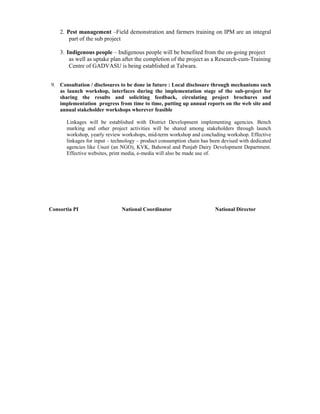
      1. Environment- The screening of environmental issues has been done to include
          possible impacts and appropriate mitigation measures or employed (enclosure I)
2. Pest management –Field demonstration and farmers training on IPM are an integral
        part of the sub project

    3. Indigenous people – Indigenous people will be benefited from the on-going project
        as well as uptake plan after the completion of the project as a Research-cum-Training
        Centre of GADVASU is being established at Talwara.


9. Consultation / disclosures to be done in future : Local disclosure through mechanisms such
   as launch workshop, interfaces during the implementation stage of the sub-project for
   sharing the results and soliciting feedback, circulating project brochures and
   implementation progress from time to time, putting up annual reports on the web site and
   annual stakeholder workshops wherever feasible

       Linkages will be established with District Development implementing agencies. Bench
       marking and other project activities will be shared among stakeholders through launch
       workshop, yearly review workshops, mid-term workshop and concluding workshop. Effective
       linkages for input – technology – product consumption chain has been devised with dedicated
       agencies like Unati (an NGO), KVK, Bahowal and Punjab Dairy Development Department.
       Effective websites, print media, e-media will also be made use of.


Consortia PI                   National Coordinator                      National Director

Esc3 gadvasu

  • 1.
    Sustainable livestock basedfarming system for livelihood security in Hoshiarpur district of Punjab (Proponent: GADVASU, Ludhiana) Environmental and Social Safeguards Management No. of States / UT covered : 1 ( Punjab) No. of Districts covered : 1 (Hoshiarpur) Number of beneficiary farmers : 800 Duration : 4 Years (2008-09 to 2011-12) Funds sought from NAIP : Rs. 400.96 lakhs Consortium Leader : Dr O S Parmar, Directorate of Extension Education, Guru Angad Dev Veterinary and Animal Sciences University, Ludhiana (Punjab)-141004 Principal Investigator : Dr A L Saini, Professor (LPM) Telephone Number : 0161-2553363, 2553364 Fax No.: 0161-2553340 (With STD Code) E-mail : sainial@yahoo.co.in ; rkkural@yahoo.com osparmar319b @ yahoo.co.in Consortium Partners S. Consortium Name of the Designation Full address with Phone, Fax and No. Partner Co-PIs e-mail 1. PAU, Ludhiana Dr S C Director Regional Research Station of PAU Sharma for Kandi Area, Ballowal Saunkhri District Nawan Shahr (Punjab) (M) 094172-41604 2. Dairy Mr. Jaswinder Deputy Deputy Director Dairy Development Development Singh Mann Director SCO:1106-07 Department, (HQ) Sector: 22-B, Chandigarh Punjab Ph 0172-2700055 Email: jsmannpddb@rediffmail.com 3. The Unati Co- Mr Jyoti President Main Market, Talwara operative Saroop PO: Talwara Marketing-cum- Tehsil: Mukerian Processing District: Hoshiarpur Society Limited, Ph.:94170-36707 Talwara. Project Objectives: • Enhancement in the productivity of animals through adoption of some improved interventions • Promotion of agro-forestry with fodder trees and medicinal plants • Processing and marketing of various products. • Development and training of SHGs for sustainability of various enterprises • Socio-economic impact of various interventions on employment generation
  • 2.
    Brief Project Description Hoshiarpur district has two distinct regions namely Kandi area and plain area. Kandi area is comprised of 4 under-developed and 3 developed blocks whereas plain area has developed blocks. The project is proposed in the under-developed blocks of Kandi area. Dairy farming is the most common occupation in the area with 68% of the population engaged in this activity followed by agro forestry (27% ). Total area of the target blocks is 124518 ha with area under forest varying from 6.62% to 52.29% for different blocks. Estimated net income from livestock farming and crop cultivation are Rs 5689 and Rs 2793 per annum per farm respectively. Contribution of women in total family income is about 36%. Total population of the area and livestock population are 368923 and 165232, respectively. SC population varies from 16 % to 47 %. The per capita income, milk production, fodder availability in the target areas are much lower than that of the whole district and the state. Lack of organized marketing channels, value addition of livestock and other produce, negligible training facilities are some of the major constraints in the area. Interventions Proposed : • Production of improved dairy animals through use of superior indigenous/ Jersey/ HF cattle and buffalo bulls/semen and increased coverage of artificial insemination • Supplementation of mineral mixture, feeding of uromin licks and fermented dry fodder blocks after supplementing with complete ration and mineral mixture to improve production and reproduction. • Cultivation of Guinea grass and hybrid Napier bajra for increased availability of green fodder. • Vaccination, deworming and other health management practices of different livestock species. • Stall-feeding of goats with limited grazing. • Strengthening of agro-forestry with fodder trees like subabul etc. and medicinal plants like Amla/ Bill/ Neem/Harar/ Bahera in the selected villages. • Organization of Self Help Groups (SHGs), cooperatives and lead farmers and their training programmes. Environmental Category: B 2. Major environmental and social issues in the subproject Social: Major social issues likely to arise on implementation of the projects are – 1) Inclusion of poor and disadvantaged groups 2) The capacity of farmers to adapt and sustain the productivity gains
  • 3.
    3) Demonstration ofeconomic benefits of the interventions Only the small and marginal farmers have been included in the list of beneficiary families. These families will get different inputs at subsidized rates depending on the year of the project. However, the other families of each village can also get benefit from different interventions of the project, thereby minimizing the discrimination in the selection of beneficiary families. The beneficiary families have been selected based upon their previous occupations. The introduction of different interventions will depend upon their previous occupation, thereby, increasing the chances of adapting and sustaining the productivity gains. When the beneficiary families will get the productivity gains and the inputs provided will be reduced gradually, they will automatically demonstrate the economic benefits of the interventions to other non-beneficiary families of the area. Environmental: Major environmental issues likely to arise on implementation of the projects are – 1. Protection of local biodiversity resources 2. Impact of use of agro chemicals on environment The project is not likely to have any adverse environmental impacts on the project area and instead will have beneficial impacts through environmentally sensitive interventions, which will enhance the ecosystem of the project area. Since most of the technologies are low external input based and having potential to increase the productivity of livestock, these will be managed socially by the user groups and thus will not impose any burden over environment. Any adverse impact of the project on the environment will be minimized through the optimum use of natural resources. The project has been developed as a holistic approach by adopting an integrated farming system with focus on diversifying income streams leading to increase in overall livestock productivity and reduction in over exploitation of natural resource base. The project will promote cultivation of multi-cut Guinea grass and Napier bajra, maize and fodder tree plantation that will have positive impact on the vegetation cover in the project area and this will increase the supply of fodder for sustainable livestock development. Sustainability of the project on long term bases is integrated with the activities by way of resource improvement, generation of better germplasm, capacity building and social upliftment. Efficient development of farmer groups into SHGs will help in sustainability and proper management of the project in future.
  • 4.
    3. Safeguard PoliciesTriggered (World Bank Policies) Safeguard Policies Triggered (World Bank Policies) Yes No Environmental Assessment (OP/BP 4.01) [X] [ ] Natural Habitats (OP/BP 4.04) [ ] [X] Pest Management (OP 4.09) [X] [ ] Cultural Property (draft OP 4.11-OPN 11.03 -) [ ] [X] Involuntary Resettlement (OP/BP 4.12) [ ] [X] Indigenous Peoples (OD 4.20) [X] [ ] Forests (OP/BP 4.36) [ ] [X] Safety of Dams (OP/BP 4.37) [ ] [ X] Projects in Disputed Areas (OP/BP 7.60) [ ] [X] Projects on International Waterways (OP/BP 7.50) [ ] [X] 4. Risk related Issues (not covered under 3 above but perceived to be important in the sub project): No such issue is there 5. Impact Assessment A. Environmental Safeguard: Activities, Issues, Impact and mitigation Measures Activities Issues Anticipated level of Impacts Positive Negative Mitigation Measures (Negative Impact) Enhancement in Enhanced livestock 3 the productivity biodiversity through of animals use of superior through adoption quality semen of improved 1 The dung produced will be utilized as interventions farm yard manure and for compost Waste disposal making / vermin-composting Promotion of 1 Livestock farming will enrich the high yielding Loss of soil nutrients soil through organic manure varieties Increase in 3 productive vegetative cover Increase in 1 Agricultural waste will be used as agricultural waste livestock fodder after enrichment through natural fermentation Effect on human 3 health through food chain Use of fermented Effect on human 3 dry fodder health through food chain Strengthening of Increase in 3 agro-forestry productive vegetative cover
  • 5.
    B. Social Safeguard: Activities, Issues, Impact and mitigation Measures Activities Issues Anticipated level of Impacts Mitigation Positive Negative Measures (Negative Impact) Mechanization Reduced drudgery 3 of crop 1 Cost effective technology, cultivation training on use, operation High Investment and maintenance Formation of Economic empowerment 3 SHG’s, FBG’s & Social conflicts 1 Participatory approach, Producer Adequate capacity Company building would be done, involvement of panchayats , village level committees etc Introduction of Enhanced income, 3 value addition, employment generation PHT etc Change in occupational 1 Participatory approach, pattern Adequate capacity building would be done 6. Potential indirect and / or long-term Impacts due to anticipated future activities in the project areas (assessment of anticipated conflict / complimentarily with the current as well as those proposed for the next five years) in the areas of activities of the sub-Project) • Enhancement in production level (at least 50%) • Decrease in calving/kidding interval (by 3-4 months) • Decrease in losses due to mortality of livestock (by 60%) • Enhancement in farm income by 50 per cent or more • Employment generation: Self-employment of at least one family member of the beneficiary families and about 300 in the service sector including procurement, processing and marketing of inputs and produce • Organized procurement, processing and marketing network • Empowerment of farm women and weaker sections 7. Identify the key stakeholders and describe mechanisms for consultation with and to them done / disclosure so far done including pre-project consultations with the stake holders, stakeholders’ workshop before formulating the full proposal, discussing the full proposal with some stakeholders before submission to the PIU • Implementation of the project in consortium mode is proposed with partners already working in identified areas, have inherent advantages of linkages with other programmes undertaken by them. Linkages were established with district level development agencies like Soil Conservation Department, Punjab Remote Sensing Centre, Punjab Animal Husbandry Department, Punjab Dairy Development Department, and projects like IWDP, and NABARD Two meetings were conducted and personal contacts were established to generate the basic information and plan the future strategies. 8. Measures to address the issues 8a) 1. Environment- The screening of environmental issues has been done to include possible impacts and appropriate mitigation measures or employed (enclosure I)
  • 6.
    2. Pest management–Field demonstration and farmers training on IPM are an integral part of the sub project 3. Indigenous people – Indigenous people will be benefited from the on-going project as well as uptake plan after the completion of the project as a Research-cum-Training Centre of GADVASU is being established at Talwara. 9. Consultation / disclosures to be done in future : Local disclosure through mechanisms such as launch workshop, interfaces during the implementation stage of the sub-project for sharing the results and soliciting feedback, circulating project brochures and implementation progress from time to time, putting up annual reports on the web site and annual stakeholder workshops wherever feasible Linkages will be established with District Development implementing agencies. Bench marking and other project activities will be shared among stakeholders through launch workshop, yearly review workshops, mid-term workshop and concluding workshop. Effective linkages for input – technology – product consumption chain has been devised with dedicated agencies like Unati (an NGO), KVK, Bahowal and Punjab Dairy Development Department. Effective websites, print media, e-media will also be made use of. Consortia PI National Coordinator National Director