CLIMATE CHANGE ADAPTATION AND
          AFRICAN AGRICULTURE GRANTEE CONVENING
                    24-25 February 2011


 Making Ethiopian Agriculture Climate Resilient:
   Towards Networking and Coordination to
Mainstream Climate Change Adapataion into Food
     Security and Sustaiable Developemnt
    Ethiopian Institute of Agricultural Research (EIAR)
           Girma Mamo, Principal Investigator


                                                          0
Brief Background of EIAR

 EIAR: evolved through several
stages since its first initiation
in late 1940s.

Part of NARS=
    EIAR+ Regional
   Agricultural Research
   Institutes (RARIs) + Higher
   Learning Institutions
   (HLIs)

EIAR Overall coordination countrywide

55 research centers across various agro-ecological
zones.                                               1
Brief Background of EIAR

                                                  Technical Man Power
                              Directorate
Prime responsibility to                     PhD   MSc/MA       BSc/BA/BEd   Total
                              Crop          48    108          76           232
address climate issues in     Livestock     7     56           37           100

Growth and                    Forestry      9     27           21           57

Transformation Plan
                              Soil and
                                            11    35           48           94
                              Water
(GTP)                         Agricultural
                                            0     5            7            12
                              Mechanization

                              Total         75    231          189          495
Current core value:

Better position in terms of
technically capable
manpower in climate
science
                                                                                    2
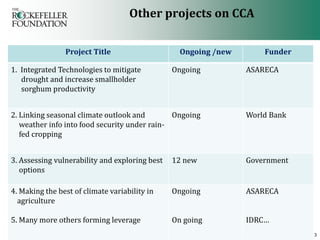
Other projects on CCA

                Project Title                     Ongoing /new       Funder

1. Integrated Technologies to mitigate          Ongoing          ASARECA
   drought and increase smallholder
   sorghum productivity


2. Linking seasonal climate outlook and        Ongoing           World Bank
   weather info into food security under rain-
   fed cropping


3. Assessing vulnerability and exploring best   12 new           Government
   options

4. Making the best of climate variability in    Ongoing          ASARECA
  agriculture

5. Many more others forming leverage            On going         IDRC…
                                                                              3
Objectives of the Rockefeller Foundation Grant


1. To form a consortium that ensures networking among climate
   and agriculture institutions for mainstreaming climate change
   adaptations       Capacity building

2. To develop a standard methodological tool for monitoring
   progresses from mainstreaming of CCA and sustain the impact
   beyond the project life      Scalability/Sustainability
3. To assess vulnerability (social, economic and environmental)
   and map impacts         Science
4. To create relevant climate risk adaptation policies and practices
   suited to effective networking       Policy
5. To develop institutional capacity for technology dissemination,
   uptake and impact pathways to enhance climate change
   adaptations        Technology/communication/impact
                                                                   4
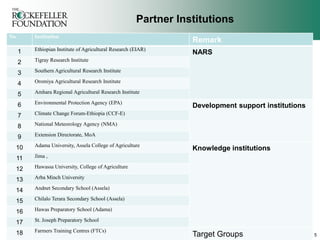
Partner Institutions
No.       Institution
                                                                   Remark
      1   Ethiopian Institute of Agricultural Research (EIAR)
                                                                   NARS
      2   Tigray Research Institute

      3   Southern Agricultural Research Institute

      4   Oromiya Agricultural Research Institute

      5   Amhara Regional Agricultural Research Institute

      6   Environmental Protection Agency (EPA)
                                                                   Development support institutions
      7   Climate Change Forum-Ethiopia (CCF-E)

      8   National Meteorology Agency (NMA)

      9   Extension Directorate, MoA

  10      Adama University, Assela College of Agriculture
                                                                   Knowledge institutions
  11      Jima ,

  12      Hawassa University, College of Agriculture

  13      Arba Minch University

  14      Andnet Secondary School (Assela)

  15      Chilalo Terara Secondary School (Assela)

  16      Hawas Preparatory School (Adama)

  17      St. Joseph Preparatory School

  18      Farmers Training Centres (FTCs)
                                                                   Target Groups                      5
Key Activities

1. Coordination and networking: Seven key climate-agriculture
      institutions with common goals have formed alliance


                                                                6
Key Activities Continued

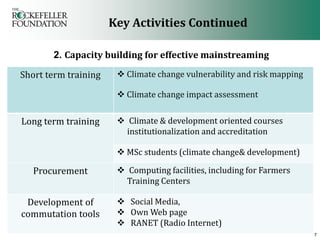
       2. Capacity building for effective mainstreaming

Short term training     Climate change vulnerability and risk mapping

                        Climate change impact assessment


Long term training      Climate & development oriented courses
                         institutionalization and accreditation

                        MSc students (climate change& development)

   Procurement          Computing facilities, including for Farmers
                         Training Centers

 Development of         Social Media,
commutation tools       Own Web page
                        RANET (Radio Internet)
                                                                         7
Key Activities Continued


4. Climate change policy formulation
  Policy gap analyses for agriculture sector
   Policy gap analyses on climate data use
   Build on existing policy documents on agriculture and climate data use


5. Adaptation technology & communication mainstreaming
   Assess project activities for climate risk management
    Identification of adaptation options
    Prioritize adaptation options
    Select best adaptation options
    Evaluation of adaptation options (through work-shopping )
    Scoping the existing national technology communication structure
         Value addition NMA-Research- Extension- Farmers chain
                                                                             8
Entry points/Indicators for Mainstreaming CCA

    Project Level                       Higher Learning           Farmer Training
                                         Institute Level            Center Level
   Assess project activities
    for climate risk                      Curriculum review
                                                                  Selection of FTCs

   Identify, Prioritize and           Curriculum               Module development
    Select best bet                     design/update
    adaptation options                                           Capacity building
                                       Feedback collection       training for
   Implement adaptation                                          development agents
    options                            Program accreditation
                                                                 Farmers training
                                       Enroll students


                                                                                        9
Communication Tool Among Partners


                                    10
Highlight on the Progress to date

Training Specific area                                                      No of
                                                                            trainees
Short term   • Climate change adaptation related project proposal writing   20
             • Focal Personnel in climate change impact assessment and      22
               downscaling of GCM outputs
             • Experts from NARS and Arba Minch University in using         16
               RegCM 4.1 for downscaling (Abdus Salam International
               Center for Theoretical Physics)
             •Training on Social Media                                      15
             •Sensitization workshop for community at 4 EIAR Research       900
             Centers
             • Sensitization workshop for environmental clubs/scouts in     200
               4 High Schools
Long Term    MSc students in climate science                                15 + 6
             Resource persons (international) offering courses at Arba      7
             Minch University expressed commitment
                                                                                       11
Challenges
 Currently, initiatives are many across a wide ranging institutions,
        However, climate change is such a complex challenge that,
        neither research nor development efforts can solve its adverse
        impacts in isolation
        In Ethiopian context, with almost virtually rain-fed system,
        agriculture will continue to take the lead in the Growth and
        Transformation Plan (GTP) of the nation over the coming 5 years
            But, existing adaptation options can not stand this
             ambitious plan:
                  Poor networking and coordination
                  Poor institutional capacity to analyze climate
                   vulnerability, risks and impact mapping
                  Poor technology,
                  Poor financial backup
                  Poor infrastructure
            Government funded research projects identified to make
             the best entry point in mainstreaming CCA in research
                                                                          12
Lessons Learnt
NARS can not have any priority agenda than considering climate as
a variable in its core business
Clearly, adaptation to the constraint in point will require new level
of thinking and technologies (Business as usual can not be the
way forward)
Therefore, re-positioning the existing technologies in response to
ensuing opportunities
Climate science courses structuring and accreditation identified to
make the best entry point in mainstreaming CCA in HLIs &
secondary schools
The need for graduation of institutions for mainstreaming CCA
Building on existing climate related agriculture policy issues
Of partner local universities, only one is member of RUFORUM
                                                                     13
Emerging Opportunities for Collaboration


Opportunities are also many, especially since the time is right and ripe
to confront climate change through networking, and that, international
donors are demonstrating great interest.

Opportunity of expanding (scaling out) the project idea and practices
to Rockefeller Foundation grant receiving countries in East Africa
Strong commitment from African Governments on CCA

Establishment of 11,000 Farmer Training Centers (out reach )

Public climate money is hovering (Copenhagen and Cancun texts)


                                                                           14
Next steps

Enhancing analytical capacity in CC vulnerability and impact
mapping
Building on existing farmers capacities


Building on existing policies in climate and agriculture

Strengthening communication tools in reaching out the farmers
Scientific evidence (both historical and future scenario)

 Overall, working towards the graduation of partner institutions
for mainstreaming CCA
                                                               15

Eiar presentation 24th

  • 1.
    CLIMATE CHANGE ADAPTATIONAND AFRICAN AGRICULTURE GRANTEE CONVENING 24-25 February 2011 Making Ethiopian Agriculture Climate Resilient: Towards Networking and Coordination to Mainstream Climate Change Adapataion into Food Security and Sustaiable Developemnt Ethiopian Institute of Agricultural Research (EIAR) Girma Mamo, Principal Investigator 0
  • 2.
    Brief Background ofEIAR EIAR: evolved through several stages since its first initiation in late 1940s. Part of NARS= EIAR+ Regional Agricultural Research Institutes (RARIs) + Higher Learning Institutions (HLIs) EIAR Overall coordination countrywide 55 research centers across various agro-ecological zones. 1
  • 3.
    Brief Background ofEIAR Technical Man Power Directorate Prime responsibility to PhD MSc/MA BSc/BA/BEd Total Crop 48 108 76 232 address climate issues in Livestock 7 56 37 100 Growth and Forestry 9 27 21 57 Transformation Plan Soil and 11 35 48 94 Water (GTP) Agricultural 0 5 7 12 Mechanization Total 75 231 189 495 Current core value: Better position in terms of technically capable manpower in climate science 2
  • 4.
    Other projects onCCA Project Title Ongoing /new Funder 1. Integrated Technologies to mitigate Ongoing ASARECA drought and increase smallholder sorghum productivity 2. Linking seasonal climate outlook and Ongoing World Bank weather info into food security under rain- fed cropping 3. Assessing vulnerability and exploring best 12 new Government options 4. Making the best of climate variability in Ongoing ASARECA agriculture 5. Many more others forming leverage On going IDRC… 3
  • 5.
    Objectives of theRockefeller Foundation Grant 1. To form a consortium that ensures networking among climate and agriculture institutions for mainstreaming climate change adaptations Capacity building 2. To develop a standard methodological tool for monitoring progresses from mainstreaming of CCA and sustain the impact beyond the project life Scalability/Sustainability 3. To assess vulnerability (social, economic and environmental) and map impacts Science 4. To create relevant climate risk adaptation policies and practices suited to effective networking Policy 5. To develop institutional capacity for technology dissemination, uptake and impact pathways to enhance climate change adaptations Technology/communication/impact 4
  • 6.
    Partner Institutions No. Institution Remark 1 Ethiopian Institute of Agricultural Research (EIAR) NARS 2 Tigray Research Institute 3 Southern Agricultural Research Institute 4 Oromiya Agricultural Research Institute 5 Amhara Regional Agricultural Research Institute 6 Environmental Protection Agency (EPA) Development support institutions 7 Climate Change Forum-Ethiopia (CCF-E) 8 National Meteorology Agency (NMA) 9 Extension Directorate, MoA 10 Adama University, Assela College of Agriculture Knowledge institutions 11 Jima , 12 Hawassa University, College of Agriculture 13 Arba Minch University 14 Andnet Secondary School (Assela) 15 Chilalo Terara Secondary School (Assela) 16 Hawas Preparatory School (Adama) 17 St. Joseph Preparatory School 18 Farmers Training Centres (FTCs) Target Groups 5
  • 7.
    Key Activities 1. Coordinationand networking: Seven key climate-agriculture institutions with common goals have formed alliance 6
  • 8.
    Key Activities Continued 2. Capacity building for effective mainstreaming Short term training  Climate change vulnerability and risk mapping  Climate change impact assessment Long term training  Climate & development oriented courses institutionalization and accreditation  MSc students (climate change& development) Procurement  Computing facilities, including for Farmers Training Centers Development of  Social Media, commutation tools  Own Web page  RANET (Radio Internet) 7
  • 9.
    Key Activities Continued 4.Climate change policy formulation Policy gap analyses for agriculture sector  Policy gap analyses on climate data use  Build on existing policy documents on agriculture and climate data use 5. Adaptation technology & communication mainstreaming Assess project activities for climate risk management  Identification of adaptation options  Prioritize adaptation options  Select best adaptation options  Evaluation of adaptation options (through work-shopping )  Scoping the existing national technology communication structure Value addition NMA-Research- Extension- Farmers chain 8
  • 10.
    Entry points/Indicators forMainstreaming CCA Project Level Higher Learning Farmer Training Institute Level Center Level  Assess project activities for climate risk Curriculum review   Selection of FTCs  Identify, Prioritize and  Curriculum  Module development Select best bet design/update adaptation options  Capacity building  Feedback collection training for  Implement adaptation development agents options  Program accreditation  Farmers training  Enroll students 9
  • 11.
  • 12.
    Highlight on theProgress to date Training Specific area No of trainees Short term • Climate change adaptation related project proposal writing 20 • Focal Personnel in climate change impact assessment and 22 downscaling of GCM outputs • Experts from NARS and Arba Minch University in using 16 RegCM 4.1 for downscaling (Abdus Salam International Center for Theoretical Physics) •Training on Social Media 15 •Sensitization workshop for community at 4 EIAR Research 900 Centers • Sensitization workshop for environmental clubs/scouts in 200 4 High Schools Long Term MSc students in climate science 15 + 6 Resource persons (international) offering courses at Arba 7 Minch University expressed commitment 11
  • 13.
    Challenges  Currently, initiativesare many across a wide ranging institutions, However, climate change is such a complex challenge that, neither research nor development efforts can solve its adverse impacts in isolation In Ethiopian context, with almost virtually rain-fed system, agriculture will continue to take the lead in the Growth and Transformation Plan (GTP) of the nation over the coming 5 years  But, existing adaptation options can not stand this ambitious plan:  Poor networking and coordination  Poor institutional capacity to analyze climate vulnerability, risks and impact mapping  Poor technology,  Poor financial backup  Poor infrastructure  Government funded research projects identified to make the best entry point in mainstreaming CCA in research 12
  • 14.
    Lessons Learnt NARS cannot have any priority agenda than considering climate as a variable in its core business Clearly, adaptation to the constraint in point will require new level of thinking and technologies (Business as usual can not be the way forward) Therefore, re-positioning the existing technologies in response to ensuing opportunities Climate science courses structuring and accreditation identified to make the best entry point in mainstreaming CCA in HLIs & secondary schools The need for graduation of institutions for mainstreaming CCA Building on existing climate related agriculture policy issues Of partner local universities, only one is member of RUFORUM 13
  • 15.
    Emerging Opportunities forCollaboration Opportunities are also many, especially since the time is right and ripe to confront climate change through networking, and that, international donors are demonstrating great interest. Opportunity of expanding (scaling out) the project idea and practices to Rockefeller Foundation grant receiving countries in East Africa Strong commitment from African Governments on CCA Establishment of 11,000 Farmer Training Centers (out reach ) Public climate money is hovering (Copenhagen and Cancun texts) 14
  • 16.
    Next steps Enhancing analyticalcapacity in CC vulnerability and impact mapping Building on existing farmers capacities Building on existing policies in climate and agriculture Strengthening communication tools in reaching out the farmers Scientific evidence (both historical and future scenario) Overall, working towards the graduation of partner institutions for mainstreaming CCA 15