Energy Efficiency in the Supply Chain through
Collaboration, Advanced Decision Support and
               Automatic Sensing

                        E-SAVE

                    FP7-ICT-2011-7

        Katerina Pramatari, k.pramatari@aueb.gr
      ELTRUN, Athens University of Economics & Business
Rationale
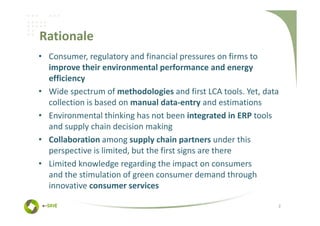
• Consumer, regulatory and financial pressures on firms to
  improve their environmental performance and energy
  efficiency
• Wide spectrum of methodologies and first LCA tools. Yet, data
  collection is based on manual data-entry and estimations
• Environmental thinking has not been integrated in ERP tools
  and supply chain decision making
• Collaboration among supply chain partners under this
  perspective is limited, but the first signs are there
• Limited knowledge regarding the impact on consumers
  and the stimulation of green consumer demand through
  innovative consumer services

                                                              2
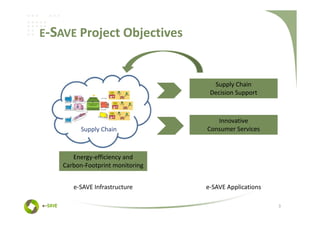
E-SAVE Project Objectives


                                    Supply Chain
                                   Decision Support


                                     Innovative
          Supply Chain            Consumer Services


       Energy-efficiency and
    Carbon-Footprint monitoring


       e-SAVE Infrastructure      e-SAVE Applications

                                                        3
Energy Efficiency and Carbon Footprint
Monitoring
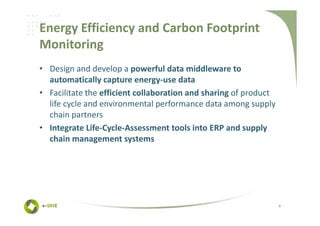
• Design and develop a powerful data middleware to
  automatically capture energy-use data
• Facilitate the efficient collaboration and sharing of product
  life cycle and environmental performance data among supply
  chain partners
• Integrate Life-Cycle-Assessment tools into ERP and supply
  chain management systems


                                                                  4
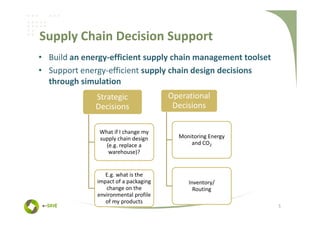
Supply Chain Decision Support
• Build an energy-efficient supply chain management toolset
• Support energy-efficient supply chain design decisions
  through simulation
              Strategic               Operational
              Decisions                Decisions

               What if I change my
               supply chain design      Monitoring Energy
                 (e.g. replace a            and CO2
                  warehouse)?


                 E.g. what is the
              impact of a packaging        Inventory/
                 change on the               Routing
              environmental profile
                 of my products
                                                              5
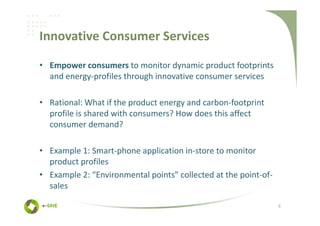
Innovative Consumer Services

• Empower consumers to monitor dynamic product footprints
  and energy-profiles through innovative consumer services

• Rational: What if the product energy and carbon-footprint
  profile is shared with consumers? How does this affect
  consumer demand?

• Example 1: Smart-phone application in-store to monitor
  product profiles
• Example 2: “Environmental points” collected at the point-of-
  sales

                                                                 6
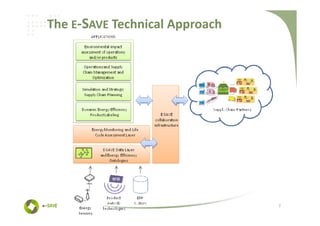
The E-SAVE Technical Approach


                                7
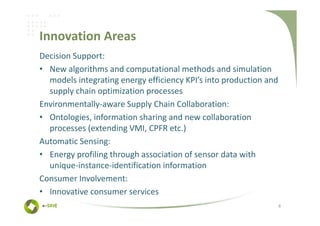
Innovation Areas
Decision Support:
• New algorithms and computational methods and simulation
  models integrating energy efficiency KPI’s into production and
  supply chain optimization processes
Environmentally-aware Supply Chain Collaboration:
• Ontologies, information sharing and new collaboration
  processes (extending VMI, CPFR etc.)
Automatic Sensing:
• Energy profiling through association of sensor data with
  unique-instance-identification information
Consumer Involvement:
• Innovative consumer services
                                                                   8
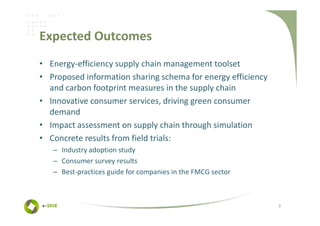
Expected Outcomes
• Energy-efficiency supply chain management toolset
• Proposed information sharing schema for energy efficiency
  and carbon footprint measures in the supply chain
• Innovative consumer services, driving green consumer
  demand
• Impact assessment on supply chain through simulation
• Concrete results from field trials:
   – Industry adoption study
   – Consumer survey results
   – Best-practices guide for companies in the FMCG sector


                                                              9
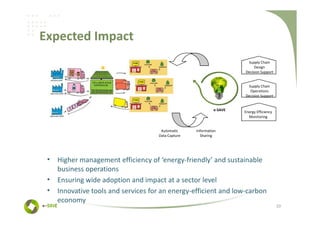
Expected Impact
                                                                      Supply Chain
                                                                          Design
                                                                     Decision Support


                                                                      Supply Chain
                                                                       Operations
                                                                     Decision Support


                                                            e-SAVE   Energy Efficiency
                                                                       Monitoring


                                     Automatic     Information
                                    Data Capture     Sharing


 • Higher management efficiency of ‘energy-friendly’ and sustainable
   business operations
 • Ensuring wide adoption and impact at a sector level
 • Innovative tools and services for an energy-efficient and low-carbon
   economy
                                                                                         10
Thank you!

• Find more: www.e-save.eu
• Contact us:
   – Project Coordinator: Antonis Ramfos (antonis.ramfos@intrasoft-
     intl.com)
   – Scientific Coordinator: Katerina Pramatari (k.pramatari@aueb.gr)


                                                                        11

e-SAVE project presentation-overview

  • 1.
    Energy Efficiency inthe Supply Chain through Collaboration, Advanced Decision Support and Automatic Sensing E-SAVE FP7-ICT-2011-7 Katerina Pramatari, k.pramatari@aueb.gr ELTRUN, Athens University of Economics & Business
  • 2.
    Rationale • Consumer, regulatoryand financial pressures on firms to improve their environmental performance and energy efficiency • Wide spectrum of methodologies and first LCA tools. Yet, data collection is based on manual data-entry and estimations • Environmental thinking has not been integrated in ERP tools and supply chain decision making • Collaboration among supply chain partners under this perspective is limited, but the first signs are there • Limited knowledge regarding the impact on consumers and the stimulation of green consumer demand through innovative consumer services 2
  • 3.
    E-SAVE Project Objectives Supply Chain Decision Support Innovative Supply Chain Consumer Services Energy-efficiency and Carbon-Footprint monitoring e-SAVE Infrastructure e-SAVE Applications 3
  • 4.
    Energy Efficiency andCarbon Footprint Monitoring • Design and develop a powerful data middleware to automatically capture energy-use data • Facilitate the efficient collaboration and sharing of product life cycle and environmental performance data among supply chain partners • Integrate Life-Cycle-Assessment tools into ERP and supply chain management systems 4
  • 5.
    Supply Chain DecisionSupport • Build an energy-efficient supply chain management toolset • Support energy-efficient supply chain design decisions through simulation Strategic Operational Decisions Decisions What if I change my supply chain design Monitoring Energy (e.g. replace a and CO2 warehouse)? E.g. what is the impact of a packaging Inventory/ change on the Routing environmental profile of my products 5
  • 6.
    Innovative Consumer Services •Empower consumers to monitor dynamic product footprints and energy-profiles through innovative consumer services • Rational: What if the product energy and carbon-footprint profile is shared with consumers? How does this affect consumer demand? • Example 1: Smart-phone application in-store to monitor product profiles • Example 2: “Environmental points” collected at the point-of- sales 6
  • 7.
  • 8.
    Innovation Areas Decision Support: •New algorithms and computational methods and simulation models integrating energy efficiency KPI’s into production and supply chain optimization processes Environmentally-aware Supply Chain Collaboration: • Ontologies, information sharing and new collaboration processes (extending VMI, CPFR etc.) Automatic Sensing: • Energy profiling through association of sensor data with unique-instance-identification information Consumer Involvement: • Innovative consumer services 8
  • 9.
    Expected Outcomes • Energy-efficiencysupply chain management toolset • Proposed information sharing schema for energy efficiency and carbon footprint measures in the supply chain • Innovative consumer services, driving green consumer demand • Impact assessment on supply chain through simulation • Concrete results from field trials: – Industry adoption study – Consumer survey results – Best-practices guide for companies in the FMCG sector 9
  • 10.
    Expected Impact Supply Chain Design Decision Support Supply Chain Operations Decision Support e-SAVE Energy Efficiency Monitoring Automatic Information Data Capture Sharing • Higher management efficiency of ‘energy-friendly’ and sustainable business operations • Ensuring wide adoption and impact at a sector level • Innovative tools and services for an energy-efficient and low-carbon economy 10
  • 11.
    Thank you! • Findmore: www.e-save.eu • Contact us: – Project Coordinator: Antonis Ramfos (antonis.ramfos@intrasoft- intl.com) – Scientific Coordinator: Katerina Pramatari (k.pramatari@aueb.gr) 11