NCSS Statistical Software NCSS.com
155-1
© NCSS, LLC. All Rights Reserved.
Chapter 155
Error-Bar Charts
Introduction
Error-Bar Charts graphically display tables of means (or medians) and variability. Following are examples of the
types of charts produced by this procedure. The error bars may represent the standard deviation (SD) of the data,
the standard error of the mean (SE), a confidence interval, the data range, or percentiles.
NCSS Statistical Software NCSS.com
Error-Bar Charts
155-2
© NCSS, LLC. All Rights Reserved.
Data Structure
An error-bar chart is constructed from a numeric variable. A second variable may be used to divide the first
variable into groups (e.g., age group or gender). In the two-factor procedure, a third variable may be used to
divide the groups into subgroups.
Error-Bar Chart Window Options
This section describes the specific options available on the Error-Bar Chart window, which is displayed when the
Error-Bar Chart button is clicked. Common options, such as axes, labels, legends, and titles are documented in the
Graphics Components chapter.
Error-Bar Chart Tab
Estimation of Center Section
You can choose whether to plot means or medians.
Bars and Symbols Section
You can modify the color of bars, border, and/or symbols using the options in this section.
One Factor
NCSS Statistical Software NCSS.com
Error-Bar Charts
155-3
© NCSS, LLC. All Rights Reserved.
Two Factors
Variation (Error Bars) Section
You modify the variation line that extends from the mean using the options in this section.
NCSS Statistical Software NCSS.com
Error-Bar Charts
155-4
© NCSS, LLC. All Rights Reserved.
Layout Tab
Orientation Section
You can orient the bars horizontally or vertically.
Object Spacing and Size Section
You can change the size of the gap between individual bars.
Connecting Lines Tab
Connect Between Groups Section
You can add reference lines at group means and percentiles.
NCSS Statistical Software NCSS.com
Error-Bar Charts
155-5
© NCSS, LLC. All Rights Reserved.
Titles, Legend, Numeric Axis, Group Axis, Grid Lines, and Background
Tabs
Details on setting the options in these tabs are given in the Graphics Components chapter.
Example 1 – Creating an Error-Bar Chart
This section presents an example of how to generate an error-bar chart. The data used are from the Fisher dataset.
We will create error-bar charts of the SepalLength variable, grouping on the type of iris.
Setup
To run this example, complete the following steps:
1 Open the Fisher example dataset
• From the File menu of the NCSS Data window, select Open Example Data.
• Select Fisher and click OK.
2 Specify the Error-Bar Charts procedure options
• Find and open the Error-Bar Charts procedure using the menus or the Procedure Navigator.
• The settings for this example are listed below and are stored in the Example 1 settings template. To load
this template, click Open Example Template in the Help Center or File menu.
Option Value
Variables Tab
Data Variable(s)...................................... SepalLength
Horizontal (Group) Variable.................... Iris
Report Options (in the Toolbar)
Variable Labels....................................... Column Names
Data Labels............................................. Value Labels
3 Run the procedure
• Click the Run button to perform the calculations and generate the output.
NCSS Statistical Software NCSS.com
Error-Bar Charts
155-6
© NCSS, LLC. All Rights Reserved.
Error-Bar Chart Output
Error-Bar Charts ────────────────────────────────────────────────────────────
The second plot is the same data with the bar fill and bar border removed and symbols and connecting lines added
(see Example 1b settings template).
NCSS Statistical Software NCSS.com
Error-Bar Charts
155-7
© NCSS, LLC. All Rights Reserved.
Example 2 – Creating an Error-Bar Chart with Subgroups
This section presents an example of how to generate an error-bar chart with subgroups. The data used are from the
fictitious Tree dataset. We will create error-bar charts of the Diameter variable, grouping on Species, with
subgroups according to Sunlight.
Setup
To run this example, complete the following steps:
1 Open the Tree example dataset
• From the File menu of the NCSS Data window, select Open Example Data.
• Select Tree and click OK.
2 Specify the Error-Bar Charts (2 Factors) procedure options
• Find and open the Error-Bar Charts (2 Factors) procedure using the menus or the Procedure Navigator.
• The settings for this example are listed below and are stored in the Example 2 settings template. To load
this template, click Open Example Template in the Help Center or File menu.
Option Value
Variables Tab
Data Variable(s)...................................... Diameter
Horizontal (Group) Variable.................... Species
Legend (Subgroup) Variable .................. Sunlight
Report Options (in the Toolbar)
Data Labels............................................. Value Labels
3 Run the procedure
• Click the Run button to perform the calculations and generate the output.
NCSS Statistical Software NCSS.com
Error-Bar Charts
155-8
© NCSS, LLC. All Rights Reserved.
Error-Bar Chart Output
Error-Bar Charts ────────────────────────────────────────────────────────────
The second plot is the same data with the bar fill and bar border removed and symbols and connecting lines added
(see Example 2b settings template).
NCSS Statistical Software NCSS.com
Error-Bar Charts
155-9
© NCSS, LLC. All Rights Reserved.
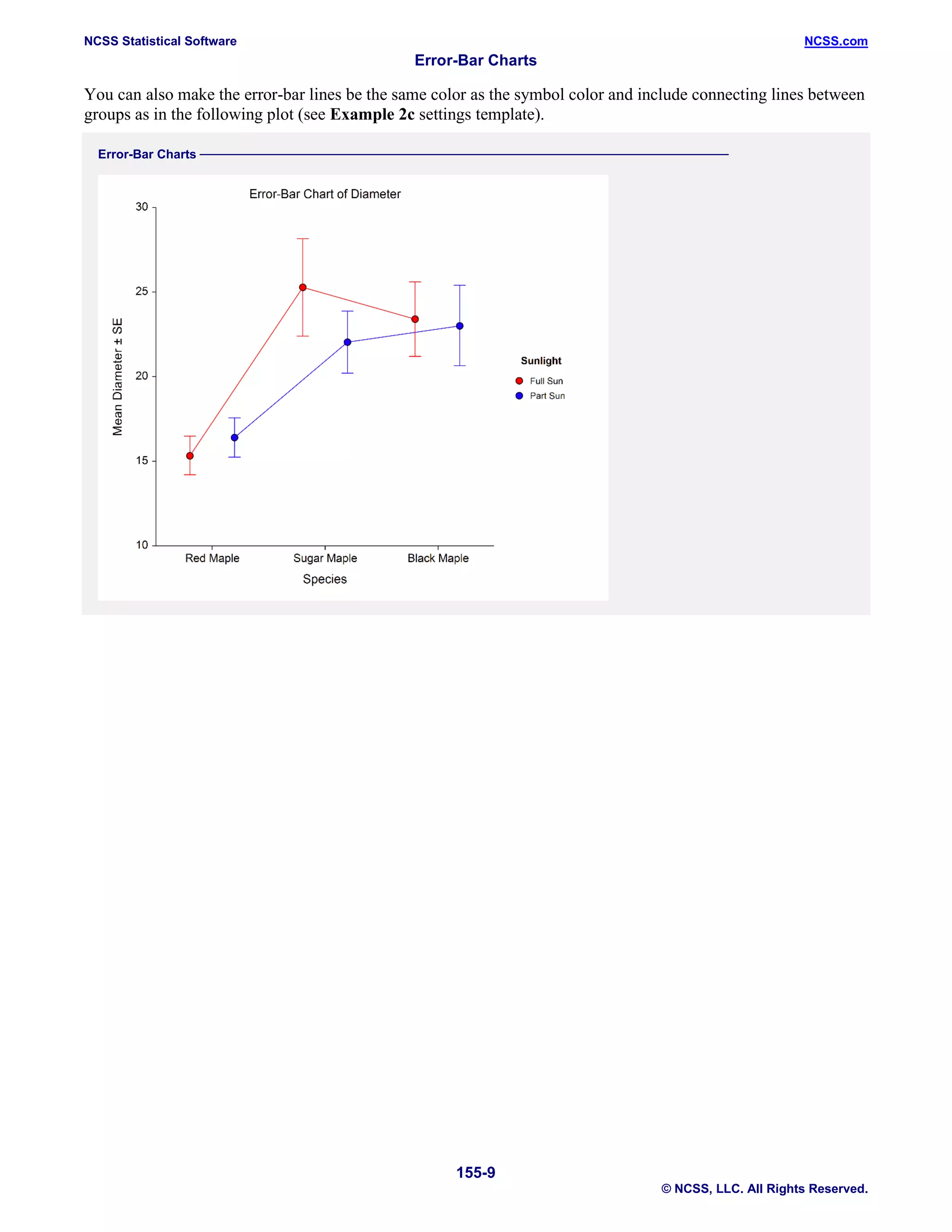
You can also make the error-bar lines be the same color as the symbol color and include connecting lines between
groups as in the following plot (see Example 2c settings template).
Error-Bar Charts ────────────────────────────────────────────────────────────
NCSS Statistical Software NCSS.com
Error-Bar Charts
155-10
© NCSS, LLC. All Rights Reserved.
Example 3 – Creating an Error-Bar Chart with 95% Confidence
Interval Limits and Raw Data
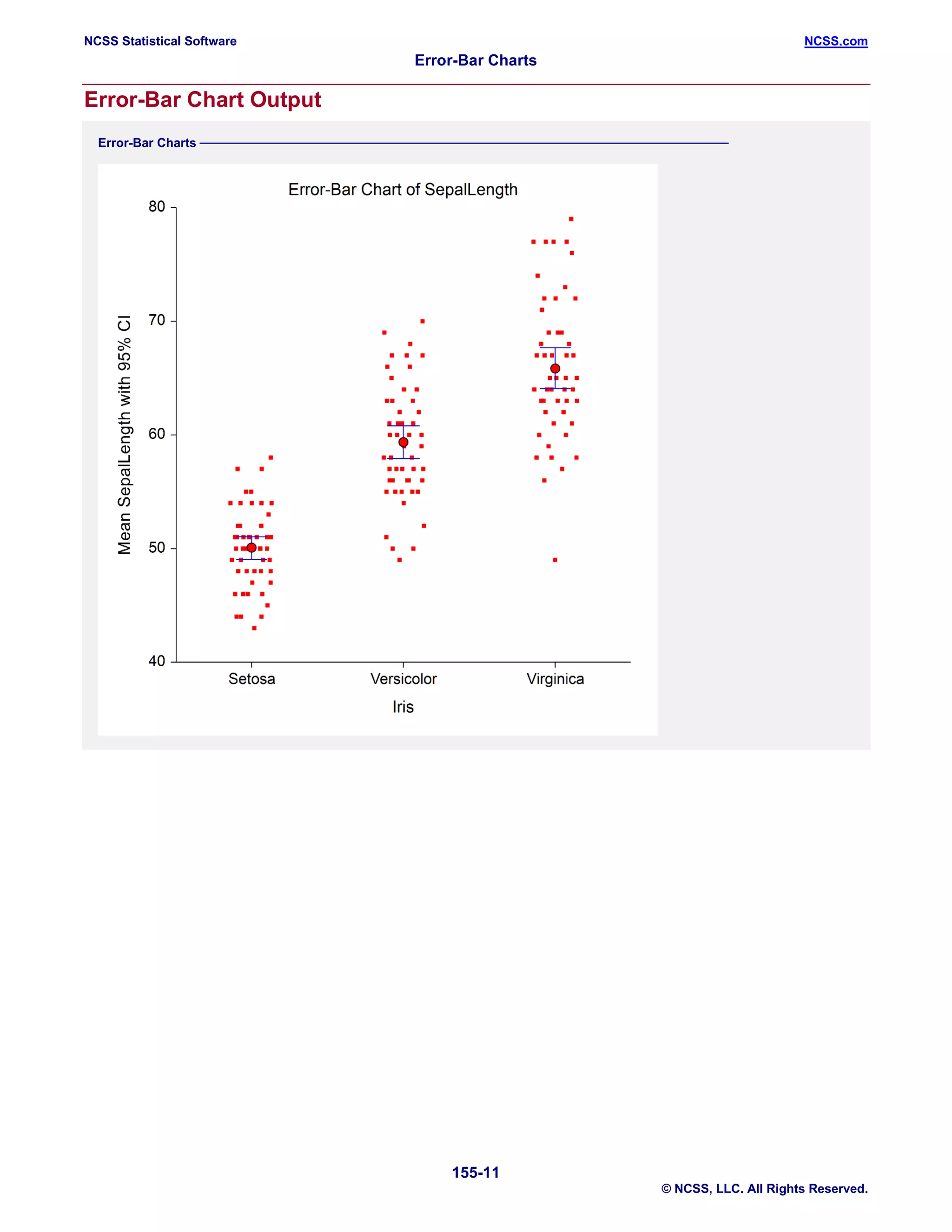
This section presents an example of how to generate an error-bar chart with 95% confidence interval limits. The
data used are from the Fisher dataset. We will create error-bar charts of the SepalLength variable, grouping on the
type of iris.
Setup
To run this example, complete the following steps:
1 Open the Fisher example dataset
• From the File menu of the NCSS Data window, select Open Example Data.
• Select Fisher and click OK.
2 Specify the Error-Bar Charts procedure options
• Find and open the Error-Bar Charts procedure using the menus or the Procedure Navigator.
• The settings for this example are listed below and are stored in the Example 3 settings template. To load
this template, click Open Example Template in the Help Center or File menu.
Option Value
Variables Tab
Data Variable(s)...................................... SepalLength
Horizontal (Group) Variable.................... Iris
Error-Bar Chart Format (Click the Button)
Bar Fill ................................................. Unchecked
Bar Border ........................................... Unchecked
Symbol................................................. Checked
Raw Data............................................. Checked
Error-Bar Variation Line Type.............. Confidence Interval
Report Options (in the Toolbar)
Variable Labels....................................... Column Names
Data Labels............................................. Value Labels
3 Run the procedure
• Click the Run button to perform the calculations and generate the output.
NCSS Statistical Software NCSS.com
Error-Bar Charts
155-11
© NCSS, LLC. All Rights Reserved.
Error-Bar Chart Output
Error-Bar Charts ────────────────────────────────────────────────────────────
NCSS Statistical Software NCSS.com
Error-Bar Charts
155-12
© NCSS, LLC. All Rights Reserved.
Example 4 – Creating an Error-Bar Chart with Medians
This section presents an example of how to generate an error-bar chart with medians instead of means. The data
used are from the Fisher dataset. We will create error-bar charts of the SepalLength variable, grouping on the type
of iris.
Setup
To run this example, complete the following steps:
1 Open the Fisher example dataset
• From the File menu of the NCSS Data window, select Open Example Data.
• Select Fisher and click OK.
2 Specify the Error-Bar Charts procedure options
• Find and open the Error-Bar Charts procedure using the menus or the Procedure Navigator.
• The settings for this example are listed below and are stored in the Example 4 settings template. To load
this template, click Open Example Template in the Help Center or File menu.
Option Value
Variables Tab
Data Variable(s)...................................... SepalLength
Horizontal (Group) Variable.................... Iris
Error-Bar Chart Format (Click the Button)
Error-Bar Chart Tab
Bar Fill ................................................. Unchecked
Bar Border ........................................... Unchecked
Symbol................................................. Checked
Raw Data............................................. Unchecked
Connecting Lines Tab
Medians............................................... Checked
Painting Order Tab
Move Connecting Lines before Error-Bar Chart
Report Options (in the Toolbar)
Variable Labels....................................... Column Names
Data Labels............................................. Value Labels
3 Run the procedure
• Click the Run button to perform the calculations and generate the output.
NCSS Statistical Software NCSS.com
Error-Bar Charts
155-13
© NCSS, LLC. All Rights Reserved.
Error-Bar Chart Output
Error-Bar Charts ────────────────────────────────────────────────────────────
When medians are plotted, the error-bars are not necessarily symmetric about the median. In this example, the 25th
and 75th
percentiles are represented by the lower and upper error bars, respectively.
The other option when plotting medians is to draw error bars that cover the entire range of the data as displayed in
the following plot (see Example 4b settings template).
NCSS Statistical Software NCSS.com
Error-Bar Charts
155-14
© NCSS, LLC. All Rights Reserved.
Error-Bar Charts ────────────────────────────────────────────────────────────

Error-Bar_Charts.pdf

  • 1.
    NCSS Statistical SoftwareNCSS.com 155-1 © NCSS, LLC. All Rights Reserved. Chapter 155 Error-Bar Charts Introduction Error-Bar Charts graphically display tables of means (or medians) and variability. Following are examples of the types of charts produced by this procedure. The error bars may represent the standard deviation (SD) of the data, the standard error of the mean (SE), a confidence interval, the data range, or percentiles.
  • 2.
    NCSS Statistical SoftwareNCSS.com Error-Bar Charts 155-2 © NCSS, LLC. All Rights Reserved. Data Structure An error-bar chart is constructed from a numeric variable. A second variable may be used to divide the first variable into groups (e.g., age group or gender). In the two-factor procedure, a third variable may be used to divide the groups into subgroups. Error-Bar Chart Window Options This section describes the specific options available on the Error-Bar Chart window, which is displayed when the Error-Bar Chart button is clicked. Common options, such as axes, labels, legends, and titles are documented in the Graphics Components chapter. Error-Bar Chart Tab Estimation of Center Section You can choose whether to plot means or medians. Bars and Symbols Section You can modify the color of bars, border, and/or symbols using the options in this section. One Factor
  • 3.
    NCSS Statistical SoftwareNCSS.com Error-Bar Charts 155-3 © NCSS, LLC. All Rights Reserved. Two Factors Variation (Error Bars) Section You modify the variation line that extends from the mean using the options in this section.
  • 4.
    NCSS Statistical SoftwareNCSS.com Error-Bar Charts 155-4 © NCSS, LLC. All Rights Reserved. Layout Tab Orientation Section You can orient the bars horizontally or vertically. Object Spacing and Size Section You can change the size of the gap between individual bars. Connecting Lines Tab Connect Between Groups Section You can add reference lines at group means and percentiles.
  • 5.
    NCSS Statistical SoftwareNCSS.com Error-Bar Charts 155-5 © NCSS, LLC. All Rights Reserved. Titles, Legend, Numeric Axis, Group Axis, Grid Lines, and Background Tabs Details on setting the options in these tabs are given in the Graphics Components chapter. Example 1 – Creating an Error-Bar Chart This section presents an example of how to generate an error-bar chart. The data used are from the Fisher dataset. We will create error-bar charts of the SepalLength variable, grouping on the type of iris. Setup To run this example, complete the following steps: 1 Open the Fisher example dataset • From the File menu of the NCSS Data window, select Open Example Data. • Select Fisher and click OK. 2 Specify the Error-Bar Charts procedure options • Find and open the Error-Bar Charts procedure using the menus or the Procedure Navigator. • The settings for this example are listed below and are stored in the Example 1 settings template. To load this template, click Open Example Template in the Help Center or File menu. Option Value Variables Tab Data Variable(s)...................................... SepalLength Horizontal (Group) Variable.................... Iris Report Options (in the Toolbar) Variable Labels....................................... Column Names Data Labels............................................. Value Labels 3 Run the procedure • Click the Run button to perform the calculations and generate the output.
  • 6.
    NCSS Statistical SoftwareNCSS.com Error-Bar Charts 155-6 © NCSS, LLC. All Rights Reserved. Error-Bar Chart Output Error-Bar Charts ──────────────────────────────────────────────────────────── The second plot is the same data with the bar fill and bar border removed and symbols and connecting lines added (see Example 1b settings template).
  • 7.
    NCSS Statistical SoftwareNCSS.com Error-Bar Charts 155-7 © NCSS, LLC. All Rights Reserved. Example 2 – Creating an Error-Bar Chart with Subgroups This section presents an example of how to generate an error-bar chart with subgroups. The data used are from the fictitious Tree dataset. We will create error-bar charts of the Diameter variable, grouping on Species, with subgroups according to Sunlight. Setup To run this example, complete the following steps: 1 Open the Tree example dataset • From the File menu of the NCSS Data window, select Open Example Data. • Select Tree and click OK. 2 Specify the Error-Bar Charts (2 Factors) procedure options • Find and open the Error-Bar Charts (2 Factors) procedure using the menus or the Procedure Navigator. • The settings for this example are listed below and are stored in the Example 2 settings template. To load this template, click Open Example Template in the Help Center or File menu. Option Value Variables Tab Data Variable(s)...................................... Diameter Horizontal (Group) Variable.................... Species Legend (Subgroup) Variable .................. Sunlight Report Options (in the Toolbar) Data Labels............................................. Value Labels 3 Run the procedure • Click the Run button to perform the calculations and generate the output.
  • 8.
    NCSS Statistical SoftwareNCSS.com Error-Bar Charts 155-8 © NCSS, LLC. All Rights Reserved. Error-Bar Chart Output Error-Bar Charts ──────────────────────────────────────────────────────────── The second plot is the same data with the bar fill and bar border removed and symbols and connecting lines added (see Example 2b settings template).
  • 9.
    NCSS Statistical SoftwareNCSS.com Error-Bar Charts 155-9 © NCSS, LLC. All Rights Reserved. You can also make the error-bar lines be the same color as the symbol color and include connecting lines between groups as in the following plot (see Example 2c settings template). Error-Bar Charts ────────────────────────────────────────────────────────────
  • 10.
    NCSS Statistical SoftwareNCSS.com Error-Bar Charts 155-10 © NCSS, LLC. All Rights Reserved. Example 3 – Creating an Error-Bar Chart with 95% Confidence Interval Limits and Raw Data This section presents an example of how to generate an error-bar chart with 95% confidence interval limits. The data used are from the Fisher dataset. We will create error-bar charts of the SepalLength variable, grouping on the type of iris. Setup To run this example, complete the following steps: 1 Open the Fisher example dataset • From the File menu of the NCSS Data window, select Open Example Data. • Select Fisher and click OK. 2 Specify the Error-Bar Charts procedure options • Find and open the Error-Bar Charts procedure using the menus or the Procedure Navigator. • The settings for this example are listed below and are stored in the Example 3 settings template. To load this template, click Open Example Template in the Help Center or File menu. Option Value Variables Tab Data Variable(s)...................................... SepalLength Horizontal (Group) Variable.................... Iris Error-Bar Chart Format (Click the Button) Bar Fill ................................................. Unchecked Bar Border ........................................... Unchecked Symbol................................................. Checked Raw Data............................................. Checked Error-Bar Variation Line Type.............. Confidence Interval Report Options (in the Toolbar) Variable Labels....................................... Column Names Data Labels............................................. Value Labels 3 Run the procedure • Click the Run button to perform the calculations and generate the output.
  • 11.
    NCSS Statistical SoftwareNCSS.com Error-Bar Charts 155-11 © NCSS, LLC. All Rights Reserved. Error-Bar Chart Output Error-Bar Charts ────────────────────────────────────────────────────────────
  • 12.
    NCSS Statistical SoftwareNCSS.com Error-Bar Charts 155-12 © NCSS, LLC. All Rights Reserved. Example 4 – Creating an Error-Bar Chart with Medians This section presents an example of how to generate an error-bar chart with medians instead of means. The data used are from the Fisher dataset. We will create error-bar charts of the SepalLength variable, grouping on the type of iris. Setup To run this example, complete the following steps: 1 Open the Fisher example dataset • From the File menu of the NCSS Data window, select Open Example Data. • Select Fisher and click OK. 2 Specify the Error-Bar Charts procedure options • Find and open the Error-Bar Charts procedure using the menus or the Procedure Navigator. • The settings for this example are listed below and are stored in the Example 4 settings template. To load this template, click Open Example Template in the Help Center or File menu. Option Value Variables Tab Data Variable(s)...................................... SepalLength Horizontal (Group) Variable.................... Iris Error-Bar Chart Format (Click the Button) Error-Bar Chart Tab Bar Fill ................................................. Unchecked Bar Border ........................................... Unchecked Symbol................................................. Checked Raw Data............................................. Unchecked Connecting Lines Tab Medians............................................... Checked Painting Order Tab Move Connecting Lines before Error-Bar Chart Report Options (in the Toolbar) Variable Labels....................................... Column Names Data Labels............................................. Value Labels 3 Run the procedure • Click the Run button to perform the calculations and generate the output.
  • 13.
    NCSS Statistical SoftwareNCSS.com Error-Bar Charts 155-13 © NCSS, LLC. All Rights Reserved. Error-Bar Chart Output Error-Bar Charts ──────────────────────────────────────────────────────────── When medians are plotted, the error-bars are not necessarily symmetric about the median. In this example, the 25th and 75th percentiles are represented by the lower and upper error bars, respectively. The other option when plotting medians is to draw error bars that cover the entire range of the data as displayed in the following plot (see Example 4b settings template).
  • 14.
    NCSS Statistical SoftwareNCSS.com Error-Bar Charts 155-14 © NCSS, LLC. All Rights Reserved. Error-Bar Charts ────────────────────────────────────────────────────────────