Justifying the transition to an Enterprise
Risk Management (ERM) Model
for Senior Management
Introduction
• Enterprise Risk Management Overview
• Current Organizational Challenges
• Risk Restructuring / Future Vision
• Benefits of Change
Let’s talk Enterprise Risk Management (ERM)
• The underlying premise of ERM is that every entity exists to
provide value for its stakeholders.
• All entities face uncertainty and uncertainty presents both risk
and opportunity, with the potential to erode or enhance value.
• ERM enables management to effectively deal with uncertainty
and associated risk and opportunity, enhancing the capacity to
build value.
ERM is a Strategy, Tool & Culture
• Value is maximized when management sets strategy and
objectives to strike an optimal balance between growth and
return goals and related risks, and efficiently and effectively
deploys resources in pursuit of the entity’s objectives.
• ERM encompasses
• Aligning risk appetite and strategy
• Enhancing risk response decisions
• Reducing operational surprises and losses
• Identifying and managing multiple and cross-enterprise risks
• Seizing opportunities
• Improving deployment of capital
ERM Management Components
• ERM Management Components:
• Internal Environment
• Objective Setting
• Event Identification
• Risk Assessment
• Risk Response
• Control Activities
• Information and Communication
• Monitoring
• A coordinated and normalized ERM approach is geared towards achieving
improvement in the following areas:
• Strategic
• Operations
• Reporting
• Compliance
Changing Business Environment
• The ERM model supports changing business environments and
adapts to the following:
• Consolidation of legacy systems, data and operations.
• Increased Client & Customer needs.
• Increased regulations
• Cost pressure
• New digital and mobile channels have put demands on
businesses to adapt quickly and cheaply.
• Media highlighting operational failures and potential
exposures.
ERM Research
• Research on ERM mainly focused on the financial industry has
found the following:
• Better risk data management and reporting can increase a
firm’s ability to meet strategic goals while reducing earning
volatility and ultimately lead to improved profitability.1
• Firms with more mature risk management practices
outperform their peers financially.2
• Firms with mature risk management practices generate the
highest growth in revenue giving them a clear competitive
advantage.2
1 Harner, Michelle, Potential Cost and Value of ERM, The Conference Board, March 2013.
2 Ernst & Young, “Turning Risk into Results: How Leading Companies Use Risk Management to Fuel Better Performance,” February 2012.
ERM Research
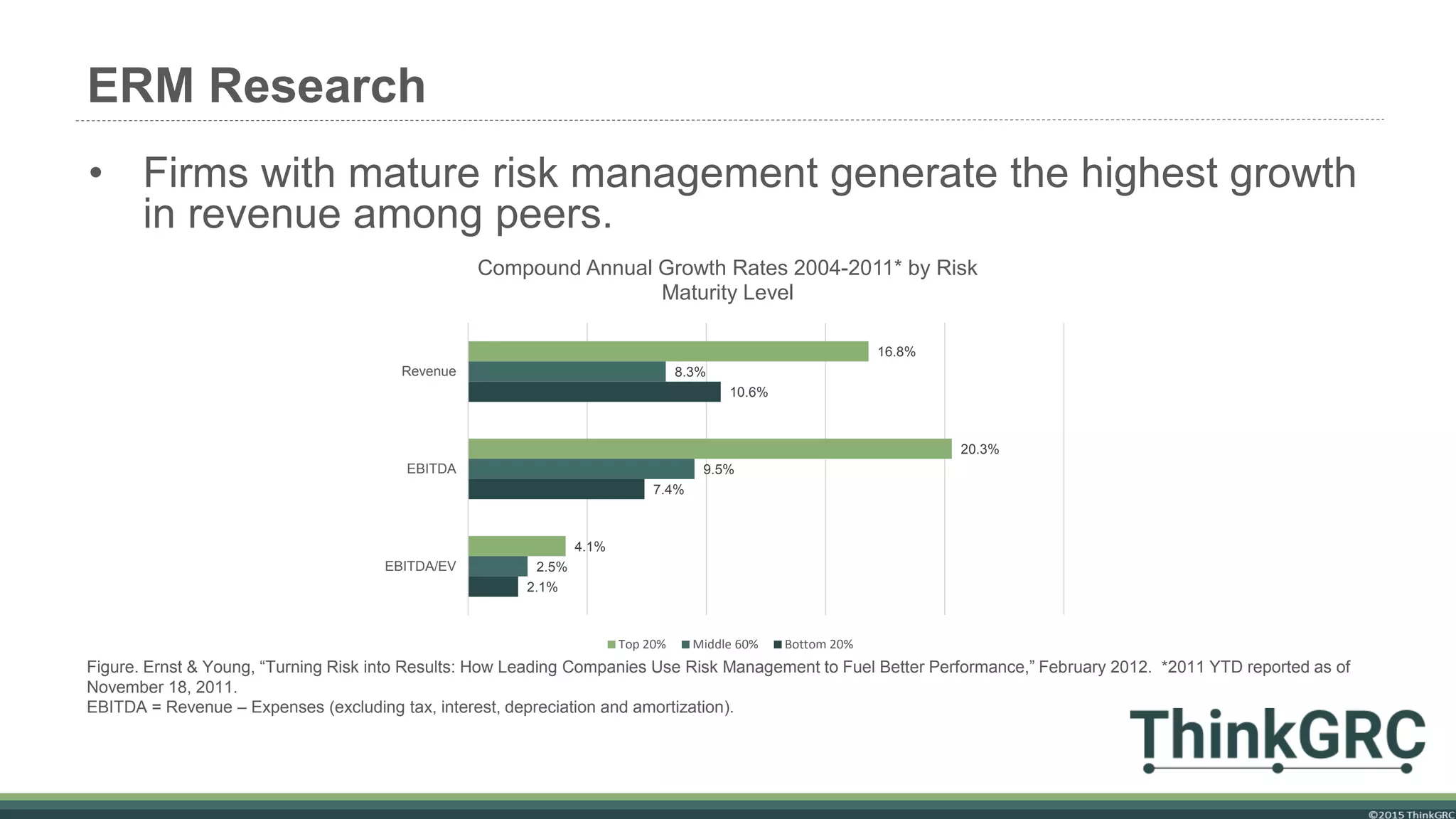
• Firms with mature risk management generate the highest growth
in revenue among peers.
Figure. Ernst & Young, “Turning Risk into Results: How Leading Companies Use Risk Management to Fuel Better Performance,” February 2012. *2011 YTD reported as of
November 18, 2011.
EBITDA = Revenue – Expenses (excluding tax, interest, depreciation and amortization).
16.8%
20.3%
4.1%
8.3%
9.5%
2.5%
10.6%
7.4%
2.1%
Revenue
EBITDA
EBITDA/EV
Compound Annual Growth Rates 2004-2011* by Risk
Maturity Level
Top 20% Middle 60% Bottom 20%
Benefits of ERM
• Better financial performance among peers.
• Increased competitive advantage.
• Cost savings via risk reduction and improved decision making.
• Improved operational insights for Management into operational
risks and exposures.
• Improved risk management measures via consolidation, metrics,
administration and compliance.
Current Organizational Challenges
• Inconsistent approach to capture and assess risk across the
organization.
• Multiple and manual risk management processes.
• Risk related operations seems to be “reactive” not “proactive”.
• Inability to produce a consolidated risk portfolio for the
organization.
• Lack of centralization.
• No driving committee/coordinated effort to consolidate Risk
based operations.
• Lack of confidence that all risks are being identified and
maintained accordingly.
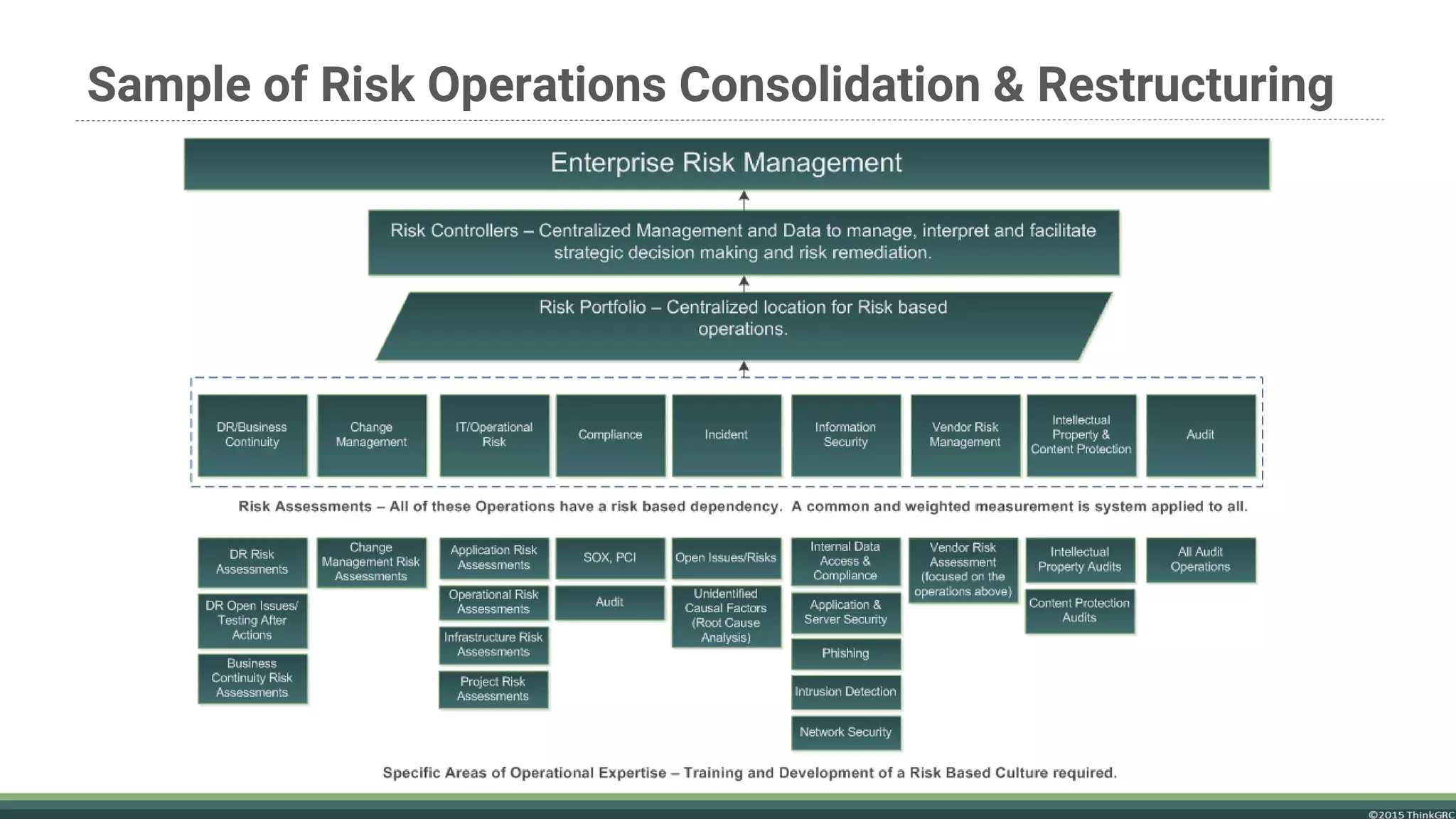
Sample of Risk Operations Consolidation & Restructuring
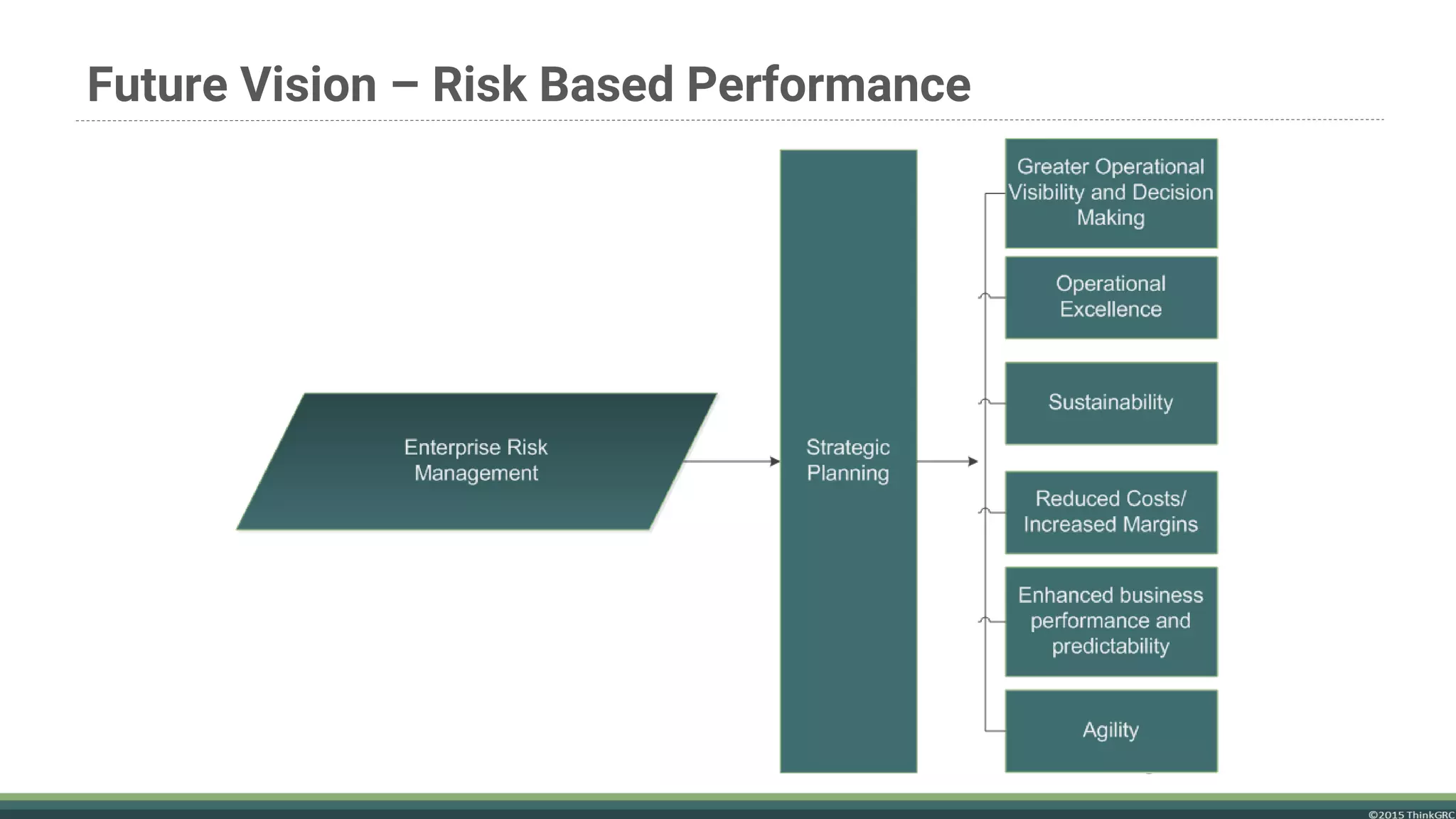
Future Vision – Risk Based Performance
Summary
• The move to an ERM model should be framed around improving
organizational performance, with a focus on strategic planning
and decision making.
• ERM can increase the scope or volume of data to be captured
maintained and analyzed as part a risk management program. A
value assessment should be done to ensure that data of value is
being captured for your objectives and duplication or non-valued
data eliminated.
• Always start with defining the program focusing on process,
procedures and people.
• Software is not a solution, it is an enabler and should only be
used where there is a clearly defined program that requires
support.
Contact Information
• Prepared by:
• ThinkGRC
• ThinkGRC.com
• thinkgrc@thinkgrc.com

ThinkGRC justifying the transition to an Enterprise Risk Management (ERM) model

  • 1.
    Justifying the transitionto an Enterprise Risk Management (ERM) Model for Senior Management
  • 2.
    Introduction • Enterprise RiskManagement Overview • Current Organizational Challenges • Risk Restructuring / Future Vision • Benefits of Change
  • 3.
    Let’s talk EnterpriseRisk Management (ERM) • The underlying premise of ERM is that every entity exists to provide value for its stakeholders. • All entities face uncertainty and uncertainty presents both risk and opportunity, with the potential to erode or enhance value. • ERM enables management to effectively deal with uncertainty and associated risk and opportunity, enhancing the capacity to build value.
  • 4.
    ERM is aStrategy, Tool & Culture • Value is maximized when management sets strategy and objectives to strike an optimal balance between growth and return goals and related risks, and efficiently and effectively deploys resources in pursuit of the entity’s objectives. • ERM encompasses • Aligning risk appetite and strategy • Enhancing risk response decisions • Reducing operational surprises and losses • Identifying and managing multiple and cross-enterprise risks • Seizing opportunities • Improving deployment of capital
  • 5.
    ERM Management Components •ERM Management Components: • Internal Environment • Objective Setting • Event Identification • Risk Assessment • Risk Response • Control Activities • Information and Communication • Monitoring • A coordinated and normalized ERM approach is geared towards achieving improvement in the following areas: • Strategic • Operations • Reporting • Compliance
  • 6.
    Changing Business Environment •The ERM model supports changing business environments and adapts to the following: • Consolidation of legacy systems, data and operations. • Increased Client & Customer needs. • Increased regulations • Cost pressure • New digital and mobile channels have put demands on businesses to adapt quickly and cheaply. • Media highlighting operational failures and potential exposures.
  • 7.
    ERM Research • Researchon ERM mainly focused on the financial industry has found the following: • Better risk data management and reporting can increase a firm’s ability to meet strategic goals while reducing earning volatility and ultimately lead to improved profitability.1 • Firms with more mature risk management practices outperform their peers financially.2 • Firms with mature risk management practices generate the highest growth in revenue giving them a clear competitive advantage.2 1 Harner, Michelle, Potential Cost and Value of ERM, The Conference Board, March 2013. 2 Ernst & Young, “Turning Risk into Results: How Leading Companies Use Risk Management to Fuel Better Performance,” February 2012.
  • 8.
    ERM Research • Firmswith mature risk management generate the highest growth in revenue among peers. Figure. Ernst & Young, “Turning Risk into Results: How Leading Companies Use Risk Management to Fuel Better Performance,” February 2012. *2011 YTD reported as of November 18, 2011. EBITDA = Revenue – Expenses (excluding tax, interest, depreciation and amortization). 16.8% 20.3% 4.1% 8.3% 9.5% 2.5% 10.6% 7.4% 2.1% Revenue EBITDA EBITDA/EV Compound Annual Growth Rates 2004-2011* by Risk Maturity Level Top 20% Middle 60% Bottom 20%
  • 9.
    Benefits of ERM •Better financial performance among peers. • Increased competitive advantage. • Cost savings via risk reduction and improved decision making. • Improved operational insights for Management into operational risks and exposures. • Improved risk management measures via consolidation, metrics, administration and compliance.
  • 10.
    Current Organizational Challenges •Inconsistent approach to capture and assess risk across the organization. • Multiple and manual risk management processes. • Risk related operations seems to be “reactive” not “proactive”. • Inability to produce a consolidated risk portfolio for the organization. • Lack of centralization. • No driving committee/coordinated effort to consolidate Risk based operations. • Lack of confidence that all risks are being identified and maintained accordingly.
  • 11.
    Sample of RiskOperations Consolidation & Restructuring
  • 12.
    Future Vision –Risk Based Performance
  • 13.
    Summary • The moveto an ERM model should be framed around improving organizational performance, with a focus on strategic planning and decision making. • ERM can increase the scope or volume of data to be captured maintained and analyzed as part a risk management program. A value assessment should be done to ensure that data of value is being captured for your objectives and duplication or non-valued data eliminated. • Always start with defining the program focusing on process, procedures and people. • Software is not a solution, it is an enabler and should only be used where there is a clearly defined program that requires support.
  • 14.
    Contact Information • Preparedby: • ThinkGRC • ThinkGRC.com • thinkgrc@thinkgrc.com