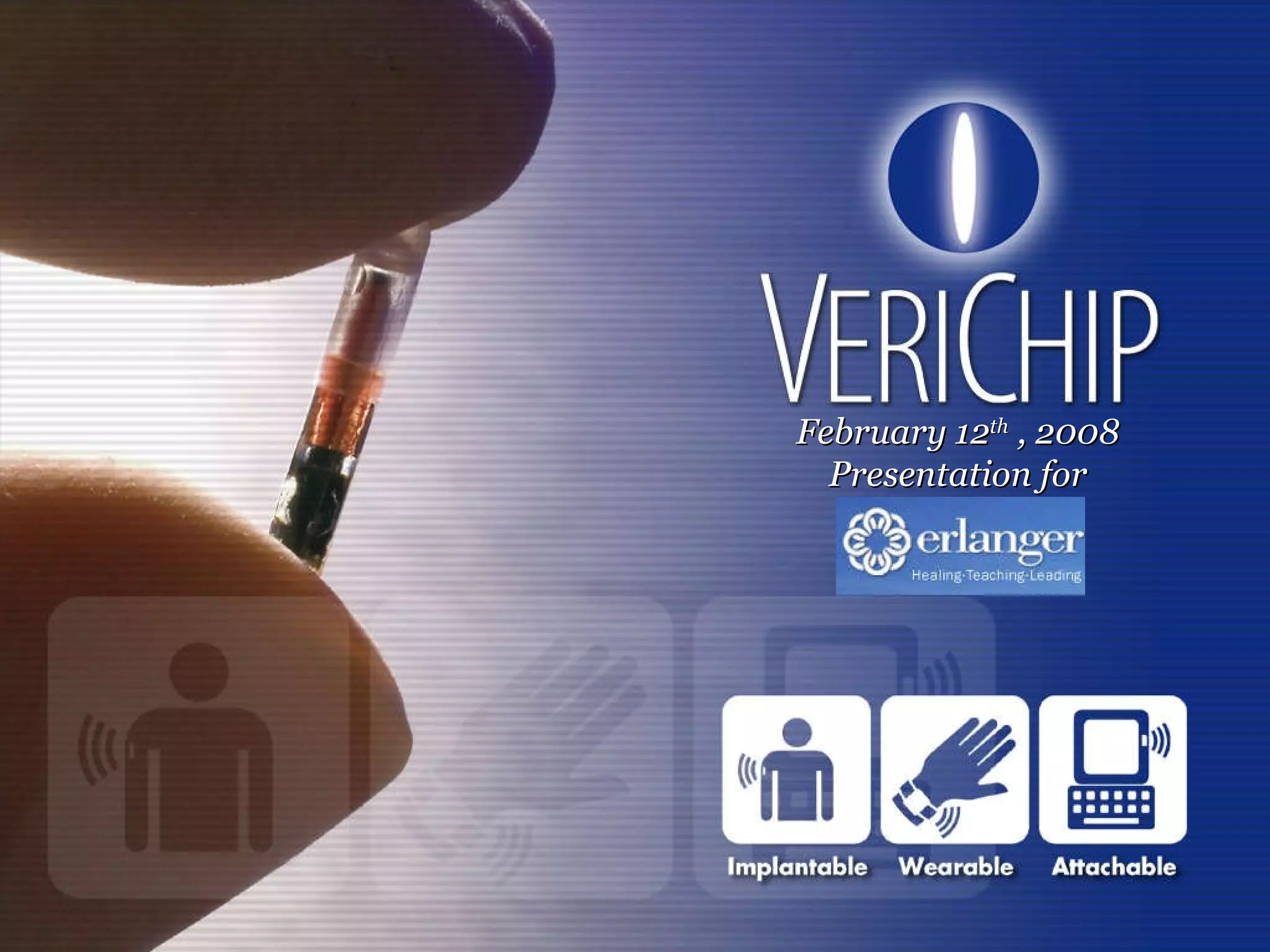
February 12 th  , 2008 Presentation for
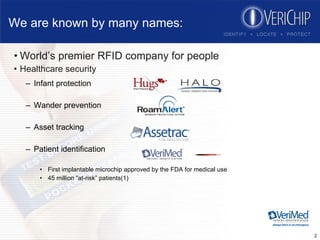
We are known by many names: World’s premier RFID company for people Healthcare security Infant protection Wander prevention Asset tracking Patient identification First implantable microchip approved by the FDA for medical use 45 million “at-risk” patients(1)
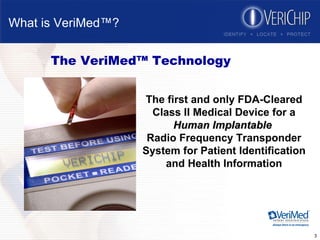
What is VeriMed™? The VeriMed™ Technology The first and only   FDA-Cleared Class II Medical Device for a   Human Implantable   Radio Frequency Transponder System for Patient Identification and Health Information
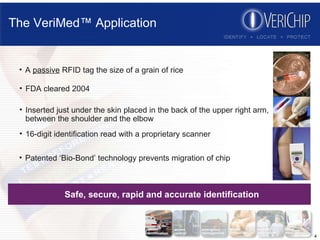
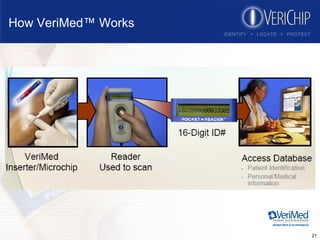
The VeriMed™ Application Safe, secure, rapid and accurate identification Patented ‘Bio-Bond’ technology prevents migration of chip 16-digit identification read with a proprietary scanner Inserted just under the skin placed in the back of the upper right arm, between the shoulder and the elbow FDA cleared 2004 A  passive  RFID tag the size of a grain of rice
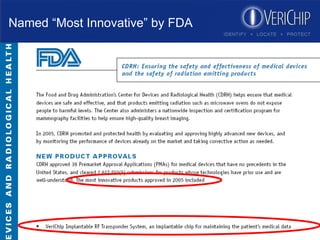
Named “Most Innovative” by FDA
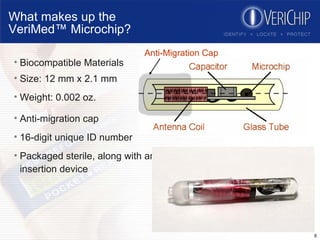
What makes up the  VeriMed™ Microchip? Biocompatible Materials Size: 12 mm x 2.1 mm Weight: 0.002 oz. Anti-migration cap 16-digit unique ID number Packaged sterile, along with an insertion device Anti-Migration Cap
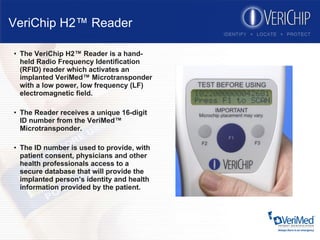
VeriChip H2™ Reader The VeriChip H2™ Reader is a hand-held Radio Frequency Identification (RFID) reader which activates an implanted VeriMed™ Microtransponder with a low power, low frequency (LF) electromagnetic field. The Reader receives a unique 16-digit ID number from the VeriMed™ Microtransponder.  The ID number is used to provide, with patient consent, physicians and other health professionals access to a secure database that will provide the implanted person’s identity and health information provided by the patient.
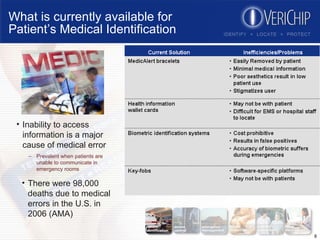
What is currently available for  Patient’s Medical Identification  Inability to access information is a major cause of medical error Prevalent when patients are unable to communicate in emergency rooms There were 98,000 deaths due to medical errors in the U.S. in 2006 (AMA)
VeriMed™:  Improving Health Outcomes Improve Acute and Chronic Disease Management Improve Efficiency Of Care Provided To At-risk Beneficiaries Reduce Morbidity and Mortality Caused By Inaccurate  Medical History
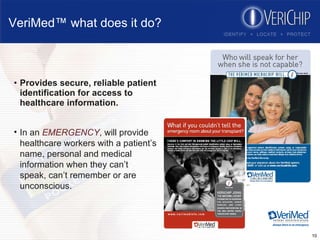
VeriMed™ what does it do? Provides secure, reliable patient identification for access to healthcare information. In an  EMERGENCY , will provide healthcare workers with a patient’s name, personal and medical information when they can’t speak, can’t remember or are unconscious.
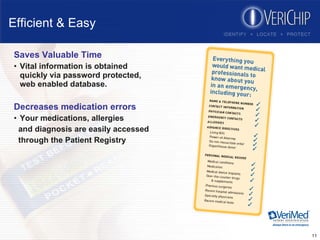
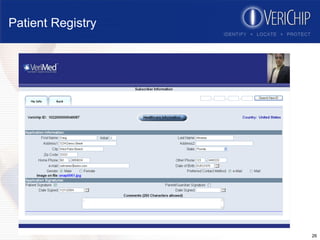
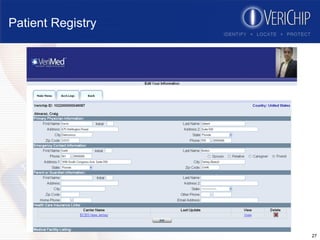
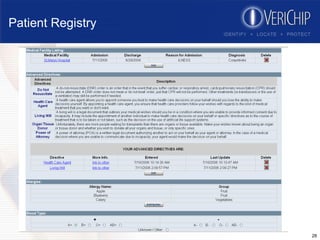
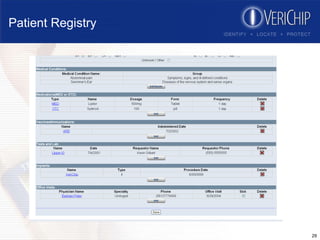
Efficient & Easy Saves Valuable Time Vital information is obtained quickly via password protected, web enabled database. Decreases medication errors Your medications, allergies and diagnosis are easily accessed through the Patient Registry
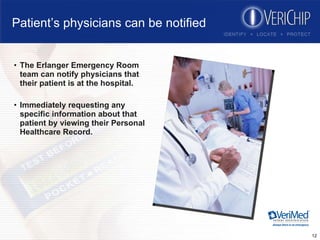
Patient’s physicians can be notified The Erlanger Emergency Room team can notify physicians that their patient is at the hospital.  Immediately requesting any specific information about that patient by viewing their Personal Healthcare Record.
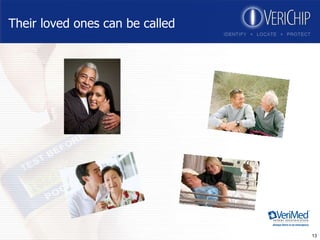
Their loved ones can be called
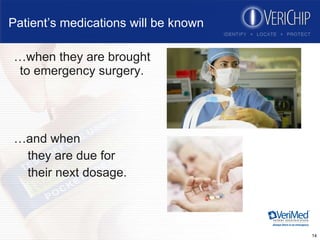
Patient’s medications will be known … when they are brought to emergency surgery. … and when  they are due for their next dosage.
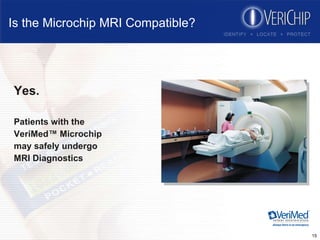
Is the Microchip MRI Compatible? Yes. Patients with the  VeriMed™ Microchip may safely undergo MRI Diagnostics
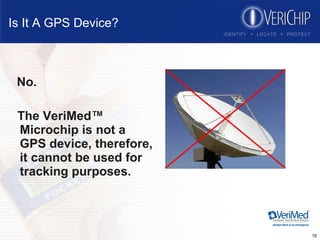
Is It A GPS Device? No. The VeriMed™ Microchip is not a GPS device, therefore, it cannot be used for tracking purposes.
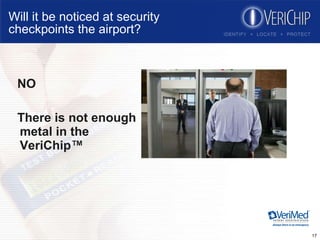
Will it be noticed at security  checkpoints the airport? NO There is not enough metal in the VeriChip™
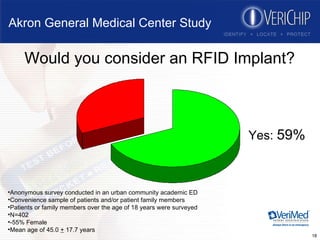
Akron General Medical Center Study Would you consider an RFID Implant? Anonymous survey conducted in an urban community academic ED Convenience sample of patients and/or patient family members Patients or family members over the age of 18 years were surveyed N=402 -55% Female Mean age of 45.0  +  17.7 years Yes:  59%
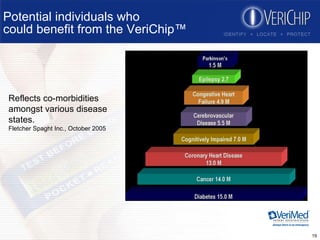
Potential individuals who  could benefit from the VeriChip™ Reflects co-morbidities amongst various disease states. Fletcher Spaght Inc., October 2005
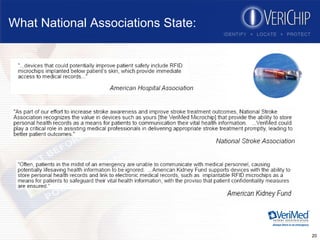
What National Associations State:
How VeriMed™ Works
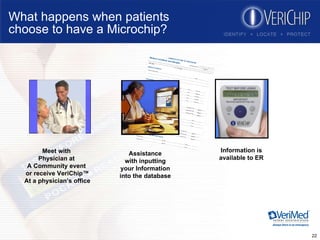
What happens when patients  choose to have a Microchip? Meet with  Physician at  A Community event  or receive VeriChip™ At a physician’s office Assistance with inputting your Information into the database Information is available to ER
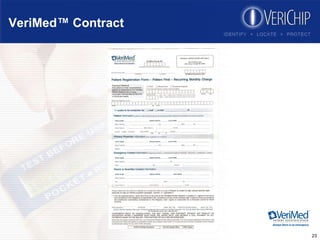
VeriMed™ Contract
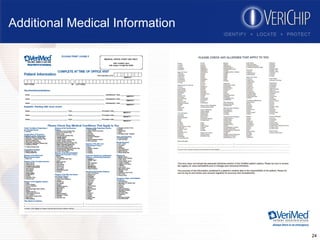
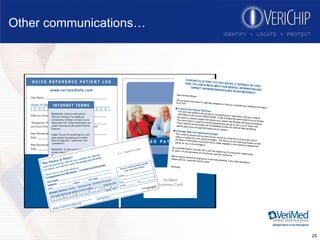
Additional Medical Information
Other communications…
Patient Registry
Patient Registry
Patient Registry
Patient Registry
Secure and Private Safe secure link to various electronic medical records HIPAA Compliant Secure database/encrypted Corporate privacy policy Voluntary informed consent Patient controlled information Designated access to information
Marketing of Erlanger with VeriMed™ Within Hospital Within Erlanger Affiliated physicians With LIFEFORCE Air Ambulance With Hamilton County EMS Working with local Independent and Assisted Living Facilities Partnering with Orange Grove Center Press Release Linking with our Database for Admissions-Discharge-Transfer
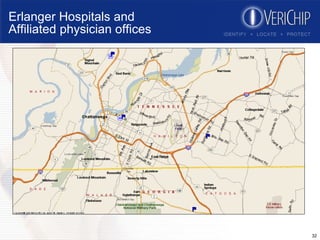
Erlanger Hospitals and  Affiliated physician offices
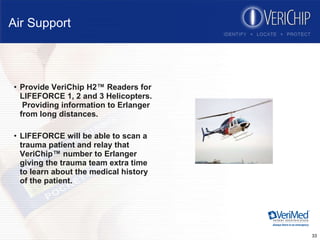
Air Support Provide VeriChip H2™ Readers for LIFEFORCE 1, 2 and 3 Helicopters.  Providing information to Erlanger from long distances. LIFEFORCE will be able to scan a trauma patient and relay that VeriChip™ number to Erlanger giving the trauma team extra time to learn about the medical history of the patient.
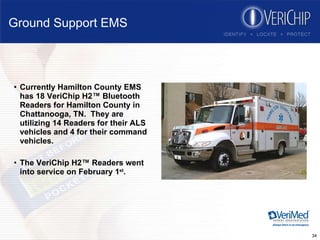
Ground Support EMS Currently Hamilton County EMS has 18 VeriChip H2™ Bluetooth Readers for Hamilton County in Chattanooga, TN.  They are utilizing 14 Readers for their ALS vehicles and 4 for their command vehicles. The VeriChip H2™ Readers went into service on February 1 st .
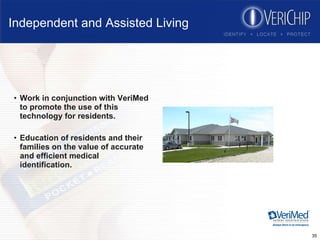
Independent and Assisted Living Work in conjunction with VeriMed to promote the use of this technology for residents. Education of residents and their families on the value of accurate and efficient medical identification.
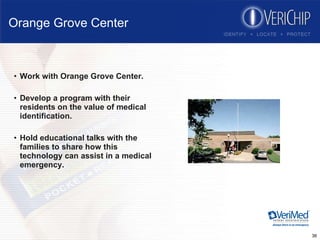
Orange Grove Center Work with Orange Grove Center. Develop a program with their residents on the value of medical identification. Hold educational talks with the families to share how this technology can assist in a medical emergency.
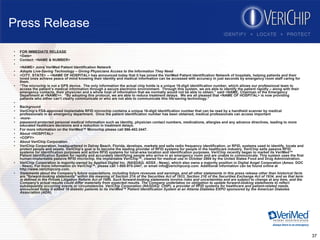
Press Release FOR IMMEDIATE RELEASE <Date> Contact: <NAME & NUMBER> <NAME> Joins VeriMed Patient Identification Network Adopts Live-Saving Technology – Giving Physicians Access to the Information They Need <CITY, STATE> -- <NAME OF HOSPITAL> has announced today that it has joined the VeriMed Patient Identification Network of hospitals, helping patients and their loved ones achieve peace of mind knowing their identity and medical information can be accessed with accuracy in just seconds by emergency room staff caring for them. “ The microchip is not a GPS device.  The only information the actual chip holds is a unique 16-digit identification number, which allows our professional team to access the patient’s medical information through a secure electronic environment.  Through this system, we are able to identify the patient rapidly – along with their emergency contacts, their physician and a whole host of information that we normally would not be able to obtain,” said <NAME, Chairman of the Emergency Department at <NAME>>.  “By adopting this protocol, we are able to reduce treatment delays.  We are all pleased that <NAME OF HOSPITAL> is now providing patients who either can’t clearly communicate or who are not able to communicate this life-saving technology.” Background VeriChip’s FDA-approved implantable RFID microchip contains a unique 16-digit identification number that can be read by a handheld scanner by medical professionals in an emergency department.  Once the patient identification number has been obtained, medical professionals can access important  -more- password-protected personal medical information such as identity, physician contact numbers, medications, allergies and any advance directives, leading to more educated healthcare decisions and a reduction in treatment delays. For more information on the VeriMed™ Microchip please call 866-402-2447. About <HOSPITAL>  <COPY> About VeriChip Corporation VeriChip Corporation, headquartered in Delray Beach, Florida, develops, markets and sells radio frequency identification, or RFID, systems used to identify, locate and protect people and assets. VeriChip's goal is to become the leading provider of RFID systems for people in the healthcare industry. VeriChip sells passive RFID systems for identification purposes and active RFID systems for local-area location and identification purposes. VeriChip recently began to market its VeriMed™ Patient Identification System for rapidly and accurately identifying people who arrive in an emergency room and are unable to communicate. This system uses the first human-implantable passive RFID microchip, the implantable VeriChip™, cleared for medical use in October 2004 by the United States Food and Drug Administration. VeriChip Corporation is majority-owned by Applied Digital Inc. (NASDAQ: ADSX - News), which also owns a majority position in Digital Angel Corporation (Amex: DOC - News). For more information on VeriChip™, please call 1-800-970-2447, or email info@verichipcorp.com. Additional information can be found online at http://www.verichipcorp.com. Statements about the Company's future expectations, including future revenues and earnings, and all other statements in this press release other than historical facts are &quot;forward-looking statements&quot; within the meaning of Section 27A of the Securities Act of 1933, Section 21E of the Securities Exchange Act of 1934, and as that term is defined in the Private Litigation Reform Act of 1995. Such forward-looking statements involve risks and uncertainties and are subject to change at any time, and the Company's actual results could differ materially from expected results. The Company undertakes no obligation to update forward-looking statements to reflect subsequently occurring events or circumstances. VeriChip Corporation (NASDAQ: CHIP), a provider of RFID systems for healthcare and patient-related needs, announced today it added 18 diabetic patients to its VeriMed™ Patient Identification System at an Atlanta Diabetes EXPO sponsored by the American Diabetes Association (ADA).
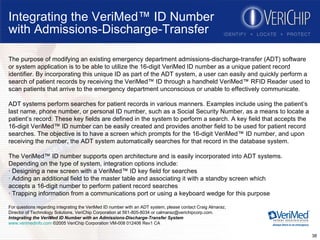
Integrating the VeriMed™ ID Number with Admissions-Discharge-Transfer The purpose of modifying an existing emergency department admissions-discharge-transfer (ADT) software or system application is to be able to utilize the 16-digit VeriMed ID number as a unique patient record identifier. By incorporating this unique ID as part of the ADT system, a user can easily and quickly perform a search of patient records by receiving the VeriMed™ ID through a handheld VeriMed™ RFID Reader used to scan patients that arrive to the emergency department unconscious or unable to effectively communicate. ADT systems perform searches for patient records in various manners. Examples include using the patient’s last name, phone number, or personal ID number, such as a Social Security Number, as a means to locate a patient’s record. These key fields are defined in the system to perform a search. A key field that accepts the 16-digit VeriMed™ ID number can be easily created and provides another field to be used for patient record searches. The objective is to have a screen which prompts for the 16-digit VeriMed™ ID number, and upon receiving the number, the ADT system automatically searches for that record in the database system. The VeriMed™ ID number supports open architecture and is easily incorporated into ADT systems. Depending on the type of system, integration options include: · Designing a new screen with a VeriMed™ ID key field for searches · Adding an additional field to the master table and associating it with a standby screen which accepts a 16-digit number to perform patient record searches · Trapping information from a communications port or using a keyboard wedge for this purpose For questions regarding integrating the VeriMed ID number with an ADT system, please contact Craig Almaraz,  Director of Technology Solutions, VeriChip Corporation at 561-805-8034 or calmaraz@verichipcorp.com. Integrating the VeriMed ID Number with an Admissions-Discharge-Transfer System www.verimedinfo.com  ©2005 VeriChip Corporation VM-008 012406 Rev1 CA
In Closing VeriMed™:  Helps ER team, patient and saves hospital money If the patient is allergic to latex, the proper IV tubing and IV fluid bags can be used to avoid anaphylaxis during initiation of treatment. If the patient is allergic to IV contrast dye and needs an urgent study, the doctors can either pre-medicate the patient or pick an alternative non-contrast study, avoiding a life threatening allergic response.  If the patient is allergic to a drug like Penicillin and arrives with apparent overwhelming sepsis, requiring immediate cultures, and stat IV antibiotics, an appropriate non-Penicillin antibiotic can be chosen - in a fraction of the time - and avoid a potentially deadly allergic reaction.
In Closing VeriMed™:  Helps ER team, patient and saves hospital money If the patient forgets that they have an asthma history and presents with malignant hypertension to the ER, the doctor will want to avoid intravenous beta-blockers that might elicit severe bronchospasm. If the patient presents with a severe migraine, but forgets to tell the doctor that he has coronary disease, the use of a Tryptan drug - like Imitrex- can clear the headache well, but may also induce angina and even possibly an MI with coronary vasoconstriction. If a patient is immunocompromised from leukemia, cancer, chemo, organ transplant or AIDS and is unconscious, or forgets to tell the doctor about this, then the loss of time in doing an immediate septic work up, with rapid infusion of IV antibiotics, could be the difference between life and death.
In Closing VeriMed™:  Helps ER team, patient and saves hospital money Knowledge of past surgeries can significantly speed up the patient's work up, thus avoiding loss of time and possible medical complications.  Elderly patients (over 70) often forget surgeries they had many years ago, when they were younger, i.e., gall bladder removed, appendectomy, hysterectomy, a cesarean section, etc.  Knowledge of prior abdominal surgeries can be significant - if not crucial - when a patient presents with abdominal pain, nausea and vomiting. Knowing if the patient already had their appendix or gall bladder removed, could avoid the time lost doing a biliary ultrasound when a CT-scan of the abdomen and pelvis is more appropriate.  Knowing that the patient had a prior abdominal surgery allows the physician to focus on the possibility of a bowel obstruction resulting from adhesions of prior surgeries (c-section, hysterectomy, etc.).
In Closing VeriMed™:  Helps ER team, patient and saves hospital money If a patient's Personal Healthcare Record shows that they are taking Glucophage for diabetes, certain urgent studies with IV contrast can be avoided in order to avoid kidney damage.  If a patient, presenting to the ER with chest pain, is taking Viagra and the paramedics and doctor are unaware, nitroglycerine would most likely be used immediately as sublingual, spray or IV. The unfortunate outcome could be severe hypotension and possible extension of an acute MI. If a patient is taking a Depakote or Dilantin for seizures or Lithium for Bipolar Disorder, and the physician is not aware, the levels of these drugs may not be checked immediately when the patient arrives at the ER. If the patient is presenting with symptoms caused by toxic levels of any of these drugs, and levels are not checked, an extensive work up may be done that is unnecessary and costly. The proper diagnosis is therefore delayed, wasting valuable time. If the patient is on Coumadin and the doctor is unaware, the PT, INR and PTT may never be checked. If the workup for the presenting symptom leads to an emergent procedure - or surgery - and the INR is elevated, the procedure or surgery may be complicated with excessive bleeding. If the patient's medication list was available, and the INR was checked immediately, then IV Fresh Frozen Plasma or Vitamin K could have been given emergently, prior to an unexpected surgery.  If a patient, taking chronic steroid pills, presents to the ER, and forgets to inform anyone of steroid use, a deadly situation could occur. Without knowledge of the patient's long-term steroid use, the physician will not realize that a large intravenous steroid dose (stress dose) should be given to avoid the serious life threatening shock of Addison's Crisis.
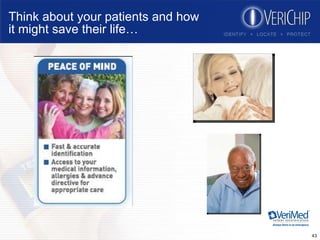
Think about your patients and how  it might save their life…
Thank you for letting us be here with you today It’s all about peace-of-mind in a medical emergency

Erlanger Presentation

  • 1.
    February 12 th , 2008 Presentation for
  • 2.
    We are knownby many names: World’s premier RFID company for people Healthcare security Infant protection Wander prevention Asset tracking Patient identification First implantable microchip approved by the FDA for medical use 45 million “at-risk” patients(1)
  • 3.
    What is VeriMed™?The VeriMed™ Technology The first and only FDA-Cleared Class II Medical Device for a Human Implantable Radio Frequency Transponder System for Patient Identification and Health Information
  • 4.
    The VeriMed™ ApplicationSafe, secure, rapid and accurate identification Patented ‘Bio-Bond’ technology prevents migration of chip 16-digit identification read with a proprietary scanner Inserted just under the skin placed in the back of the upper right arm, between the shoulder and the elbow FDA cleared 2004 A passive RFID tag the size of a grain of rice
  • 5.
  • 6.
    What makes upthe VeriMed™ Microchip? Biocompatible Materials Size: 12 mm x 2.1 mm Weight: 0.002 oz. Anti-migration cap 16-digit unique ID number Packaged sterile, along with an insertion device Anti-Migration Cap
  • 7.
    VeriChip H2™ ReaderThe VeriChip H2™ Reader is a hand-held Radio Frequency Identification (RFID) reader which activates an implanted VeriMed™ Microtransponder with a low power, low frequency (LF) electromagnetic field. The Reader receives a unique 16-digit ID number from the VeriMed™ Microtransponder. The ID number is used to provide, with patient consent, physicians and other health professionals access to a secure database that will provide the implanted person’s identity and health information provided by the patient.
  • 8.
    What is currentlyavailable for Patient’s Medical Identification Inability to access information is a major cause of medical error Prevalent when patients are unable to communicate in emergency rooms There were 98,000 deaths due to medical errors in the U.S. in 2006 (AMA)
  • 9.
    VeriMed™: ImprovingHealth Outcomes Improve Acute and Chronic Disease Management Improve Efficiency Of Care Provided To At-risk Beneficiaries Reduce Morbidity and Mortality Caused By Inaccurate Medical History
  • 10.
    VeriMed™ what doesit do? Provides secure, reliable patient identification for access to healthcare information. In an EMERGENCY , will provide healthcare workers with a patient’s name, personal and medical information when they can’t speak, can’t remember or are unconscious.
  • 11.
    Efficient & EasySaves Valuable Time Vital information is obtained quickly via password protected, web enabled database. Decreases medication errors Your medications, allergies and diagnosis are easily accessed through the Patient Registry
  • 12.
    Patient’s physicians canbe notified The Erlanger Emergency Room team can notify physicians that their patient is at the hospital. Immediately requesting any specific information about that patient by viewing their Personal Healthcare Record.
  • 13.
    Their loved onescan be called
  • 14.
    Patient’s medications willbe known … when they are brought to emergency surgery. … and when they are due for their next dosage.
  • 15.
    Is the MicrochipMRI Compatible? Yes. Patients with the VeriMed™ Microchip may safely undergo MRI Diagnostics
  • 16.
    Is It AGPS Device? No. The VeriMed™ Microchip is not a GPS device, therefore, it cannot be used for tracking purposes.
  • 17.
    Will it benoticed at security checkpoints the airport? NO There is not enough metal in the VeriChip™
  • 18.
    Akron General MedicalCenter Study Would you consider an RFID Implant? Anonymous survey conducted in an urban community academic ED Convenience sample of patients and/or patient family members Patients or family members over the age of 18 years were surveyed N=402 -55% Female Mean age of 45.0 + 17.7 years Yes: 59%
  • 19.
    Potential individuals who could benefit from the VeriChip™ Reflects co-morbidities amongst various disease states. Fletcher Spaght Inc., October 2005
  • 20.
  • 21.
  • 22.
    What happens whenpatients choose to have a Microchip? Meet with Physician at A Community event or receive VeriChip™ At a physician’s office Assistance with inputting your Information into the database Information is available to ER
  • 23.
  • 24.
  • 25.
  • 26.
  • 27.
  • 28.
  • 29.
  • 30.
    Secure and PrivateSafe secure link to various electronic medical records HIPAA Compliant Secure database/encrypted Corporate privacy policy Voluntary informed consent Patient controlled information Designated access to information
  • 31.
    Marketing of Erlangerwith VeriMed™ Within Hospital Within Erlanger Affiliated physicians With LIFEFORCE Air Ambulance With Hamilton County EMS Working with local Independent and Assisted Living Facilities Partnering with Orange Grove Center Press Release Linking with our Database for Admissions-Discharge-Transfer
  • 32.
    Erlanger Hospitals and Affiliated physician offices
  • 33.
    Air Support ProvideVeriChip H2™ Readers for LIFEFORCE 1, 2 and 3 Helicopters. Providing information to Erlanger from long distances. LIFEFORCE will be able to scan a trauma patient and relay that VeriChip™ number to Erlanger giving the trauma team extra time to learn about the medical history of the patient.
  • 34.
    Ground Support EMSCurrently Hamilton County EMS has 18 VeriChip H2™ Bluetooth Readers for Hamilton County in Chattanooga, TN. They are utilizing 14 Readers for their ALS vehicles and 4 for their command vehicles. The VeriChip H2™ Readers went into service on February 1 st .
  • 35.
    Independent and AssistedLiving Work in conjunction with VeriMed to promote the use of this technology for residents. Education of residents and their families on the value of accurate and efficient medical identification.
  • 36.
    Orange Grove CenterWork with Orange Grove Center. Develop a program with their residents on the value of medical identification. Hold educational talks with the families to share how this technology can assist in a medical emergency.
  • 37.
    Press Release FORIMMEDIATE RELEASE <Date> Contact: <NAME & NUMBER> <NAME> Joins VeriMed Patient Identification Network Adopts Live-Saving Technology – Giving Physicians Access to the Information They Need <CITY, STATE> -- <NAME OF HOSPITAL> has announced today that it has joined the VeriMed Patient Identification Network of hospitals, helping patients and their loved ones achieve peace of mind knowing their identity and medical information can be accessed with accuracy in just seconds by emergency room staff caring for them. “ The microchip is not a GPS device. The only information the actual chip holds is a unique 16-digit identification number, which allows our professional team to access the patient’s medical information through a secure electronic environment. Through this system, we are able to identify the patient rapidly – along with their emergency contacts, their physician and a whole host of information that we normally would not be able to obtain,” said <NAME, Chairman of the Emergency Department at <NAME>>. “By adopting this protocol, we are able to reduce treatment delays. We are all pleased that <NAME OF HOSPITAL> is now providing patients who either can’t clearly communicate or who are not able to communicate this life-saving technology.” Background VeriChip’s FDA-approved implantable RFID microchip contains a unique 16-digit identification number that can be read by a handheld scanner by medical professionals in an emergency department. Once the patient identification number has been obtained, medical professionals can access important -more- password-protected personal medical information such as identity, physician contact numbers, medications, allergies and any advance directives, leading to more educated healthcare decisions and a reduction in treatment delays. For more information on the VeriMed™ Microchip please call 866-402-2447. About <HOSPITAL> <COPY> About VeriChip Corporation VeriChip Corporation, headquartered in Delray Beach, Florida, develops, markets and sells radio frequency identification, or RFID, systems used to identify, locate and protect people and assets. VeriChip's goal is to become the leading provider of RFID systems for people in the healthcare industry. VeriChip sells passive RFID systems for identification purposes and active RFID systems for local-area location and identification purposes. VeriChip recently began to market its VeriMed™ Patient Identification System for rapidly and accurately identifying people who arrive in an emergency room and are unable to communicate. This system uses the first human-implantable passive RFID microchip, the implantable VeriChip™, cleared for medical use in October 2004 by the United States Food and Drug Administration. VeriChip Corporation is majority-owned by Applied Digital Inc. (NASDAQ: ADSX - News), which also owns a majority position in Digital Angel Corporation (Amex: DOC - News). For more information on VeriChip™, please call 1-800-970-2447, or email info@verichipcorp.com. Additional information can be found online at http://www.verichipcorp.com. Statements about the Company's future expectations, including future revenues and earnings, and all other statements in this press release other than historical facts are &quot;forward-looking statements&quot; within the meaning of Section 27A of the Securities Act of 1933, Section 21E of the Securities Exchange Act of 1934, and as that term is defined in the Private Litigation Reform Act of 1995. Such forward-looking statements involve risks and uncertainties and are subject to change at any time, and the Company's actual results could differ materially from expected results. The Company undertakes no obligation to update forward-looking statements to reflect subsequently occurring events or circumstances. VeriChip Corporation (NASDAQ: CHIP), a provider of RFID systems for healthcare and patient-related needs, announced today it added 18 diabetic patients to its VeriMed™ Patient Identification System at an Atlanta Diabetes EXPO sponsored by the American Diabetes Association (ADA).
  • 38.
    Integrating the VeriMed™ID Number with Admissions-Discharge-Transfer The purpose of modifying an existing emergency department admissions-discharge-transfer (ADT) software or system application is to be able to utilize the 16-digit VeriMed ID number as a unique patient record identifier. By incorporating this unique ID as part of the ADT system, a user can easily and quickly perform a search of patient records by receiving the VeriMed™ ID through a handheld VeriMed™ RFID Reader used to scan patients that arrive to the emergency department unconscious or unable to effectively communicate. ADT systems perform searches for patient records in various manners. Examples include using the patient’s last name, phone number, or personal ID number, such as a Social Security Number, as a means to locate a patient’s record. These key fields are defined in the system to perform a search. A key field that accepts the 16-digit VeriMed™ ID number can be easily created and provides another field to be used for patient record searches. The objective is to have a screen which prompts for the 16-digit VeriMed™ ID number, and upon receiving the number, the ADT system automatically searches for that record in the database system. The VeriMed™ ID number supports open architecture and is easily incorporated into ADT systems. Depending on the type of system, integration options include: · Designing a new screen with a VeriMed™ ID key field for searches · Adding an additional field to the master table and associating it with a standby screen which accepts a 16-digit number to perform patient record searches · Trapping information from a communications port or using a keyboard wedge for this purpose For questions regarding integrating the VeriMed ID number with an ADT system, please contact Craig Almaraz, Director of Technology Solutions, VeriChip Corporation at 561-805-8034 or calmaraz@verichipcorp.com. Integrating the VeriMed ID Number with an Admissions-Discharge-Transfer System www.verimedinfo.com ©2005 VeriChip Corporation VM-008 012406 Rev1 CA
  • 39.
    In Closing VeriMed™: Helps ER team, patient and saves hospital money If the patient is allergic to latex, the proper IV tubing and IV fluid bags can be used to avoid anaphylaxis during initiation of treatment. If the patient is allergic to IV contrast dye and needs an urgent study, the doctors can either pre-medicate the patient or pick an alternative non-contrast study, avoiding a life threatening allergic response. If the patient is allergic to a drug like Penicillin and arrives with apparent overwhelming sepsis, requiring immediate cultures, and stat IV antibiotics, an appropriate non-Penicillin antibiotic can be chosen - in a fraction of the time - and avoid a potentially deadly allergic reaction.
  • 40.
    In Closing VeriMed™: Helps ER team, patient and saves hospital money If the patient forgets that they have an asthma history and presents with malignant hypertension to the ER, the doctor will want to avoid intravenous beta-blockers that might elicit severe bronchospasm. If the patient presents with a severe migraine, but forgets to tell the doctor that he has coronary disease, the use of a Tryptan drug - like Imitrex- can clear the headache well, but may also induce angina and even possibly an MI with coronary vasoconstriction. If a patient is immunocompromised from leukemia, cancer, chemo, organ transplant or AIDS and is unconscious, or forgets to tell the doctor about this, then the loss of time in doing an immediate septic work up, with rapid infusion of IV antibiotics, could be the difference between life and death.
  • 41.
    In Closing VeriMed™: Helps ER team, patient and saves hospital money Knowledge of past surgeries can significantly speed up the patient's work up, thus avoiding loss of time and possible medical complications. Elderly patients (over 70) often forget surgeries they had many years ago, when they were younger, i.e., gall bladder removed, appendectomy, hysterectomy, a cesarean section, etc. Knowledge of prior abdominal surgeries can be significant - if not crucial - when a patient presents with abdominal pain, nausea and vomiting. Knowing if the patient already had their appendix or gall bladder removed, could avoid the time lost doing a biliary ultrasound when a CT-scan of the abdomen and pelvis is more appropriate. Knowing that the patient had a prior abdominal surgery allows the physician to focus on the possibility of a bowel obstruction resulting from adhesions of prior surgeries (c-section, hysterectomy, etc.).
  • 42.
    In Closing VeriMed™: Helps ER team, patient and saves hospital money If a patient's Personal Healthcare Record shows that they are taking Glucophage for diabetes, certain urgent studies with IV contrast can be avoided in order to avoid kidney damage. If a patient, presenting to the ER with chest pain, is taking Viagra and the paramedics and doctor are unaware, nitroglycerine would most likely be used immediately as sublingual, spray or IV. The unfortunate outcome could be severe hypotension and possible extension of an acute MI. If a patient is taking a Depakote or Dilantin for seizures or Lithium for Bipolar Disorder, and the physician is not aware, the levels of these drugs may not be checked immediately when the patient arrives at the ER. If the patient is presenting with symptoms caused by toxic levels of any of these drugs, and levels are not checked, an extensive work up may be done that is unnecessary and costly. The proper diagnosis is therefore delayed, wasting valuable time. If the patient is on Coumadin and the doctor is unaware, the PT, INR and PTT may never be checked. If the workup for the presenting symptom leads to an emergent procedure - or surgery - and the INR is elevated, the procedure or surgery may be complicated with excessive bleeding. If the patient's medication list was available, and the INR was checked immediately, then IV Fresh Frozen Plasma or Vitamin K could have been given emergently, prior to an unexpected surgery. If a patient, taking chronic steroid pills, presents to the ER, and forgets to inform anyone of steroid use, a deadly situation could occur. Without knowledge of the patient's long-term steroid use, the physician will not realize that a large intravenous steroid dose (stress dose) should be given to avoid the serious life threatening shock of Addison's Crisis.
  • 43.
    Think about yourpatients and how it might save their life…
  • 44.
    Thank you forletting us be here with you today It’s all about peace-of-mind in a medical emergency

Editor's Notes

  • #7 About the size of a grain of rice, the VeriMed microchip contains a 16-digit unique ID number. Being a passive RFID microchip, it doesn’t actively send information to the reader but requires the reader to excite the microchip to relay the information. Despite many fears from people about being tracked, the VeriMed microchip does not have tracking capabilities. The microchip is pre-loaded in a sterile inserter and comes with instructions and registration materials.
  • #13 A patient’s primary care physician and specialist can be called to assist the ER physicians in treating.
  • #14 The ER team can notify the family of what is going on. In addition, a patient’s family can be notified about what is going on with a their loved one.
  • #21 Add other endorsements
  • #32 Market to the employees and patients who work and visit at the hospital. Work with Erlanger physician and University of Tennessee physicians to share this technology with their patients.
  • #33 Market to the employees and patients who work and visit at the hospital. Work with Erlanger physician and University of Tennessee physicians to share this technology with their patients.
  • #34 Share this technology with surrounding hospitals letting them know that your trauma facility has this technology to assist in saving lives.
  • #35 Work in tandem with Hamilton County in the sharing of information to increase that Golden Hour.
  • #40 The CDC reports that up to 10 percent of the population may be at risk for allergic reactions to medications, and that severe life threatening anaphylactic (allergic) reactions occur in about 30 per 100,000 persons each year. A simple patient recorded list of drug allergies and drugs, currently being taken, can help the physician unfamiliar with the patient to avoid serious life threatening allergic reactions or drug-drug interactions that could further complicate the patient&apos;s stay in the ER or in the Hospital. By simply knowing current medications, medical problems, prior surgeries, etc. expensive and unnecessary testing can be quickly avoided, thus speeding along the proper medical work up and successful treatment, saving time, saving money and saving lives.