Presents


The HealthSmartID Card System
The only portable medical record that operates at the point of service, provides a
synchronized patient portal as well as a patient folder on a central repository of data
all working together to ensure that patient medical information is available to
caregivers across the entire spectrum of a patient’s care.
The HealthSmartID card operates at the point of service allowing it to automate many
processes including importing and exporting data to and from the Continuation of Care
Document (CCD). It is unsurpassed as a patient identifier and provides the highest
level of security available with its biometric authentication system.
The HealthSmartID card provides patients an electronic copy of their medical record
as well as a myriad of tools that will allow patients to better understand and become
more involved in their care regimen.
Upon each access the HealthSmartID card “calls home” to leave an audit trail on the
patients file on backend servers. New features and functionality can be uploaded to
the backend and pushed out to the HealthSmartID card allowing the system to grow
with client missions and objectives.
What is a Smart Card?
A smart card resembles a credit card in size and shape,
but inside it is completely different. A normal credit card
is a simple piece of plastic. The smart card contains an
embedded microprocessor. Think of the microprocessor
as replacing the usual magnetic stripe on a credit or debit
card by offering much more functionality.
The host computer and smart card reader actually "talk"
to the microprocessor which runs programs that:
•Directs the card to seamlessly store a copy of its data on
its associated patient web portal and in the patients folder
on the backend systems.
•Acts as a key to unlimited amounts of patient data,
images and files stored on backend servers.
The problem, Interoperability
One of the key problems in healthcare
informatics is the lack of interoperability among
different healthcare information systems.
Interoperability can be investigated in different
categories in the eHealth domain, such as the
interoperability of the messages exchanged
between healthcare applications, interoperability
of Electronic Healthcare Records (EHRs),
interoperability of patient identifiers, coding
terms and data sharing.
The Solution?
        “SmartCard Driven Identity Management”

The HealthSmartID card system is a highly secure
patient identification card that provides:
Biometric authentication (fingerprint scans)
Picture on chip and on face of card
Patient Identifier (Medical Record Number)
More efficient registration process
Process for updating data and securing access

Automatically link patient to existing records
Reduce duplicate records
Reduce insurance claim rejections
Provide clinical data to providers in and out of network
What is the HealthSmartID Card System?
        “Portable Medical Record”
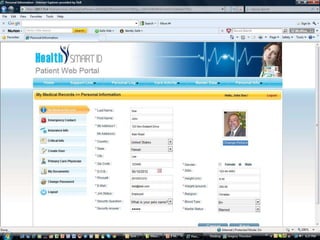
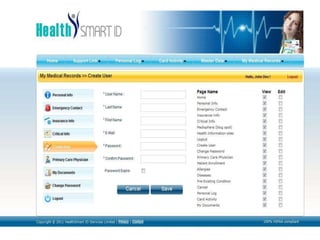
The HealthSmartID card system provides a user friendly
portable medical record that provides each cardholder with
an associated “patient web portal” that allows patients
access to and control of their medical information. This
capability satisfies “patient centric” meaningful use criteria
and entitles Healthcare professionals to substantial
Government subsidies.
The patient web portal can offer patients a myriad of
additional benefits such as links to health information sites
like dlife, American Heart association, wellness programs
and even a personal health log (diary) etc.
What is the HealthSmartID Card System?
         “Portable Medical Record”
The patient web portal also gives the patient the ability to
authorize access to his/her web portal for caregivers,
surrogates and others by creating login names and passwords.
These passwords can be expiring (one access only) or non
expiring (unlimited access). Patients can also print out parts
(medications) or all of their medical record.

The patient web portal will continuously be updated and
enhanced with new content, features and functionality as new
technologies and healthcare advances occur.
What is the HealthSmartID Card System?
       “Portable Medical Record”

Each HealthSmartID card has an associated Iphone,
IPod and Android app that it synchronizes with. All
data written to the card is simultaneously uploaded
to the patient web portal as well as the Iphone app
and in the absence of the card (forgotten, lost or
stolen) data can be written directly into the patient
portal or Iphone app which upon card access,
synchronizes with the card (reissued or found)
creating a continuity of care and guaranteeing the
accuracy of the data.
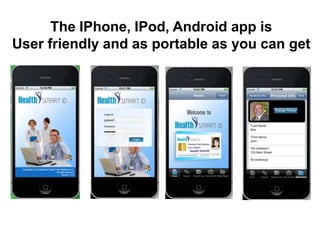
The IPhone, IPod, Android app is
User friendly and as portable as you can get
The HealthSmartID Card System
                      Functional Components

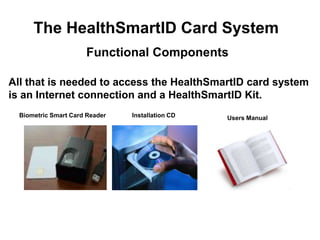
All that is needed to access the HealthSmartID card system
is an Internet connection and a HealthSmartID Kit.
  Biometric Smart Card Reader   Installation CD   Users Manual
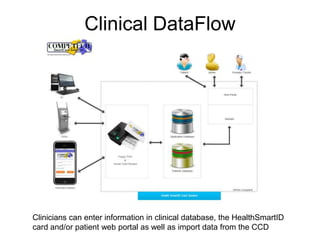
Clinical DataFlow


Clinicians can enter information in clinical database, the HealthSmartID
card and/or patient web portal as well as import data from the CCD
Return on Investment
                       Meaningful Use
Hospitals can collect an incentive payment calculated as the sum of a
$2 million base amount plus Medicare discharge related payments.
And physicians can qualify for a reimbursement of $44,000 to $64,000
dollars. Hospitals can begin to qualify for the incentives October 1,
2010, and eligible physicians can begin to qualify January 1, 2011.
The HealthSmartID card system satisfies all “patient centric”
meaningful use objectives and insures client eligibility for considerable
Government subsidies.
Other benefits include:
  Ease of Registration greatly Improved
  Wait time in registration decreased by at least 25 percent
  Errors: reduced to less than 1%
  Duplicate medical records: reduced to less than 1%
  Reduction in rejected insurance claims
Return on Investment
         Duplicate record reconciliation
• Consider, for example, a 300-bed hospital facility with a
  database of 250,000 patients. If 10% of these records
  are duplicated (25,000 records), the average cost of
  cleanup is $500,000–$2,500,000.
• Unfortunately, without any change in process, this
  cleanup will need to be repeated every 2–3 years. By
  implementing smart card technology as part of the
  admission and registration process, an institution can
  reliably identify its patients, increase the accuracy of
  data capture, optimize patient throughput, accurately link
  patients to their medical records, and ultimately improve
  patient experience and satisfaction.
Return on Investment
         Fewer insurance claim denials
Two of the most common reasons for claims denials are
incomplete demographic information and incomplete
insurance information, which can cost a healthcare
institution millions of dollars in lost or delayed revenue.
Most healthcare CFOs are acutely aware of the high cost of
reviewing and resubmitting old claims and the revenue lost
because of cumbersome claims processing, including
detailed chart reviews and outreach to patients and
physicians for additional information.
The healthcare revenue cycle is highly dependent on the
front-end registration process, which drives much of the
downstream claims process. Studies estimate that 50%–
90% of claim denials could be prevented by securing
accurate patient information at the front desk.
Return on Investment
    Fewer insurance claim resubmissions
• The HealthSmartID card could offer tremendous
  administrative savings by reducing the amount of data
  entry errors and the need for reprocessing of those
  claims.
• The biggest cost factor today is the need to send
  information to the participants and providers anytime
  claims are processed whether approved or denied.
• Sometimes the same claim is submitted and
  reprocessed two or three times until a final determination
  is made because of missing or incorrect information.
• The HealthSmartID card could greatly reduce that
  number of claims and help reduce the administrative
  costs for Payers.
We make smartcards work for you!
Competech SmartCard Solutions
2 Executive Drive (suite 850)
Fort Lee, NJ, 07024
Office 201-292-1818
info@competech.com
www.healthsmartid.com

CSS - HealthSmartID Client Presentation

  • 1.
  • 2.
    The HealthSmartID CardSystem The only portable medical record that operates at the point of service, provides a synchronized patient portal as well as a patient folder on a central repository of data all working together to ensure that patient medical information is available to caregivers across the entire spectrum of a patient’s care. The HealthSmartID card operates at the point of service allowing it to automate many processes including importing and exporting data to and from the Continuation of Care Document (CCD). It is unsurpassed as a patient identifier and provides the highest level of security available with its biometric authentication system. The HealthSmartID card provides patients an electronic copy of their medical record as well as a myriad of tools that will allow patients to better understand and become more involved in their care regimen. Upon each access the HealthSmartID card “calls home” to leave an audit trail on the patients file on backend servers. New features and functionality can be uploaded to the backend and pushed out to the HealthSmartID card allowing the system to grow with client missions and objectives.
  • 3.
    What is aSmart Card? A smart card resembles a credit card in size and shape, but inside it is completely different. A normal credit card is a simple piece of plastic. The smart card contains an embedded microprocessor. Think of the microprocessor as replacing the usual magnetic stripe on a credit or debit card by offering much more functionality. The host computer and smart card reader actually "talk" to the microprocessor which runs programs that: •Directs the card to seamlessly store a copy of its data on its associated patient web portal and in the patients folder on the backend systems. •Acts as a key to unlimited amounts of patient data, images and files stored on backend servers.
  • 4.
    The problem, Interoperability Oneof the key problems in healthcare informatics is the lack of interoperability among different healthcare information systems. Interoperability can be investigated in different categories in the eHealth domain, such as the interoperability of the messages exchanged between healthcare applications, interoperability of Electronic Healthcare Records (EHRs), interoperability of patient identifiers, coding terms and data sharing.
  • 5.
    The Solution? “SmartCard Driven Identity Management” The HealthSmartID card system is a highly secure patient identification card that provides: Biometric authentication (fingerprint scans) Picture on chip and on face of card Patient Identifier (Medical Record Number) More efficient registration process Process for updating data and securing access Automatically link patient to existing records Reduce duplicate records Reduce insurance claim rejections Provide clinical data to providers in and out of network
  • 6.
    What is theHealthSmartID Card System? “Portable Medical Record” The HealthSmartID card system provides a user friendly portable medical record that provides each cardholder with an associated “patient web portal” that allows patients access to and control of their medical information. This capability satisfies “patient centric” meaningful use criteria and entitles Healthcare professionals to substantial Government subsidies. The patient web portal can offer patients a myriad of additional benefits such as links to health information sites like dlife, American Heart association, wellness programs and even a personal health log (diary) etc.
  • 8.
    What is theHealthSmartID Card System? “Portable Medical Record” The patient web portal also gives the patient the ability to authorize access to his/her web portal for caregivers, surrogates and others by creating login names and passwords. These passwords can be expiring (one access only) or non expiring (unlimited access). Patients can also print out parts (medications) or all of their medical record. The patient web portal will continuously be updated and enhanced with new content, features and functionality as new technologies and healthcare advances occur.
  • 10.
    What is theHealthSmartID Card System? “Portable Medical Record” Each HealthSmartID card has an associated Iphone, IPod and Android app that it synchronizes with. All data written to the card is simultaneously uploaded to the patient web portal as well as the Iphone app and in the absence of the card (forgotten, lost or stolen) data can be written directly into the patient portal or Iphone app which upon card access, synchronizes with the card (reissued or found) creating a continuity of care and guaranteeing the accuracy of the data.
  • 11.
    The IPhone, IPod,Android app is User friendly and as portable as you can get
  • 12.
    The HealthSmartID CardSystem Functional Components All that is needed to access the HealthSmartID card system is an Internet connection and a HealthSmartID Kit. Biometric Smart Card Reader Installation CD Users Manual
  • 13.
    Clinical DataFlow Clinicians canenter information in clinical database, the HealthSmartID card and/or patient web portal as well as import data from the CCD
  • 14.
    Return on Investment Meaningful Use Hospitals can collect an incentive payment calculated as the sum of a $2 million base amount plus Medicare discharge related payments. And physicians can qualify for a reimbursement of $44,000 to $64,000 dollars. Hospitals can begin to qualify for the incentives October 1, 2010, and eligible physicians can begin to qualify January 1, 2011. The HealthSmartID card system satisfies all “patient centric” meaningful use objectives and insures client eligibility for considerable Government subsidies. Other benefits include:  Ease of Registration greatly Improved  Wait time in registration decreased by at least 25 percent  Errors: reduced to less than 1%  Duplicate medical records: reduced to less than 1%  Reduction in rejected insurance claims
  • 15.
    Return on Investment Duplicate record reconciliation • Consider, for example, a 300-bed hospital facility with a database of 250,000 patients. If 10% of these records are duplicated (25,000 records), the average cost of cleanup is $500,000–$2,500,000. • Unfortunately, without any change in process, this cleanup will need to be repeated every 2–3 years. By implementing smart card technology as part of the admission and registration process, an institution can reliably identify its patients, increase the accuracy of data capture, optimize patient throughput, accurately link patients to their medical records, and ultimately improve patient experience and satisfaction.
  • 16.
    Return on Investment Fewer insurance claim denials Two of the most common reasons for claims denials are incomplete demographic information and incomplete insurance information, which can cost a healthcare institution millions of dollars in lost or delayed revenue. Most healthcare CFOs are acutely aware of the high cost of reviewing and resubmitting old claims and the revenue lost because of cumbersome claims processing, including detailed chart reviews and outreach to patients and physicians for additional information. The healthcare revenue cycle is highly dependent on the front-end registration process, which drives much of the downstream claims process. Studies estimate that 50%– 90% of claim denials could be prevented by securing accurate patient information at the front desk.
  • 17.
    Return on Investment Fewer insurance claim resubmissions • The HealthSmartID card could offer tremendous administrative savings by reducing the amount of data entry errors and the need for reprocessing of those claims. • The biggest cost factor today is the need to send information to the participants and providers anytime claims are processed whether approved or denied. • Sometimes the same claim is submitted and reprocessed two or three times until a final determination is made because of missing or incorrect information. • The HealthSmartID card could greatly reduce that number of claims and help reduce the administrative costs for Payers.
  • 18.
    We make smartcardswork for you! Competech SmartCard Solutions 2 Executive Drive (suite 850) Fort Lee, NJ, 07024 Office 201-292-1818 info@competech.com www.healthsmartid.com