The Free LunchIs OverThe Free Lunch?The Free Performance Lunch!싱글코어CPU 의 발전한계.멀티코어 CPUConcurrency is the next major revolution in how we write software. -Herb Sutter
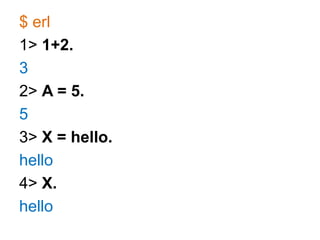
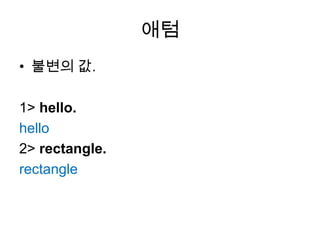
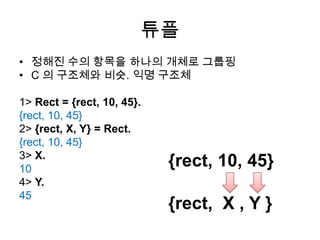
단일 할당 변수1>X.1: variable ‘X' is unbound2> X = 50.503> X = 23.** exception error: no match of right hand side value 23변수가 아니라 write-once 변수즉 한번만 bound 를 할 수 있음
17.
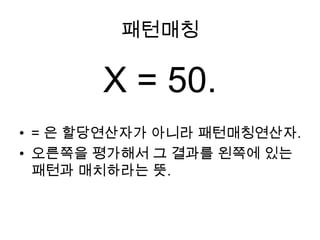
패턴매칭X = 50.=은 할당연산자가 아니라 패턴매칭연산자.오른쪽을 평가해서 그 결과를 왼쪽에 있는 패턴과 매치하라는 뜻.
18.
왜 단일 할당이프로그램을 더 낫게 만드는가?변수의 값을 바꿀수 있다?누가 언제 바꿨는지 깔끔하게 알기힘듬. 복잡한 잠금 매커니즘 필요.변수의 값을 바꿀수 없다?불변상태의 메모리는 read 만 가능.잠금 매커니즘이필요없다.즉 쉬운 병행 프로그래밍 가능어떻게? 프로세스 메시지 전달 방식으로.
19.
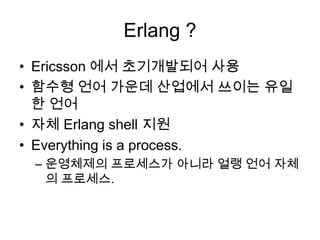
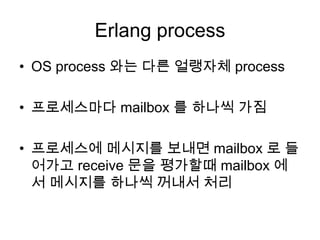
Pure message passinglanguage순수 메시지 전달 언어명령어 3개로병행프로그래밍 가능spawn : 프로세스 생성! (send) : 메시지 보내기receive : 메시지 받기
(server@host)1> fault:start().…5초후…system down!!=ERROR REPORT==== 7-Jan-2009::23:56:29 ===Error in process <0.67.0> on node 'server@host' with exit value: {badarith,[{fault,work,0}]}(server@host)2>
(server@host)1> fault:start().…5초후…system down!!=ERROR REPORT==== 7-Jan-2009::23:56:29 ===Error in process <0.67.0> on node 'server@host' with exit value: {badarith,[{fault,work,0}]}…5초후…system down !!=ERROR REPORT==== 7-Jan-2009::23:56:34 ===Error in process <0.68.0> on node 'server@host' with exit value: {badarith,[{fault,work,0}]}




![리스트[ Head | Tail ]1> L = [1,2,3,4].[1,2,3,4]2> [H|T] = L.[1,2,3,4]3> H.14> T.[2,3,4]5> [H1|T1] = T.[2,3,4]6> H1.27> T1.[3,4,][1 , 2,3,4][H| T ][2 , 3,4][H1| T1 ]](https://image.slidesharecdn.com/erlang20090110-100713073645-phpapp01/85/Erlang-10-320.jpg)
![Factorialfact.erl-module(fact).-export([fac/1]).fac(0) -> 1;fac(N) -> N * fac(N-1).](https://image.slidesharecdn.com/erlang20090110-100713073645-phpapp01/85/Erlang-11-320.jpg)
![Quicksortquicksort.erl-module(quicksort). -export([quicksort/1]).quicksort([]) -> []; quicksort([Pivot|Rest]) ->quicksort([Front || Front <- Rest, Front < Pivot]) ++ [Pivot] ++ quicksort([Back || Back <- Rest, Back >= Pivot]).짧은 코드!](https://image.slidesharecdn.com/erlang20090110-100713073645-phpapp01/85/Erlang-12-320.jpg)




![area.erl-module(area).-export([loop/0]).loop()->receive {rect, Width, Ht} ->io:format(“rect : ~p~n”, [Width * Ht]), loop(); {circle, R} ->io:format(“circle : ~p~n”, [3.14 * R * R]), loop(); Other ->io:format(“what is it? ~p?~n”, [Other]), loop() end.](https://image.slidesharecdn.com/erlang20090110-100713073645-phpapp01/85/Erlang-21-320.jpg)


![-module(pmap).-export([map/2,pmap/2]).map(_, []) -> []; map(F, [H|T]) -> [F(H) | map(F,T)]. pmap(F, L) -> S = self(), Ref = erlang:make_ref(), Pids = map( fun(I) -> spawn(fun() -> do_f(S, Ref, F, I) end) end , L ), gather(Pids, Ref). do_f(Parent, Ref, F, I) -> Parent ! {self(), Ref, (catch F(I))}. gather([Pid|T], Ref) -> receive {Pid, Ref, Ret} -> [Ret|gather(T, Ref)] end; gather([], _) -> [].](https://image.slidesharecdn.com/erlang20090110-100713073645-phpapp01/85/Erlang-26-320.jpg)
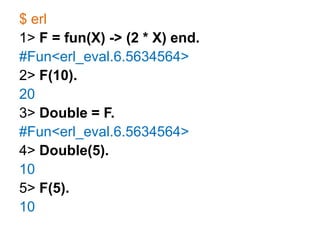
![싱글코어 프로그래밍map(_, []) -> []; map(F, [H|T]) -> [F(H) | map(F,T)].1> F = fun(X) -> (2 * X) end.#Fun<erl_eval.6.5634564>2> F(10).203> pmap:map(F,[1,2,3,4,5]).[2,4,6,8,10]](https://image.slidesharecdn.com/erlang20090110-100713073645-phpapp01/85/Erlang-27-320.jpg)
![멀티코어 프로그래밍1> F = fun(X) -> (2 * X) end.#Fun<erl_eval.6.5634564>2> F(10).203> pmap:pmap(F,[1,2,3,4,5]).[2,4,6,8,10]process 5개가 각각 인수를 병렬로 평가](https://image.slidesharecdn.com/erlang20090110-100713073645-phpapp01/85/Erlang-28-320.jpg)
![멀티코어 프로그래밍pmap(F, L) -> S = self(), Ref = erlang:make_ref(), Pids = map( fun(I) -> spawn(fun() -> do_f(S, Ref, F, I) end) end , L ), gather(Pids, Ref). do_f(Parent, Ref, F, I) -> Parent ! {self(), Ref, (catch F(I))}. gather([Pid|T], Ref) -> receive {Pid, Ref, Ret} -> [Ret|gather(T, Ref)] end; gather([], _) -> [].](https://image.slidesharecdn.com/erlang20090110-100713073645-phpapp01/85/Erlang-29-320.jpg)
![pmap:pmap(F,[1,2,3,4,5]).Pids = map( fun(I) -> spawn(fun() -> do_f(S, Ref, F, I) end) end , L ),do_fF(I)spawnpmapdo_f(Parent, Ref, F, I) -> Parent ! {self(), Ref, (catch F(I))}. Parent ! 2gather([Pid|T], Ref) -> receive {Pid, Ref, Ret} -> [Ret|gather(T, Ref)] end; gather([], _) -> []. 반복](https://image.slidesharecdn.com/erlang20090110-100713073645-phpapp01/85/Erlang-30-320.jpg)



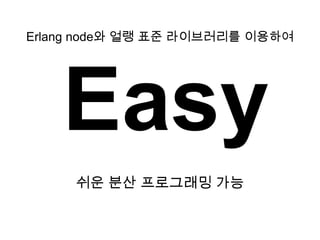
![-module(mod).-export([F/1]).F(X) -> 2*X.$erl –sname server(server@serverhost) 1>rpc:call(client@clienthost, mod, F, [2]).4Server Noderpc:call4F(2)Client Node$erl –sname client(client@clienthost) 1>](https://image.slidesharecdn.com/erlang20090110-100713073645-phpapp01/85/Erlang-37-320.jpg)


![-module(fault).-export([start/0]).start() -> process_flag(trap_exit, true),spawn_link(fun() -> work() end), loop().work() -> sleep(5000), 2/0.loop() -> receive {'EXIT',SomePid,Reason} ->io:format("system down !!") end.sleep(T) -> receive after T -> true end.](https://image.slidesharecdn.com/erlang20090110-100713073645-phpapp01/85/Erlang-43-320.jpg)
![(server@host)1> fault:start().…5초후…system down !!=ERROR REPORT==== 7-Jan-2009::23:56:29 ===Error in process <0.67.0> on node 'server@host' with exit value: {badarith,[{fault,work,0}]}(server@host)2>](https://image.slidesharecdn.com/erlang20090110-100713073645-phpapp01/85/Erlang-44-320.jpg)
![-module(fault).-export([start/0]).start() -> process_flag(trap_exit, true),spawn_link(fun() -> work() end), loop().work() -> sleep(5000), 2/0.loop() -> receive {'EXIT',SomePid,Reason} ->io:format("system down !!"),start(). end.sleep(T) -> receive after T -> true end.](https://image.slidesharecdn.com/erlang20090110-100713073645-phpapp01/85/Erlang-45-320.jpg)
![(server@host)1> fault:start().…5초후…system down !!=ERROR REPORT==== 7-Jan-2009::23:56:29 ===Error in process <0.67.0> on node 'server@host' with exit value: {badarith,[{fault,work,0}]}…5초후…system down !!=ERROR REPORT==== 7-Jan-2009::23:56:34 ===Error in process <0.68.0> on node 'server@host' with exit value: {badarith,[{fault,work,0}]}](https://image.slidesharecdn.com/erlang20090110-100713073645-phpapp01/85/Erlang-46-320.jpg)


![-module(hotcode).-export([start/0]).start() -> spawn(fun() -> loop() end).loop() -> sleep(1000), Val = a:x(),io:format("a:x() : ~p~n", [Val]), loop().sleep(T) -> receive after T -> true end.-module(a).-export([x/0]).x() -> 1.](https://image.slidesharecdn.com/erlang20090110-100713073645-phpapp01/85/Erlang-49-320.jpg)
![1> c(hotcode).{ok,hotcode}2> hotcode:start(a).<0.49.0>a:x() : 1a:x() : 1a:x() : 1-module(a).-export([x/0]).x() -> 1.-module(a).-export([x/0]).x() -> 2.3> c(a).{ok,a}a:x() : 2a:x() : 2](https://image.slidesharecdn.com/erlang20090110-100713073645-phpapp01/85/Erlang-50-320.jpg)


![[KGC 2011]Boost 라이브러리와 C++11](https://cdn.slidesharecdn.com/ss_thumbnails/kgc2011boostcpp11-111125022526-phpapp01-thumbnail.jpg?width=640&height=640&fit=bounds)

![[IGC 2016] 아마존 구승모 - 게임 제작을 위한 Amazon의 편리한 도구들 (게임리프트와 럼버야드)](https://cdn.slidesharecdn.com/ss_thumbnails/igclumberyarddist-161010010704-thumbnail.jpg?width=640&height=640&fit=bounds)


![[1116 박민근] c++11에 추가된 새로운 기능들](https://cdn.slidesharecdn.com/ss_thumbnails/1116c11-131118002832-phpapp01-thumbnail.jpg?width=640&height=640&fit=bounds)


![[Devil's camp 2019] 혹시 Elixir 아십니까? 정.말.갓.언.어.입.니.다](https://cdn.slidesharecdn.com/ss_thumbnails/devilscamp2019-elixirintroduce-190630161657-thumbnail.jpg?width=640&height=640&fit=bounds)


![[SICP] 3.4 Concurrency : Time is of the essence - 병행성 : 시간은 중요하다.](https://cdn.slidesharecdn.com/ss_thumbnails/3-4-090608224115-phpapp02-thumbnail.jpg?width=640&height=640&fit=bounds)

![[아꿈사/110528] 멀티코어cpu이야기 5,6장](https://cdn.slidesharecdn.com/ss_thumbnails/110528cpu56-110527204545-phpapp02-thumbnail.jpg?width=640&height=640&fit=bounds)


![[페차쿠차] 배움의 기술](https://cdn.slidesharecdn.com/ss_thumbnails/artoflearningupload-100901083140-phpapp01-thumbnail.jpg?width=640&height=640&fit=bounds)


