CIRCULATIONS AND METABOLISMS: HYBRID NATURES AND CYBORG CITIES   Erik Swyngedouw Geography – School of Environment and Development, University of Manchester Environmental Conflicts Summer School ICTA-AUB, 26 June – 10 July 2010
Circulations and Metabolisms Hybrid Nature and Cyborg Cities The Urbanisation of Nature and the Making of Hybrid Worlds Historical-Materialist Perspectives Socio-Natural Metabolisms The Invention of Circulation The Cultural Turn: from Binaries to Back to the Future Cyborg Cities and Flows of Power: Guayaquil’s Waters
The Urbanisation of Nature and the Making of Hybrid Worlds Cyborg Cities and Hybrid Natures The City in a Cup of Coffee London’s Piccadily Circus Jakarta’s Dengue and Cholera plague Urban Climates and ‘Accumulation by Contamination’ (Allier) Guayaquil’s waters as Flows of Power
Historical-Materialist Perspectives 1. Socio-Natural Metabolisms The materialist foundation “ The first premise of all human history is, of course, the existence of living human individuals. Thus the first fact to be established is the physical organisation of these individuals and their consequent relationship to the rest of nature… The writing of history must always set out from these natural bases and their modification in the course of history through the action of men …  [M]en must be in a position to live in order to be able to ‘make history’… The first historical act is thus the production of the means to satisfy these needs, the production of material life itself.”
Labour as a ‘natural process’   “ Labour is, first of all, a process between man and nature, a process by which man, through his own actions, mediates, regulates, and controls the  metabolism  between himself and nature. He confronts the materials of nature as a force of nature. He sets in motion the natural forces which belong to his own body, his arms, legs, head, and hands, in order to appropriate the materials of nature in a form adapted to his own needs. Through this movement he acts upon external nature and changes it, and in this way he simultaneously changes his own nature ….  [labouring] is an appropriation of what exists in nature for the requirements of man. It is the universal condition for  the metabolic interaction  between man and nature, the ever-lasting nature-imposed condition of human existence” (Marx 1867 (1971): 283 and 290).
‘ Metabolism’ as a central metaphor and practice  a) Von Liebig’s ‘stoffwechsel’. (transformation, qualitative change, maintenance, thermodynamics, circular) b) Darwin’s Evolution c) Marx’s socio-natural metabolism “ Actual labour is the appropriation of nature for the satisfaction of human needs, the activity through which the metabolism between man and nature is mediated” (Marx in Economic Manuscripts, 1861-1863).
2. The Invention of Circulation PRE-CIRCULATION : extraction (phlogiston, physiocrats, malthus) CIRCULATION: Lavoisier, William Harvey,  Montesquie, Rousseau, Chadwick, Haussman, Harvey, Ricardo  Capitalism/Modernity as circulatory conduits organised through socially molecular strategies and activities, embedded in political-territorial forms regulation (Ricardo, Marx. Harvey).    
“ The economic circular flow then was closely bound up, in Marx’s analysis, with the material exchange (ecological circular flow) associated with the metabolic interaction between human beings and nature” (Foster 2000: 157-158).     The circulation of capital is a metabolic circular process.    Product, thing: good, commodity, city, water are the result of socio-metabolic circulatory processes (tension/contradiction, separation (town/countryside; nature/society)
The Cultural Turn: from Binaries to Back to the Future 1. Critique of binaries “ It is not the unity of living and active humanity the natural, inorganic conditions of their metabolic exchange with nature, and hence their appropriation of nature, which requires explanation, or is the result of a historic process, but rather the separation between these inorganic conditions of human existence and this active existence.” (Marx (1858 (1973): 489).    Historical Materialist ‘transcendence’ of binaries   2. Binaries as cultural critique * Cultural Hybridity  (post-colonial theory) *  Hybridity as social/discursive construct (Hybrid geographies) *  Binaries as the modern ‘constitution’ (Latour): reclaiming modernity    Discursive/cultural ‘transcendence’ of binaries (the politics of representation)
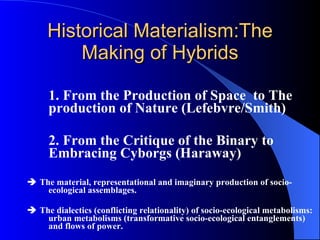
Historical Materialism:The Making of Hybrids 1. From the Production of Space  to The production of Nature (Lefebvre/Smith) 2. From the Critique of the Binary to Embracing Cyborgs (Haraway)    The material, representational and imaginary production of socio-ecological assemblages.    The dialectics (conflicting relationality) of socio-ecological metabolisms: urban metabolisms (transformative socio-ecological entanglements) and flows of power.
FLOWS OF POWER: THE POLITICAL ECOLOGY OF WATER AND URBANISATION  The Case of Guayaquil, Ecuador Erik Swyngedouw ‘ Agua, drama sin final’   (El Universo, 14/07/91)
FLOWS OF POWER: THE POLITICAL ECOLOGY OF WATER AND URBANISATION  Water and Cities Flows of Power: The Case of Guayaquil a) Uneven Waters b) Cocoa and the Re-making of the Guayaquileno Bourgeoisie c) Moving the Water Frontier: The Emergence of Exclusionary Water Practices d) Watering with Bananas: Opening up a New Waterfront e) Black Gold/Blue Gold:The Last Breath of the Urban Water Dream 3. Whose Water? Whose Nature? Whose City? Hydro-social Struggles
CITIES AND THE WATER PROBLEM
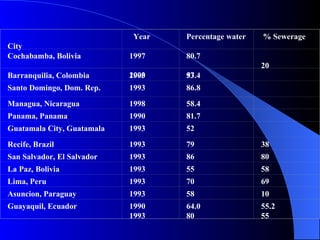
Table 3.3.  Percentage of houses with indoor piped water and sewerage connections, selected Latin American cities.   Source: (1) UNCHS (2001: 323); (2) The World Bank (1998: 278-279); (3) INEC, Census 1990; (4) Crespo (2002).   City   Year  Percentage water   % Sewerage Cochabamba, Bolivia     1997 2000 80.7 57   20 Barranquilia, Colombia 1993 93.4   Santo Domingo, Dom. Rep. 1993 86.8   Managua, Nicaragua 1998 58.4   Panama, Panama 1990 81.7   Guatamala City, Guatamala 1993 52   Recife, Brazil 1993 79 38 San Salvador, El Salvador 1993 86 80 La Paz, Bolivia 1993 55 58 Lima, Peru 1993 70 69 Asuncion, Paraguay 1993 58 10 Guayaquil, Ecuador 1990 1993 64.0 80   55.2 55
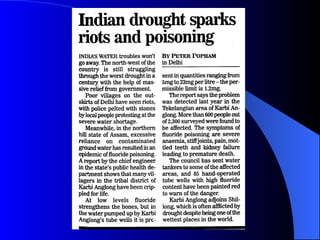
Blame it on nature! The Myth of Scarcity


Blaming Nature and the Ideology of Scarcity De-politicization From Social Power to Nature’s Power Celebrating Technical Rationality Producing Scarcity (consumption, culture, pollution) Commodification as panacea
Flows of Power: The struggle for water in Guayaquil
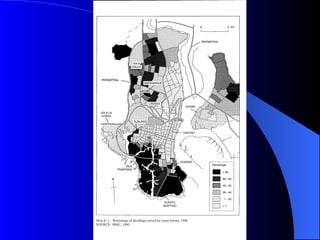
0. Introduction Guayaquil: ‘Drowning in water and starving of thirst’ Guayaquil’s water struggles: splintered networks/broken lines/flows and drums Urban metabolism and hydro-social circulation: re-writing the political-ecological history of urbanisation
Houses  % Inhabitants % Total 349176 100 1643207 100 in-house 163183  47   743978  45 outdoor  43696  13   202476  12 quarter  18887   5   92129   6 no-water 123369  35   604624  37 public net 219439  63 1007574  61 priv. vendor 121257  35   593731  36   Water accessibility and water provision in the metropolitan area of Guayaquil (City of Guayaquil plus Duran)
 
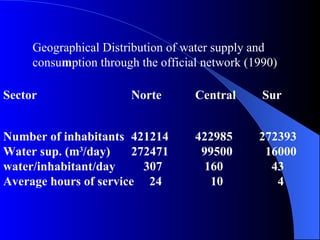
Sector    Norte Central  Sur Number of inhabitants 421214 422985 272393 Water sup. (m 3 /day) 272471   99500   16000 water/inhabitant/day   307   160   43 Average hours of service  24   10   4   Geographical Distribution of water supply and consu m ption through the official network (1990)
1. Guayaquil as Hybrid Transcending Binaries: ‘there is nothing unnatural about the city’ (D. Harvey) H20, metabolism and circulation Social Power and the hydro-social cycles: on bodies and cities, networks and connections Cyborg urbanisation: Hybridity and socio-ecological processes The making of a cyborg city: urbanising water in Guayaquil: a double socio-ecological conquest
2. Cocoa and the Re-making of the Guayaquileno Bourgeoisie (1880-1920) Water and social stratification before 1880 On water and cocoa: local cocoa bourgeoisie, global cocoa flows, global capital flows, local water urbanisation The premature end of ‘cocoa’ urbanisation (1920)
3. Moving the Water Frontier: The Emergence of Exclusionary Water Practices in an Age of Reformation (1920-1945) Cocoa bust and hyperurbanisation Political conflict and the premature end of the water dream From Ford’s dream to the emergence of the ‘third’ world Reformation and the water stratification
4. Watering with Bananas: Opening up a New Waterfront (1945-1965) Globalising Bananas: socio-ecological transformations From Euro-Cocoa to Yankee dollars Opening a new waterfront The myth of urban oasis and the making of dependency The ‘Chiquita’ drama and the end of abundant waters
5. Black Gold/Blue Gold:The Last Breath of the Urban Water Dream (1973 – 2002) Moving East – Petro-dreams/socio-ecological nightmares Colouring Black Gold Blue Global Crisis, Local Catastrophe: Debt peonage Structural dependency and institutionalised water exclusion Water scarcity and the panacea of the ‘market’
1. Dependence on external financing: Debt peonage and the export of nature 2. The myth of dependency and the realities of social power 3. Subsidizing the rich -- Excluding the poor 4. Technological Fix: The Productivist Logic 5. Land rent, urban development and the water fix (speculation versus land invasions)
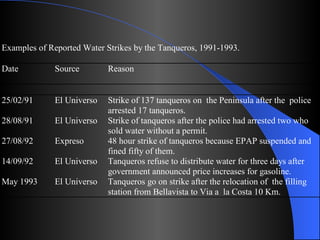
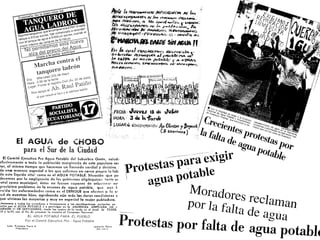
3.  Whose Water? Whose Nature? Whose City? Hydro-social Struggles 1. Water Terrorism and Water conflict 2. Local social struggle  3. Expanding Water Frontiers: The Metabolism of Water 4. Globalized Water/Money Circulation
Price multiples and water prices charged by water vendors, mid 1970s-1980s and 2001 City Country Multiples of   Water price b water charged   U.S.$/m 3   Tegucigalpa Honduras   16-34 Lima Peru   17 20-50 intis Barranquilla Colombia   28    2.00 Mexico City Mexico    40-114 400 pesos Guayaquil Ecuador   200-300 2.11-3.16 Quito Ecuador   27 1.70-2.00 Data for 2001   Baranquilla Colombia   10-12 5.50-6.40 Guatamala City Guatamala   7-10 2.70-4.50 Lima Peru   8-10   2.40  Guayaquil Ecuador   3.20 Cochabamba Bolivia   5     2.40  El Alto Bolivia   16   3.30


3. Expanding Water Frontiers: Globalising Nature – Urbanising Water A) Urbanising nature: Metabolising Cocoa, Bananas, Oil B) Local/Global Circulations
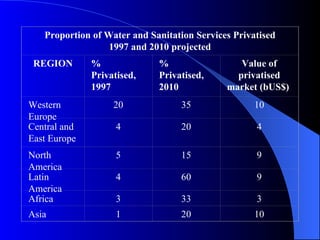
4. Globalized Water/Money Circulation:  The ‘rush’ to privatisation 4.1. A discursive politics 4.2. An accounting exercise 4.3. The local politics of privatisation 4.4. The global politics of privatisation 4.5. The privatisation game
Source:  www.thewaterpage.com  (5 September 2002)   Proportion of Water and Sanitation Services Privatised 1997 and 2010 projected REGION % Privatised, 1997 % Privatised, 2010 Value of privatised market (bUS$)  Western Europe 20 35 10 Central and East Europe 4 20 4 North America 5 15 9 Latin America 4 60 9 Africa 3 33 3 Asia 1 20 10
Whose Water?  Whose Nature?  Whose City? What kind of urban socio-natural  metabolism and for whom?

Course 29/6 Erik Swyngedouw

  • 1.
    CIRCULATIONS AND METABOLISMS:HYBRID NATURES AND CYBORG CITIES Erik Swyngedouw Geography – School of Environment and Development, University of Manchester Environmental Conflicts Summer School ICTA-AUB, 26 June – 10 July 2010
  • 2.
    Circulations and MetabolismsHybrid Nature and Cyborg Cities The Urbanisation of Nature and the Making of Hybrid Worlds Historical-Materialist Perspectives Socio-Natural Metabolisms The Invention of Circulation The Cultural Turn: from Binaries to Back to the Future Cyborg Cities and Flows of Power: Guayaquil’s Waters
  • 3.
    The Urbanisation ofNature and the Making of Hybrid Worlds Cyborg Cities and Hybrid Natures The City in a Cup of Coffee London’s Piccadily Circus Jakarta’s Dengue and Cholera plague Urban Climates and ‘Accumulation by Contamination’ (Allier) Guayaquil’s waters as Flows of Power
  • 4.
    Historical-Materialist Perspectives 1.Socio-Natural Metabolisms The materialist foundation “ The first premise of all human history is, of course, the existence of living human individuals. Thus the first fact to be established is the physical organisation of these individuals and their consequent relationship to the rest of nature… The writing of history must always set out from these natural bases and their modification in the course of history through the action of men … [M]en must be in a position to live in order to be able to ‘make history’… The first historical act is thus the production of the means to satisfy these needs, the production of material life itself.”
  • 5.
    Labour as a‘natural process’ “ Labour is, first of all, a process between man and nature, a process by which man, through his own actions, mediates, regulates, and controls the metabolism between himself and nature. He confronts the materials of nature as a force of nature. He sets in motion the natural forces which belong to his own body, his arms, legs, head, and hands, in order to appropriate the materials of nature in a form adapted to his own needs. Through this movement he acts upon external nature and changes it, and in this way he simultaneously changes his own nature …. [labouring] is an appropriation of what exists in nature for the requirements of man. It is the universal condition for the metabolic interaction between man and nature, the ever-lasting nature-imposed condition of human existence” (Marx 1867 (1971): 283 and 290).
  • 6.
    ‘ Metabolism’ asa central metaphor and practice a) Von Liebig’s ‘stoffwechsel’. (transformation, qualitative change, maintenance, thermodynamics, circular) b) Darwin’s Evolution c) Marx’s socio-natural metabolism “ Actual labour is the appropriation of nature for the satisfaction of human needs, the activity through which the metabolism between man and nature is mediated” (Marx in Economic Manuscripts, 1861-1863).
  • 7.
    2. The Inventionof Circulation PRE-CIRCULATION : extraction (phlogiston, physiocrats, malthus) CIRCULATION: Lavoisier, William Harvey, Montesquie, Rousseau, Chadwick, Haussman, Harvey, Ricardo Capitalism/Modernity as circulatory conduits organised through socially molecular strategies and activities, embedded in political-territorial forms regulation (Ricardo, Marx. Harvey).  
  • 8.
    “ The economiccircular flow then was closely bound up, in Marx’s analysis, with the material exchange (ecological circular flow) associated with the metabolic interaction between human beings and nature” (Foster 2000: 157-158).  The circulation of capital is a metabolic circular process.  Product, thing: good, commodity, city, water are the result of socio-metabolic circulatory processes (tension/contradiction, separation (town/countryside; nature/society)
  • 9.
    The Cultural Turn:from Binaries to Back to the Future 1. Critique of binaries “ It is not the unity of living and active humanity the natural, inorganic conditions of their metabolic exchange with nature, and hence their appropriation of nature, which requires explanation, or is the result of a historic process, but rather the separation between these inorganic conditions of human existence and this active existence.” (Marx (1858 (1973): 489).  Historical Materialist ‘transcendence’ of binaries 2. Binaries as cultural critique * Cultural Hybridity (post-colonial theory) * Hybridity as social/discursive construct (Hybrid geographies) * Binaries as the modern ‘constitution’ (Latour): reclaiming modernity  Discursive/cultural ‘transcendence’ of binaries (the politics of representation)
  • 10.
    Historical Materialism:The Makingof Hybrids 1. From the Production of Space to The production of Nature (Lefebvre/Smith) 2. From the Critique of the Binary to Embracing Cyborgs (Haraway)  The material, representational and imaginary production of socio-ecological assemblages.  The dialectics (conflicting relationality) of socio-ecological metabolisms: urban metabolisms (transformative socio-ecological entanglements) and flows of power.
  • 11.
    FLOWS OF POWER:THE POLITICAL ECOLOGY OF WATER AND URBANISATION The Case of Guayaquil, Ecuador Erik Swyngedouw ‘ Agua, drama sin final’ (El Universo, 14/07/91)
  • 12.
    FLOWS OF POWER:THE POLITICAL ECOLOGY OF WATER AND URBANISATION Water and Cities Flows of Power: The Case of Guayaquil a) Uneven Waters b) Cocoa and the Re-making of the Guayaquileno Bourgeoisie c) Moving the Water Frontier: The Emergence of Exclusionary Water Practices d) Watering with Bananas: Opening up a New Waterfront e) Black Gold/Blue Gold:The Last Breath of the Urban Water Dream 3. Whose Water? Whose Nature? Whose City? Hydro-social Struggles
  • 13.
    CITIES AND THEWATER PROBLEM
  • 14.
    Table 3.3. Percentage of houses with indoor piped water and sewerage connections, selected Latin American cities.   Source: (1) UNCHS (2001: 323); (2) The World Bank (1998: 278-279); (3) INEC, Census 1990; (4) Crespo (2002).   City   Year  Percentage water   % Sewerage Cochabamba, Bolivia     1997 2000 80.7 57   20 Barranquilia, Colombia 1993 93.4   Santo Domingo, Dom. Rep. 1993 86.8   Managua, Nicaragua 1998 58.4   Panama, Panama 1990 81.7   Guatamala City, Guatamala 1993 52   Recife, Brazil 1993 79 38 San Salvador, El Salvador 1993 86 80 La Paz, Bolivia 1993 55 58 Lima, Peru 1993 70 69 Asuncion, Paraguay 1993 58 10 Guayaquil, Ecuador 1990 1993 64.0 80   55.2 55
  • 15.
    Blame it onnature! The Myth of Scarcity
  • 16.
  • 17.
  • 18.
  • 19.
    Blaming Nature andthe Ideology of Scarcity De-politicization From Social Power to Nature’s Power Celebrating Technical Rationality Producing Scarcity (consumption, culture, pollution) Commodification as panacea
  • 20.
    Flows of Power:The struggle for water in Guayaquil
  • 21.
    0. Introduction Guayaquil:‘Drowning in water and starving of thirst’ Guayaquil’s water struggles: splintered networks/broken lines/flows and drums Urban metabolism and hydro-social circulation: re-writing the political-ecological history of urbanisation
  • 22.
    Houses %Inhabitants % Total 349176 100 1643207 100 in-house 163183 47 743978 45 outdoor 43696 13 202476 12 quarter 18887 5 92129 6 no-water 123369 35 604624 37 public net 219439 63 1007574 61 priv. vendor 121257 35 593731 36 Water accessibility and water provision in the metropolitan area of Guayaquil (City of Guayaquil plus Duran)
  • 23.
  • 24.
    Sector Norte Central  Sur Number of inhabitants 421214 422985 272393 Water sup. (m 3 /day) 272471 99500 16000 water/inhabitant/day 307 160 43 Average hours of service 24 10 4 Geographical Distribution of water supply and consu m ption through the official network (1990)
  • 25.
    1. Guayaquil asHybrid Transcending Binaries: ‘there is nothing unnatural about the city’ (D. Harvey) H20, metabolism and circulation Social Power and the hydro-social cycles: on bodies and cities, networks and connections Cyborg urbanisation: Hybridity and socio-ecological processes The making of a cyborg city: urbanising water in Guayaquil: a double socio-ecological conquest
  • 26.
    2. Cocoa andthe Re-making of the Guayaquileno Bourgeoisie (1880-1920) Water and social stratification before 1880 On water and cocoa: local cocoa bourgeoisie, global cocoa flows, global capital flows, local water urbanisation The premature end of ‘cocoa’ urbanisation (1920)
  • 27.
    3. Moving theWater Frontier: The Emergence of Exclusionary Water Practices in an Age of Reformation (1920-1945) Cocoa bust and hyperurbanisation Political conflict and the premature end of the water dream From Ford’s dream to the emergence of the ‘third’ world Reformation and the water stratification
  • 28.
    4. Watering withBananas: Opening up a New Waterfront (1945-1965) Globalising Bananas: socio-ecological transformations From Euro-Cocoa to Yankee dollars Opening a new waterfront The myth of urban oasis and the making of dependency The ‘Chiquita’ drama and the end of abundant waters
  • 29.
    5. Black Gold/BlueGold:The Last Breath of the Urban Water Dream (1973 – 2002) Moving East – Petro-dreams/socio-ecological nightmares Colouring Black Gold Blue Global Crisis, Local Catastrophe: Debt peonage Structural dependency and institutionalised water exclusion Water scarcity and the panacea of the ‘market’
  • 30.
    1. Dependence onexternal financing: Debt peonage and the export of nature 2. The myth of dependency and the realities of social power 3. Subsidizing the rich -- Excluding the poor 4. Technological Fix: The Productivist Logic 5. Land rent, urban development and the water fix (speculation versus land invasions)
  • 31.
    3. WhoseWater? Whose Nature? Whose City? Hydro-social Struggles 1. Water Terrorism and Water conflict 2. Local social struggle 3. Expanding Water Frontiers: The Metabolism of Water 4. Globalized Water/Money Circulation
  • 32.
    Price multiples andwater prices charged by water vendors, mid 1970s-1980s and 2001 City Country Multiples of Water price b water charged U.S.$/m 3 Tegucigalpa Honduras 16-34 Lima Peru 17 20-50 intis Barranquilla Colombia 28    2.00 Mexico City Mexico 40-114 400 pesos Guayaquil Ecuador 200-300 2.11-3.16 Quito Ecuador 27 1.70-2.00 Data for 2001   Baranquilla Colombia 10-12 5.50-6.40 Guatamala City Guatamala 7-10 2.70-4.50 Lima Peru 8-10 2.40 Guayaquil Ecuador 3.20 Cochabamba Bolivia 5 2.40 El Alto Bolivia 16 3.30
  • 33.
  • 34.
  • 35.
  • 36.
    3. Expanding WaterFrontiers: Globalising Nature – Urbanising Water A) Urbanising nature: Metabolising Cocoa, Bananas, Oil B) Local/Global Circulations
  • 37.
    4. Globalized Water/MoneyCirculation: The ‘rush’ to privatisation 4.1. A discursive politics 4.2. An accounting exercise 4.3. The local politics of privatisation 4.4. The global politics of privatisation 4.5. The privatisation game
  • 38.
    Source: www.thewaterpage.com (5 September 2002) Proportion of Water and Sanitation Services Privatised 1997 and 2010 projected REGION % Privatised, 1997 % Privatised, 2010 Value of privatised market (bUS$) Western Europe 20 35 10 Central and East Europe 4 20 4 North America 5 15 9 Latin America 4 60 9 Africa 3 33 3 Asia 1 20 10
  • 39.
    Whose Water? Whose Nature? Whose City? What kind of urban socio-natural metabolism and for whom?