STUDY ON
RESTAURANT,
ERGONOMICS
RUMANA KHATUN
Session : 2017-18
Department of architecture
Dining Area
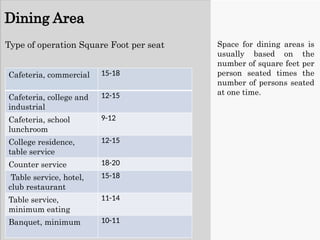
Space for dining areas is
usually based on the
number of square feet per
person seated times the
number of persons seated
at one time.
Type of operation Square Foot per seat
Cafeteria, commercial 15-18
Cafeteria, college and
industrial
12-15
Cafeteria, school
lunchroom
9-12
College residence,
table service
12-15
Counter service 18-20
Table service, hotel,
club restaurant
15-18
Table service,
minimum eating
11-14
Banquet, minimum 10-11
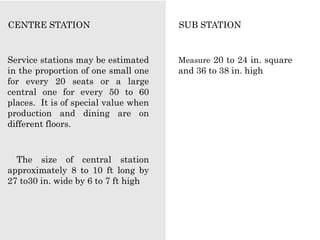
CENTRE STATION
Service stations may be estimated
in the proportion of one small one
for every 20 seats or a large
central one for every 50 to 60
places. It is of special value when
production and dining are on
different floors.
SUB STATION
Measure 20 to 24 in. square
and 36 to 38 in. high
The size of central station
approximately 8 to 10 ft long by
27 to30 in. wide by 6 to 7 ft high
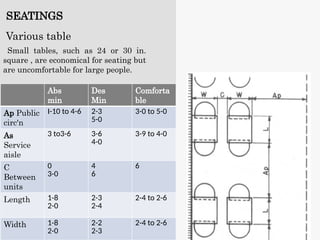
Various table
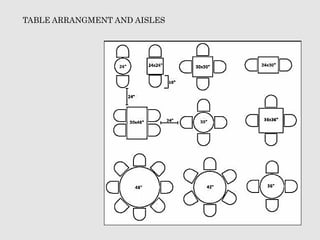
Small tables, such as 24 or 30 in.
square , are economical for seating but
are uncomfortable for large people.
Abs
min
Des
Min
Comforta
ble
Ap Public
circ'n
I-10 to 4-6 2-3
5-0
3-0 to 5-0
As
Service
aisle
3 to3-6 3-6
4-0
3-9 to 4-0
C
Between
units
0
3-0
4
6
6
Length 1-8
2-0
2-3
2-4
2-4 to 2-6
Width 1-8
2-0
2-2
2-3
2-4 to 2-6
SEATINGS
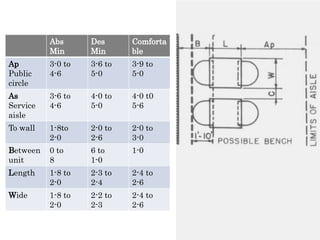
Abs
Min
Des
Min
Comforta
ble
Ap
Public
circle
3-0 to
4-6
3-6 to
5-0
3-9 to
5-0
As
Service
aisle
3-6 to
4-6
4-0 to
5-0
4-0 t0
5-6
To wall 1-8to
2-0
2-0 to
2-6
2-0 to
3-0
Between
unit
0 to
8
6 to
1-0
1-0
Length 1-8 to
2-0
2-3 to
2-4
2-4 to
2-6
Wide 1-8 to
2-0
2-2 to
2-3
2-4 to
2-6
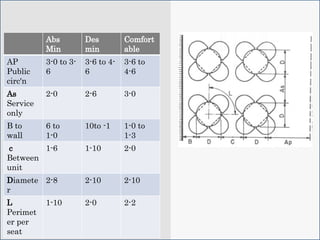
Abs
Min
Des
min
Comfort
able
AP
Public
circ'n
3-0 to 3-
6
3-6 to 4-
6
3-6 to
4-6
As
Service
only
2-0 2-6 3-0
B to
wall
6 to
1-0
10to -1 1-0 to
1-3
c
Between
unit
1-6 1-10 2-0
Diamete
r
2-8 2-10 2-10
L
Perimet
er per
seat
1-10 2-0 2-2
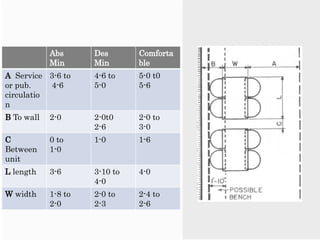
Abs
Min
Des
Min
Comforta
ble
A Service
or pub.
circulatio
n
3-6 to
4-6
4-6 to
5-0
5-0 t0
5-6
B To wall 2-0 2-0t0
2-6
2-0 to
3-0
C
Between
unit
0 to
1-0
1-0 1-6
L length 3-6 3-10 to
4-0
4-0
W width 1-8 to
2-0
2-0 to
2-3
2-4 to
2-6
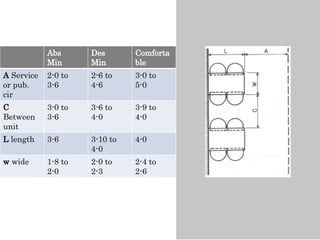
Abs
Min
Des
Min
Comforta
ble
A Service
or pub.
cir
2-0 to
3-6
2-6 to
4-6
3-0 to
5-0
C
Between
unit
3-0 to
3-6
3-6 to
4-0
3-9 to
4-0
L length 3-6 3-10 to
4-0
4-0
w wide 1-8 to
2-0
2-0 to
2-3
2-4 to
2-6
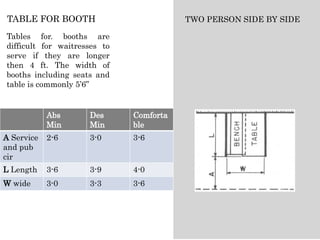
Tables for. booths are
difficult for waitresses to
serve if they are longer
then 4 ft. The width of
booths including seats and
table is commonly 5’6”
TABLE FOR BOOTH
Abs
Min
Des
Min
Comforta
ble
A Service
and pub
cir
2-6 3-0 3-6
L Length 3-6 3-9 4-0
W wide 3-0 3-3 3-6
TWO PERSON SIDE BY SIDE
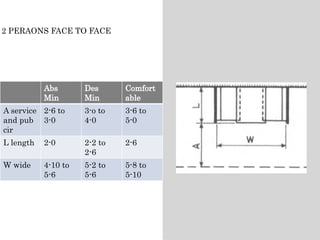
Abs
Min
Des
Min
Comfort
able
A service
and pub
cir
2-6 to
3-0
3-o to
4-0
3-6 to
5-0
L length 2-0 2-2 to
2-6
2-6
W wide 4-10 to
5-6
5-2 to
5-6
5-8 to
5-10
2 PERAONS FACE TO FACE
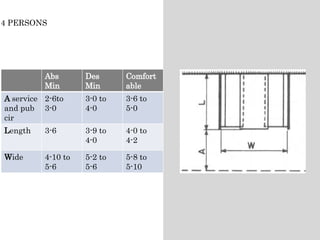
4 PERSONS
Abs
Min
Des
Min
Comfort
able
A service
and pub
cir
2-6to
3-0
3-0 to
4-0
3-6 to
5-0
Length 3-6 3-9 to
4-0
4-0 to
4-2
Wide 4-10 to
5-6
5-2 to
5-6
5-8 to
5-10
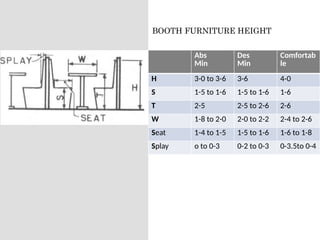
Abs
Min
Des
Min
Comfortab
le
H 3-0 to 3-6 3-6 4-0
S 1-5 to 1-6 1-5 to 1-6 1-6
T 2-5 2-5 to 2-6 2-6
W 1-8 to 2-0 2-0 to 2-2 2-4 to 2-6
Seat 1-4 to 1-5 1-5 to 1-6 1-6 to 1-8
Splay o to 0-3 0-2 to 0-3 0-3.5to 0-4
BOOTH FURNITURE HEIGHT
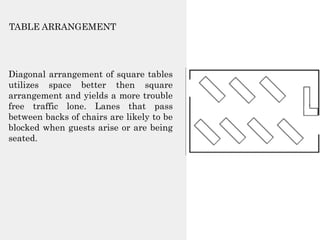
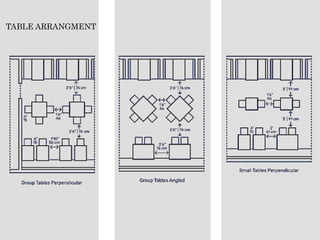
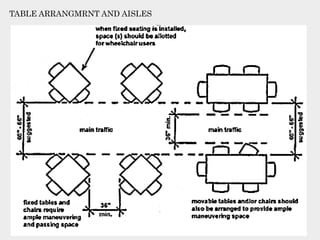
Diagonal arrangement of square tables
utilizes space better then square
arrangement and yields a more trouble
free traffic lone. Lanes that pass
between backs of chairs are likely to be
blocked when guests arise or are being
seated.
TABLE ARRANGEMENT
TABLE ARRANGMENT
TABLE ARRANGMRNT AND AISLES
TABLE ARRANGMENT AND AISLES
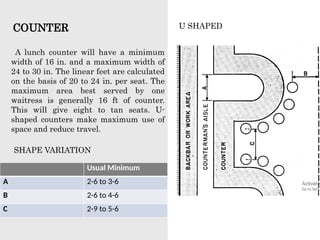
A lunch counter will have a minimum
width of 16 in. and a maximum width of
24 to 30 in. The linear feet are calculated
on the basis of 20 to 24 in. per seat. The
maximum area best served by one
waitress is generally 16 ft of counter.
This will give eight to tan seats. U-
shaped counters make maximum use of
space and reduce travel.
COUNTER
SHAPE VARIATION
U SHAPED
Usual Minimum
A 2-6 to 3-6
B 2-6 to 4-6
C 2-9 to 5-6
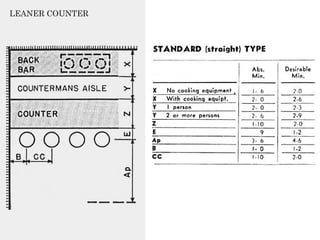
LEANER COUNTER
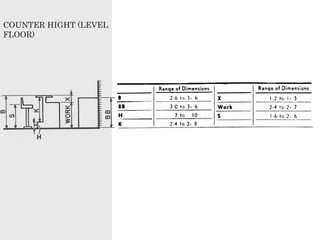
COUNTER HIGHT (LEVEL
FLOOR)
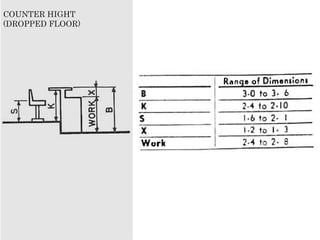
COUNTER HIGHT
(DROPPED FLOOR)
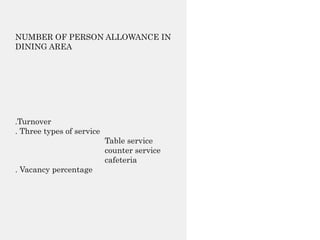
NUMBER OF PERSON ALLOWANCE IN
DINING AREA
.Turnover
. Three types of service
Table service
counter service
cafeteria
. Vacancy percentage
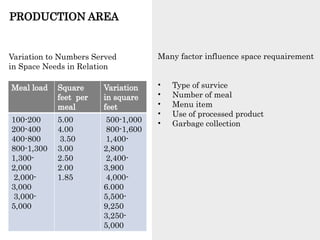
PRODUCTION AREA
Many factor influence space requairement
• Type of survice
• Number of meal
• Menu item
• Use of processed product
• Garbage collection
Variation to Numbers Served
in Space Needs in Relation
Meal load Square
feet per
meal
Variation
in square
feet
100-200
200-400
400-800
800-1,300
1,300-
2,000
2,000-
3,000
3,000-
5,000
5.00
4.00
3.50
3.00
2.50
2.00
1.85
500-1,000
800-1,600
1,400-
2,800
2,400-
3,900
4,000-
6.000
5,500-
9,250
3,250-
5,000
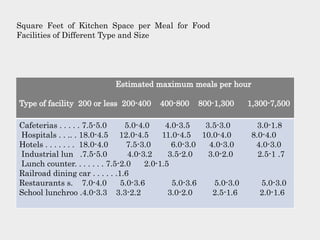
Square Feet of Kitchen Space per Meal for Food
Facilities of Different Type and Size
Estimated maximum meals per hour
Type of facility 200 or less 200-400 400-800 800-1,300 1,300-7,500
Cafeterias . . . . . 7.5-5.0 5.0-4.0 4.0-3.5 3.5-3.0 3.0-1.8
Hospitals . . .. . 18.0-4.5 12.0-4.5 11.0-4.5 10.0-4.0 8.0-4.0
Hotels . . . . . . . 18.0-4.0 7.5-3.0 6.0-3.0 4.0-3.0 4.0-3.0
Industrial lun .7.5-5.0 4.0-3.2 3.5-2.0 3.0-2.0 2.5-1 .7
Lunch counter. . . . . . . 7.5-2.0 2.0-1.5
Railroad dining car . . . . . .1.6
Restaurants s. 7.0-4.0 5.0-3.6 5.0-3.6 5.0-3.0 5.0-3.0
School lunchroo .4.0-3.3 3.3-2.2 3.0-2.0 2.5-1.6 2.0-1.6
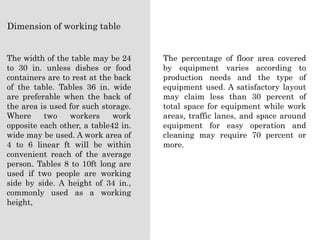
Dimension of working table
The width of the table may be 24
to 30 in. unless dishes or food
containers are to rest at the back
of the table. Tables 36 in. wide
are preferable when the back of
the area is used for such storage.
Where two workers work
opposite each other, a table42 in.
wide may be used. A work area of
4 to 6 linear ft will be within
convenient reach of the average
person. Tables 8 to 10ft long are
used if two people are working
side by side. A height of 34 in.,
commonly used as a working
height,
The percentage of floor area covered
by equipment varies according to
production needs and the type of
equipment used. A satisfactory layout
may claim less than 30 percent of
total space for equipment while work
areas, traffic lanes, and space around
equipment for easy operation and
cleaning may require 70 percent or
more.
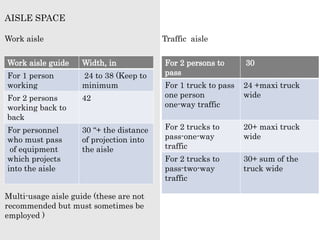
AISLE SPACE
Work aisle guide Width, in
For 1 person
working
24 to 38 (Keep to
minimum
For 2 persons
working back to
back
42
For personnel
who must pass
of equipment
which projects
into the aisle
30 “+ the distance
of projection into
the aisle
Work aisle Traffic aisle
For 2 persons to
pass
30
For 1 truck to pass
one person
one-way traffic
24 +maxi truck
wide
For 2 trucks to
pass-one-way
traffic
20+ maxi truck
wide
For 2 trucks to
pass-two-way
traffic
30+ sum of the
truck wide
Multi-usage aisle guide (these are not
recommended but must sometimes be
employed )
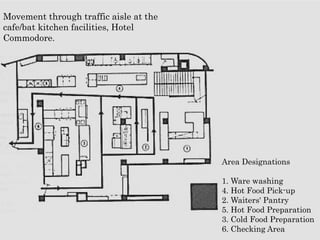
Movement through traffic aisle at the
cafe/bat kitchen facilities, Hotel
Commodore.
Area Designations
1. Ware washing
4. Hot Food Pick-up
2. Waiters' Pantry
5. Hot Food Preparation
3. Cold Food Preparation
6. Checking Area
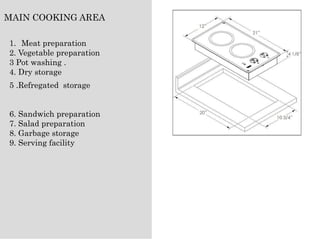
MAIN COOKING AREA
1. Meat preparation
2. Vegetable preparation
3 Pot washing .
4. Dry storage
5 .Refregated storage
6. Sandwich preparation
7. Salad preparation
8. Garbage storage
9. Serving facility
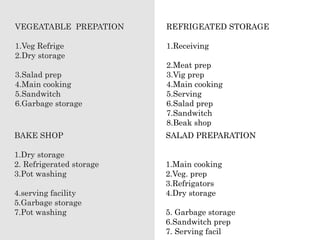
VEGEATABLE PREPATION
1.Veg Refrige
2.Dry storage
3.Salad prep
4.Main cooking
5.Sandwitch
6.Garbage storage
BAKE SHOP
1.Dry storage
2. Refrigerated storage
3.Pot washing
4.serving facility
5.Garbage storage
7.Pot washing
REFRIGEATED STORAGE
1.Receiving
2.Meat prep
3.Vig prep
4.Main cooking
5.Serving
6.Salad prep
7.Sandwitch
8.Beak shop
SALAD PREPARATION
1.Main cooking
2.Veg. prep
3.Refrigators
4.Dry storage
5. Garbage storage
6.Sandwitch prep
7. Serving facil
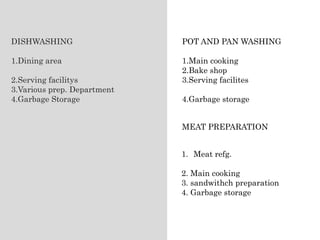
DISHWASHING
1.Dining area
2.Serving facilitys
3.Various prep. Department
4.Garbage Storage
POT AND PAN WASHING
1.Main cooking
2.Bake shop
3.Serving facilites
4.Garbage storage
MEAT PREPARATION
1. Meat refg.
2. Main cooking
3. sandwithch preparation
4. Garbage storage
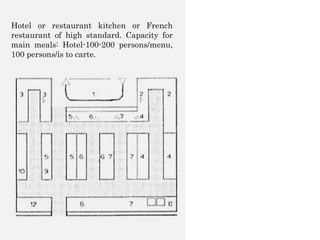
Hotel or restaurant kitchen or French
restaurant of high standard. Capacity for
main meals: Hotel-100-200 persons/menu,
100 persons/is to carte.
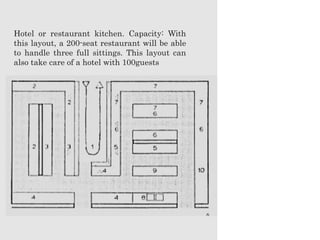
Hotel or restaurant kitchen. Capacity: With
this layout, a 200-seat restaurant will be able
to handle three full sittings. This layout can
also take care of a hotel with 100guests
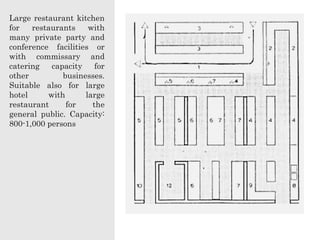
Large restaurant kitchen
for restaurants with
many private party and
conference facilities or
with commissary and
catering capacity for
other businesses.
Suitable also for large
hotel with large
restaurant for the
general public. Capacity:
800-1,000 persons
1. Waiters' passageway-meal and
beverage counter-dish return
2. Dishwashing area (dishes,
glasses, silver)
3. Beverages-preparation and
serving
4. Pastry (cookies, cakes, ice cream,
dessert)preparation and serving
S.
5. Cold kitchen (cold appetizers,
salad, fish)preparation and serving
6. Warm kitchen-saucier/r6tisseur
area (sauces, roasts, grill, fish)-
preparation including large
apparatus area and serving
7. Warm kitchen-entremétier area
(soups, vegetables, entrées)-
preparation including large
apparatus area and serving
8. Pot and pan washing-
casserolier area
9. Vegetable preparation
10. Meat preparation
11 . Vegetable cold %forage
12. Meat cold storage
13. Economat (dry storage)
14. Beverage cold storage
15. Linen, dish, cleaning
supplies storage
16. Staple goods storage
17. Goods acceptance and
control
18. Empty goods and garbage
collecting rooms
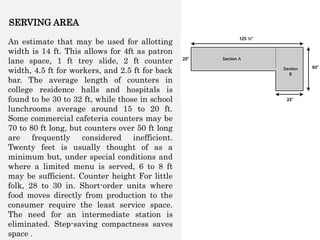
An estimate that may be used for allotting
width is 14 ft. This allows for 4ft as patron
lane space, 1 ft trey slide, 2 ft counter
width, 4.5 ft for workers, and 2.5 ft for back
bar. The average length of counters in
college residence halls and hospitals is
found to be 30 to 32 ft, while those in school
lunchrooms average around 15 to 20 ft.
Some commercial cafeteria counters may be
70 to 80 ft long, but counters over 50 ft long
are frequently considered inefficient.
Twenty feet is usually thought of as a
minimum but, under special conditions and
where a limited menu is served, 6 to 8 ft
may be sufficient. Counter height For little
folk, 28 to 30 in. Short-order units where
food moves directly from production to the
consumer require the least service space.
The need for an intermediate station is
eliminated. Step-saving compactness saves
space .
SERVING AREA
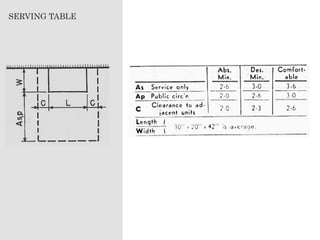
SERVING TABLE
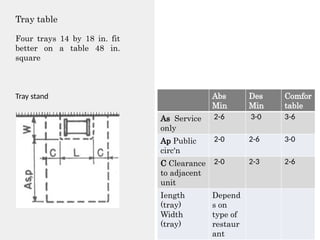
Tray table
Four trays 14 by 18 in. fit
better on a table 48 in.
square
Abs
Min
Des
Min
Comfor
table
As Service
only
2-6 3-0 3-6
Ap Public
circ'n
2-0 2-6 3-0
C Clearance
to adjacent
unit
2-0 2-3 2-6
Iength
(tray)
Width
(tray)
Depend
s on
type of
restaur
ant
Tray stand
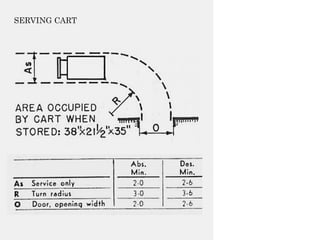
SERVING CART
Receiving and Storage Areas
Common Storage
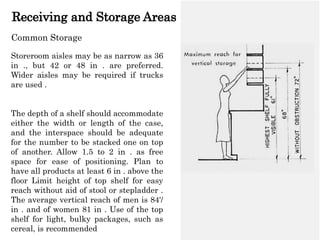
Storeroom aisles may be as narrow as 36
in ., but 42 or 48 in . are preferred.
Wider aisles may be required if trucks
are used .
The depth of a shelf should accommodate
either the width or length of the case,
and the interspace should be adequate
for the number to be stacked one on top
of another. Allow 1.5 to 2 in . as free
space for ease of positioning. Plan to
have all products at least 6 in . above the
floor Limit height of top shelf for easy
reach without aid of stool or stepladder .
The average vertical reach of men is 84'/
in . and of women 81 in . Use of the top
shelf for light, bulky packages, such as
cereal, is recommended
Refrigerated and Low-Temperature
Storage
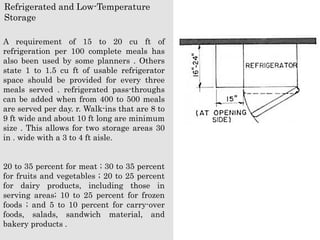
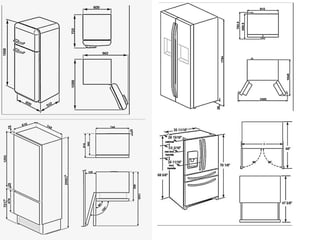
A requirement of 15 to 20 cu ft of
refrigeration per 100 complete meals has
also been used by some planners . Others
state 1 to 1.5 cu ft of usable refrigerator
space should be provided for every three
meals served . refrigerated pass-throughs
can be added when from 400 to 500 meals
are served per day. r. Walk-ins that are 8 to
9 ft wide and about 10 ft long are minimum
size . This allows for two storage areas 30
in . wide with a 3 to 4 ft aisle.
20 to 35 percent for meat ; 30 to 35 percent
for fruits and vegetables ; 20 to 25 percent
for dairy products, including those in
serving areas; 10 to 25 percent for frozen
foods ; and 5 to 10 percent for carry-over
foods, salads, sandwich material, and
bakery products .
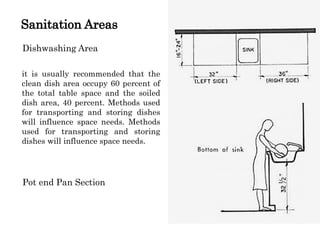
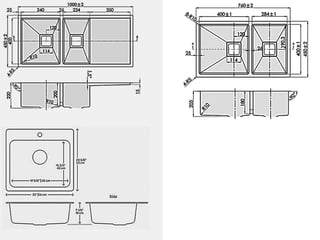
Sanitation Areas
Dishwashing Area
it is usually recommended that the
clean dish area occupy 60 percent of
the total table space and the soiled
dish area, 40 percent. Methods used
for transporting and storing dishes
will influence space needs. Methods
used for transporting and storing
dishes will influence space needs.
Pot end Pan Section
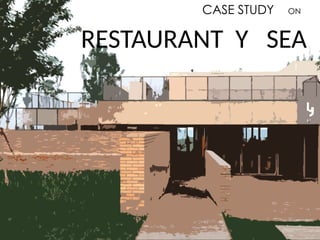
CASE STUDY ON
RESTAURANT Y SEA
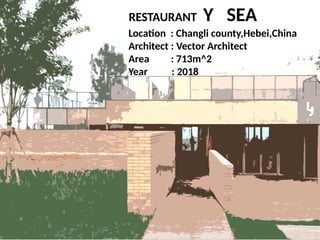
RESTAURANT Y SEA
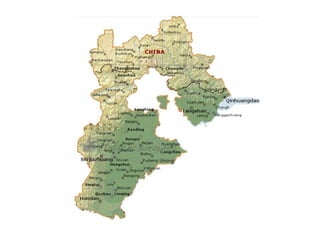
Location : Changli county,Hebei,China
Architect : Vector Architect
Area : 713m^2
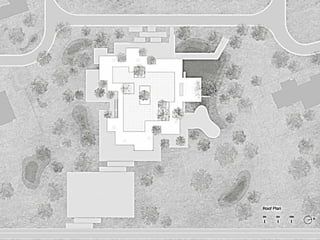
Year : 2018
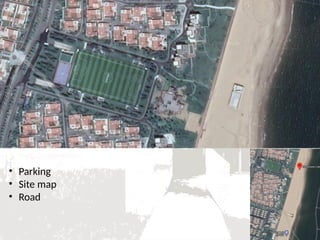
• Parking
• Site map
• Road
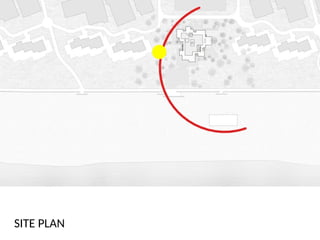
SITE PLAN
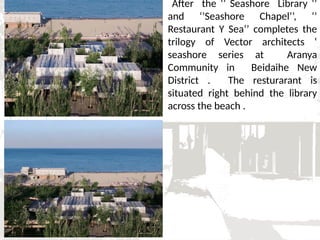
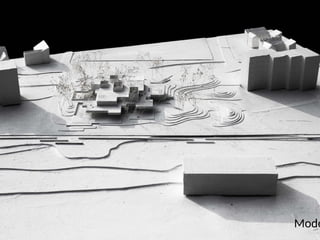
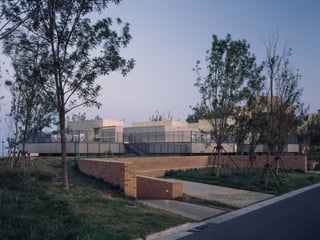
After the ‘’ Seashore Library ‘’
and ‘’Seashore Chapel’’, ‘’
Restaurant Y Sea’’ completes the
trilogy of Vector architects ‘
seashore series at Aranya
Community in Beidaihe New
District . The resturarant is
situated right behind the library
across the beach .
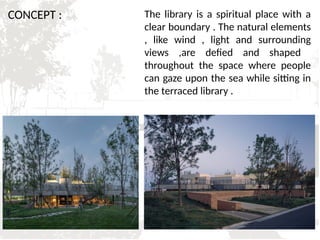
The library is a spiritual place with a
clear boundary . The natural elements
, like wind , light and surrounding
views ,are defied and shaped
throughout the space where people
can gaze upon the sea while sitting in
the terraced library .
CONCEPT :
CONCEPT :
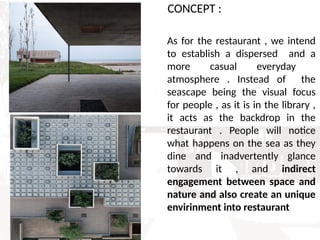
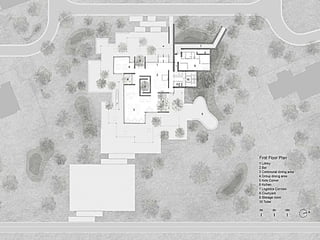
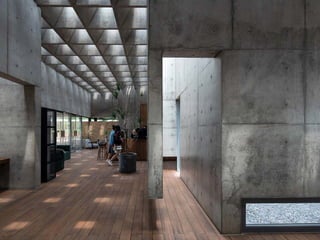
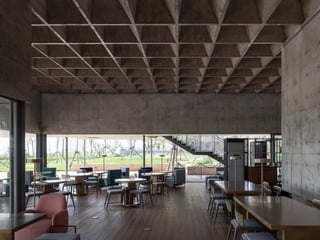
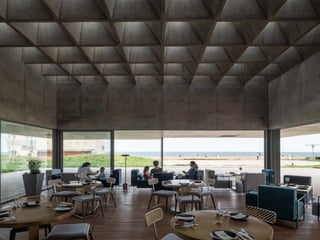
As for the restaurant , we intend
to establish a dispersed and a
more casual everyday
atmosphere . Instead of the
seascape being the visual focus
for people , as it is in the library ,
it acts as the backdrop in the
restaurant . People will notice
what happens on the sea as they
dine and inadvertently glance
towards it , and indirect
engagement between space and
nature and also create an unique
envirinment into restaurant
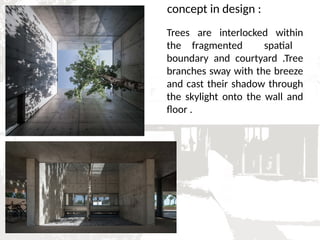
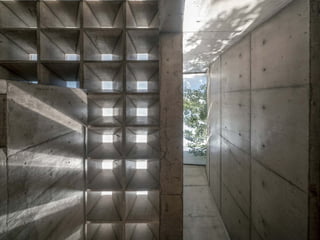
concept in design :
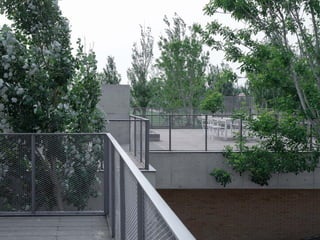
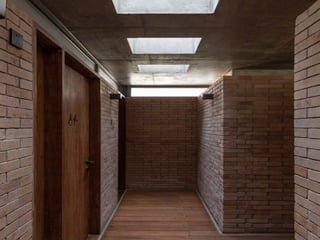
Trees are interlocked within
the fragmented spatial
boundary and courtyard .Tree
branches sway with the breeze
and cast their shadow through
the skylight onto the wall and
floor .
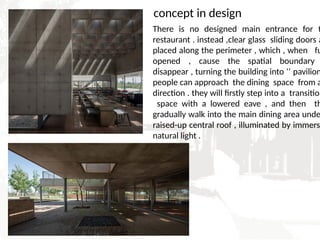
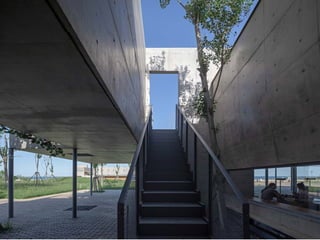
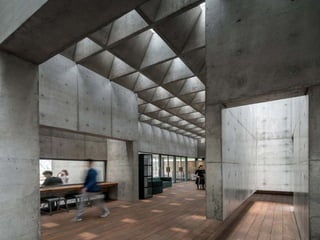
There is no designed main entrance for t
restaurant . instead ,clear glass sliding doors a
placed along the perimeter , which , when fu
opened , cause the spatial boundary
disappear , turning the building into ‘’ pavilion
people can approach the dining space from a
direction . they will firstly step into a transition
space with a lowered eave , and then th
gradually walk into the main dining area unde
raised-up central roof , illuminated by immersi
natural light .
concept in design
concept in design :
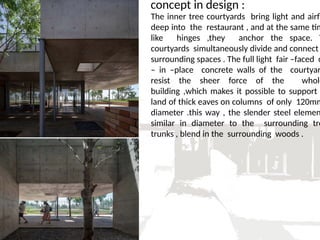
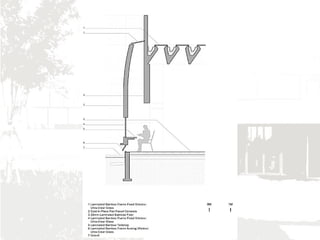
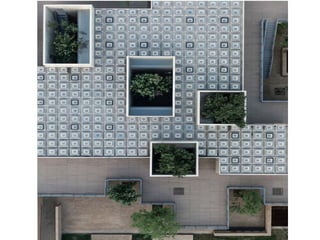
The inner tree courtyards bring light and airfl
deep into the restaurant , and at the same tim
like hinges ,they anchor the space. T
courtyards simultaneously divide and connect
surrounding spaces . The full light fair –faced c
– in –place concrete walls of the courtyar
resist the sheer force of the whole
building ,which makes it possible to support
land of thick eaves on columns of only 120mm
diameter .this way , the slender steel elemen
similar in diameter to the surrounding tre
trunks , blend in the surrounding woods .
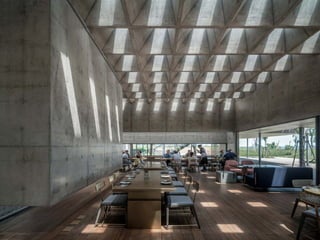
concept in design :
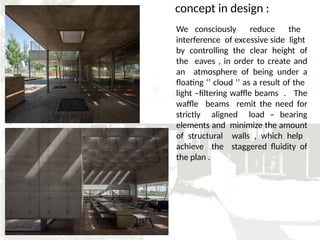
We consciously reduce the
interference of excessive side light
by controlling the clear height of
the eaves , in order to create and
an atmosphere of being under a
floating ‘’ cloud ‘’ as a result of the
light –filtering waffle beams . The
waffle beams remit the need for
strictly aligned load – bearing
elements and minimize the amount
of structural walls , which help
achieve the staggered fluidity of
the plan .
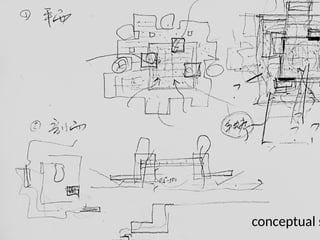
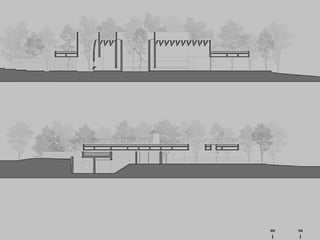
conceptual s
Mode
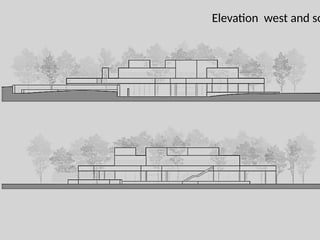
Elevation west and so
EL SITIO
RESTAURANT
CASE STUDY ON
Location : Puerto Varas , CHILE
Architect : Cristobal Lamarca , Estudio Alinea
Area : 188 m^2
Year : 2018
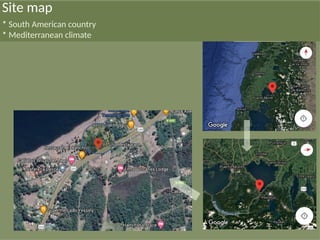
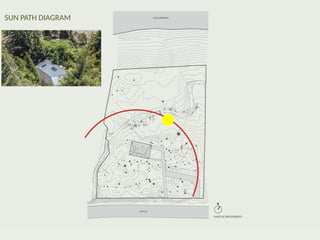
Site map
* South American country
* Mediterranean climate
SUN PATH DIAGRAM
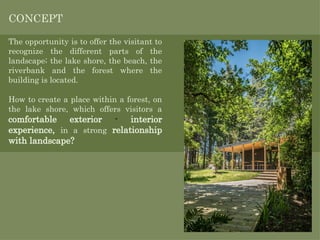
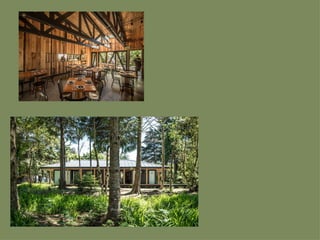
The opportunity is to offer the visitant to
recognize the different parts of the
landscape; the lake shore, the beach, the
riverbank and the forest where the
building is located.
CONCEPT
How to create a place within a forest, on
the lake shore, which offers visitors a
comfortable exterior - interior
experience, in a strong relationship
with landscape?
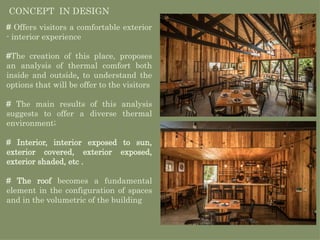
# Offers visitors a comfortable exterior
- interior experience
#The creation of this place, proposes
an analysis of thermal comfort both
inside and outside, to understand the
options that will be offer to the visitors
# The main results of this analysis
suggests to offer a diverse thermal
environment;
# Interior, interior exposed to sun,
exterior covered, exterior exposed,
exterior shaded, etc .
# The roof becomes a fundamental
element in the configuration of spaces
and in the volumetric of the building
CONCEPT IN DESIGN
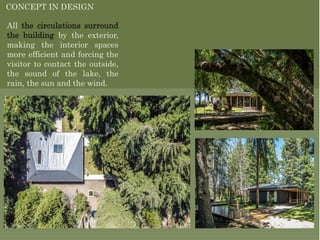
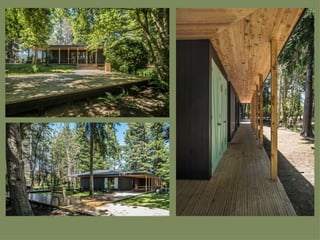
All the circulations surround
the building by the exterior,
making the interior spaces
more efficient and forcing the
visitor to contact the outside,
the sound of the lake, the
rain, the sun and the wind.
CONCEPT IN DESIGN
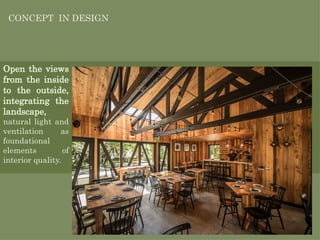
Open the views
from the inside
to the outside,
integrating the
landscape,
natural light and
ventilation as
foundational
elements of
interior quality.
CONCEPT IN DESIGN
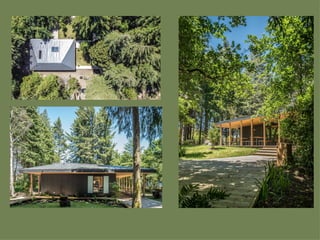
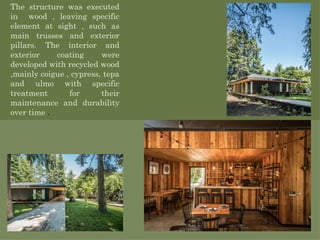
The structure was executed
in wood , leaving specific
element at sight , such as
main trusses and exterior
pillars. The interior and
exterior coating were
developed with recycled wood
,mainly coigue , cypress, tepa
and ulmo with specific
treatment for their
maintenance and durability
over time .
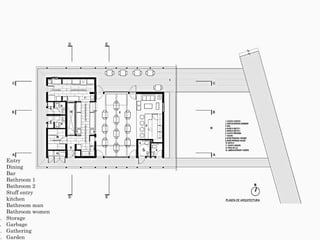
Entry
Dining
Bar
Bathroom 1
Bathroom 2
Stuff entry
kitchen
Bathroom man
Bathroom women
0. Storage
. Garbage
2. Gathering
3. Garden
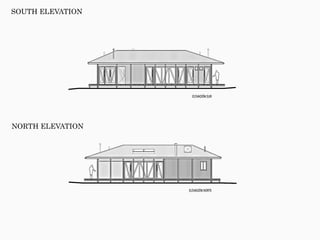
SOUTH ELEVATION
NORTH ELEVATION
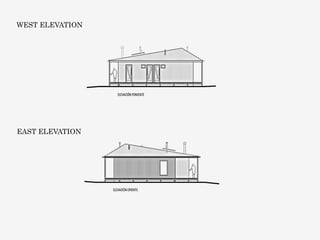
WEST ELEVATION
EAST ELEVATION

Ergonomics and case study on Restaurant.pptx

  • 1.
    STUDY ON RESTAURANT, ERGONOMICS RUMANA KHATUN Session: 2017-18 Department of architecture
  • 2.
    Dining Area Space fordining areas is usually based on the number of square feet per person seated times the number of persons seated at one time. Type of operation Square Foot per seat Cafeteria, commercial 15-18 Cafeteria, college and industrial 12-15 Cafeteria, school lunchroom 9-12 College residence, table service 12-15 Counter service 18-20 Table service, hotel, club restaurant 15-18 Table service, minimum eating 11-14 Banquet, minimum 10-11
  • 3.
    CENTRE STATION Service stationsmay be estimated in the proportion of one small one for every 20 seats or a large central one for every 50 to 60 places. It is of special value when production and dining are on different floors. SUB STATION Measure 20 to 24 in. square and 36 to 38 in. high The size of central station approximately 8 to 10 ft long by 27 to30 in. wide by 6 to 7 ft high
  • 4.
    Various table Small tables,such as 24 or 30 in. square , are economical for seating but are uncomfortable for large people. Abs min Des Min Comforta ble Ap Public circ'n I-10 to 4-6 2-3 5-0 3-0 to 5-0 As Service aisle 3 to3-6 3-6 4-0 3-9 to 4-0 C Between units 0 3-0 4 6 6 Length 1-8 2-0 2-3 2-4 2-4 to 2-6 Width 1-8 2-0 2-2 2-3 2-4 to 2-6 SEATINGS
  • 5.
    Abs Min Des Min Comforta ble Ap Public circle 3-0 to 4-6 3-6 to 5-0 3-9to 5-0 As Service aisle 3-6 to 4-6 4-0 to 5-0 4-0 t0 5-6 To wall 1-8to 2-0 2-0 to 2-6 2-0 to 3-0 Between unit 0 to 8 6 to 1-0 1-0 Length 1-8 to 2-0 2-3 to 2-4 2-4 to 2-6 Wide 1-8 to 2-0 2-2 to 2-3 2-4 to 2-6
  • 6.
    Abs Min Des min Comfort able AP Public circ'n 3-0 to 3- 6 3-6to 4- 6 3-6 to 4-6 As Service only 2-0 2-6 3-0 B to wall 6 to 1-0 10to -1 1-0 to 1-3 c Between unit 1-6 1-10 2-0 Diamete r 2-8 2-10 2-10 L Perimet er per seat 1-10 2-0 2-2
  • 7.
    Abs Min Des Min Comforta ble A Service or pub. circulatio n 3-6to 4-6 4-6 to 5-0 5-0 t0 5-6 B To wall 2-0 2-0t0 2-6 2-0 to 3-0 C Between unit 0 to 1-0 1-0 1-6 L length 3-6 3-10 to 4-0 4-0 W width 1-8 to 2-0 2-0 to 2-3 2-4 to 2-6
  • 8.
    Abs Min Des Min Comforta ble A Service or pub. cir 2-0to 3-6 2-6 to 4-6 3-0 to 5-0 C Between unit 3-0 to 3-6 3-6 to 4-0 3-9 to 4-0 L length 3-6 3-10 to 4-0 4-0 w wide 1-8 to 2-0 2-0 to 2-3 2-4 to 2-6
  • 9.
    Tables for. boothsare difficult for waitresses to serve if they are longer then 4 ft. The width of booths including seats and table is commonly 5’6” TABLE FOR BOOTH Abs Min Des Min Comforta ble A Service and pub cir 2-6 3-0 3-6 L Length 3-6 3-9 4-0 W wide 3-0 3-3 3-6 TWO PERSON SIDE BY SIDE
  • 10.
    Abs Min Des Min Comfort able A service and pub cir 2-6to 3-0 3-o to 4-0 3-6 to 5-0 L length 2-0 2-2 to 2-6 2-6 W wide 4-10 to 5-6 5-2 to 5-6 5-8 to 5-10 2 PERAONS FACE TO FACE
  • 11.
    4 PERSONS Abs Min Des Min Comfort able A service andpub cir 2-6to 3-0 3-0 to 4-0 3-6 to 5-0 Length 3-6 3-9 to 4-0 4-0 to 4-2 Wide 4-10 to 5-6 5-2 to 5-6 5-8 to 5-10
  • 12.
    Abs Min Des Min Comfortab le H 3-0 to3-6 3-6 4-0 S 1-5 to 1-6 1-5 to 1-6 1-6 T 2-5 2-5 to 2-6 2-6 W 1-8 to 2-0 2-0 to 2-2 2-4 to 2-6 Seat 1-4 to 1-5 1-5 to 1-6 1-6 to 1-8 Splay o to 0-3 0-2 to 0-3 0-3.5to 0-4 BOOTH FURNITURE HEIGHT
  • 13.
    Diagonal arrangement ofsquare tables utilizes space better then square arrangement and yields a more trouble free traffic lone. Lanes that pass between backs of chairs are likely to be blocked when guests arise or are being seated. TABLE ARRANGEMENT
  • 14.
  • 15.
  • 16.
  • 17.
    A lunch counterwill have a minimum width of 16 in. and a maximum width of 24 to 30 in. The linear feet are calculated on the basis of 20 to 24 in. per seat. The maximum area best served by one waitress is generally 16 ft of counter. This will give eight to tan seats. U- shaped counters make maximum use of space and reduce travel. COUNTER SHAPE VARIATION U SHAPED Usual Minimum A 2-6 to 3-6 B 2-6 to 4-6 C 2-9 to 5-6
  • 18.
  • 19.
  • 20.
  • 21.
    NUMBER OF PERSONALLOWANCE IN DINING AREA .Turnover . Three types of service Table service counter service cafeteria . Vacancy percentage
  • 22.
    PRODUCTION AREA Many factorinfluence space requairement • Type of survice • Number of meal • Menu item • Use of processed product • Garbage collection Variation to Numbers Served in Space Needs in Relation Meal load Square feet per meal Variation in square feet 100-200 200-400 400-800 800-1,300 1,300- 2,000 2,000- 3,000 3,000- 5,000 5.00 4.00 3.50 3.00 2.50 2.00 1.85 500-1,000 800-1,600 1,400- 2,800 2,400- 3,900 4,000- 6.000 5,500- 9,250 3,250- 5,000
  • 23.
    Square Feet ofKitchen Space per Meal for Food Facilities of Different Type and Size Estimated maximum meals per hour Type of facility 200 or less 200-400 400-800 800-1,300 1,300-7,500 Cafeterias . . . . . 7.5-5.0 5.0-4.0 4.0-3.5 3.5-3.0 3.0-1.8 Hospitals . . .. . 18.0-4.5 12.0-4.5 11.0-4.5 10.0-4.0 8.0-4.0 Hotels . . . . . . . 18.0-4.0 7.5-3.0 6.0-3.0 4.0-3.0 4.0-3.0 Industrial lun .7.5-5.0 4.0-3.2 3.5-2.0 3.0-2.0 2.5-1 .7 Lunch counter. . . . . . . 7.5-2.0 2.0-1.5 Railroad dining car . . . . . .1.6 Restaurants s. 7.0-4.0 5.0-3.6 5.0-3.6 5.0-3.0 5.0-3.0 School lunchroo .4.0-3.3 3.3-2.2 3.0-2.0 2.5-1.6 2.0-1.6
  • 24.
    Dimension of workingtable The width of the table may be 24 to 30 in. unless dishes or food containers are to rest at the back of the table. Tables 36 in. wide are preferable when the back of the area is used for such storage. Where two workers work opposite each other, a table42 in. wide may be used. A work area of 4 to 6 linear ft will be within convenient reach of the average person. Tables 8 to 10ft long are used if two people are working side by side. A height of 34 in., commonly used as a working height, The percentage of floor area covered by equipment varies according to production needs and the type of equipment used. A satisfactory layout may claim less than 30 percent of total space for equipment while work areas, traffic lanes, and space around equipment for easy operation and cleaning may require 70 percent or more.
  • 25.
    AISLE SPACE Work aisleguide Width, in For 1 person working 24 to 38 (Keep to minimum For 2 persons working back to back 42 For personnel who must pass of equipment which projects into the aisle 30 “+ the distance of projection into the aisle Work aisle Traffic aisle For 2 persons to pass 30 For 1 truck to pass one person one-way traffic 24 +maxi truck wide For 2 trucks to pass-one-way traffic 20+ maxi truck wide For 2 trucks to pass-two-way traffic 30+ sum of the truck wide Multi-usage aisle guide (these are not recommended but must sometimes be employed )
  • 26.
    Movement through trafficaisle at the cafe/bat kitchen facilities, Hotel Commodore. Area Designations 1. Ware washing 4. Hot Food Pick-up 2. Waiters' Pantry 5. Hot Food Preparation 3. Cold Food Preparation 6. Checking Area
  • 27.
    MAIN COOKING AREA 1.Meat preparation 2. Vegetable preparation 3 Pot washing . 4. Dry storage 5 .Refregated storage 6. Sandwich preparation 7. Salad preparation 8. Garbage storage 9. Serving facility
  • 29.
    VEGEATABLE PREPATION 1.Veg Refrige 2.Drystorage 3.Salad prep 4.Main cooking 5.Sandwitch 6.Garbage storage BAKE SHOP 1.Dry storage 2. Refrigerated storage 3.Pot washing 4.serving facility 5.Garbage storage 7.Pot washing REFRIGEATED STORAGE 1.Receiving 2.Meat prep 3.Vig prep 4.Main cooking 5.Serving 6.Salad prep 7.Sandwitch 8.Beak shop SALAD PREPARATION 1.Main cooking 2.Veg. prep 3.Refrigators 4.Dry storage 5. Garbage storage 6.Sandwitch prep 7. Serving facil
  • 30.
    DISHWASHING 1.Dining area 2.Serving facilitys 3.Variousprep. Department 4.Garbage Storage POT AND PAN WASHING 1.Main cooking 2.Bake shop 3.Serving facilites 4.Garbage storage MEAT PREPARATION 1. Meat refg. 2. Main cooking 3. sandwithch preparation 4. Garbage storage
  • 31.
    Hotel or restaurantkitchen or French restaurant of high standard. Capacity for main meals: Hotel-100-200 persons/menu, 100 persons/is to carte.
  • 32.
    Hotel or restaurantkitchen. Capacity: With this layout, a 200-seat restaurant will be able to handle three full sittings. This layout can also take care of a hotel with 100guests
  • 33.
    Large restaurant kitchen forrestaurants with many private party and conference facilities or with commissary and catering capacity for other businesses. Suitable also for large hotel with large restaurant for the general public. Capacity: 800-1,000 persons
  • 34.
    1. Waiters' passageway-mealand beverage counter-dish return 2. Dishwashing area (dishes, glasses, silver) 3. Beverages-preparation and serving 4. Pastry (cookies, cakes, ice cream, dessert)preparation and serving S. 5. Cold kitchen (cold appetizers, salad, fish)preparation and serving 6. Warm kitchen-saucier/r6tisseur area (sauces, roasts, grill, fish)- preparation including large apparatus area and serving 7. Warm kitchen-entremétier area (soups, vegetables, entrées)- preparation including large apparatus area and serving 8. Pot and pan washing- casserolier area 9. Vegetable preparation 10. Meat preparation 11 . Vegetable cold %forage 12. Meat cold storage 13. Economat (dry storage) 14. Beverage cold storage 15. Linen, dish, cleaning supplies storage 16. Staple goods storage 17. Goods acceptance and control 18. Empty goods and garbage collecting rooms
  • 35.
    An estimate thatmay be used for allotting width is 14 ft. This allows for 4ft as patron lane space, 1 ft trey slide, 2 ft counter width, 4.5 ft for workers, and 2.5 ft for back bar. The average length of counters in college residence halls and hospitals is found to be 30 to 32 ft, while those in school lunchrooms average around 15 to 20 ft. Some commercial cafeteria counters may be 70 to 80 ft long, but counters over 50 ft long are frequently considered inefficient. Twenty feet is usually thought of as a minimum but, under special conditions and where a limited menu is served, 6 to 8 ft may be sufficient. Counter height For little folk, 28 to 30 in. Short-order units where food moves directly from production to the consumer require the least service space. The need for an intermediate station is eliminated. Step-saving compactness saves space . SERVING AREA
  • 36.
  • 37.
    Tray table Four trays14 by 18 in. fit better on a table 48 in. square Abs Min Des Min Comfor table As Service only 2-6 3-0 3-6 Ap Public circ'n 2-0 2-6 3-0 C Clearance to adjacent unit 2-0 2-3 2-6 Iength (tray) Width (tray) Depend s on type of restaur ant Tray stand
  • 38.
  • 39.
    Receiving and StorageAreas Common Storage Storeroom aisles may be as narrow as 36 in ., but 42 or 48 in . are preferred. Wider aisles may be required if trucks are used . The depth of a shelf should accommodate either the width or length of the case, and the interspace should be adequate for the number to be stacked one on top of another. Allow 1.5 to 2 in . as free space for ease of positioning. Plan to have all products at least 6 in . above the floor Limit height of top shelf for easy reach without aid of stool or stepladder . The average vertical reach of men is 84'/ in . and of women 81 in . Use of the top shelf for light, bulky packages, such as cereal, is recommended
  • 40.
    Refrigerated and Low-Temperature Storage Arequirement of 15 to 20 cu ft of refrigeration per 100 complete meals has also been used by some planners . Others state 1 to 1.5 cu ft of usable refrigerator space should be provided for every three meals served . refrigerated pass-throughs can be added when from 400 to 500 meals are served per day. r. Walk-ins that are 8 to 9 ft wide and about 10 ft long are minimum size . This allows for two storage areas 30 in . wide with a 3 to 4 ft aisle. 20 to 35 percent for meat ; 30 to 35 percent for fruits and vegetables ; 20 to 25 percent for dairy products, including those in serving areas; 10 to 25 percent for frozen foods ; and 5 to 10 percent for carry-over foods, salads, sandwich material, and bakery products .
  • 42.
    Sanitation Areas Dishwashing Area itis usually recommended that the clean dish area occupy 60 percent of the total table space and the soiled dish area, 40 percent. Methods used for transporting and storing dishes will influence space needs. Methods used for transporting and storing dishes will influence space needs. Pot end Pan Section
  • 44.
  • 45.
    RESTAURANT Y SEA Location: Changli county,Hebei,China Architect : Vector Architect Area : 713m^2 Year : 2018
  • 46.
  • 47.
  • 49.
    After the ‘’Seashore Library ‘’ and ‘’Seashore Chapel’’, ‘’ Restaurant Y Sea’’ completes the trilogy of Vector architects ‘ seashore series at Aranya Community in Beidaihe New District . The resturarant is situated right behind the library across the beach .
  • 50.
    The library isa spiritual place with a clear boundary . The natural elements , like wind , light and surrounding views ,are defied and shaped throughout the space where people can gaze upon the sea while sitting in the terraced library . CONCEPT :
  • 51.
    CONCEPT : As forthe restaurant , we intend to establish a dispersed and a more casual everyday atmosphere . Instead of the seascape being the visual focus for people , as it is in the library , it acts as the backdrop in the restaurant . People will notice what happens on the sea as they dine and inadvertently glance towards it , and indirect engagement between space and nature and also create an unique envirinment into restaurant
  • 52.
    concept in design: Trees are interlocked within the fragmented spatial boundary and courtyard .Tree branches sway with the breeze and cast their shadow through the skylight onto the wall and floor .
  • 53.
    There is nodesigned main entrance for t restaurant . instead ,clear glass sliding doors a placed along the perimeter , which , when fu opened , cause the spatial boundary disappear , turning the building into ‘’ pavilion people can approach the dining space from a direction . they will firstly step into a transition space with a lowered eave , and then th gradually walk into the main dining area unde raised-up central roof , illuminated by immersi natural light . concept in design
  • 54.
    concept in design: The inner tree courtyards bring light and airfl deep into the restaurant , and at the same tim like hinges ,they anchor the space. T courtyards simultaneously divide and connect surrounding spaces . The full light fair –faced c – in –place concrete walls of the courtyar resist the sheer force of the whole building ,which makes it possible to support land of thick eaves on columns of only 120mm diameter .this way , the slender steel elemen similar in diameter to the surrounding tre trunks , blend in the surrounding woods .
  • 55.
    concept in design: We consciously reduce the interference of excessive side light by controlling the clear height of the eaves , in order to create and an atmosphere of being under a floating ‘’ cloud ‘’ as a result of the light –filtering waffle beams . The waffle beams remit the need for strictly aligned load – bearing elements and minimize the amount of structural walls , which help achieve the staggered fluidity of the plan .
  • 56.
  • 57.
  • 60.
  • 74.
  • 75.
    Location : PuertoVaras , CHILE Architect : Cristobal Lamarca , Estudio Alinea Area : 188 m^2 Year : 2018
  • 76.
    Site map * SouthAmerican country * Mediterranean climate
  • 77.
  • 78.
    The opportunity isto offer the visitant to recognize the different parts of the landscape; the lake shore, the beach, the riverbank and the forest where the building is located. CONCEPT How to create a place within a forest, on the lake shore, which offers visitors a comfortable exterior - interior experience, in a strong relationship with landscape?
  • 79.
    # Offers visitorsa comfortable exterior - interior experience #The creation of this place, proposes an analysis of thermal comfort both inside and outside, to understand the options that will be offer to the visitors # The main results of this analysis suggests to offer a diverse thermal environment; # Interior, interior exposed to sun, exterior covered, exterior exposed, exterior shaded, etc . # The roof becomes a fundamental element in the configuration of spaces and in the volumetric of the building CONCEPT IN DESIGN
  • 81.
    All the circulationssurround the building by the exterior, making the interior spaces more efficient and forcing the visitor to contact the outside, the sound of the lake, the rain, the sun and the wind. CONCEPT IN DESIGN
  • 82.
    Open the views fromthe inside to the outside, integrating the landscape, natural light and ventilation as foundational elements of interior quality. CONCEPT IN DESIGN
  • 83.
    The structure wasexecuted in wood , leaving specific element at sight , such as main trusses and exterior pillars. The interior and exterior coating were developed with recycled wood ,mainly coigue , cypress, tepa and ulmo with specific treatment for their maintenance and durability over time .
  • 84.
    Entry Dining Bar Bathroom 1 Bathroom 2 Stuffentry kitchen Bathroom man Bathroom women 0. Storage . Garbage 2. Gathering 3. Garden
  • 87.
  • 88.