“One for all and all for one” –
Engaging Tourism Stakeholders for
Collaborative Governance
A Case Study of the Mountain Destination Whistler (Canada)
By Eva Erdmenger
OVERVIEW
1. How and why collaborative Governance?
2. Why Whisler?
3. Reserach Method
4. Results&Findings
5. Conclusion
COLLABORATIVE GOVERNANCE
“Collaborative governance is therefore a type of governance in which
public and private actors work collectively in distinctive ways, using
particular processes, to establish laws and rules for the provision of public
goods.” (Ansell and Gash, 2007, p.544 f.)
Aim: What are the critical factors enabling tourism stakeholders to
engage in collaborative governance of a destination.
Study objective
COLLABORATIVE GOVERNANCE
Study objective
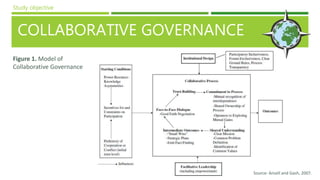
Figure 1. Model of
Collaborative Governance
Source: Ansell and Gash, 2007.
WHISTLER (B.C.)
Study objective
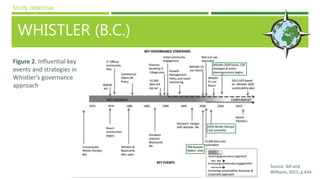
Figure 2. Influential key
events and strategies in
Whistler’s governance
approach
Source: Gill and
Williams, 2011, p.634.
PAPER VS. VOICE
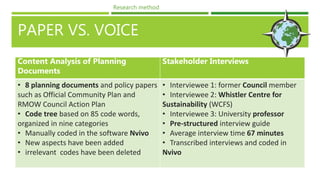
Content Analysis of Planning
Documents
Stakeholder Interviews
• 8 planning documents and policy papers
such as Official Community Plan and
RMOW Council Action Plan
• Code tree based on 85 code words,
organized in nine categories
• Manually coded in the software Nvivo
• New aspects have been added
• irrelevant codes have been deleted
• Interviewee 1: former Council member
• Interviewee 2: Whistler Centre for
Sustainability (WCFS)
• Interviewee 3: University professor
• Pre-structured interview guide
• Average interview time 67 minutes
• Transcribed interviews and coded in
Nvivo
Research method
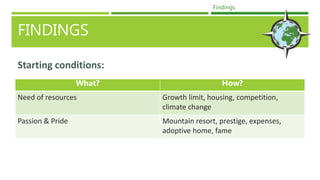
FINDINGS
Starting conditions:
Findings
What? How?
Need of resources Growth limit, housing, competition,
climate change
Passion & Pride Mountain resort, prestige, expenses,
adoptive home, fame
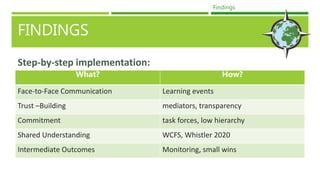
FINDINGS
Step-by-step implementation:
Findings
What? How?
Face-to-Face Communication Learning events
Trust –Building mediators, transparency
Commitment task forces, low hierarchy
Shared Understanding WCFS, Whistler 2020
Intermediate Outcomes Monitoring, small wins
FINDINGS
Only in Whistler?
• Young, small and mobile community
• 2010 Olympic Games – blessing or curse?
• Election 2011
Findings
0
20
40
60
2006 2011
age[years]
Canada
British Columbia
Whistler
Figure 3. Median Age of Canada, British
Columbia and Whistler in 2006 and 2011.
Source: Government of Canada,
Statistics Canada, Census 2011.
FINDINGS
Lessons learnd:
• Demographical characteristics are universal
• Tourism economic drive
• Trigger and initiator
• Guideline built and established by stakeholders
• Monitoring for success
• Non-political and non-state leaders
• Community events for education and empowerment
Findings
FINDINGS
Findings
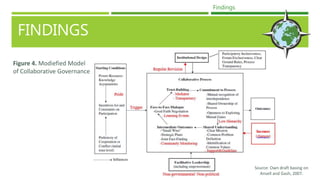
Figure 4. Modiefied Model
of Collaborative Governance
Source: Own draft basing on
Ansell and Gash, 2007.
CONCULSION
“Where conflict is high and trust is low, but power distribution is relatively equal and
stakeholders have an incentive to participate, then collaborative governance can
successfully proceed by relying on the services of an honest broker that the respective
stakeholders accept and trust.” (Ansell and Gash, 2007, p.555)
“Nothing truly great is accomplished alone. Much of Whistler's success is due to the
power of partnership and the spirit of collaboration embedded into the DNA of the
resort community.” (RMOW, 2015, n.p.)
REFERENCES
• ANSELL, C. and GASH, A. (2007) Collaborative Governance in Theory and Practice. Journal of Public
Administration Research and Theory, 18(4), pp. 543-571.
• GILL, A.M. and WILLIAMS, P.W. (2011) Rethinking resort growth: understanding evolving governance
strategies in Whistler, British Columbia. Journal of Sustainable Tourism, 19(4-5), pp.629-648.
• GOVERNMENT OF CANADA (2011) Focus on Geography Series, 2011 Census. Census subdivision of Whistler,
DM - British Columbia [Online] Available from: http://www12.statcan.gc.ca/census-
recensement/2011/as-sa/fogs-spg/Facts-csd-eng.cfm?LANG=Eng&GK=CSD&GC=5931020
[05/25/2015].
• RESORT MUNICIPALITY OF WHISTLER (2015) It takes a village to raise a world-class resort. [Online] Available
from: https://www.whistler.ca/40th-anniversary/it-takes-a-village-to-raise-a-world-class-resort
[09/12/2016].
exploresustainability.com
by Eva Erdmenger

Erdmenger collaborative governance whistler

  • 1.
    “One for alland all for one” – Engaging Tourism Stakeholders for Collaborative Governance A Case Study of the Mountain Destination Whistler (Canada) By Eva Erdmenger
  • 2.
    OVERVIEW 1. How andwhy collaborative Governance? 2. Why Whisler? 3. Reserach Method 4. Results&Findings 5. Conclusion
  • 3.
    COLLABORATIVE GOVERNANCE “Collaborative governanceis therefore a type of governance in which public and private actors work collectively in distinctive ways, using particular processes, to establish laws and rules for the provision of public goods.” (Ansell and Gash, 2007, p.544 f.) Aim: What are the critical factors enabling tourism stakeholders to engage in collaborative governance of a destination. Study objective
  • 4.
    COLLABORATIVE GOVERNANCE Study objective Figure1. Model of Collaborative Governance Source: Ansell and Gash, 2007.
  • 5.
    WHISTLER (B.C.) Study objective Figure2. Influential key events and strategies in Whistler’s governance approach Source: Gill and Williams, 2011, p.634.
  • 6.
    PAPER VS. VOICE ContentAnalysis of Planning Documents Stakeholder Interviews • 8 planning documents and policy papers such as Official Community Plan and RMOW Council Action Plan • Code tree based on 85 code words, organized in nine categories • Manually coded in the software Nvivo • New aspects have been added • irrelevant codes have been deleted • Interviewee 1: former Council member • Interviewee 2: Whistler Centre for Sustainability (WCFS) • Interviewee 3: University professor • Pre-structured interview guide • Average interview time 67 minutes • Transcribed interviews and coded in Nvivo Research method
  • 7.
    FINDINGS Starting conditions: Findings What? How? Needof resources Growth limit, housing, competition, climate change Passion & Pride Mountain resort, prestige, expenses, adoptive home, fame
  • 8.
    FINDINGS Step-by-step implementation: Findings What? How? Face-to-FaceCommunication Learning events Trust –Building mediators, transparency Commitment task forces, low hierarchy Shared Understanding WCFS, Whistler 2020 Intermediate Outcomes Monitoring, small wins
  • 9.
    FINDINGS Only in Whistler? •Young, small and mobile community • 2010 Olympic Games – blessing or curse? • Election 2011 Findings 0 20 40 60 2006 2011 age[years] Canada British Columbia Whistler Figure 3. Median Age of Canada, British Columbia and Whistler in 2006 and 2011. Source: Government of Canada, Statistics Canada, Census 2011.
  • 10.
    FINDINGS Lessons learnd: • Demographicalcharacteristics are universal • Tourism economic drive • Trigger and initiator • Guideline built and established by stakeholders • Monitoring for success • Non-political and non-state leaders • Community events for education and empowerment Findings
  • 11.
    FINDINGS Findings Figure 4. ModiefiedModel of Collaborative Governance Source: Own draft basing on Ansell and Gash, 2007.
  • 12.
    CONCULSION “Where conflict ishigh and trust is low, but power distribution is relatively equal and stakeholders have an incentive to participate, then collaborative governance can successfully proceed by relying on the services of an honest broker that the respective stakeholders accept and trust.” (Ansell and Gash, 2007, p.555) “Nothing truly great is accomplished alone. Much of Whistler's success is due to the power of partnership and the spirit of collaboration embedded into the DNA of the resort community.” (RMOW, 2015, n.p.)
  • 13.
    REFERENCES • ANSELL, C.and GASH, A. (2007) Collaborative Governance in Theory and Practice. Journal of Public Administration Research and Theory, 18(4), pp. 543-571. • GILL, A.M. and WILLIAMS, P.W. (2011) Rethinking resort growth: understanding evolving governance strategies in Whistler, British Columbia. Journal of Sustainable Tourism, 19(4-5), pp.629-648. • GOVERNMENT OF CANADA (2011) Focus on Geography Series, 2011 Census. Census subdivision of Whistler, DM - British Columbia [Online] Available from: http://www12.statcan.gc.ca/census- recensement/2011/as-sa/fogs-spg/Facts-csd-eng.cfm?LANG=Eng&GK=CSD&GC=5931020 [05/25/2015]. • RESORT MUNICIPALITY OF WHISTLER (2015) It takes a village to raise a world-class resort. [Online] Available from: https://www.whistler.ca/40th-anniversary/it-takes-a-village-to-raise-a-world-class-resort [09/12/2016].
  • 14.

Editor's Notes

  • #4 Why? Puzzle From theory to practical work SMEs Bottom-up Empowerment Multi-sector Social sustainability Win-Win situation Competitive advantage
  • #5 Starting condition Face-to-Face Dialogue Trust-Building Commitment Shared Understanding Intermediate Outcomes Facilitative Leadership Institutional design