Erasmus+ KA2 “Steps of Citizenship”
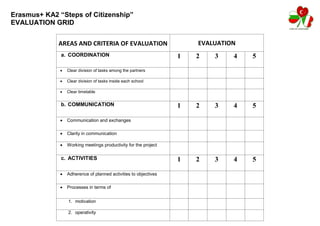
EVALUATION GRID
AREAS AND CRITERIA OF EVALUATION EVALUATION
a. COORDINATION 1 2 3 4 5
 Clear division of tasks among the partners
 Clear division of tasks inside each school
 Clear timetable
b. COMMUNICATION 1 2 3 4 5
 Communication and exchanges
 Clarity in communication
 Working meetings productivity for the project
c. ACTIVITIES 1 2 3 4 5
 Adherence of planned activities to objectives
 Processes in terms of
1. motivation
2. operativity
 Processes in terms of
1. Products/outputs
2. behaviours
d. TRANSNATIONAL MEETINGS
1 2 3 4 5
 Adherence of the organized activities to the
projects’ objectives
 Productivity during the transnational workshops
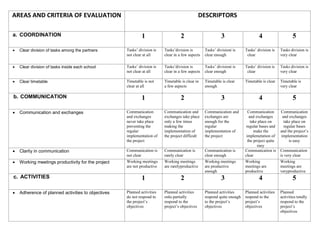
AREAS AND CRITERIA OF EVALUATION DESCRIPTORS
a. COORDINATION 1 2 3 4 5
 Clear division of tasks among the partners Tasks’ division is
not clear at all
Tasks’division is
clear in a few aspects
Tasks’ divisioni is
clear enough
Tasks’ division is
clear
Tasks division is
very clear
 Clear division of tasks inside each school Tasks’ division is
not clear at all
Tasks’division is
clear in a few aspects
Tasks’ divisioni is
clear enough
Tasks’ division is
clear
Tasks division is
very clear
 Clear timetable Timetable is not
clear at all
Timetable is clear in
a few aspects
Timetable is clear
enough
Timetable is clear Timetable is
very clear
b. COMMUNICATION 1 2 3 4 5
 Communication and exchanges Communication
and exchanges
never take place
preventing the
regular
implementation of
the project
Communication and
exchanges take place
only a few times
making the
implementation of
the project difficult
Communication and
exchanges are
enough for the
regular
implementation of
the project
Communication
and exchanges
take place on
regular bases and
make the
implemetation of
the project quite
easy
Communication
and exchanges
take place on
regular bases
and the project’s
implementation
is easy
 Clarity in communication Communication is
not clear
Communication is
rarely clear
Communication is
clear enough
Communication is
clear
Communication
is very clear
 Working meetings productivity for the project Working meetings
are not productive
Working meetings
are rarelyproductive
Working meetings
are productive
enough
Working
meetings are
productive
Working
meetings are
veryproductive
c. ACTIVITIES 1 2 3 4 5
 Adherence of planned activities to objectives Planned activities
do not respond to
the project’s
objectives
Planned activities
onlu partially
respond to the
project’s objectives
Planned activities
respond quite enough
to the project’s
objectives
Planned activities
respond to the
project’s
objectives
Planned
activities totally
respond to the
project’s
objectives
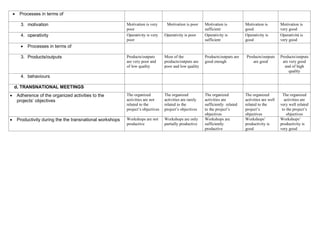
 Processes in terms of
3. motivation Motivation is very
poor
Motivation is poor Motivation is
sufficient
Motivation is
good
Motivation is
very good
4. operativity Operativity is very
poor
Operativity is poor Operativity is
sufficient
Operativity is
good
Operatività is
very good
 Processes in terms of
3. Products/outputs Products/outputs
are very poor and
of low quality
Most of the
products/outputs are
poor and low quality
Products/outputs are
good enough
Products/outputs
are good
Products/outputs
are very good
and of high
quality
4. behaviours
d. TRANSNATIONAL MEETINGS
 Adherence of the organized activities to the
projects’ objectives
The organized
activities are not
related to the
project’s objectives
The organized
activities are rarely
related to the
project’s objectives
The organized
activities are
sufficiently related
to the project’s
objectives
The organized
activities are well
related to the
project’s
objectives
The organized
activities are
very well related
to the project’s
objectives
 Productivity during the the transnational workshops Workshops are not
productive
Workshops are only
partially productive
Workshops are
sufficiently
productive
Workshops’
productivity is
good
Workshops’
productivity is
very good

Erasmus evaluation grid&and_descriptors

  • 1.
    Erasmus+ KA2 “Stepsof Citizenship” EVALUATION GRID AREAS AND CRITERIA OF EVALUATION EVALUATION a. COORDINATION 1 2 3 4 5  Clear division of tasks among the partners  Clear division of tasks inside each school  Clear timetable b. COMMUNICATION 1 2 3 4 5  Communication and exchanges  Clarity in communication  Working meetings productivity for the project c. ACTIVITIES 1 2 3 4 5  Adherence of planned activities to objectives  Processes in terms of 1. motivation 2. operativity
  • 2.
     Processes interms of 1. Products/outputs 2. behaviours d. TRANSNATIONAL MEETINGS 1 2 3 4 5  Adherence of the organized activities to the projects’ objectives  Productivity during the transnational workshops
  • 3.
    AREAS AND CRITERIAOF EVALUATION DESCRIPTORS a. COORDINATION 1 2 3 4 5  Clear division of tasks among the partners Tasks’ division is not clear at all Tasks’division is clear in a few aspects Tasks’ divisioni is clear enough Tasks’ division is clear Tasks division is very clear  Clear division of tasks inside each school Tasks’ division is not clear at all Tasks’division is clear in a few aspects Tasks’ divisioni is clear enough Tasks’ division is clear Tasks division is very clear  Clear timetable Timetable is not clear at all Timetable is clear in a few aspects Timetable is clear enough Timetable is clear Timetable is very clear b. COMMUNICATION 1 2 3 4 5  Communication and exchanges Communication and exchanges never take place preventing the regular implementation of the project Communication and exchanges take place only a few times making the implementation of the project difficult Communication and exchanges are enough for the regular implementation of the project Communication and exchanges take place on regular bases and make the implemetation of the project quite easy Communication and exchanges take place on regular bases and the project’s implementation is easy  Clarity in communication Communication is not clear Communication is rarely clear Communication is clear enough Communication is clear Communication is very clear  Working meetings productivity for the project Working meetings are not productive Working meetings are rarelyproductive Working meetings are productive enough Working meetings are productive Working meetings are veryproductive c. ACTIVITIES 1 2 3 4 5  Adherence of planned activities to objectives Planned activities do not respond to the project’s objectives Planned activities onlu partially respond to the project’s objectives Planned activities respond quite enough to the project’s objectives Planned activities respond to the project’s objectives Planned activities totally respond to the project’s objectives
  • 4.
     Processes interms of 3. motivation Motivation is very poor Motivation is poor Motivation is sufficient Motivation is good Motivation is very good 4. operativity Operativity is very poor Operativity is poor Operativity is sufficient Operativity is good Operatività is very good  Processes in terms of 3. Products/outputs Products/outputs are very poor and of low quality Most of the products/outputs are poor and low quality Products/outputs are good enough Products/outputs are good Products/outputs are very good and of high quality 4. behaviours d. TRANSNATIONAL MEETINGS  Adherence of the organized activities to the projects’ objectives The organized activities are not related to the project’s objectives The organized activities are rarely related to the project’s objectives The organized activities are sufficiently related to the project’s objectives The organized activities are well related to the project’s objectives The organized activities are very well related to the project’s objectives  Productivity during the the transnational workshops Workshops are not productive Workshops are only partially productive Workshops are sufficiently productive Workshops’ productivity is good Workshops’ productivity is very good