ICSM 2011
Williamsburg,VA, USA
May 25 – May 30, 2011


           Tracking Technical Debt
                  — An Exploratory Case Study
      Yuepu Guo, Carolyn Seaman
      Information Systems Department, University of Maryland Baltimore County, USA

      Rebeka Gomes, Antonio Cavalcanti, Graziela Tonin, Fabio
      Q. B. Da Silva, André L. M. Santos, Clauirton Siebra
      CIn/UFPE - Center of Informatics at Federal University of Pernambuco, Brazil
Introduction
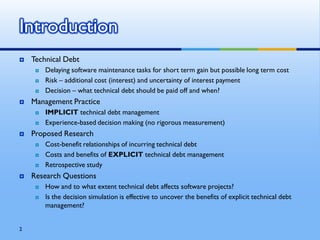
   Technical Debt
        Delaying software maintenance tasks for short term gain but possible long term cost
        Risk – additional cost (interest) and uncertainty of interest payment
        Decision – what technical debt should be paid off and when?
   Management Practice
        IMPLICIT technical debt management
        Experience-based decision making (no rigorous measurement)
   Proposed Research
        Cost-benefit relationships of incurring technical debt
        Costs and benefits of EXPLICIT technical debt management
        Retrospective study
   Research Questions
        How and to what extent technical debt affects software projects?
        Is the decision simulation is effective to uncover the benefits of explicit technical debt
         management?


2
Background
   Larger Research Project
       Measuring and Monitoring Technical Debt
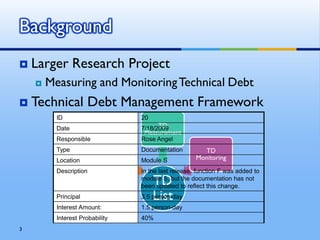
   Technical Debt Management Framework
          ID                              20
          Date                                  TD
                                          7/18/2009
                                           Measurement
          Responsible                     Rose Angel
          Type                TD          Documentation         TD
          Location       Identification   Module S            Monitoring
          Description                     In the last release, function F was added to
                                              TD
                                          module S, but the documentation has not
                                          been updated to reflect this change.
          Principal                           List
                                          3.5 person-day
          Interest Amount:                1.5 person-day
          Interest Probability            40%
3
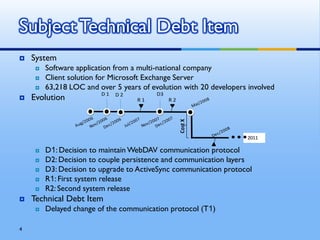
Subject Technical Debt Item
   System
        Software application from a multi-national company
        Client solution for Microsoft Exchange Server
        63,218 LOC and over 5 years of evolution with 20 developers involved
                            D1                 D3
   Evolution                    D2
                                         R1         R2


                                                         Cost X
                                                                               2011

        D1: Decision to maintain WebDAV communication protocol
                     D1: Decision to maintain WebDAV protocol
        D2: Decision to couple persistenceand communication layers
                     D2: Decision to coupple persistence
                                                         and communication layers
                     D3: Decision to support MS Exchange 2007
        D3: Decision to upgrade to ActiveSync communication protocol
                     R1: First system release
                     R2: First maintenance release
        R1: First system release
        R2: Second system release
   Technical Debt Item
        Delayed change of the communication protocol (T1)

4
Methodology
   Measurement
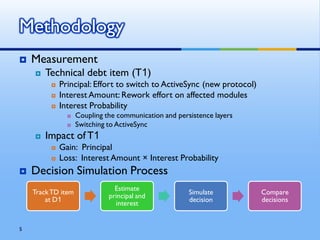
       Technical debt item (T1)
            Principal: Effort to switch to ActiveSync (new protocol)
            Interest Amount: Rework effort on affected modules
            Interest Probability
                   Coupling the communication and persistence layers
                   Switching to ActiveSync
       Impact of T1
            Gain: Principal
            Loss: Interest Amount × Interest Probability
   Decision Simulation Process
                                Estimate
    Track TD item                                      Simulate         Compare
                              principal and
        at D1                                          decision         decisions
                                interest


5
Results
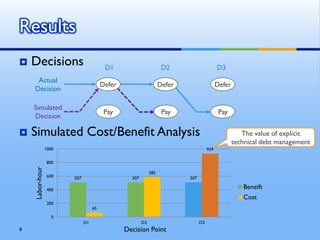
   Decisions                            D1                         D2                      D3
     Actual
                                        Defer                      Defer                    Defer
    Decision

    Simulated
                                         Pay                        Pay                      Pay
    Decision

   Simulated Cost/Benefit Analysis                                                                    The value of explicit
                                                                                                    technical debt management
                 1000                                                                 929

                  800
    Labor-hour


                                                             585
                  600   507                       507                      507

                  400
                                                                                                       Beneift
                                                                                                       Cost
                  200
                                   65
                    0
                              D1                        D2                       D3
6                                               Decision Point
Conclusion
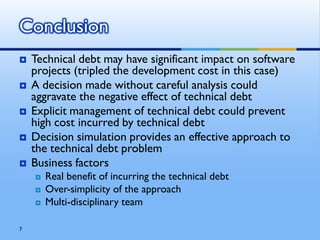
   Technical debt may have significant impact on software
    projects (tripled the development cost in this case)
   A decision made without careful analysis could
    aggravate the negative effect of technical debt
   Explicit management of technical debt could prevent
    high cost incurred by technical debt
   Decision simulation provides an effective approach to
    the technical debt problem
   Business factors
       Real benefit of incurring the technical debt
       Over-simplicity of the approach
       Multi-disciplinary team

7
Questions?


8

ERA - Tracking Technical Debt

  • 1.
    ICSM 2011 Williamsburg,VA, USA May25 – May 30, 2011 Tracking Technical Debt — An Exploratory Case Study Yuepu Guo, Carolyn Seaman Information Systems Department, University of Maryland Baltimore County, USA Rebeka Gomes, Antonio Cavalcanti, Graziela Tonin, Fabio Q. B. Da Silva, André L. M. Santos, Clauirton Siebra CIn/UFPE - Center of Informatics at Federal University of Pernambuco, Brazil
  • 2.
    Introduction  Technical Debt  Delaying software maintenance tasks for short term gain but possible long term cost  Risk – additional cost (interest) and uncertainty of interest payment  Decision – what technical debt should be paid off and when?  Management Practice  IMPLICIT technical debt management  Experience-based decision making (no rigorous measurement)  Proposed Research  Cost-benefit relationships of incurring technical debt  Costs and benefits of EXPLICIT technical debt management  Retrospective study  Research Questions  How and to what extent technical debt affects software projects?  Is the decision simulation is effective to uncover the benefits of explicit technical debt management? 2
  • 3.
    Background  Larger Research Project  Measuring and Monitoring Technical Debt  Technical Debt Management Framework ID 20 Date TD 7/18/2009 Measurement Responsible Rose Angel Type TD Documentation TD Location Identification Module S Monitoring Description In the last release, function F was added to TD module S, but the documentation has not been updated to reflect this change. Principal List 3.5 person-day Interest Amount: 1.5 person-day Interest Probability 40% 3
  • 4.
    Subject Technical DebtItem  System  Software application from a multi-national company  Client solution for Microsoft Exchange Server  63,218 LOC and over 5 years of evolution with 20 developers involved D1 D3  Evolution D2 R1 R2 Cost X 2011  D1: Decision to maintain WebDAV communication protocol D1: Decision to maintain WebDAV protocol  D2: Decision to couple persistenceand communication layers D2: Decision to coupple persistence and communication layers D3: Decision to support MS Exchange 2007  D3: Decision to upgrade to ActiveSync communication protocol R1: First system release R2: First maintenance release  R1: First system release  R2: Second system release  Technical Debt Item  Delayed change of the communication protocol (T1) 4
  • 5.
    Methodology  Measurement  Technical debt item (T1)  Principal: Effort to switch to ActiveSync (new protocol)  Interest Amount: Rework effort on affected modules  Interest Probability  Coupling the communication and persistence layers  Switching to ActiveSync  Impact of T1  Gain: Principal  Loss: Interest Amount × Interest Probability  Decision Simulation Process Estimate Track TD item Simulate Compare principal and at D1 decision decisions interest 5
  • 6.
    Results  Decisions D1 D2 D3 Actual Defer Defer Defer Decision Simulated Pay Pay Pay Decision  Simulated Cost/Benefit Analysis The value of explicit technical debt management 1000 929 800 Labor-hour 585 600 507 507 507 400 Beneift Cost 200 65 0 D1 D2 D3 6 Decision Point
  • 7.
    Conclusion  Technical debt may have significant impact on software projects (tripled the development cost in this case)  A decision made without careful analysis could aggravate the negative effect of technical debt  Explicit management of technical debt could prevent high cost incurred by technical debt  Decision simulation provides an effective approach to the technical debt problem  Business factors  Real benefit of incurring the technical debt  Over-simplicity of the approach  Multi-disciplinary team 7
  • 8.