Heterogeneous Computing at USC
Dept. of Computer Science and Engineering
University of South Carolina
Dr. Jason D. Bakos
Assistant Professor
Heterogeneous and Reconfigurable Computing Lab (HeRC)
This material is based upon work supported
by the National Science Foundation under
Grant Nos. CCF-0844951 and CCF-0915608.
Heterogeneous Computing
• Subfield of computer architecture
• Mix general-purpose CPUs with “specialized processors” for high-
performance computing
• Specialized processors include:
– Field Programmable Gate Arrays (FPGAs)
– Graphical Processing Units (GPUs)
• Our goals:
– Adapt scientific and engineering applications to heterogeneous
programming and execution models
– Leverage our experience to build development tools for these models
Heterogeneous Computing at USC | USC HPC Workshop | 4/14/11 2
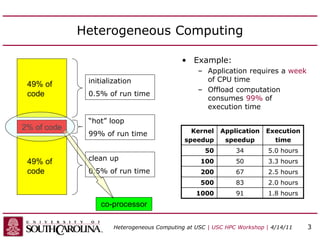
Heterogeneous Computing
initialization
0.5% of run time
“hot” loop
99% of run time
clean up
0.5% of run time
49% of
code
49% of
code
2% of code
co-processor
Kernel
speedup
Application
speedup
Execution
time
50 34 5.0 hours
100 50 3.3 hours
200 67 2.5 hours
500 83 2.0 hours
1000 91 1.8 hours
• Example:
– Application requires a week
of CPU time
– Offload computation
consumes 99% of
execution time
Heterogeneous Computing at USC | USC HPC Workshop | 4/14/11 3
My Group
• Applications work
– Computational biology:
• Computational phylogeny reconstruction (FPGA)
• Sequence alignment (GPU)
– Numerical linear algebra
• Sparse matrix-vector multiply (FPGA)
– Data mining:
• Frequent itemset mining (GPU)
– Electronic design automation:
• Logic minimization heuristics (GPU)
• Tools
– Automatic CPU/coprocessor partitioning for legacy code
– Performance modeling
– Bandwidth-constrained high-level synthesis
Heterogeneous Computing at USC | USC HPC Workshop | 4/14/11 4
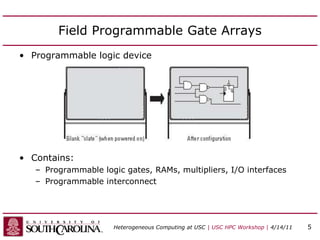
Field Programmable Gate Arrays
• Programmable logic device
• Contains:
– Programmable logic gates, RAMs, multipliers, I/O interfaces
– Programmable interconnect
Heterogeneous Computing at USC | USC HPC Workshop | 4/14/11 5
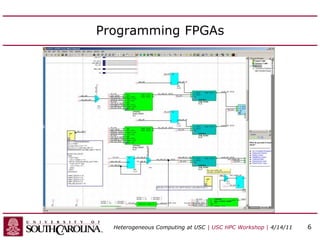
Programming FPGAs
Heterogeneous Computing at USC | USC HPC Workshop | 4/14/11 6
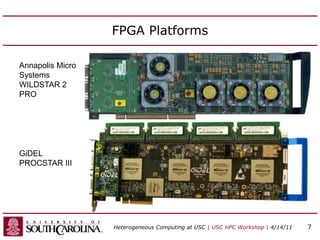
FPGA Platforms
Annapolis Micro
Systems
WILDSTAR 2
PRO
GiDEL
PROCSTAR III
Heterogeneous Computing at USC | USC HPC Workshop | 4/14/11 7
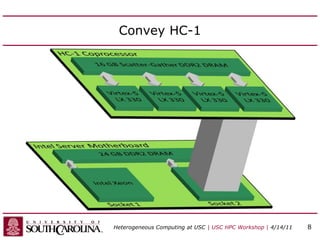
Convey HC-1
Heterogeneous Computing at USC | USC HPC Workshop | 4/14/11 8
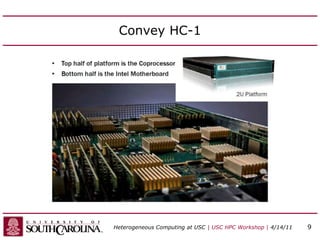
Convey HC-1
Heterogeneous Computing at USC | USC HPC Workshop | 4/14/11 9
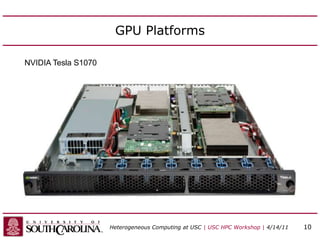
GPU Platforms
NVIDIA Tesla S1070
Heterogeneous Computing at USC | USC HPC Workshop | 4/14/11 10
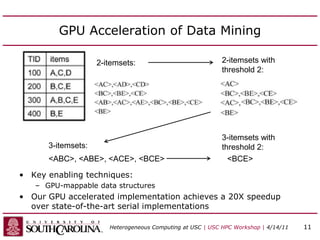
GPU Acceleration of Data Mining
2-itemsets:
<ABC>, <ABE>, <ACE>, <BCE>
2-itemsets with
threshold 2:
3-itemsets:
3-itemsets with
threshold 2:
<BCE>
• Key enabling techniques:
– GPU-mappable data structures
• Our GPU accelerated implementation achieves a 20X speedup
over state-of-the-art serial implementations
Heterogeneous Computing at USC | USC HPC Workshop | 4/14/11 11
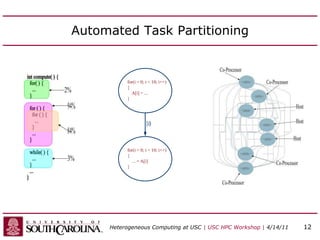
Automated Task Partitioning
Heterogeneous Computing at USC | USC HPC Workshop | 4/14/11 12
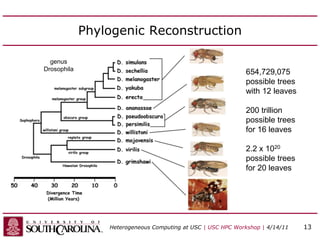
Phylogenic Reconstruction
genus
Drosophila
654,729,075
possible trees
with 12 leaves
200 trillion
possible trees
for 16 leaves
2.2 x 10²⁰
possible trees
for 20 leaves
Heterogeneous Computing at USC | USC HPC Workshop | 4/14/11 13
Our Projects
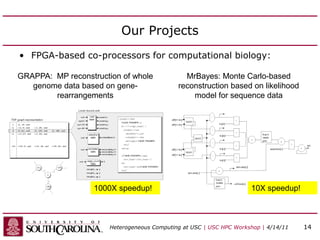
• FPGA-based co-processors for computational biology:
1000X speedup! 10X speedup!
GRAPPA: MP reconstruction of whole
genome data based on gene-
rearrangements
MrBayes: Monte Carlo-based
reconstruction based on likelihood
model for sequence data
Heterogeneous Computing at USC | USC HPC Workshop | 4/14/11 14
Sparse Matrix Arithmetic
• Sparse matrices are large matrices that contain mostly zero-
values
– Common in many scientific and engineering applications
• Often represent a linear system and are thus multiplied by a
vector when using an iterative linear solver
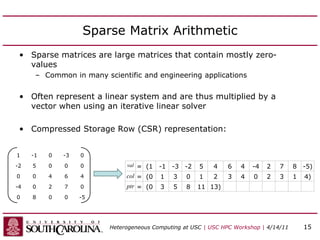
• Compressed Storage Row (CSR) representation:
1 -1 0 -3 0
-2 5 0 0 0
0 0 4 6 4
-4 0 2 7 0
0 8 0 0 -5
val = (1 -1 -3 -2 5 4 6 4 -4 2 7 8 -5)
col = (0 1 3 0 1 2 3 4 0 2 3 1 4)
ptr = (0 3 5 8 11 13)
Heterogeneous Computing at USC | USC HPC Workshop | 4/14/11 15
Sparse Matrix-Vector Multiply
• Code for Ax = b
– A is matrix stored in val, col, ptr
row = 0
for i = 0 to number_of_nonzero_elements do
if i = ptr[row+1] then row=row+1, b[row]=0.0
b[row] = b[row] + val[i] * x[col[i]]
end
recurrence (reduction)
non-affine (indirect) indexing
Heterogeneous Computing at USC | USC HPC Workshop | 4/14/11 16
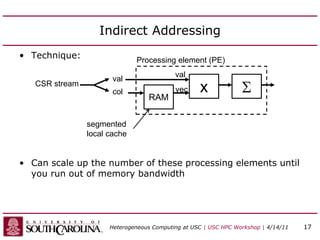
Indirect Addressing
• Technique:
• Can scale up the number of these processing elements until
you run out of memory bandwidth
S
x
RAM
CSR stream
val
col
Processing element (PE)
val
vec
Heterogeneous Computing at USC | USC HPC Workshop | 4/14/11 17
segmented
local cache
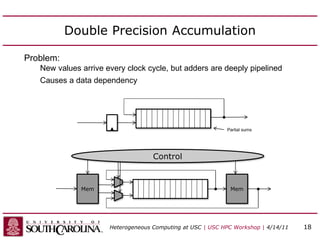
Double Precision Accumulation
Mem Mem
Control
Partial sums
Heterogeneous Computing at USC | USC HPC Workshop | 4/14/11 18
Problem:
New values arrive every clock cycle, but adders are deeply pipelined
Causes a data dependency
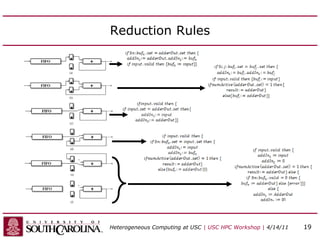
Reduction Rules
Heterogeneous Computing at USC | USC HPC Workshop | 4/14/11 19
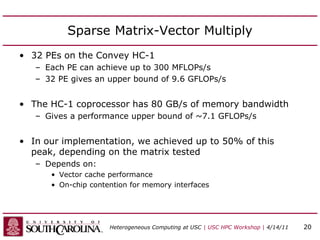
Sparse Matrix-Vector Multiply
• 32 PEs on the Convey HC-1
– Each PE can achieve up to 300 MFLOPs/s
– 32 PE gives an upper bound of 9.6 GFLOPs/s
• The HC-1 coprocessor has 80 GB/s of memory bandwidth
– Gives a performance upper bound of ~7.1 GFLOPs/s
• In our implementation, we achieved up to 50% of this
peak, depending on the matrix tested
– Depends on:
• Vector cache performance
• On-chip contention for memory interfaces
Heterogeneous Computing at USC | USC HPC Workshop | 4/14/11 20
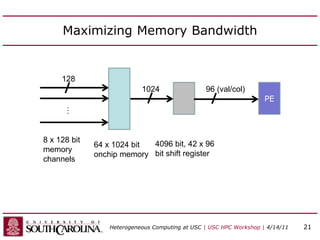
Maximizing Memory Bandwidth
Heterogeneous Computing at USC | USC HPC Workshop | 4/14/11 21
…
8 x 128 bit
memory
channels
64 x 1024 bit
onchip memory
4096 bit, 42 x 96
bit shift register
128
1024 96 (val/col)
PE
Summary
• Manually accelerated several applications on using FPGA
and GPU-based coprocessors
• Working to develop tools for to make it easier to take
advantage of heterogeneous platforms
Heterogeneous Computing at USC | USC HPC Workshop| 4/14/11 22
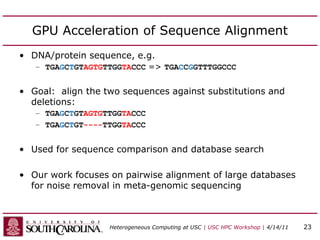
GPU Acceleration of Sequence Alignment
• DNA/protein sequence, e.g.
– TGAGCTGTAGTGTTGGTACCC => TGACCGGTTTGGCCC
• Goal: align the two sequences against substitutions and
deletions:
– TGAGCTGTAGTGTTGGTACCC
– TGAGCTGT----TTGGTACCC
• Used for sequence comparison and database search
• Our work focuses on pairwise alignment of large databases
for noise removal in meta-genomic sequencing
Heterogeneous Computing at USC | USC HPC Workshop | 4/14/11 23
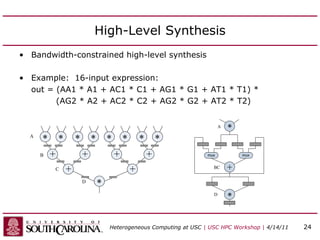
High-Level Synthesis
• Bandwidth-constrained high-level synthesis
• Example: 16-input expression:
out = (AA1 * A1 + AC1 * C1 + AG1 * G1 + AT1 * T1) *
(AG2 * A2 + AC2 * C2 + AG2 * G2 + AT2 * T2)
* * * * * * * *
+ + + +
+ +
*
A
B
C
D
A
BC
D
mux mux
*
*
+
Heterogeneous Computing at USC | USC HPC Workshop | 4/14/11 24
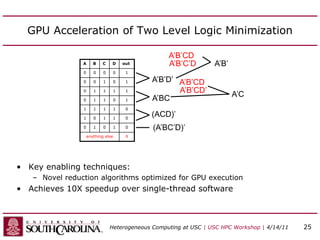
GPU Acceleration of Two Level Logic Minimization
A B C D out
0 0 0 0 1
0 0 1 0 1
0 1 1 1 1
0 1 1 0 1
1 1 1 1 0
1 0 1 1 0
0 1 0 1 0
anything else X
A’B’D’
A’BC
(ACD)’
(A’BC’D)’
A’B’CD
A’B’C’D A’B’
A’B’CD
A’B’CD’
A’C
• Key enabling techniques:
– Novel reduction algorithms optimized for GPU execution
• Achieves 10X speedup over single-thread software
Heterogeneous Computing at USC | USC HPC Workshop | 4/14/11 25

epscor_talk_2.pptx

  • 1.
    Heterogeneous Computing atUSC Dept. of Computer Science and Engineering University of South Carolina Dr. Jason D. Bakos Assistant Professor Heterogeneous and Reconfigurable Computing Lab (HeRC) This material is based upon work supported by the National Science Foundation under Grant Nos. CCF-0844951 and CCF-0915608.
  • 2.
    Heterogeneous Computing • Subfieldof computer architecture • Mix general-purpose CPUs with “specialized processors” for high- performance computing • Specialized processors include: – Field Programmable Gate Arrays (FPGAs) – Graphical Processing Units (GPUs) • Our goals: – Adapt scientific and engineering applications to heterogeneous programming and execution models – Leverage our experience to build development tools for these models Heterogeneous Computing at USC | USC HPC Workshop | 4/14/11 2
  • 3.
    Heterogeneous Computing initialization 0.5% ofrun time “hot” loop 99% of run time clean up 0.5% of run time 49% of code 49% of code 2% of code co-processor Kernel speedup Application speedup Execution time 50 34 5.0 hours 100 50 3.3 hours 200 67 2.5 hours 500 83 2.0 hours 1000 91 1.8 hours • Example: – Application requires a week of CPU time – Offload computation consumes 99% of execution time Heterogeneous Computing at USC | USC HPC Workshop | 4/14/11 3
  • 4.
    My Group • Applicationswork – Computational biology: • Computational phylogeny reconstruction (FPGA) • Sequence alignment (GPU) – Numerical linear algebra • Sparse matrix-vector multiply (FPGA) – Data mining: • Frequent itemset mining (GPU) – Electronic design automation: • Logic minimization heuristics (GPU) • Tools – Automatic CPU/coprocessor partitioning for legacy code – Performance modeling – Bandwidth-constrained high-level synthesis Heterogeneous Computing at USC | USC HPC Workshop | 4/14/11 4
  • 5.
    Field Programmable GateArrays • Programmable logic device • Contains: – Programmable logic gates, RAMs, multipliers, I/O interfaces – Programmable interconnect Heterogeneous Computing at USC | USC HPC Workshop | 4/14/11 5
  • 6.
    Programming FPGAs Heterogeneous Computingat USC | USC HPC Workshop | 4/14/11 6
  • 7.
    FPGA Platforms Annapolis Micro Systems WILDSTAR2 PRO GiDEL PROCSTAR III Heterogeneous Computing at USC | USC HPC Workshop | 4/14/11 7
  • 8.
    Convey HC-1 Heterogeneous Computingat USC | USC HPC Workshop | 4/14/11 8
  • 9.
    Convey HC-1 Heterogeneous Computingat USC | USC HPC Workshop | 4/14/11 9
  • 10.
    GPU Platforms NVIDIA TeslaS1070 Heterogeneous Computing at USC | USC HPC Workshop | 4/14/11 10
  • 11.
    GPU Acceleration ofData Mining 2-itemsets: <ABC>, <ABE>, <ACE>, <BCE> 2-itemsets with threshold 2: 3-itemsets: 3-itemsets with threshold 2: <BCE> • Key enabling techniques: – GPU-mappable data structures • Our GPU accelerated implementation achieves a 20X speedup over state-of-the-art serial implementations Heterogeneous Computing at USC | USC HPC Workshop | 4/14/11 11
  • 12.
    Automated Task Partitioning HeterogeneousComputing at USC | USC HPC Workshop | 4/14/11 12
  • 13.
    Phylogenic Reconstruction genus Drosophila 654,729,075 possible trees with12 leaves 200 trillion possible trees for 16 leaves 2.2 x 10²⁰ possible trees for 20 leaves Heterogeneous Computing at USC | USC HPC Workshop | 4/14/11 13
  • 14.
    Our Projects • FPGA-basedco-processors for computational biology: 1000X speedup! 10X speedup! GRAPPA: MP reconstruction of whole genome data based on gene- rearrangements MrBayes: Monte Carlo-based reconstruction based on likelihood model for sequence data Heterogeneous Computing at USC | USC HPC Workshop | 4/14/11 14
  • 15.
    Sparse Matrix Arithmetic •Sparse matrices are large matrices that contain mostly zero- values – Common in many scientific and engineering applications • Often represent a linear system and are thus multiplied by a vector when using an iterative linear solver • Compressed Storage Row (CSR) representation: 1 -1 0 -3 0 -2 5 0 0 0 0 0 4 6 4 -4 0 2 7 0 0 8 0 0 -5 val = (1 -1 -3 -2 5 4 6 4 -4 2 7 8 -5) col = (0 1 3 0 1 2 3 4 0 2 3 1 4) ptr = (0 3 5 8 11 13) Heterogeneous Computing at USC | USC HPC Workshop | 4/14/11 15
  • 16.
    Sparse Matrix-Vector Multiply •Code for Ax = b – A is matrix stored in val, col, ptr row = 0 for i = 0 to number_of_nonzero_elements do if i = ptr[row+1] then row=row+1, b[row]=0.0 b[row] = b[row] + val[i] * x[col[i]] end recurrence (reduction) non-affine (indirect) indexing Heterogeneous Computing at USC | USC HPC Workshop | 4/14/11 16
  • 17.
    Indirect Addressing • Technique: •Can scale up the number of these processing elements until you run out of memory bandwidth S x RAM CSR stream val col Processing element (PE) val vec Heterogeneous Computing at USC | USC HPC Workshop | 4/14/11 17 segmented local cache
  • 18.
    Double Precision Accumulation MemMem Control Partial sums Heterogeneous Computing at USC | USC HPC Workshop | 4/14/11 18 Problem: New values arrive every clock cycle, but adders are deeply pipelined Causes a data dependency
  • 19.
    Reduction Rules Heterogeneous Computingat USC | USC HPC Workshop | 4/14/11 19
  • 20.
    Sparse Matrix-Vector Multiply •32 PEs on the Convey HC-1 – Each PE can achieve up to 300 MFLOPs/s – 32 PE gives an upper bound of 9.6 GFLOPs/s • The HC-1 coprocessor has 80 GB/s of memory bandwidth – Gives a performance upper bound of ~7.1 GFLOPs/s • In our implementation, we achieved up to 50% of this peak, depending on the matrix tested – Depends on: • Vector cache performance • On-chip contention for memory interfaces Heterogeneous Computing at USC | USC HPC Workshop | 4/14/11 20
  • 21.
    Maximizing Memory Bandwidth HeterogeneousComputing at USC | USC HPC Workshop | 4/14/11 21 … 8 x 128 bit memory channels 64 x 1024 bit onchip memory 4096 bit, 42 x 96 bit shift register 128 1024 96 (val/col) PE
  • 22.
    Summary • Manually acceleratedseveral applications on using FPGA and GPU-based coprocessors • Working to develop tools for to make it easier to take advantage of heterogeneous platforms Heterogeneous Computing at USC | USC HPC Workshop| 4/14/11 22
  • 23.
    GPU Acceleration ofSequence Alignment • DNA/protein sequence, e.g. – TGAGCTGTAGTGTTGGTACCC => TGACCGGTTTGGCCC • Goal: align the two sequences against substitutions and deletions: – TGAGCTGTAGTGTTGGTACCC – TGAGCTGT----TTGGTACCC • Used for sequence comparison and database search • Our work focuses on pairwise alignment of large databases for noise removal in meta-genomic sequencing Heterogeneous Computing at USC | USC HPC Workshop | 4/14/11 23
  • 24.
    High-Level Synthesis • Bandwidth-constrainedhigh-level synthesis • Example: 16-input expression: out = (AA1 * A1 + AC1 * C1 + AG1 * G1 + AT1 * T1) * (AG2 * A2 + AC2 * C2 + AG2 * G2 + AT2 * T2) * * * * * * * * + + + + + + * A B C D A BC D mux mux * * + Heterogeneous Computing at USC | USC HPC Workshop | 4/14/11 24
  • 25.
    GPU Acceleration ofTwo Level Logic Minimization A B C D out 0 0 0 0 1 0 0 1 0 1 0 1 1 1 1 0 1 1 0 1 1 1 1 1 0 1 0 1 1 0 0 1 0 1 0 anything else X A’B’D’ A’BC (ACD)’ (A’BC’D)’ A’B’CD A’B’C’D A’B’ A’B’CD A’B’CD’ A’C • Key enabling techniques: – Novel reduction algorithms optimized for GPU execution • Achieves 10X speedup over single-thread software Heterogeneous Computing at USC | USC HPC Workshop | 4/14/11 25