Risk of Diabetes associated with the use of Atypical Antipsychotics in Children and Adolescents - A Texas Medicaid Study Saurabh Nagar, MS Candidate Sandhya Mehta, MS Candidate Philip Zweifel, Pharm.D Hua Chen, Ph.D  ISPOR 14 th  Annual Conference, Orlando, Florida, May 19, 2009
OUTLINE Introduction Research Objective Methods Results Conclusion Limitation
INTRODUCTION
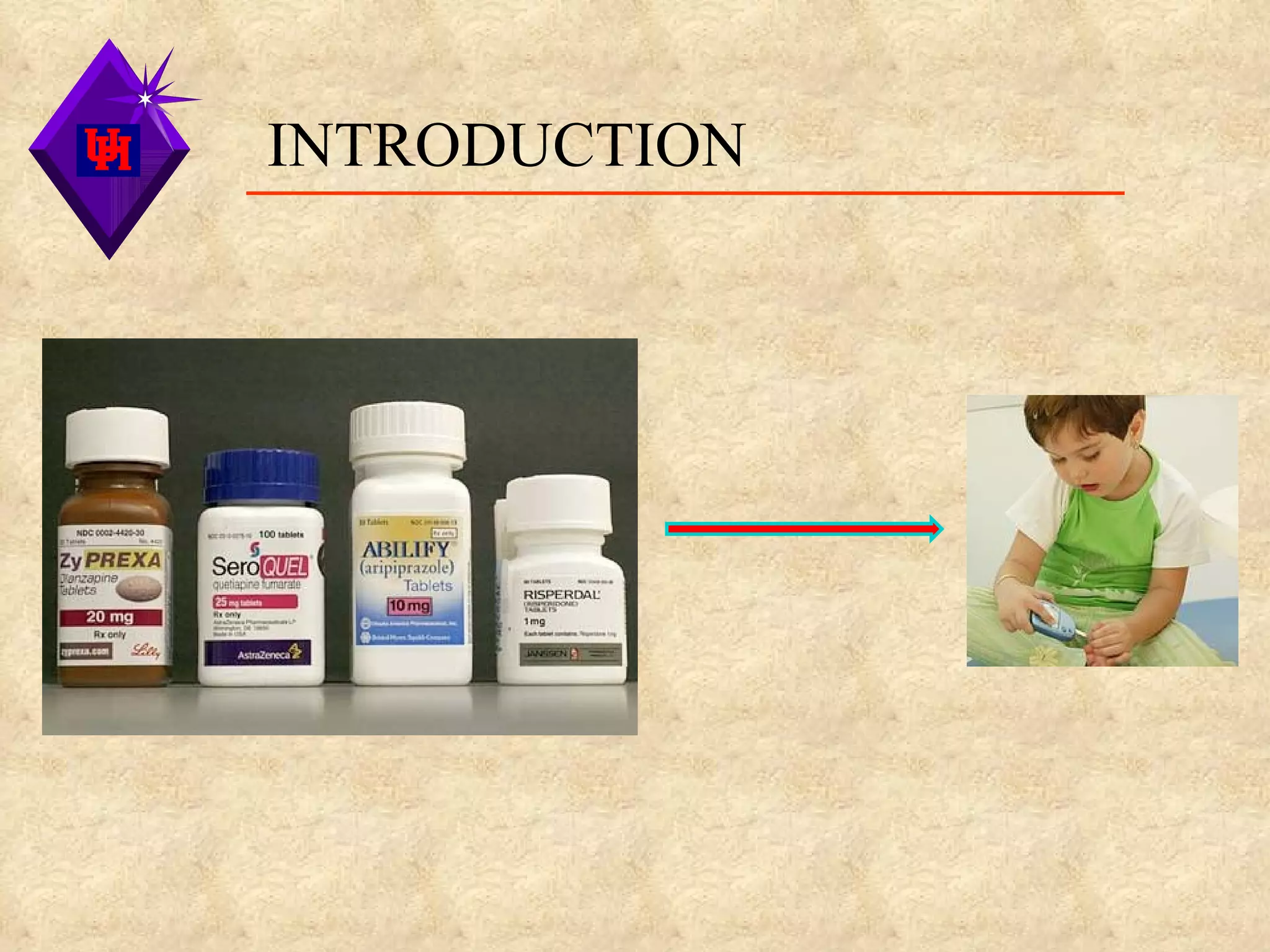
ATYPICALS IN CHILDREN There has been continuous increase in the prescription of atypical antipsychotics in children. Studies done on public and privately insured children and on office visits have reported this increase in children. Till date, none of the atypical antipsychotic agents is approved by the FDA for pediatric use.
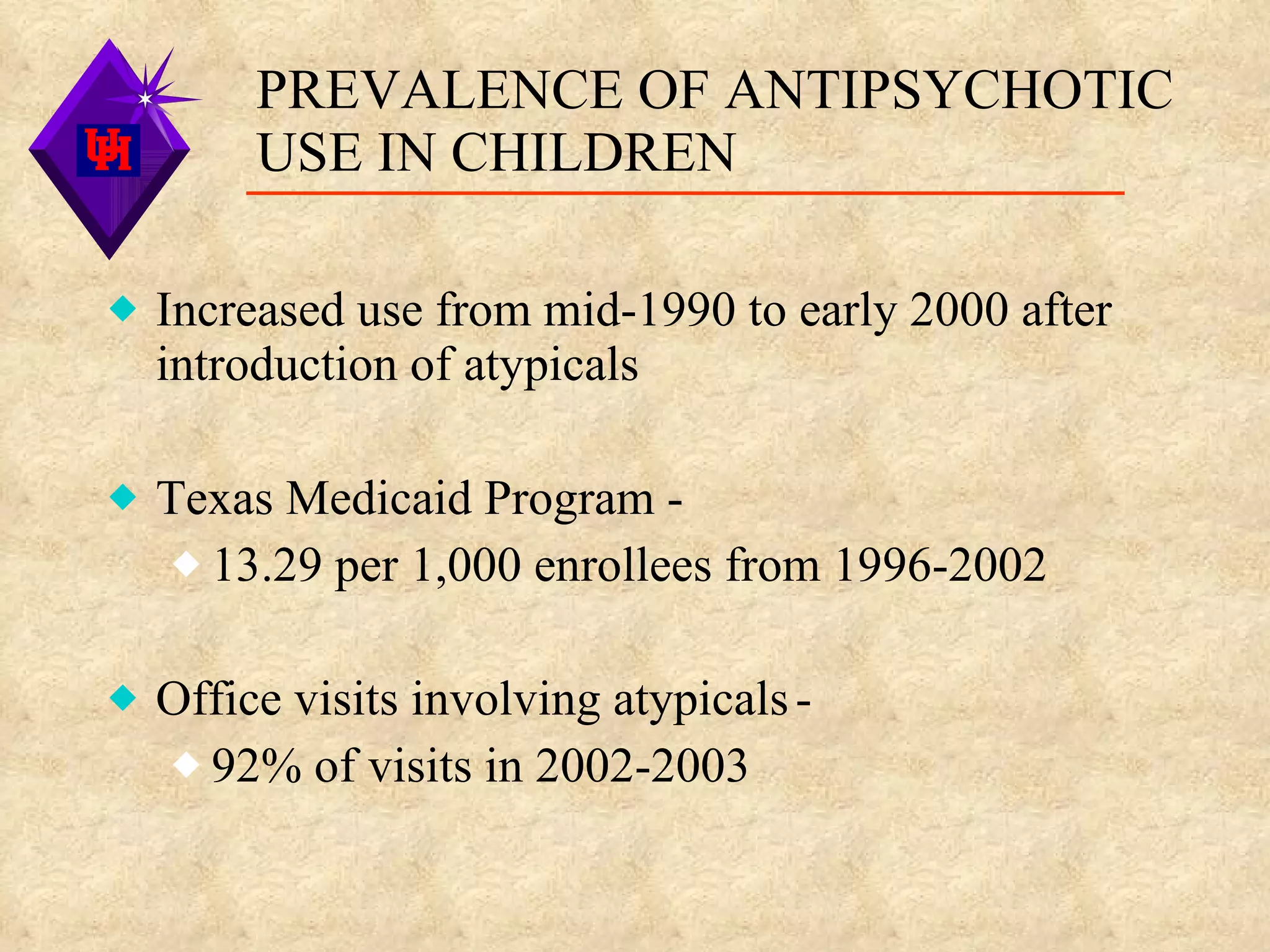
PREVALENCE OF ANTIPSYCHOTIC USE IN CHILDREN Increased use from mid-1990 to early 2000 after introduction of atypicals Texas Medicaid Program - 13.29 per 1,000 enrollees from 1996-2002 Office visits involving atypicals   - 92% of visits in 2002-2003
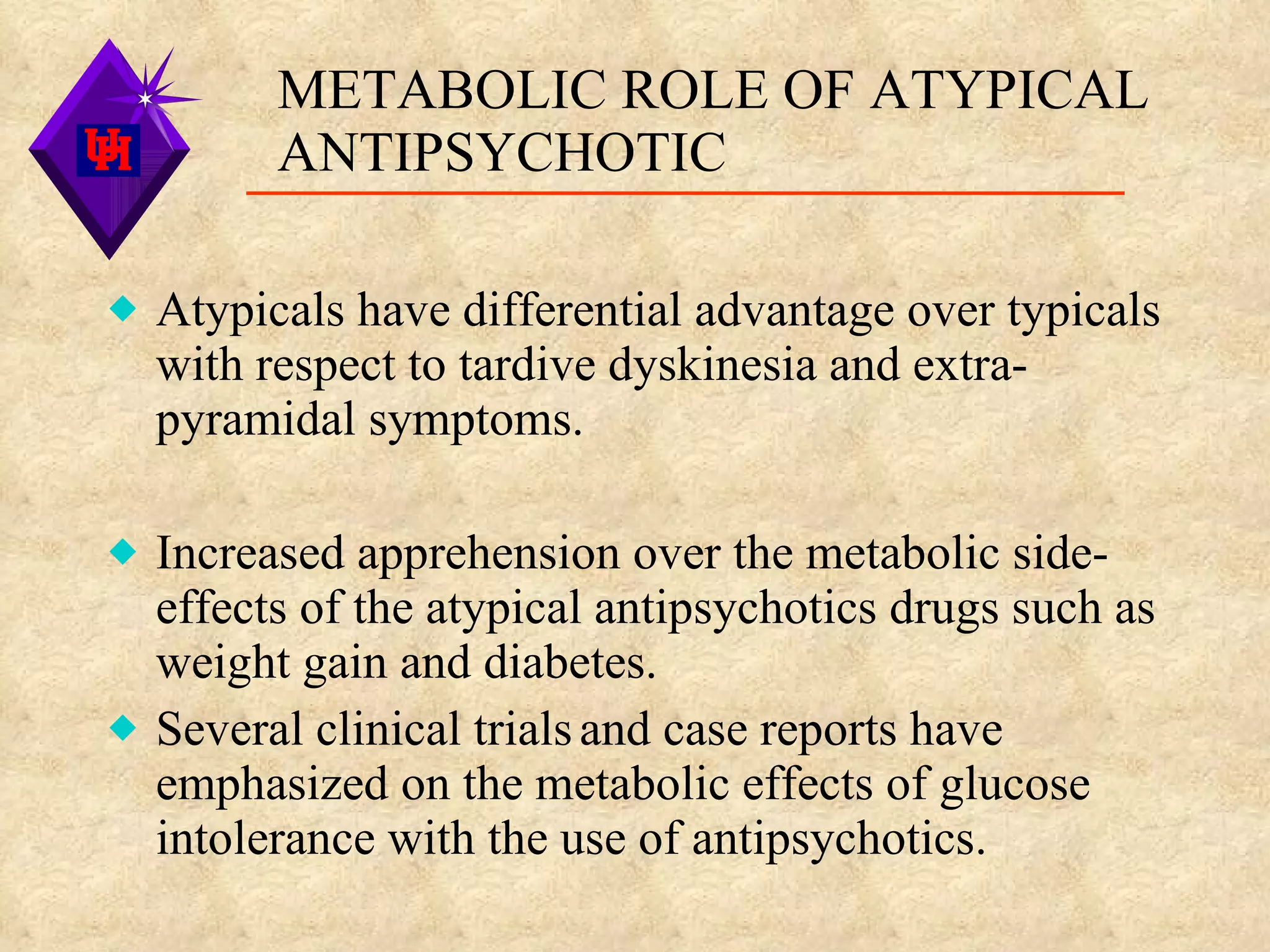
METABOLIC ROLE OF ATYPICAL ANTIPSYCHOTIC Atypicals have differential advantage over typicals with respect to tardive dyskinesia and extra-pyramidal symptoms. Increased apprehension over the metabolic side-effects of the atypical antipsychotics drugs such as weight gain and diabetes. Several clinical trials   and case reports have emphasized on the metabolic effects of glucose intolerance with the use of antipsychotics.
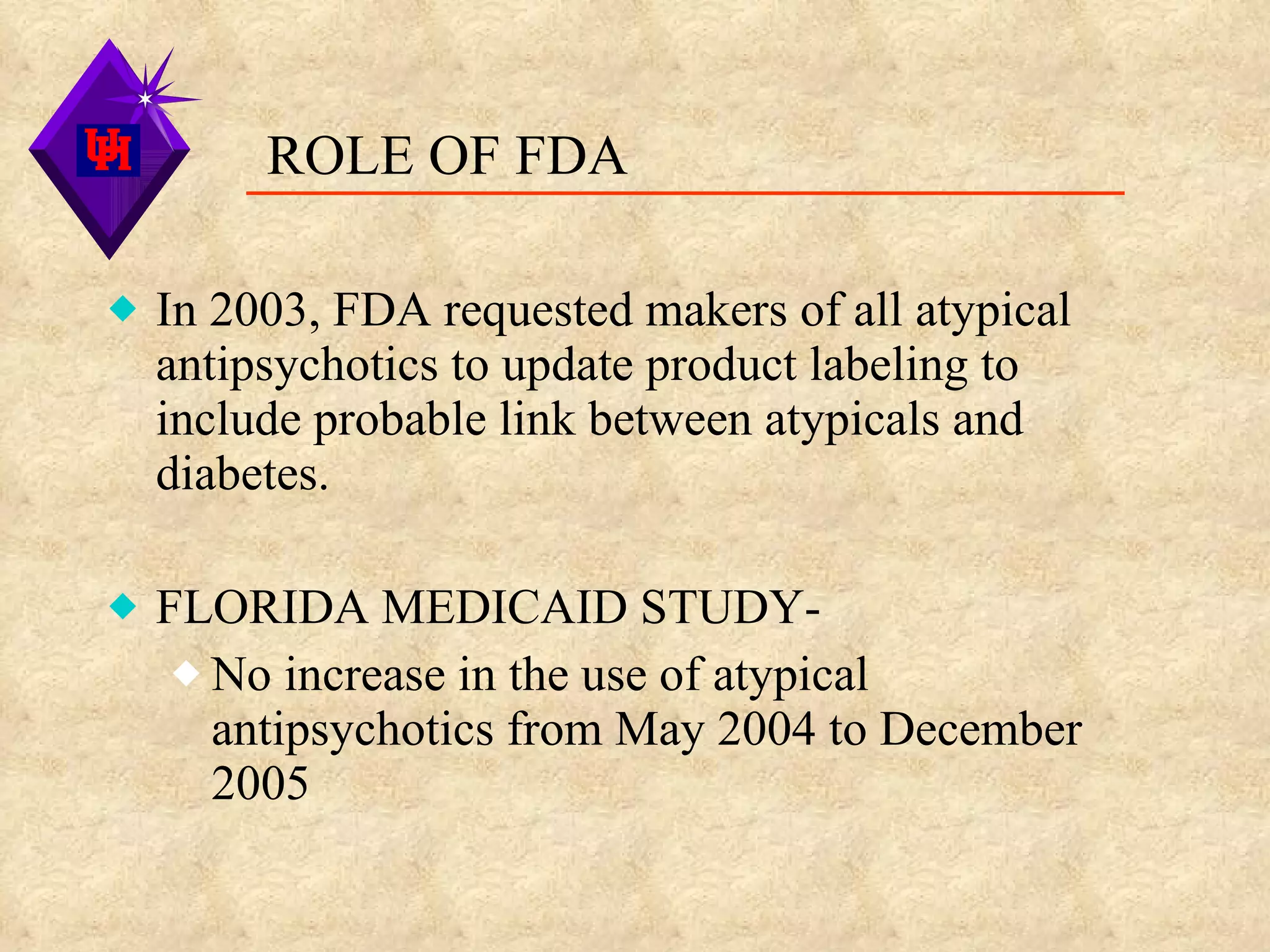
ROLE OF FDA  In 2003, FDA requested makers of all atypical antipsychotics to update product labeling to include probable link between atypicals and diabetes. FLORIDA MEDICAID STUDY- No increase in the use of atypical antipsychotics from May 2004 to December 2005
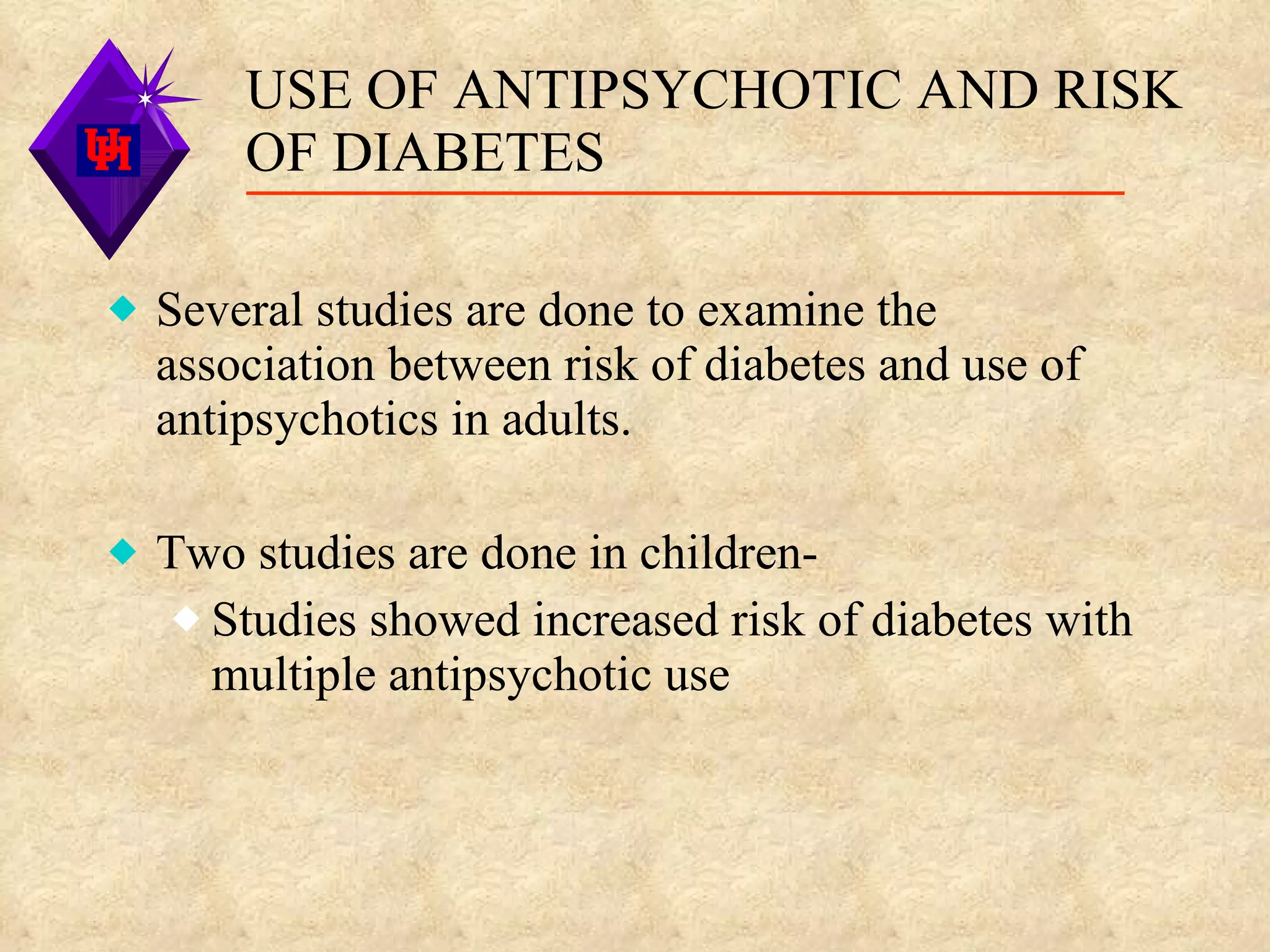
USE OF ANTIPSYCHOTIC AND RISK OF DIABETES Several studies are done to examine the association between risk of diabetes and use of antipsychotics in adults. Two studies are done in children- Studies showed increased risk of diabetes with multiple antipsychotic use
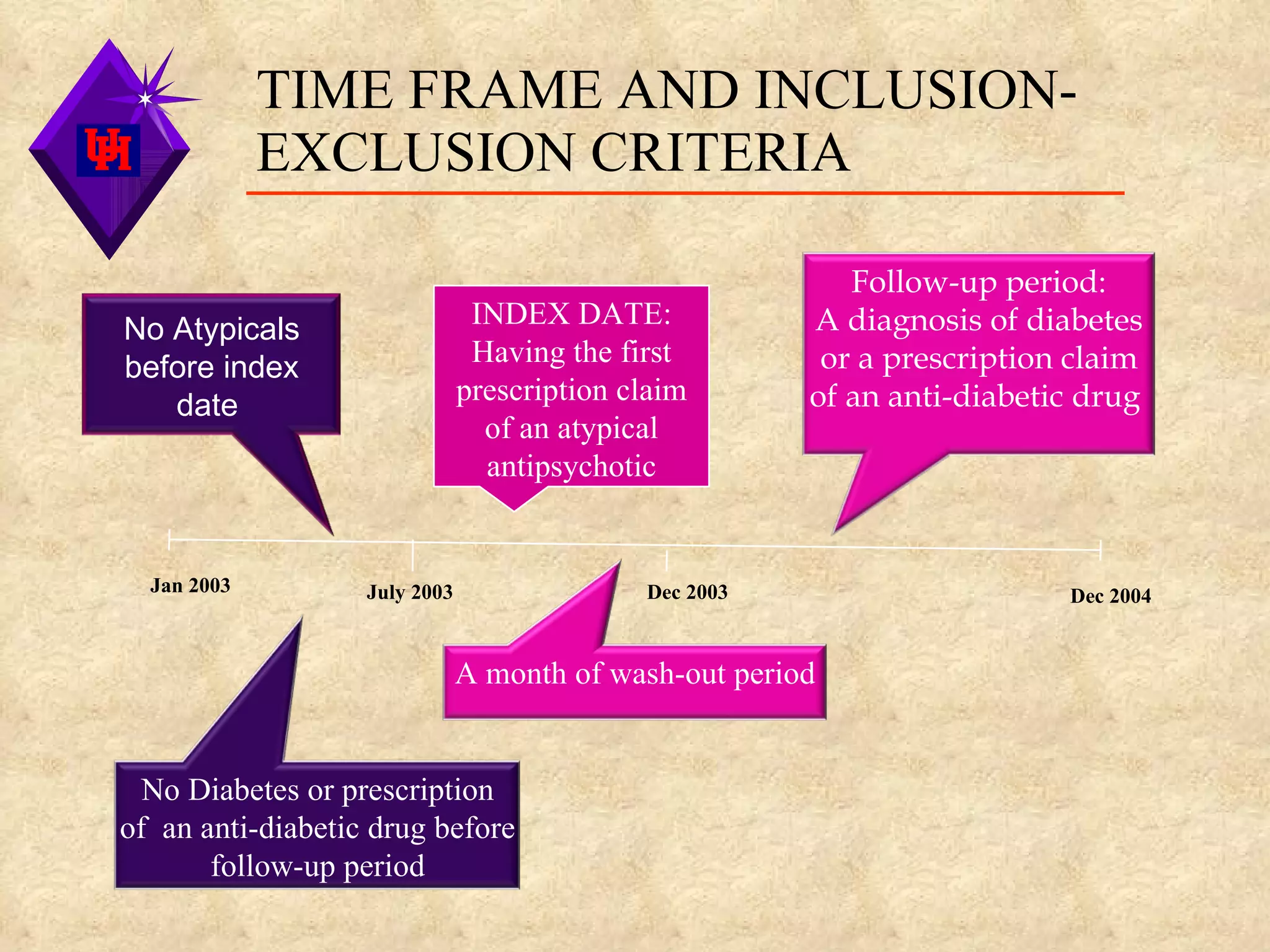
OBJECTIVE To examine the risk of developing diabetes among children and adolescents who received a single atypical antipsychotic drug.
Study design: Retrospective cohort study Study sample: Children and adolescents  aged 6 to 20 years who were users of atypical  antipsychotics Data source:  Texas Medicaid data Analytical measures:  Risk of diabetes Files used: Personal summary files, prescription files and outpatient files METHODS
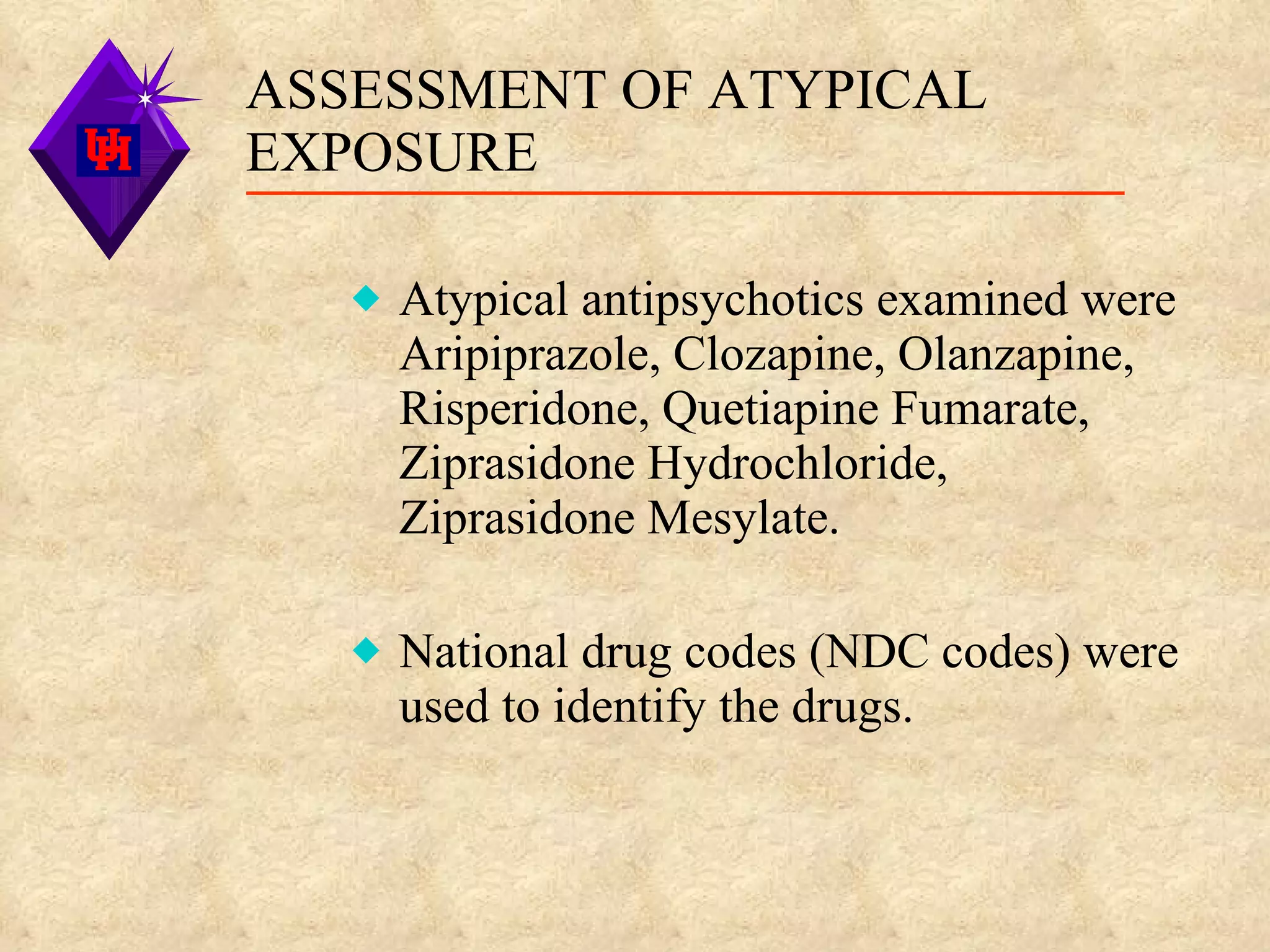
TIME FRAME AND INCLUSION-EXCLUSION CRITERIA Jan 2003 Dec 2004 Dec 2003 July 2003 INDEX DATE: Having the first prescription claim of an atypical antipsychotic A month of wash-out period Follow-up period: A diagnosis of diabetes or a prescription claim  of an anti-diabetic drug  No Atypicals before index date  No Diabetes or prescription of  an anti-diabetic drug before follow-up period
ASSESSMENT OF ATYPICAL EXPOSURE Atypical antipsychotics examined were Aripiprazole, Clozapine, Olanzapine, Risperidone, Quetiapine Fumarate, Ziprasidone Hydrochloride, Ziprasidone Mesylate. National drug codes (NDC codes) were used to identify the drugs.
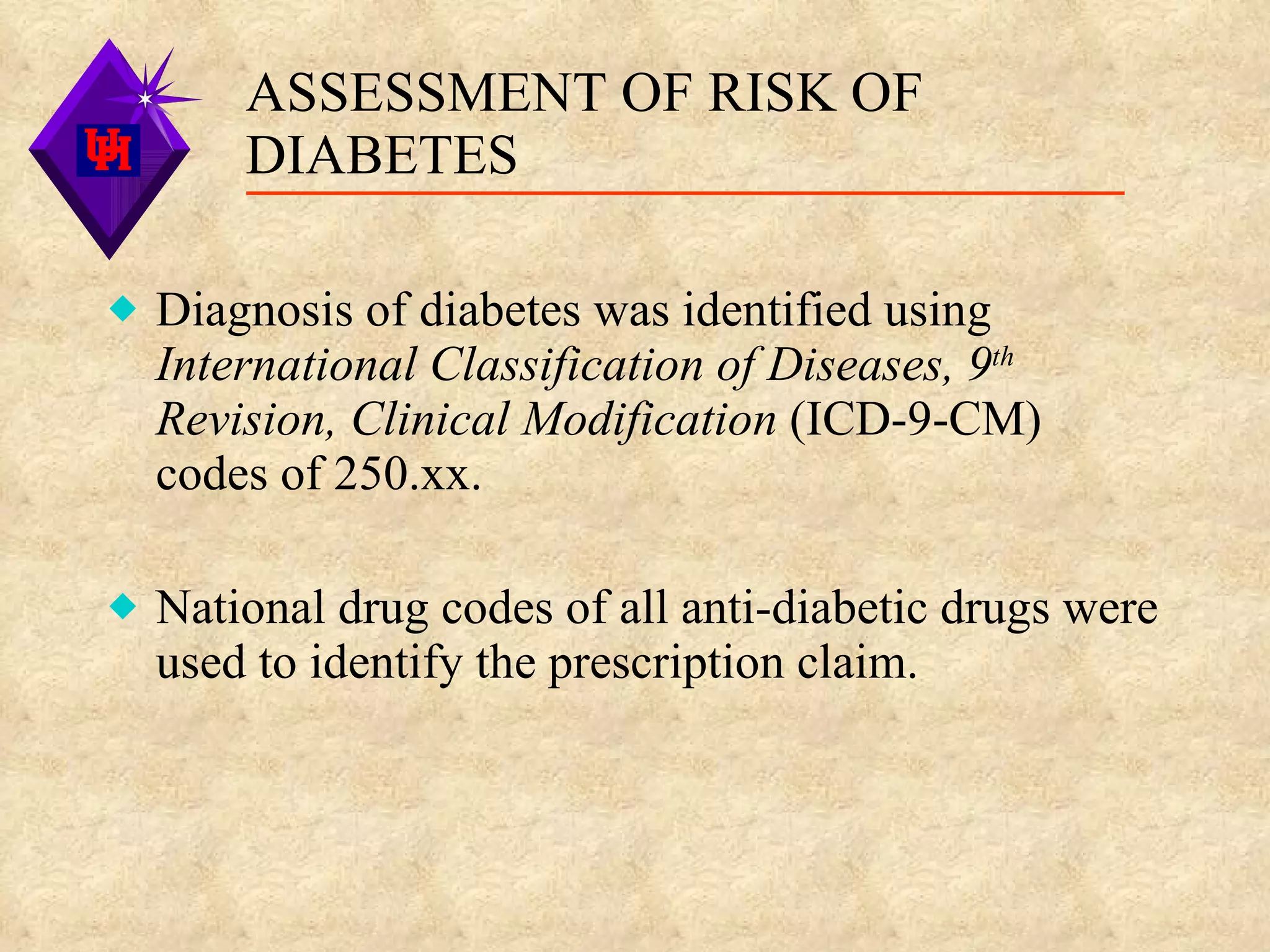
Diagnosis of diabetes was identified using  International Classification of Diseases, 9 th  Revision, Clinical Modification  (ICD-9-CM) codes of 250.xx. National drug codes of all anti-diabetic drugs were used to identify the prescription claim.  ASSESSMENT OF RISK OF DIABETES
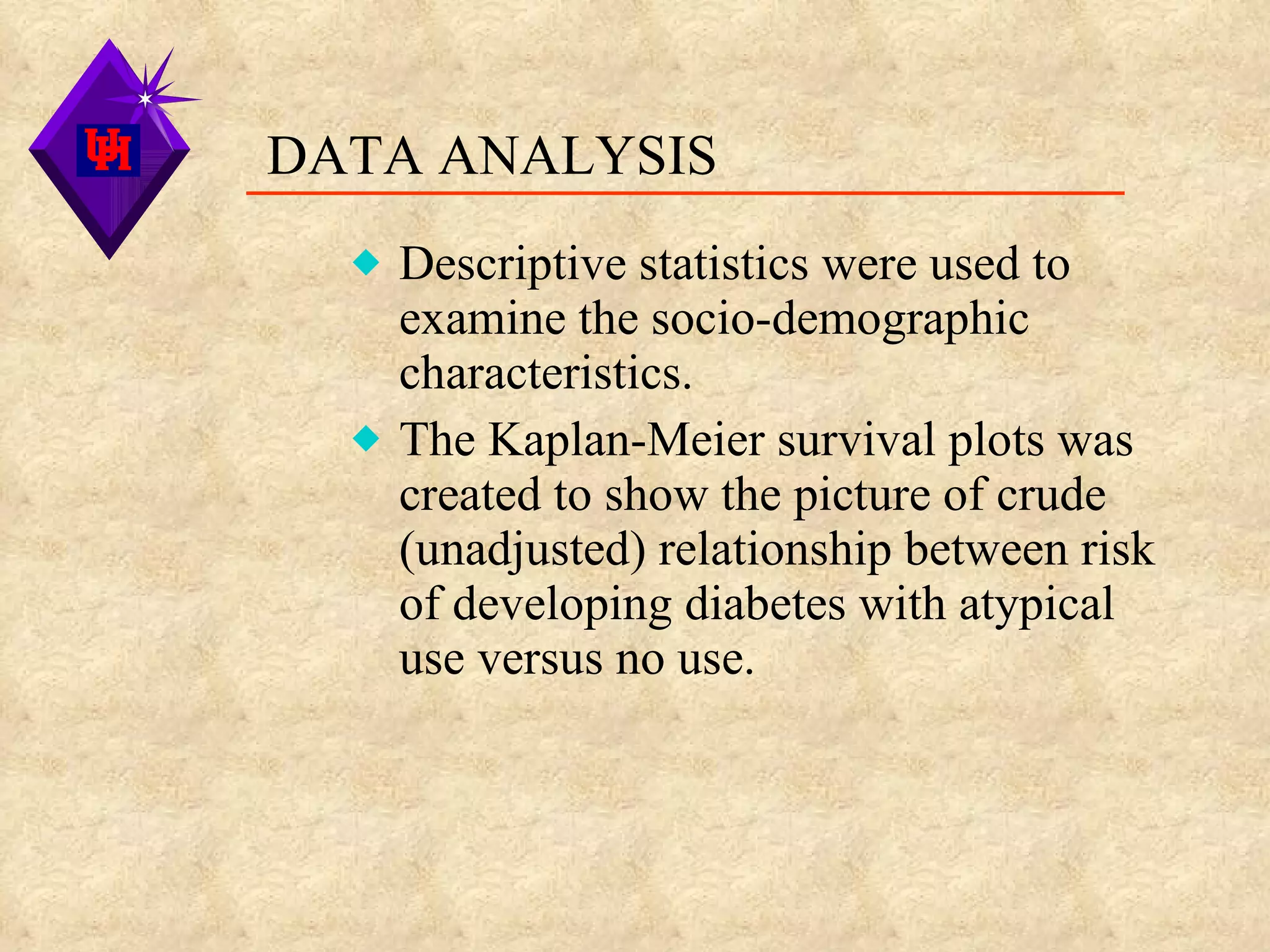
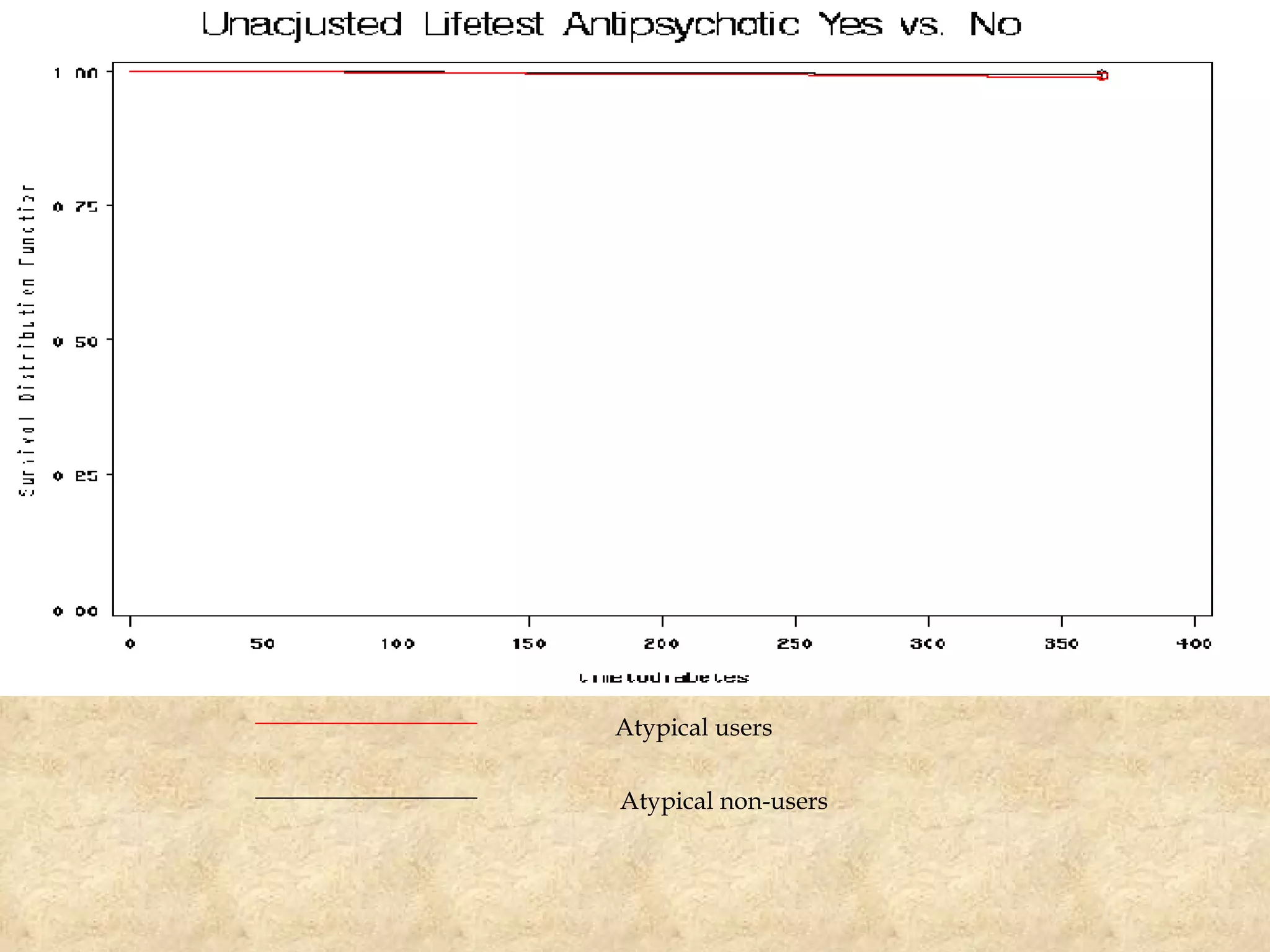
DATA ANALYSIS Descriptive statistics were used to examine the socio-demographic characteristics. The Kaplan-Meier survival plots was created to show the picture of crude (unadjusted) relationship between risk of developing diabetes with atypical use versus no use.
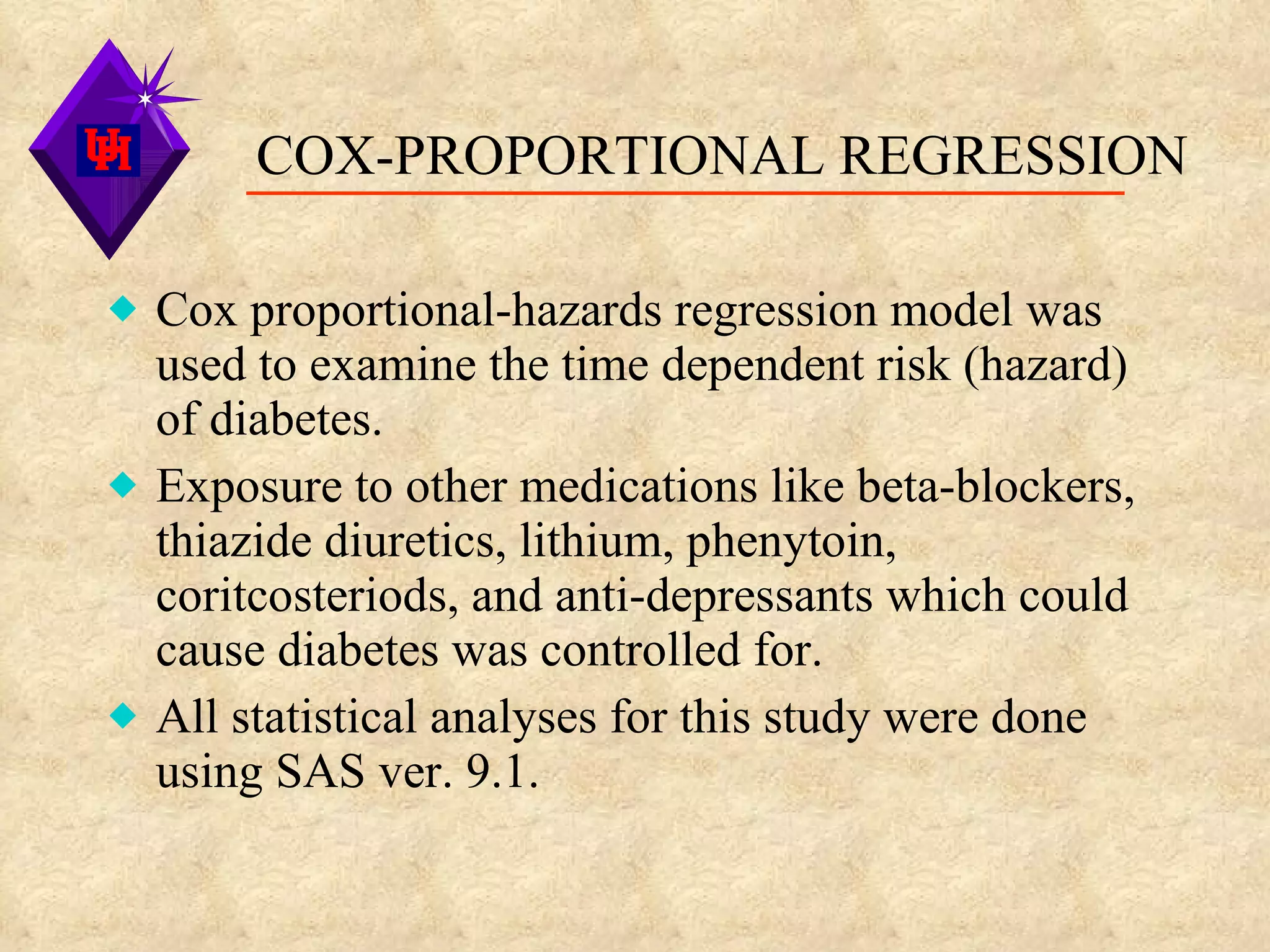
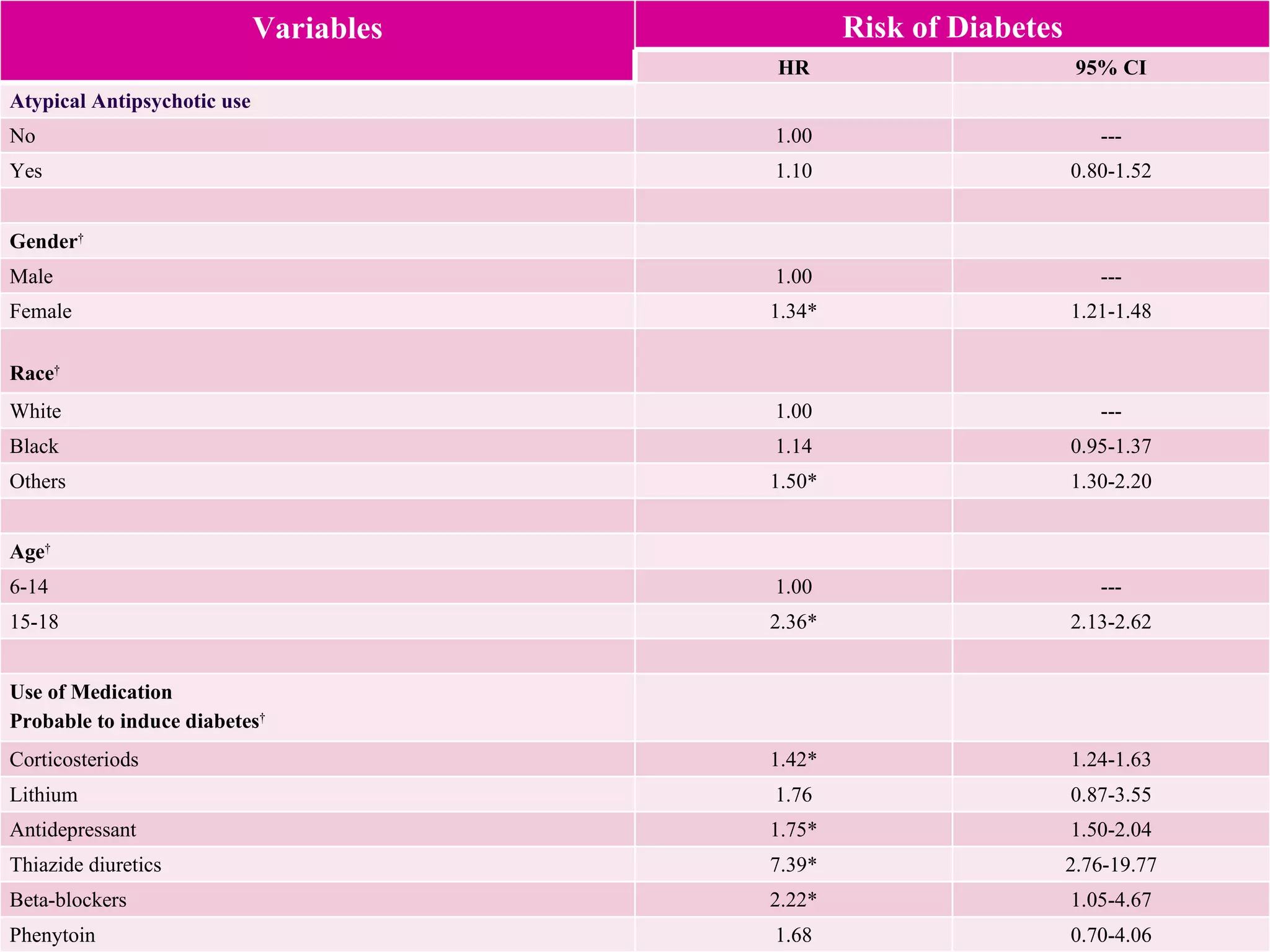
COX-PROPORTIONAL REGRESSION Cox proportional-hazards regression model was used to examine the time dependent risk (hazard) of diabetes. Exposure to other medications like beta-blockers, thiazide diuretics, lithium, phenytoin, coritcosteriods, and anti-depressants which could cause diabetes was controlled for. All statistical analyses for this study were done using SAS ver. 9.1.
RESULTS
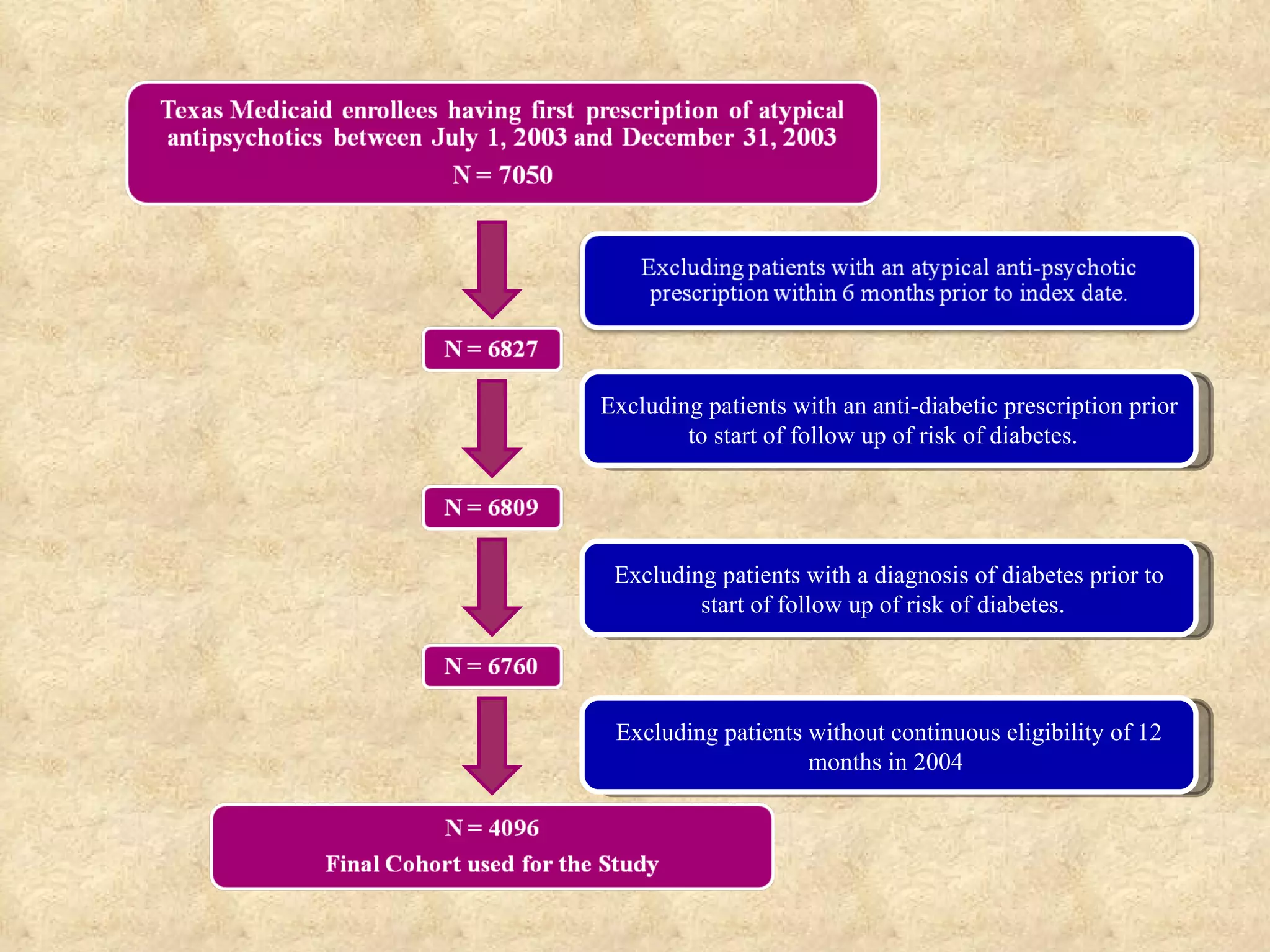
Excluding patients with an anti-diabetic prescription prior to start of follow up of risk of diabetes.  Excluding patients with a diagnosis of diabetes prior to start of follow up of risk of diabetes.  Excluding patients without continuous eligibility of 12 months in 2004
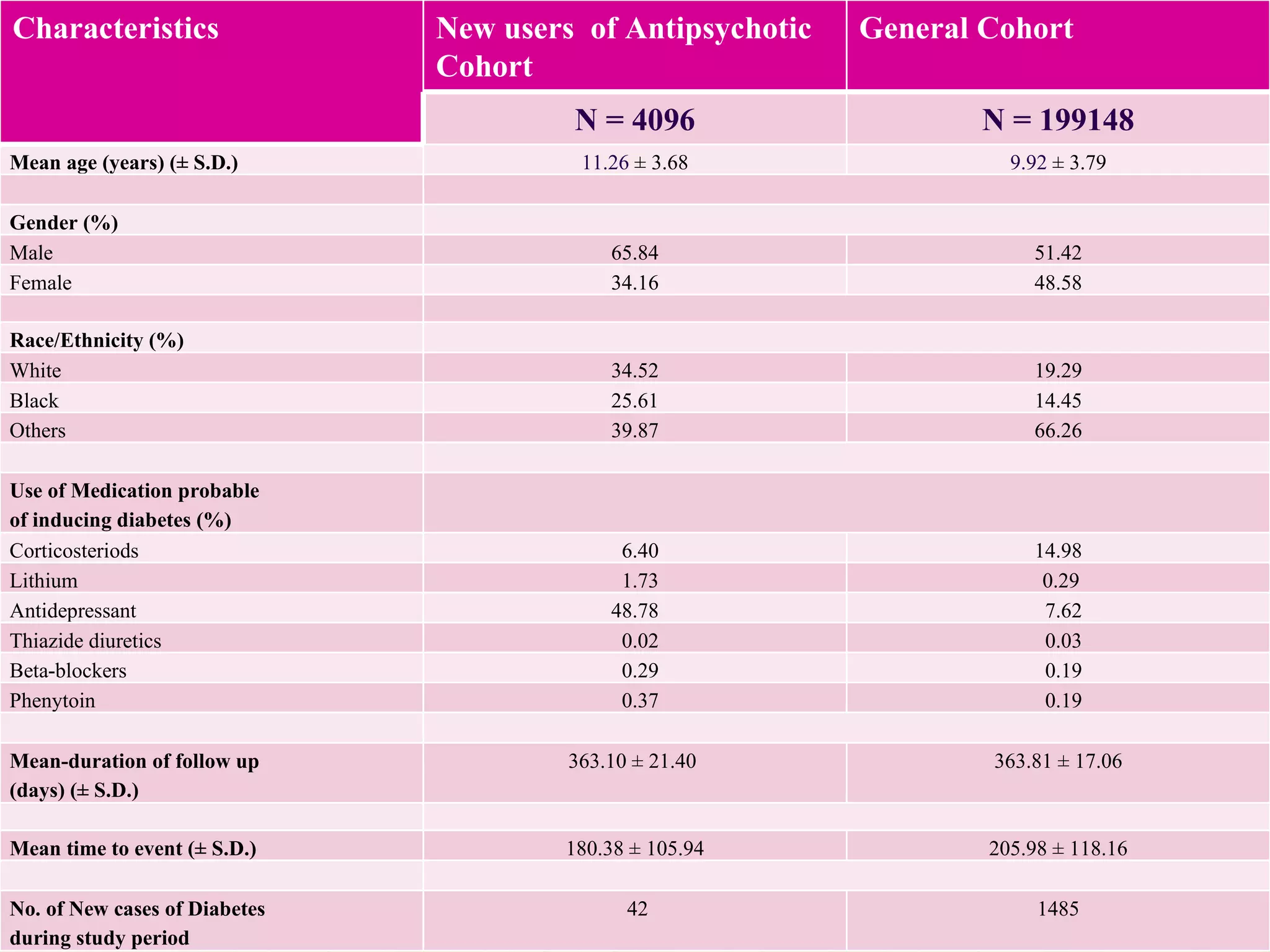
Characteristics New users  of Antipsychotic Cohort General Cohort N = 4096 N = 199148 Mean age (years) (± S.D.) 11.26  ± 3.68 9.92  ± 3.79 Gender (%) Male   65.84 51.42 Female 34.16 48.58 Race/Ethnicity (%) White 34.52 19.29 Black 25.61 14.45 Others 39.87 66.26 Use of Medication probable  of inducing diabetes (%) Corticosteriods   6.40 14.98 Lithium 1.73 0.29  Antidepressant 48.78 7.62 Thiazide diuretics 0.02 0.03 Beta-blockers  0.29 0.19 Phenytoin 0.37 0.19 Mean-duration of follow up (days) (± S.D.) 363.10 ± 21.40  363.81 ± 17.06 Mean time to event (± S.D.) 180.38 ± 105.94 205.98 ± 118.16 No. of New cases of Diabetes during study period 42 1485
Atypical users Atypical non-users
Variables Risk of Diabetes HR 95% CI Atypical Antipsychotic use No 1.00 --- Yes   1.10 0.80-1.52 Gender † Male 1.00 --- Female 1.34* 1.21-1.48 Race † White 1.00 --- Black 1.14 0.95-1.37 Others 1.50* 1.30-2.20 Age † 6-14 1.00 --- 15-18 2.36* 2.13-2.62 Use of Medication Probable to induce diabetes † Corticosteriods 1.42* 1.24-1.63 Lithium 1.76 0.87-3.55 Antidepressant 1.75* 1.50-2.04 Thiazide diuretics 7.39* 2.76-19.77 Beta-blockers  2.22* 1.05-4.67 Phenytoin 1.68 0.70-4.06
DISCUSSION
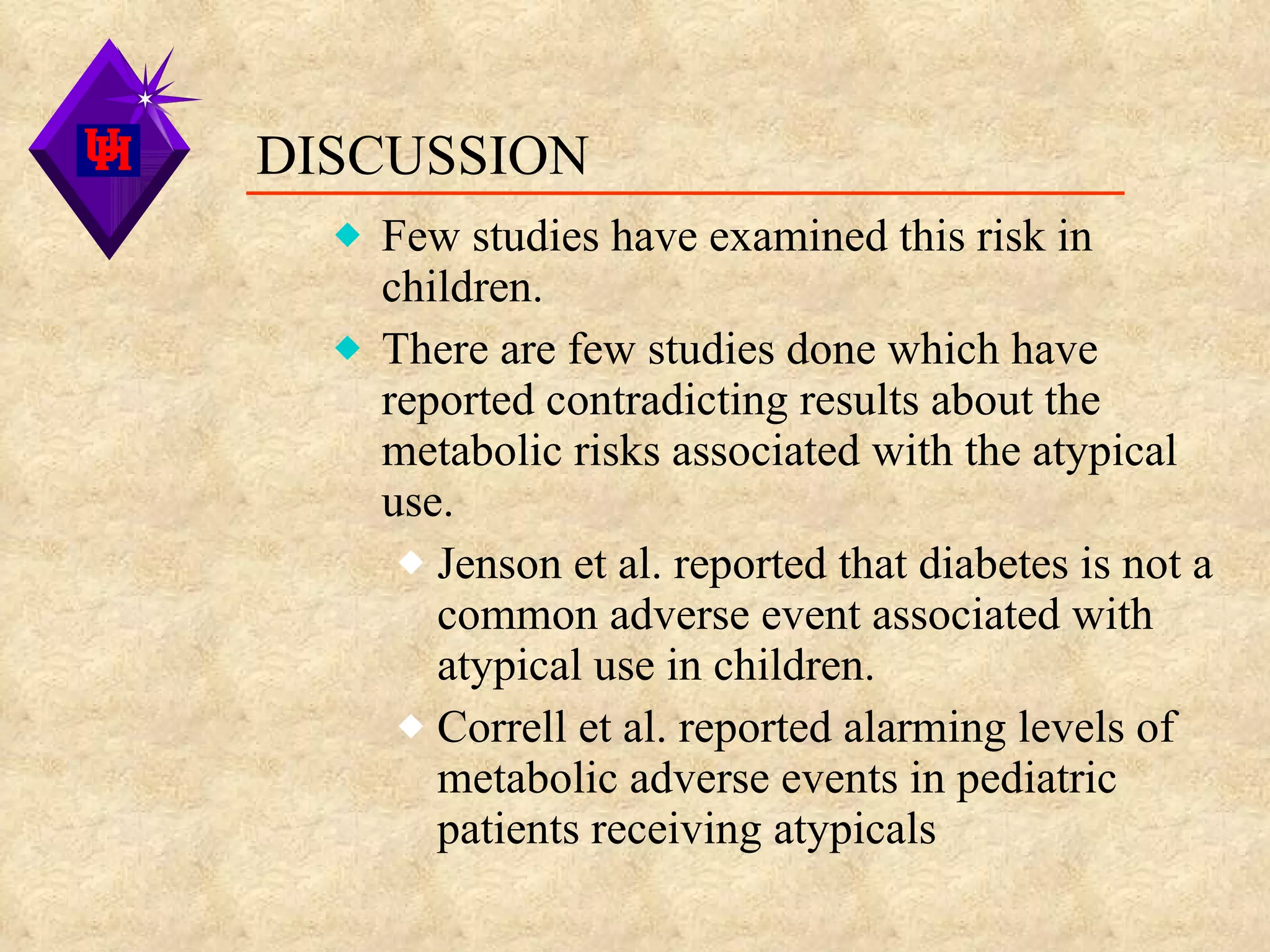
DISCUSSION Few studies have examined this risk in children. There are few studies done which have reported contradicting results about the metabolic risks associated with the atypical use. Jenson et al. reported that diabetes is not a common adverse event associated with atypical use in children. Correll et al. reported alarming levels of metabolic adverse events in pediatric patients receiving atypicals
LIMITATIONS The results may not be generalizable to overall population Dosage of the atypical antipsychotic drugs could not be controlled for in the analysis. Other diabetogenic factors like BMI, glucose levels and family history of diabetes could not be controlled for in the analysis. There could be errors present while coding and misdiagnosing diabetes which could not be controlled for in the study.
STRENGTHS Large claims database having sufficient information on drug exposure and outcome. A wash out period of six months to ascertain new use of atypical antipsychotic in children. A lag period of 30 days after exposure to allow the drug to show its diabetogenic effects.  A follow-up period of 12 months was selected and risk of diabetes was reported by either of diabetes diagnosis or prescription of an antidiabetic agent making the estimates more reliable.
CONCLUSION Our results indicate no significant increase in the risk of diabetes in pediatric patients receiving atypical antipsychotics.  There is a necessity of long term clinical and epidemiological studies to ascertain the efficacy and tolerability of atypical agents in pediatric population. Future studies could focus on comparing atypical agents individually and with typical agents to examine risk of diabetes by longer follow-up periods.
THANK YOU QUESTIONS?? COMMENTS?? Contact Information: Saurabh Nagar: nagar.saurabhp@gmail.com

ISPOR podium presentation

  • 1.
    Risk of Diabetesassociated with the use of Atypical Antipsychotics in Children and Adolescents - A Texas Medicaid Study Saurabh Nagar, MS Candidate Sandhya Mehta, MS Candidate Philip Zweifel, Pharm.D Hua Chen, Ph.D ISPOR 14 th Annual Conference, Orlando, Florida, May 19, 2009
  • 2.
    OUTLINE Introduction ResearchObjective Methods Results Conclusion Limitation
  • 3.
  • 4.
    ATYPICALS IN CHILDRENThere has been continuous increase in the prescription of atypical antipsychotics in children. Studies done on public and privately insured children and on office visits have reported this increase in children. Till date, none of the atypical antipsychotic agents is approved by the FDA for pediatric use.
  • 5.
    PREVALENCE OF ANTIPSYCHOTICUSE IN CHILDREN Increased use from mid-1990 to early 2000 after introduction of atypicals Texas Medicaid Program - 13.29 per 1,000 enrollees from 1996-2002 Office visits involving atypicals - 92% of visits in 2002-2003
  • 6.
    METABOLIC ROLE OFATYPICAL ANTIPSYCHOTIC Atypicals have differential advantage over typicals with respect to tardive dyskinesia and extra-pyramidal symptoms. Increased apprehension over the metabolic side-effects of the atypical antipsychotics drugs such as weight gain and diabetes. Several clinical trials and case reports have emphasized on the metabolic effects of glucose intolerance with the use of antipsychotics.
  • 7.
    ROLE OF FDA In 2003, FDA requested makers of all atypical antipsychotics to update product labeling to include probable link between atypicals and diabetes. FLORIDA MEDICAID STUDY- No increase in the use of atypical antipsychotics from May 2004 to December 2005
  • 8.
    USE OF ANTIPSYCHOTICAND RISK OF DIABETES Several studies are done to examine the association between risk of diabetes and use of antipsychotics in adults. Two studies are done in children- Studies showed increased risk of diabetes with multiple antipsychotic use
  • 9.
    OBJECTIVE To examinethe risk of developing diabetes among children and adolescents who received a single atypical antipsychotic drug.
  • 10.
    Study design: Retrospectivecohort study Study sample: Children and adolescents aged 6 to 20 years who were users of atypical antipsychotics Data source: Texas Medicaid data Analytical measures: Risk of diabetes Files used: Personal summary files, prescription files and outpatient files METHODS
  • 11.
    TIME FRAME ANDINCLUSION-EXCLUSION CRITERIA Jan 2003 Dec 2004 Dec 2003 July 2003 INDEX DATE: Having the first prescription claim of an atypical antipsychotic A month of wash-out period Follow-up period: A diagnosis of diabetes or a prescription claim of an anti-diabetic drug No Atypicals before index date No Diabetes or prescription of an anti-diabetic drug before follow-up period
  • 12.
    ASSESSMENT OF ATYPICALEXPOSURE Atypical antipsychotics examined were Aripiprazole, Clozapine, Olanzapine, Risperidone, Quetiapine Fumarate, Ziprasidone Hydrochloride, Ziprasidone Mesylate. National drug codes (NDC codes) were used to identify the drugs.
  • 13.
    Diagnosis of diabeteswas identified using International Classification of Diseases, 9 th Revision, Clinical Modification (ICD-9-CM) codes of 250.xx. National drug codes of all anti-diabetic drugs were used to identify the prescription claim. ASSESSMENT OF RISK OF DIABETES
  • 14.
    DATA ANALYSIS Descriptivestatistics were used to examine the socio-demographic characteristics. The Kaplan-Meier survival plots was created to show the picture of crude (unadjusted) relationship between risk of developing diabetes with atypical use versus no use.
  • 15.
    COX-PROPORTIONAL REGRESSION Coxproportional-hazards regression model was used to examine the time dependent risk (hazard) of diabetes. Exposure to other medications like beta-blockers, thiazide diuretics, lithium, phenytoin, coritcosteriods, and anti-depressants which could cause diabetes was controlled for. All statistical analyses for this study were done using SAS ver. 9.1.
  • 16.
  • 17.
    Excluding patients withan anti-diabetic prescription prior to start of follow up of risk of diabetes. Excluding patients with a diagnosis of diabetes prior to start of follow up of risk of diabetes. Excluding patients without continuous eligibility of 12 months in 2004
  • 18.
    Characteristics New users of Antipsychotic Cohort General Cohort N = 4096 N = 199148 Mean age (years) (± S.D.) 11.26 ± 3.68 9.92 ± 3.79 Gender (%) Male 65.84 51.42 Female 34.16 48.58 Race/Ethnicity (%) White 34.52 19.29 Black 25.61 14.45 Others 39.87 66.26 Use of Medication probable of inducing diabetes (%) Corticosteriods 6.40 14.98 Lithium 1.73 0.29 Antidepressant 48.78 7.62 Thiazide diuretics 0.02 0.03 Beta-blockers 0.29 0.19 Phenytoin 0.37 0.19 Mean-duration of follow up (days) (± S.D.) 363.10 ± 21.40 363.81 ± 17.06 Mean time to event (± S.D.) 180.38 ± 105.94 205.98 ± 118.16 No. of New cases of Diabetes during study period 42 1485
  • 19.
  • 20.
    Variables Risk ofDiabetes HR 95% CI Atypical Antipsychotic use No 1.00 --- Yes 1.10 0.80-1.52 Gender † Male 1.00 --- Female 1.34* 1.21-1.48 Race † White 1.00 --- Black 1.14 0.95-1.37 Others 1.50* 1.30-2.20 Age † 6-14 1.00 --- 15-18 2.36* 2.13-2.62 Use of Medication Probable to induce diabetes † Corticosteriods 1.42* 1.24-1.63 Lithium 1.76 0.87-3.55 Antidepressant 1.75* 1.50-2.04 Thiazide diuretics 7.39* 2.76-19.77 Beta-blockers 2.22* 1.05-4.67 Phenytoin 1.68 0.70-4.06
  • 21.
  • 22.
    DISCUSSION Few studieshave examined this risk in children. There are few studies done which have reported contradicting results about the metabolic risks associated with the atypical use. Jenson et al. reported that diabetes is not a common adverse event associated with atypical use in children. Correll et al. reported alarming levels of metabolic adverse events in pediatric patients receiving atypicals
  • 23.
    LIMITATIONS The resultsmay not be generalizable to overall population Dosage of the atypical antipsychotic drugs could not be controlled for in the analysis. Other diabetogenic factors like BMI, glucose levels and family history of diabetes could not be controlled for in the analysis. There could be errors present while coding and misdiagnosing diabetes which could not be controlled for in the study.
  • 24.
    STRENGTHS Large claimsdatabase having sufficient information on drug exposure and outcome. A wash out period of six months to ascertain new use of atypical antipsychotic in children. A lag period of 30 days after exposure to allow the drug to show its diabetogenic effects. A follow-up period of 12 months was selected and risk of diabetes was reported by either of diabetes diagnosis or prescription of an antidiabetic agent making the estimates more reliable.
  • 25.
    CONCLUSION Our resultsindicate no significant increase in the risk of diabetes in pediatric patients receiving atypical antipsychotics. There is a necessity of long term clinical and epidemiological studies to ascertain the efficacy and tolerability of atypical agents in pediatric population. Future studies could focus on comparing atypical agents individually and with typical agents to examine risk of diabetes by longer follow-up periods.
  • 26.
    THANK YOU QUESTIONS??COMMENTS?? Contact Information: Saurabh Nagar: nagar.saurabhp@gmail.com