
EO 70
Institutionalizing the Whole-
of-Nation Approach in
Attaining Inclusive and
Sustainable Peace, Creating
a National Task Force to End
Local Communist Armed
Conflict, and Directing the
Adoption of a National Peace
Framework
Whole-of-Nation
Approach
A government policy for the attainment of
inclusive and sustainable peace. The
Philippine Government shall prioritize and
harmonize the delivery of basic services and
social development packages in conflict-
affected areas and vulnerable communities,
facilitate societal inclusivity, and ensure active
participation of all sectors of society in the
pursuit of the country’s peace agenda.
National Task Force to End
Local Communist Armed
Conflict
Composition:
 President of the Republic of the Philippines – Chair
 National Security Adviser – Vice-Chair
♦ Members:
 Secretaries of DILG, DOJ, DND, DPWH, DBM, DOF, DAR, DSWD,
DepEd, PCOO
 Directors General of NEDA, NICA, TESDA, PNP
 Presidential Adviser on the Peace Process
 Presidential Adviser for Indigenous Peoples’ Concerns
 Chief of Staff, AFP
 Chairperson, NCIP
 Two (2) Representatives from the private sector
National Task Force to End
Local Communist Armed
Conflict
Except for the private sector representatives, the
members may designate an alternate, with a rank
not lower than an Assistant Secretary, to represent
their respective offices in the Task Force, provided
that the alternate must be fully authorized to decide
on behalf of the member.
The Private Sector Representatives, with a term
of one (1) year each, shall be appointed by the
President upon recommendation of the Task Force.
Powers and Functions of the
National Task Force
a. Formulate and implement in coordination with relevant
national government agencies, LGUs, the civil society and
other stakeholders, a Whole-of-Nation approach-driven
National Peace Framework;
b. Ensure inter-agency convergence in the implementation of
the Framework in conflict-affected and vulnerable
communities;
c. Enlist the assistance of any department, bureau, office,
agency, or instrumentality of the government, including
LGUs, GOCCs, and SUCs, in accordance with their respective
mandates, in the implementation of the Framework;
Powers and Functions of the
National Task Force
d. Evaluate, define, modify or integrate policies, programs and
activities contained in the Framework;
e. Organize ad hoc inter-agency and multi-sectoral clusters,
councils, committees and groups in national, regional and
local levels, or modify existing ones, whenever necessary, to
fulfill its mandates;
f. Develop strategic communication, advocacy, and peace
constituency plans in case of ceasefire, as well as capacity-
building measures, to enable local chief executives and local
peace bodies to engage and facilitate local peace
engagements or negotiations and interventions;
Powers and Functions of the
National Task Force
g. Review the mandates and functions of offices undertaking
peace efforts to avoid duplication of functions and programs,
and submit its recommendation/s to the President for
approval;
h. As may be necessary, issue supplemental guidelines, protocols
or policies in furtherance of this Order;
i. Recommend to the Office of the Presidential Adviser on the
Peace Process projects in conflict-affected areas where the
PAMANA Program may be implemented, subject to the
provisions of the GAA; and
j. Perform such other duties and functions as the President may
direct
The National Peace
Framework
The Framework shall contain principles, policies,
plans and programs that will bring inclusive and
sustainable peace, and address the root causes of
insurgences, internal disturbances, and tensions as well
as other armed conflicts and threats in identified areas.
The Framework shall be responsive to local needs and
sensitive to realities on the ground.
The Framework shall include a mechanism for
localized peace engagements or negotiations and
interventions that is nationally orchestrated, directed
and supervised, while being locally implemented.
Convergence
All departments, bureaus, offices, agencies or
instrumentalities of the government, including
GOCCs and SUCs are directed to render the
necessary support to the Task Force.
The private sector, non-government
organizations and other stakeholders are
encouraged to participate in all peace-building
programs, plans and activities, in the
implementation of the Framework.
WAY FORWARD:
Encourage all HUC/Provincial
Governments to create their
Local Task Force-ELCAC
for E.O. 70 Implementation in
Caraga Region
WAY FORWARD:
What have we done so far?
 CONDUCT OF
PROVINCIAL/CITY/MUNICIPAL AND
BARANGAY PEACE AND ORDER AND
PUBLIC SAFETY PLANNING (POPSP) TO
INCLUDE PLANS, PROGRAMS AND
ACTIVITIES IN LINE WITH THE
IMPLEMENTATION OF EXECUTIVE ORDER
NO. 70
 CREATION OF
PROVINCIAL/CITY/MUNICIPAL AND
BARANGAY TASK FORCE ON ELCAC thru
JOINT PROVINCIAL/CITY/MUNICIPAL AND
BARANGAY DEVELOPMENT COUNCIL AND
PROVINCIAL/CITY/MUNICIPAL AND
BARANGAY PEACE AND ORDER
COUNCIL/COMMITTEE
 ISSUANCE OF THE MUNICIPALITIES OF
NASIPIT AND BUENAVISTA DECLARING
THE CNTs AS PERSONA NON GRATA
 CONDUCT OF MULTISTAKEHOLDERS
FORUM BY THE PROVINCE OF AGUSAN
DEL NORTE AND THE MUNICIPALITY OF
NASIPIT
 ISSUANCE OF SEVERAL BARANGAYS OF
THE PROVINCE OF AGUSAN DEL NORTE
DECLARING CNTs AS PERSONA NON
GRATA
 PLANNING AND LAUNCHING OF THE
“RENEWED AND INTENSIFIED COMMUNITY
OUTREACH (RICO) PROGRAM “ BY THE
MUNICIPALITY OF NASIPIT
 PLANNING AND LAUNCHING OF “LENI
CARES” BY THE MUNICIPALITY OF LAS
NIEVES
(COMMUNITY IMMERSION PROGRAM)
 REGULAR CONDUCT OF THE
PROVINCIAL PEACE AND
ORDER COUNCIL (PPOC)
IMMERSION
17
Mahaba,
Cabadbaran City
March 13, 2018
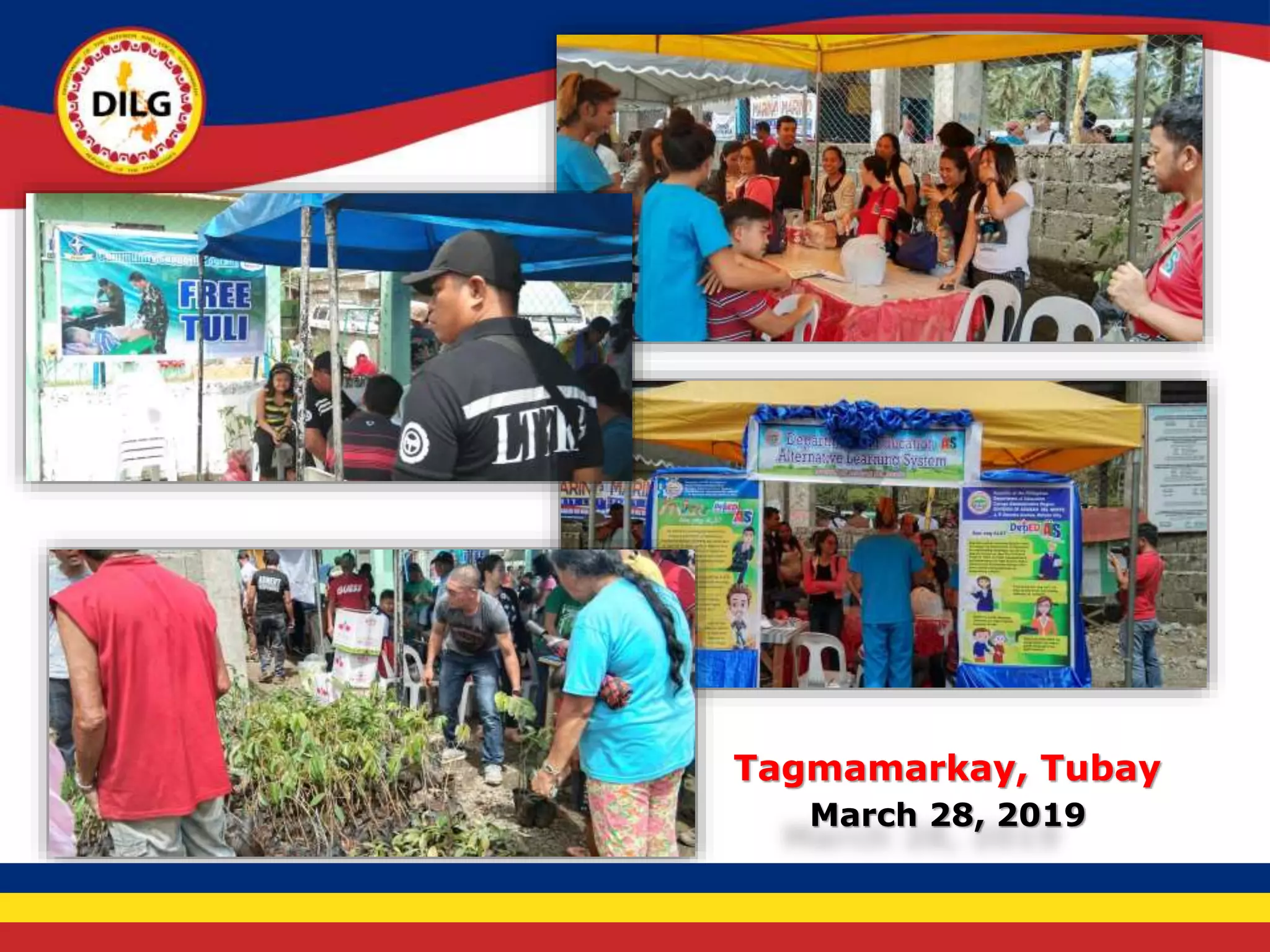
18
Tagmamarkay, Tubay
March 28, 2019
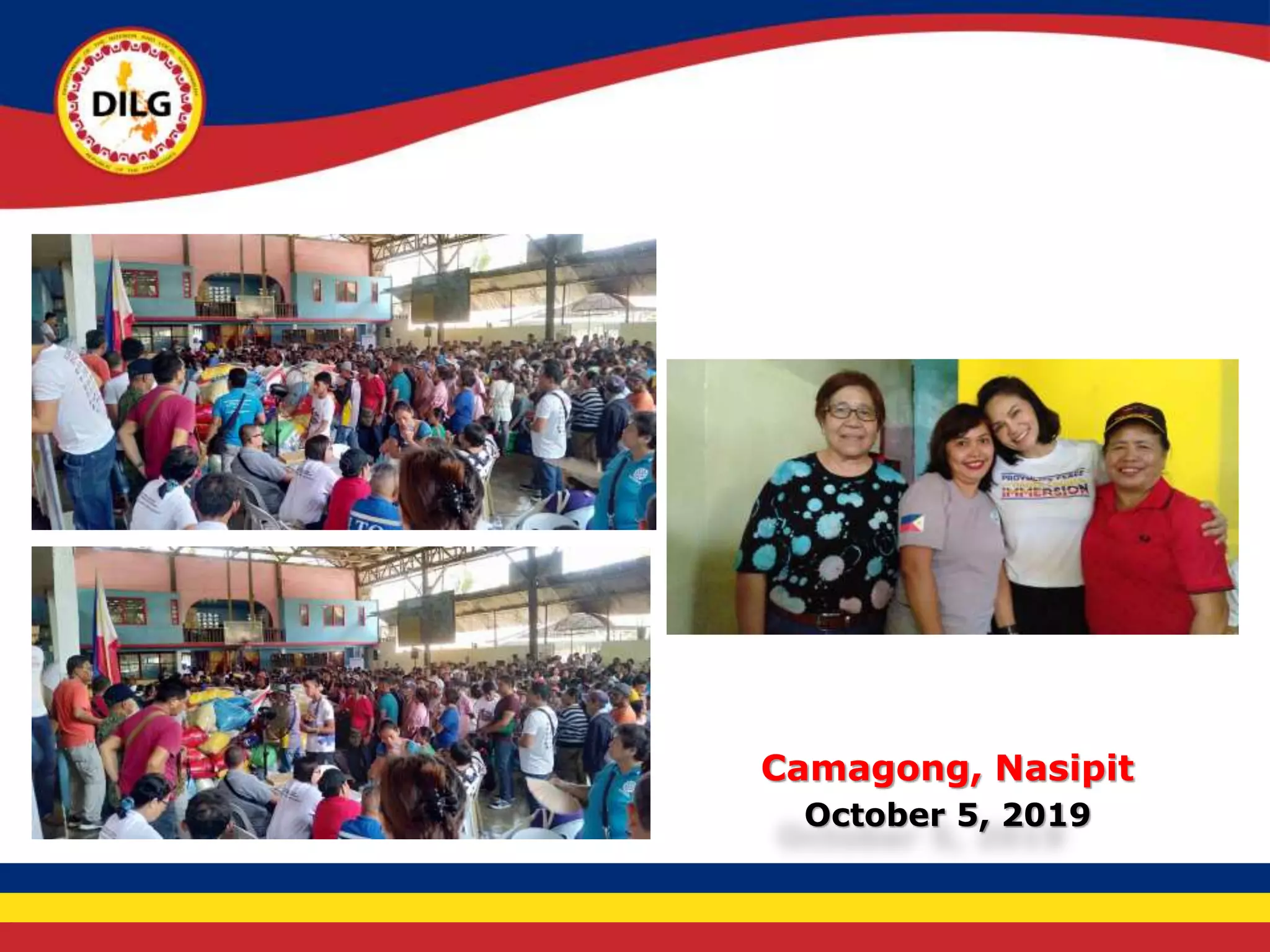
19
Camagong, Nasipit
October 5, 2019
Thank
you!

EO 70 UPDATES.ppt

  • 2.
    EO 70 Institutionalizing theWhole- of-Nation Approach in Attaining Inclusive and Sustainable Peace, Creating a National Task Force to End Local Communist Armed Conflict, and Directing the Adoption of a National Peace Framework
  • 3.
    Whole-of-Nation Approach A government policyfor the attainment of inclusive and sustainable peace. The Philippine Government shall prioritize and harmonize the delivery of basic services and social development packages in conflict- affected areas and vulnerable communities, facilitate societal inclusivity, and ensure active participation of all sectors of society in the pursuit of the country’s peace agenda.
  • 4.
    National Task Forceto End Local Communist Armed Conflict Composition:  President of the Republic of the Philippines – Chair  National Security Adviser – Vice-Chair ♦ Members:  Secretaries of DILG, DOJ, DND, DPWH, DBM, DOF, DAR, DSWD, DepEd, PCOO  Directors General of NEDA, NICA, TESDA, PNP  Presidential Adviser on the Peace Process  Presidential Adviser for Indigenous Peoples’ Concerns  Chief of Staff, AFP  Chairperson, NCIP  Two (2) Representatives from the private sector
  • 5.
    National Task Forceto End Local Communist Armed Conflict Except for the private sector representatives, the members may designate an alternate, with a rank not lower than an Assistant Secretary, to represent their respective offices in the Task Force, provided that the alternate must be fully authorized to decide on behalf of the member. The Private Sector Representatives, with a term of one (1) year each, shall be appointed by the President upon recommendation of the Task Force.
  • 6.
    Powers and Functionsof the National Task Force a. Formulate and implement in coordination with relevant national government agencies, LGUs, the civil society and other stakeholders, a Whole-of-Nation approach-driven National Peace Framework; b. Ensure inter-agency convergence in the implementation of the Framework in conflict-affected and vulnerable communities; c. Enlist the assistance of any department, bureau, office, agency, or instrumentality of the government, including LGUs, GOCCs, and SUCs, in accordance with their respective mandates, in the implementation of the Framework;
  • 7.
    Powers and Functionsof the National Task Force d. Evaluate, define, modify or integrate policies, programs and activities contained in the Framework; e. Organize ad hoc inter-agency and multi-sectoral clusters, councils, committees and groups in national, regional and local levels, or modify existing ones, whenever necessary, to fulfill its mandates; f. Develop strategic communication, advocacy, and peace constituency plans in case of ceasefire, as well as capacity- building measures, to enable local chief executives and local peace bodies to engage and facilitate local peace engagements or negotiations and interventions;
  • 8.
    Powers and Functionsof the National Task Force g. Review the mandates and functions of offices undertaking peace efforts to avoid duplication of functions and programs, and submit its recommendation/s to the President for approval; h. As may be necessary, issue supplemental guidelines, protocols or policies in furtherance of this Order; i. Recommend to the Office of the Presidential Adviser on the Peace Process projects in conflict-affected areas where the PAMANA Program may be implemented, subject to the provisions of the GAA; and j. Perform such other duties and functions as the President may direct
  • 9.
    The National Peace Framework TheFramework shall contain principles, policies, plans and programs that will bring inclusive and sustainable peace, and address the root causes of insurgences, internal disturbances, and tensions as well as other armed conflicts and threats in identified areas. The Framework shall be responsive to local needs and sensitive to realities on the ground. The Framework shall include a mechanism for localized peace engagements or negotiations and interventions that is nationally orchestrated, directed and supervised, while being locally implemented.
  • 10.
    Convergence All departments, bureaus,offices, agencies or instrumentalities of the government, including GOCCs and SUCs are directed to render the necessary support to the Task Force. The private sector, non-government organizations and other stakeholders are encouraged to participate in all peace-building programs, plans and activities, in the implementation of the Framework.
  • 11.
    WAY FORWARD: Encourage allHUC/Provincial Governments to create their Local Task Force-ELCAC for E.O. 70 Implementation in Caraga Region
  • 12.
    WAY FORWARD: What havewe done so far?
  • 13.
     CONDUCT OF PROVINCIAL/CITY/MUNICIPALAND BARANGAY PEACE AND ORDER AND PUBLIC SAFETY PLANNING (POPSP) TO INCLUDE PLANS, PROGRAMS AND ACTIVITIES IN LINE WITH THE IMPLEMENTATION OF EXECUTIVE ORDER NO. 70  CREATION OF PROVINCIAL/CITY/MUNICIPAL AND BARANGAY TASK FORCE ON ELCAC thru JOINT PROVINCIAL/CITY/MUNICIPAL AND BARANGAY DEVELOPMENT COUNCIL AND PROVINCIAL/CITY/MUNICIPAL AND BARANGAY PEACE AND ORDER COUNCIL/COMMITTEE
  • 14.
     ISSUANCE OFTHE MUNICIPALITIES OF NASIPIT AND BUENAVISTA DECLARING THE CNTs AS PERSONA NON GRATA  CONDUCT OF MULTISTAKEHOLDERS FORUM BY THE PROVINCE OF AGUSAN DEL NORTE AND THE MUNICIPALITY OF NASIPIT  ISSUANCE OF SEVERAL BARANGAYS OF THE PROVINCE OF AGUSAN DEL NORTE DECLARING CNTs AS PERSONA NON GRATA
  • 15.
     PLANNING ANDLAUNCHING OF THE “RENEWED AND INTENSIFIED COMMUNITY OUTREACH (RICO) PROGRAM “ BY THE MUNICIPALITY OF NASIPIT  PLANNING AND LAUNCHING OF “LENI CARES” BY THE MUNICIPALITY OF LAS NIEVES (COMMUNITY IMMERSION PROGRAM)
  • 16.
     REGULAR CONDUCTOF THE PROVINCIAL PEACE AND ORDER COUNCIL (PPOC) IMMERSION
  • 17.
  • 18.
  • 19.
  • 20.