USES OF ENZYMES
● Measurements ofenzymes are used in medicine
in two major ways.
● Enzymes are measured in serum and other body
fluids to detect injuryto atissue that makes up
the enzyme and are also measured, often within
a tissue, to identify abnormalities or absence of
the enzyme, which may cause disease.
● Some enzymes are found predominantly in
specialized tissue (eg, lipase in the pancreas);
others, more widely distributed,
Enzyme, is a substance that acts as a
catalyst in living organisms, regulating
the rate at which chemical reactions
proceed without itself being altered in
the process.
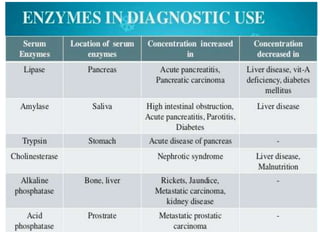
Diagnostic uses of enzymes
Enzymes are known as marker of cellular damage.
The amount of enzymes present in the plasma is
used for the investigation of the diseases of liver,
heart, skeletal muscle, biliary tract etc.
Classification of diagnostically important enzymes:
Liver, cardiac and skeletal enzymes
Biliary tract enzymes
Digestive enzymes of pancreatic origin
Liver, cardiac and skeletal enzymes:- Enzymes in this category
include:
Aminotransferases or transaminase
Increases plasma Aspartate aminotransferase(AST) level and increased
plasma alanine aminotransferase (ALT) level indicates liver diseases.
Increased AST level occurs after myocardial infraction as heart muscle
contains relatively high concentration of AST.
AST activity levels are increased in muscular dystrophy and
dermatomyositis.
Moderate increase of both AST and ALT have been observed after the
intake of alcohol, or after taking various drugs such as salicylates
ampicillin etc.
Alkaline phosphatase:- Plasma ALP level are particularly used in the
investigation of bone diseases and hepatobiliary diseases.
Biliary tract enzymes:-
Enzymes included in this category are
5’-Nucleotidase (nucleotide phosphate NTP)- Increased level of
serum NTP occur in hepatobiliary diseases in which there is
obstruction in the secretion of bile.
Gamma-glutamyl transferase GGT- Increased level of GGT occurs in
all form of liver diseases. It is used for the investigation of obstructive
jaundice, cholangitis (inflammation of bile duct) and cholecystitis
(inflammation of gall bladder).
Digestive enzymes of pancreatic origin:- The digestive enzymes are
investigated for the diagnosis of pancreatic diseases
Alpha-amylase:- Assays of amylase in the serum and urine are
primarily used for the diagnosis of pancreatic diseases like
pancreatitis, cholecystitis, tumors etc.
Trypsin:- Determination of serum trypsin can be used to screen for the
cystic fibrosis during first 6 weeks of life. Also it is used in pancreatic
ductules.
Chymotrypsin:- As with amylase and trypsin, elevation of serum
chymotrypsin level if reaches 8 times the normal level than it
indicates renal failure
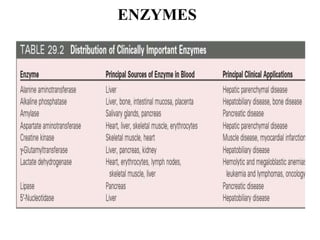
ENZYMES
ISOENZYMES
□ Catalyze the same reaction.
□ Differ in AA sequence and physical properties
□ Separable on the basis of charge.
□ Are tissue specific.
Different Isoenzymes may arise from
□ different tissues and their specific detection may give clues to the site
of pathology.
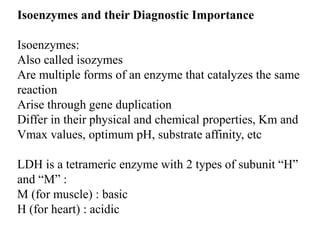
Isoenzymes and their Diagnostic Importance
Isoenzymes:
Also called isozymes
Are multiple forms of an enzyme that catalyzes the same
reaction
Arise through gene duplication
Differ in their physical and chemical properties, Km and
Vmax values, optimum pH, substrate affinity, etc
LDH is a tetrameric enzyme with 2 types of subunit “H”
and “M” :
M (for muscle) : basic
H (for heart) : acidic
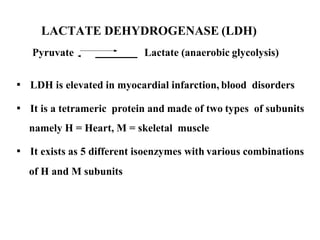
LACTATE DEHYDROGENASE (LDH)
Pyruvate Lactate (anaerobic glycolysis)
▪ LDH is elevated in myocardial infarction, blood disorders
▪ It is a tetrameric protein and made of two types of subunits
namely H = Heart, M = skeletal muscle
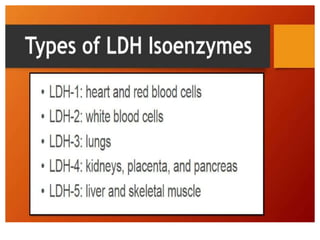
▪ It exists as 5 different isoenzymes with various combinations
of H and M subunits
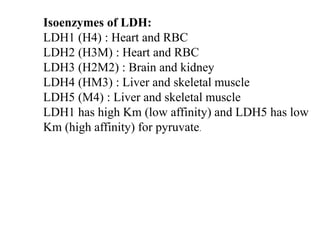
Isoenzymes of LDH:
LDH1 (H4) : Heart and RBC
LDH2 (H3M) : Heart and RBC
LDH3 (H2M2) : Brain and kidney
LDH4 (HM3) : Liver and skeletal muscle
LDH5 (M4) : Liver and skeletal muscle
LDH1 has high Km (low affinity) and LDH5 has low
Km (high affinity) for pyruvate.
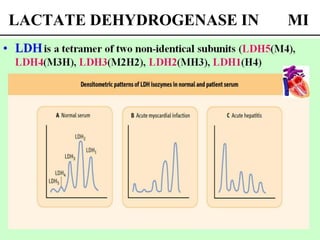
LACTATE DEHYDROGENASE IN MI
Diagnositc importance of LDH:
Normal: LDH2 > LDH1
Myocardial infarction (within 12-24 hours):
LDH1>>LDH2 (flipped LDH pattern)
Liver diseases: increased LDH5 in serum
Increased LDH suggests other following diseases:
Hemolytic anemia
Hypotension
Infectious mononucleosis
Intestinal ischemia and infarction
Muscle injury
Muscular dystrophy
Pancreatitis
Lung tissue death
Stroke
Ischemic cardiomyopathy
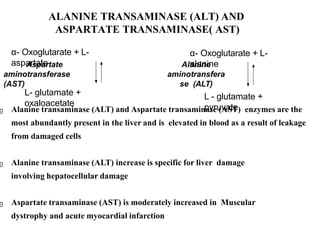
Alanine
aminotransfera
se (ALT)
Aspartate
aminotransferase
(AST)
ALANINE TRANSAMINASE (ALT) AND
ASPARTATE TRANSAMINASE( AST)
α- Oxoglutarate + L-
aspartate
L- glutamate +
oxaloacetate
L - glutamate +
pyruvate
α- Oxoglutarate + L-
alanine
□ Alanine transaminase (ALT) and Aspartate transaminase (AST) enzymes are the
most abundantly present in the liver and is elevated in blood as a result of leakage
from damaged cells
□ Alanine transaminase (ALT) increase is specific for liver damage
involving hepatocellular damage
□ Aspartate transaminase (AST) is moderately increased in Muscular
dystrophy and acute myocardial infarction
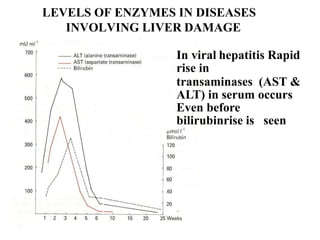
LEVELS OF ENZYMES IN DISEASES
INVOLVING LIVER DAMAGE
In viral hepatitis Rapid
rise in
transaminases (AST &
ALT) in serum occurs
Even before
bilirubinrise is seen
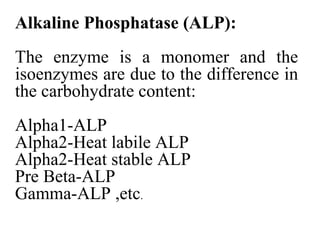
Alkaline Phosphatase (ALP):
The enzyme is a monomer and the
isoenzymes are due to the difference in
the carbohydrate content:
Alpha1-ALP
Alpha2-Heat labile ALP
Alpha2-Heat stable ALP
Pre Beta-ALP
Gamma-ALP ,etc.
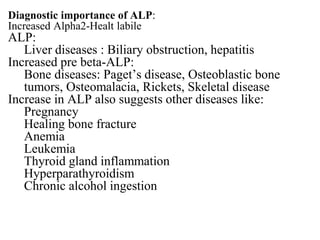
Diagnostic importance of ALP:
Increased Alpha2-Healt labile
ALP:
Liver diseases : Biliary obstruction, hepatitis
Increased pre beta-ALP:
Bone diseases: Paget’s disease, Osteoblastic bone
tumors, Osteomalacia, Rickets, Skeletal disease
Increase in ALP also suggests other diseases like:
Pregnancy
Healing bone fracture
Anemia
Leukemia
Thyroid gland inflammation
Hyperparathyroidism
Chronic alcohol ingestion
Myocardial Infraction
CREATINE KINASE (CK)
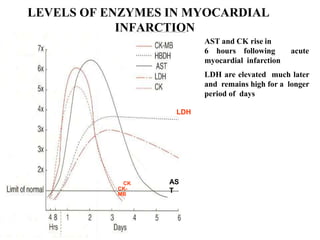
LEVELS OF ENZYMES IN MYOCARDIAL
INFARCTION
CK
CK-
MB
AS
T
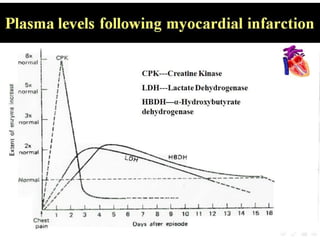
AST and CK rise in
6 hours following acute
myocardial infarction
LDH are elevated much later
and remains high for a longer
period of days
LDH
Creatine Phosphokinase (CPK)
Phosphocreatine ←CPK→ Creatine
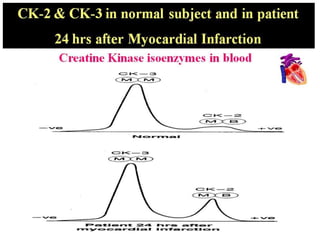
CPK is a dimeric enzyme consisting of 2 subunits:
a. M : for muscle
b. B : for brain
Isoenzymes of CPK:
CPK1 (BB) : Brain
CPK2 (MB) : Heart
CPK3 (MM) : Skeletal muscles
Diagnositic importance of CPK:
Normal: low CPK2 (<2%) in serum
MI (within 6-18 hrs): increased CPK2 (20%) in serum
Increased CPK-1 suggests:
Brain cancer
Brain injury
Pulmonary infarction
Seizure
Increased CPK-2 suggests other diseases like:
Electrical injuries
Heart injury
Myocarditis
Increased CPK-3 suggests:
Crush injuries
Rhabdomyolysis
Muscular dystrophy
Myositis
Recent seizures
.
Analytical uses of enzymes
Enzymes can be used as reagents and labels.
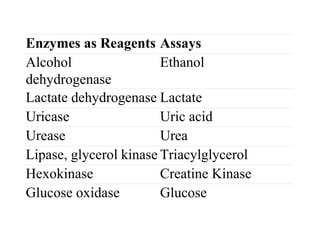
Enzymes as reagents:- Enzymes are used in laboratories
as reagents for the estimation of serum constituents.
Enzymes as labels:- Many enzymes are used as the label
in various immunoassays for the determination of serum
level of drugs, hormones, and other compounds.
Examples :
Glucose-6-phosphate dehydrogenase
Alkaline phosphatase
Beta-galactosidase
Peroxidase
Enzymes as Reagents Assays
Alcohol
dehydrogenase
Ethanol
Lactate dehydrogenase Lactate
Uricase Uric acid
Urease Urea
Lipase, glycerol kinase Triacylglycerol
Hexokinase Creatine Kinase
Glucose oxidase Glucose
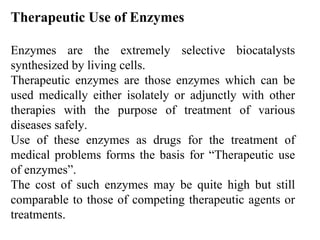
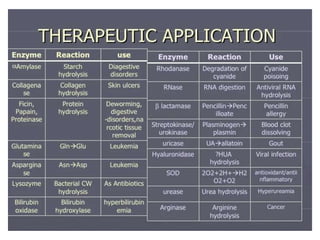
Therapeutic Use of Enzymes
Enzymes are the extremely selective biocatalysts
synthesized by living cells.
Therapeutic enzymes are those enzymes which can be
used medically either isolately or adjunctly with other
therapies with the purpose of treatment of various
diseases safely.
Use of these enzymes as drugs for the treatment of
medical problems forms the basis for “Therapeutic use
of enzymes”.
The cost of such enzymes may be quite high but still
comparable to those of competing therapeutic agents or
treatments.
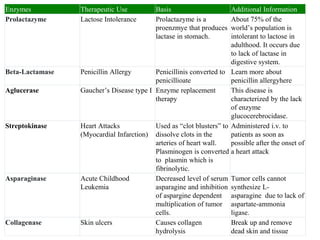
Enzymes Therapeutic Use Basis Additional Information
Prolactazyme Lactose Intolerance Prolactazyme is a
proenzmye that produces
lactase in stomach.
About 75% of the
world’s population is
intolerant to lactose in
adulthood. It occurs due
to lack of lactase in
digestive system.
Beta-Lactamase Penicillin Allergy Penicillinis converted to
penicillioate
Learn more about
penicillin allergyhere
Aglucerase Gaucher’s Disease type I Enzyme replacement
therapy
This disease is
characterized by the lack
of enzyme
glucocerebrocidase.
Streptokinase Heart Attacks
(Myocardial Infarction)
Used as “clot blusters” to
dissolve clots in the
arteries of heart wall.
Plasminogen is converted
to plasmin which is
fibrinolytic.
Administered i.v. to
patients as soon as
possible after the onset of
a heart attack
Asparaginase Acute Childhood
Leukemia
Decreased level of serum
asparagine and inhibition
of aspargine dependent
multiplication of tumor
cells.
Tumor cells cannot
synthesize L-
asparagine due to lack of
aspartate-ammonia
ligase.
Collagenase Skin ulcers Causes collagen
hydrolysis
Break up and remove
dead skin and tissue
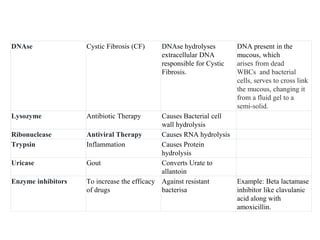
DNAse Cystic Fibrosis (CF) DNAse hydrolyses
extracellular DNA
responsible for Cystic
Fibrosis.
DNA present in the
mucous, which
arises from dead
WBCs and bacterial
cells, serves to cross link
the mucous, changing it
from a fluid gel to a
semi-solid.
Lysozyme Antibiotic Therapy Causes Bacterial cell
wall hydrolysis
Ribonuclease Antiviral Therapy Causes RNA hydrolysis
Trypsin Inflammation Causes Protein
hydrolysis
Uricase Gout Converts Urate to
allantoin
Enzyme inhibitors To increase the efficacy
of drugs
Against resistant
bacterisa
Example: Beta lactamase
inhibitor like clavulanic
acid along with
amoxicillin.
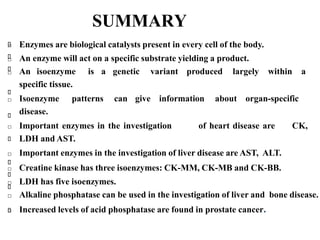
SUMMARY
□ Enzymes are biological catalysts present in every cell of the body.
□ An enzyme will act on a specific substrate yielding a product.
□ An isoenzyme is a genetic variant produced largely within a
specific tissue.
□ Isoenzyme patterns can give information about organ-specific
disease.
□ Important enzymes in the investigation of heart disease are CK,
LDH and AST.
□ Important enzymes in the investigation of liver disease are AST, ALT.
□ Creatine kinase has three isoenzymes: CK-MM, CK-MB and CK-BB.
□ LDH has five isoenzymes.
□ Alkaline phosphatase can be used in the investigation of liver and bone disease.
□ Increased levels of acid phosphatase are found in prostate cancer.
Enzyme - uses.pptx

Enzyme - uses.pptx

  • 1.
  • 2.
    ● Measurements ofenzymesare used in medicine in two major ways. ● Enzymes are measured in serum and other body fluids to detect injuryto atissue that makes up the enzyme and are also measured, often within a tissue, to identify abnormalities or absence of the enzyme, which may cause disease. ● Some enzymes are found predominantly in specialized tissue (eg, lipase in the pancreas); others, more widely distributed,
  • 3.
    Enzyme, is asubstance that acts as a catalyst in living organisms, regulating the rate at which chemical reactions proceed without itself being altered in the process.
  • 4.
    Diagnostic uses ofenzymes Enzymes are known as marker of cellular damage. The amount of enzymes present in the plasma is used for the investigation of the diseases of liver, heart, skeletal muscle, biliary tract etc. Classification of diagnostically important enzymes: Liver, cardiac and skeletal enzymes Biliary tract enzymes Digestive enzymes of pancreatic origin
  • 5.
    Liver, cardiac andskeletal enzymes:- Enzymes in this category include: Aminotransferases or transaminase Increases plasma Aspartate aminotransferase(AST) level and increased plasma alanine aminotransferase (ALT) level indicates liver diseases. Increased AST level occurs after myocardial infraction as heart muscle contains relatively high concentration of AST. AST activity levels are increased in muscular dystrophy and dermatomyositis. Moderate increase of both AST and ALT have been observed after the intake of alcohol, or after taking various drugs such as salicylates ampicillin etc. Alkaline phosphatase:- Plasma ALP level are particularly used in the investigation of bone diseases and hepatobiliary diseases.
  • 6.
    Biliary tract enzymes:- Enzymesincluded in this category are 5’-Nucleotidase (nucleotide phosphate NTP)- Increased level of serum NTP occur in hepatobiliary diseases in which there is obstruction in the secretion of bile. Gamma-glutamyl transferase GGT- Increased level of GGT occurs in all form of liver diseases. It is used for the investigation of obstructive jaundice, cholangitis (inflammation of bile duct) and cholecystitis (inflammation of gall bladder). Digestive enzymes of pancreatic origin:- The digestive enzymes are investigated for the diagnosis of pancreatic diseases Alpha-amylase:- Assays of amylase in the serum and urine are primarily used for the diagnosis of pancreatic diseases like pancreatitis, cholecystitis, tumors etc. Trypsin:- Determination of serum trypsin can be used to screen for the cystic fibrosis during first 6 weeks of life. Also it is used in pancreatic ductules. Chymotrypsin:- As with amylase and trypsin, elevation of serum chymotrypsin level if reaches 8 times the normal level than it indicates renal failure
  • 7.
  • 8.
    ISOENZYMES □ Catalyze thesame reaction. □ Differ in AA sequence and physical properties □ Separable on the basis of charge. □ Are tissue specific. Different Isoenzymes may arise from □ different tissues and their specific detection may give clues to the site of pathology.
  • 9.
    Isoenzymes and theirDiagnostic Importance Isoenzymes: Also called isozymes Are multiple forms of an enzyme that catalyzes the same reaction Arise through gene duplication Differ in their physical and chemical properties, Km and Vmax values, optimum pH, substrate affinity, etc LDH is a tetrameric enzyme with 2 types of subunit “H” and “M” : M (for muscle) : basic H (for heart) : acidic
  • 10.
    LACTATE DEHYDROGENASE (LDH) PyruvateLactate (anaerobic glycolysis) ▪ LDH is elevated in myocardial infarction, blood disorders ▪ It is a tetrameric protein and made of two types of subunits namely H = Heart, M = skeletal muscle ▪ It exists as 5 different isoenzymes with various combinations of H and M subunits
  • 12.
    Isoenzymes of LDH: LDH1(H4) : Heart and RBC LDH2 (H3M) : Heart and RBC LDH3 (H2M2) : Brain and kidney LDH4 (HM3) : Liver and skeletal muscle LDH5 (M4) : Liver and skeletal muscle LDH1 has high Km (low affinity) and LDH5 has low Km (high affinity) for pyruvate.
  • 13.
  • 14.
    Diagnositc importance ofLDH: Normal: LDH2 > LDH1 Myocardial infarction (within 12-24 hours): LDH1>>LDH2 (flipped LDH pattern) Liver diseases: increased LDH5 in serum Increased LDH suggests other following diseases: Hemolytic anemia Hypotension Infectious mononucleosis Intestinal ischemia and infarction Muscle injury Muscular dystrophy Pancreatitis Lung tissue death Stroke Ischemic cardiomyopathy
  • 16.
    Alanine aminotransfera se (ALT) Aspartate aminotransferase (AST) ALANINE TRANSAMINASE(ALT) AND ASPARTATE TRANSAMINASE( AST) α- Oxoglutarate + L- aspartate L- glutamate + oxaloacetate L - glutamate + pyruvate α- Oxoglutarate + L- alanine □ Alanine transaminase (ALT) and Aspartate transaminase (AST) enzymes are the most abundantly present in the liver and is elevated in blood as a result of leakage from damaged cells □ Alanine transaminase (ALT) increase is specific for liver damage involving hepatocellular damage □ Aspartate transaminase (AST) is moderately increased in Muscular dystrophy and acute myocardial infarction
  • 17.
    LEVELS OF ENZYMESIN DISEASES INVOLVING LIVER DAMAGE In viral hepatitis Rapid rise in transaminases (AST & ALT) in serum occurs Even before bilirubinrise is seen
  • 18.
    Alkaline Phosphatase (ALP): Theenzyme is a monomer and the isoenzymes are due to the difference in the carbohydrate content: Alpha1-ALP Alpha2-Heat labile ALP Alpha2-Heat stable ALP Pre Beta-ALP Gamma-ALP ,etc.
  • 19.
    Diagnostic importance ofALP: Increased Alpha2-Healt labile ALP: Liver diseases : Biliary obstruction, hepatitis Increased pre beta-ALP: Bone diseases: Paget’s disease, Osteoblastic bone tumors, Osteomalacia, Rickets, Skeletal disease Increase in ALP also suggests other diseases like: Pregnancy Healing bone fracture Anemia Leukemia Thyroid gland inflammation Hyperparathyroidism Chronic alcohol ingestion
  • 20.
  • 21.
  • 23.
    LEVELS OF ENZYMESIN MYOCARDIAL INFARCTION CK CK- MB AS T AST and CK rise in 6 hours following acute myocardial infarction LDH are elevated much later and remains high for a longer period of days LDH
  • 25.
    Creatine Phosphokinase (CPK) Phosphocreatine←CPK→ Creatine CPK is a dimeric enzyme consisting of 2 subunits: a. M : for muscle b. B : for brain Isoenzymes of CPK: CPK1 (BB) : Brain CPK2 (MB) : Heart CPK3 (MM) : Skeletal muscles Diagnositic importance of CPK: Normal: low CPK2 (<2%) in serum MI (within 6-18 hrs): increased CPK2 (20%) in serum
  • 26.
    Increased CPK-1 suggests: Braincancer Brain injury Pulmonary infarction Seizure Increased CPK-2 suggests other diseases like: Electrical injuries Heart injury Myocarditis Increased CPK-3 suggests: Crush injuries Rhabdomyolysis Muscular dystrophy Myositis Recent seizures .
  • 28.
    Analytical uses ofenzymes Enzymes can be used as reagents and labels. Enzymes as reagents:- Enzymes are used in laboratories as reagents for the estimation of serum constituents. Enzymes as labels:- Many enzymes are used as the label in various immunoassays for the determination of serum level of drugs, hormones, and other compounds. Examples : Glucose-6-phosphate dehydrogenase Alkaline phosphatase Beta-galactosidase Peroxidase
  • 29.
    Enzymes as ReagentsAssays Alcohol dehydrogenase Ethanol Lactate dehydrogenase Lactate Uricase Uric acid Urease Urea Lipase, glycerol kinase Triacylglycerol Hexokinase Creatine Kinase Glucose oxidase Glucose
  • 30.
    Therapeutic Use ofEnzymes Enzymes are the extremely selective biocatalysts synthesized by living cells. Therapeutic enzymes are those enzymes which can be used medically either isolately or adjunctly with other therapies with the purpose of treatment of various diseases safely. Use of these enzymes as drugs for the treatment of medical problems forms the basis for “Therapeutic use of enzymes”. The cost of such enzymes may be quite high but still comparable to those of competing therapeutic agents or treatments.
  • 32.
    Enzymes Therapeutic UseBasis Additional Information Prolactazyme Lactose Intolerance Prolactazyme is a proenzmye that produces lactase in stomach. About 75% of the world’s population is intolerant to lactose in adulthood. It occurs due to lack of lactase in digestive system. Beta-Lactamase Penicillin Allergy Penicillinis converted to penicillioate Learn more about penicillin allergyhere Aglucerase Gaucher’s Disease type I Enzyme replacement therapy This disease is characterized by the lack of enzyme glucocerebrocidase. Streptokinase Heart Attacks (Myocardial Infarction) Used as “clot blusters” to dissolve clots in the arteries of heart wall. Plasminogen is converted to plasmin which is fibrinolytic. Administered i.v. to patients as soon as possible after the onset of a heart attack Asparaginase Acute Childhood Leukemia Decreased level of serum asparagine and inhibition of aspargine dependent multiplication of tumor cells. Tumor cells cannot synthesize L- asparagine due to lack of aspartate-ammonia ligase. Collagenase Skin ulcers Causes collagen hydrolysis Break up and remove dead skin and tissue
  • 33.
    DNAse Cystic Fibrosis(CF) DNAse hydrolyses extracellular DNA responsible for Cystic Fibrosis. DNA present in the mucous, which arises from dead WBCs and bacterial cells, serves to cross link the mucous, changing it from a fluid gel to a semi-solid. Lysozyme Antibiotic Therapy Causes Bacterial cell wall hydrolysis Ribonuclease Antiviral Therapy Causes RNA hydrolysis Trypsin Inflammation Causes Protein hydrolysis Uricase Gout Converts Urate to allantoin Enzyme inhibitors To increase the efficacy of drugs Against resistant bacterisa Example: Beta lactamase inhibitor like clavulanic acid along with amoxicillin.
  • 34.
    SUMMARY □ Enzymes arebiological catalysts present in every cell of the body. □ An enzyme will act on a specific substrate yielding a product. □ An isoenzyme is a genetic variant produced largely within a specific tissue. □ Isoenzyme patterns can give information about organ-specific disease. □ Important enzymes in the investigation of heart disease are CK, LDH and AST. □ Important enzymes in the investigation of liver disease are AST, ALT. □ Creatine kinase has three isoenzymes: CK-MM, CK-MB and CK-BB. □ LDH has five isoenzymes. □ Alkaline phosphatase can be used in the investigation of liver and bone disease. □ Increased levels of acid phosphatase are found in prostate cancer.