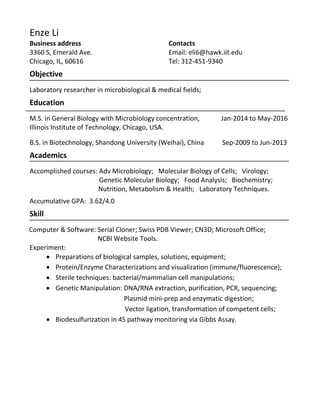
Enze Li
Business address
3360 S, Emerald Ave.
Chicago, IL, 60616
Contacts
Email: eli6@hawk.iit.edu
Tel: 312-451-9340
Objective
Laboratory researcher in microbiological & medical fields;
Education
M.S. in General Biology with Microbiology concentration, Jan-2014 to May-2016
Illinois Institute of Technology, Chicago, USA.
B.S. in Biotechnology, Shandong University (Weihai), China Sep-2009 to Jun-2013
Academics
Accomplished courses: Adv Microbiology; Molecular Biology of Cells; Virology;
Genetic Molecular Biology; Food Analysis; Biochemistry;
Nutrition, Metabolism & Health; Laboratory Techniques.
Accumulative GPA: 3.62/4.0
Skill
Computer & Software: Serial Cloner; Swiss PDB Viewer; CN3D; Microsoft Office;
NCBI Website Tools.
Experiment:
 Preparations of biological samples, solutions, equipment;
 Protein/Enzyme Characterizations and visualization (immune/fluorescence);
 Sterile techniques: bacterial/mammalian cell manipulations;
 Genetic Manipulation: DNA/RNA extraction, purification, PCR, sequencing;
Plasmid mini-prep and enzymatic digestion;
Vector ligation, transformation of competent cells;
 Biodesulfurization in 4S pathway monitoring via Gibbs Assay.
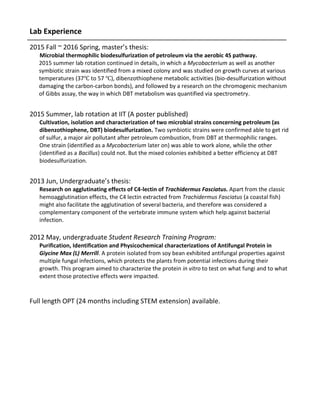
Lab Experience
2015 Fall ~ 2016 Spring, master’s thesis:
Microbial thermophilic biodesulfurization of petroleum via the aerobic 4S pathway.
2015 summer lab rotation continued in details, in which a Mycobacterium as well as another
symbiotic strain was identified from a mixed colony and was studied on growth curves at various
temperatures (37℃ to 57 ℃), dibenzothiophene metabolic activities (bio-desulfurization without
damaging the carbon-carbon bonds), and followed by a research on the chromogenic mechanism
of Gibbs assay, the way in which DBT metabolism was quantified via spectrometry.
2015 Summer, lab rotation at IIT (A poster published)
Cultivation, isolation and characterization of two microbial strains concerning petroleum (as
dibenzothiophene, DBT) biodesulfurization. Two symbiotic strains were confirmed able to get rid
of sulfur, a major air pollutant after petroleum combustion, from DBT at thermophilic ranges.
One strain (identified as a Mycobacterium later on) was able to work alone, while the other
(identified as a Bacillus) could not. But the mixed colonies exhibited a better efficiency at DBT
biodesulfurization.
2013 Jun, Undergraduate’s thesis:
Research on agglutinating effects of C4-lectin of Trachidermus Fasciatus. Apart from the classic
hemoagglutination effects, the C4 lectin extracted from Trachidermus Fasciatus (a coastal fish)
might also facilitate the agglutination of several bacteria, and therefore was considered a
complementary component of the vertebrate immune system which help against bacterial
infection.
2012 May, undergraduate Student Research Training Program:
Purification, Identification and Physicochemical characterizations of Antifungal Protein in
Giycine Max (L) Merrill. A protein isolated from soy bean exhibited antifungal properties against
multiple fungal infections, which protects the plants from potential infections during their
growth. This program aimed to characterize the protein in vitro to test on what fungi and to what
extent those protective effects were impacted.
Full length OPT (24 months including STEM extension) available.

Enze Li CV

  • 1.
    Enze Li Business address 3360S, Emerald Ave. Chicago, IL, 60616 Contacts Email: eli6@hawk.iit.edu Tel: 312-451-9340 Objective Laboratory researcher in microbiological & medical fields; Education M.S. in General Biology with Microbiology concentration, Jan-2014 to May-2016 Illinois Institute of Technology, Chicago, USA. B.S. in Biotechnology, Shandong University (Weihai), China Sep-2009 to Jun-2013 Academics Accomplished courses: Adv Microbiology; Molecular Biology of Cells; Virology; Genetic Molecular Biology; Food Analysis; Biochemistry; Nutrition, Metabolism & Health; Laboratory Techniques. Accumulative GPA: 3.62/4.0 Skill Computer & Software: Serial Cloner; Swiss PDB Viewer; CN3D; Microsoft Office; NCBI Website Tools. Experiment:  Preparations of biological samples, solutions, equipment;  Protein/Enzyme Characterizations and visualization (immune/fluorescence);  Sterile techniques: bacterial/mammalian cell manipulations;  Genetic Manipulation: DNA/RNA extraction, purification, PCR, sequencing; Plasmid mini-prep and enzymatic digestion; Vector ligation, transformation of competent cells;  Biodesulfurization in 4S pathway monitoring via Gibbs Assay.
  • 2.
    Lab Experience 2015 Fall~ 2016 Spring, master’s thesis: Microbial thermophilic biodesulfurization of petroleum via the aerobic 4S pathway. 2015 summer lab rotation continued in details, in which a Mycobacterium as well as another symbiotic strain was identified from a mixed colony and was studied on growth curves at various temperatures (37℃ to 57 ℃), dibenzothiophene metabolic activities (bio-desulfurization without damaging the carbon-carbon bonds), and followed by a research on the chromogenic mechanism of Gibbs assay, the way in which DBT metabolism was quantified via spectrometry. 2015 Summer, lab rotation at IIT (A poster published) Cultivation, isolation and characterization of two microbial strains concerning petroleum (as dibenzothiophene, DBT) biodesulfurization. Two symbiotic strains were confirmed able to get rid of sulfur, a major air pollutant after petroleum combustion, from DBT at thermophilic ranges. One strain (identified as a Mycobacterium later on) was able to work alone, while the other (identified as a Bacillus) could not. But the mixed colonies exhibited a better efficiency at DBT biodesulfurization. 2013 Jun, Undergraduate’s thesis: Research on agglutinating effects of C4-lectin of Trachidermus Fasciatus. Apart from the classic hemoagglutination effects, the C4 lectin extracted from Trachidermus Fasciatus (a coastal fish) might also facilitate the agglutination of several bacteria, and therefore was considered a complementary component of the vertebrate immune system which help against bacterial infection. 2012 May, undergraduate Student Research Training Program: Purification, Identification and Physicochemical characterizations of Antifungal Protein in Giycine Max (L) Merrill. A protein isolated from soy bean exhibited antifungal properties against multiple fungal infections, which protects the plants from potential infections during their growth. This program aimed to characterize the protein in vitro to test on what fungi and to what extent those protective effects were impacted. Full length OPT (24 months including STEM extension) available.