INTRODUCTION:
DEFORESTATIONS
NAME-RAJEEV KUMAR
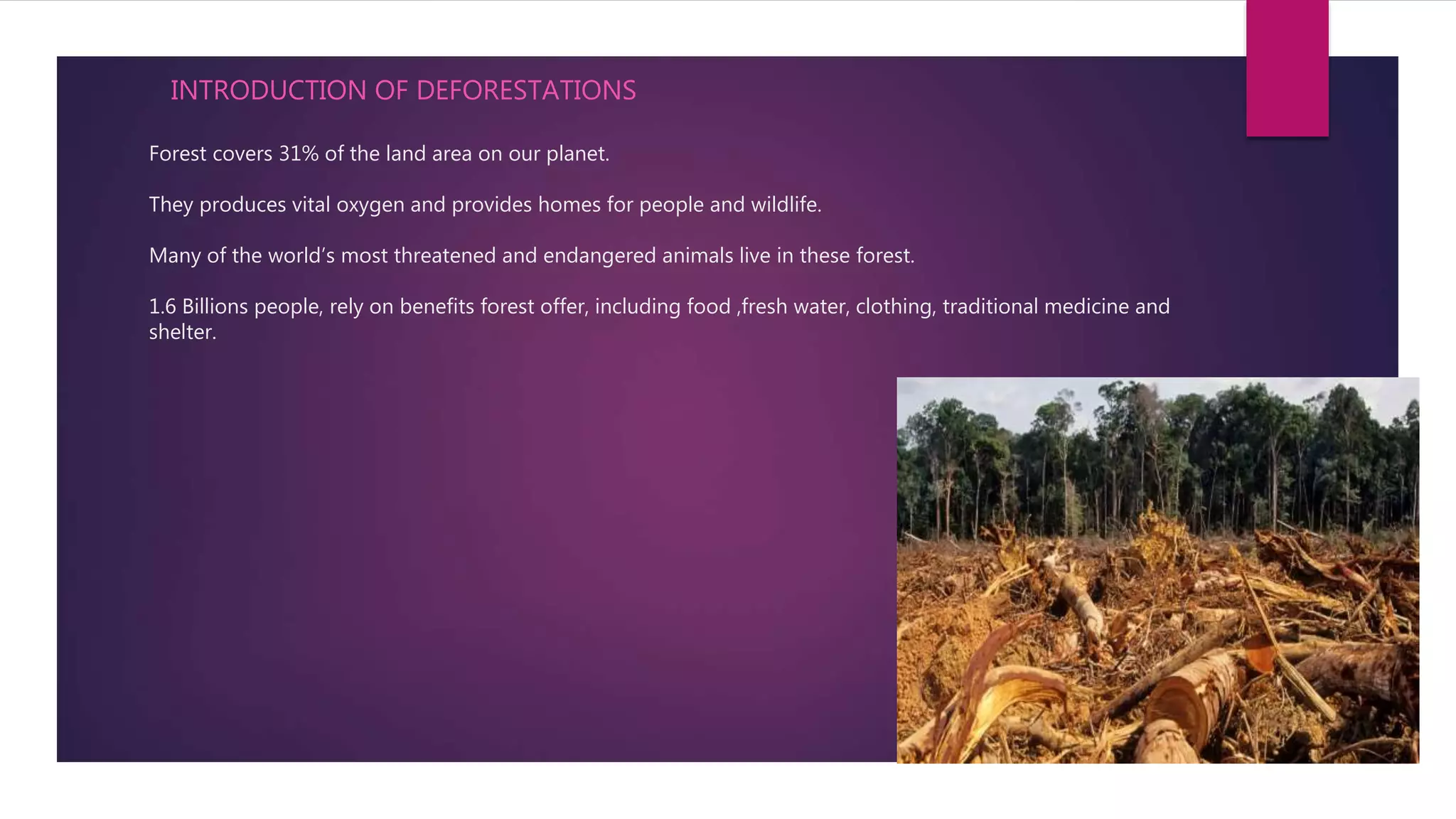
Forest covers 31% of the land area on our planet.
They produces vital oxygen and provides homes for people and wildlife.
Many of the world’s most threatened and endangered animals live in these forest.
1.6 Billions people, rely on benefits forest offer, including food ,fresh water, clothing, traditional medicine and
shelter.
INTRODUCTION OF DEFORESTATIONS
What is Deforestation
When human remove or clear large area of forest land related ecosystem
for non forest use.
These include clearing for farming purpose, ranching and urban use.
In these cases, Trees are never re-panted.
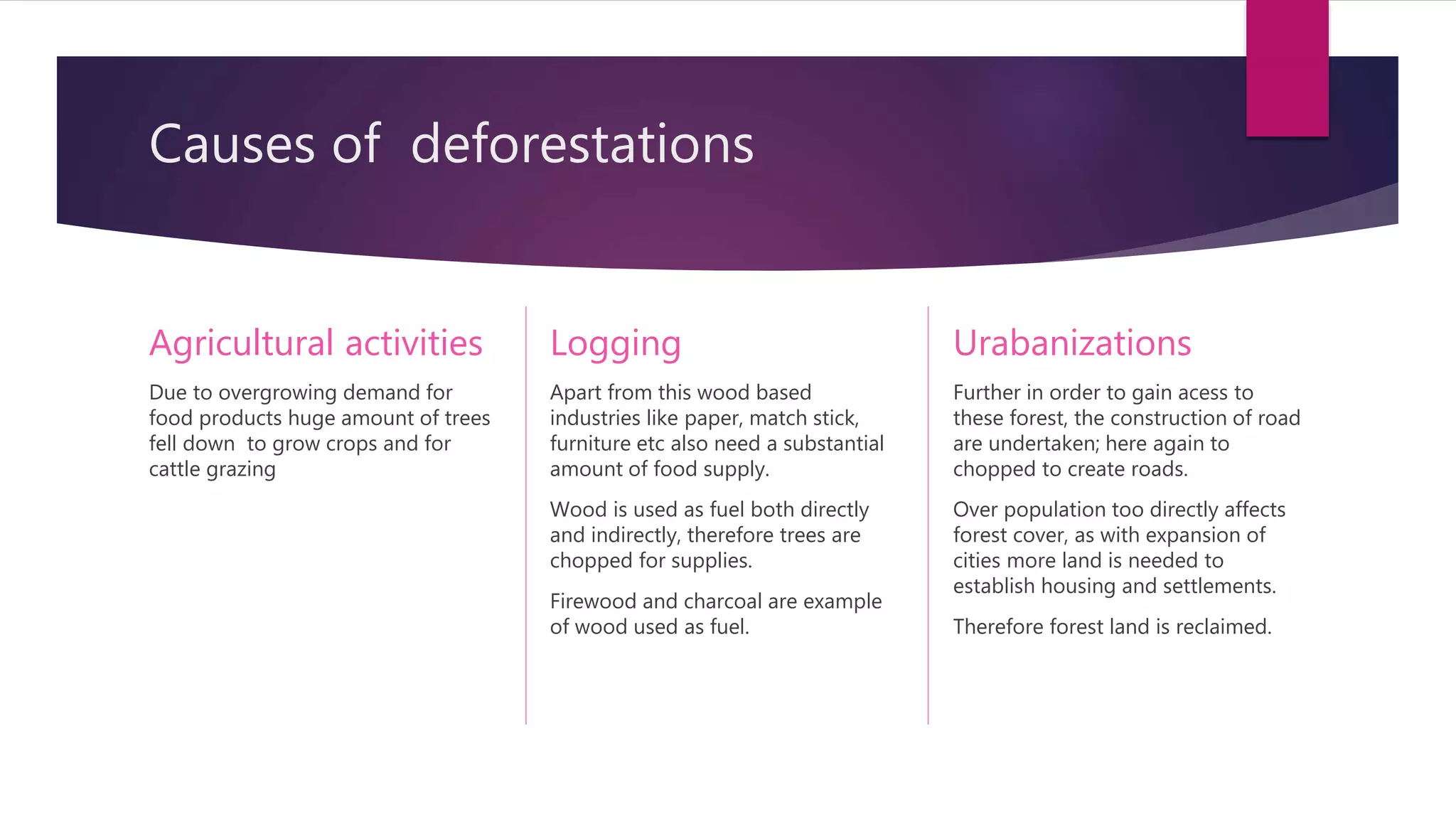
Causes of deforestations
Agricultural activities
Due to overgrowing demand for
food products huge amount of trees
fell down to grow crops and for
cattle grazing
Logging
Apart from this wood based
industries like paper, match stick,
furniture etc also need a substantial
amount of food supply.
Wood is used as fuel both directly
and indirectly, therefore trees are
chopped for supplies.
Firewood and charcoal are example
of wood used as fuel.
Urabanizations
Further in order to gain acess to
these forest, the construction of road
are undertaken; here again to
chopped to create roads.
Over population too directly affects
forest cover, as with expansion of
cities more land is needed to
establish housing and settlements.
Therefore forest land is reclaimed.
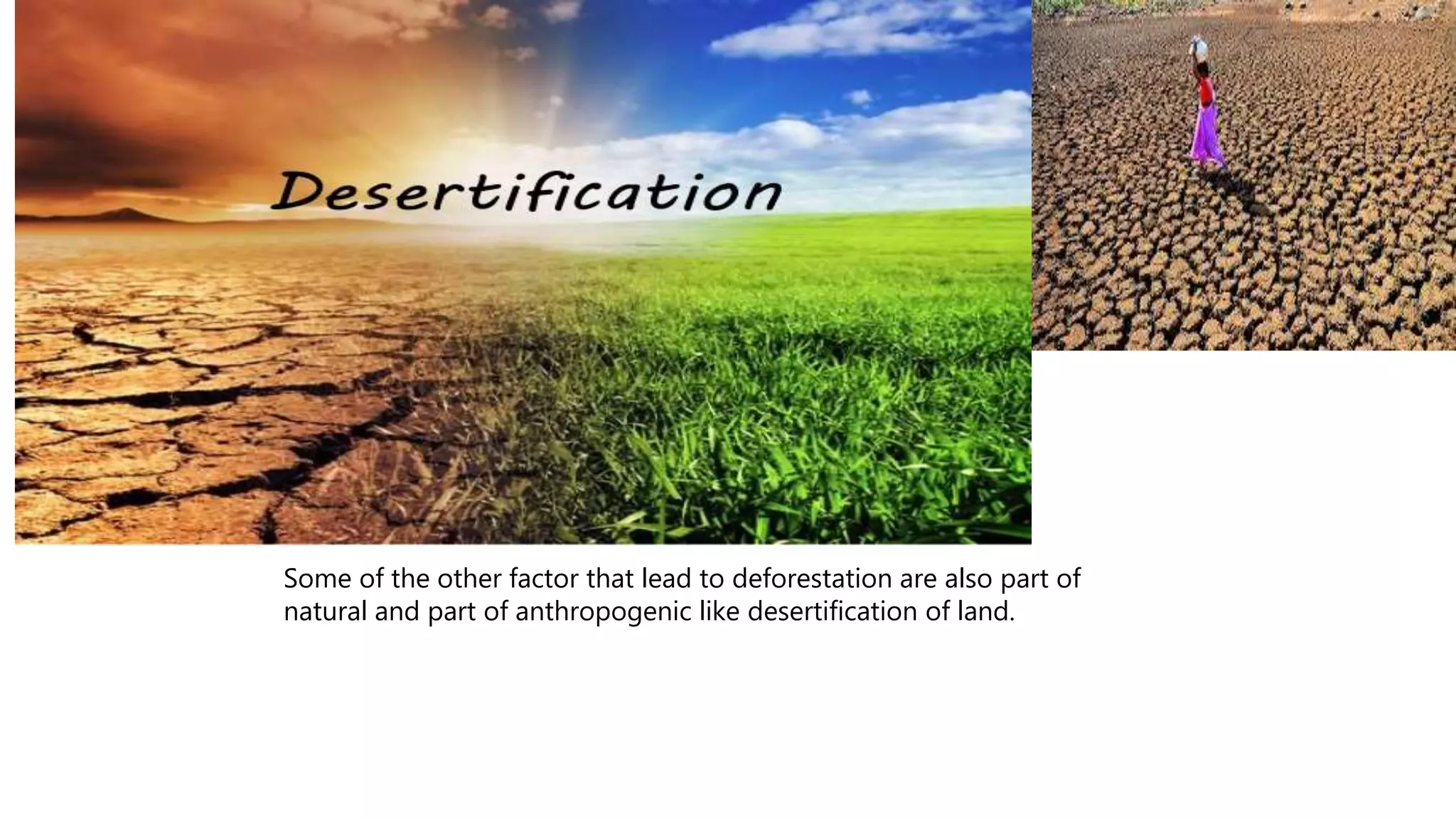
Some of the other factor that lead to deforestation are also part of
natural and part of anthropogenic like desertification of land.
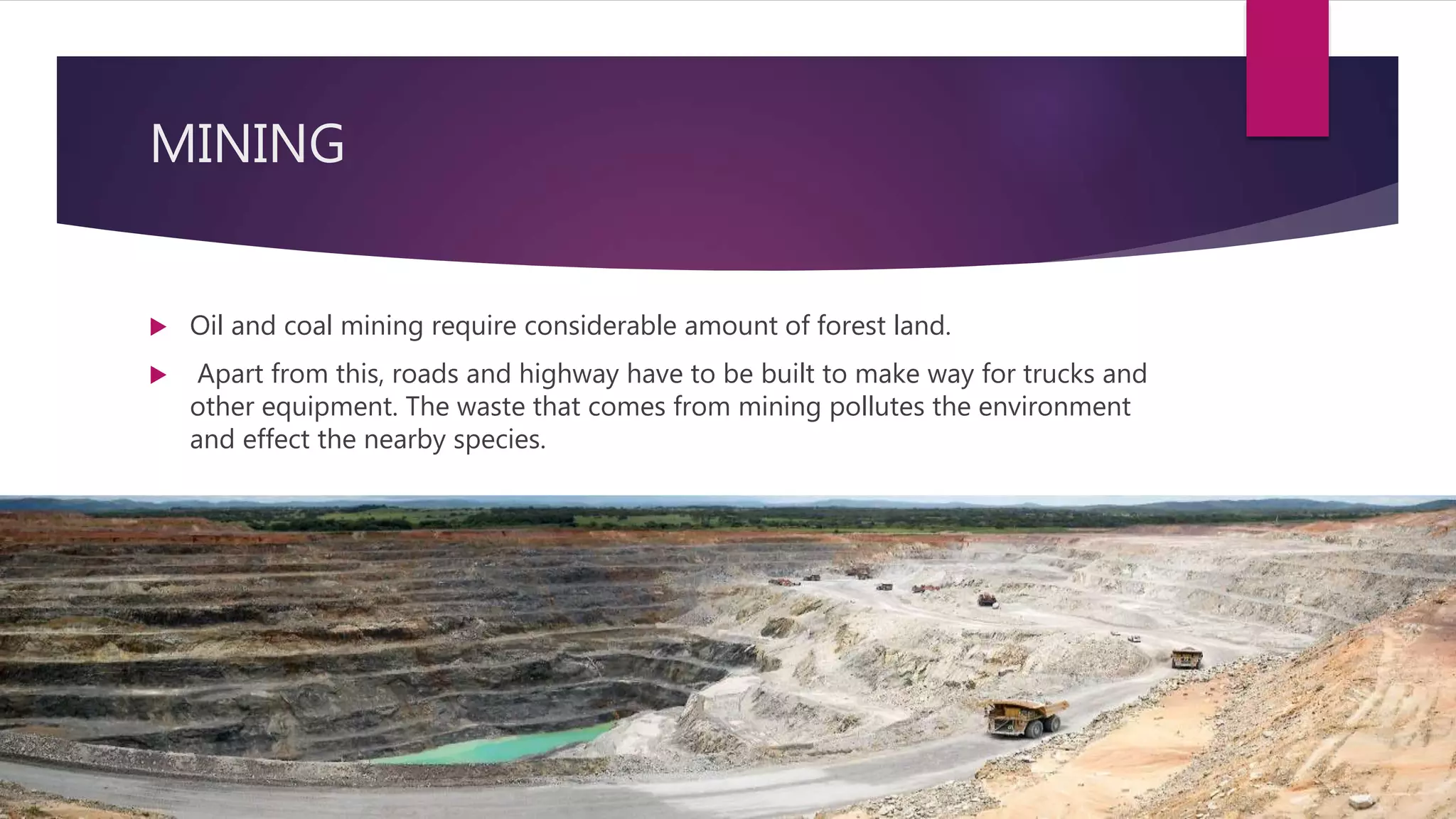
MINING
 Oil and coal mining require considerable amount of forest land.
 Apart from this, roads and highway have to be built to make way for trucks and
other equipment. The waste that comes from mining pollutes the environment
and effect the nearby species.
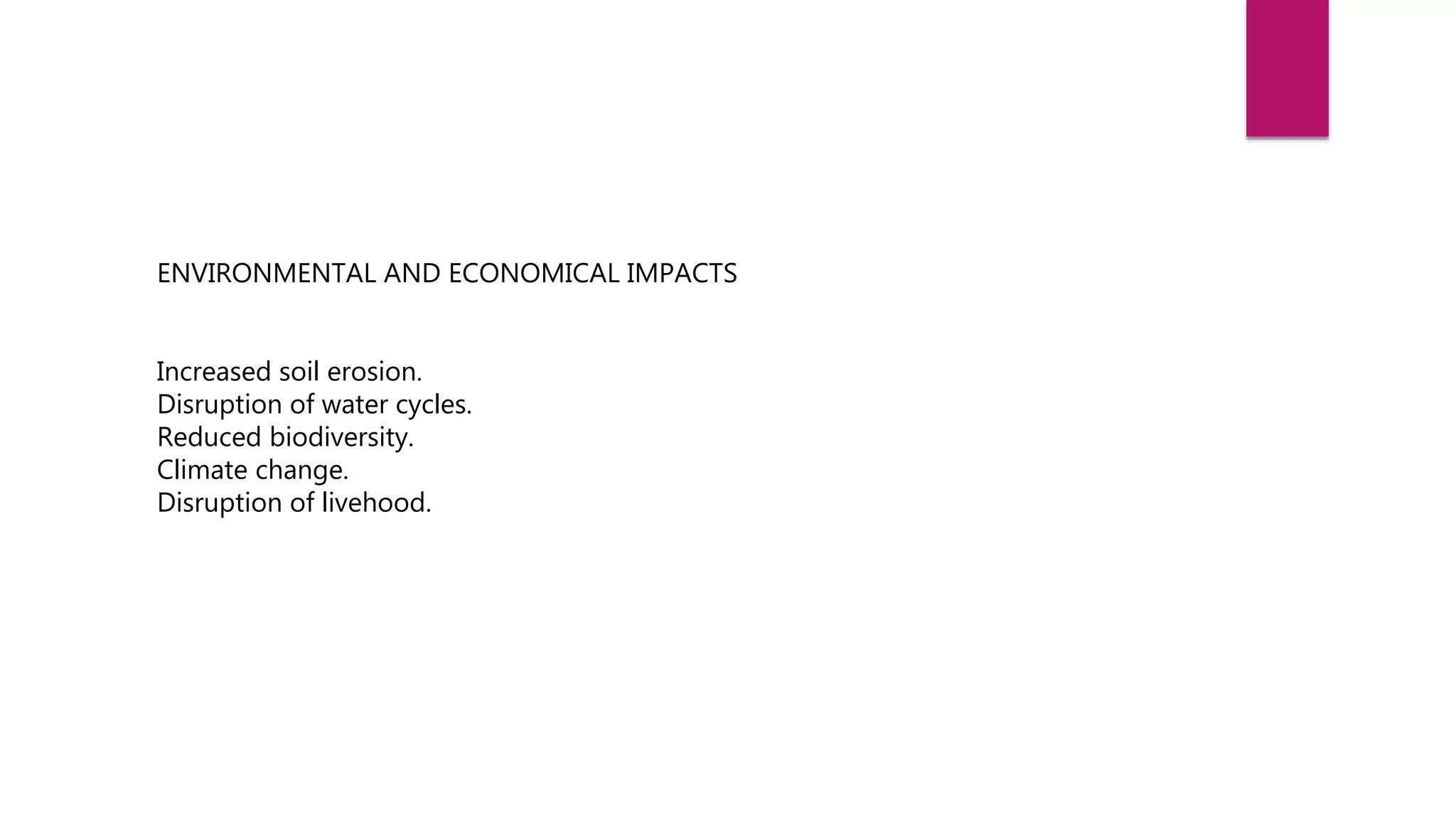
ENVIRONMENTAL AND ECONOMICAL IMPACTS
Increased soil erosion.
Disruption of water cycles.
Reduced biodiversity.
Climate change.
Disruption of livehood.
Short term environmental effects
 Increased soil erosion
 No trees anchoring the fertile soil.
 The agriculture plants replacing the forest
are unable to hold onto the soil.
 AS fertile soil washes away producers
move on, clearing more forest.
 DISRUPTION OF WATER CYCLES
 Trees play a key role in the local water
cycles.
 Keep balance between the water on the
land and water in the atmosphere.
 Disrupted balance changes the
precipitation and river flow
Long term environmental effect
 REDUCED BIODIVERSITY
 80% species can be found in tropical
rainforest.
 Often unable to survive in the small
fragments of forest land left behind.
 Accessible to hunter and poacher.
 Leading to extinction.
 CLIMATE CHANGE
 Forest help to mitigate carbon dioxide and
green house emission.
 When cut, burned or otherwise removed
they become carbon sources.
 Deforestations represent 15% of green
house gas emission.
 Rising temperature changed pattern of
weather and increase weathering events.
SOLUTION
CORPORATION
If corporation have the ability to
destroy the world’s rainforest, they
also have the power to help and save
them.
GOVERNMENT
Government are able to enact
ambitious domestic and international
forest policies that have wide ranging
effect
INDIVIDUALS
We contribute significantly to
deforestation with our life style,
hence we have responsibility to keep
ourselves in check.
Corporation
 Implement anti- deforestations policies
 Corporation can implement anti
deforestations policies that requires
suppliers and other stakeholder to operate
in ways that do not harm the environment.
 Minimising paper wastage and encourage
recycling
 Corporation are huge consumers of paper.
Management can work towards a paper
free office by shifting towards email and
soft copies and also encourage their
employees to recycle.
Government
 Reforestation
 The cutting down of trees must be
countered by replacing old one that were
cut with young ones.
 Trees are being planted every year, but
still they do not match the number of
trees that we lost.
 Support organisations that push for anti-
deforestations
 Government have resources to allow anti
deforestation organisations to get their
sphere of influence. This is a good way to
indirectly solve the deforestations.
GOVERNMENT SCHEME
The ministry is implementing three major schemes for development of forest areas i.e. National
Afforestation Programmed (NAP) scheme, National Mission for a Green India (GIM) and Forest
Fire Prevention & Management Scheme (FFPM).
While NAP is being implemented for afforestation of degraded forest lands,
GIM aims at improving the quality of forest and increase in forest cover besides cross sectoral
activities on landscape basis
. The FFPM takes care of forest fire prevention and management measures.
For scientific management of forests, the States prepare management plan called Working Plan
which highlights various activities to be undertaken in a forest division for effective management of
forest. The working plan is approved by the Ministry. Besides, the funds collected under
Compensatory Afforestation Fund Management and Planning Authority (CAMPA), as
compensatory levies from states inter-alia, is also used in plantation activity including
compensatory afforestation by States/UTs.
THE END

Environmental science ppt [autosaved]

  • 1.
  • 2.
    Forest covers 31%of the land area on our planet. They produces vital oxygen and provides homes for people and wildlife. Many of the world’s most threatened and endangered animals live in these forest. 1.6 Billions people, rely on benefits forest offer, including food ,fresh water, clothing, traditional medicine and shelter. INTRODUCTION OF DEFORESTATIONS
  • 3.
    What is Deforestation Whenhuman remove or clear large area of forest land related ecosystem for non forest use. These include clearing for farming purpose, ranching and urban use. In these cases, Trees are never re-panted.
  • 6.
    Causes of deforestations Agriculturalactivities Due to overgrowing demand for food products huge amount of trees fell down to grow crops and for cattle grazing Logging Apart from this wood based industries like paper, match stick, furniture etc also need a substantial amount of food supply. Wood is used as fuel both directly and indirectly, therefore trees are chopped for supplies. Firewood and charcoal are example of wood used as fuel. Urabanizations Further in order to gain acess to these forest, the construction of road are undertaken; here again to chopped to create roads. Over population too directly affects forest cover, as with expansion of cities more land is needed to establish housing and settlements. Therefore forest land is reclaimed.
  • 7.
    Some of theother factor that lead to deforestation are also part of natural and part of anthropogenic like desertification of land.
  • 8.
    MINING  Oil andcoal mining require considerable amount of forest land.  Apart from this, roads and highway have to be built to make way for trucks and other equipment. The waste that comes from mining pollutes the environment and effect the nearby species.
  • 9.
    ENVIRONMENTAL AND ECONOMICALIMPACTS Increased soil erosion. Disruption of water cycles. Reduced biodiversity. Climate change. Disruption of livehood.
  • 10.
    Short term environmentaleffects  Increased soil erosion  No trees anchoring the fertile soil.  The agriculture plants replacing the forest are unable to hold onto the soil.  AS fertile soil washes away producers move on, clearing more forest.  DISRUPTION OF WATER CYCLES  Trees play a key role in the local water cycles.  Keep balance between the water on the land and water in the atmosphere.  Disrupted balance changes the precipitation and river flow
  • 11.
    Long term environmentaleffect  REDUCED BIODIVERSITY  80% species can be found in tropical rainforest.  Often unable to survive in the small fragments of forest land left behind.  Accessible to hunter and poacher.  Leading to extinction.  CLIMATE CHANGE  Forest help to mitigate carbon dioxide and green house emission.  When cut, burned or otherwise removed they become carbon sources.  Deforestations represent 15% of green house gas emission.  Rising temperature changed pattern of weather and increase weathering events.
  • 12.
    SOLUTION CORPORATION If corporation havethe ability to destroy the world’s rainforest, they also have the power to help and save them. GOVERNMENT Government are able to enact ambitious domestic and international forest policies that have wide ranging effect INDIVIDUALS We contribute significantly to deforestation with our life style, hence we have responsibility to keep ourselves in check.
  • 13.
    Corporation  Implement anti-deforestations policies  Corporation can implement anti deforestations policies that requires suppliers and other stakeholder to operate in ways that do not harm the environment.  Minimising paper wastage and encourage recycling  Corporation are huge consumers of paper. Management can work towards a paper free office by shifting towards email and soft copies and also encourage their employees to recycle.
  • 14.
    Government  Reforestation  Thecutting down of trees must be countered by replacing old one that were cut with young ones.  Trees are being planted every year, but still they do not match the number of trees that we lost.  Support organisations that push for anti- deforestations  Government have resources to allow anti deforestation organisations to get their sphere of influence. This is a good way to indirectly solve the deforestations.
  • 15.
    GOVERNMENT SCHEME The ministryis implementing three major schemes for development of forest areas i.e. National Afforestation Programmed (NAP) scheme, National Mission for a Green India (GIM) and Forest Fire Prevention & Management Scheme (FFPM). While NAP is being implemented for afforestation of degraded forest lands, GIM aims at improving the quality of forest and increase in forest cover besides cross sectoral activities on landscape basis . The FFPM takes care of forest fire prevention and management measures. For scientific management of forests, the States prepare management plan called Working Plan which highlights various activities to be undertaken in a forest division for effective management of forest. The working plan is approved by the Ministry. Besides, the funds collected under Compensatory Afforestation Fund Management and Planning Authority (CAMPA), as compensatory levies from states inter-alia, is also used in plantation activity including compensatory afforestation by States/UTs.
  • 16.