Download to read offline
![Seed Programs International 828-707-1640 www.seedprograms.org
Saving Vegetable Seeds
Julian Hoyle
Seeds of some vegetables can be saved. If the seed packet is labeled as “Hybrid”, seed should not be saved, because crops grown from those saved seeds will not always be the same as the hybrid [parent plant], and may even be very different. If the seed packet is labeled as “open pollinated,” then seed may be saved.
Some seeds require washing to remove sugars which may encourage fungal molds. Always use clean water for this. Dry seed well in the shade for two to three days until it is completely dry. After the seed has been harvested and cleaned, it should be kept dry and in a cool place.
In tropical countries with high humidity, seeds which are kept in the open and not in air-tight containers, may absorb moisture from the air, and this together with high temperatures, will cause seed to die quickly. Also, if seed is kept in the sun or other hot places, it will quickly die. The best way to keep seed is to dry it well, then to keep it in a screw top glass jar which has a rubber seal, in a cool place. This will also protect the seed from weevil and insect damage. Dry seed kept in an airtight container as described above, should remain alive for 2-3 years.
Crop
Ease of
saving seed
Instructions for saving seed
Beans
Easy
Allow plant to mature completely. When pod is dry, extract seed. Treat seed gently so as not to crack or split seed coat, or break off part of seed. Bean seed can be easily damaged by rough treatment.
Beet
Difficult
Roots need a period of cold weather for growth to stop and for flowering and seed production to start. Not recommended for tropical countries.
Broccoli
Difficult
Plants require cold weather conditions to cause plant to flower and produce seed. Some tropical varieties may flower if left to mature completely. After flowering, allow the pods to dry, then remove seed.
Brussels
Sprouts
Difficult
Plants require cold weather conditions to cause plant to flower and produce seed. Some tropical varieties may flower if left to mature completely. After flowering, allow the pods to dry, then remove seed.
Cabbage
Difficult
Plants require cold weather conditions to cause plant to flower and produce seed. Some tropical varieties may flower if left to mature completely. If seed production is attempted, the cabbage head must be cut open carefully to expose the growing point to grow up and produce flowers. Care is needed not to damage the growing point when cutting the heads open. After flowering, allow the pods to dry, then remove seed.
Cantaloupe
Easy
Allow plants to mature completely, and fruits are past normal market stage. Extract seeds, wash in clean water, and dry well in shade.
Carrot
Difficult
Roots need a period of cold weather for growth to stop and for flowering and seed production to start. Not recommended for tropical countries
Chinese
Cabbage
Difficult
Plants require cold weather conditions to cause plant to flower and produce seed. Some tropical varieties may flower if left to mature completely. After flowering, allow the pods to dry, then remove seed
Cucumber
Easy
Allow plants to grow well past normal market stage, and fruits turn a yellowish color, and plant is no longer growing. Harvest fruits, extract seed, wash in clean water, and dry in shade.](https://image.slidesharecdn.com/zwv155-141002154433-phpapp02/85/Saving-Vegetable-Seeds-seedprograms-org-1-320.jpg)
![Seed Programs International 828-707-1640 www.seedprograms.org
Saving Vegetable Seeds
Julian Hoyle
Seeds of some vegetables can be saved. If the seed packet is labeled as “Hybrid”, seed should not be saved, because crops grown from those saved seeds will not always be the same as the hybrid [parent plant], and may even be very different. If the seed packet is labeled as “open pollinated,” then seed may be saved.
Some seeds require washing to remove sugars which may encourage fungal molds. Always use clean water for this. Dry seed well in the shade for two to three days until it is completely dry. After the seed has been harvested and cleaned, it should be kept dry and in a cool place.
In tropical countries with high humidity, seeds which are kept in the open and not in air-tight containers, may absorb moisture from the air, and this together with high temperatures, will cause seed to die quickly. Also, if seed is kept in the sun or other hot places, it will quickly die. The best way to keep seed is to dry it well, then to keep it in a screw top glass jar which has a rubber seal, in a cool place. This will also protect the seed from weevil and insect damage. Dry seed kept in an airtight container as described above, should remain alive for 2-3 years.
Crop
Ease of
saving seed
Instructions for saving seed
Beans
Easy
Allow plant to mature completely. When pod is dry, extract seed. Treat seed gently so as not to crack or split seed coat, or break off part of seed. Bean seed can be easily damaged by rough treatment.
Beet
Difficult
Roots need a period of cold weather for growth to stop and for flowering and seed production to start. Not recommended for tropical countries.
Broccoli
Difficult
Plants require cold weather conditions to cause plant to flower and produce seed. Some tropical varieties may flower if left to mature completely. After flowering, allow the pods to dry, then remove seed.
Brussels
Sprouts
Difficult
Plants require cold weather conditions to cause plant to flower and produce seed. Some tropical varieties may flower if left to mature completely. After flowering, allow the pods to dry, then remove seed.
Cabbage
Difficult
Plants require cold weather conditions to cause plant to flower and produce seed. Some tropical varieties may flower if left to mature completely. If seed production is attempted, the cabbage head must be cut open carefully to expose the growing point to grow up and produce flowers. Care is needed not to damage the growing point when cutting the heads open. After flowering, allow the pods to dry, then remove seed.
Cantaloupe
Easy
Allow plants to mature completely, and fruits are past normal market stage. Extract seeds, wash in clean water, and dry well in shade.
Carrot
Difficult
Roots need a period of cold weather for growth to stop and for flowering and seed production to start. Not recommended for tropical countries
Chinese
Cabbage
Difficult
Plants require cold weather conditions to cause plant to flower and produce seed. Some tropical varieties may flower if left to mature completely. After flowering, allow the pods to dry, then remove seed
Cucumber
Easy
Allow plants to grow well past normal market stage, and fruits turn a yellowish color, and plant is no longer growing. Harvest fruits, extract seed, wash in clean water, and dry in shade.](https://image.slidesharecdn.com/zwv155-141002154433-phpapp02/75/Saving-Vegetable-Seeds-seedprograms-org-1-2048.jpg)
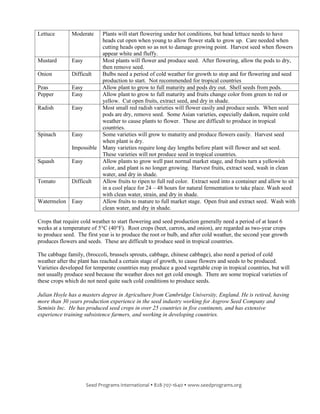

This document provides instructions for saving seeds from vegetable crops. It explains that hybrid seeds should not be saved as the resulting plants may differ, while open-pollinated varieties can be saved. Seeds must be thoroughly dried and stored in airtight containers in a cool, dry place to maintain viability for 2-3 years. The document then lists various vegetable crops and rates their ease of saving seeds, from easy to difficult, along with specific instructions for each. Crops requiring cold weather to flower are difficult to save seeds from in tropical climates.


