SOLUBILITY
What is called solubility?
Types of Solubilities as per USP?
What is called saturated and unsaturated solutions?
Soluble and insoluble depends on___________?
What is called miscbility?
What is the term Freely soluble and Sparingly soluble?
What is purpose of testing Solubility of product?
Conductivity Meter
What is called conductivity?
Ans: The ability to conduct heat or electricity.
What are the units of conductivity?
What is the limit for conductivity of process water as per USP?
How to calibrate conductivity meter?
What is the purpose of conductivity meter?
Ans: Conductivity meter is measure of water‘s capability to pass electrical flow.
KF Titrator
What is the purpose of KF Titrator?
What are the ingradients persent in KF Reagent?
How to determine the KF Factor? What is the calculation?
How to calculate the water content by KF Titrator?
KF Titration is ___________Titration?
What is the electrode used in KF Titrator?
Why 15.66 used in KF Factor calculation?
If we want to do the water content of Aldehydes or Ketones …
_____________Media should used instead of methanol?
Melting Point Apparatus:
What is called melting point?
What are the requirements to conduct MR Test?
What is the Oil will be used in MR oil bath and why?
What is the temparature ramp to chech the MR of sample?
How much sample to fill the in capillary tube and how to fill?
What are the MR standards used for MR apparatus calibration?
What is the purpose of Melting point apparatus?
What are the precautions to be taken for MR apparatus?
Stability Studies:
What is the pupose of Stability testing?
What are the Temparature and RH Condition of each type of Stability?
How many batches to consider to conduct the Stability testing?
How to conduct Photo Stability?
How long to study Accelarated Stability and Long test Stability?
Who are the responsible to conduct the Stability study?
What is the guideline to follow the Stability study?
FTIR Spectroscopy :
What is the full form of FTIR?
What is the IR range?
What is the purpose of FTIR?
What is called finger print region?
What is the source of IR?
What are the requirements to conduct the IR Test?
What are the cells used for liquid samples analysis by IR?
How to calibrate the FTIR?
Beakers
• Beakers are used
for holding various
chemicals.
• Not for measuring
precisely.
• Sizes vary.
Graduated Cylinder
• Used to precisely
measure the volume
of liquids or run
experiments.
• Read from the
meniscus at eye
level.
• Plastic ring always on
top if applicable.
• Sizes vary.
Erlenmeyer Flask
• Used to
approximately
measure the
volume various
liquids.
• Useful for mixing
by swirling
• Sizes vary.
Florence Flask
• Used to boil
liquids.
• Also used to
collect gases, if
applicable.
• Sizes vary.
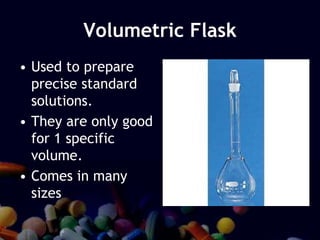
Volumetric Flask
• Used to prepare
precise standard
solutions.
• They are only good
for 1 specific
volume.
• Comes in many
sizes
Reagent Bottle
• Used to store,
transport, or view
reagents such as
acids or bases.
Rubber Stoppers
• Used to close flasks
and test tubes.
• The holes allow the
insertion of glass
tubing, probes, or
thermometers as
needed by the
experiment.
Test Tubes and Rack
• Used to hold
chemicals/tubes
while experimenting.
• Not for measuring
precisely.
• Waft!
• Aim away from faces.
• Sizes vary.
• Label tubes.
Distillation Flask
• Used to separate
liquids based on
boiling point.
Buret and Buret Clamp
• Used for precisely
measuring
dispensed liquids
• Holds buret to ring
stand.
Double buret clamp
Single buret clamp
Buret
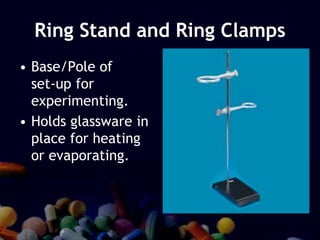
Ring Stand and Ring Clamps
• Base/Pole of
set-up for
experimenting.
• Holds glassware in
place for heating
or evaporating.
Test Tube Brushes
• Cleaning.
• You must clean
tubes before and
after you use.
Test Tube Holder
• Used for carrying
or holding hot test
tubes.
Thermometer
• Measuring
temperature.
• Use metric!!
Hot Plate
• Used to heat
substances.
Bunsen Burner
• Used to heat
substances quickly
or if > 400oC is
needed.
• Do not use with
flammable
substances.
Rubber Tubing
• Used for a variety
of things.
• Example:
– Connecting Bunsen
burner to gas valve
stem.
– Connecting glass
tubing together.
Wire Mesh or Gauze
• Used to absorb and
spread the heat of
flame.
• Keeps glassware
from cracking and
breaking.
• Part of ring stand
set-up.
Clay Triangle
• Used to hold a
crucible in place
on a ring stand.
• Also helps absorb
and spread heat of
flame.
• Part of ring stand
set-up.
Crucible and Cover
• Used for heating
substances.
• Can withstand high
direct heat.
Crucible Tongs
• Used to carry
crucible.
Beaker Tongs
• Used to carry
beakers.
Mortar and Pestle
• Used to grind
substances into
powder or slurry.
Scoopula
• Used to scoop
chemical powders.
• Not a measuring
instrument.
• Ours do not have
handles.
Stirring Rods
• Used to stir
substances.
• Clean in between
uses.
Striker
• Used to ignite gas
from a Bunsen
burner.
• Do not waste flint.
Watch Glass
• Used to show
chemical
reactions.
Evaporating Dish
• Used to
evaporate
excess liquids.
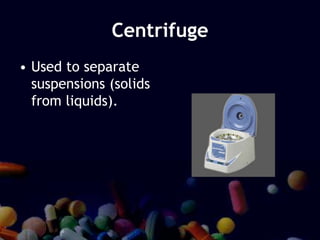
Centrifuge
• Used to separate
suspensions (solids
from liquids).
Meter Stick
• Used to precisely
measure length.
• 1m = 10dm
• 1m = 100cm
• 1m = 1000mm
Funnel
• Used to safely
transfer
substances from
one container to
another.
Dropper and Bottle
• Used to measure
out small amounts
of liquids for
experiments.
Wash Bottle
• Usually contains
deionized water.
• Handy for rinsing
glassware and for
dispensing small
amounts of dH2O
for chemical
reactions.
Goggles and Apron
• Used to protect
your eyes and
clothing from
damage.
• These are a must
in lab!!
Inoculating or Flame Loop
• Used to collect
samples from
colonies (ex. Bacteria)
• Also used to test
the spectra of
chemicals.
Digital Balance
• Used to accurately
measure mass.
• Only up to 200g in
our labs.
Triple Beam Balance
• Measures the mass
of an object.
• Make certain the
balance is
calibrated
correctly before
use.
Double Pan Balance
• Used to compare
the masses of two
substances.
Centigram Balance
• Used to precisely
measure the mass
of a substance.
• More precise than
the triple beam
balance.
iii. Analytical Balance – a balance used to
determine the mass of an object to a high
degree of precision.
1. Readings made by this
balance must be reported to 4
decimal places.
2. Because of its high degree of
precision, the pan is enclosed
in a chamber to eliminate the
effect of air currents in the
room on the reading.
Pipet, Pump, and Bulb
• Used to precisely
measure the
volume of liquids
in small amounts.
Berol Pipet
• Disposable pipets
used to transfer
small amounts of
chemicals.
• Graduated pipets
can precisely
measure small
amounts of
chemicals.
Capillary Tubes
• Used to collect
liquid through the
process of
capillary action.

Revision ppt.pptx

  • 1.
    SOLUBILITY What is calledsolubility? Types of Solubilities as per USP? What is called saturated and unsaturated solutions? Soluble and insoluble depends on___________? What is called miscbility? What is the term Freely soluble and Sparingly soluble? What is purpose of testing Solubility of product?
  • 2.
    Conductivity Meter What iscalled conductivity? Ans: The ability to conduct heat or electricity. What are the units of conductivity? What is the limit for conductivity of process water as per USP? How to calibrate conductivity meter? What is the purpose of conductivity meter? Ans: Conductivity meter is measure of water‘s capability to pass electrical flow.
  • 3.
    KF Titrator What isthe purpose of KF Titrator? What are the ingradients persent in KF Reagent? How to determine the KF Factor? What is the calculation? How to calculate the water content by KF Titrator? KF Titration is ___________Titration? What is the electrode used in KF Titrator? Why 15.66 used in KF Factor calculation? If we want to do the water content of Aldehydes or Ketones … _____________Media should used instead of methanol?
  • 4.
    Melting Point Apparatus: Whatis called melting point? What are the requirements to conduct MR Test? What is the Oil will be used in MR oil bath and why? What is the temparature ramp to chech the MR of sample? How much sample to fill the in capillary tube and how to fill? What are the MR standards used for MR apparatus calibration? What is the purpose of Melting point apparatus? What are the precautions to be taken for MR apparatus?
  • 5.
    Stability Studies: What isthe pupose of Stability testing? What are the Temparature and RH Condition of each type of Stability? How many batches to consider to conduct the Stability testing? How to conduct Photo Stability? How long to study Accelarated Stability and Long test Stability? Who are the responsible to conduct the Stability study? What is the guideline to follow the Stability study?
  • 6.
    FTIR Spectroscopy : Whatis the full form of FTIR? What is the IR range? What is the purpose of FTIR? What is called finger print region? What is the source of IR? What are the requirements to conduct the IR Test? What are the cells used for liquid samples analysis by IR? How to calibrate the FTIR?
  • 7.
    Beakers • Beakers areused for holding various chemicals. • Not for measuring precisely. • Sizes vary.
  • 8.
    Graduated Cylinder • Usedto precisely measure the volume of liquids or run experiments. • Read from the meniscus at eye level. • Plastic ring always on top if applicable. • Sizes vary.
  • 9.
    Erlenmeyer Flask • Usedto approximately measure the volume various liquids. • Useful for mixing by swirling • Sizes vary.
  • 10.
    Florence Flask • Usedto boil liquids. • Also used to collect gases, if applicable. • Sizes vary.
  • 11.
    Volumetric Flask • Usedto prepare precise standard solutions. • They are only good for 1 specific volume. • Comes in many sizes
  • 12.
    Reagent Bottle • Usedto store, transport, or view reagents such as acids or bases.
  • 13.
    Rubber Stoppers • Usedto close flasks and test tubes. • The holes allow the insertion of glass tubing, probes, or thermometers as needed by the experiment.
  • 14.
    Test Tubes andRack • Used to hold chemicals/tubes while experimenting. • Not for measuring precisely. • Waft! • Aim away from faces. • Sizes vary. • Label tubes.
  • 15.
    Distillation Flask • Usedto separate liquids based on boiling point.
  • 16.
    Buret and BuretClamp • Used for precisely measuring dispensed liquids • Holds buret to ring stand. Double buret clamp Single buret clamp Buret
  • 17.
    Ring Stand andRing Clamps • Base/Pole of set-up for experimenting. • Holds glassware in place for heating or evaporating.
  • 18.
    Test Tube Brushes •Cleaning. • You must clean tubes before and after you use.
  • 19.
    Test Tube Holder •Used for carrying or holding hot test tubes.
  • 20.
  • 21.
    Hot Plate • Usedto heat substances.
  • 22.
    Bunsen Burner • Usedto heat substances quickly or if > 400oC is needed. • Do not use with flammable substances.
  • 23.
    Rubber Tubing • Usedfor a variety of things. • Example: – Connecting Bunsen burner to gas valve stem. – Connecting glass tubing together.
  • 24.
    Wire Mesh orGauze • Used to absorb and spread the heat of flame. • Keeps glassware from cracking and breaking. • Part of ring stand set-up.
  • 25.
    Clay Triangle • Usedto hold a crucible in place on a ring stand. • Also helps absorb and spread heat of flame. • Part of ring stand set-up.
  • 26.
    Crucible and Cover •Used for heating substances. • Can withstand high direct heat.
  • 27.
    Crucible Tongs • Usedto carry crucible.
  • 28.
    Beaker Tongs • Usedto carry beakers.
  • 29.
    Mortar and Pestle •Used to grind substances into powder or slurry.
  • 30.
    Scoopula • Used toscoop chemical powders. • Not a measuring instrument. • Ours do not have handles.
  • 31.
    Stirring Rods • Usedto stir substances. • Clean in between uses.
  • 32.
    Striker • Used toignite gas from a Bunsen burner. • Do not waste flint.
  • 33.
    Watch Glass • Usedto show chemical reactions.
  • 34.
    Evaporating Dish • Usedto evaporate excess liquids.
  • 35.
    Centrifuge • Used toseparate suspensions (solids from liquids).
  • 36.
    Meter Stick • Usedto precisely measure length. • 1m = 10dm • 1m = 100cm • 1m = 1000mm
  • 37.
    Funnel • Used tosafely transfer substances from one container to another.
  • 38.
    Dropper and Bottle •Used to measure out small amounts of liquids for experiments.
  • 39.
    Wash Bottle • Usuallycontains deionized water. • Handy for rinsing glassware and for dispensing small amounts of dH2O for chemical reactions.
  • 40.
    Goggles and Apron •Used to protect your eyes and clothing from damage. • These are a must in lab!!
  • 41.
    Inoculating or FlameLoop • Used to collect samples from colonies (ex. Bacteria) • Also used to test the spectra of chemicals.
  • 42.
    Digital Balance • Usedto accurately measure mass. • Only up to 200g in our labs.
  • 43.
    Triple Beam Balance •Measures the mass of an object. • Make certain the balance is calibrated correctly before use.
  • 44.
    Double Pan Balance •Used to compare the masses of two substances.
  • 45.
    Centigram Balance • Usedto precisely measure the mass of a substance. • More precise than the triple beam balance.
  • 46.
    iii. Analytical Balance– a balance used to determine the mass of an object to a high degree of precision. 1. Readings made by this balance must be reported to 4 decimal places. 2. Because of its high degree of precision, the pan is enclosed in a chamber to eliminate the effect of air currents in the room on the reading.
  • 47.
    Pipet, Pump, andBulb • Used to precisely measure the volume of liquids in small amounts.
  • 48.
    Berol Pipet • Disposablepipets used to transfer small amounts of chemicals. • Graduated pipets can precisely measure small amounts of chemicals.
  • 49.
    Capillary Tubes • Usedto collect liquid through the process of capillary action.