INTRODUCTION TO
ENTREPRENEURSHIP
ENTREPRENEURSHIP
Activity 1. Let Me Know
Give at least five (5) names of
entrepreneurs that you know, may it be
from your locality or within the
Philippines. Identify what are their
common traits as entrepreneurs.
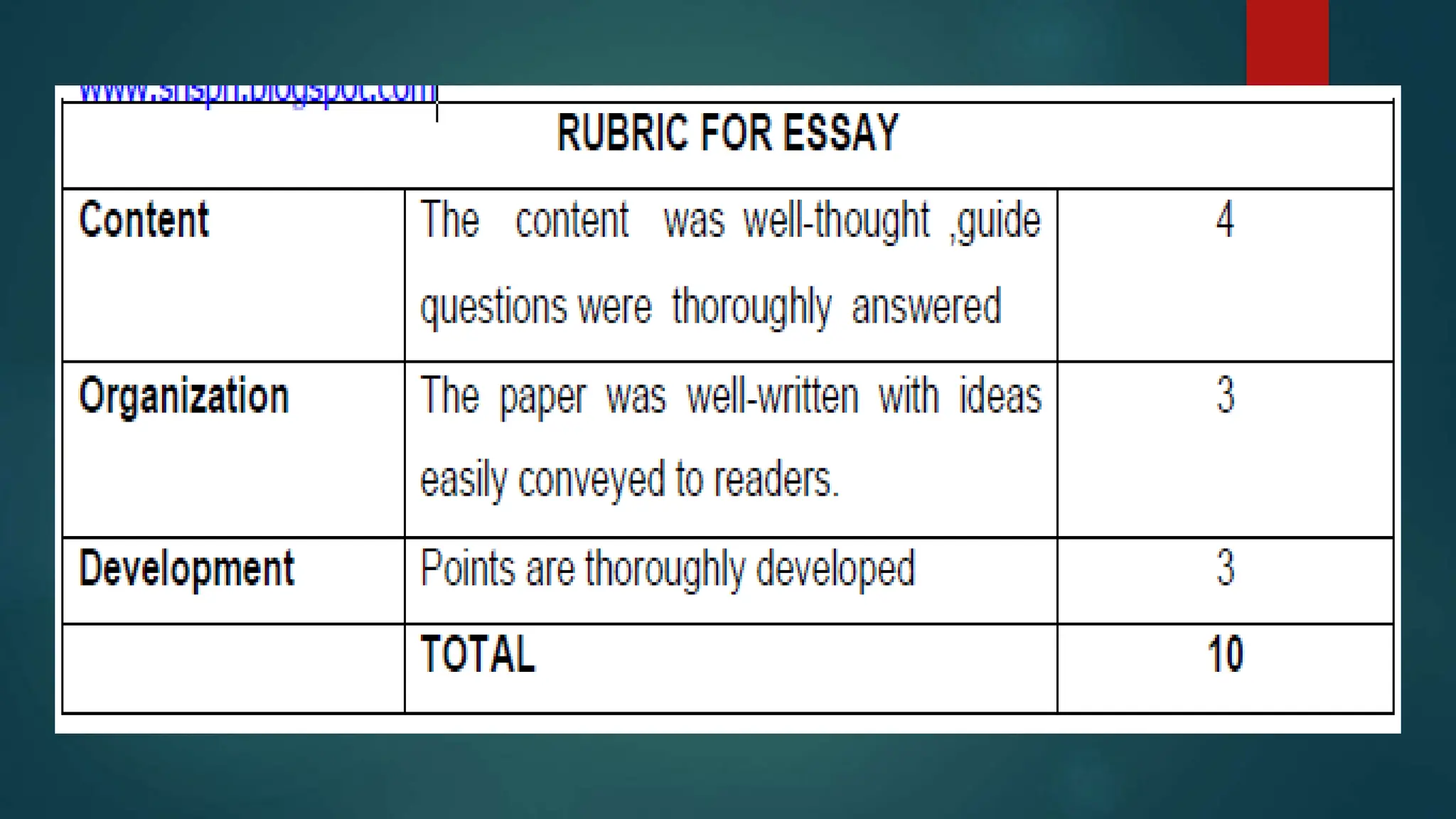
Activity 2. Essay
Explain the following questions below
about the competencies of
entrepreneurs.
1. What characteristics can you observe
or see that are common among the
entrepreneurs that you have listed?
Activity 2. Essay
Explain the following questions below about
the competencies of entrepreneurs.
2. Who among the entrepreneurs that you
mentioned do you admire the most and why?
3. In your own opinion, what do you need to
possess to become a successful entrepreneur?
Relevance of
entrepreneurship to an
organization
1. Development of
Managerial capabilities
this means that one of the
benefits an entrepreneur
gets is to develop his
managerial skills.
2. Creation of Organizations
which means that because
of entrepreneurships many
organizations will exist
3. Improving standard of living
this means that
entrepreneurship can lift up
the economic status of an
individual.
4. Means of economic
development
this means that not only the
life of the entrepreneur is
improved but also the society
where the business is located.
Concept of
Entrepreneurship
Entrepreneur
derived from the French
verb enterprendre
- to undertake
This is pinpointing to
those who “undertake”
the risk of enterprise.
Entrepreneurship
 it is the process that the enterprise is
created by an entrepreneur
are innovators, willing to take risks
and generate new ideas to make it
unique and profitable solutions to the
present – day problems.
Factors Affecting
Entrepreneurship
1. Personality Factors
which includes:
a. Initiative – which means doings things even
before being told
b. Proactive – which means he can classify
opportunities and seize it.
c. Problem solver – which means he can retain
good relations with other people.
1. Personality Factors which
includes:
d. Perseverance – meaning he will
pursue things to get done regardless
of challenges
e. Persuasion – means that he can
entice people to buy even if they
don’t.
1. Personality Factors which
includes:
f. A Planner – meaning he makes
plan before he can entice people to
buy even if they don’t.
g. Risk – taker – which means that he
is willing to gamble but he will
calculate it first.
2. Environmental Factors
which include political,
climate, legal system,
economic and social
conditions and market
situations.
Common Competencies
in Entrepreneurship
1. Decisive
an entrepreneur
must be firm in
making decisions.
2. Communicator
an entrepreneur
must have a
convincing power.
3. Leader
an entrepreneur an
entrepreneur must have
the charisma to be
obeyed by his employees
4. Opportunity seeker-
an entrepreneur must
have the ability to be
the first to see
business chances.
5. Proactive
controlling a situation by
making things to happen
or by preparing for
possible future problems.
6. Risk Taker
They have the
courage to pursue what
is their business ideas.
7. Innovative
the entrepreneurs have big
business ideas and they do
not stop improving and
thinking of new worthwhile
ideas for their business.
Core Competencies in
Entrepreneurship
1. Economic and dynamic
activity
Entrepreneurship is an economic activity
because it involves the creation and
operation of an enterprise with a view to
creating value or wealth by ensuring
optimum utilization of limited resources.
2. Innovative
Entrepreneurs constantly
look for new ideas, thus he
needs to be creative.
3. Profit Potential-
meaning the entrepreneur
can be compensated by his
profit coming from the
operation.
4. Risk bearing
meaning the entrepreneur
needs to gamble but wise
enough to offset the risk
Types of
entrepreneurs
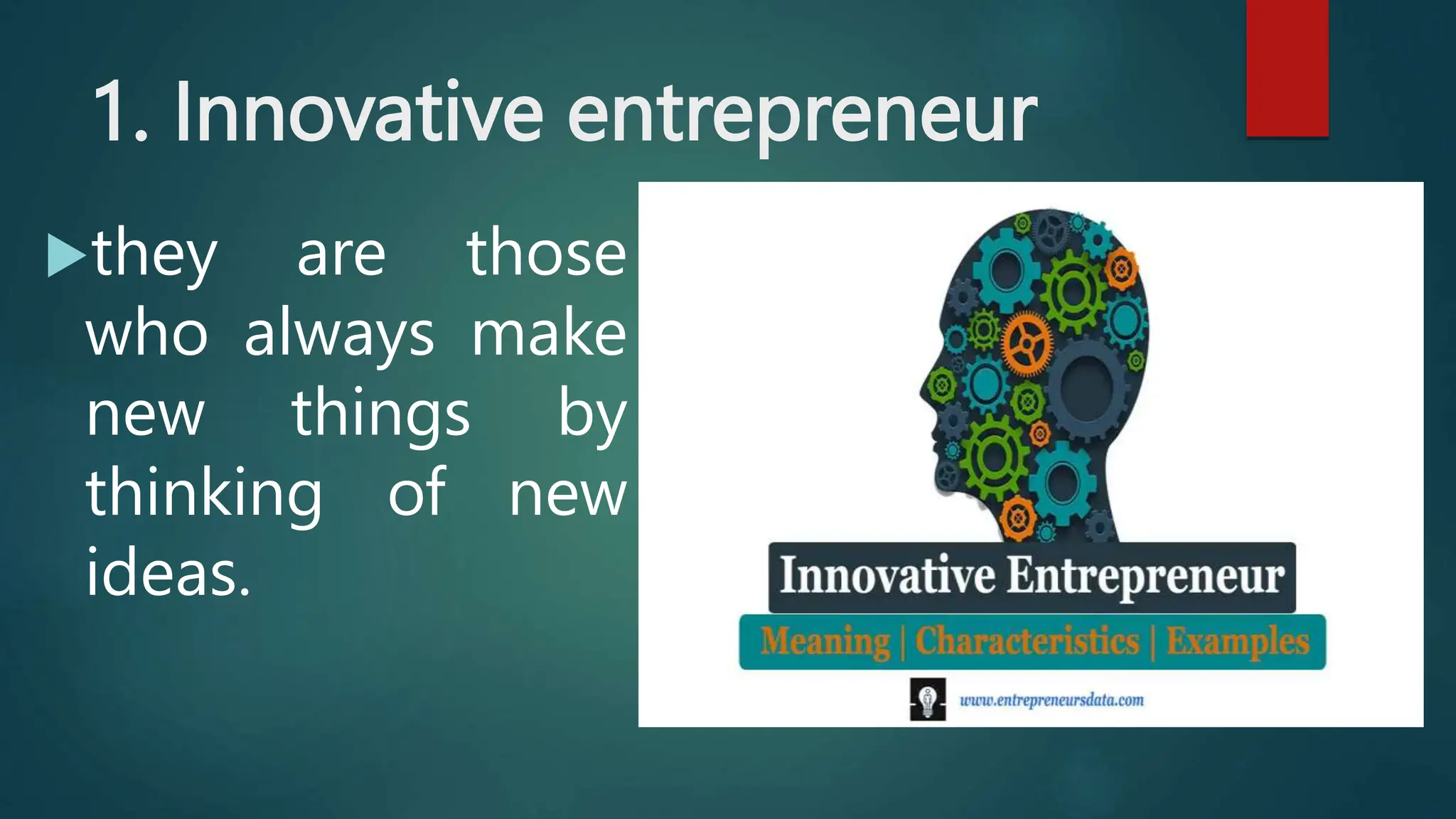
1. Innovative entrepreneur
they are those
who always make
new things by
thinking of new
ideas.
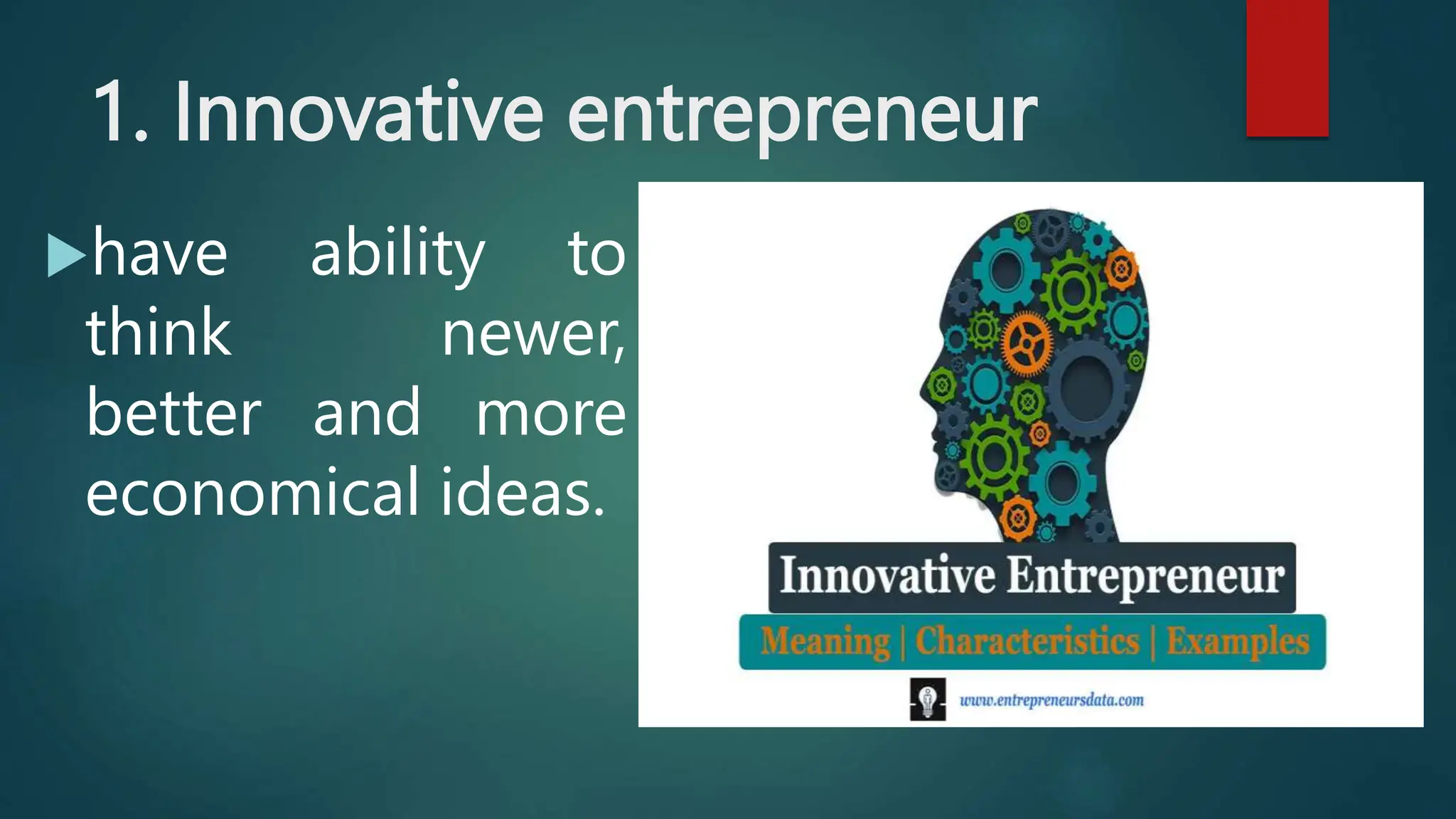
1. Innovative entrepreneur
have ability to
think newer,
better and more
economical ideas.
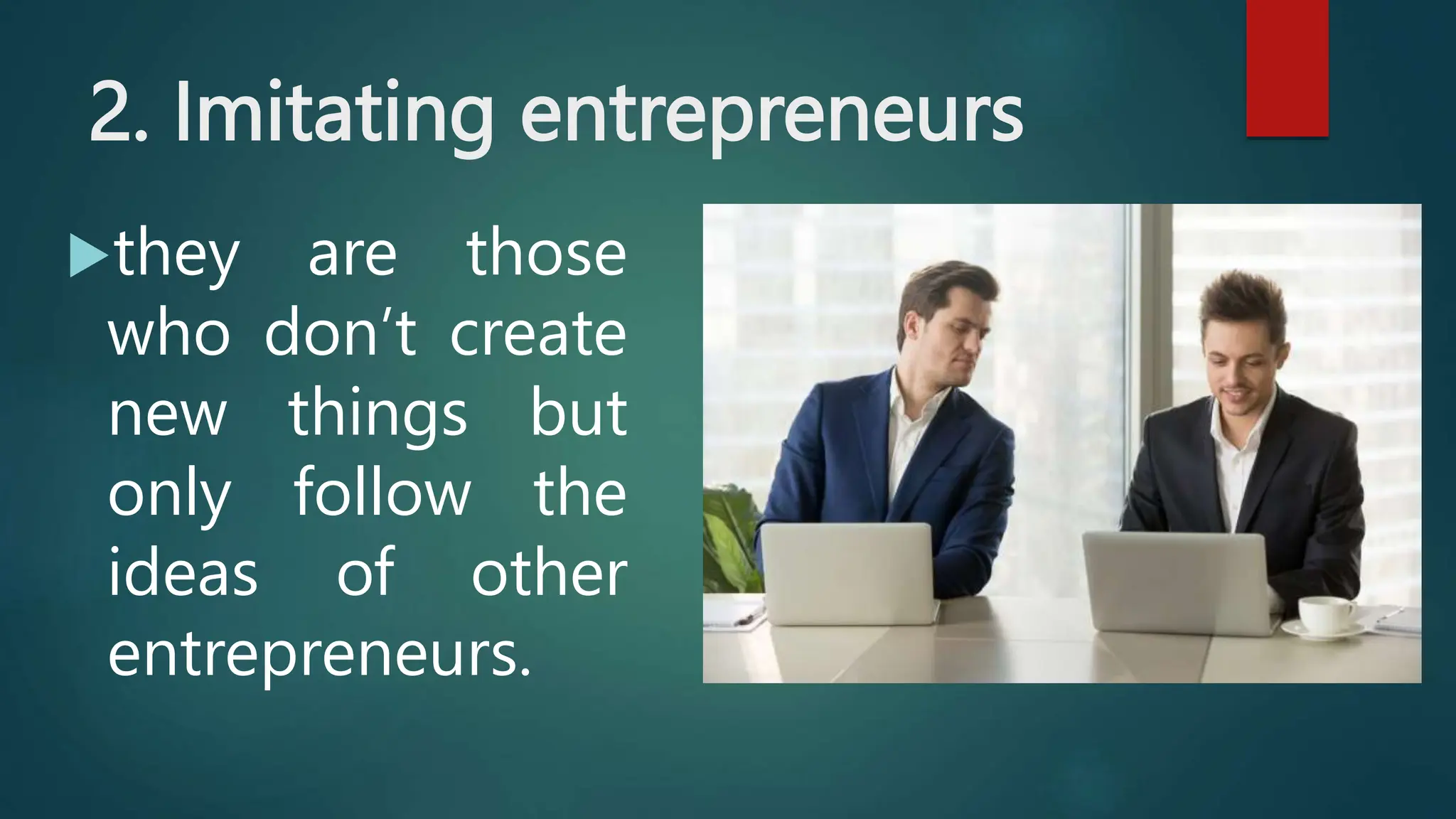
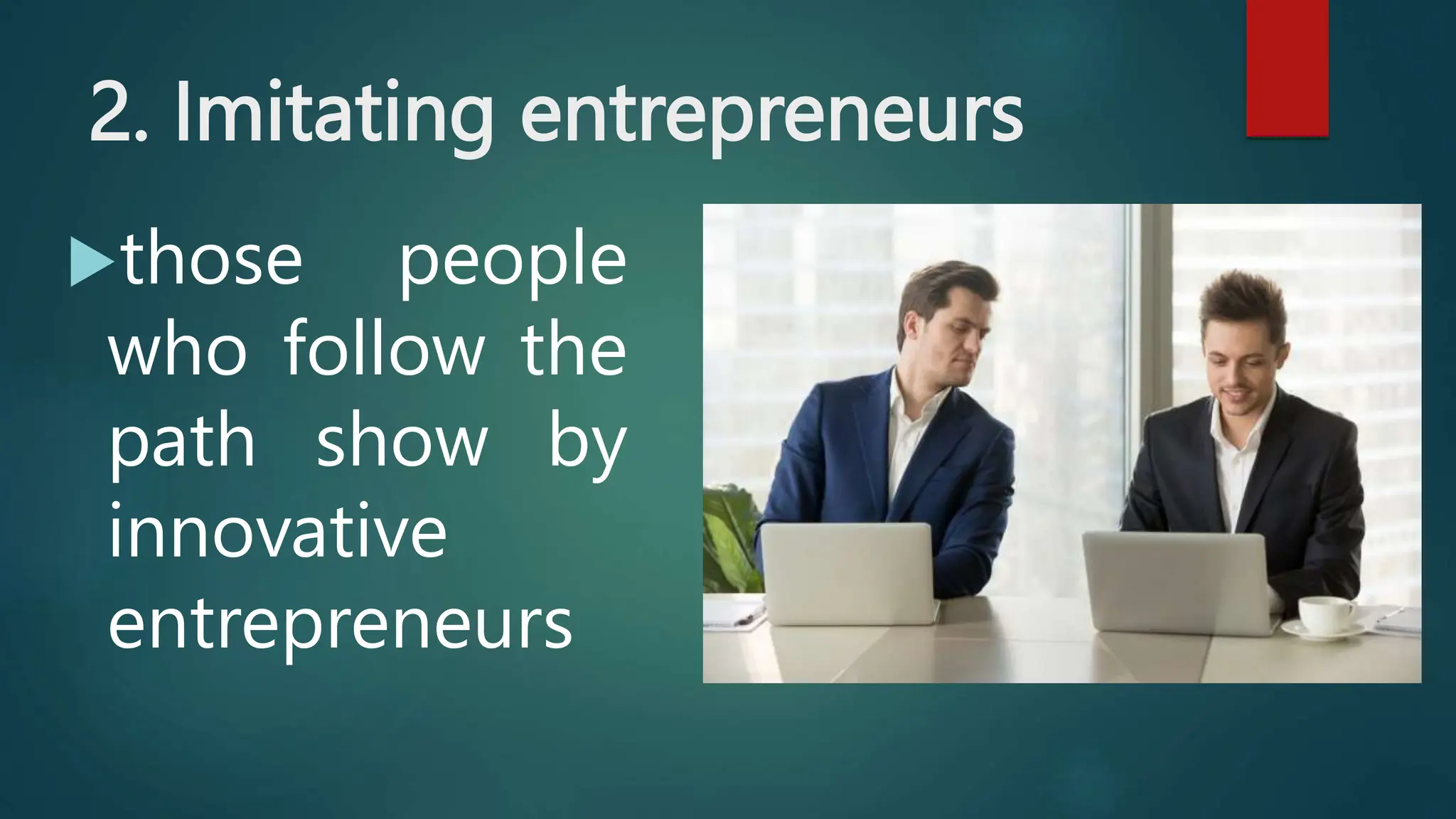
2. Imitating entrepreneurs
they are those
who don’t create
new things but
only follow the
ideas of other
entrepreneurs.
2. Imitating entrepreneurs
those people
who follow the
path show by
innovative
entrepreneurs
Examples:
Spotify (imitated online music streaming
and created a user – friendly platform)
Xiaomi (imitated Apple’s business model)
Zara (imitated like H&M)
3. Fabian entrepreneurs
they are those skeptical(unconvinced)in their approach in
adopting or innovating new technology in their
enterprise.
They are not adoptable to the changing environment.
They only adopt the new technology when they realize
that failure to adopt will lead to loss or collapse of the
enterprise
 They don’t initiate but follow only after they are satisfied.
Example
The creator of McDonald’s, Ray Kroc, might be
compared to a Fabian entrepreneur. Although the
McDonald brothers opened the first McDonald’s
restaurant with an emphasis on a small menu and
quick service, it was Ray Kroc who saw the potential
for rapid expansion. He modified the business
strategy and made McDonald’s a dominant franchise
worldwide. The success of McDonald’s was largely
attributed to Kroc’s capacity to adapt and welcome
change.
4. Drone entrepreneur-
they are those who lives on the labor of
others.
Reluctant to make or accept any
transformation
are die-hard conservatives even ready to
suffer the loss of business.
EXAMPLE
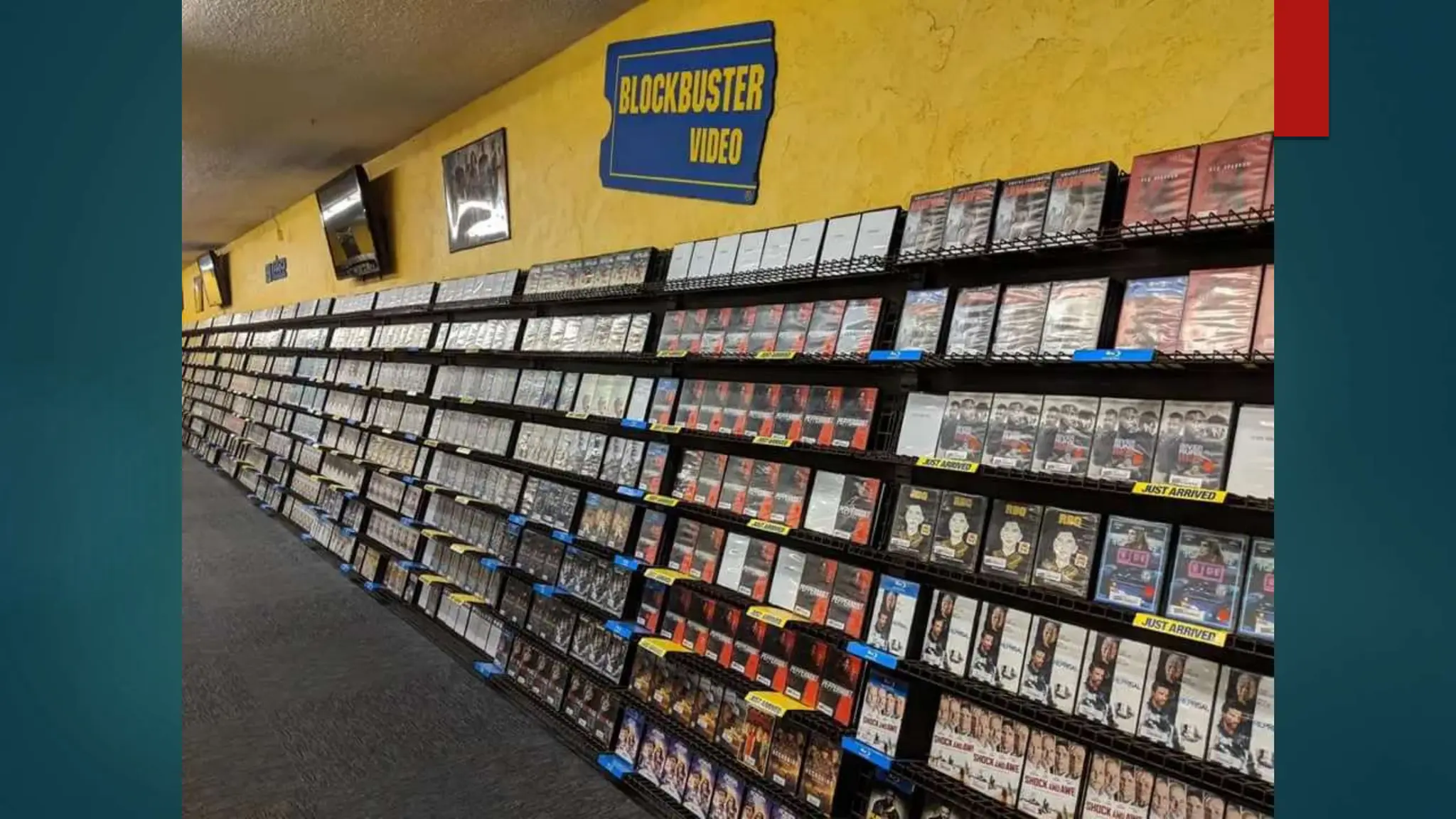
The once-dominant video rental business Blockbuster is a
prime example of a drone entrepreneur. Blockbuster stuck to
its established brick-and-mortar rental strategy in the face of
the shifting environment of the entertainment business and
the emergence of Internet streaming services. The business
finally declared bankruptcy because it was unable to
transform for the digital age. They were finally defeated
because of their stubborn commitment to outmoded
practices, which prevented them from taking advantage of
fresh prospects.
DIFFERENCE BETWEEN:
FABIAN
ENTREPRENEUR
Willing to adjust
when necessary
Inflexible and
steadfast in their
ways
DRONE
ENTREPRENEUR
Similarities:
• both rejects changes.
• stick to tried – and true practices
5. Social entrepreneurs
they are those who initiate
changes in the various fields such
as education, health, human
rights, environment and
enterprise development.
5. Social entrepreneurs
 focuses on providing solutions to
environmental and societal
problems through businesses
after philanthropic change; and
profit is just secondary
EXAMPLES:
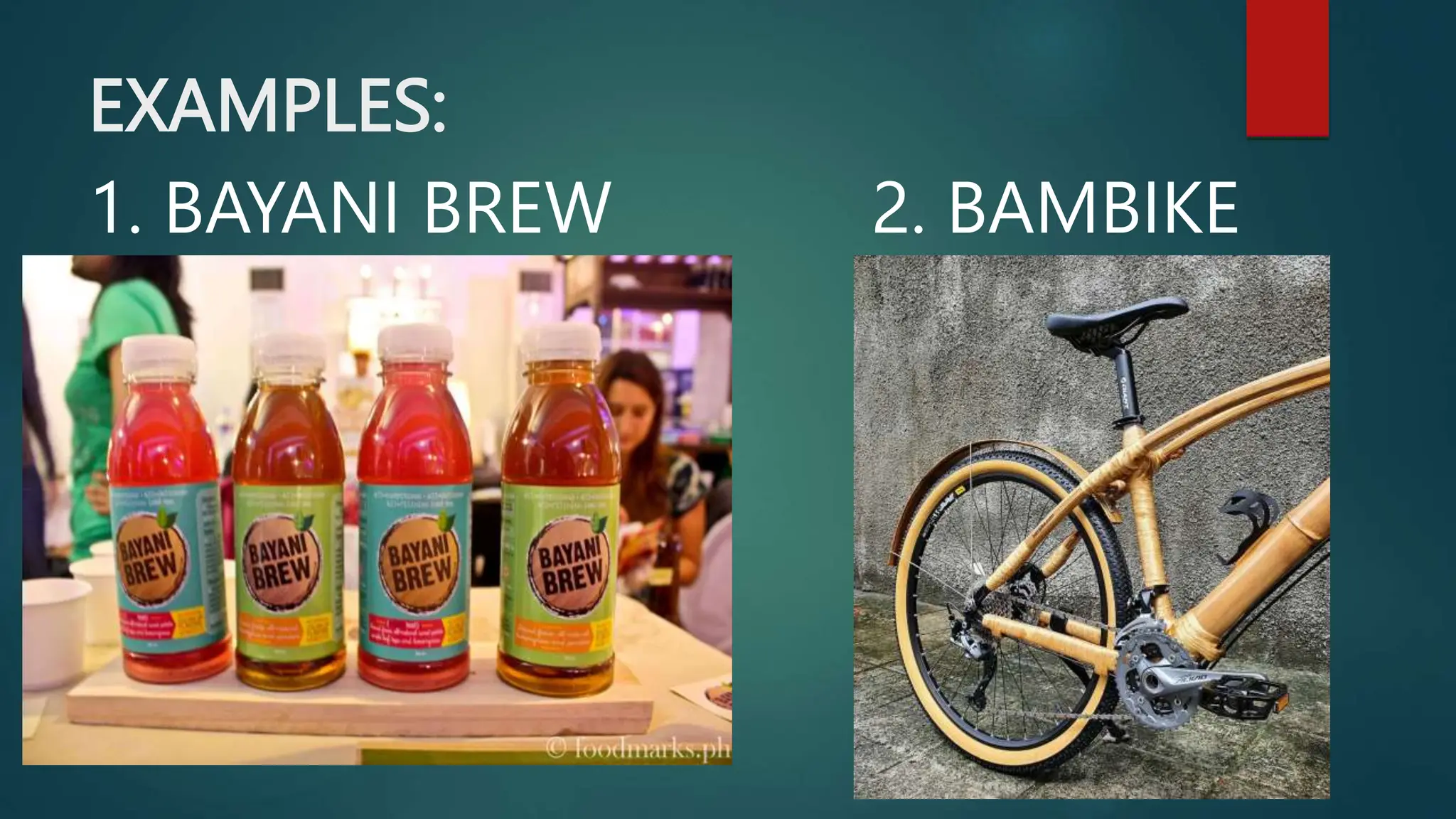
1. BAYANI BREW 2. BAMBIKE
Career Opportunities
of Entrepreneurship
1. Business Consultant
with expertise of the
entrepreneur he can be a very
good source of advices to
other entrepreneurs and would
be business man
2. Teacher
a graduate of
entrepreneurship can be
use his knowledge in
teaching
3. Researcher
the entrepreneur can
be employed as
researcher by an
enterprise
4. Sales
the entrepreneurship
graduate can apply as
salesman
5. Business Reporter
the entrepreneur being
expert in the field, he can
be employed as business
reporter.
Activity 3 Interview the Known
Choose three successful entrepreneurs in your community or
nearby places and conduct an interview using the guide
questions below. Discuss the result of your
interview to your teacher.
1. What motivated you to become an entrepreneur?
2. What do you think are your characteristics and competencies
that made you a successful entrepreneur?
3. What do you think of being employed? Why didn’t you
choose that path?
Activity 1 Interview the Known
Write the answers in paragraph
form. The output should be
written in your activity notebook.

INTRODUCTION TO ENTREPRENEURSHIP.pptx SH

  • 1.
  • 2.
    Activity 1. LetMe Know Give at least five (5) names of entrepreneurs that you know, may it be from your locality or within the Philippines. Identify what are their common traits as entrepreneurs.
  • 3.
    Activity 2. Essay Explainthe following questions below about the competencies of entrepreneurs. 1. What characteristics can you observe or see that are common among the entrepreneurs that you have listed?
  • 4.
    Activity 2. Essay Explainthe following questions below about the competencies of entrepreneurs. 2. Who among the entrepreneurs that you mentioned do you admire the most and why? 3. In your own opinion, what do you need to possess to become a successful entrepreneur?
  • 6.
  • 7.
    1. Development of Managerialcapabilities this means that one of the benefits an entrepreneur gets is to develop his managerial skills.
  • 8.
    2. Creation ofOrganizations which means that because of entrepreneurships many organizations will exist
  • 9.
    3. Improving standardof living this means that entrepreneurship can lift up the economic status of an individual.
  • 10.
    4. Means ofeconomic development this means that not only the life of the entrepreneur is improved but also the society where the business is located.
  • 11.
  • 12.
    Entrepreneur derived from theFrench verb enterprendre - to undertake
  • 13.
    This is pinpointingto those who “undertake” the risk of enterprise.
  • 14.
    Entrepreneurship  it isthe process that the enterprise is created by an entrepreneur are innovators, willing to take risks and generate new ideas to make it unique and profitable solutions to the present – day problems.
  • 15.
  • 16.
    1. Personality Factors whichincludes: a. Initiative – which means doings things even before being told b. Proactive – which means he can classify opportunities and seize it. c. Problem solver – which means he can retain good relations with other people.
  • 17.
    1. Personality Factorswhich includes: d. Perseverance – meaning he will pursue things to get done regardless of challenges e. Persuasion – means that he can entice people to buy even if they don’t.
  • 18.
    1. Personality Factorswhich includes: f. A Planner – meaning he makes plan before he can entice people to buy even if they don’t. g. Risk – taker – which means that he is willing to gamble but he will calculate it first.
  • 19.
    2. Environmental Factors whichinclude political, climate, legal system, economic and social conditions and market situations.
  • 20.
  • 21.
    1. Decisive an entrepreneur mustbe firm in making decisions.
  • 22.
  • 23.
    3. Leader an entrepreneuran entrepreneur must have the charisma to be obeyed by his employees
  • 24.
    4. Opportunity seeker- anentrepreneur must have the ability to be the first to see business chances.
  • 25.
    5. Proactive controlling asituation by making things to happen or by preparing for possible future problems.
  • 26.
    6. Risk Taker Theyhave the courage to pursue what is their business ideas.
  • 27.
    7. Innovative the entrepreneurshave big business ideas and they do not stop improving and thinking of new worthwhile ideas for their business.
  • 28.
  • 29.
    1. Economic anddynamic activity Entrepreneurship is an economic activity because it involves the creation and operation of an enterprise with a view to creating value or wealth by ensuring optimum utilization of limited resources.
  • 30.
    2. Innovative Entrepreneurs constantly lookfor new ideas, thus he needs to be creative.
  • 31.
    3. Profit Potential- meaningthe entrepreneur can be compensated by his profit coming from the operation.
  • 32.
    4. Risk bearing meaningthe entrepreneur needs to gamble but wise enough to offset the risk
  • 33.
  • 34.
    1. Innovative entrepreneur theyare those who always make new things by thinking of new ideas.
  • 35.
    1. Innovative entrepreneur haveability to think newer, better and more economical ideas.
  • 36.
    2. Imitating entrepreneurs theyare those who don’t create new things but only follow the ideas of other entrepreneurs.
  • 37.
    2. Imitating entrepreneurs thosepeople who follow the path show by innovative entrepreneurs
  • 38.
    Examples: Spotify (imitated onlinemusic streaming and created a user – friendly platform) Xiaomi (imitated Apple’s business model) Zara (imitated like H&M)
  • 39.
    3. Fabian entrepreneurs theyare those skeptical(unconvinced)in their approach in adopting or innovating new technology in their enterprise. They are not adoptable to the changing environment. They only adopt the new technology when they realize that failure to adopt will lead to loss or collapse of the enterprise  They don’t initiate but follow only after they are satisfied.
  • 40.
    Example The creator ofMcDonald’s, Ray Kroc, might be compared to a Fabian entrepreneur. Although the McDonald brothers opened the first McDonald’s restaurant with an emphasis on a small menu and quick service, it was Ray Kroc who saw the potential for rapid expansion. He modified the business strategy and made McDonald’s a dominant franchise worldwide. The success of McDonald’s was largely attributed to Kroc’s capacity to adapt and welcome change.
  • 41.
    4. Drone entrepreneur- theyare those who lives on the labor of others. Reluctant to make or accept any transformation are die-hard conservatives even ready to suffer the loss of business.
  • 42.
    EXAMPLE The once-dominant videorental business Blockbuster is a prime example of a drone entrepreneur. Blockbuster stuck to its established brick-and-mortar rental strategy in the face of the shifting environment of the entertainment business and the emergence of Internet streaming services. The business finally declared bankruptcy because it was unable to transform for the digital age. They were finally defeated because of their stubborn commitment to outmoded practices, which prevented them from taking advantage of fresh prospects.
  • 44.
    DIFFERENCE BETWEEN: FABIAN ENTREPRENEUR Willing toadjust when necessary Inflexible and steadfast in their ways DRONE ENTREPRENEUR Similarities: • both rejects changes. • stick to tried – and true practices
  • 45.
    5. Social entrepreneurs theyare those who initiate changes in the various fields such as education, health, human rights, environment and enterprise development.
  • 46.
    5. Social entrepreneurs focuses on providing solutions to environmental and societal problems through businesses after philanthropic change; and profit is just secondary
  • 48.
  • 49.
  • 50.
    1. Business Consultant withexpertise of the entrepreneur he can be a very good source of advices to other entrepreneurs and would be business man
  • 51.
    2. Teacher a graduateof entrepreneurship can be use his knowledge in teaching
  • 52.
    3. Researcher the entrepreneurcan be employed as researcher by an enterprise
  • 53.
  • 54.
    5. Business Reporter theentrepreneur being expert in the field, he can be employed as business reporter.
  • 55.
    Activity 3 Interviewthe Known Choose three successful entrepreneurs in your community or nearby places and conduct an interview using the guide questions below. Discuss the result of your interview to your teacher. 1. What motivated you to become an entrepreneur? 2. What do you think are your characteristics and competencies that made you a successful entrepreneur? 3. What do you think of being employed? Why didn’t you choose that path?
  • 56.
    Activity 1 Interviewthe Known Write the answers in paragraph form. The output should be written in your activity notebook.

Editor's Notes

  • #39 Spotify, the popular music streaming platform, is an example of imitative entrepreneurship. It entered a market that was already established by pioneers like Pandora and Apple’s iTunes. Spotify imitated the concept of online music streaming and created a user-friendly platform with a vast music library, offering a freemium model that attracted millions of users. While it replicated the basic idea, Spotify differentiated itself through its user interface, personalized recommendations, and social sharing features, ultimately becoming a dominant player in the music streaming industry. Xiaomi, a Chinese electronics company, is often referred to as the “Apple of China.” It imitated Apple’s business model, focusing on producing high-quality smartphones at affordable prices. Xiaomi replicated the minimalist design aesthetic, user-friendly interface, and direct-to-consumer sales approach popularized by Apple. By offering feature-rich smartphones at competitive prices, Xiaomi gained significant market share and established itself as one of the leading smartphone manufacturers globally. Zara, the Spanish clothing retailer, exemplifies imitative entrepreneurship in the fashion industry. Zara imitated the fast-fashion model pioneered by companies like H&M. It replicated the concept of quickly responding to fashion trends, producing affordable yet fashionable clothing, and maintaining a vertically integrated supply chain. By imitating and adapting this model, Zara became known for its agile production, frequent product turnover, and ability to deliver trendy clothing to consumers at a rapid pace.
  • #49 Bayani Brew supports Gawad Kalinga’s social programs. A part of its profit goes to providing housing and livelihood programs for farmers in different rural areas of the country. Bambike manufactures handmade bamboo bicycles. They aim to alleviate poverty while advocating the importance of going green. Moreover, they partner with Gawad Kalinga to provide programs such as scholarships, sponsorship for teachers, and skills training.