http://www.iaeme.com/IJCET/index.asp 24 editor@iaeme.com
International Journal of Computer Engineering & Technology (IJCET)
Volume 7, Issue 2, March-April 2016, pp. 24–29, Article ID: IJCET_07_02_003
Available online at
http://www.iaeme.com/IJCET/issues.asp?JType=IJCET&VType=7&IType=2
Journal Impact Factor (2016): 9.3590 (Calculated by GISI) www.jifactor.com
ISSN Print: 0976-6367 and ISSN Online: 0976–6375
© IAEME Publication
ENHANCED WEB IMAGE RE-RANKING
USING SEMANTIC SIGNATURES
Mangai P
Guest Faculty, Department of Computer Science,
Pondicherry University, Karaikal Campus.
ABSTRACT
Several commercial search engines adopt Image re- ranking approach to
enhance the quality of results for web based image search .When an user
issues a query keyword, the search engine first selects a group of images
based on textual information. If the user selects a query image from the
retrieved group, the rest of the images are re-ranked based on their visual
similarities with the query image. The images with similar visual features
cannot be correlated. Also learning a universal visual semantic space which
depicts the characteristics of images which are highly different to each other
is a tedious task.
Hence a novel image re-ranking framework has been proposed to
overcome the above said limitations. It has the property of Automatic offline
learning. It learns different visual semantic spaces for different query
keywords. Thus a semantic signature will be produced by projecting visual
features of images to their visual semantic space. The produced semantic
signature is compared with the images so that images are re-ranked as the
semantic signature is obtained from keywords visual semantic space. The
proposed image re-ranking framework thus increases the accuracy and
efficiency of image re-ranking.
Key words: Query keyword, Re-ranking, Semantic signature, Visual
Semantic space.
Cite this Article: Mangai P. Enhanced Web Image Re-Ranking Using
Semantic Signatures, International Journal of Computer Engineering and
Technology, 7(2), 2016, pp. 24–29.
http://www.iaeme.com/IJCET/issues.asp?JType=IJCET&VType=7&IType=1
Enhanced Web Image Re-Ranking Using Semantic Signatures
http://www.iaeme.com/IJCET/index.asp 25 editor@iaeme.com
1. INTRODUCTION
Web image retrieval starts with keyword queries and the major challenge is that
ambiguity in query keyword specified by the user. Ambiguity in query keyword
produces noisy image results. For example using “cakes” as keyword, the image
retrieved will fall on different categories, cakes of different shapes, styles etc. Hence
image re-ranking methodology has been adopted for better search results. It starts
with acceptance of a query keyword and a set of images are retrieved, then the user
selects an image of search intention. The remaining images will be re-ranked
according to the selected image visual features.
The major problem in image re-ranking is images with similar low level visual
features cannot be correlated with the higher level semantic meaning of image
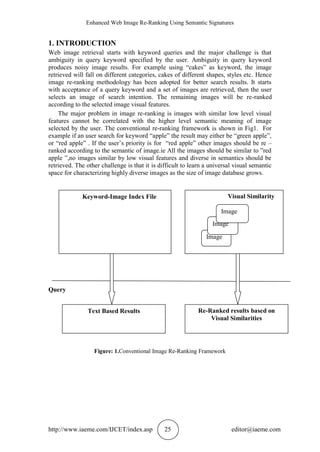
selected by the user. The conventional re-ranking framework is shown in Fig1. For
example if an user search for keyword “apple” the result may either be “green apple”,
or “red apple” . If the user’s priority is for “red apple” other images should be re –
ranked according to the semantic of image.ie All the images should be similar to ”red
apple ”,no images similar by low visual features and diverse in semantics should be
retrieved. The other challenge is that it is difficult to learn a universal visual semantic
space for characterizing highly diverse images as the size of image database grows.
Query
Figure: 1.Conventional Image Re-Ranking Framework
Keywords Images
Keyword-Image Index File Visual Similarity
Image
Images
img
Image
Image
Re-Ranked results based on
Visual Similarities
Text Based Results
Mangai P.
http://www.iaeme.com/IJCET/index.asp 26 editor@iaeme.com
2. RELATED WORK
In Internet image retrieval, images with different number of text keywords are linked
together. Text based image retrieval starts with matching the keywords that are linked
with images in data base and query keywords. The Matched images are retrieved as
results of the user. As the imaged data base grows in size, it is cumbersome for the
technical people to label the images as each images can be in different sector .For
example image of a “pen” can be labeled as under its type, its company and so on
.Thus each image can have different labels to identify. Content based image retrieval
(CBIR) is introduced with self learning capability to interconnect images .Images that
are retrieved by the search will be based on the content which are labeled manually.
As the images data base increases it become impractical to label all available images
manually. Not only labeling images makes the technique impractical but also
connecting the similar images.
The method of accounting color texture to predict similar images are not considered
efficient as it gives a semantic gap between lower level features and higher level
features (User Intention).Short term learning and long time learning approaches are
used for the reduction of semantic gap between low level features and high level
features. Short term learning helps in learning the list of images relevant with the user
query keywords. On the other hand the long term learning helps in learning
connection between images from the short term learning technique. Though CBIR is
considered more efficient than text based it provides noisy results to user.
One click internet image search method overrides the limitations of CBIR. It
helps in clearing the ambiguity in image retrieval. It combines text based and CBIR
with additional visual features to learn user intention. The major challenge of this
method is that similar visual featured images are not correlated.
3. PROPOSED IMAGE RE-RANKING ARCHITECTURE
The proposed system has the capability to learn different visual semantic spaces for
different query keywords instead of relying on a universal concept dictionary. The
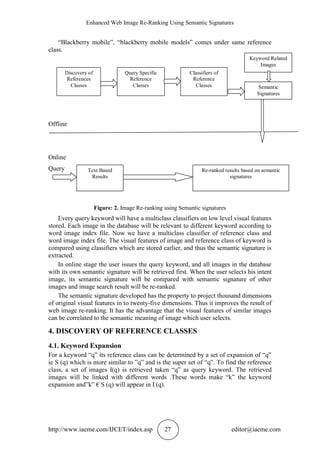
architecture of proposed image re-ranking using semantics signatures is shown in Fig
2. The query keyword itself helps in narrowing semantic space of images that are to
be re-ranked. For example, consider the given keyword is “blackberry” the concepts
like “cars”, “bikes” can be avoided and concepts like “mobile phone”,”fruit”can be
taken into account. This relevant concept can be made use for learning visual
semantic space of “blackberry”. Thus the non relevant concept can be avoided and the
visual semantic space will be accurately modeled. Those non relevant concepts will
always be noisy and it brings down the accuracy of re-ranking. In the next stage the
visual features of images will get projected to their respective visual semantic spaces
and the produced output will be semantic signatures. This produced semantic
signature of the given query keyword will be compared with other images and are re-
ranked.
Proposed system architecture consists of two phases online and offline. In the
offline stage for a query keyword “blackberry” the most relevant concept that matches
the keyword will be automatically selected. Concepts like “fruit”, ”mobile phone” are
selected as relevant concept by considering visual and textual information .A
reference class is developed, with a set of keyword expansions. Hence the retrieved
images by keyword expansion will have less difference with images retrieved by
query keyword “blackberry”. This stage also performs removal of noisy data and
redundant reference class. For example
Enhanced Web Image Re-Ranking Using Semantic Signatures
http://www.iaeme.com/IJCET/index.asp 27 editor@iaeme.com
“Blackberry mobile”, “blackberry mobile models” comes under same reference
class.
Offline
Online
Query
Figure: 2. Image Re-ranking using Semantic signatures
Every query keyword will have a multiclass classifiers on low level visual features
stored. Each image in the database will be relevant to different keyword according to
word image index file. Now we have a multiclass classifier of reference class and
word image index file. The visual features of image and reference class of keyword is
compared using classifiers which are stored earlier, and thus the semantic signature is
extracted.
In online stage the user issues the query keyword, and all images in the database
with its own semantic signature will be retrieved first. When the user selects his intent
image, its semantic signature will be compared with semantic signature of other
images and image search result will be re-ranked.
The semantic signature developed has the property to project thousand dimensions
of original visual features in to twenty-five dimensions. Thus it improves the result of
web image re-ranking. It has the advantage that the visual features of similar images
can be correlated to the semantic meaning of image which user selects.
4. DISCOVERY OF REFERENCE CLASSES
4.1. Keyword Expansion
For a keyword “q‟ its reference class can be determined by a set of expansion of “q‟
ie S (q) which is more similar to ‟q‟ and is the super set of “q‟. To find the reference
class, a set of images I(q) is retrieved taken “q‟ as query keyword. The retrieved
images will be linked with different words .These words make “k‟ the keyword
expansion and”k‟ € S (q) will appear in I (q).
Discovery of
References
Classes
Query Specific
Reference
Classes
Classifiers of
Reference
Classes
Keyword Related
Images
Semantic
Signatures
Text Based
Results
Re-ranked results based on semantic
signatures
Mangai P.
http://www.iaeme.com/IJCET/index.asp 28 editor@iaeme.com
4.2. Training Images of Reference Class
Training images of reference class is obtained automatically. The result from the
keyword expansion ‟k‟ is taken as query keyword and top “m‟ images are taken as
training images. The keyword expansion “k‟ will have less ambiguity to “q‟.
4.3. Redundant Reference Classes
Keyword expansion of “blackberry “as “blackberry mobiles “and ”blackberry mobile
models” are both visually and semantically same. To identify these kinds of redundant
classes half of the data in both classes are taken and SVM classifier is used to classify
next half. If it is possible to classify both halves easily then it is proven that both
classes are not the same.
5. CONCLUSION
The proposed framework improves the method of Web image re-ranking by using
semantic signatures. The semantic signature which is obtained from keywords and
user intent image semantic space are compared with the semantic signature of other
images at online stage to get an efficient image re-ranking. However user experience
is critical for web-based image search. To fully reflect the extent of user’s satisfaction
a study has to be conducted.
REFERENCES
[1] Xiangang Wang,Kr Lie,Xiaoou Tang.Web image re-ranking using query specific
semantic signatures IEEE transactions on patterns analysis and machine
intelligence(volume:36,issue:4) April 2014
[2] Siddangowda.G.R,Santhosh.S,Sandeep Kumar.S, Raghu M.T. Image retrieval
using semantics of query imageInternational Journal of Darshan institute on
Engineering research & emerging technologies.vol.2,no.2,2013
[3] Xiaoou Tang,Ke Liu,Jimgyu Cui,Fang Wen,Xiaogang Wang.Intent
search:capturing user intention for one-click internet image search. signatures
IEEE transactions on patterns analysis and machine intelligence
(volume:34,issue:7) july 2012
[4] Y. Cao, C. Wang, Z. Li, L. Zhang, and L. Zhang. Spatial-bag-offeatures. In Proc.
CVPR, 2010.
[5] G. Cauwenberghs and T. Poggio. Incremental and decremental support vector
machine learning. In Proc. NIPS, 2001.
[6] J. Cui, F. Wen, and X. Tang. Intentsearch: Interactive on-line image search re-
ranking. In Proc. ACM Multimedia. ACM, 2008.
[7] J. Cui, F. Wen, and X. Tang. Real time google and live image search re-ranking.
In Proc. ACM Multimedia, 2008.
[8] N. Dalal and B. Triggs. Histograms of oriented gradients for human detection. In
Proc. CVPR, 2005.
[9] C. Lampert, H. Nickisch, and S. Harmeling. Learning to detect unseen object
classes by between-class attribute transfer. In Proc.CVPR, 2005.
[10] B. Luo, X. Wang, and X. Tang. A world wide web based image search engine
using text and image content features. In Proceedings of the SPIE Electronic
Imaging, 2003.
[11] J. Philbin, M. Isard, J. Sivic, and A. Zisserman. Descriptor Learning for Efficient
Retrieval. In Proc. ECCV, 2010.
Enhanced Web Image Re-Ranking Using Semantic Signatures
http://www.iaeme.com/IJCET/index.asp 29 editor@iaeme.com
[12] N. Rasiwasia, P. J. Moreno, and N. Vasconcelos. Bridging the gap: Query by
semantic example. IEEE Trans. on Multimedia, 2007.
[13] Y. Rui, T. S. Huang, M. Ortega, and S. Mehrotra. Relevance feedback: a power
tool for interactive content-based image retrieval.IEEE Trans. on Circuits and
Systems for Video Technology, 1998.
[14] D. Tao, X. Tang, X. Li, and X. Wu. Asymmetric bagging and random subspace
for support vector machines-based relevance feedback in image retrieval. IEEE
Trans. on Pattern Analysis and Machine Intelligence, 2006.
[15] P.Mangai and Mrs.M.Priya. Personalized User and Query Dependent
Ranking for Web Databases, International Journal of Computer
Engineering and Technology, 5(2), 2014, pp. 234–239.
[16] X. S. Zhou and T. S. Huang. Relevance feedback in image retrieval: A
comprehensive review. Multimedia Systems, 2003.

ENHANCED WEB IMAGE RE-RANKING USING SEMANTIC SIGNATURES

  • 1.
    http://www.iaeme.com/IJCET/index.asp 24 editor@iaeme.com InternationalJournal of Computer Engineering & Technology (IJCET) Volume 7, Issue 2, March-April 2016, pp. 24–29, Article ID: IJCET_07_02_003 Available online at http://www.iaeme.com/IJCET/issues.asp?JType=IJCET&VType=7&IType=2 Journal Impact Factor (2016): 9.3590 (Calculated by GISI) www.jifactor.com ISSN Print: 0976-6367 and ISSN Online: 0976–6375 © IAEME Publication ENHANCED WEB IMAGE RE-RANKING USING SEMANTIC SIGNATURES Mangai P Guest Faculty, Department of Computer Science, Pondicherry University, Karaikal Campus. ABSTRACT Several commercial search engines adopt Image re- ranking approach to enhance the quality of results for web based image search .When an user issues a query keyword, the search engine first selects a group of images based on textual information. If the user selects a query image from the retrieved group, the rest of the images are re-ranked based on their visual similarities with the query image. The images with similar visual features cannot be correlated. Also learning a universal visual semantic space which depicts the characteristics of images which are highly different to each other is a tedious task. Hence a novel image re-ranking framework has been proposed to overcome the above said limitations. It has the property of Automatic offline learning. It learns different visual semantic spaces for different query keywords. Thus a semantic signature will be produced by projecting visual features of images to their visual semantic space. The produced semantic signature is compared with the images so that images are re-ranked as the semantic signature is obtained from keywords visual semantic space. The proposed image re-ranking framework thus increases the accuracy and efficiency of image re-ranking. Key words: Query keyword, Re-ranking, Semantic signature, Visual Semantic space. Cite this Article: Mangai P. Enhanced Web Image Re-Ranking Using Semantic Signatures, International Journal of Computer Engineering and Technology, 7(2), 2016, pp. 24–29. http://www.iaeme.com/IJCET/issues.asp?JType=IJCET&VType=7&IType=1
  • 2.
    Enhanced Web ImageRe-Ranking Using Semantic Signatures http://www.iaeme.com/IJCET/index.asp 25 editor@iaeme.com 1. INTRODUCTION Web image retrieval starts with keyword queries and the major challenge is that ambiguity in query keyword specified by the user. Ambiguity in query keyword produces noisy image results. For example using “cakes” as keyword, the image retrieved will fall on different categories, cakes of different shapes, styles etc. Hence image re-ranking methodology has been adopted for better search results. It starts with acceptance of a query keyword and a set of images are retrieved, then the user selects an image of search intention. The remaining images will be re-ranked according to the selected image visual features. The major problem in image re-ranking is images with similar low level visual features cannot be correlated with the higher level semantic meaning of image selected by the user. The conventional re-ranking framework is shown in Fig1. For example if an user search for keyword “apple” the result may either be “green apple”, or “red apple” . If the user’s priority is for “red apple” other images should be re – ranked according to the semantic of image.ie All the images should be similar to ”red apple ”,no images similar by low visual features and diverse in semantics should be retrieved. The other challenge is that it is difficult to learn a universal visual semantic space for characterizing highly diverse images as the size of image database grows. Query Figure: 1.Conventional Image Re-Ranking Framework Keywords Images Keyword-Image Index File Visual Similarity Image Images img Image Image Re-Ranked results based on Visual Similarities Text Based Results
  • 3.
    Mangai P. http://www.iaeme.com/IJCET/index.asp 26editor@iaeme.com 2. RELATED WORK In Internet image retrieval, images with different number of text keywords are linked together. Text based image retrieval starts with matching the keywords that are linked with images in data base and query keywords. The Matched images are retrieved as results of the user. As the imaged data base grows in size, it is cumbersome for the technical people to label the images as each images can be in different sector .For example image of a “pen” can be labeled as under its type, its company and so on .Thus each image can have different labels to identify. Content based image retrieval (CBIR) is introduced with self learning capability to interconnect images .Images that are retrieved by the search will be based on the content which are labeled manually. As the images data base increases it become impractical to label all available images manually. Not only labeling images makes the technique impractical but also connecting the similar images. The method of accounting color texture to predict similar images are not considered efficient as it gives a semantic gap between lower level features and higher level features (User Intention).Short term learning and long time learning approaches are used for the reduction of semantic gap between low level features and high level features. Short term learning helps in learning the list of images relevant with the user query keywords. On the other hand the long term learning helps in learning connection between images from the short term learning technique. Though CBIR is considered more efficient than text based it provides noisy results to user. One click internet image search method overrides the limitations of CBIR. It helps in clearing the ambiguity in image retrieval. It combines text based and CBIR with additional visual features to learn user intention. The major challenge of this method is that similar visual featured images are not correlated. 3. PROPOSED IMAGE RE-RANKING ARCHITECTURE The proposed system has the capability to learn different visual semantic spaces for different query keywords instead of relying on a universal concept dictionary. The architecture of proposed image re-ranking using semantics signatures is shown in Fig 2. The query keyword itself helps in narrowing semantic space of images that are to be re-ranked. For example, consider the given keyword is “blackberry” the concepts like “cars”, “bikes” can be avoided and concepts like “mobile phone”,”fruit”can be taken into account. This relevant concept can be made use for learning visual semantic space of “blackberry”. Thus the non relevant concept can be avoided and the visual semantic space will be accurately modeled. Those non relevant concepts will always be noisy and it brings down the accuracy of re-ranking. In the next stage the visual features of images will get projected to their respective visual semantic spaces and the produced output will be semantic signatures. This produced semantic signature of the given query keyword will be compared with other images and are re- ranked. Proposed system architecture consists of two phases online and offline. In the offline stage for a query keyword “blackberry” the most relevant concept that matches the keyword will be automatically selected. Concepts like “fruit”, ”mobile phone” are selected as relevant concept by considering visual and textual information .A reference class is developed, with a set of keyword expansions. Hence the retrieved images by keyword expansion will have less difference with images retrieved by query keyword “blackberry”. This stage also performs removal of noisy data and redundant reference class. For example
  • 4.
    Enhanced Web ImageRe-Ranking Using Semantic Signatures http://www.iaeme.com/IJCET/index.asp 27 editor@iaeme.com “Blackberry mobile”, “blackberry mobile models” comes under same reference class. Offline Online Query Figure: 2. Image Re-ranking using Semantic signatures Every query keyword will have a multiclass classifiers on low level visual features stored. Each image in the database will be relevant to different keyword according to word image index file. Now we have a multiclass classifier of reference class and word image index file. The visual features of image and reference class of keyword is compared using classifiers which are stored earlier, and thus the semantic signature is extracted. In online stage the user issues the query keyword, and all images in the database with its own semantic signature will be retrieved first. When the user selects his intent image, its semantic signature will be compared with semantic signature of other images and image search result will be re-ranked. The semantic signature developed has the property to project thousand dimensions of original visual features in to twenty-five dimensions. Thus it improves the result of web image re-ranking. It has the advantage that the visual features of similar images can be correlated to the semantic meaning of image which user selects. 4. DISCOVERY OF REFERENCE CLASSES 4.1. Keyword Expansion For a keyword “q‟ its reference class can be determined by a set of expansion of “q‟ ie S (q) which is more similar to ‟q‟ and is the super set of “q‟. To find the reference class, a set of images I(q) is retrieved taken “q‟ as query keyword. The retrieved images will be linked with different words .These words make “k‟ the keyword expansion and”k‟ € S (q) will appear in I (q). Discovery of References Classes Query Specific Reference Classes Classifiers of Reference Classes Keyword Related Images Semantic Signatures Text Based Results Re-ranked results based on semantic signatures
  • 5.
    Mangai P. http://www.iaeme.com/IJCET/index.asp 28editor@iaeme.com 4.2. Training Images of Reference Class Training images of reference class is obtained automatically. The result from the keyword expansion ‟k‟ is taken as query keyword and top “m‟ images are taken as training images. The keyword expansion “k‟ will have less ambiguity to “q‟. 4.3. Redundant Reference Classes Keyword expansion of “blackberry “as “blackberry mobiles “and ”blackberry mobile models” are both visually and semantically same. To identify these kinds of redundant classes half of the data in both classes are taken and SVM classifier is used to classify next half. If it is possible to classify both halves easily then it is proven that both classes are not the same. 5. CONCLUSION The proposed framework improves the method of Web image re-ranking by using semantic signatures. The semantic signature which is obtained from keywords and user intent image semantic space are compared with the semantic signature of other images at online stage to get an efficient image re-ranking. However user experience is critical for web-based image search. To fully reflect the extent of user’s satisfaction a study has to be conducted. REFERENCES [1] Xiangang Wang,Kr Lie,Xiaoou Tang.Web image re-ranking using query specific semantic signatures IEEE transactions on patterns analysis and machine intelligence(volume:36,issue:4) April 2014 [2] Siddangowda.G.R,Santhosh.S,Sandeep Kumar.S, Raghu M.T. Image retrieval using semantics of query imageInternational Journal of Darshan institute on Engineering research & emerging technologies.vol.2,no.2,2013 [3] Xiaoou Tang,Ke Liu,Jimgyu Cui,Fang Wen,Xiaogang Wang.Intent search:capturing user intention for one-click internet image search. signatures IEEE transactions on patterns analysis and machine intelligence (volume:34,issue:7) july 2012 [4] Y. Cao, C. Wang, Z. Li, L. Zhang, and L. Zhang. Spatial-bag-offeatures. In Proc. CVPR, 2010. [5] G. Cauwenberghs and T. Poggio. Incremental and decremental support vector machine learning. In Proc. NIPS, 2001. [6] J. Cui, F. Wen, and X. Tang. Intentsearch: Interactive on-line image search re- ranking. In Proc. ACM Multimedia. ACM, 2008. [7] J. Cui, F. Wen, and X. Tang. Real time google and live image search re-ranking. In Proc. ACM Multimedia, 2008. [8] N. Dalal and B. Triggs. Histograms of oriented gradients for human detection. In Proc. CVPR, 2005. [9] C. Lampert, H. Nickisch, and S. Harmeling. Learning to detect unseen object classes by between-class attribute transfer. In Proc.CVPR, 2005. [10] B. Luo, X. Wang, and X. Tang. A world wide web based image search engine using text and image content features. In Proceedings of the SPIE Electronic Imaging, 2003. [11] J. Philbin, M. Isard, J. Sivic, and A. Zisserman. Descriptor Learning for Efficient Retrieval. In Proc. ECCV, 2010.
  • 6.
    Enhanced Web ImageRe-Ranking Using Semantic Signatures http://www.iaeme.com/IJCET/index.asp 29 editor@iaeme.com [12] N. Rasiwasia, P. J. Moreno, and N. Vasconcelos. Bridging the gap: Query by semantic example. IEEE Trans. on Multimedia, 2007. [13] Y. Rui, T. S. Huang, M. Ortega, and S. Mehrotra. Relevance feedback: a power tool for interactive content-based image retrieval.IEEE Trans. on Circuits and Systems for Video Technology, 1998. [14] D. Tao, X. Tang, X. Li, and X. Wu. Asymmetric bagging and random subspace for support vector machines-based relevance feedback in image retrieval. IEEE Trans. on Pattern Analysis and Machine Intelligence, 2006. [15] P.Mangai and Mrs.M.Priya. Personalized User and Query Dependent Ranking for Web Databases, International Journal of Computer Engineering and Technology, 5(2), 2014, pp. 234–239. [16] X. S. Zhou and T. S. Huang. Relevance feedback in image retrieval: A comprehensive review. Multimedia Systems, 2003.