ENGLISH
INTRODUCTION
BIBLIOGRAPHY
MODALS
COHESIVE
DEVICES
EMOTIVE WORDS
CONTEXT CLUES
Hi! My name is Johanne Cabañas. I am
from Grade-8 Narra. This is my
Interactive Powerpoint Presentation
with English topics.
BIBLIOGRAPHY
- Gives the reader of your essay or assignment an idea of your wide reading
on the topic studied.
- The alphabetical listing of the books, articles, and other sources used is
an easy guide for the reader to follow.
BIBLIOGRAPHY FOR
BOOKS
BIBLIOGRAPHY FOR
MAGAZINES
BIBLIOGRAPHY FOR
WEBPAGE
INTRODUCTION
BIBLIOGRAPHY FOR
BOOKS
Author’s Surname, First Name Initials( Date of Publication). Title of
Book. Place of Publication: Publishing House.
EXAMPLE
1. Book with one author:
Hutchens, B. (2001). Nickel and dimed: On (not) getting by in America. New
York: Henry Holt and Company.
2. Book with more than one author:
Ehrenreich, D.L., and Ross, L. (2007). Pearl, the man and the place: The Origin
of Mount Pearl. St. John’s, NL: Seaflow Publishing.
BACK
INRODUCTION
BIBLIOGRAPHY FOR
MAGAZINES
Author’s Surname, First Name Initials( Date of Publication). “Title of
Article”. Title of Magazine, page number.
EXAMPLE
Pincott, J. (2012, March 9). Slips of the tongue. Psychology Today, 15-22.
BACK
INTRODUCTION
BIBLIOGRAPHY FOR
WEBPAGE
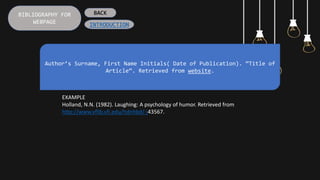
Author’s Surname, First Name Initials( Date of Publication). “Title of
Article”. Retrieved from website.
EXAMPLE
Holland, N.N. (1982). Laughing: A psychology of humor. Retrieved from
http://www.vflib.vfi.edu/hdnhbd/-j43567.
BACK
INTRODUCTION
MODALS
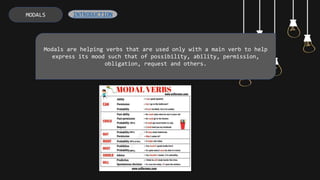
Modals are helping verbs that are used only with a main verb to help
express its mood such that of possibility, ability, permission,
obligation, request and others.
INTRODUCTION
COHESIVE
DEVICES
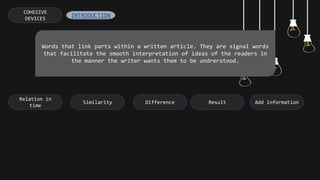
Words that link parts within a written article. They are signal words
that facilitate the smooth interpretation of ideas of the readers in
the manner the writer wants them to be undrerstood.
Similarity Add information
Relation in
time
Difference Result
INTRODUCTION
Relation in
time
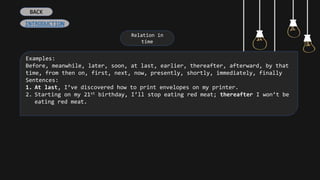
Examples:
Before, meanwhile, later, soon, at last, earlier, thereafter, afterward, by that
time, from then on, first, next, now, presently, shortly, immediately, finally
Sentences:
1. At last, I’ve discovered how to print envelopes on my printer.
2. Starting on my 21st birthday, I’ll stop eating red meat; thereafter I won’t be
eating red meat.
BACK
INTRODUCTION
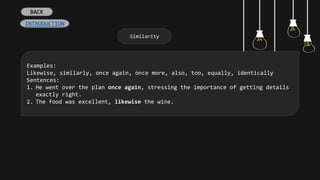
Similarity
Examples:
Likewise, similarly, once again, once more, also, too, equally, identically
Sentences:
1. He went over the plan once again, stressing the importance of getting details
exactly right.
2. The food was excellent, likewise the wine.
BACK
INTRODUCTION
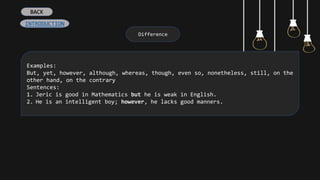
Difference
Examples:
But, yet, however, although, whereas, though, even so, nonetheless, still, on the
other hand, on the contrary
Sentences:
1. Jeric is good in Mathematics but he is weak in English.
2. He is an intelligent boy; however, he lacks good manners.
INTRODUCTION
BACK
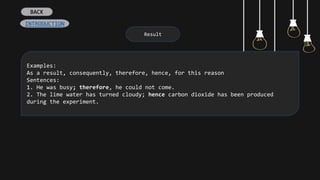
Result
Examples:
As a result, consequently, therefore, hence, for this reason
Sentences:
1. He was busy; therefore, he could not come.
2. The lime water has turned cloudy; hence carbon dioxide has been produced
during the experiment.
BACK
INTRODUCTION
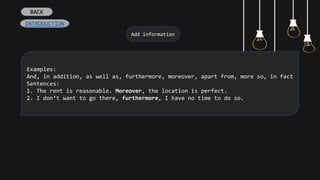
Add information
Examples:
And, in addition, as well as, furthermore, moreover, apart from, more so, in fact
Sentences:
1. The rent is reasonable. Moreover, the location is perfect.
2. I don’t want to go there, furthermore, I have no time to do so.
INTRODUCTION
BACK
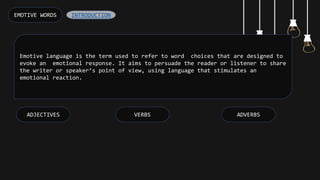
Emotive language is the term used to refer to word choices that are designed to
evoke an emotional response. It aims to persuade the reader or listener to share
the writer or speaker’s point of view, using language that stimulates an
emotional reaction.
EMOTIVE WORDS
ADVERBS
VERBS
ADJECTIVES
INTRODUCTION
ADJECTIVES
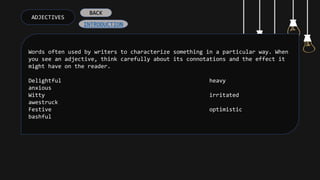
Words often used by writers to characterize something in a particular way. When
you see an adjective, think carefully about its connotations and the effect it
might have on the reader.
Delightful heavy
anxious
Witty irritated
awestruck
Festive optimistic
bashful
INTRODUCTION
BACK
VERBS
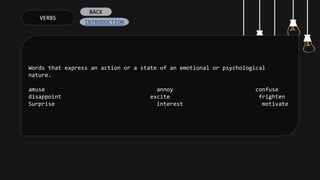
Words that express an action or a state of an emotional or psychological
nature.
amuse annoy confuse
disappoint excite frighten
Surprise interest motivate
INTRODUCTION
BACK
ADVERBS
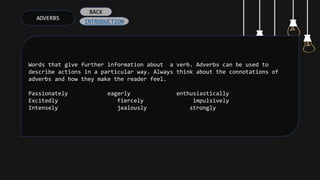
Words that give further information about a verb. Adverbs can be used to
describe actions in a particular way. Always think about the connotations of
adverbs and how they make the reader feel.
Passionately eagerly enthusiastically
Excitedly fiercely impulsively
Intensely jealously strongly
INTRODUCTION
BACK
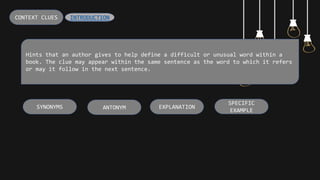
Hints that an author gives to help define a difficult or unusual word within a
book. The clue may appear within the same sentence as the word to which it refers
or may it follow in the next sentence.
CONTEXT CLUES
SPECIFIC
EXAMPLE
EXPLANATION
ANTONYM
SYNONYMS
INTRODUCTION
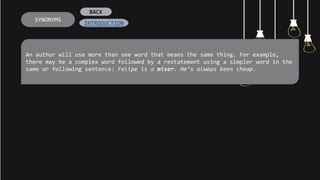
An author will use more than one word that means the same thing. For example,
there may be a complex word followed by a restatement using a simpler word in the
same or following sentence: Felipe is a miser. He’s always been cheap.
SYNONYMS
INTRODUCTION
BACK
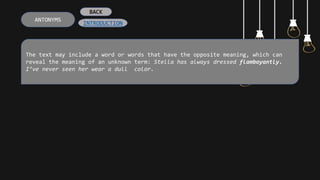
The text may include a word or words that have the opposite meaning, which can
reveal the meaning of an unknown term: Stella has always dressed flamboyantly.
I’ve never seen her wear a dull color.
ANTONYMS
INTRODUCTION
BACK
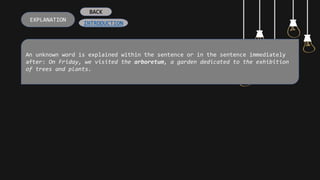
An unknown word is explained within the sentence or in the sentence immediately
after: On Friday, we visited the arboretum, a garden dedicated to the exhibition
of trees and plants.
EXPLANATION
INTRODUCTION
BACK
The text provides one or more examples used to define the term: The children were
able to observe several crustaceans, including crabs, lobsters, and shrimp.
EXAMPLE
INTRODUCTION
BACK

ENGLISH TOPICS FOR GRADE 8

  • 1.
    ENGLISH INTRODUCTION BIBLIOGRAPHY MODALS COHESIVE DEVICES EMOTIVE WORDS CONTEXT CLUES Hi!My name is Johanne Cabañas. I am from Grade-8 Narra. This is my Interactive Powerpoint Presentation with English topics.
  • 2.
    BIBLIOGRAPHY - Gives thereader of your essay or assignment an idea of your wide reading on the topic studied. - The alphabetical listing of the books, articles, and other sources used is an easy guide for the reader to follow. BIBLIOGRAPHY FOR BOOKS BIBLIOGRAPHY FOR MAGAZINES BIBLIOGRAPHY FOR WEBPAGE INTRODUCTION
  • 3.
    BIBLIOGRAPHY FOR BOOKS Author’s Surname,First Name Initials( Date of Publication). Title of Book. Place of Publication: Publishing House. EXAMPLE 1. Book with one author: Hutchens, B. (2001). Nickel and dimed: On (not) getting by in America. New York: Henry Holt and Company. 2. Book with more than one author: Ehrenreich, D.L., and Ross, L. (2007). Pearl, the man and the place: The Origin of Mount Pearl. St. John’s, NL: Seaflow Publishing. BACK INRODUCTION
  • 4.
    BIBLIOGRAPHY FOR MAGAZINES Author’s Surname,First Name Initials( Date of Publication). “Title of Article”. Title of Magazine, page number. EXAMPLE Pincott, J. (2012, March 9). Slips of the tongue. Psychology Today, 15-22. BACK INTRODUCTION
  • 5.
    BIBLIOGRAPHY FOR WEBPAGE Author’s Surname,First Name Initials( Date of Publication). “Title of Article”. Retrieved from website. EXAMPLE Holland, N.N. (1982). Laughing: A psychology of humor. Retrieved from http://www.vflib.vfi.edu/hdnhbd/-j43567. BACK INTRODUCTION
  • 6.
    MODALS Modals are helpingverbs that are used only with a main verb to help express its mood such that of possibility, ability, permission, obligation, request and others. INTRODUCTION
  • 7.
    COHESIVE DEVICES Words that linkparts within a written article. They are signal words that facilitate the smooth interpretation of ideas of the readers in the manner the writer wants them to be undrerstood. Similarity Add information Relation in time Difference Result INTRODUCTION
  • 8.
    Relation in time Examples: Before, meanwhile,later, soon, at last, earlier, thereafter, afterward, by that time, from then on, first, next, now, presently, shortly, immediately, finally Sentences: 1. At last, I’ve discovered how to print envelopes on my printer. 2. Starting on my 21st birthday, I’ll stop eating red meat; thereafter I won’t be eating red meat. BACK INTRODUCTION
  • 9.
    Similarity Examples: Likewise, similarly, onceagain, once more, also, too, equally, identically Sentences: 1. He went over the plan once again, stressing the importance of getting details exactly right. 2. The food was excellent, likewise the wine. BACK INTRODUCTION
  • 10.
    Difference Examples: But, yet, however,although, whereas, though, even so, nonetheless, still, on the other hand, on the contrary Sentences: 1. Jeric is good in Mathematics but he is weak in English. 2. He is an intelligent boy; however, he lacks good manners. INTRODUCTION BACK
  • 11.
    Result Examples: As a result,consequently, therefore, hence, for this reason Sentences: 1. He was busy; therefore, he could not come. 2. The lime water has turned cloudy; hence carbon dioxide has been produced during the experiment. BACK INTRODUCTION
  • 12.
    Add information Examples: And, inaddition, as well as, furthermore, moreover, apart from, more so, in fact Sentences: 1. The rent is reasonable. Moreover, the location is perfect. 2. I don’t want to go there, furthermore, I have no time to do so. INTRODUCTION BACK
  • 13.
    Emotive language isthe term used to refer to word choices that are designed to evoke an emotional response. It aims to persuade the reader or listener to share the writer or speaker’s point of view, using language that stimulates an emotional reaction. EMOTIVE WORDS ADVERBS VERBS ADJECTIVES INTRODUCTION
  • 14.
    ADJECTIVES Words often usedby writers to characterize something in a particular way. When you see an adjective, think carefully about its connotations and the effect it might have on the reader. Delightful heavy anxious Witty irritated awestruck Festive optimistic bashful INTRODUCTION BACK
  • 15.
    VERBS Words that expressan action or a state of an emotional or psychological nature. amuse annoy confuse disappoint excite frighten Surprise interest motivate INTRODUCTION BACK
  • 16.
    ADVERBS Words that givefurther information about a verb. Adverbs can be used to describe actions in a particular way. Always think about the connotations of adverbs and how they make the reader feel. Passionately eagerly enthusiastically Excitedly fiercely impulsively Intensely jealously strongly INTRODUCTION BACK
  • 17.
    Hints that anauthor gives to help define a difficult or unusual word within a book. The clue may appear within the same sentence as the word to which it refers or may it follow in the next sentence. CONTEXT CLUES SPECIFIC EXAMPLE EXPLANATION ANTONYM SYNONYMS INTRODUCTION
  • 18.
    An author willuse more than one word that means the same thing. For example, there may be a complex word followed by a restatement using a simpler word in the same or following sentence: Felipe is a miser. He’s always been cheap. SYNONYMS INTRODUCTION BACK
  • 19.
    The text mayinclude a word or words that have the opposite meaning, which can reveal the meaning of an unknown term: Stella has always dressed flamboyantly. I’ve never seen her wear a dull color. ANTONYMS INTRODUCTION BACK
  • 20.
    An unknown wordis explained within the sentence or in the sentence immediately after: On Friday, we visited the arboretum, a garden dedicated to the exhibition of trees and plants. EXPLANATION INTRODUCTION BACK
  • 21.
    The text providesone or more examples used to define the term: The children were able to observe several crustaceans, including crabs, lobsters, and shrimp. EXAMPLE INTRODUCTION BACK