A: Excuse me. I don’t think we have met before.
My name is Mary Jenson.
B: Oh, hello. I’m Bikash Chettri
A: Good to meet you Mr Chettri.
B: Pleased to meet you too, Ms Jenson.
Now in the same way introduce yourself to
your partner or to someone else.
Useful expressions
Hello, I’m.... Hi, my name is.... Nice/Good/Pleased to meet you.
C Pair work
1
1
A: Hello. I’m Jason.
B: Hi. My name is Dolma.
A: Nice to meet you, Dolma.
B: Good to meet you too.
A Listen to people introduce themselves. Listen at least
three times.
Now practice the same conversations with a
partner. Practice for three to five minutes.
B Role play
A: Hello. Can I sit here?
B: Yes.
A: By the way, I’m Robin.
B: Hi. My name is Jessica.
A: Nice to meet you.
B: Pleased to meet you too. And where are you from,
Robin?
A: I’m from Kathmandu. What about you?
B: I’m from New York. Oh, this is my stop. Bye, Robin.
A: Bye. See you.
6
w
w
w
.allonlinefree.com
A: Hi. How have you been?
B: Fine, thanks. And you?
A: Pretty good. How’s the family?
B: Just fine. And how’s work?
A: Good. Very busy.
B: Yeah, me too.
A: Well, talk to you later.
B: Yeah. Nice talking to you. Bye.
A: Bye.
2
A: Hi. Subodh. How are you today?
B: Not bad, thanks. How about you?
A: Great, thanks.
B: So, where are you heading?
A: To college, as usual. I’m already late. See you
later, Subodh.
B: Take care. Bye bye.
A Listen to friends talking when they meet.Listen at least
twice.
Now take turns talking.This time use your own
information.
C Pair work
Now practice the same conversations with a
partner. Practice for three to five minutes.
B Role play
Some useful expressions
How are you?
How have you been?
How are you doing?
How are things?
How’s family?
How’s work?
How’s business?
How are studies?
Just fine, thanks.
Great, thanks.
Pretty good, thanks.
So so. Thanks.
Well, talk to you later.
Well, nice talking to you.
See you.
See you later.
7
www.allonlinefree.com
w
w
w
.allonlinefree.com
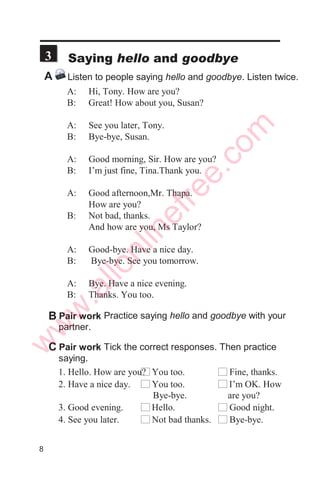
1. Hello. How are you? You too. Fine, thanks.
2. Have a nice day. You too. I’m OK. How
Bye-bye. are you?
3. Good evening. Hello. Good night.
4. See you later. Not bad thanks. Bye-bye.
A: Hi, Tony. How are you?
B: Great! How about you, Susan?
A: See you later, Tony.
B: Bye-bye, Susan.
A: Good morning, Sir. How are you?
B: I’m just fine, Tina.Thank you.
A: Good afternoon,Mr. Thapa.
How are you?
B: Not bad, thanks.
And how are you, Ms Taylor?
A: Good-bye. Have a nice day.
B: Bye-bye. See you tomorrow.
A: Bye. Have a nice evening.
B: Thanks. You too.
A Listen to people saying and . Listen twice.
Practice saying and with your
partner.
B Pair work
Tick the correct responses. Then practice
saying.
C Pair work
3
8
w
w
w
.allonlinefree.com
1
2
A Listen to a student talk about his routines.
B Listen again. Which of these words do you hear? Tick
them as you listen.
always
usually
often
sometimes
seldom
hardly ever
never
C Listen again and tick these words and phrases as
you hear them.
get up
study
get dressed
go out
go to bed
have breakfast
watch TV
visit
in the morning
for sometime
on time
in the afternoon
in the evening
weekends
late
on holidays
D Listen once again. The student is talking about what he
does on college days, at weekends and on long holidays.
E Now tell from memory what the student does. You may
say something like this:
9
w
w
w
.allonlinefree.com
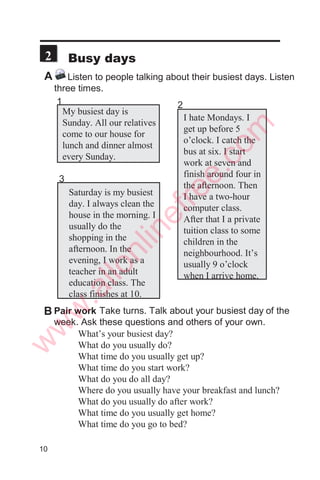
My busiest day is
Sunday. All our relatives
come to our house for
lunch and dinner almost
every Sunday.
A Listen to people talking about their busiest days. Listen
three times.
2
Take turns. Talk about your busiest day of the
week. Ask these questions and others of your own.
What’s your busiest day?
What do you usually do?
What time do you usually get up?
What time do you start work?
What do you do all day?
Where do you usually have your breakfast and lunch?
What do you usually do after work?
What time do you usually get home?
What time do you go to bed?
B Pair work
I hate Mondays. I
get up before 5
o’clock. I catch the
bus at six. I start
work at seven and
finish around four in
the afternoon. Then
I have a two-hour
computer class.
After that I a private
tuition class to some
children in the
neighbourhood. It’s
usually 9 o’clock
when I arrive home.
Saturday is my busiest
day. I always clean the
house in the morning. I
usually do the
shopping in the
afternoon. In the
evening, I work as a
teacher in an adult
education class. The
class finishes at 10.
1 2
3
10
w
w
w
.allonlinefree.com
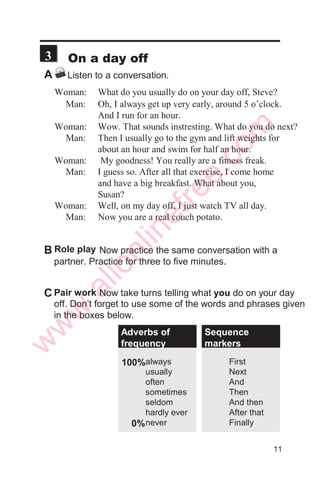
A Listen to a conversation.
3
Woman: What do you usually do on your day off, Steve?
Man: Oh, I always get up very early, around 5 o’clock.
And I run for an hour.
Woman: Wow. That sounds instresting. What do you do next?
Man: Then I usually go to the gym and lift weights for
about an hour and swim for half an hour.
Woman: My goodness! You really are a fitness freak.
Man: I guess so. After all that exercise, I come home
and have a big breakfast. What about you,
Susan?
Woman: Well, on my day off, I just watch TV all day.
Man: Now you are a real couch potato.
always
usually
often
sometimes
seldom
hardly ever
never
100%
0%
Adverbs of
frequency
Now take turns telling what you do on your day
off. Don’t forget to use some of the words and phrases given
in the boxes below.
C Pair work
First
Next
And
Then
And then
After that
Finally
Sequence
markers
Now practice the same conversation with a
partner. Practice for three to five minutes.
B Role play
11
w
w
w
.allonlinefree.com
Woman: What do you do, Laxman?
Man: I work with a travel agency.
Woman: Sounds good. What do you do, exactly?
Man: I’m a tourist guide. I take people on tours to
different parts of the country.
Woman: So, you get to travel a lot, don’t you?
Man: Yes. Sometimes I even go out of the country to
places like Tibet and Sikkim.
Woman: Wow. You really have a great job.
Man: Yes, I love my job. What about you, Rosy?
What do you do?
Woman: I work in a hospital.
Man: Really? Are you a nurse?
Woman: No, I’m a brain surgeon. I perform more than a
dozen operations every week. I have to work
long hours and I hardly get any holidays.
Man: So, how do you like your job?
Woman: Not bad. But I can’t give much time to my
family.
Ask about your partner
Do you have a job?
Where do you work?
What do you do exactly?
What time do you start work?
What time do you finish work?
Do you have lunch at work?
Do you take a break in the
afternoon?
How do you like your job?
What do you do after work?
Do you watch television?read?
Ask about your partner’s
friend or relative
Tell me about your friend/brother/
sister/father/mother.....
Where does he/she work?
What does he/she do exactly?
What time does he/she start work?
What time does he/she finish
work?
Does he/she like his job?
What does he/she do after work?
A Listen to a conversation. Listen at least three times.
Then practice the conversation with a partner.
4
Now take turns talking about your own job or your
friend or relative’s job.Take help of the questions given below.
B Pair work
12
w
w
w
.allonlinefree.com
Practice the same conversation with a partner.
Practice for three to five minutes.
B Role play
Man: What do you, Sarita?
Woman: I’m a teacher.
Man: Really? Tell me about your family.
Woman: Well, I’m married and have three children.
Man: What does your husband do?
Woman: He has a small business.
Man: Oh, that’s interesting. What business does he have?
Woman: He has a small garment factory. He exports all
the products.
Man: What about your children? Do they all go to school.
Woman: No, only two of them go to school. The
youngest one is just five months old.
Man: You have a small and beautiful family.
Woman: Yes, it’s a lovely family. And what about you?
Are you married?
Man: No, I’m not. I’m still studying. I’m in my final
year of MBA.
Woman: Oh, great. By the way, do you have any brothers
and sisters?
Man: Yes, I do. I have a brother and a sister.
Woman: And what do they do?
Man: Well, my brother drives a taxi and my sister flies
a plane.
Woman: No kidding!
A Listen to a conversation. Listen at least three times.
5
Now have a similar conversation with your
partner using your own information
C Pair work
13
w
w
w
.allonlinefree.com
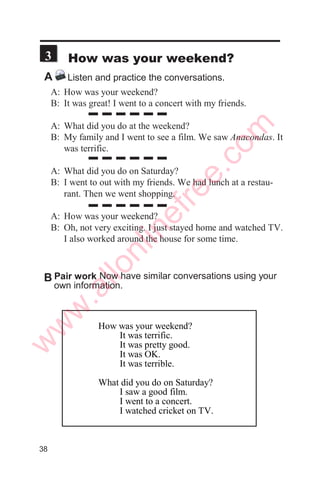
!1
3
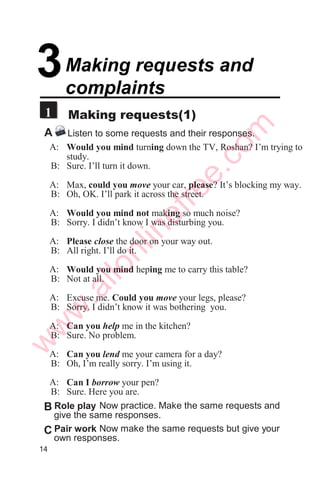
A Listen to some requests and their responses.
A: Would you mind turning down the TV, Roshan? I’m trying to
study.
B: Sure. I’ll turn it down.
A: Max, could you move your car, please? It’s blocking my way.
B: Oh, OK. I’ll park it across the street.
A: Would you mind not making so much noise?
B: Sorry. I didn’t know I was disturbing you.
A: Please close the door on your way out.
B: All right. I’ll do it.
A: Would you mind heping me to carry this table?
B: Not at all.
A: Excuse me. Could you move your legs, please?
B: Sorry. I didn’t know it was bothering you.
A: Can you help me in the kitchen?
B: Sure. No problem.
A: Can you lend me your camera for a day?
B: Oh, I’m really sorry. I’m using it.
A: Can I borrow your pen?
B: Sure. Here you are.
Now make the same requests but give your
own responses.
C Pair work
Now practice. Make the same requests and
give the same responses.
B Role play
14
w
w
w
.allonlinefree.com

English e book

  • 3.
    A: Excuse me.I don’t think we have met before. My name is Mary Jenson. B: Oh, hello. I’m Bikash Chettri A: Good to meet you Mr Chettri. B: Pleased to meet you too, Ms Jenson. Now in the same way introduce yourself to your partner or to someone else. Useful expressions Hello, I’m.... Hi, my name is.... Nice/Good/Pleased to meet you. C Pair work
  • 4.
    1 1 A: Hello. I’mJason. B: Hi. My name is Dolma. A: Nice to meet you, Dolma. B: Good to meet you too. A Listen to people introduce themselves. Listen at least three times. Now practice the same conversations with a partner. Practice for three to five minutes. B Role play A: Hello. Can I sit here? B: Yes. A: By the way, I’m Robin. B: Hi. My name is Jessica. A: Nice to meet you. B: Pleased to meet you too. And where are you from, Robin? A: I’m from Kathmandu. What about you? B: I’m from New York. Oh, this is my stop. Bye, Robin. A: Bye. See you. 6 w w w .allonlinefree.com
  • 7.
    A: Hi. Howhave you been? B: Fine, thanks. And you? A: Pretty good. How’s the family? B: Just fine. And how’s work? A: Good. Very busy. B: Yeah, me too. A: Well, talk to you later. B: Yeah. Nice talking to you. Bye. A: Bye.
  • 8.
    2 A: Hi. Subodh.How are you today? B: Not bad, thanks. How about you? A: Great, thanks. B: So, where are you heading? A: To college, as usual. I’m already late. See you later, Subodh. B: Take care. Bye bye. A Listen to friends talking when they meet.Listen at least twice. Now take turns talking.This time use your own information. C Pair work Now practice the same conversations with a partner. Practice for three to five minutes. B Role play Some useful expressions How are you? How have you been? How are you doing? How are things? How’s family? How’s work? How’s business? How are studies? Just fine, thanks. Great, thanks. Pretty good, thanks. So so. Thanks. Well, talk to you later. Well, nice talking to you. See you. See you later. 7 www.allonlinefree.com w w w .allonlinefree.com
  • 11.
    1. Hello. Howare you? You too. Fine, thanks. 2. Have a nice day. You too. I’m OK. How Bye-bye. are you? 3. Good evening. Hello. Good night. 4. See you later. Not bad thanks. Bye-bye. A: Hi, Tony. How are you? B: Great! How about you, Susan? A: See you later, Tony. B: Bye-bye, Susan. A: Good morning, Sir. How are you? B: I’m just fine, Tina.Thank you. A: Good afternoon,Mr. Thapa. How are you? B: Not bad, thanks. And how are you, Ms Taylor? A: Good-bye. Have a nice day. B: Bye-bye. See you tomorrow. A: Bye. Have a nice evening. B: Thanks. You too. A Listen to people saying and . Listen twice. Practice saying and with your partner. B Pair work Tick the correct responses. Then practice saying. C Pair work
  • 12.
  • 16.
    1 2 A Listen toa student talk about his routines. B Listen again. Which of these words do you hear? Tick them as you listen. always usually often sometimes seldom hardly ever never C Listen again and tick these words and phrases as you hear them. get up study get dressed go out go to bed have breakfast watch TV visit in the morning for sometime on time in the afternoon in the evening weekends late on holidays D Listen once again. The student is talking about what he does on college days, at weekends and on long holidays. E Now tell from memory what the student does. You may say something like this:
  • 17.
  • 20.
    My busiest dayis Sunday. All our relatives come to our house for lunch and dinner almost every Sunday. A Listen to people talking about their busiest days. Listen three times.
  • 21.
    2 Take turns. Talkabout your busiest day of the week. Ask these questions and others of your own. What’s your busiest day? What do you usually do? What time do you usually get up? What time do you start work? What do you do all day? Where do you usually have your breakfast and lunch? What do you usually do after work? What time do you usually get home? What time do you go to bed? B Pair work I hate Mondays. I get up before 5 o’clock. I catch the bus at six. I start work at seven and finish around four in the afternoon. Then I have a two-hour computer class. After that I a private tuition class to some children in the neighbourhood. It’s usually 9 o’clock when I arrive home. Saturday is my busiest day. I always clean the house in the morning. I usually do the shopping in the afternoon. In the evening, I work as a teacher in an adult education class. The class finishes at 10. 1 2 3 10 w w w .allonlinefree.com
  • 24.
    A Listen toa conversation.
  • 25.
    3 Woman: What doyou usually do on your day off, Steve? Man: Oh, I always get up very early, around 5 o’clock. And I run for an hour. Woman: Wow. That sounds instresting. What do you do next? Man: Then I usually go to the gym and lift weights for about an hour and swim for half an hour. Woman: My goodness! You really are a fitness freak. Man: I guess so. After all that exercise, I come home and have a big breakfast. What about you, Susan? Woman: Well, on my day off, I just watch TV all day. Man: Now you are a real couch potato. always usually often sometimes seldom hardly ever never 100% 0% Adverbs of frequency Now take turns telling what you do on your day off. Don’t forget to use some of the words and phrases given in the boxes below. C Pair work First Next And Then And then After that Finally Sequence markers Now practice the same conversation with a partner. Practice for three to five minutes. B Role play 11 w w w .allonlinefree.com
  • 28.
    Woman: What doyou do, Laxman? Man: I work with a travel agency. Woman: Sounds good. What do you do, exactly? Man: I’m a tourist guide. I take people on tours to different parts of the country. Woman: So, you get to travel a lot, don’t you? Man: Yes. Sometimes I even go out of the country to places like Tibet and Sikkim. Woman: Wow. You really have a great job. Man: Yes, I love my job. What about you, Rosy? What do you do? Woman: I work in a hospital. Man: Really? Are you a nurse? Woman: No, I’m a brain surgeon. I perform more than a dozen operations every week. I have to work long hours and I hardly get any holidays. Man: So, how do you like your job? Woman: Not bad. But I can’t give much time to my family. Ask about your partner Do you have a job? Where do you work? What do you do exactly? What time do you start work? What time do you finish work? Do you have lunch at work? Do you take a break in the afternoon? How do you like your job? What do you do after work? Do you watch television?read? Ask about your partner’s friend or relative Tell me about your friend/brother/ sister/father/mother..... Where does he/she work? What does he/she do exactly? What time does he/she start work? What time does he/she finish work? Does he/she like his job? What does he/she do after work? A Listen to a conversation. Listen at least three times. Then practice the conversation with a partner.
  • 29.
    4 Now take turnstalking about your own job or your friend or relative’s job.Take help of the questions given below. B Pair work 12 w w w .allonlinefree.com
  • 32.
    Practice the sameconversation with a partner. Practice for three to five minutes. B Role play Man: What do you, Sarita? Woman: I’m a teacher. Man: Really? Tell me about your family. Woman: Well, I’m married and have three children. Man: What does your husband do? Woman: He has a small business. Man: Oh, that’s interesting. What business does he have? Woman: He has a small garment factory. He exports all the products. Man: What about your children? Do they all go to school. Woman: No, only two of them go to school. The youngest one is just five months old. Man: You have a small and beautiful family. Woman: Yes, it’s a lovely family. And what about you? Are you married? Man: No, I’m not. I’m still studying. I’m in my final year of MBA. Woman: Oh, great. By the way, do you have any brothers and sisters? Man: Yes, I do. I have a brother and a sister. Woman: And what do they do? Man: Well, my brother drives a taxi and my sister flies a plane. Woman: No kidding! A Listen to a conversation. Listen at least three times.
  • 33.
    5 Now have asimilar conversation with your partner using your own information C Pair work 13 w w w .allonlinefree.com
  • 36.
    !1 3 A Listen tosome requests and their responses. A: Would you mind turning down the TV, Roshan? I’m trying to study. B: Sure. I’ll turn it down. A: Max, could you move your car, please? It’s blocking my way. B: Oh, OK. I’ll park it across the street. A: Would you mind not making so much noise? B: Sorry. I didn’t know I was disturbing you. A: Please close the door on your way out. B: All right. I’ll do it. A: Would you mind heping me to carry this table? B: Not at all. A: Excuse me. Could you move your legs, please? B: Sorry. I didn’t know it was bothering you. A: Can you help me in the kitchen? B: Sure. No problem. A: Can you lend me your camera for a day? B: Oh, I’m really sorry. I’m using it. A: Can I borrow your pen? B: Sure. Here you are. Now make the same requests but give your own responses. C Pair work Now practice. Make the same requests and give the same responses. B Role play 14 w w w .allonlinefree.com