GE6075
PROFESSIONAL ETHICS
IN ENGINEERING
UNIT III
ENGINEERING AS SOCIAL
EXPERIMENTATION
Engineering as Experimentation
Engineers as responsible Experimenters
Codes of Ethics
 A Balanced Outlook on Law.
UNIT III ENGINEERING AS SOCIAL
EXPERIMENTATION
ENGINEERING AS
EXPERIMENTATION
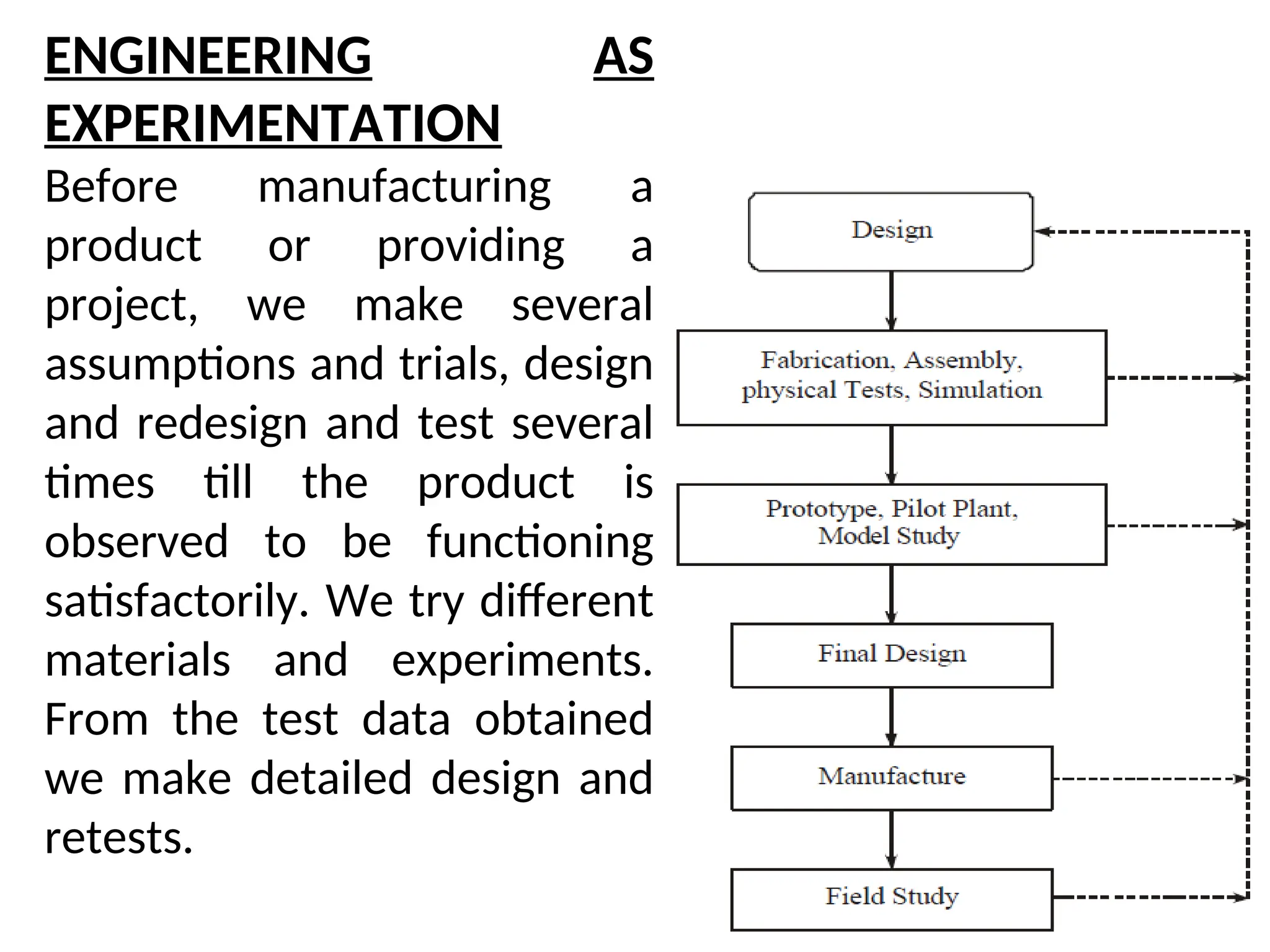
Before manufacturing a
product or providing a
project, we make several
assumptions and trials, design
and redesign and test several
times till the product is
observed to be functioning
satisfactorily. We try different
materials and experiments.
From the test data obtained
we make detailed design and
retests.
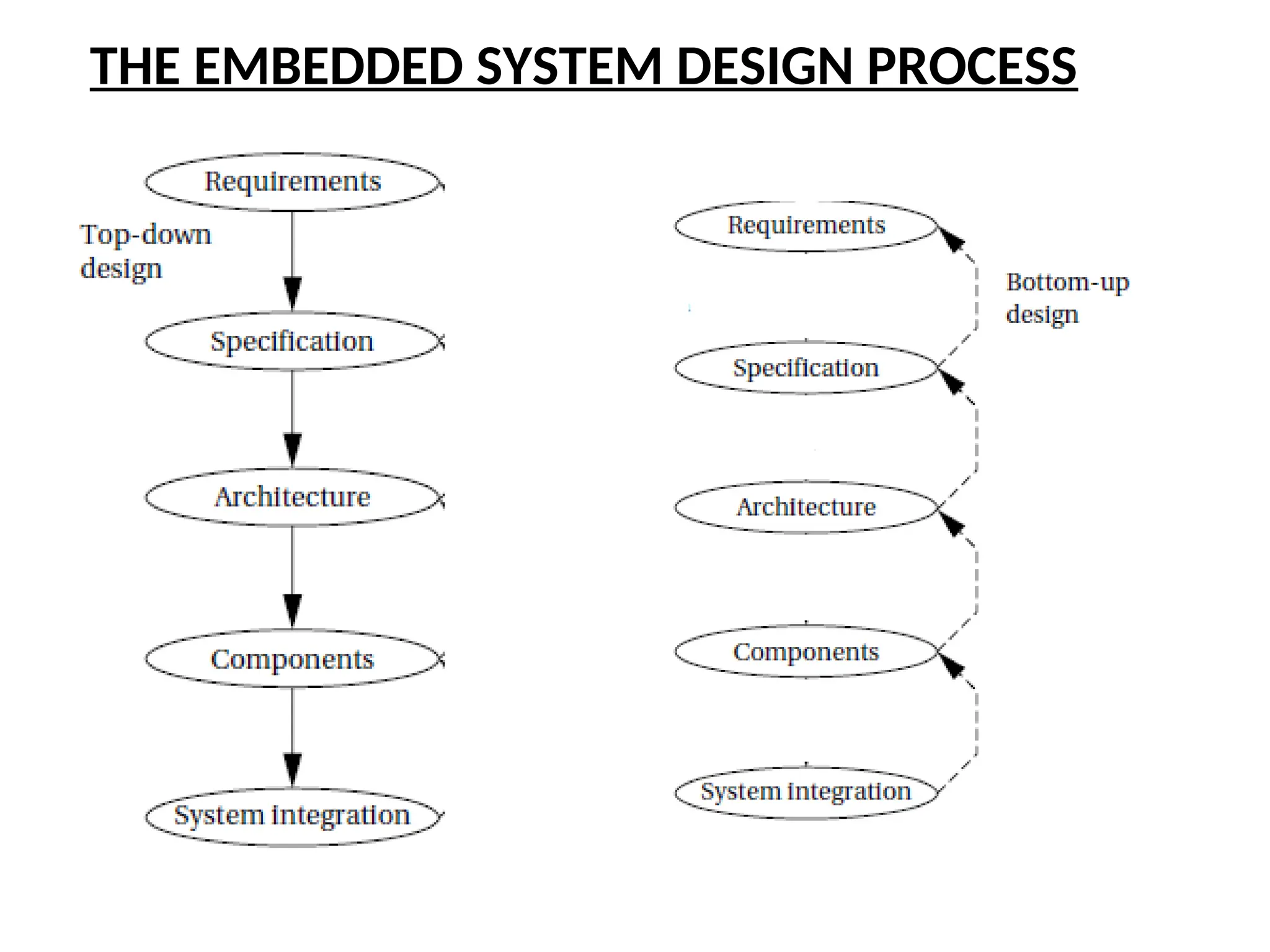
THE EMBEDDED SYSTEM DESIGN PROCESS
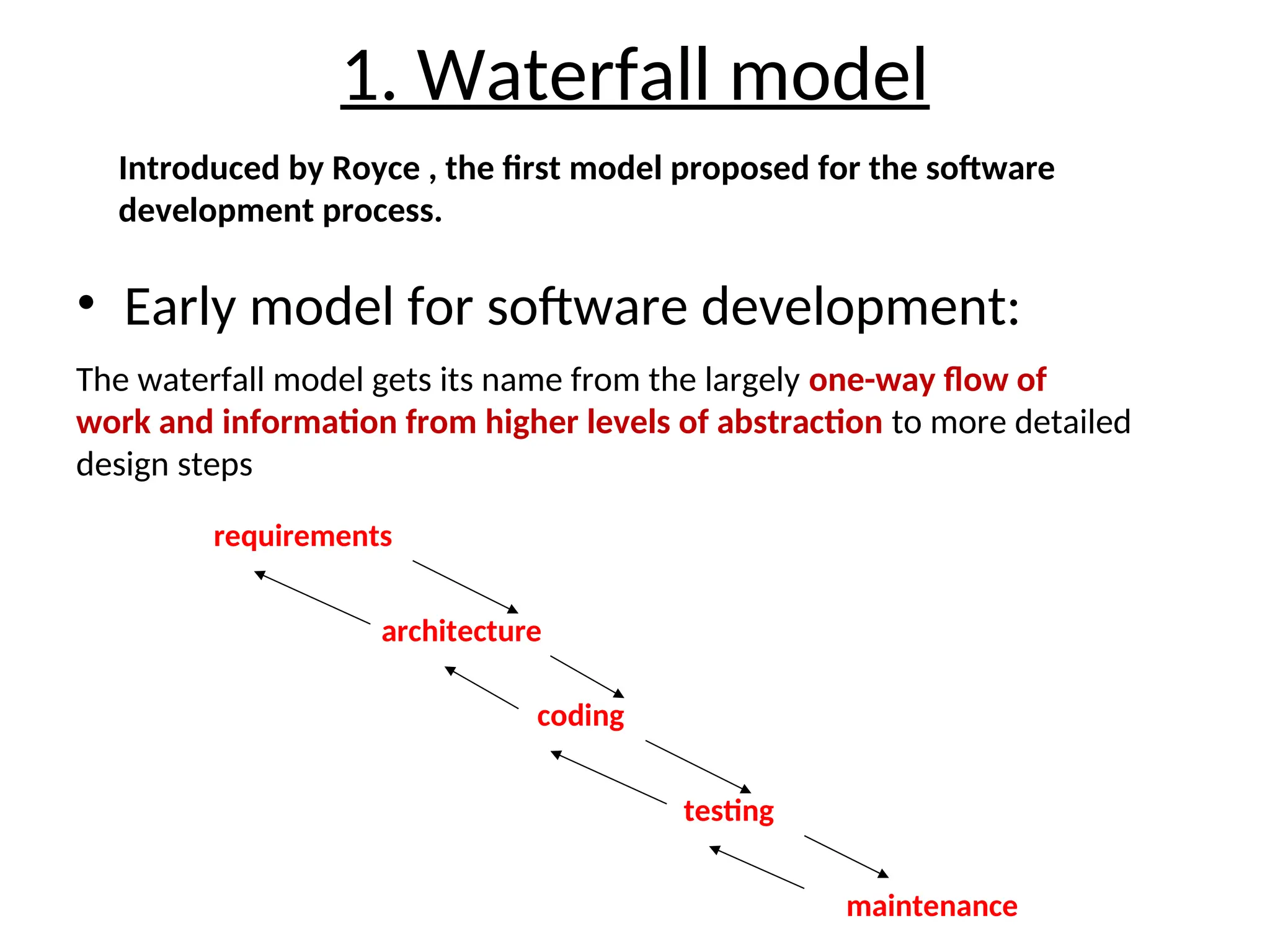
1. Waterfall model
• Early model for software development:
requirements
architecture
coding
testing
maintenance
Introduced by Royce , the first model proposed for the software
development process.
The waterfall model gets its name from the largely one-way flow of
work and information from higher levels of abstraction to more detailed
design steps
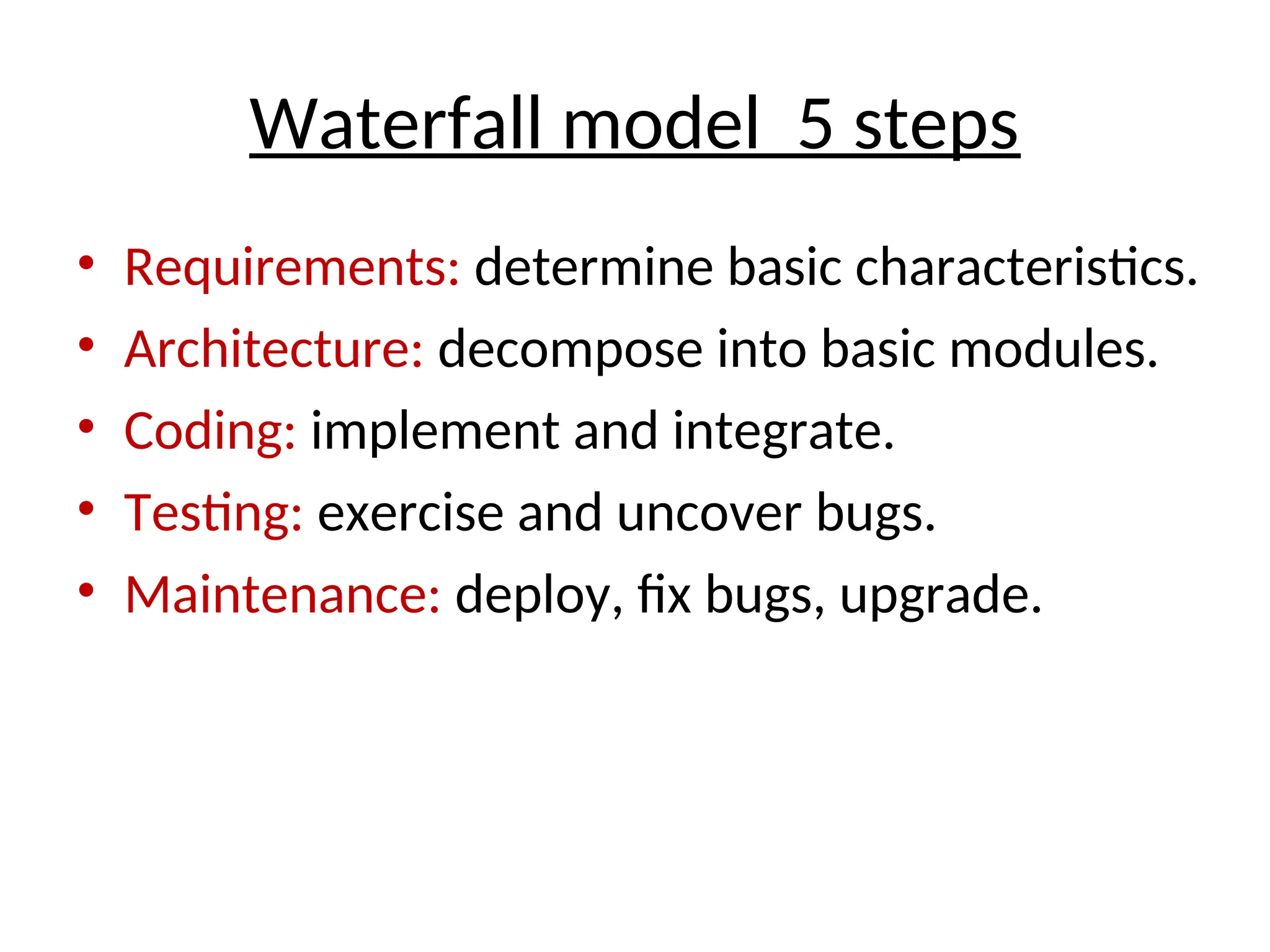
Waterfall model 5 steps
• Requirements: determine basic characteristics.
• Architecture: decompose into basic modules.
• Coding: implement and integrate.
• Testing: exercise and uncover bugs.
• Maintenance: deploy, fix bugs, upgrade.
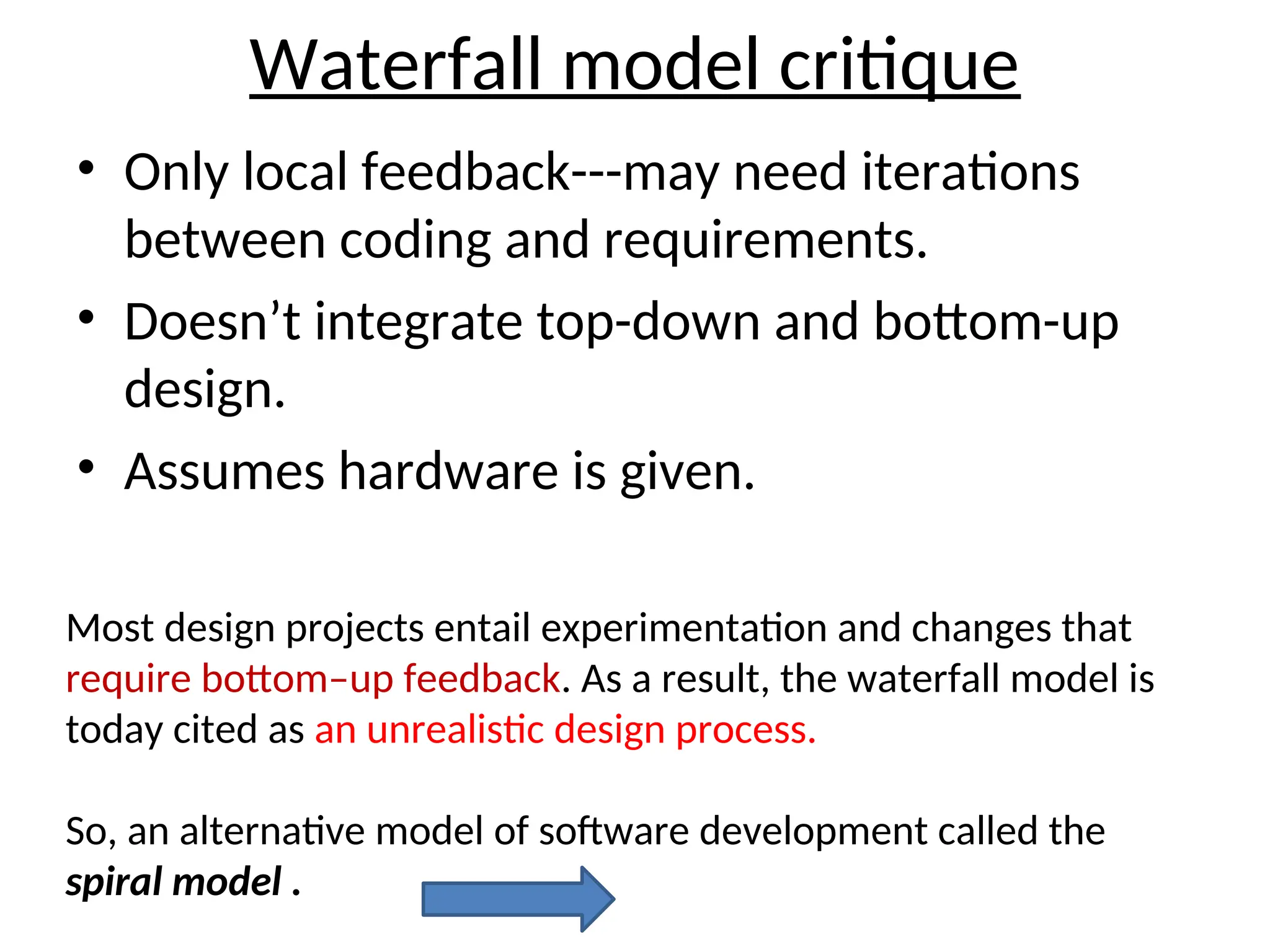
Waterfall model critique
• Only local feedback---may need iterations
between coding and requirements.
• Doesn’t integrate top-down and bottom-up
design.
• Assumes hardware is given.
Most design projects entail experimentation and changes that
require bottom–up feedback. As a result, the waterfall model is
today cited as an unrealistic design process.
So, an alternative model of software development called the
spiral model .
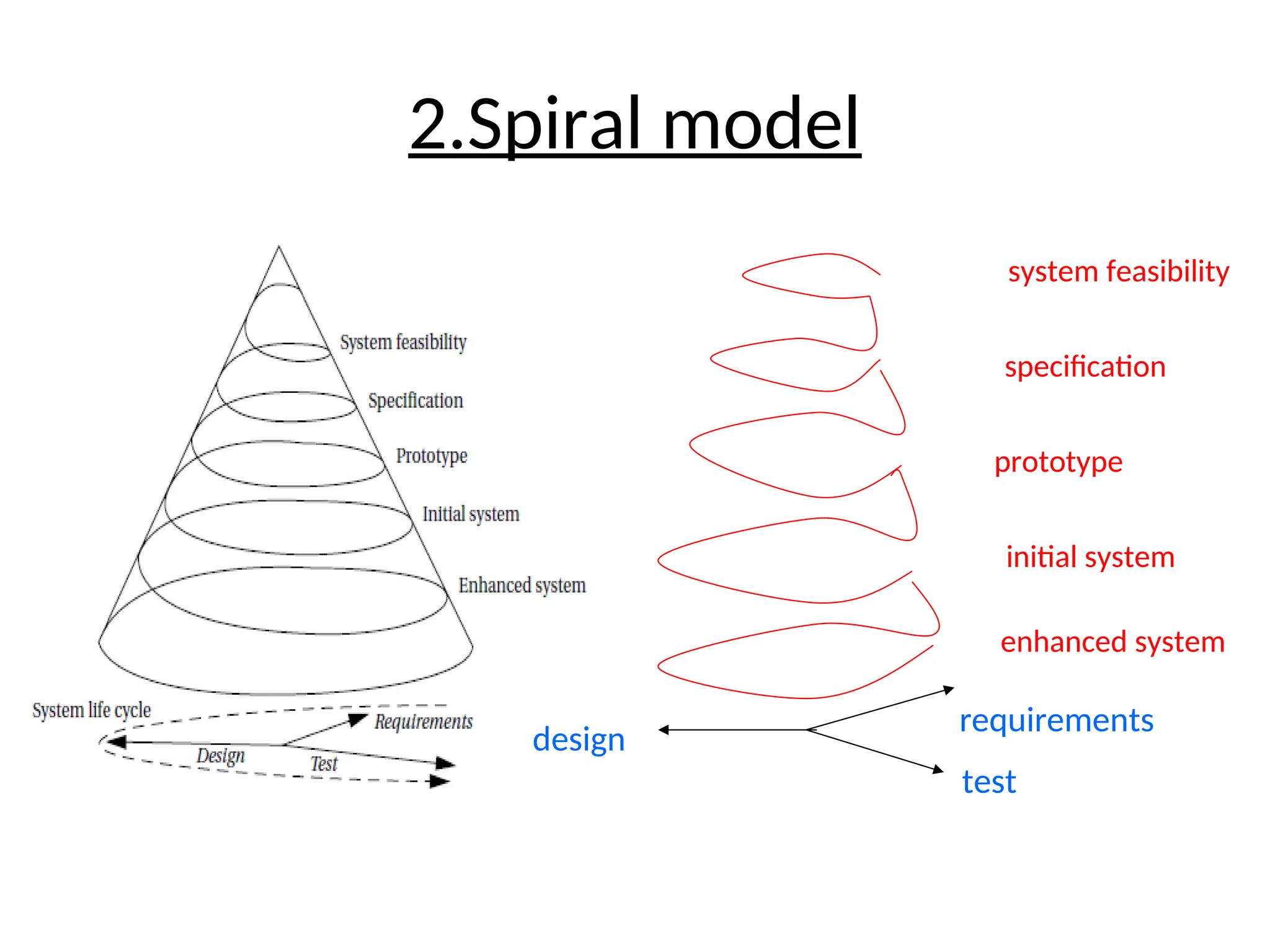
2.Spiral model
requirements
design
test
system feasibility
specification
prototype
initial system
enhanced system
Spiral model critique
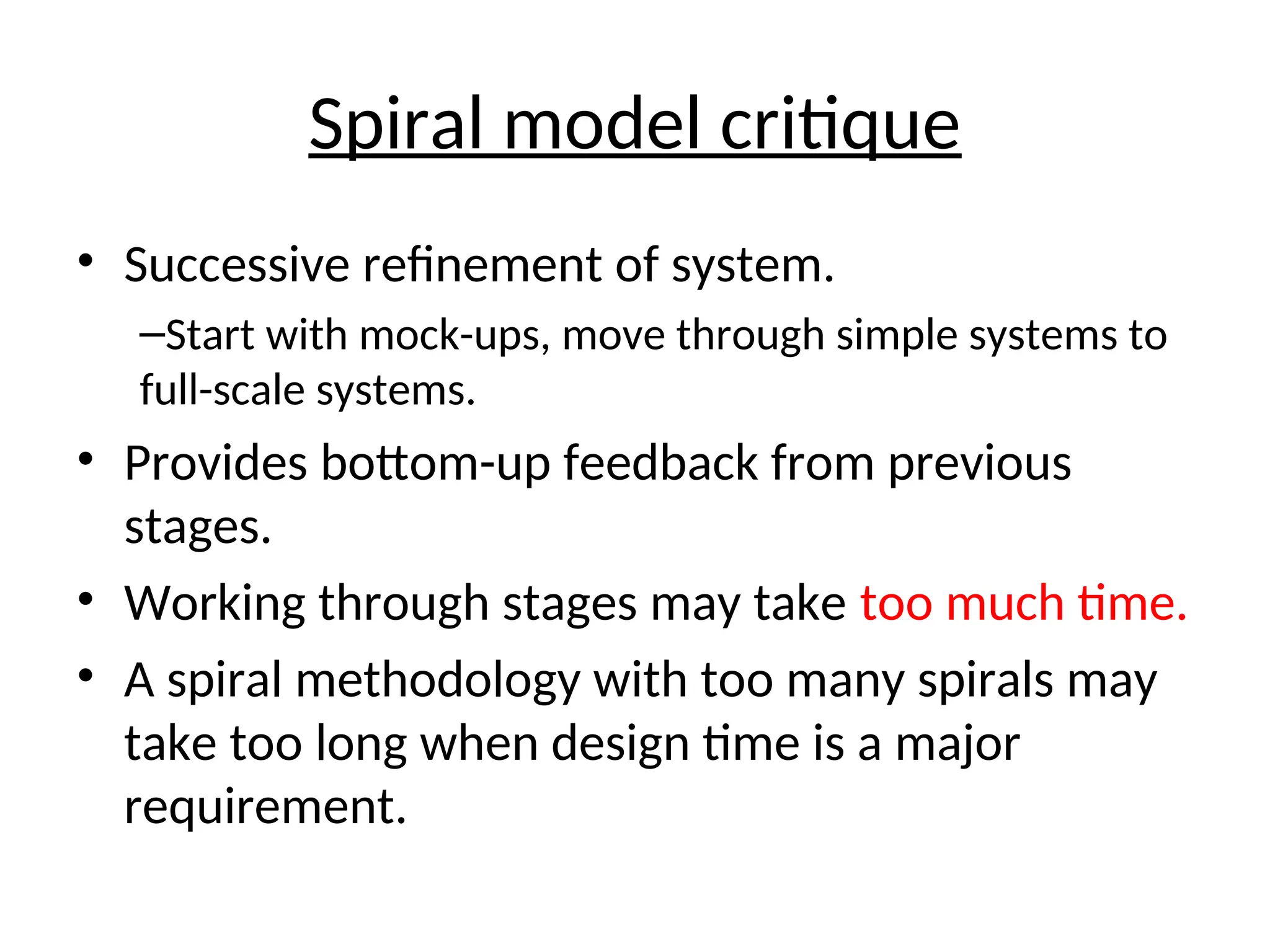
• Successive refinement of system.
–Start with mock-ups, move through simple systems to
full-scale systems.
• Provides bottom-up feedback from previous
stages.
• Working through stages may take too much time.
• A spiral methodology with too many spirals may
take too long when design time is a major
requirement.
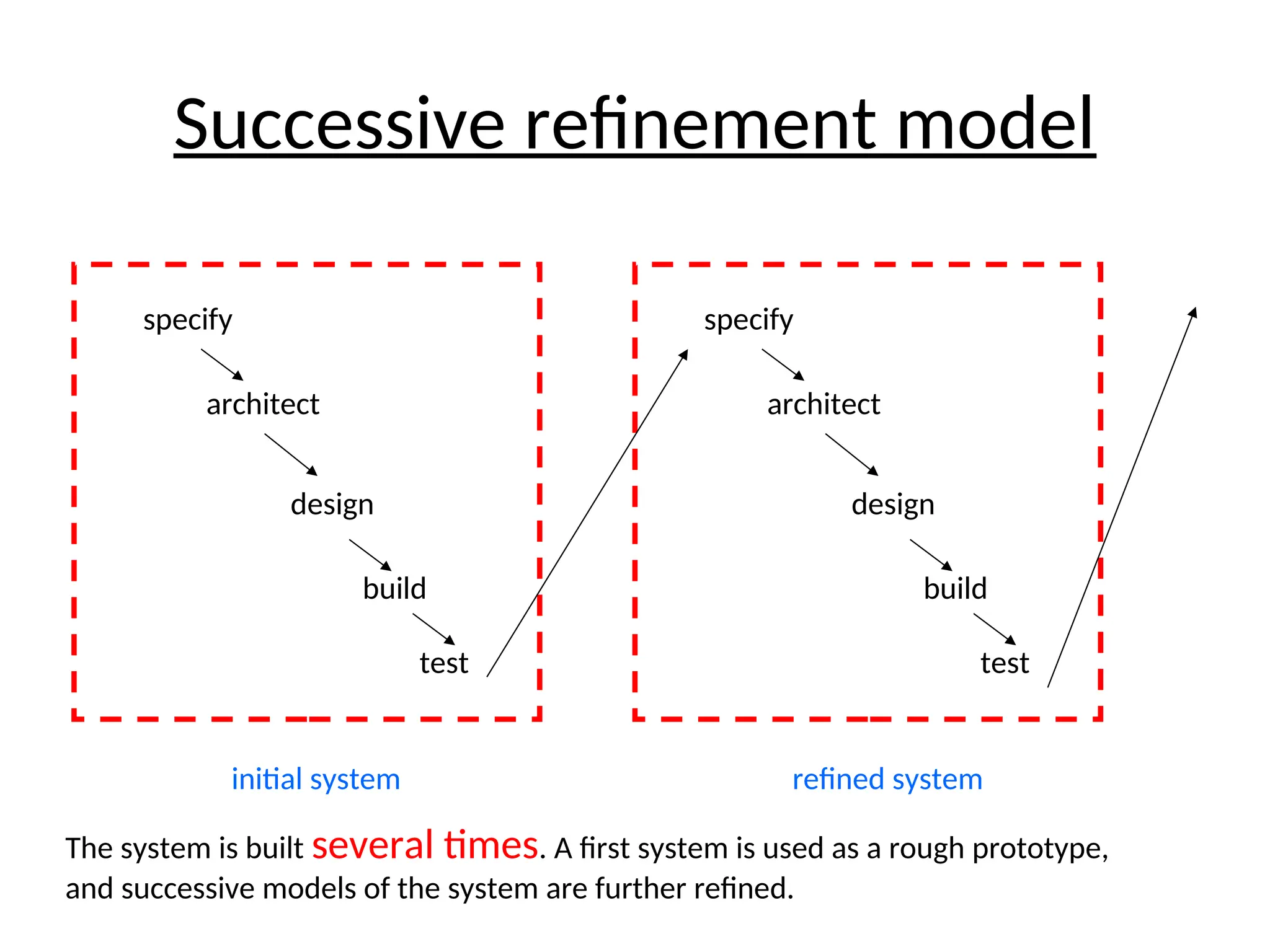
Successive refinement model
specify
architect
design
build
test
initial system
specify
architect
design
build
test
refined system
The system is built several times. A first system is used as a rough prototype,
and successive models of the system are further refined.
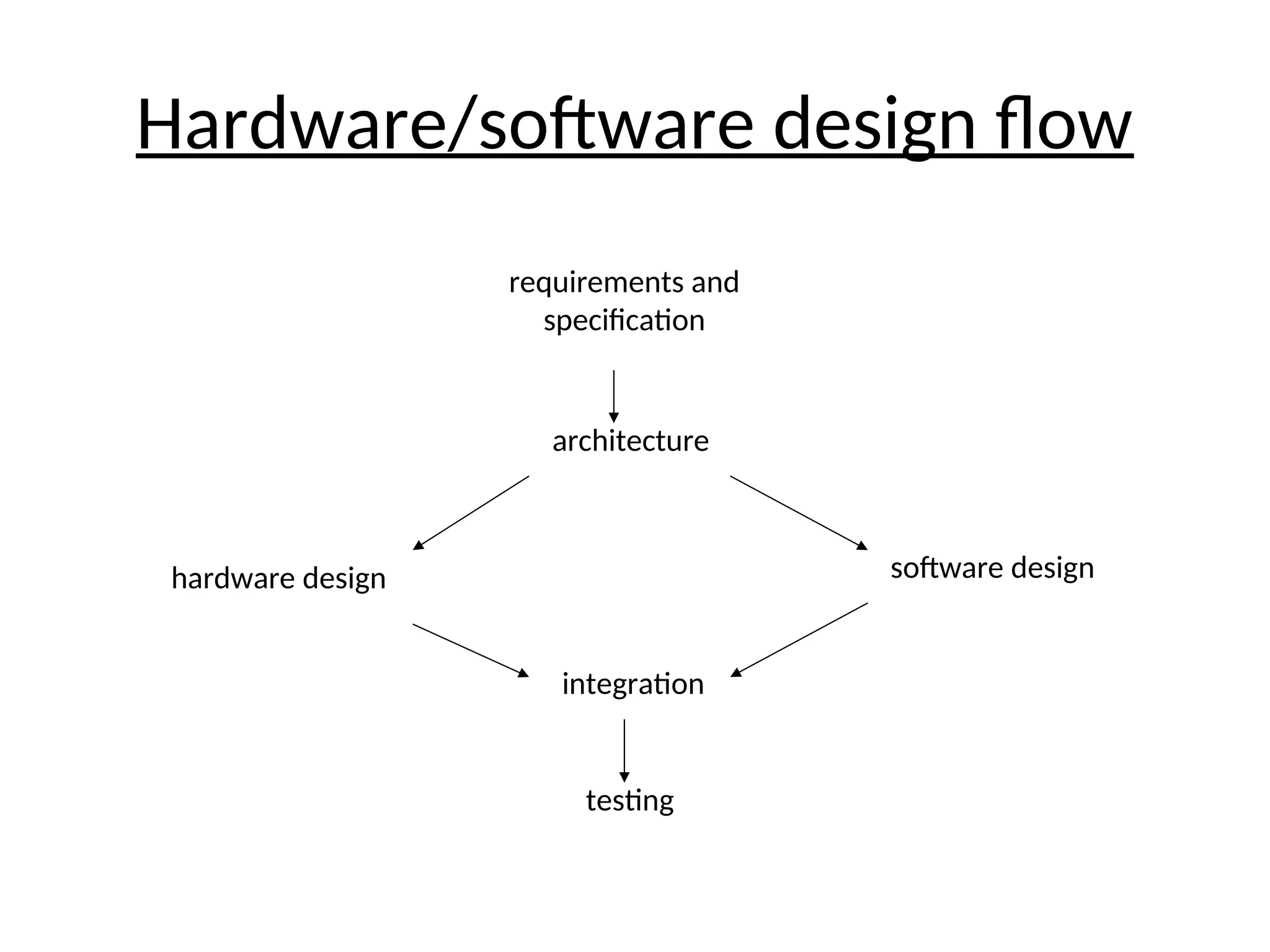
Hardware/software design flow
requirements and
specification
architecture
hardware design software design
integration
testing
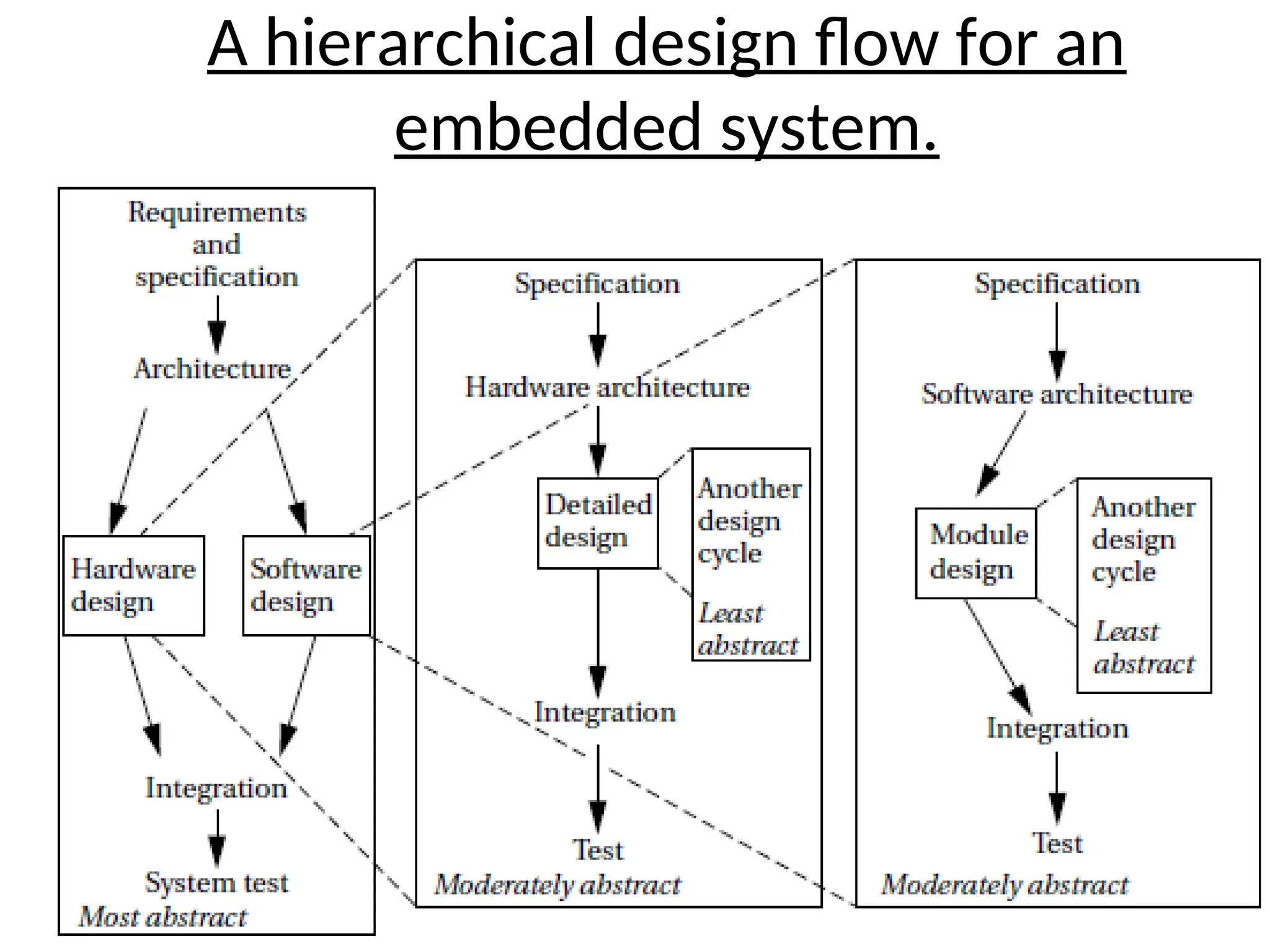
A hierarchical design flow for an
embedded system.
Engineering Projects VS. Standard Experiments
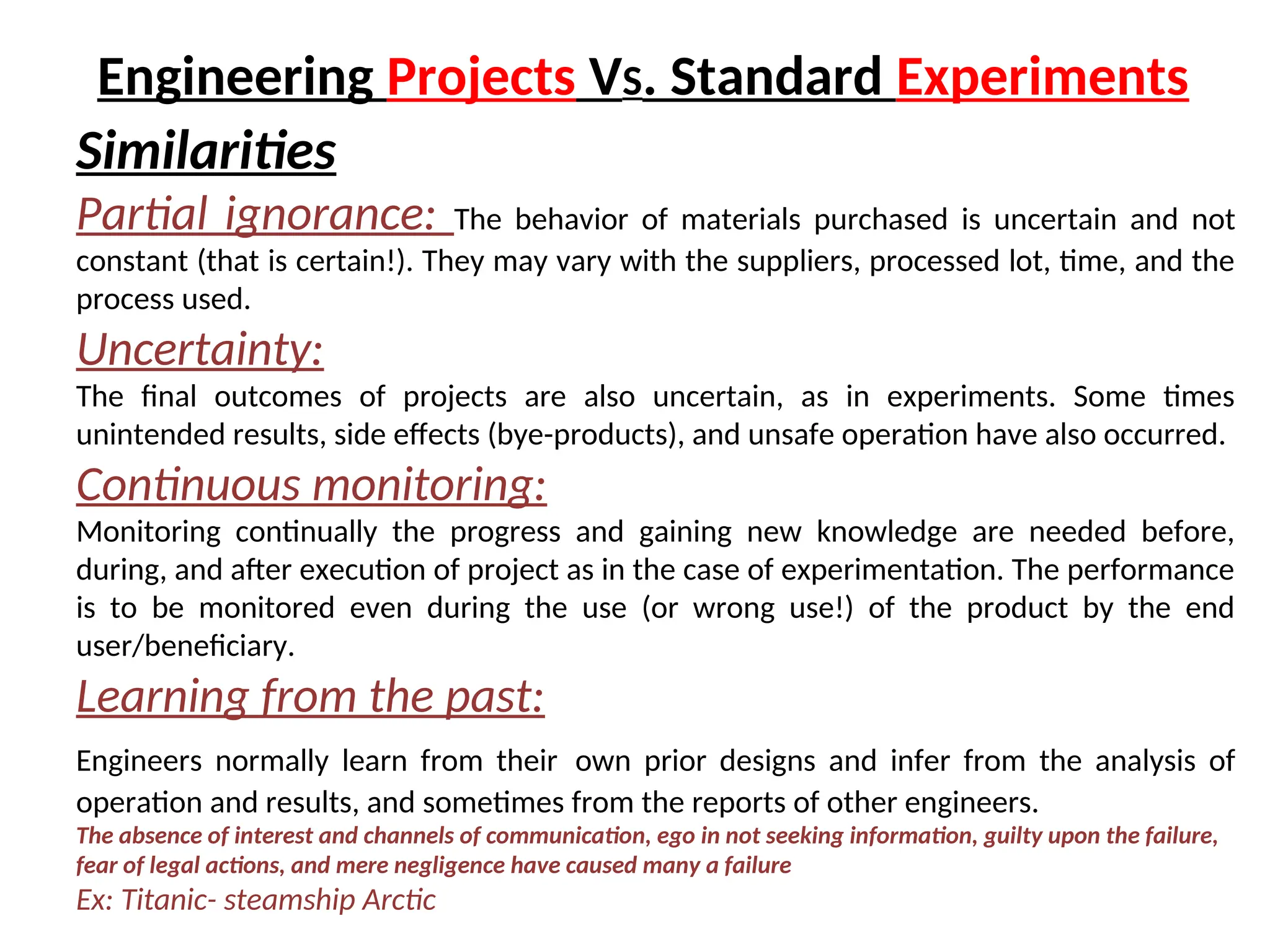
Similarities
Partial ignorance: The behavior of materials purchased is uncertain and not
constant (that is certain!). They may vary with the suppliers, processed lot, time, and the
process used.
Uncertainty:
The final outcomes of projects are also uncertain, as in experiments. Some times
unintended results, side effects (bye-products), and unsafe operation have also occurred.
Continuous monitoring:
Monitoring continually the progress and gaining new knowledge are needed before,
during, and after execution of project as in the case of experimentation. The performance
is to be monitored even during the use (or wrong use!) of the product by the end
user/beneficiary.
Learning from the past:
Engineers normally learn from their own prior designs and infer from the analysis of
operation and results, and sometimes from the reports of other engineers.
The absence of interest and channels of communication, ego in not seeking information, guilty upon the failure,
fear of legal actions, and mere negligence have caused many a failure
Ex: Titanic- steamship Arctic
Engineering Projects VS. Standard Experiments
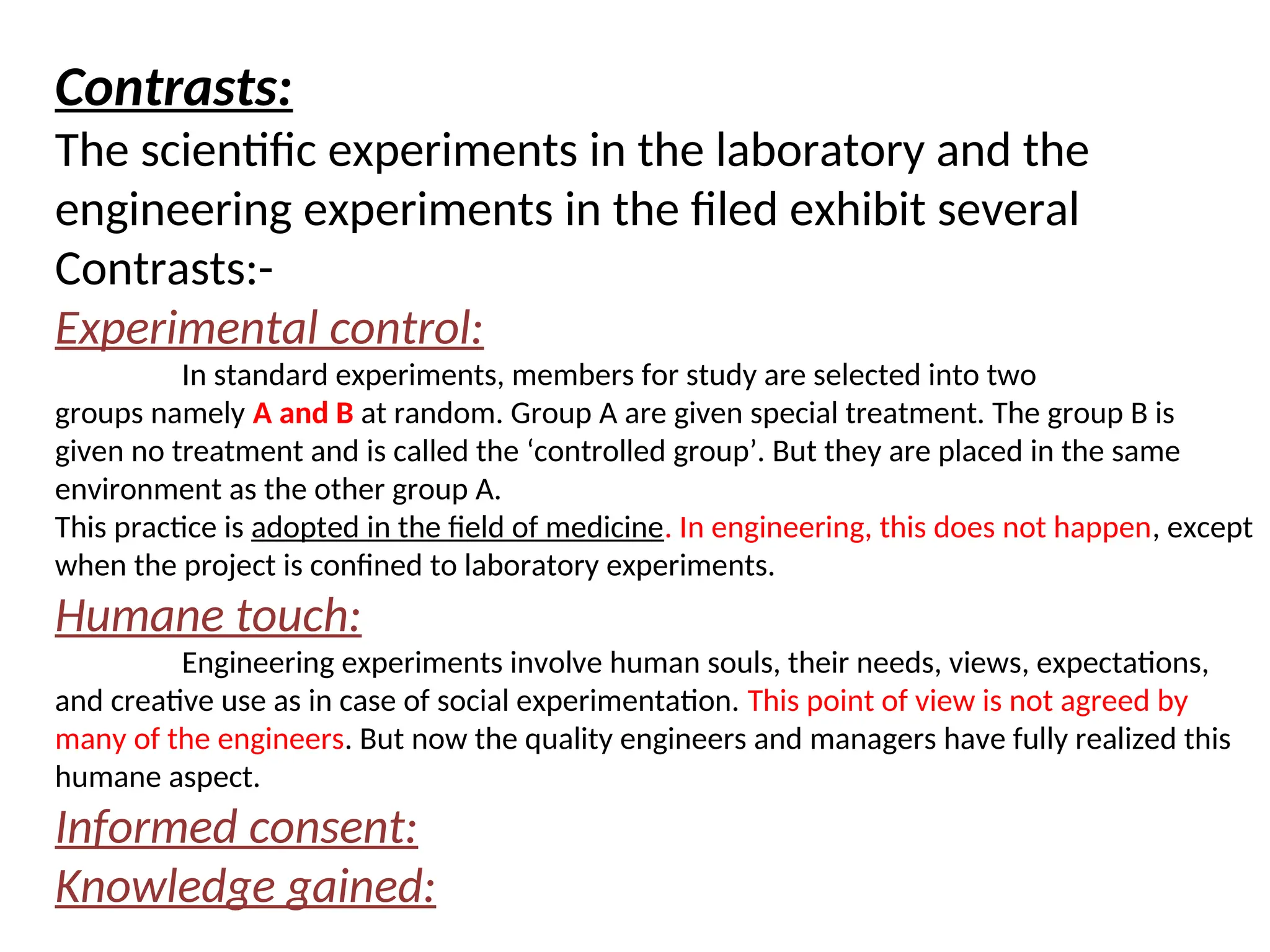
Contrasts:
The scientific experiments in the laboratory and the
engineering experiments in the filed exhibit several
Contrasts:-
Experimental control:
In standard experiments, members for study are selected into two
groups namely A and B at random. Group A are given special treatment. The group B is
given no treatment and is called the ‘controlled group’. But they are placed in the same
environment as the other group A.
This practice is adopted in the field of medicine. In engineering, this does not happen, except
when the project is confined to laboratory experiments.
Humane touch:
Engineering experiments involve human souls, their needs, views, expectations,
and creative use as in case of social experimentation. This point of view is not agreed by
many of the engineers. But now the quality engineers and managers have fully realized this
humane aspect.
Informed consent:
Knowledge gained:
“Informed Consent”
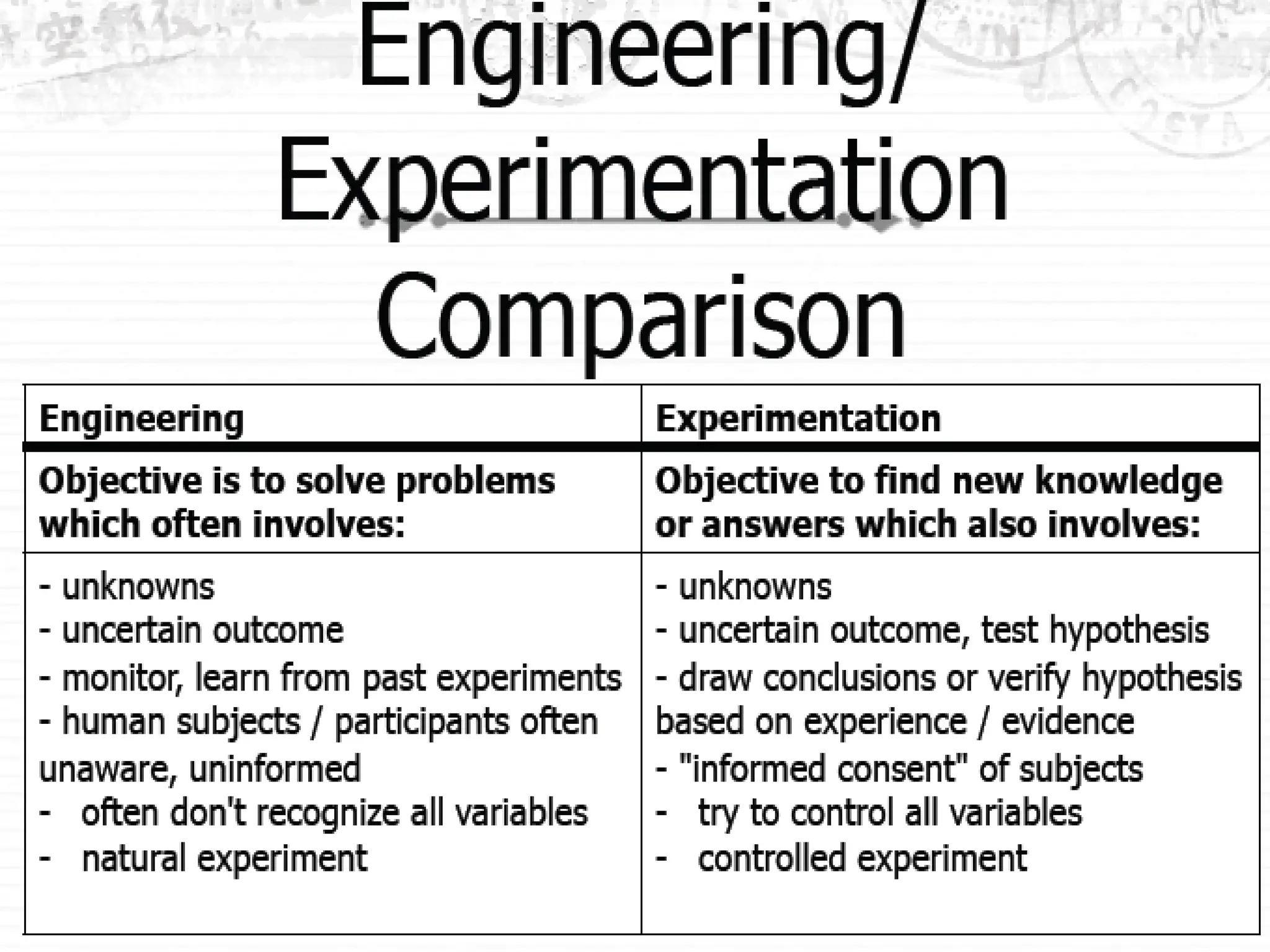
Engineering experimentation is viewed as Societal Experiment since the
subject and the beneficiary are human beings. In this respect, it is similar to
medical experimentation on human beings
Informed consent has two basic elements:
1. Knowledge: The subject should be given all relevant information needed to
make the decision to participate.
2. Voluntariness: Subject should take part without force, fraud or deception.
Respect for rights of minorities to dissent and compensation for harmful effect are
assumed here.
For a valid consent, the following conditions are to be fulfilled:
1. Consent must be voluntary
2. All relevant information shall be presented/stated in a clearly understandable
form
3. Consenter shall be capable of processing the information and make rational
decisions.
4. The subject’s consent may be offered in proxy by a group that represents many
subjects of like-interests
Not much of new knowledge is developed in engineering
experiments as in the case of scientific experiments in the
laboratory.
Engineering experiments at the most help us to:
(a) verify the adequacy of the design,
(b) to check the stability of the design parameters, and
(c) prepare for the unexpected outcomes, in the actual field
environments.
Inference:
From the models tested in the laboratory to the pilot plant
tested in the field, there are differences in performance as well
as other outcomes.
Knowledge gained:
Although the engineers facilitate experiments, they are not alone in
the field. Their responsibility is shared with the organizations,
people, government, and others.
No doubt the engineers share a greater responsibility
while monitoring the projects,
identifying the risks, and
informing the clients and the public with facts.
Based on this, they can take decisions to
•participate or
•protest or
•promote.
ENGINEERS AS RESPONSIBLE EXPERIMENTERS
1. A conscientious commitment to live by moral values.
2. A comprehensive perspective on relevant
information. It includes constant awareness of the
progress of the experiment and readiness to monitor
the side effects, if any.
3. Unrestricted free-personal involvement in all steps of
the project/product development (autonomy).
4. Be accountable for the results of the project
(accountability).
The engineer, as an experimenter, owe several
responsibilities to the society
Conscientious moral commitment means:
(a) Being sensitive to full range of moral values and responsibilities
relevant to the prevailing situation and
(b) the willingness to develop the skill and put efforts needed to
reach the best balance possible among those considerations.
“In short, engineers must possess open eyes, open ears, and an
open mind (i.e., moral vision, moral listening, and moral
reasoning).”
This makes the engineers as social experimenters, respect foremost
the safety and health of the affected, while they seek to enrich their
knowledge, rush for the profit, follow the rules, or care for only the
beneficiary. The human rights of the participant should be
protected through voluntary and informed consent.
1.Conscientiousness
The engineer should grasp the context of his work and ensure that
the work involved results in only moral ends. One should not
ignore his conscience, if the product or project that he is involved
will result in damaging the nervous system of the people (or even
the enemy, in case of weapon development)
EX. If a product has a built-in obsolete or redundant component to
boost sales with a false claim. In possessing of the perspective of
factual information, the engineer should exhibit a moral concern
and not agree for this design.
2.Comprehensive Perspective
3. Moral Autonomy
Viewing engineering as social experimentation, and anticipating
unknown consequences should promote an attitude of questioning
about the adequacy of the existing economic and safety standards.
This proves a greater sense of personal involvement in one’s work
Moral autonomy is defined as, decisions and actions exercised on
the basis of moral concern for other people and recognition of
good moral reasons.
Alternatively, moral autonomy means ‘self determinant or
independent’.
It appears that the blue-collar workers with the support of the union
can adopt better autonomy than the employed professionals. Only
recently the legal support has been obtained by the professional
societies in exhibiting moral autonomy by professionals in this
country as well as in the West.
4. Accountability
The term Accountability means:
1. The capacity to understand and act on moral reasons
2. Willingness to submit one’s actions to moral scrutiny and be
responsive to the assessment of others.
It includes being answerable for meeting specific
obligations, i.e., liable to justify (or give reasonable excuses) the
decisions, actions or means, and outcomes (sometimes
unexpected), when required by the stakeholders or by law.
(a) The fragmentation of work in a project inevitably makes the final
products lie away from the immediate work place, and lessens the
personal responsibility of the employee.
(b) Further the responsibilities diffuse into various hierarchies and to
various people. Nobody gets the real feel of personal responsibility.
(c) Often projects are executed one after another. An employee is more
interested in adherence of tight schedules rather than giving personal
care for the current project.
(d) More litigation is to be faced by the engineers (as in the case of
medical practitioners). This makes them wary of showing moral concerns
beyond what is prescribed by the institutions. In spite of all these
shortcomings, engineers are expected to face the risk and show up
personal responsibility as the profession demands.
The tug-of-war(PROBLEM) between of causal influence
by the employer and moral responsibility of the
employee are listed below
CODES OF ETHICS
The ‘codes of ethics’ exhibit, rights, duties, and obligations of the
members of a profession and a professional society.
The codes exhibit the following essential roles:
1. Inspiration and guidance. The codes express the collective
commitment of the profession to ethical conduct and public good
and thus inspire the individuals. They identify primary
responsibilities and provide statements and guidelines on
interpretations for the professionals and the professional
societies.
2. Support to engineers. The codes give positive support to
professionals for taking stands on moral issues. Further they
serve as potential legal support to discharge professional
obligations.
3.Deterrence (discourage to act immorally) and discipline
(regulate to act morally). The codes serve as the basis for
investigating unethical actions. The professional societies
sometimes revoke membership or suspend/expel the members,
when proved to have acted unethical.
4. Education and mutual understanding. Codes are used to
prompt discussion and reflection on moral issues. They develop a
shared understanding by the professionals, public, and the
government on the moral responsibilities of the engineers. The
Board of Review of the professional societies encourages moral
discussion for educational purposes.
CODES OF ETHICS Contd…
5. Create good public image. The codes present positive image of
the committed profession to the public, help the engineers to serve
the public effectively. They promote more of self regulation and
lessen the government regulations. This is bound to raise the
reputation of the profession and the organization, in establishing
the trust of the public.
6. Protect the status quo. They create minimum level of ethical
conduct and promotes agreement within the profession. Primary
obligation namely the safety, health, and welfare of the public,
declared by the codes serves and protects the public.
7. Promotes business interests. The codes offer inspiration to the
entrepreneurs, establish shared standards, healthy competition,
and maximize profit to investors, employees, and consumers.
CODES OF ETHICS Contd…
The codes are not remedy for all evils. They have many
limitations, namely:
Limitations of Codes:
1. General and vague wordings. Many statements are general in
nature and hence unable to solve all problems.
2. Not applicable to all situations. Codes are not sacred, and need
not be accepted without criticism. Tolerance for criticisms of
the codes themselves should be allowed.
3. Often have internal conflicts. Many times, the priorities are
clearly spelt out, e.g., codes forbid public remarks critical of
colleagues (engineers), but they actually discovered a major
bribery, which might have caused a huge loss to the exchequer
(Owner).
4. They can not be treated as final moral authority for
professional conduct.
Codes have flaws by commission and omission. There are
still some grey areas undefined by codes. They can not be equated
to laws. After all, even laws have loopholes and they invoke
creativity in the legal practitioners.
5. Only a few enroll as members in professional society and non-
members can not be compelled.
6. Even as members of the professional society, many are unaware
of the codes
7. Different societies have different codes. The codes can not be
uniform or same! Unifying the codes may not necessarily solve the
problems prevailing various professions, but attempts are still made
towards this unified codes.
Ex: Leave for Pongal
8. Codes are said to be coercive(Powerful). They are sometimes
claimed to be threatening and forceful.
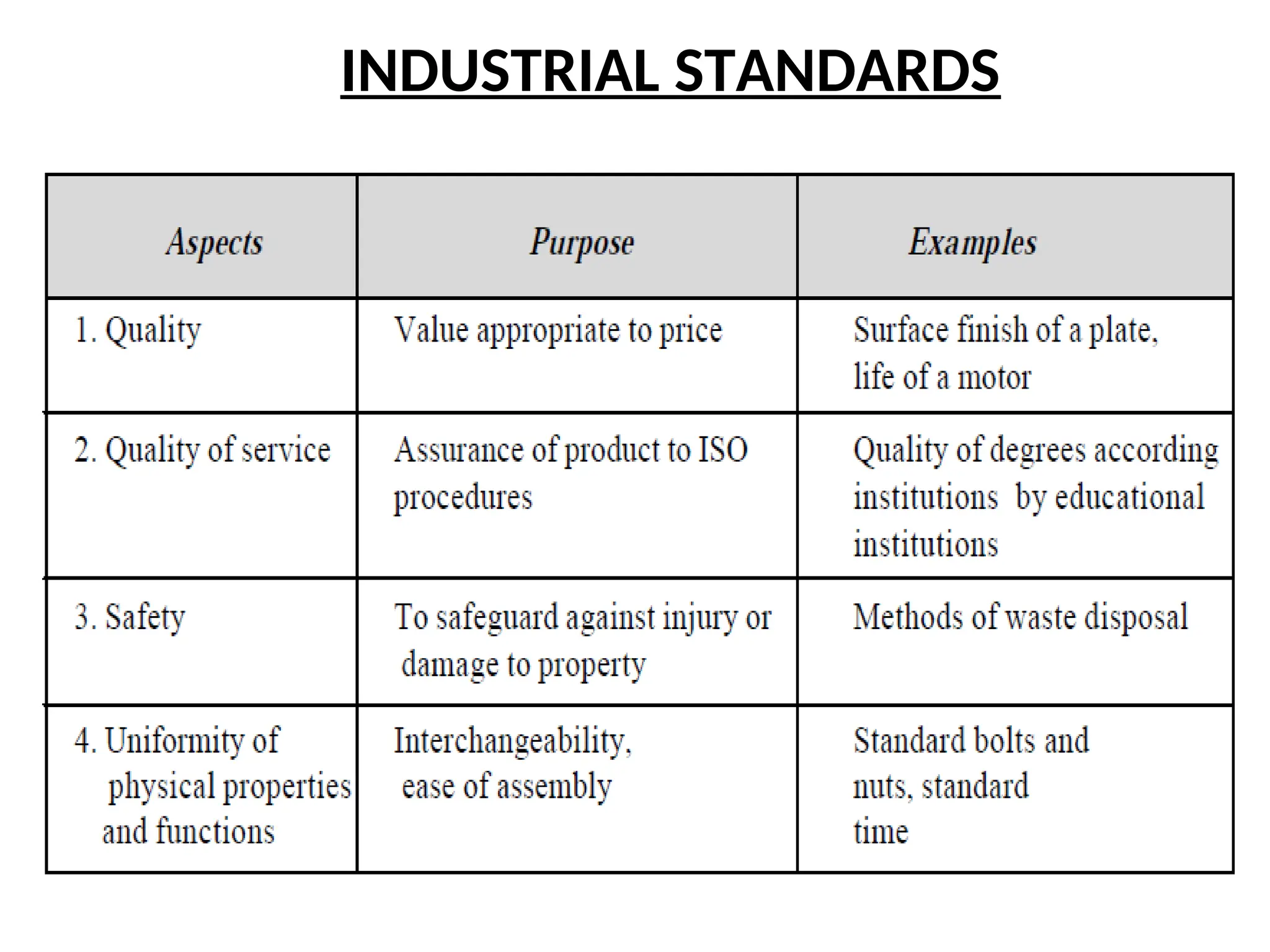
INDUSTRIAL STANDARDS
Industrial standards are important for any industry. Specification
helps in achieving interchangeability.
Standardization reduces the production costs and at the same time,
the quality is achieved easily.
It helps the manufacturer, customers and the public, in keeping
competitiveness and ensuring quality simultaneously.
Industrial standards are established by the Bureau of Indian
Standards, in our country in consultation with leading industries and
services.
The International Standards Organization has now detailed
specifications for generic products/services with procedures that
the manufacturers or service providers should follow to assure the
quality of their products or service. ISO 9000-2000 series are typical
examples in this direction.
INDUSTRIAL STANDARDS
A BALANCED OUTLOOK ON LAW
The ‘balanced outlook on law’ in engineering practice stresses the
necessity of laws and regulations and also their limitations in
directing and controlling the engineering practice.
Laws are necessary because, people are not fully responsible by
themselves and because of the competitive nature of the free
enterprise, which does not encourage moral initiatives.
Laws are needed to provide a minimum level of compliance.
Examples
1. Code for Builders by Hammurabi
Hummurabi the king of Babylon in 1758 framed the following code for the builders:
“If a builder has built a house for a man and has not made his work sound and the house
which he has built has fallen down and caused the death of the householder, that builder
shall be put to death.
If it causes the death of the householder’s son, they shall put that builder’s son to death.
If it causes the death of the householder’s slave, he shall give slave for slave to the
householder. If it destroys property, he shall replace anything it has destroyed;
and because he has not made the house sound which he has built and it has fallen down,
he shall rebuild the house which has fallen down from his own property.
If a builder has built a house for a man and does not make his work perfect and the wall
bulges, that builder shall put that wall in sound condition at his own cost”
This code was expected to put in self-regulation seriously in those years.
2. Steam Boat Code in USA
“Whenever there is crisis we claim that there ought to be
law to control this. “
Whenever there is a fire accident in a factory or fire cracker’s store house or boat capsize
we make this claim, and soon forget.
Laws are meant to be interpreted for minimal compliance. On the other hand, laws when
amended or updated continuously, would be counter productive.
Laws will always lag behind the technological development. The regulatory or inspection
agencies such as Environmental authority of India can play a major role by framing rules and
enforcing compliance.
In the early 19th century, a law was passed in USA to provide for inspection of the safety of
boilers and engines in ships. It was amended many times and now the standards formulated
by the American Society of Mechanical Engineers are followed.
3. Proper Role of Laws
Good laws when enforced effectively produce benefits.
They establish minimal standards of professional conduct and
provide a motivation to people. Further they serve as moral support
for the people who are willing to act ethically.
1. The rules which govern engineering practice should be construed
as of responsible experimentation rather than rules of a game. This
makes the engineer responsible for the safe conduct of the
experiment.
Thus, it is concluded that:
2. Precise rules and sanctions are suitable in case of ethical
misconduct that involves the violation of established engineering
procedures, which are aimed at the safety and the welfare of the
public.
3. In situations where the experimentation is large and time
consuming, the rules must not try to cover all possible outcomes,
and they should not compel the engineers to follow rigid courses of
action.
4. The regulation should be broad, but make engineers accountable
for their decisions, and
5. Through their professional societies, the engineers can facilitate
framing the rules, amend wherever necessary, and enforce them,
but without giving-in for conflicts of interest.
CASE STUDY: THE CHALLENGER
Main engines fuelled by liquid hydrogen
The thrust was provided by the two booster rockets.
The casing of each booster rocket - four-field joints and they use seals consisting of
pairs of O-rings made of vulcanized rubber. The O-rings work with a putty barrier
made of zinc chromate.
The engineers were employed with Rockwell International (manufacturers for the
orbiter and main rocket),
Morton-Thiokol (maker of booster rockets), and they worked for NASA.
Launch of Challenger was set for morning of Jan 28, 1986.
Allan J. McDonald was an engineer from Morton-Thiokol
Arnold Thompson and Roger Boisjoly, the seal experts at MT explained to the other
engineers about the O-ring
On many of the previous flights the rings have been found to have charred and
eroded
“From the past data gathered, at temperature less than 65 °F the O-rings failure was
certain. But these data were not deliberated at that conference as the launch time
was fast approaching.”
Mr. Boisjoly testified and recommended that no launch should be
attempted with temperature less than 53 °F.
“These managers were annoyed to postpone the
launch yet again.”
At 11.38 a.m. the rockets along with Challenger rose up the sky. The
cameras recorded smoke coming out of one of the filed joints on the
right booster rocket. Soon there was a flame that hit the external
fuel tank. At 76 seconds into the flight, the Challenger at a height of
10 miles was totally engulfed in a fireball. The crew cabin fell into
the ocean killing all the seven aboard.
CASE STUDY: THE CHALLENGER –Space Shuttle
Moral/Normative Issues
1. The crew had no escape mechanism. Douglas, the engineer,
designed an abort module to allow the separation of the orbiter,
triggered by a field-joint leak. But such a ‘safe exit’ was rejected
as too expensive, and because of an accompanying reduction in
payload.
2. The crew were not informed of the problems existing in the
field joints. The principle of informed consent was not followed.
3. Engineers gave warning signals on safety. But the management
group prevailed over and ignored the warning
CASE STUDY: THE CHALLENGER
Conceptual Issues
NASA counted that the probability of failure of the craft was one in
one lakh launches. But it was expected that only the 100000th
launch will fail.
There were 700 criticality-1 items, which included the field joints. A
failure in any one of them would have caused the tragedy. No back-
up or stand-bye had been provided for these criticality-1
components.
CASE STUDY: THE CHALLENGER
Factual/Descriptive Issues
Field joints gave way in earlier flights. But the authorities felt the risk
is not high.
NASA has disregarded warnings about the bad weather, at the time
of launch, because they wanted to complete the project, prove their
supremacy, get the funding from Government continued and get an
applaud from the President of USA.
The inability of the Rockwell Engineers (manufacturer) to prove that
the lift-off was unsafe.
This was interpreted by the NASA, as an approval by Rockwell to
launch.
Engineering - PROFESSIONAL ETHICS- CHAPTER 3

Engineering - PROFESSIONAL ETHICS- CHAPTER 3

  • 1.
  • 2.
    UNIT III ENGINEERING ASSOCIAL EXPERIMENTATION
  • 3.
    Engineering as Experimentation Engineersas responsible Experimenters Codes of Ethics  A Balanced Outlook on Law. UNIT III ENGINEERING AS SOCIAL EXPERIMENTATION
  • 4.
    ENGINEERING AS EXPERIMENTATION Before manufacturinga product or providing a project, we make several assumptions and trials, design and redesign and test several times till the product is observed to be functioning satisfactorily. We try different materials and experiments. From the test data obtained we make detailed design and retests.
  • 5.
    THE EMBEDDED SYSTEMDESIGN PROCESS
  • 6.
    1. Waterfall model •Early model for software development: requirements architecture coding testing maintenance Introduced by Royce , the first model proposed for the software development process. The waterfall model gets its name from the largely one-way flow of work and information from higher levels of abstraction to more detailed design steps
  • 7.
    Waterfall model 5steps • Requirements: determine basic characteristics. • Architecture: decompose into basic modules. • Coding: implement and integrate. • Testing: exercise and uncover bugs. • Maintenance: deploy, fix bugs, upgrade.
  • 8.
    Waterfall model critique •Only local feedback---may need iterations between coding and requirements. • Doesn’t integrate top-down and bottom-up design. • Assumes hardware is given. Most design projects entail experimentation and changes that require bottom–up feedback. As a result, the waterfall model is today cited as an unrealistic design process. So, an alternative model of software development called the spiral model .
  • 9.
  • 10.
    Spiral model critique •Successive refinement of system. –Start with mock-ups, move through simple systems to full-scale systems. • Provides bottom-up feedback from previous stages. • Working through stages may take too much time. • A spiral methodology with too many spirals may take too long when design time is a major requirement.
  • 11.
    Successive refinement model specify architect design build test initialsystem specify architect design build test refined system The system is built several times. A first system is used as a rough prototype, and successive models of the system are further refined.
  • 12.
    Hardware/software design flow requirementsand specification architecture hardware design software design integration testing
  • 13.
    A hierarchical designflow for an embedded system.
  • 14.
    Engineering Projects VS.Standard Experiments
  • 16.
    Similarities Partial ignorance: Thebehavior of materials purchased is uncertain and not constant (that is certain!). They may vary with the suppliers, processed lot, time, and the process used. Uncertainty: The final outcomes of projects are also uncertain, as in experiments. Some times unintended results, side effects (bye-products), and unsafe operation have also occurred. Continuous monitoring: Monitoring continually the progress and gaining new knowledge are needed before, during, and after execution of project as in the case of experimentation. The performance is to be monitored even during the use (or wrong use!) of the product by the end user/beneficiary. Learning from the past: Engineers normally learn from their own prior designs and infer from the analysis of operation and results, and sometimes from the reports of other engineers. The absence of interest and channels of communication, ego in not seeking information, guilty upon the failure, fear of legal actions, and mere negligence have caused many a failure Ex: Titanic- steamship Arctic Engineering Projects VS. Standard Experiments
  • 17.
    Contrasts: The scientific experimentsin the laboratory and the engineering experiments in the filed exhibit several Contrasts:- Experimental control: In standard experiments, members for study are selected into two groups namely A and B at random. Group A are given special treatment. The group B is given no treatment and is called the ‘controlled group’. But they are placed in the same environment as the other group A. This practice is adopted in the field of medicine. In engineering, this does not happen, except when the project is confined to laboratory experiments. Humane touch: Engineering experiments involve human souls, their needs, views, expectations, and creative use as in case of social experimentation. This point of view is not agreed by many of the engineers. But now the quality engineers and managers have fully realized this humane aspect. Informed consent: Knowledge gained:
  • 18.
    “Informed Consent” Engineering experimentationis viewed as Societal Experiment since the subject and the beneficiary are human beings. In this respect, it is similar to medical experimentation on human beings Informed consent has two basic elements: 1. Knowledge: The subject should be given all relevant information needed to make the decision to participate. 2. Voluntariness: Subject should take part without force, fraud or deception. Respect for rights of minorities to dissent and compensation for harmful effect are assumed here. For a valid consent, the following conditions are to be fulfilled: 1. Consent must be voluntary 2. All relevant information shall be presented/stated in a clearly understandable form 3. Consenter shall be capable of processing the information and make rational decisions. 4. The subject’s consent may be offered in proxy by a group that represents many subjects of like-interests
  • 19.
    Not much ofnew knowledge is developed in engineering experiments as in the case of scientific experiments in the laboratory. Engineering experiments at the most help us to: (a) verify the adequacy of the design, (b) to check the stability of the design parameters, and (c) prepare for the unexpected outcomes, in the actual field environments. Inference: From the models tested in the laboratory to the pilot plant tested in the field, there are differences in performance as well as other outcomes. Knowledge gained:
  • 20.
    Although the engineersfacilitate experiments, they are not alone in the field. Their responsibility is shared with the organizations, people, government, and others. No doubt the engineers share a greater responsibility while monitoring the projects, identifying the risks, and informing the clients and the public with facts. Based on this, they can take decisions to •participate or •protest or •promote. ENGINEERS AS RESPONSIBLE EXPERIMENTERS
  • 21.
    1. A conscientiouscommitment to live by moral values. 2. A comprehensive perspective on relevant information. It includes constant awareness of the progress of the experiment and readiness to monitor the side effects, if any. 3. Unrestricted free-personal involvement in all steps of the project/product development (autonomy). 4. Be accountable for the results of the project (accountability). The engineer, as an experimenter, owe several responsibilities to the society
  • 22.
    Conscientious moral commitmentmeans: (a) Being sensitive to full range of moral values and responsibilities relevant to the prevailing situation and (b) the willingness to develop the skill and put efforts needed to reach the best balance possible among those considerations. “In short, engineers must possess open eyes, open ears, and an open mind (i.e., moral vision, moral listening, and moral reasoning).” This makes the engineers as social experimenters, respect foremost the safety and health of the affected, while they seek to enrich their knowledge, rush for the profit, follow the rules, or care for only the beneficiary. The human rights of the participant should be protected through voluntary and informed consent. 1.Conscientiousness
  • 23.
    The engineer shouldgrasp the context of his work and ensure that the work involved results in only moral ends. One should not ignore his conscience, if the product or project that he is involved will result in damaging the nervous system of the people (or even the enemy, in case of weapon development) EX. If a product has a built-in obsolete or redundant component to boost sales with a false claim. In possessing of the perspective of factual information, the engineer should exhibit a moral concern and not agree for this design. 2.Comprehensive Perspective
  • 24.
    3. Moral Autonomy Viewingengineering as social experimentation, and anticipating unknown consequences should promote an attitude of questioning about the adequacy of the existing economic and safety standards. This proves a greater sense of personal involvement in one’s work Moral autonomy is defined as, decisions and actions exercised on the basis of moral concern for other people and recognition of good moral reasons. Alternatively, moral autonomy means ‘self determinant or independent’. It appears that the blue-collar workers with the support of the union can adopt better autonomy than the employed professionals. Only recently the legal support has been obtained by the professional societies in exhibiting moral autonomy by professionals in this country as well as in the West.
  • 25.
    4. Accountability The termAccountability means: 1. The capacity to understand and act on moral reasons 2. Willingness to submit one’s actions to moral scrutiny and be responsive to the assessment of others. It includes being answerable for meeting specific obligations, i.e., liable to justify (or give reasonable excuses) the decisions, actions or means, and outcomes (sometimes unexpected), when required by the stakeholders or by law.
  • 26.
    (a) The fragmentationof work in a project inevitably makes the final products lie away from the immediate work place, and lessens the personal responsibility of the employee. (b) Further the responsibilities diffuse into various hierarchies and to various people. Nobody gets the real feel of personal responsibility. (c) Often projects are executed one after another. An employee is more interested in adherence of tight schedules rather than giving personal care for the current project. (d) More litigation is to be faced by the engineers (as in the case of medical practitioners). This makes them wary of showing moral concerns beyond what is prescribed by the institutions. In spite of all these shortcomings, engineers are expected to face the risk and show up personal responsibility as the profession demands. The tug-of-war(PROBLEM) between of causal influence by the employer and moral responsibility of the employee are listed below
  • 27.
    CODES OF ETHICS The‘codes of ethics’ exhibit, rights, duties, and obligations of the members of a profession and a professional society. The codes exhibit the following essential roles: 1. Inspiration and guidance. The codes express the collective commitment of the profession to ethical conduct and public good and thus inspire the individuals. They identify primary responsibilities and provide statements and guidelines on interpretations for the professionals and the professional societies. 2. Support to engineers. The codes give positive support to professionals for taking stands on moral issues. Further they serve as potential legal support to discharge professional obligations.
  • 28.
    3.Deterrence (discourage toact immorally) and discipline (regulate to act morally). The codes serve as the basis for investigating unethical actions. The professional societies sometimes revoke membership or suspend/expel the members, when proved to have acted unethical. 4. Education and mutual understanding. Codes are used to prompt discussion and reflection on moral issues. They develop a shared understanding by the professionals, public, and the government on the moral responsibilities of the engineers. The Board of Review of the professional societies encourages moral discussion for educational purposes. CODES OF ETHICS Contd…
  • 29.
    5. Create goodpublic image. The codes present positive image of the committed profession to the public, help the engineers to serve the public effectively. They promote more of self regulation and lessen the government regulations. This is bound to raise the reputation of the profession and the organization, in establishing the trust of the public. 6. Protect the status quo. They create minimum level of ethical conduct and promotes agreement within the profession. Primary obligation namely the safety, health, and welfare of the public, declared by the codes serves and protects the public. 7. Promotes business interests. The codes offer inspiration to the entrepreneurs, establish shared standards, healthy competition, and maximize profit to investors, employees, and consumers. CODES OF ETHICS Contd…
  • 30.
    The codes arenot remedy for all evils. They have many limitations, namely: Limitations of Codes: 1. General and vague wordings. Many statements are general in nature and hence unable to solve all problems. 2. Not applicable to all situations. Codes are not sacred, and need not be accepted without criticism. Tolerance for criticisms of the codes themselves should be allowed. 3. Often have internal conflicts. Many times, the priorities are clearly spelt out, e.g., codes forbid public remarks critical of colleagues (engineers), but they actually discovered a major bribery, which might have caused a huge loss to the exchequer (Owner).
  • 31.
    4. They cannot be treated as final moral authority for professional conduct. Codes have flaws by commission and omission. There are still some grey areas undefined by codes. They can not be equated to laws. After all, even laws have loopholes and they invoke creativity in the legal practitioners. 5. Only a few enroll as members in professional society and non- members can not be compelled. 6. Even as members of the professional society, many are unaware of the codes
  • 32.
    7. Different societieshave different codes. The codes can not be uniform or same! Unifying the codes may not necessarily solve the problems prevailing various professions, but attempts are still made towards this unified codes. Ex: Leave for Pongal 8. Codes are said to be coercive(Powerful). They are sometimes claimed to be threatening and forceful.
  • 33.
    INDUSTRIAL STANDARDS Industrial standardsare important for any industry. Specification helps in achieving interchangeability. Standardization reduces the production costs and at the same time, the quality is achieved easily. It helps the manufacturer, customers and the public, in keeping competitiveness and ensuring quality simultaneously. Industrial standards are established by the Bureau of Indian Standards, in our country in consultation with leading industries and services. The International Standards Organization has now detailed specifications for generic products/services with procedures that the manufacturers or service providers should follow to assure the quality of their products or service. ISO 9000-2000 series are typical examples in this direction.
  • 34.
  • 35.
    A BALANCED OUTLOOKON LAW The ‘balanced outlook on law’ in engineering practice stresses the necessity of laws and regulations and also their limitations in directing and controlling the engineering practice. Laws are necessary because, people are not fully responsible by themselves and because of the competitive nature of the free enterprise, which does not encourage moral initiatives. Laws are needed to provide a minimum level of compliance.
  • 36.
    Examples 1. Code forBuilders by Hammurabi Hummurabi the king of Babylon in 1758 framed the following code for the builders: “If a builder has built a house for a man and has not made his work sound and the house which he has built has fallen down and caused the death of the householder, that builder shall be put to death. If it causes the death of the householder’s son, they shall put that builder’s son to death. If it causes the death of the householder’s slave, he shall give slave for slave to the householder. If it destroys property, he shall replace anything it has destroyed; and because he has not made the house sound which he has built and it has fallen down, he shall rebuild the house which has fallen down from his own property. If a builder has built a house for a man and does not make his work perfect and the wall bulges, that builder shall put that wall in sound condition at his own cost” This code was expected to put in self-regulation seriously in those years.
  • 37.
    2. Steam BoatCode in USA “Whenever there is crisis we claim that there ought to be law to control this. “ Whenever there is a fire accident in a factory or fire cracker’s store house or boat capsize we make this claim, and soon forget. Laws are meant to be interpreted for minimal compliance. On the other hand, laws when amended or updated continuously, would be counter productive. Laws will always lag behind the technological development. The regulatory or inspection agencies such as Environmental authority of India can play a major role by framing rules and enforcing compliance. In the early 19th century, a law was passed in USA to provide for inspection of the safety of boilers and engines in ships. It was amended many times and now the standards formulated by the American Society of Mechanical Engineers are followed.
  • 38.
    3. Proper Roleof Laws Good laws when enforced effectively produce benefits. They establish minimal standards of professional conduct and provide a motivation to people. Further they serve as moral support for the people who are willing to act ethically. 1. The rules which govern engineering practice should be construed as of responsible experimentation rather than rules of a game. This makes the engineer responsible for the safe conduct of the experiment. Thus, it is concluded that:
  • 39.
    2. Precise rulesand sanctions are suitable in case of ethical misconduct that involves the violation of established engineering procedures, which are aimed at the safety and the welfare of the public. 3. In situations where the experimentation is large and time consuming, the rules must not try to cover all possible outcomes, and they should not compel the engineers to follow rigid courses of action. 4. The regulation should be broad, but make engineers accountable for their decisions, and 5. Through their professional societies, the engineers can facilitate framing the rules, amend wherever necessary, and enforce them, but without giving-in for conflicts of interest.
  • 40.
    CASE STUDY: THECHALLENGER Main engines fuelled by liquid hydrogen The thrust was provided by the two booster rockets. The casing of each booster rocket - four-field joints and they use seals consisting of pairs of O-rings made of vulcanized rubber. The O-rings work with a putty barrier made of zinc chromate. The engineers were employed with Rockwell International (manufacturers for the orbiter and main rocket), Morton-Thiokol (maker of booster rockets), and they worked for NASA. Launch of Challenger was set for morning of Jan 28, 1986. Allan J. McDonald was an engineer from Morton-Thiokol Arnold Thompson and Roger Boisjoly, the seal experts at MT explained to the other engineers about the O-ring On many of the previous flights the rings have been found to have charred and eroded “From the past data gathered, at temperature less than 65 °F the O-rings failure was certain. But these data were not deliberated at that conference as the launch time was fast approaching.”
  • 41.
    Mr. Boisjoly testifiedand recommended that no launch should be attempted with temperature less than 53 °F. “These managers were annoyed to postpone the launch yet again.” At 11.38 a.m. the rockets along with Challenger rose up the sky. The cameras recorded smoke coming out of one of the filed joints on the right booster rocket. Soon there was a flame that hit the external fuel tank. At 76 seconds into the flight, the Challenger at a height of 10 miles was totally engulfed in a fireball. The crew cabin fell into the ocean killing all the seven aboard. CASE STUDY: THE CHALLENGER –Space Shuttle
  • 42.
    Moral/Normative Issues 1. Thecrew had no escape mechanism. Douglas, the engineer, designed an abort module to allow the separation of the orbiter, triggered by a field-joint leak. But such a ‘safe exit’ was rejected as too expensive, and because of an accompanying reduction in payload. 2. The crew were not informed of the problems existing in the field joints. The principle of informed consent was not followed. 3. Engineers gave warning signals on safety. But the management group prevailed over and ignored the warning CASE STUDY: THE CHALLENGER
  • 43.
    CASE STUDY: THECHALLENGER Conceptual Issues NASA counted that the probability of failure of the craft was one in one lakh launches. But it was expected that only the 100000th launch will fail. There were 700 criticality-1 items, which included the field joints. A failure in any one of them would have caused the tragedy. No back- up or stand-bye had been provided for these criticality-1 components.
  • 44.
    CASE STUDY: THECHALLENGER Factual/Descriptive Issues Field joints gave way in earlier flights. But the authorities felt the risk is not high. NASA has disregarded warnings about the bad weather, at the time of launch, because they wanted to complete the project, prove their supremacy, get the funding from Government continued and get an applaud from the President of USA. The inability of the Rockwell Engineers (manufacturer) to prove that the lift-off was unsafe. This was interpreted by the NASA, as an approval by Rockwell to launch.