UNIT-II
Safety, Responsibilities and Rights
in Social Experimentation
Prepared By
Dr. Jami Venkata Suman
Department of ECE
GMRIT, Rajam
1
2
3
4
Engineers as Responsible
Experimenters
5
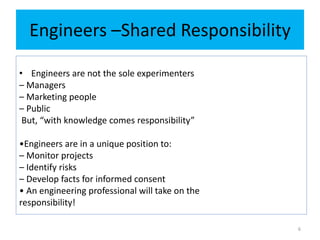
Engineers –Shared Responsibility
• Engineers are not the sole experimenters
– Managers
– Marketing people
– Public
But, “with knowledge comes responsibility”
•Engineers are in a unique position to:
– Monitor projects
– Identify risks
– Develop facts for informed consent
• An engineering professional will take on the
responsibility!
6
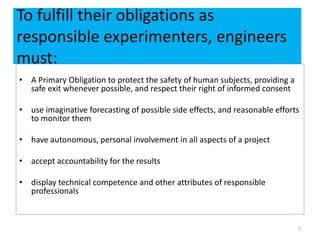
To fulfill their obligations as
responsible experimenters, engineers
must:
• A Primary Obligation to protect the safety of human subjects, providing a
safe exit whenever possible, and respect their right of informed consent
• use imaginative forecasting of possible side effects, and reasonable efforts
to monitor them
• have autonomous, personal involvement in all aspects of a project
• accept accountability for the results
• display technical competence and other attributes of responsible
professionals
7
For Remembrance
• Informing for consent requires excellent
communications skills in order to provide
appropriate information in an understandable
way.
• Also, cooperation with other disciplines is often
essential to assess potential side effects and
monitor effects of "social experiments" through
engineering.. (Recall Alasdair MacIntyre's virtue
of professional responsibility which includes: i)
self direction, ii) public spirited, iii) team work
iv) proficiency. (Martin & Schinzinger, 42)
8
• Engineers should also display technical
competence and other attributes of
professionalism .
• Definite “Style” of Engineering
• Contemporary Threats
9
Contemporary Threats
• Conscientiousness
• Relevant Information
• Moral Autonomy
• Accountability
10
Responsible Experimentalists
1. Conscientiousness: Protect safety knowledge,
respect right of consent of public
2. Relevant Information / Comprehensive
perspective: Awareness of experimental nature of
projects, forecasting, monitoring
3. Moral autonomy: Personally engaged,
thoughtful, involvement in project
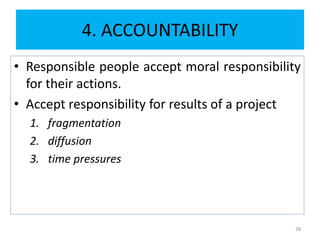
4. Accountability: Accept responsibility for results
of a project (avoid fragmentation, diffusion, time
pressures)
11
1.CONSCIENTIOUSNESS
• People act responsibly to the extent that they
conscientiously commit themselves to live
according to moral values .
• Self interest
• Moral Agents
Individuals who think solely of their own
good to the exclusion of the good of others are
not moral agents
12
Conscientiousness moral commitment
• a sensitivity to the full range of moral values
and responsibilities that are relevant to a
given situation
• Willingness to develop the skill and expend
the effort needed to reach the best balance
possible among those considerations .
• Conscientiousness implies consciousness ( in
the sense of awareness), because intent is not
sufficient.
13
Open eyes, Open ears and an Open mind are
required to recognize a given situation, its
implications and who is involved or affected.
14
Working Conditions
• The contemporary (modern or present)
working conditions of engineers tend a
narrow moral vision solely to the obligations
that accompany employee status.
15
Engineers work benefits
• 90% of engineers are salaried employees
work in large bureaucracies ( organizations or
administrations ) under great pressure to function
smoothly within the organization
• Benefits :Prudent self interest and concern for
one’s family  make it easy to emphasize as
primary the obligations to one‘s employer
16
Moral aspiration (goal)
• Minimal negative duties:
– Not falsifying data
– Not violating patent rights
– Not breaching confidentiality
17
Engineering as Social Experimentation
• Restores vision of engineers as guardians of
the public interest  professional duty it is to
guard the Welfare and safety of those affected
by engineering projects .
• Engineers should not impose their own views
of the social good upon society
18
2. RELEVANT INFORMATION
• Conscientiousness is blind without relevant
factual information.
• Shows moral concern that involves
commitment to obtain and properly assess all
available information pertinent to meeting
one’s moral obligations
19
• Grasp the context of one’s work( which makes
it count as an activity having a moral import )
• Specialization
• Division of Labor
20
Example
• A company may produce items with
obsolescence built into them , or the items
might promote unnecessary energy usage
• It is easy to place the burden on the sales
department : “Let them inform the
customers”
• It may be natural to thus rationalize one’s
neglect of safety or cost considerations , but it
shows no moral concern.
21
• Consequences of what one does
• Regarding engineering as social
experimentation :
– Engineer should view his/her specialized activities
in a project as part of a larger whole having a
social impact.
– Goal is to practice “Defensive engineering “ or “
preventive technology “
– Moral Responsibility
22
3. MORAL AUTONOMY
(Morally Self directed )
When People are morally autonomous ?
23
• People are morally autonomous when their
moral conduct and principles of action are
their own.
• Moral Beliefs and attitudes basis of Critical
reflection
-Moral beliefs and attitudes must be held on the basis
of critical reflection rather than merely through passive
adoption ie... Particular conventions of one’s society,
church or profession
24
• Moral Beliefs and attitudes must integrate
into the core of an individual’s personality in a
manner that leads to committed action.
• Cannot be agreed abstractly and formally or
verbally .
25
• Engineers working for an employer  sells
one’s labor and skills may make it seem that
one has thereby disowned and forfeited
power over one’s actions
• Viewing engineering as social experimentation
can help one overcome the above tendency .
26
ATTITUDE OF MANAGEMENT
• Plays a decisive (vital) role in how much moral
autonomy engineers feel they have.
• Long term interest
• Thoughtful &
• Involvement in project
27
4. ACCOUNTABILITY
• Responsible people accept moral responsibility
for their actions.
• Accept responsibility for results of a project
1. fragmentation
2. diffusion
3. time pressures
28
29
30
31
32
33
34
35
36
37
38
39
40
41
42
43
44
45
46
47
48
49
50
51
52
53
54
55
56
57
58
59
60
61
62
63
64
65
66
67
68
69
70
71
72
73
74
75
76
Employer Responsibilities
77

UNIT-2.pptx

  • 1.
    UNIT-II Safety, Responsibilities andRights in Social Experimentation Prepared By Dr. Jami Venkata Suman Department of ECE GMRIT, Rajam 1
  • 2.
  • 3.
  • 4.
  • 5.
  • 6.
    Engineers –Shared Responsibility •Engineers are not the sole experimenters – Managers – Marketing people – Public But, “with knowledge comes responsibility” •Engineers are in a unique position to: – Monitor projects – Identify risks – Develop facts for informed consent • An engineering professional will take on the responsibility! 6
  • 7.
    To fulfill theirobligations as responsible experimenters, engineers must: • A Primary Obligation to protect the safety of human subjects, providing a safe exit whenever possible, and respect their right of informed consent • use imaginative forecasting of possible side effects, and reasonable efforts to monitor them • have autonomous, personal involvement in all aspects of a project • accept accountability for the results • display technical competence and other attributes of responsible professionals 7
  • 8.
    For Remembrance • Informingfor consent requires excellent communications skills in order to provide appropriate information in an understandable way. • Also, cooperation with other disciplines is often essential to assess potential side effects and monitor effects of "social experiments" through engineering.. (Recall Alasdair MacIntyre's virtue of professional responsibility which includes: i) self direction, ii) public spirited, iii) team work iv) proficiency. (Martin & Schinzinger, 42) 8
  • 9.
    • Engineers shouldalso display technical competence and other attributes of professionalism . • Definite “Style” of Engineering • Contemporary Threats 9
  • 10.
    Contemporary Threats • Conscientiousness •Relevant Information • Moral Autonomy • Accountability 10
  • 11.
    Responsible Experimentalists 1. Conscientiousness:Protect safety knowledge, respect right of consent of public 2. Relevant Information / Comprehensive perspective: Awareness of experimental nature of projects, forecasting, monitoring 3. Moral autonomy: Personally engaged, thoughtful, involvement in project 4. Accountability: Accept responsibility for results of a project (avoid fragmentation, diffusion, time pressures) 11
  • 12.
    1.CONSCIENTIOUSNESS • People actresponsibly to the extent that they conscientiously commit themselves to live according to moral values . • Self interest • Moral Agents Individuals who think solely of their own good to the exclusion of the good of others are not moral agents 12
  • 13.
    Conscientiousness moral commitment •a sensitivity to the full range of moral values and responsibilities that are relevant to a given situation • Willingness to develop the skill and expend the effort needed to reach the best balance possible among those considerations . • Conscientiousness implies consciousness ( in the sense of awareness), because intent is not sufficient. 13
  • 14.
    Open eyes, Openears and an Open mind are required to recognize a given situation, its implications and who is involved or affected. 14
  • 15.
    Working Conditions • Thecontemporary (modern or present) working conditions of engineers tend a narrow moral vision solely to the obligations that accompany employee status. 15
  • 16.
    Engineers work benefits •90% of engineers are salaried employees work in large bureaucracies ( organizations or administrations ) under great pressure to function smoothly within the organization • Benefits :Prudent self interest and concern for one’s family  make it easy to emphasize as primary the obligations to one‘s employer 16
  • 17.
    Moral aspiration (goal) •Minimal negative duties: – Not falsifying data – Not violating patent rights – Not breaching confidentiality 17
  • 18.
    Engineering as SocialExperimentation • Restores vision of engineers as guardians of the public interest  professional duty it is to guard the Welfare and safety of those affected by engineering projects . • Engineers should not impose their own views of the social good upon society 18
  • 19.
    2. RELEVANT INFORMATION •Conscientiousness is blind without relevant factual information. • Shows moral concern that involves commitment to obtain and properly assess all available information pertinent to meeting one’s moral obligations 19
  • 20.
    • Grasp thecontext of one’s work( which makes it count as an activity having a moral import ) • Specialization • Division of Labor 20
  • 21.
    Example • A companymay produce items with obsolescence built into them , or the items might promote unnecessary energy usage • It is easy to place the burden on the sales department : “Let them inform the customers” • It may be natural to thus rationalize one’s neglect of safety or cost considerations , but it shows no moral concern. 21
  • 22.
    • Consequences ofwhat one does • Regarding engineering as social experimentation : – Engineer should view his/her specialized activities in a project as part of a larger whole having a social impact. – Goal is to practice “Defensive engineering “ or “ preventive technology “ – Moral Responsibility 22
  • 23.
    3. MORAL AUTONOMY (MorallySelf directed ) When People are morally autonomous ? 23
  • 24.
    • People aremorally autonomous when their moral conduct and principles of action are their own. • Moral Beliefs and attitudes basis of Critical reflection -Moral beliefs and attitudes must be held on the basis of critical reflection rather than merely through passive adoption ie... Particular conventions of one’s society, church or profession 24
  • 25.
    • Moral Beliefsand attitudes must integrate into the core of an individual’s personality in a manner that leads to committed action. • Cannot be agreed abstractly and formally or verbally . 25


  • 26.
    • Engineers workingfor an employer  sells one’s labor and skills may make it seem that one has thereby disowned and forfeited power over one’s actions • Viewing engineering as social experimentation can help one overcome the above tendency . 26
  • 27.
    ATTITUDE OF MANAGEMENT •Plays a decisive (vital) role in how much moral autonomy engineers feel they have. • Long term interest • Thoughtful & • Involvement in project 27
  • 28.
    4. ACCOUNTABILITY • Responsiblepeople accept moral responsibility for their actions. • Accept responsibility for results of a project 1. fragmentation 2. diffusion 3. time pressures 28
  • 29.
  • 30.
  • 31.
  • 32.
  • 33.
  • 34.
  • 35.
  • 36.
  • 37.
  • 38.
  • 39.
  • 40.
  • 41.
  • 42.
  • 43.
  • 44.
  • 45.
  • 46.
  • 47.
  • 48.
  • 49.
  • 50.
  • 51.
  • 52.
  • 53.
  • 54.
  • 55.
  • 56.
  • 57.
  • 58.
  • 59.
  • 60.
  • 61.
  • 62.
  • 63.
  • 64.
  • 65.
  • 66.
  • 67.
  • 68.
  • 69.
  • 70.
  • 71.
  • 72.
  • 73.
  • 74.
  • 75.
  • 76.
  • 77.