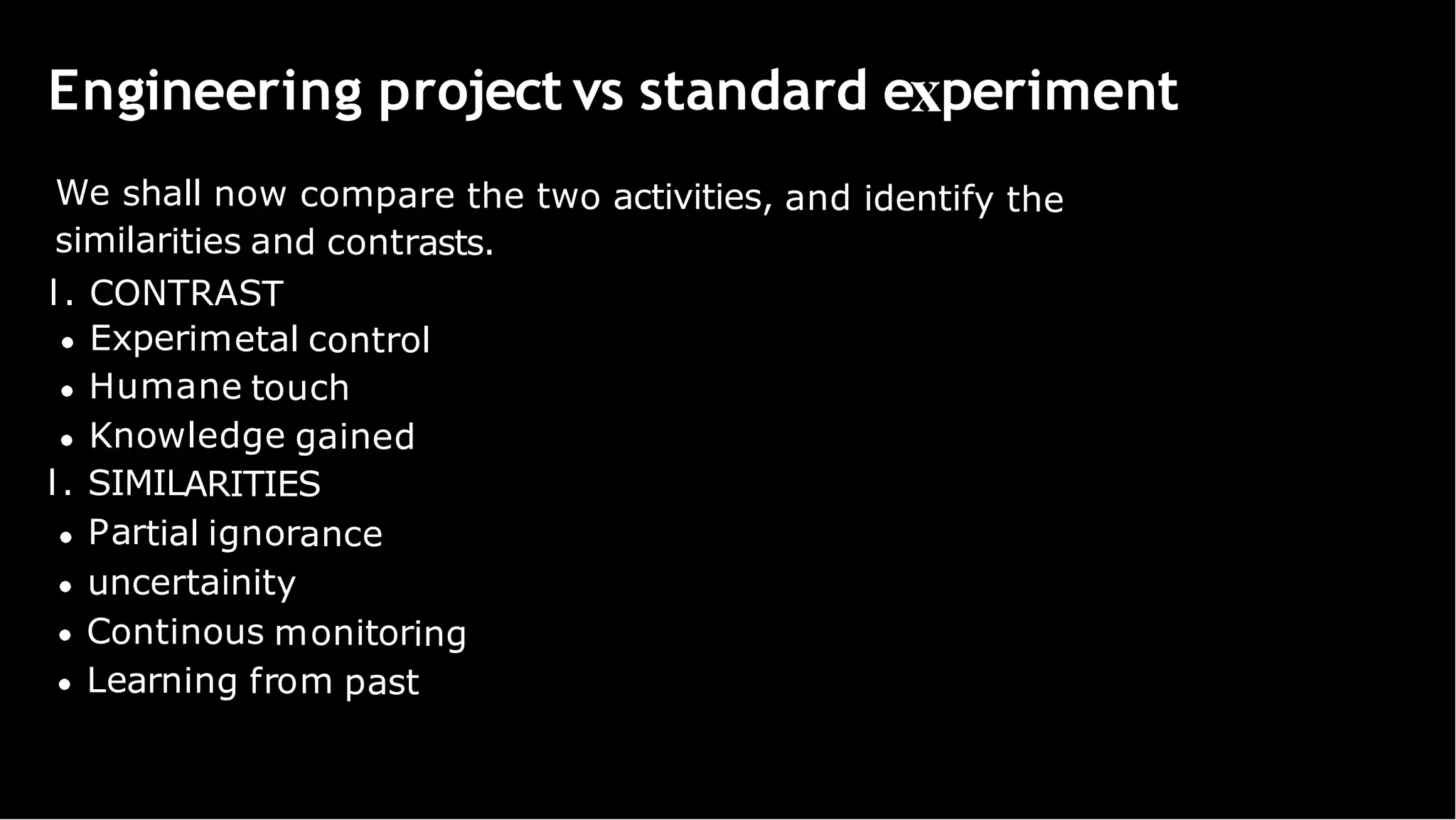
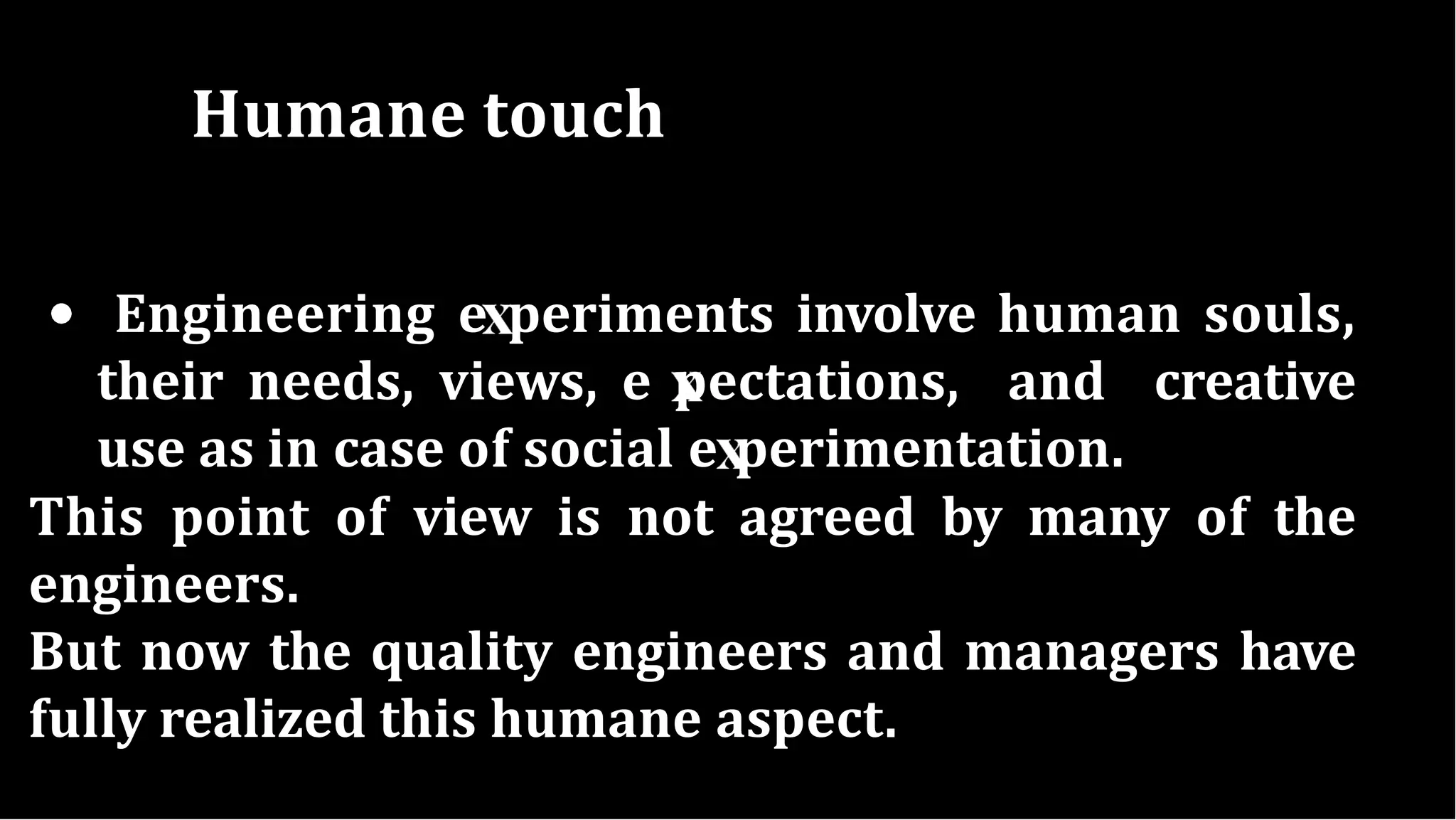
Engineering as
e perimentation:
by:
Mukesh majhi
naman raj
Kartik vashishtha
Pranav gaikwad
E perimentation
The process of doing scientific
experiment
The process of trying or testing
new ideas or methods
Engineering
Engineering is the application of
and mathematical
to design ,test,build
scientific
principle
machine.
Engineering as
e perimentation
Before manufacturing a product or providing a
project, we make several assumptions and trials,
design and redesign and test several times till
the product is observed to be functioning
satisfactorily.
Thus, design as well as engineering is iterative
process .
like for example before a road construction
begins, researchers in civil engineering lab
asked to prepare different samples of the
aggregates to see which is well suited in terms
of strength of the material used and proposed
road load.
Engineering project vs standard e periment
We shall now compare the two activities, and identify the
similarities and contrasts.
l. CONTRAST
Experimetal control
Humane touch
Knowledge gained
l. SIMILARITIES
Partial ignorance
uncertainity
Continous monitoring
Learning from past
In standard e periments, e perimental control involves
selecting members for two different groups randomly.
The first group members aregiven the special,
e perimental treatment, whereas the members of other
group are not given that special treatment. Even both
the groups are subjected to same environment ; the
group that was not given the special treatment is called
"control group‟.
In engineering e periments, usually there is no control
group.
E perimental control
Humane touch
Engineering e periments involve human souls,
their needs, views, e pectations, and creative
use as in case of social e perimentation.
This point of view is not agreed by many of the
engineers.
But now the quality engineers and managers have
fully realized this humane aspect.
Not much of new knowledge is developed in engineering
e periments as in the case of scientific e periments in the
laboratory.
Engineering e periments at the most help us to
a)verify the adequacy of the design,
b)to check the stability of the design parameters, and
c)prepare for the une pected outcomes, in the actual field
environments. From the models tested in the laboratory to the
pilot plant tested in the field, there are differences in performance
as well as other outcomes.
KNOWLEDGE GAINED
1
. PARTIAL IGNORANCE
The project is usually e ecuted in partial ignorance.
Uncertainties e ist in the model assumed. The behavior of materials purchased is
uncertain and not constant (that is certain!).
They may vary with the suppliers, processed lot, time, and the process used in
shaping the materials (e.g., sheet or plate, rod or wire, forged or cast or welded).
There may be variations in the grain structure and its resulting failure stress. It is
not possible to collect data on all variations.
In some cases, e trapolation, interpolation, assumptions of linear behavior over the
range of parameters, accelerated testing, simulations, and virtual testing are
resorted.
SIMILARITIES
The final outcomes of projects are also uncertain, as in
e periments.
Sometimes unintended results, side effects (bye-products), and
unsafe operation have also occurred.
Une pected risks, such as undue seepage in a storage dam, leakage
of nuclear radiation from an atomic power plant, presence of
pesticides in food or soft drink bot le, an new irrigation canal
spreading water-borne diseases, and an unsuspecting hair dryer
causing lung cancer on the user from the asbestos gasket used in
the product have been reported.
2.UNCERTAINITY
Monitoring continually the progress and gaining
new knowledge are needed before, during, and
after e ecution of project as in the case of
e perimentation.
The performance is to be monitored even during
the use (or wrong use!) of the product by the end
user/beneficiary.
3.CONTINOUS MONITORING
Engineers normally learn from their own prior designs and infer
from the analysis of operation and results, and
sometimes from the reports of other engineers. But this does not
happen frequently.
The absence of interest and channels of communication, ego in not
seeking information, guilty upon the failure, fear of legal actions, and
mere negligence have caused many a failure, e.g., the Titanic lacked
s u cient number of life boats-it had only 825boats for the actual
passengers of 2227,the capacity of the ship being 3547!In the
emergent situation, all the e isting life boats could not be launched.
Forty years back, another steamship Arctic met with same tragedy
due to the same
4.LEARNING FROM THE PAST
ENGINEERSAS RESPONSIBLE E PERIMENTERS
Although the engineers facilitate e periments, they are not alone in the field. Their
responsibility is shared with the organizations, people, government, and others. No
doubt the engineers share a greater responsibility while monitoring the projects,
identifying the risks, and informing the clients and the public with facts. Based on this,
they can take decisions to participate or protest or promote. The engineer, as an
e perimenter, owe several responsibilities to the society, namely,
1.Aconscientious commitment to live by moral values.
2.A comprehensive perspective on relevant information. It includes constant awareness
of the progress of the e periment and readiness to monitor the side effects, if any.
3. Unrestricted free-personal involvement in all steps of the project/product
development (autonomy).
4. Be accountable for the results of the project (accountability).
ENGINEERS AS RESPONSIBLE
E PERIMENTERS
Conscientious moral commitment means:
a)Being sensitive to full range of moral values and responsibilities relevant
to the prevailing situation and
b)the willingness to develop the skill and put efforts needed to reach the
best balance possible among those considerations.
In short, engineers must possess open eyes, open ears, and an open mind
(i.e., moral vision, moral listening, and moral reasoning).
This makes the engineers as social e perimenters, respect foremost the
safety and health of the affected, while they seek to enrich their knowledge,
rush for the profit, follow the rules, or care for only the beneficiary.
The human rights of the participant should be protected through voluntary
and informed consent.
CONSCIENTIOUSNESS
Relevant information
Comprehensive Perspective
The engineer should grasp the conte t of his work and ensure that the work
involved results in only moral ends.
One should not ignore his conscience, if the product or project that he is involved
will result in damaging the nervous system of the people (or even the enemy, in
case of weapon development) A product has a built-in obsolete or redundant
component to boost sales with a false claim.
In possessing of the perspective of factual information, the engineer should
e hibit a moral concern and not agree for this design. Sometimes, the guilt is
transferred to the government or the competitors. Some organizations think that
they will let the government find the fault or let the fraudulent competitor be
caught first.
Finally, a full-scale environmental or social impact study of the product or
project by individual engineers is useful but not possible, in practice.
COMPREHENSIVE PERSPECTIVE
Viewing engineering as social
e perimentation, and anticipating unknown
consequences should promote an at itude of
questioning about the adequacy of the
e isting economic and safety standards. This
proves a greater sense of personal
involvement in one's work.
MORAL AUTONOMY
The term Accountability means:
1)The capacity to understand and act on moral reasons
2)Willingness to submit one's actions to moral scrutiny and be responsive
to the assessment of others. It includes being answerable for meeting
specific obligations, i.e., liable to justify (or give reasonable e cuses) the
decisions, actions or means, and outcomes (sometimes une pected), when
required by the stakeholders or by law. The tug-of-war between of causal
influence by the employer and moral responsibility of the employee is
quite common in professions. In the engineering practice, the problems
are:
a) The fragmentation of work in a project inevitably makes the final
products lie away from the immediate work place, and lessens the
personal responsibility of the employee.
ACCOUNTABILITY
Thank You.

Engineering as experimentation ppt.pptx

  • 1.
    Engineering as e perimentation: by: Mukeshmajhi naman raj Kartik vashishtha Pranav gaikwad
  • 2.
    E perimentation The processof doing scientific experiment The process of trying or testing new ideas or methods Engineering Engineering is the application of and mathematical to design ,test,build scientific principle machine.
  • 3.
    Engineering as e perimentation Beforemanufacturing a product or providing a project, we make several assumptions and trials, design and redesign and test several times till the product is observed to be functioning satisfactorily. Thus, design as well as engineering is iterative process . like for example before a road construction begins, researchers in civil engineering lab asked to prepare different samples of the aggregates to see which is well suited in terms of strength of the material used and proposed road load.
  • 4.
    Engineering project vsstandard e periment We shall now compare the two activities, and identify the similarities and contrasts. l. CONTRAST Experimetal control Humane touch Knowledge gained l. SIMILARITIES Partial ignorance uncertainity Continous monitoring Learning from past
  • 5.
    In standard eperiments, e perimental control involves selecting members for two different groups randomly. The first group members aregiven the special, e perimental treatment, whereas the members of other group are not given that special treatment. Even both the groups are subjected to same environment ; the group that was not given the special treatment is called "control group‟. In engineering e periments, usually there is no control group. E perimental control
  • 6.
    Humane touch Engineering eperiments involve human souls, their needs, views, e pectations, and creative use as in case of social e perimentation. This point of view is not agreed by many of the engineers. But now the quality engineers and managers have fully realized this humane aspect.
  • 7.
    Not much ofnew knowledge is developed in engineering e periments as in the case of scientific e periments in the laboratory. Engineering e periments at the most help us to a)verify the adequacy of the design, b)to check the stability of the design parameters, and c)prepare for the une pected outcomes, in the actual field environments. From the models tested in the laboratory to the pilot plant tested in the field, there are differences in performance as well as other outcomes. KNOWLEDGE GAINED
  • 8.
    1 . PARTIAL IGNORANCE Theproject is usually e ecuted in partial ignorance. Uncertainties e ist in the model assumed. The behavior of materials purchased is uncertain and not constant (that is certain!). They may vary with the suppliers, processed lot, time, and the process used in shaping the materials (e.g., sheet or plate, rod or wire, forged or cast or welded). There may be variations in the grain structure and its resulting failure stress. It is not possible to collect data on all variations. In some cases, e trapolation, interpolation, assumptions of linear behavior over the range of parameters, accelerated testing, simulations, and virtual testing are resorted. SIMILARITIES
  • 9.
    The final outcomesof projects are also uncertain, as in e periments. Sometimes unintended results, side effects (bye-products), and unsafe operation have also occurred. Une pected risks, such as undue seepage in a storage dam, leakage of nuclear radiation from an atomic power plant, presence of pesticides in food or soft drink bot le, an new irrigation canal spreading water-borne diseases, and an unsuspecting hair dryer causing lung cancer on the user from the asbestos gasket used in the product have been reported. 2.UNCERTAINITY
  • 10.
    Monitoring continually theprogress and gaining new knowledge are needed before, during, and after e ecution of project as in the case of e perimentation. The performance is to be monitored even during the use (or wrong use!) of the product by the end user/beneficiary. 3.CONTINOUS MONITORING
  • 11.
    Engineers normally learnfrom their own prior designs and infer from the analysis of operation and results, and sometimes from the reports of other engineers. But this does not happen frequently. The absence of interest and channels of communication, ego in not seeking information, guilty upon the failure, fear of legal actions, and mere negligence have caused many a failure, e.g., the Titanic lacked s u cient number of life boats-it had only 825boats for the actual passengers of 2227,the capacity of the ship being 3547!In the emergent situation, all the e isting life boats could not be launched. Forty years back, another steamship Arctic met with same tragedy due to the same 4.LEARNING FROM THE PAST
  • 12.
    ENGINEERSAS RESPONSIBLE EPERIMENTERS Although the engineers facilitate e periments, they are not alone in the field. Their responsibility is shared with the organizations, people, government, and others. No doubt the engineers share a greater responsibility while monitoring the projects, identifying the risks, and informing the clients and the public with facts. Based on this, they can take decisions to participate or protest or promote. The engineer, as an e perimenter, owe several responsibilities to the society, namely, 1.Aconscientious commitment to live by moral values. 2.A comprehensive perspective on relevant information. It includes constant awareness of the progress of the e periment and readiness to monitor the side effects, if any. 3. Unrestricted free-personal involvement in all steps of the project/product development (autonomy). 4. Be accountable for the results of the project (accountability). ENGINEERS AS RESPONSIBLE E PERIMENTERS
  • 13.
    Conscientious moral commitmentmeans: a)Being sensitive to full range of moral values and responsibilities relevant to the prevailing situation and b)the willingness to develop the skill and put efforts needed to reach the best balance possible among those considerations. In short, engineers must possess open eyes, open ears, and an open mind (i.e., moral vision, moral listening, and moral reasoning). This makes the engineers as social e perimenters, respect foremost the safety and health of the affected, while they seek to enrich their knowledge, rush for the profit, follow the rules, or care for only the beneficiary. The human rights of the participant should be protected through voluntary and informed consent. CONSCIENTIOUSNESS
  • 14.
    Relevant information Comprehensive Perspective Theengineer should grasp the conte t of his work and ensure that the work involved results in only moral ends. One should not ignore his conscience, if the product or project that he is involved will result in damaging the nervous system of the people (or even the enemy, in case of weapon development) A product has a built-in obsolete or redundant component to boost sales with a false claim. In possessing of the perspective of factual information, the engineer should e hibit a moral concern and not agree for this design. Sometimes, the guilt is transferred to the government or the competitors. Some organizations think that they will let the government find the fault or let the fraudulent competitor be caught first. Finally, a full-scale environmental or social impact study of the product or project by individual engineers is useful but not possible, in practice. COMPREHENSIVE PERSPECTIVE
  • 15.
    Viewing engineering associal e perimentation, and anticipating unknown consequences should promote an at itude of questioning about the adequacy of the e isting economic and safety standards. This proves a greater sense of personal involvement in one's work. MORAL AUTONOMY
  • 16.
    The term Accountabilitymeans: 1)The capacity to understand and act on moral reasons 2)Willingness to submit one's actions to moral scrutiny and be responsive to the assessment of others. It includes being answerable for meeting specific obligations, i.e., liable to justify (or give reasonable e cuses) the decisions, actions or means, and outcomes (sometimes une pected), when required by the stakeholders or by law. The tug-of-war between of causal influence by the employer and moral responsibility of the employee is quite common in professions. In the engineering practice, the problems are: a) The fragmentation of work in a project inevitably makes the final products lie away from the immediate work place, and lessens the personal responsibility of the employee. ACCOUNTABILITY
  • 17.