Uniformly
Accelerated
Motion
One Dimension
Uniformly Accelerated
Motion
Uniformly Accelerated Motion (UAM) is motion
of an object where the acceleration is constant. In
other words, the acceleration remains uniform;
the acceleration is equal to a number and that
number does not change as a function of time.
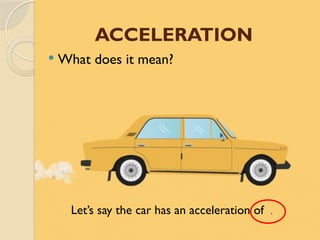
ACCELERATION
 What does it mean?
Let’s say the car has an acceleration of .
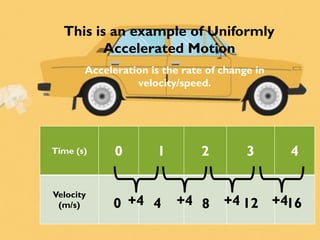
Time (s) 0 1 2 3 4
Velocity
(m/s)
Acceleration is the rate of change in
velocity/speed.
0 4 8 12 16
This is an example of Uniformly
Accelerated Motion
+4 +4 +4 +4
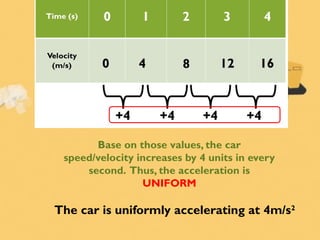
Base on those values, the car
speed/velocity increases by 4 units in every
second. Thus, the acceleration is
UNIFORM
The car is uniformly accelerating at 4m/s2
REVIEW. . . REVIEW. . .
REVIEW. . .
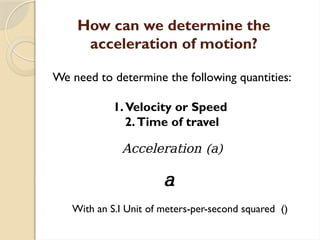
How can we determine the
acceleration of motion?
We need to determine the following quantities:
1.Velocity or Speed
2.Time of travel
Acceleration (a)
a
With an S.I Unit of meters-per-second squared ()
UNIFORMLY ACCELERATED MOTION
IS CONSIDERED AN IDEALIZED
MOTION.
To achieve this, only one
and NO other external
forces should be affecting
the motion
EXAMPLE
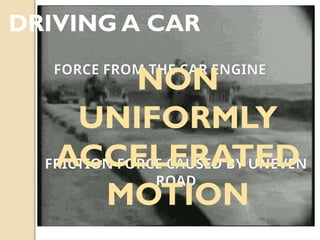
FRICTION FORCE CAUSED BY UNEVEN
ROAD
DRIVING A CAR
FORCE FROM THE CAR ENGINE
NON
UNIFORMLY
ACCELERATED
MOTION
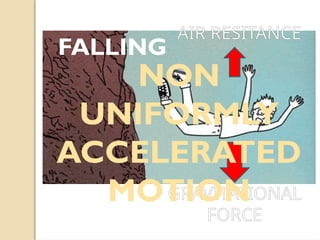
FALLING
AIR RESITANCE
GRAVITATIONAL
FORCE
NON
UNIFORMLY
ACCELERATED
MOTION
How can we achieve
uniformly accelerated
motion?
The force causing the motion should be
the only force present in that situation.
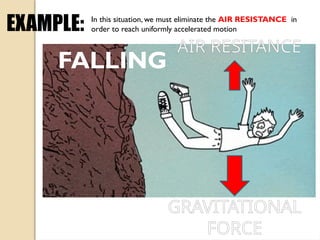
FALLING
AIR RESITANCE
GRAVITATIONAL
FORCE
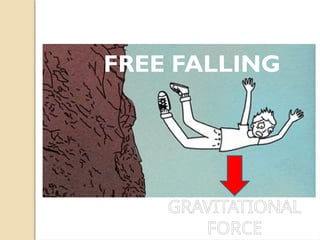
EXAMPLE: In this situation, we must eliminate the AIR RESISTANCE in
order to reach uniformly accelerated motion
FREE FALLING
GRAVITATIONAL
FORCE
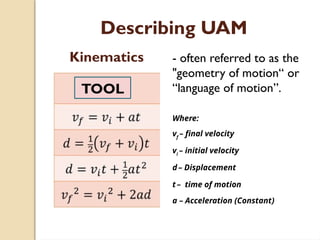
Describing UAM
Where:
vf
– final velocity
vi
– initial velocity
d – Displacement
t – time of motion
a – Acceleration (Constant)
TOOL
Kinematics - often referred to as the
"geometry of motion“ or
“language of motion”.
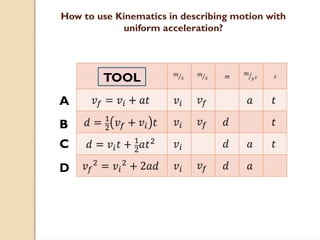
How to use Kinematics in describing motion with
uniform acceleration?
TOOL
A
B
C
D
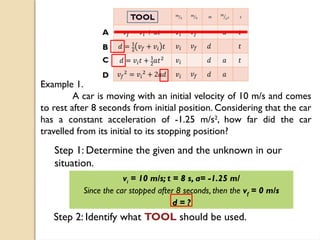
Example 1.
A car is moving with an initial velocity of 10 m/s and comes
to rest after 8 seconds from initial position. Considering that the car
has a constant acceleration of -1.25 m/s2
, how far did the car
travelled from its initial to its stopping position?
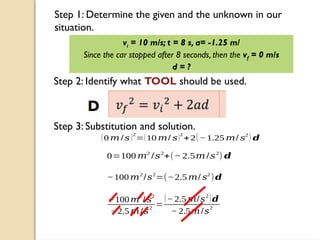
Step 1: Determine the given and the unknown in our
situation.
vi = 10 m/s; t = 8 s, a= -1.25 m/
Since the car stopped after 8 seconds, then the vf = 0 m/s
d = ?
Step 2: Identify what TOOL should be used.
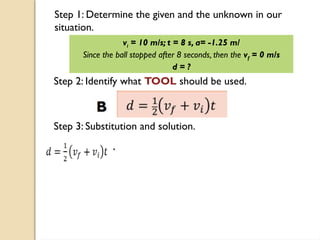
Step 1: Determine the given and the unknown in our
situation.
vi = 10 m/s; t = 8 s, a= -1.25 m/
Since the ball stopped after 8 seconds, then the vf = 0 m/s
d = ?
Step 2: Identify what TOOL should be used.
Step 3: Substitution and solution.
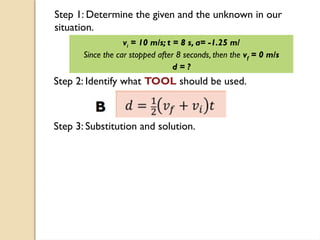
Step 1: Determine the given and the unknown in our
situation.
vi = 10 m/s; t = 8 s, a= -1.25 m/
Since the car stopped after 8 seconds, then the vf = 0 m/s
d = ?
Step 2: Identify what TOOL should be used.
Step 3: Substitution and solution.
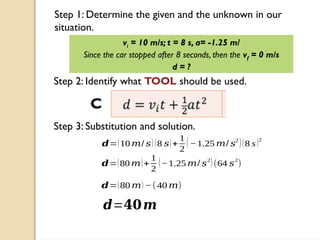
Step 1: Determine the given and the unknown in our
situation.
vi = 10 m/s; t = 8 s, a= -1.25 m/
Since the car stopped after 8 seconds, then the vf = 0 m/s
d = ?
Step 2: Identify what TOOL should be used.
Step 3: Substitution and solution.
𝒅=(10 𝑚/ 𝑠) (8 𝑠)+
1
2
(−1.25 𝑚/ 𝑠
2
)(8 s)2
𝒅=(80 𝑚)+
1
2
(−1.25 𝑚/ 𝑠
2
)(64 𝑠
2
)
𝒅=(80 𝑚) −(40 𝑚)
𝒅=𝟒𝟎𝒎
Step 1: Determine the given and the unknown in our
situation.
vi = 10 m/s; t = 8 s, a= -1.25 m/
Since the car stopped after 8 seconds, then the vf = 0 m/s
d = ?
Step 2: Identify what TOOL should be used.
Step 3: Substitution and solution.
(0 𝑚 /𝑠 )2
=(10 𝑚/ 𝑠)2
+2(−1.25 𝑚/ 𝑠
2
) 𝒅
0=100 𝑚2
/𝑠2
+(− 2.5𝑚 /𝑠2
) 𝒅
−100 𝑚2
/𝑠2
=(−2.5 𝑚/ 𝑠2
)𝒅
−100𝑚
2
/ 𝑠
2
−2.5𝑚/𝑠
2
=
(− 2.5𝑚/𝑠
2
)𝒅
− 2.5𝑚/𝑠
2
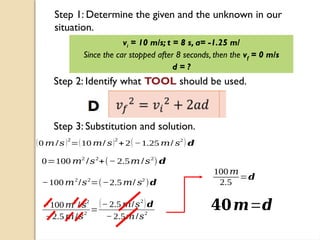
Step 1: Determine the given and the unknown in our
situation.
vi = 10 m/s; t = 8 s, a= -1.25 m/
Since the car stopped after 8 seconds, then the vf = 0 m/s
d = ?
Step 2: Identify what TOOL should be used.
Step 3: Substitution and solution.
(0 𝑚 /𝑠)2
=(10 𝑚/ 𝑠)2
+2(−1.25 𝑚/ 𝑠2
) 𝒅
0=100 𝑚2
/𝑠2
+(− 2.5𝑚/𝑠2
) 𝒅
−100 𝑚2
/𝑠2
=(−2.5𝑚/ 𝑠2
)𝒅
−100𝑚
2
/ 𝑠
2
−2.5𝑚/𝑠
2
=
(− 2.5𝑚/𝑠2
)𝒅
− 2.5𝑚/𝑠
2
100𝑚
2.5
=𝒅
𝟒𝟎𝒎=𝒅
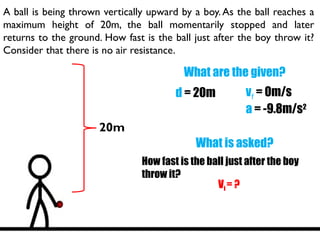
A ball is being thrown vertically upward by a boy.As the ball reaches a
maximum height of 20m, the ball momentarily stopped and later
returns to the ground. How fast is the ball just after the boy throw it?
Consider that there is no air resistance.
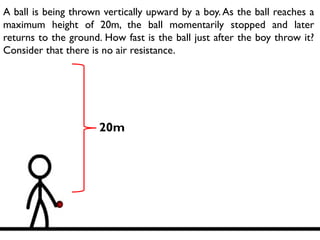
20m
A ball is being thrown vertically upward by a boy.As the ball reaches a
maximum height of 20m, the ball momentarily stopped and later
returns to the ground. How fast is the ball just after the boy throw it?
Consider that there is no air resistance.
A ball is being thrown vertically upward by a boy.As the ball reaches a
maximum height of 20m, the ball momentarily stopped and later
returns to the ground. How fast is the ball just after the boy throw it?
Consider that there is no air resistance.
What are the given?
d = 20m vf = 0m/s
a = -9.8m/s2
What is asked?
How fast is the ball just after the boy
throw it?
Vi = ?
20m
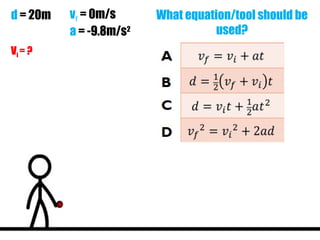
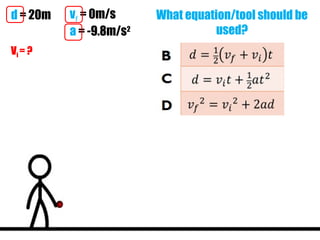
d = 20m vf = 0m/s
a = -9.8m/s2
Vi = ?
What equation/tool should be
used?
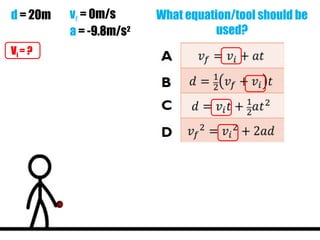
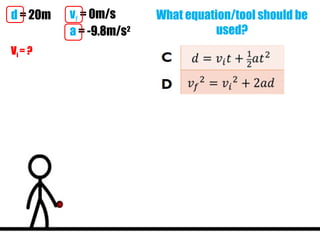
d = 20m vf = 0m/s
a = -9.8m/s2
Vi = ?
What equation/tool should be
used?
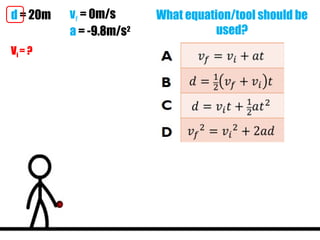
d = 20m vf = 0m/s
a = -9.8m/s2
Vi = ?
What equation/tool should be
used?
d = 20m vf = 0m/s
a = -9.8m/s2
Vi = ?
What equation/tool should be
used?
d = 20m vf = 0m/s
a = -9.8m/s2
Vi = ?
What equation/tool should be
used?
d = 20m vf = 0m/s
a = -9.8m/s2
Vi = ?
What equation/tool should be
used?
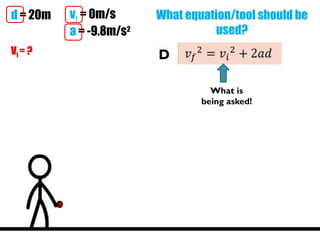
What is
being asked!
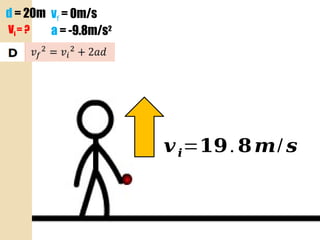
d = 20m vf = 0m/s
a = -9.8m/s2
Vi = ?
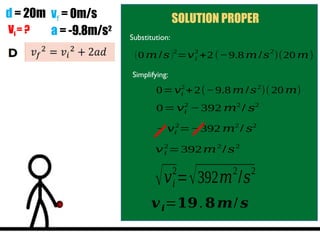
SOLUTION PROPER
Substitution:
(0 𝑚 /𝑠)2
=𝑣𝑖
2
+2 (−9.8 𝑚 /𝑠
2
)(20 𝑚)
Simplifying:
0=𝑣𝑖
2
+2(−9.8 𝑚/𝑠2
)(20 𝑚)
0=𝑣𝑖
2
−392 𝑚2
/ 𝑠2
− 𝑣𝑖
2
=−392 𝑚2
/ 𝑠2
𝑣𝑖
2
=392𝑚2
/𝑠2
√𝑣𝑖
2
=√392𝑚2
/𝑠2
𝒗𝒊=𝟏𝟗.𝟖𝒎/ 𝒔
d = 20m vf = 0m/s
a = -9.8m/s2
Vi = ?
𝒗𝒊=𝟏𝟗.𝟖𝒎/ 𝒔
Uniformly-Accelerated-Motion- GRADE 9 topic

Uniformly-Accelerated-Motion- GRADE 9 topic

  • 1.
  • 2.
    Uniformly Accelerated Motion Uniformly AcceleratedMotion (UAM) is motion of an object where the acceleration is constant. In other words, the acceleration remains uniform; the acceleration is equal to a number and that number does not change as a function of time.
  • 4.
    ACCELERATION  What doesit mean? Let’s say the car has an acceleration of .
  • 5.
    Time (s) 01 2 3 4 Velocity (m/s) Acceleration is the rate of change in velocity/speed. 0 4 8 12 16 This is an example of Uniformly Accelerated Motion +4 +4 +4 +4
  • 6.
    Base on thosevalues, the car speed/velocity increases by 4 units in every second. Thus, the acceleration is UNIFORM The car is uniformly accelerating at 4m/s2
  • 7.
    REVIEW. . .REVIEW. . . REVIEW. . .
  • 8.
    How can wedetermine the acceleration of motion? We need to determine the following quantities: 1.Velocity or Speed 2.Time of travel Acceleration (a) a With an S.I Unit of meters-per-second squared ()
  • 9.
    UNIFORMLY ACCELERATED MOTION ISCONSIDERED AN IDEALIZED MOTION. To achieve this, only one and NO other external forces should be affecting the motion
  • 10.
  • 11.
    FRICTION FORCE CAUSEDBY UNEVEN ROAD DRIVING A CAR FORCE FROM THE CAR ENGINE NON UNIFORMLY ACCELERATED MOTION
  • 12.
  • 13.
    How can weachieve uniformly accelerated motion? The force causing the motion should be the only force present in that situation.
  • 14.
    FALLING AIR RESITANCE GRAVITATIONAL FORCE EXAMPLE: Inthis situation, we must eliminate the AIR RESISTANCE in order to reach uniformly accelerated motion
  • 15.
  • 17.
    Describing UAM Where: vf – finalvelocity vi – initial velocity d – Displacement t – time of motion a – Acceleration (Constant) TOOL Kinematics - often referred to as the "geometry of motion“ or “language of motion”.
  • 18.
    How to useKinematics in describing motion with uniform acceleration? TOOL A B C D
  • 19.
    Example 1. A caris moving with an initial velocity of 10 m/s and comes to rest after 8 seconds from initial position. Considering that the car has a constant acceleration of -1.25 m/s2 , how far did the car travelled from its initial to its stopping position? Step 1: Determine the given and the unknown in our situation. vi = 10 m/s; t = 8 s, a= -1.25 m/ Since the car stopped after 8 seconds, then the vf = 0 m/s d = ? Step 2: Identify what TOOL should be used.
  • 20.
    Step 1: Determinethe given and the unknown in our situation. vi = 10 m/s; t = 8 s, a= -1.25 m/ Since the ball stopped after 8 seconds, then the vf = 0 m/s d = ? Step 2: Identify what TOOL should be used. Step 3: Substitution and solution.
  • 21.
    Step 1: Determinethe given and the unknown in our situation. vi = 10 m/s; t = 8 s, a= -1.25 m/ Since the car stopped after 8 seconds, then the vf = 0 m/s d = ? Step 2: Identify what TOOL should be used. Step 3: Substitution and solution.
  • 22.
    Step 1: Determinethe given and the unknown in our situation. vi = 10 m/s; t = 8 s, a= -1.25 m/ Since the car stopped after 8 seconds, then the vf = 0 m/s d = ? Step 2: Identify what TOOL should be used. Step 3: Substitution and solution. 𝒅=(10 𝑚/ 𝑠) (8 𝑠)+ 1 2 (−1.25 𝑚/ 𝑠 2 )(8 s)2 𝒅=(80 𝑚)+ 1 2 (−1.25 𝑚/ 𝑠 2 )(64 𝑠 2 ) 𝒅=(80 𝑚) −(40 𝑚) 𝒅=𝟒𝟎𝒎
  • 23.
    Step 1: Determinethe given and the unknown in our situation. vi = 10 m/s; t = 8 s, a= -1.25 m/ Since the car stopped after 8 seconds, then the vf = 0 m/s d = ? Step 2: Identify what TOOL should be used. Step 3: Substitution and solution. (0 𝑚 /𝑠 )2 =(10 𝑚/ 𝑠)2 +2(−1.25 𝑚/ 𝑠 2 ) 𝒅 0=100 𝑚2 /𝑠2 +(− 2.5𝑚 /𝑠2 ) 𝒅 −100 𝑚2 /𝑠2 =(−2.5 𝑚/ 𝑠2 )𝒅 −100𝑚 2 / 𝑠 2 −2.5𝑚/𝑠 2 = (− 2.5𝑚/𝑠 2 )𝒅 − 2.5𝑚/𝑠 2
  • 24.
    Step 1: Determinethe given and the unknown in our situation. vi = 10 m/s; t = 8 s, a= -1.25 m/ Since the car stopped after 8 seconds, then the vf = 0 m/s d = ? Step 2: Identify what TOOL should be used. Step 3: Substitution and solution. (0 𝑚 /𝑠)2 =(10 𝑚/ 𝑠)2 +2(−1.25 𝑚/ 𝑠2 ) 𝒅 0=100 𝑚2 /𝑠2 +(− 2.5𝑚/𝑠2 ) 𝒅 −100 𝑚2 /𝑠2 =(−2.5𝑚/ 𝑠2 )𝒅 −100𝑚 2 / 𝑠 2 −2.5𝑚/𝑠 2 = (− 2.5𝑚/𝑠2 )𝒅 − 2.5𝑚/𝑠 2 100𝑚 2.5 =𝒅 𝟒𝟎𝒎=𝒅
  • 26.
    A ball isbeing thrown vertically upward by a boy.As the ball reaches a maximum height of 20m, the ball momentarily stopped and later returns to the ground. How fast is the ball just after the boy throw it? Consider that there is no air resistance.
  • 27.
    20m A ball isbeing thrown vertically upward by a boy.As the ball reaches a maximum height of 20m, the ball momentarily stopped and later returns to the ground. How fast is the ball just after the boy throw it? Consider that there is no air resistance.
  • 28.
    A ball isbeing thrown vertically upward by a boy.As the ball reaches a maximum height of 20m, the ball momentarily stopped and later returns to the ground. How fast is the ball just after the boy throw it? Consider that there is no air resistance. What are the given? d = 20m vf = 0m/s a = -9.8m/s2 What is asked? How fast is the ball just after the boy throw it? Vi = ? 20m
  • 29.
    d = 20mvf = 0m/s a = -9.8m/s2 Vi = ? What equation/tool should be used?
  • 30.
    d = 20mvf = 0m/s a = -9.8m/s2 Vi = ? What equation/tool should be used?
  • 31.
    d = 20mvf = 0m/s a = -9.8m/s2 Vi = ? What equation/tool should be used?
  • 32.
    d = 20mvf = 0m/s a = -9.8m/s2 Vi = ? What equation/tool should be used?
  • 33.
    d = 20mvf = 0m/s a = -9.8m/s2 Vi = ? What equation/tool should be used?
  • 34.
    d = 20mvf = 0m/s a = -9.8m/s2 Vi = ? What equation/tool should be used? What is being asked!
  • 35.
    d = 20mvf = 0m/s a = -9.8m/s2 Vi = ? SOLUTION PROPER Substitution: (0 𝑚 /𝑠)2 =𝑣𝑖 2 +2 (−9.8 𝑚 /𝑠 2 )(20 𝑚) Simplifying: 0=𝑣𝑖 2 +2(−9.8 𝑚/𝑠2 )(20 𝑚) 0=𝑣𝑖 2 −392 𝑚2 / 𝑠2 − 𝑣𝑖 2 =−392 𝑚2 / 𝑠2 𝑣𝑖 2 =392𝑚2 /𝑠2 √𝑣𝑖 2 =√392𝑚2 /𝑠2 𝒗𝒊=𝟏𝟗.𝟖𝒎/ 𝒔
  • 36.
    d = 20mvf = 0m/s a = -9.8m/s2 Vi = ? 𝒗𝒊=𝟏𝟗.𝟖𝒎/ 𝒔