Engineering Measurement
Summer 2023/2024
Dr. Momen Qasaimeh
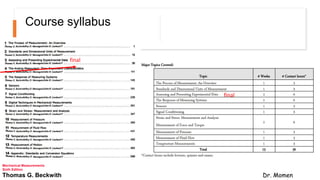
Course syllabus
Course syllabus
Mechanical Measurements
Sixth Edition
Thomas G. Beckwith Dr. Momen
Course syllabus
Mechanical Measurements
Sixth Edition
Thomas G. Beckwith Dr. Momen
Course syllabus
final
final
Mechanical Measurements
Sixth Edition
Thomas G. Beckwith Dr. Momen
Introduction
Objective: To introduce electronic instrumentation systems to make accurate and meaningful
measurements of Mechanical and Thermal quantities.
• Measurement provides quantitative information on the actual state of the physical variables and
processes that otherwise could only be estimated.
• Measurements can be performed using one of the following:
1. Mechanical systems: rarely used, simple, less accurate. e.g dial gauge.
2. Electrical systems: widely used, more accurate, and provide electrical
output signal. e.g. strain gauge, thermocouple.
Mechanical Measurements
Sixth Edition
Thomas G. Beckwith Dr. Momen
The Process of Measurement:
An Overview
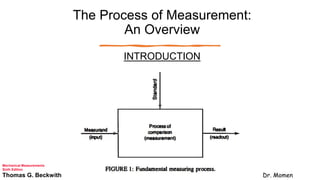
INTRODUCTION
Mechanical Measurements
Sixth Edition
Thomas G. Beckwith Dr. Momen
The Process of Measurement:
An Overview
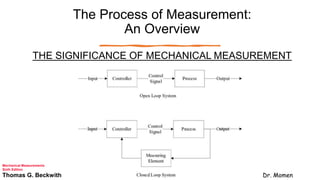
THE SIGNIFICANCE OF MECHANICAL MEASUREMENT
All mechanical design of any complexity involves three
elements:
experience, the rational element, and the experimental element.
• The experience is based on previous knowledge and on an
engineer's common sense.
• The rational element relies on quantitative engineering
principles.
• The experimental element is based on measurement.
Mechanical Measurements
Sixth Edition
Thomas G. Beckwith Dr. Momen
The Process of Measurement:
An Overview
THE SIGNIFICANCE OF MECHANICAL MEASUREMENT
Mechanical Measurements
Sixth Edition
Thomas G. Beckwith Dr. Momen
The Process of Measurement:
An Overview
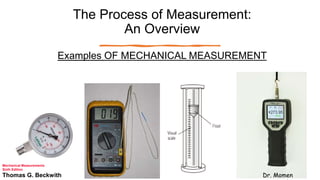
Examples OF MECHANICAL MEASUREMENT
Mechanical Measurements
Sixth Edition
Thomas G. Beckwith Dr. Momen
The Process of Measurement:
An Overview
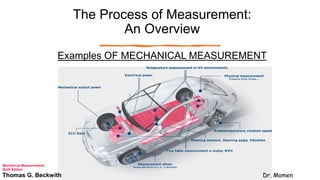
Examples OF MECHANICAL MEASUREMENT
Mechanical Measurements
Sixth Edition
Thomas G. Beckwith Dr. Momen
The Process of Measurement:
An Overview
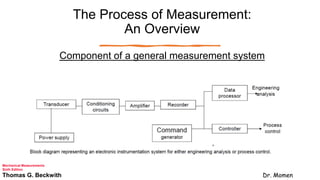
Component of a general measurement system
Mechanical Measurements
Sixth Edition
Thomas G. Beckwith Dr. Momen
The Process of Measurement:
An Overview
Sensor and transducer
A sensor detects a physical, chemical or biological quantity and converts the data it receives through this
detection into an electrical signal.
A transducer is an electronic device that converts energy from one form to another. Common examples
include microphones, loudspeakers, thermometers, position and pressure sensors, and antenna.
Mechanical Measurements
Sixth Edition
Thomas G. Beckwith Dr. Momen
The Process of Measurement:
An Overview
FUNDAMENTAL METHODS OF MEASUREMENT
• Direct comparison with either a primary or a secondary standard
• Indirect comparison through the use of a calibrated system.
Mechanical Measurements
Sixth Edition
Thomas G. Beckwith Dr. Momen
The Process of Measurement:
An Overview
THE GENERALIZED MEASURING SYSTEM
• Stage 1. A detection-transduction, or sensor-transducer, stage.
• Stage 2. An intermediate stage, which we shall call the signal-conditioning stage.
• Stage 3. A terminating, or readout-recording, stage.
Mechanical Measurements
Sixth Edition
Thomas G. Beckwith Dr. Momen
The Process of Measurement:
An Overview
THE GENERALIZED MEASURING SYSTEM
• Stage 1. A detection-transduction, or sensor-transducer, stage.
To detect or to sense the measurand. At the same time, this stage should be insensitive to every other
possible input.
Unwanted sensitivity is a measuring error, called noise when it varies rapidly and drift when it varies
very slowly.
Mechanical Measurements
Sixth Edition
Thomas G. Beckwith Dr. Momen
The Process of Measurement:
An Overview
THE GENERALIZED MEASURING SYSTEM
• Stage 2. An intermediate stage, which we shall call the signal-conditioning stage.
The purpose of the second stage of the general system is to modify the transduced information so that it is
acceptable to the third, or terminating, stage.
In addition, it may perform one or more basic operations, such as selective filtering to remove noise, integration,
differentiation or telemetering as may be required
Mechanical Measurements
Sixth Edition
Thomas G. Beckwith Dr. Momen
The Process of Measurement:
An Overview
THE GENERALIZED MEASURING SYSTEM
• Stage 3. A terminating, or readout-recording, stage.
Provides the information sought in a form comprehensible to one of the human senses or to a controller.
The output is presented in on of the following forms:
1. As a relative displacement.
2. In digital form
Mechanical Measurements
Sixth Edition
Thomas G. Beckwith Dr. Momen
The Process of Measurement:
An Overview
TYPES OF INPUT QUANTITIES
• Time Dependence:
1. Static: constant in time
2. Dynamic-varying in time
(a) Steady-state periodic
(b) Nonrepetitive or transient
i. Single pulse or aperiodic
ii. Continuing or random
• Analog and Digital Signals
Mechanical Measurements
Sixth Edition
Thomas G. Beckwith Dr. Momen
The Process of
Measurement:
An Overview
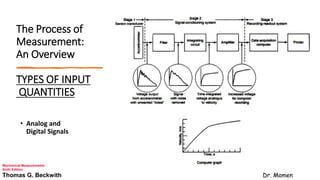
TYPES OF INPUT
QUANTITIES
• Analog and
Digital Signals
Mechanical Measurements
Sixth Edition
Thomas G. Beckwith Dr. Momen
The Process of Measurement:
An Overview
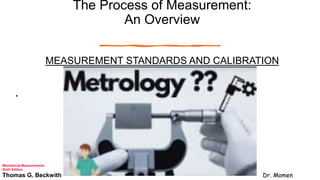
MEASUREMENT STANDARDS AND CALIBRATION
• measurement is a process of comparison.
• So, we must employ a basis of comparison-standardized units.
• At some point during the preparation of a measuring system, known magnitudes of the input quantity must be
fed into the sensor-transducer, and the system's output behavior· must be observed.
Mechanical Measurements
Sixth Edition
Thomas G. Beckwith Dr. Momen
The Process of Measurement:
An Overview
MEASUREMENT STANDARDS AND CALIBRATION
•
Mechanical Measurements
Sixth Edition
Thomas G. Beckwith Dr. Momen
The Process of Measurement:
An Overview
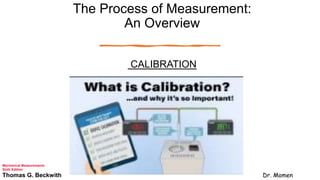
CALIBRATION
• Single-point calibration: output = constant x input
• Multipoint calibrations are used, wherein a number of different input values are applied.
• Dynamic calibration: made by using a time-dependent input standard.
• Static calibration, using a constant input signal.
Mechanical Measurements
Sixth Edition
Thomas G. Beckwith Dr. Momen
The Process of Measurement:
An Overview
CALIBRATION
Mechanical Measurements
Sixth Edition
Thomas G. Beckwith Dr. Momen
The Process of Measurement:
An Overview
Measurements, BIPM, SI, traceability, calibration and standards
Mechanical Measurements
Sixth Edition
Thomas G. Beckwith Dr. Momen
The End of Chapter 1

Engineering Measurement power point slides

  • 1.
  • 2.
  • 3.
    Course syllabus Mechanical Measurements SixthEdition Thomas G. Beckwith Dr. Momen
  • 4.
    Course syllabus Mechanical Measurements SixthEdition Thomas G. Beckwith Dr. Momen
  • 5.
  • 6.
    Introduction Objective: To introduceelectronic instrumentation systems to make accurate and meaningful measurements of Mechanical and Thermal quantities. • Measurement provides quantitative information on the actual state of the physical variables and processes that otherwise could only be estimated. • Measurements can be performed using one of the following: 1. Mechanical systems: rarely used, simple, less accurate. e.g dial gauge. 2. Electrical systems: widely used, more accurate, and provide electrical output signal. e.g. strain gauge, thermocouple. Mechanical Measurements Sixth Edition Thomas G. Beckwith Dr. Momen
  • 7.
    The Process ofMeasurement: An Overview INTRODUCTION Mechanical Measurements Sixth Edition Thomas G. Beckwith Dr. Momen
  • 8.
    The Process ofMeasurement: An Overview THE SIGNIFICANCE OF MECHANICAL MEASUREMENT All mechanical design of any complexity involves three elements: experience, the rational element, and the experimental element. • The experience is based on previous knowledge and on an engineer's common sense. • The rational element relies on quantitative engineering principles. • The experimental element is based on measurement. Mechanical Measurements Sixth Edition Thomas G. Beckwith Dr. Momen
  • 9.
    The Process ofMeasurement: An Overview THE SIGNIFICANCE OF MECHANICAL MEASUREMENT Mechanical Measurements Sixth Edition Thomas G. Beckwith Dr. Momen
  • 10.
    The Process ofMeasurement: An Overview Examples OF MECHANICAL MEASUREMENT Mechanical Measurements Sixth Edition Thomas G. Beckwith Dr. Momen
  • 11.
    The Process ofMeasurement: An Overview Examples OF MECHANICAL MEASUREMENT Mechanical Measurements Sixth Edition Thomas G. Beckwith Dr. Momen
  • 12.
    The Process ofMeasurement: An Overview Component of a general measurement system Mechanical Measurements Sixth Edition Thomas G. Beckwith Dr. Momen
  • 13.
    The Process ofMeasurement: An Overview Sensor and transducer A sensor detects a physical, chemical or biological quantity and converts the data it receives through this detection into an electrical signal. A transducer is an electronic device that converts energy from one form to another. Common examples include microphones, loudspeakers, thermometers, position and pressure sensors, and antenna. Mechanical Measurements Sixth Edition Thomas G. Beckwith Dr. Momen
  • 14.
    The Process ofMeasurement: An Overview FUNDAMENTAL METHODS OF MEASUREMENT • Direct comparison with either a primary or a secondary standard • Indirect comparison through the use of a calibrated system. Mechanical Measurements Sixth Edition Thomas G. Beckwith Dr. Momen
  • 15.
    The Process ofMeasurement: An Overview THE GENERALIZED MEASURING SYSTEM • Stage 1. A detection-transduction, or sensor-transducer, stage. • Stage 2. An intermediate stage, which we shall call the signal-conditioning stage. • Stage 3. A terminating, or readout-recording, stage. Mechanical Measurements Sixth Edition Thomas G. Beckwith Dr. Momen
  • 16.
    The Process ofMeasurement: An Overview THE GENERALIZED MEASURING SYSTEM • Stage 1. A detection-transduction, or sensor-transducer, stage. To detect or to sense the measurand. At the same time, this stage should be insensitive to every other possible input. Unwanted sensitivity is a measuring error, called noise when it varies rapidly and drift when it varies very slowly. Mechanical Measurements Sixth Edition Thomas G. Beckwith Dr. Momen
  • 17.
    The Process ofMeasurement: An Overview THE GENERALIZED MEASURING SYSTEM • Stage 2. An intermediate stage, which we shall call the signal-conditioning stage. The purpose of the second stage of the general system is to modify the transduced information so that it is acceptable to the third, or terminating, stage. In addition, it may perform one or more basic operations, such as selective filtering to remove noise, integration, differentiation or telemetering as may be required Mechanical Measurements Sixth Edition Thomas G. Beckwith Dr. Momen
  • 18.
    The Process ofMeasurement: An Overview THE GENERALIZED MEASURING SYSTEM • Stage 3. A terminating, or readout-recording, stage. Provides the information sought in a form comprehensible to one of the human senses or to a controller. The output is presented in on of the following forms: 1. As a relative displacement. 2. In digital form Mechanical Measurements Sixth Edition Thomas G. Beckwith Dr. Momen
  • 19.
    The Process ofMeasurement: An Overview TYPES OF INPUT QUANTITIES • Time Dependence: 1. Static: constant in time 2. Dynamic-varying in time (a) Steady-state periodic (b) Nonrepetitive or transient i. Single pulse or aperiodic ii. Continuing or random • Analog and Digital Signals Mechanical Measurements Sixth Edition Thomas G. Beckwith Dr. Momen
  • 20.
    The Process of Measurement: AnOverview TYPES OF INPUT QUANTITIES • Analog and Digital Signals Mechanical Measurements Sixth Edition Thomas G. Beckwith Dr. Momen
  • 21.
    The Process ofMeasurement: An Overview MEASUREMENT STANDARDS AND CALIBRATION • measurement is a process of comparison. • So, we must employ a basis of comparison-standardized units. • At some point during the preparation of a measuring system, known magnitudes of the input quantity must be fed into the sensor-transducer, and the system's output behavior· must be observed. Mechanical Measurements Sixth Edition Thomas G. Beckwith Dr. Momen
  • 22.
    The Process ofMeasurement: An Overview MEASUREMENT STANDARDS AND CALIBRATION • Mechanical Measurements Sixth Edition Thomas G. Beckwith Dr. Momen
  • 23.
    The Process ofMeasurement: An Overview CALIBRATION • Single-point calibration: output = constant x input • Multipoint calibrations are used, wherein a number of different input values are applied. • Dynamic calibration: made by using a time-dependent input standard. • Static calibration, using a constant input signal. Mechanical Measurements Sixth Edition Thomas G. Beckwith Dr. Momen
  • 24.
    The Process ofMeasurement: An Overview CALIBRATION Mechanical Measurements Sixth Edition Thomas G. Beckwith Dr. Momen
  • 25.
    The Process ofMeasurement: An Overview Measurements, BIPM, SI, traceability, calibration and standards Mechanical Measurements Sixth Edition Thomas G. Beckwith Dr. Momen
  • 26.
    The End ofChapter 1