Engineering Internet QoS1st Edition Sanjay Jha
pdf download
https://ebookfinal.com/download/engineering-internet-qos-1st-
edition-sanjay-jha/
Explore and download more ebooks or textbooks
at ebookfinal.com
2.
Here are somerecommended products for you. Click the link to
download, or explore more at ebookfinal
Recent Advances in Providing QoS and Reliability in the
Future Internet Backbone 1st Edition Ning Wang
https://ebookfinal.com/download/recent-advances-in-providing-qos-and-
reliability-in-the-future-internet-backbone-1st-edition-ning-wang/
Modern Public Economics 2nd Edition Raghbendra Jha
https://ebookfinal.com/download/modern-public-economics-2nd-edition-
raghbendra-jha/
Fundamentals of Parallel Computing 1st Edition Sanjay
Razdan
https://ebookfinal.com/download/fundamentals-of-parallel-
computing-1st-edition-sanjay-razdan/
Let Us Java 6th Edition Sanjay Jain
https://ebookfinal.com/download/let-us-java-6th-edition-sanjay-jain/
3.
Macroeconomics for DevelopingCountries 2nd Edition
Raghbendra Jha
https://ebookfinal.com/download/macroeconomics-for-developing-
countries-2nd-edition-raghbendra-jha/
Biodegradable Polymers Blends and Composites 1st Edition
Sanjay Mavinkere Rangappa (Editor)
https://ebookfinal.com/download/biodegradable-polymers-blends-and-
composites-1st-edition-sanjay-mavinkere-rangappa-editor/
Fight Fraud with Machine Learning MEAP V09 Ashish Ranjan
Jha
https://ebookfinal.com/download/fight-fraud-with-machine-learning-
meap-v09-ashish-ranjan-jha/
Preventing Hospital Infections Real World Problems
Realistic Solutions 1st Edition Sanjay Saint
https://ebookfinal.com/download/preventing-hospital-infections-real-
world-problems-realistic-solutions-1st-edition-sanjay-saint/
Construction Project Management Theory and Practices 2nd
Edition Kumar Neeraj Jha
https://ebookfinal.com/download/construction-project-management-
theory-and-practices-2nd-edition-kumar-neeraj-jha/
5.
Engineering Internet QoS1st Edition Sanjay Jha Digital
Instant Download
Author(s): Sanjay Jha, Mahbub Hassan
ISBN(s): 9781580535663, 1580535666
Edition: 1st
File Details: PDF, 1.91 MB
Year: 2002
Language: english
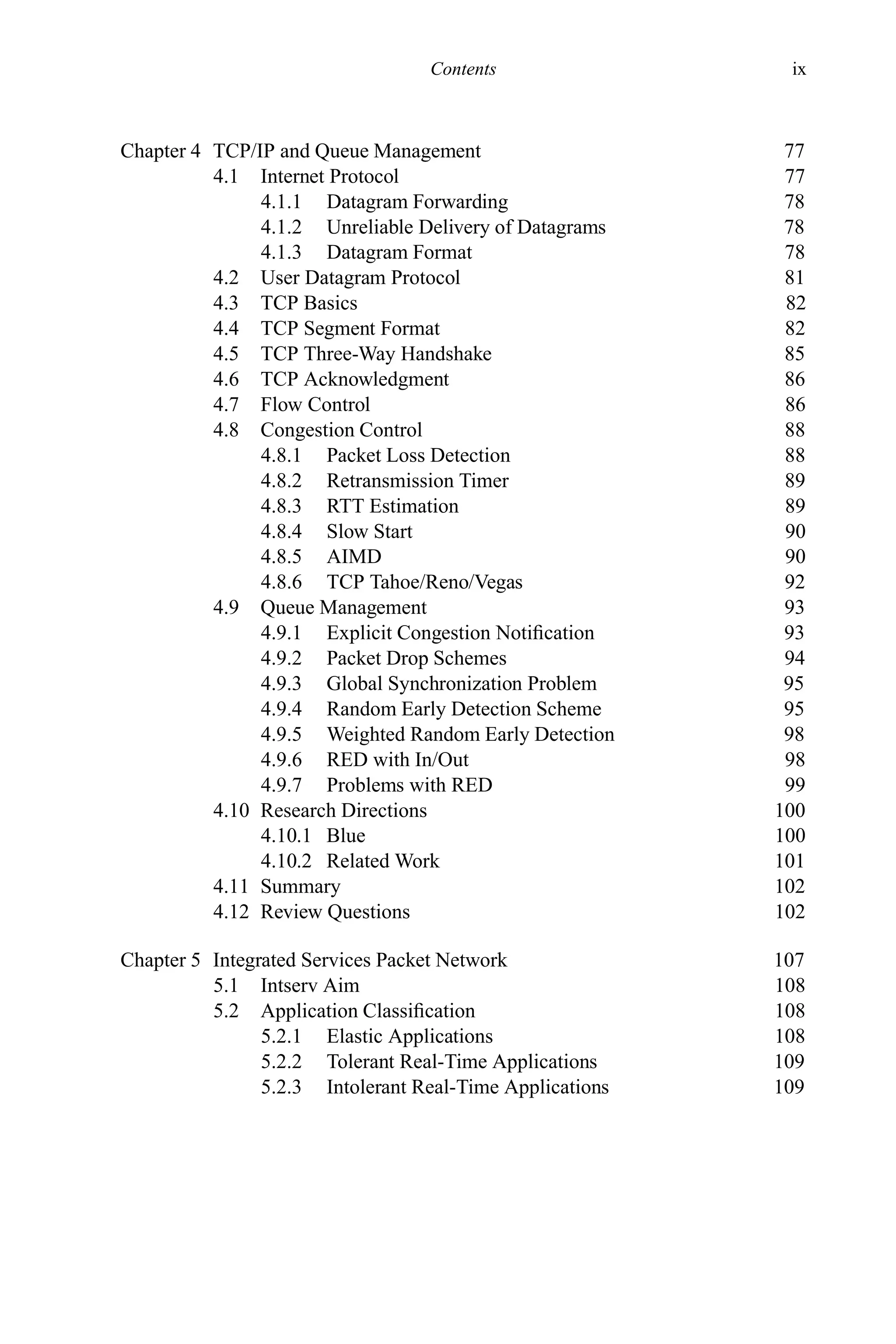
xiv Contents
11.2.1 WirelessLAN 271
11.2.2 Bluetooth 272
11.2.3 Cellular Networks 273
11.2.4 Comparison of Wireless Networks 274
11.3 Mobile Services over IP Networks 274
11.3.1 Mobile IP 274
11.3.2 Cellular IP 277
11.4 Impact of Mobility on QoS 278
11.4.1 Effect of Wireless Links 278
11.4.2 Effect of Movement 279
11.4.3 Limitations of Portable Devices 279
11.5 Managing QoS in Mobile Environments 280
11.5.1 Resource Reservation 280
11.5.2 Context-Aware Handoff 282
11.5.3 Application Adaptivity 282
11.6 Research Directions 283
11.7 Summary 287
11.8 Review Questions 287
Chapter 12Future 293
12.1 Intserv over Diffserv 293
12.1.1 Motivation 293
12.1.2 Generic Framework for Intserv over Diffserv 293
12.1.3 Guaranteed Service over EF PHB 295
12.1.4 Controlled Load over AF PHB 296
12.2 QoS Routing 297
12.3 Resource Discovery and QoS 297
12.4 Virtual Private Network and QoS 298
12.5 Content Distribution Network and QoS 299
12.6 Web QoS 300
12.7 Billing and Charging for QoS 301
12.8 Final Words 302
12.9 Summary 303
12.10Review Questions 303
About the Authors 307
Index 309
20.
Preface
Engineering Internet QoSaddresses the technical issues raised by the emergence of
new types, classes, and qualities of the Internet services. The international research
community has been working for the last decade on designing solutions to the QoS
problems in the Internet. The Internet Engineering Task Force (IETF) has issued
many standards recommending architectures and protocols to build a QoS support
infrastructure for the IP networks. The volume and pace of this QoS research
and development have demanded new textbooks on this topic. Although several
books on QoS have been published in the last few years, currently no text exists
that provides a single comprehensive source for the QoS concepts, architectures,
and algorithms. Most books cover the latest developments in IETF without going
into the depth of the fundamentals that is required to provide QoS. Readers are
required to consult several reference books to gain an in-depth understanding of the
fundamental concepts to build QoS in the Internet. This makes it difficult to adopt
any of these books as a text for a course on QoS.
We have written Engineering Internet QoS to provide a comprehensive source
of knowledge in the field. We have attempted to provide sufficient depth for the ma-
jor QoS concepts and architectures. Simulation results have been presented to help
understand some of the difficult concepts. The book has several Linux/FreeBSD–
based practical examples to illustrate how QoS testbeds can be set up for experi-
mentation and future research.
xv
21.
xvi Engineering InternetQoS
ASSUMED KNOWLEDGE
Readers would be required to have the basic knowledge of data communications
and TCP/IP protocols, with some exposure to IP routing.
AUDIENCE
The book is designed for use in a second course on networking with a prerequisite
of introductory networking or data communications. The name of the course can be
as specific as “QoS in the Internet.” The book can also be used in some existing
networking courses. Some of the possible courses for which the book can be
adopted include Advanced Computer Networks and High Performance Networks.
Graduate students will find the sections on “research direction” useful for their
literature survey in the respective fields.
Professionals working as network engineers, telecommunication and network
software developers, R&D managers, research scientists, and network administra-
tors will also find this book valuable to understanding the QoS issues and how to
implement, maintain, and deploy QoS technologies. QoS API and traffic control ex-
amples will help engineers learn how to configure a router/switch supporting QoS.
Since this book is partly based on the industry short courses the authors developed,
the book will be suitable for internal training in many telecommunication industries.
The trainees will find the knowledge acquired useful in creating new products or
setting new directions for their team.
ORGANIZATION
1. Introduction: We believe that it will be easier to understand the specific
architectures once the readers have absorbed the fundamental issues and
techniques. This chapter provides definition of the QoS problem and QoS
parameters and answers why QoS is an important problem. This is followed
by the issues in providing QoS in the Internet environment. Through an
example, we discuss issues related to providing end-to-end QoS for real-time
multimedia communications over the Internet. End system as well as network
issues are discussed. The standard protocol real-time transport protocol (RTP)
and RTCP are also discussed, with examples of how they provide features
for supporting adaptive feedback as well as jitter calculation. Readers not
familiar with the QoS area will find this chapter interesting.
22.
Preface xvii
2. QoSFundamentals: In order to understand various architectures for QoS
provisioning in the Internet, it is important to understand the fundamental
algorithms/techniques behind these architectures. This chapter provides an
overview of the fundamental issues such as traffic specification and nego-
tiation, admission control, resource reservation, scheduling, and congestion
control. A detailed treatment to shaping and policing has been provided in this
chapter. Highly technical details of scheduling, congestion control, and buffer
management as well as resource reservation are provided in later chapters.
Readers familiar with these basic concepts may find the specialized chapters
more useful.
3. Scheduling for QoS Management: Packet scheduling is an important build-
ing block for any QoS network. This chapter provides an in-depth treatment
of this topic. A variety of schedulers including FCFS, priority round robin,
fair queuing, and its variants are discussed in details with examples of how
they could meet the delay and bandwith requirements of flows. There is an
overview of several advanced schedulers, and current research issues are de-
scribed. We recommend this chapter to both novice and advanced readers.
4. TCP/IP and Queue Management: This chapter provides a brief refresher on
TCP and IP protocols. Another objective of this section is to provide readers
with background on how the congestion control problem is currently solved
in the best-effort Internet. Authors have included this material to minimize
cross–referencing to other books where possible. Readers familiar with these
concepts may skip this section. The later part of this chapter deals with
queue management techniques used in best effort as well as QoS-capable
networks. Algorithms, such as RED/RIO, wRED, and Blue are discussed in
detail. An overview of current research issues relating to queue management
is described in this chapter.
5. Integrated Services Packet Network: One of the earliest architectures for
QoS support within IETF is the integrated services (Intserv) model. This
chapter starts with classification and requirements of applications, followed
by description of various components of the Intserv model. Components of
an Intserv capable router are described in detail. QoS support issues in the
LAN environment as well as Intserv mapping of LAN QoS are also covered
in this chapter.
6. Resource Reservation Protocol: Although flow setup has been discussed
briefly in the context of Intserv, a separate chapter has been dedicated to the
23.
xviii Engineering InternetQoS
resource reservation protocol (RSVP). This chapter covers details of RSVP
protocol design and demonstrates its usefulness in the Intserv environment
through examples and simulation. Resource reservation protocol is an active
research area. This chapter will help researchers and implementors learn
the issues involved in designing any new resource reservation protocol. An
overview of various RSVP extensions and related research is also provided in
this chapter.
7. IP Differentiated Services Network: This chapter describes the Diffserv
architecture and its various elements. We also describe components of a
Diffserv router. Premium and assured service are described in detail with
experimental evaluation of premium service using Linux testbed. The chapter
concludes with Diffserv problems and new research development such as per-
domain behavior.
8. Policy–Based QoS Management: Policy-based QoS management is emerg-
ing as a strong research and development area for next generation Internet. We
discuss resource allocation protocol (RAP) framework. Bandwidth broker is
considered to be the oracle that has a global view of resources within a Diff-
serv domain. This chapter also describes the intra- and interdomain protocols
used in the Internet along with the Internet2 and Qbone architectures.
9. ATM QoS: ATM network was designed to support QoS from the start.
Currently many carriers have deployed ATM switches in their backbone
network. This chapter provides an overview of ATM technology as well as
the IP/ATM integration issues. This background is essential for understanding
the next chapter on MPLS. However, readers familiar with ATM network may
skip this chapter.
10. Multiprotocol Label Switching: Multiprotocol label switching has been a
popular topic for developers and researchers in the QoS area. This chapter
begins with the motivation behind developing this new technology. A detailed
description of the MPLS protocol, label distribution protocol, and issues
related to MPLS over ATM network is provided. Finally we discuss the
traffic engineering issues, with some examples of traffic trunking in MPLS
networks.
11. QoS in Mobile Wireless Networks: Mobile wireless technology has experi-
enced the same level of growth as the Internet. A vast topic like this deserves
a separate book. We start with discussion of applications and their QoS re-
quirments in the wireless Internet. We also provide a high-level overview of
24.
Preface xix
measures currentlybeing proposed to address the QoS issue in the wireless
Internet.
12. Future: Besides the various architectures discussed in this book, several new
architectures are evolving in the Internet. It is impossible to cover all these
new developments in a single book. We start this chapter with a detailed
discussion of Intserv over Diffserv followed by an overview of QoS routing,
VPN and QoS, content distribution network, as well as billing and charging
for QoS. Each of these sections provides a list of key references for further
reading.
Each chapter provides a section on either future research directions or latest devel-
opments in the area. Readers keen to explore the areas further will find these sec-
tions and references very useful. We have structured chapters in a way that readers
absorb basic concepts before jumping into architectural issues. Each chapter is self-
contained. We have repeated some concepts briefly in a few chapters to make them
self-contained, providing forward/backward reference for details. This facilitates
readers to carry on with the current chapter without breaking their continuity.
ON-LINE SUPPORT
On-line support material for each chapter and presentation foils (for adopters of the
text only) will be available from the following URL:
http://www.cse.unsw.edu.au/qosbook
https://hhp.bvdep.com/artechhouse
/Default.Asp?Frame=Book.Asp&Book=1-58053-341-8
ACKNOWLEDGMENTS
First of all we would like to express our gratitude to the anyonymous reviewer for
the extensive reviews of the chapters and the comments on the book’s organization.
A number of other people helped with this book. Some part of this book came
from our joint work with Professor Raj Jain from Ohio State University. Muneyb
Minhazuddin from Avaya Communications provided helpful suggestions on Diff-
serv. Professor William Atwood from Concordia University provided suggestions
25.
xx Engineering InternetQoS
on various aspects of this book. Our graduate students William Lau, Jahan Hassan,
Alfandika, and Monir Hossain, read some of the chapter drafts. Jim Wu provided
graphics for the Diffserv chapter. Abdul Aziz Mustafa helped with the NS simula-
tion setup. Matt Chalmers and Shaleeza Sohail provided references for billing and
charging as well as policy-based management sections. Filip Rosenbaum provided
experimental results for MPLS and helped with Linux TC examples. This book has
been influenced by authors of books, articles, and RFCs provided in the refence list
after each chapter. The MPLS chapter has been influenced by Bruce Davie’s MPLS
tutorial in Globecom’98.
We are indebted to our employer, the University of New South Wales, and
our head of school, Professor Arun Sharma, for their flexibity and encouragement,
which enabled us to write this book. We acknowledge Mark Walsh, Barbara Loven-
virth, Judi Stone, Jen Kelland, Susanne Schott and others at Artech House Publish-
ers for their wonderful support. Geoff Oakley helped with Latex formatting. Finally,
we extend our gratitude to our families for their continual support throughout the
entire project.
Sanjay Jha
Mahbub Hassan
July 2002
perfection. This modeconsists in opposing one or both hands
towards the patient. The examiner should sit or stand in an easy
position, cautiously avoiding all pressure on his body or arms, lest he
should suspect the impressions to proceed from that cause rather
than from the disease. He should fix on some particular part of the
patient, external or internal; then turning the backs of his hands, he
must vigorously and steadily command the emanations and
atmosphere which pass from that part to strike his hands, and he
must closely attend to whatever impressions are produced on them.
He must not permit his attention to wander from the object: if he
should, his labour is entirely lost. To render the process more steady,
the eyes of the examiner should be fixed on the part to which he is
attending, with the unvaried intent of directing the effluent atoms
towards his hands; it might naturally be supposed that his eyes
should be open, but is better they were shut, as all extraneous
objects are by that means excluded, and the porosity of the eyelids
removes the idea of impediment. It is perfectly immaterial what may
be the distance between the examiner and the patient: the process
and the impressions will be exactly the same, provided he calls forth
in himself the requisite exertion.
The second mode of examination is by opposing the whole body
to that of the patient. In this the operator must not seek to know
where the patient is, but recollecting that all human beings are
connected to each other by innumerable atmospherical nerves, and
that the whole medium in which they are placed is composed of
loose atoms, he must fix his attention upon the patient, as if he
stood before him. Thus situated, he must vigorously exert his power
to attract all the emanations and atmospheres proceeding from the
patient to himself. The atoms, then, which proceed from each
particular part of the patient run to the same parts of the examiner,
who feels in every part of his own person whatever the patient feels
in his, only in a less degree, but always sufficiently to enable him to
describe the feelings of the patient, and to ascertain the very spot in
which the derangement exists, and the consequences resulting from
it. If the examiner's attention is directed only to one particular
28.
viscus, that sameviscus alone will receive information in himself; but
if it be generally directed, every part of his body will give an account
of its own proceedings. It is to be remarked that undiseased parts
will not convey any remarkable impression to the examiner, as
nothing results from health but gentle, soft, equable heat.
The mode of healing is termed Treating;—it is a process made use
of by the operator to create, if partially obliterated, or to increase, if
become languid, the natural action and re-action in any part of the
body; and to assist nature by imitating and re-establishing her own
law, when she is become inadequate to the task. This process is the
opposite to the last; in that the examiner attracted the atoms from
the patient to himself, but in this he must propel the atoms from
himself to the patient. By a steady exertion of compound volition we
have it in our power to propel the particles which emanate from our
own body, against and into whatever part of any other form we fix
our intention upon, and can force them in any direction and to any
distance. Thus, by a continual and regular succession of particles
directed vigorously in a rapid stream against those atoms which are
stopt in their passage and accumulated into a heap, we break down
the impediments, push off those atoms which we detach, direct
them into the circulating currents for evacuation, and save the
system from all the evil consequences which its impeded functions
were occasioning. This is like throwing handfuls of shot at a heap of
sand in a rivulet, which, as the grains of sand are separated from
each other, washes them along before it. As all obstructions are not
equally hard or compact, they are not all destroyed with the same
facility. A single look will often prove sufficient for a recent
accumulation of particles, for an accidental contraction, or a sudden
distention, whereas those of long standing and of a more serious
nature demand frequent, long, and judiciously-varied treatment.
The general process of treatment is an influence of mind over
organized matter, in which unorganized matter is the occasional
instrument. The mind should be able to perform this work without
any particular motions of the body, or of its extremities. But, says
the professor, inexperience, and the frequent disturbances which
29.
occur to divertthe attention, induce us to adopt some mode of
action, the constant repetition of which may attract, rouse, or recall
the mind to its subject, when it becomes languid, or diverted from
its employment. Hence, he adds, we generally employ our hands in
the act of treating, and write, as it were, our various intentions on
each part by the motions we make towards it: or, in fact, we trace
on the diseased part with our current of emanations the various
curative intentions of our mind or spirit.
The Pathology is soon explained. The impressions produced upon
the fingers of the examiner by the stone will be heaviness,
indolence, and cold. Burns and scalds produce heavy dull pricking at
first, when inflammation has taken place great heat and sharp
pricking, but indolent numbness from the centre. Rheumatic
headache occasions pricking, numbness, and creeping or vermicular
motion, heat if the patient be strong, cold if he be relaxed.
Inflammation caused by confined wind produces intense heat,
pricking and creeping; the heat is occasioned by the inflammation,
the pricking by the wind acting against the obstructed pores, and
the creeping by the motion of the wind from one part to another.
Pus communicates to the hand of the examiner such a feeling of
softness as we should expect from dipping the hand in it, but
combined with pricking from the motion which the wind contained in
it makes in its endeavours to escape. Diseased lungs make the
fingers feel as if dough had been permitted to dry on them, this is
called clumsy stiffness. Pleurisy occasions creeping, heat and
pricking; deafness, resistance and numbness. Contracted nerves
announce themselves to the examiner by a pressure round his
fingers, as if a string was tightly bound round them; cases of relaxed
habit by a lengthened debilitated sensation; diseased spleen, or
ovaries, by a spinning in the fingers' ends, as if something were
twirling about in them. The impression which scrofula produces upon
the practitioner is curious and extraordinary: at every motion which
he makes, the joints of his fingers, wrists, elbows, and shoulders
crack. Worms excite creeping and pinching; bruises, heaviness in the
hands, and numbness of the fingers.
30.
The Modus Operandimust now be exemplified, premising,
according to the professor's words, that the operator's own
emanations become for him invisible fingers, which penetrate the
pores, and are to be considered as the natural and only ingredients
which are or can be adapted to the removal of nervous, or of any
other affections of the body.
Instead therefore of lithotomy, the stone may thus be cured
without danger or pain. This invisible power must be applied to the
juices which circulate in the vicinity of the stone: and they must be
conducted to the stone and applied to its surface, that the stone
may be soaked in them for the purpose of dissolving the gum which
makes the particles of sand cohere. If the hands are employed in
this process, the mind must conceive that the streams of atoms
which continually rush forth from the fingers, are continued on, and
lengthened out into long invisible fingers which become
continuations of our natural ones; and which, being composed of
minute particles, are perfectly adapted to pass through the pores of
another form, and to be applied, as we should apply our visible
fingers, to the very part on which it is intended to act. The last
process is Action: by striking those very emanating particles that
constitute that invisible elongation of the part of our own body which
it is intended to employ, whether it be the hand, the eye, or any
other part,—by striking them forcibly in constant and rapid
succession against the stone, the particles of sand, having been
rendered less tenacious by the soaking, loosen, and fall apart, and
are washed out of the body by the natural evacuation.
One instance more will suffice. In cases of indigestion the
sensations produced by the ropy humour in the stomach are a thick
gummy feel on the fingers; and when they are gently moved they
meet with a slight degree of resistance. To judge of the depth of this
slimy humour the fingers must be perpendicularly dipt in it to the
bottom of the stomach; the consequence will be the impression of a
circular line as if a string surrounded each finger, marking the depth
to which they had sunk. Now to remove this derangement, the coat
31.
of the stomachmust be cleared, which is done by the invisible
fingers scraping all the internal surface.
You have here the whole sum and substance of a secret for which
a hundred guineas were originally paid by aspirants, and which was
afterwards published at five guineas by subscription. The list of
subscribers contains the names of some nobles and of one bishop;
but it is short, and for that reason I suppose the second and third
parts, which were to contain new systems of anatomy and
midwifery, as improved by this new science, were never published.
It follows incontrovertibly from the principles which have been
advanced, that as the practitioners in this art heal diseases, so they
can communicate them; that they can give the itch by shaking with
invisible hands, and send a fit of the gout to any person whom they
are disposed to oblige. The Indian jongleurs, who, like these English
impostors, affect to feel the same pain as the patient, lay claim to
this power; but it did not answer the purposes of imposture here to
pretend to a power of doing mischief.
[18] Read it; for it will cost you less to read it than it did me
to write it.—Tr.
33.
LETTER LII.
Blasphemous Conclusionof Mainauduc's Lectures.—The Effects
which he produced explained.—Disappearance of the Imposture.
The conclusion of the extraordinary book from whence I have
condensed the summary of this prodigious quackery, is even more
extraordinary and more daring than the quackery itself. It may be
transcribed without offence to religion, for every catholic will regard
its atrocious impiety with due abhorrence.
"I flatter myself," says this man at the close of his lectures, "you
are now convinced that this science is of too exalted a nature to be
trifled with or despised; and I fondly hope that even the superficial
specimen which you have thus far received has given you room to
suppose it, not a human device, held out for the sportive
gratification of the idle moment, but a divine call from the
affectionate creating Parent, inviting his rebellious children by every
persuasive, by every tender motive, to renounce the destructive
allurements of earthly influence, and to perform the duties which he
sent his beloved Son into the world to inculcate, as the only and
effectual conditions on which the deluded spirit in man should
escape future punishment. The apostles received and accepted of
those terms; disciples out of number embraced the doctrine, and by
example, by discourse, and by cures, influenced the minds of the
unthinking multitude, absorbed in sin, and rioting in obstinate
disobedience.—Again, the Almighty Father deigns to rouse his
children from that indifference to their impending fate, into which
the watchful enemy omits no opportunity of enticing them. To lead
our Saviour from his duty, the tempter showed and offered him all
this world's grandeur;—so he daily in some degree does to us. Our
Saviour spurned him with contempt, and so must we. Our blessed
Saviour, whose spirit was a stranger to sin, cured by perfect spiritual
and physical innocence, and by an uninterrupted dependence on his
34.
Great, Omnipotent, SpiritualFather. He never failed. His chosen
apostles cured by relinquishing this world and following him. We
have but one example, that I can recollect, of their having failed,
and then Christ told them what was necessary to ensure success.
The disciples and the followers of the apostles performed many
cures, but how far they were checquered by failures I am not
informed. Paracelsus, Sir Kenelm Digby, Sir Robert Fludd, and several
others, experienced sufficient power in themselves to verify the
words of our Saviour; but were soon deprived of what was only lent
to urge them to seek for the great original cause. "Verily, verily," said
Christ, "the works which I do shall ye do also; and greater works
than these shall ye do, for I go unto my father." Valentine
Greatrakes, by obeying the instructions imparted to him in visions,
performed many cures; but ceasing to look up to the source, and
giving way to medical importunity, he administered drugs, and could
not expect success. Gasner, a moral and religious man, performed
many cures; he was shut up in a convent, through the ignorance of
his superiors, and the superstitious blindness of the age he lived in;
thence his progress was trivial, though his dawnings seemed to
promise much. Mesmer pillaged the subject from Sir Robert Fludd,
and found to a certainty the existence of the power: undisposed to
attend to our Saviour's information, he preferred loadstones and
magnetic ideas to the service of the Great Author; and after
performing several accidental cures, his magnetism and his errors
shared the fate of his predecessors. Doctor D'Eslon, his partner,
though a man of strong reason and impartiality, ascribed the power
which he experienced to the physical will of man; and after
performing some cures, he fell asleep. At length, after so many
centuries of ignorance, it has graciously pleased the Almighty Father
to draw aside the veil, and disclose his sacred mysteries to this
favoured generation. And when I shall be called home, it will, I
hope, appear, that for a bright and happy certainty of serving my
God, and living with my Saviour, I pointed out to you, my brethren,
the Almighty's real science, and that path to Heaven, which Christ,
35.
the only perfectand successful one of this list, left to mankind, as
his last testament, and inestimable dying gift."[19]
This portentous blasphemy shows to what excess any kind of
impiety may be carried on in this country, provided it does not
appear as a direct attack upon religion. So infamous an impostor
would in our country quickly have been silenced by the Holy Office,
or, to speak more truly, the salutary dread of the Holy Office would
have restrained him within decent bounds. Was he pure rogue
undiluted with any mixture of enthusiasm, or did he, contrary to the
ordinary process, begin in rogue, and end in enthusiast?
It is a common observation, that a man may tell a story of his own
invention so often that he verily believes it himself at last. There is
more than this in the present case. Mainauduc pretended to possess
an extraordinary power over the bodily functions of others: it was
easy to hire patients at first who would act as he prescribed, and
much was to be expected afterwards from credulity; but that it
should prove that he actually did possess this power in as great a
degree as he ever pretended, over persons not in collusion with him,
nor prepared to be affected by their previous belief, but
unprejudiced, incredulous, reasonable people, philosophical
observers who went to examine and detect the imposition, in sound
health of body and mind, was more than he expected, and perhaps
more than he could explain. This actually was the case; they who
went to hear him with a firm and rational disbelief, expecting to be
amused by the folly of his patients, were themselves thrown into
what is called the crisis: his steady looks and continued
gesticulations arrested their attention, made them dizzy, deranged
the ordinary functions of the system, and fairly deprived them for a
time of all voluntary power, and all perception.
How dangerous a power this was, and to what detestable
purposes it might be applied, need not be explained. The solution is
easy and convincing, but it by no means follows that he himself
comprehended it. If we direct our attention to the involuntary
operations of life within us, they are immediately deranged. Think
36.
for a minuteupon the palpitation of the heart, endeavour to feel the
peristaltic motion, or breathe by an act of volition, and you disturb
those actions which the life within us carries on unerringly, and as
far as we can perceive unconsciously. Any person may make the
experiment, and satisfy himself. The animal magnetists kept up this
unnatural state of attention long enough by their treatment to
produce a suspension of these involuntary motions, and consequent
insensibility.
In a country like this, where the government has no discretionary
power of interfering, to punish villany, and of course where
whosoever can invent a new roguery may practise it with impunity,
till a new law be made to render it criminal, Mainauduc might have
gone on triumphantly, and have made himself the head of a sect, or
even a religion, had the times been favourable. But politics
interfered, and took off the attention of all the wilder and busier
spirits. He died, and left a woman to succeed him in the chair. The
female caliph either wanted ability to keep the believers together, or
having made a fortune thought it best to retire from trade. So the
school was broken up. Happily for some of the disciples, who could
not exist without a constant supply of new miracles to feed their
credulity, Richard Brothers appeared, who laid higher claims than
Mainauduc, and promised more wonderful things. But of him
hereafter.
[19] The translator thought the daring impiety of this whole
extract so truly extraordinary, that he determined to seek for it
in the original work, instead of re-translating it from D.
Manuel's Spanish. With much difficulty he succeeded in finding
the book: it is a large thin quarto volume, printed in 1798, with
a portrait of Mainauduc from a picture by Cosway. From this the
technical language of the summary has been corrected, and
the exact words of this extract copied, so that the reader may
rely upon their perfect accuracy.—Tr.
38.
LETTER LIII.
Methodists.—Wesley andWhitfield.—Different Methods of attacking
the Establishment.—Tithes.—Methodism approaches Popery, and
paves the Way for it.—William Huntingdon, S. S.
In the year 1729 a great rent was made in the ragged robe of
heresy. Wesley and Whitfield were the Luther and Calvin of this
schism, which will probably, at no very remote time, end in the
overthrow of the Established Heretical Church.
They began when young men at Oxford by collecting together a
few persons who were of serious dispositions like themselves,
meeting together in prayer, visiting the prisoners, and
communicating whenever the sacrament was administered. Both
took orders in the Establishment, and for awhile differed only from
their brethren by preaching with more zeal. But they soon outwent
them in heresy also, and began to preach of the inefficacy and
worthlessness of good works, and of the necessity of being born
again, a doctrine which they perverted into the wildest enthusiasm.
The new birth they affirmed was to take place instantaneously, and
to be accompanied with an assurance of salvation; but throes and
agonies worse than death were to precede it. The effect which they
produced by such a doctrine, being both men of burning fanaticism,
and of that kind of eloquence which suited their hearers, is
wonderful. They had no sooner convinced their believers of the
necessity of this new birth, than instances enough took place. The
people were seized with demoniacal convulsions; shrieks and yells
were set up by frantic women; men fell as if shot through the heart;
and after hours of such sufferings and contortions as required the
immediate aid either of the exorcist or the beadle, they became
assured that they were born again, and fully certain that their
redemption was now sealed.
39.
There may havebeen some trick in these exhibitions, but that in
the main there was no wilful deception is beyond a doubt. Duæ res,
says St Augustine, faciunt in homine omnia peccata, timor scilicet et
cupiditas: timor facit fugere omnia quæ sunt carni molesta; cupiditas
facit habere omnia quæ sunt carni suavia. These powerful passions
were excited in the most powerful degree. They terrified their
hearers as children are terrified by tales of apparitions, and the
difference of effect was according to the difference of the dose, just
as the drunkenness produced by brandy is more furious than that
which is produced by wine. All those affections which are half-
mental, half-bodily, are contagious;—yawning, for instance, is
always, and laughter frequently so. When one person was thus
violently affected, it was like jarring a string in a room full of musical
instruments. The history of all opinions evinces that there are
epidemics of the mind.
Such scenes could not be tolerated in the churches. They then
took to the streets and fields, to the utter astonishment of the
English clergy, who in their ignorance cried out against this as a
novelty. Had these men, happily for themselves, been born in a
catholic country, it is most probable that they might indeed have
been burning and shining lights. Their zeal, their talents, and their
intrepid and indefatigable ardour, might have made them saints
instead of heresiarchs, had they submitted themselves to the
unerring rule of faith, instead of blindly trusting to their own
perverted judgments. It was of such men, and of such errors, that
St Leo the Great said: In hanc insipientiam cadunt, qui cum ad
cognoscendam veritatem aliquo impediuntur obscuro, non ad
Propheticas voces, non ad Apostolicas literas, nec ad Evangelicas
auctoritates, sed ad semetipsos recurrunt; sed ideo magistri erroris
existunt, quia veritatis discipuli non fuere.
Thousands and tens of thousands flocked to hear them; and the
more they were opposed the more rapidly their converts increased.
Riots were raised against them in many places, which were
frequently abetted by the magistrates. There is a good anecdote
recorded of the mayor of Tiverton, who was advised to follow
40.
Gamaliel's advice, andleave the Methodists (as they are called) and
their religion to themselves. "What, sir!" said he: "Why, what reason
can there be for any new religion in Tiverton? another way of going
to Heaven when there are so many already? Why, sir, there's the Old
Church and the New Church, that's one religion; there's Parson
Kiddell's at the Pitt Meeting, that's two; Parson Westcott's in Peter
Street, that's three; and old Parson Terry's in Newport Street, is four.
—Four ways of going to Heaven already!—and if they won't go to
Heaven by one or other of these ways, by —
— they sha'n't go to
Heaven at all from Tiverton, while I am mayor of the town."—The
outrages of the mob became at length so violent that the sufferers
appealed to the laws for protection, and from that time they have
remained unmolested.
The two leaders did not long agree. Wesley had deliberately
asserted, that no good works can be done before justification, none
which have not in them the nature of sin,—the abominable doctrine
which the Bonzes of Japan preach in honour of their deity Amida!
Whitfield added to this the predestinarian heresy, at once the most
absurd and most blasphemous that ever human presumption has
devised. The Methodists divided under these leaders into the two
parties of Arminians and Calvinists. Both parties protested against
separating from the Church, though they were excluded from the
churches. Wesley however, who was the more ambitious of the two,
succeeded in establishing a new church government, of which he
was the heretical pope. There was no difficulty in obtaining
assistants; he admitted lay preachers, and latterly administered
ordination himself. The œconomy of his church is well constructed.
He had felt how greatly the people are influenced by novelty, and
thus experimentally discovered one of the causes why the
Established clergy produced so little effect. His preachers, therefore,
are never to remain long in one place. A double purpose is answered
by this; a perpetual succession of preachers keeps up that stimulus
without which the people would relapse into conformity, and the
preachers themselves are prevented from obtaining in any place that
settled and rooted influence which would enable them to declare
41.
themselves independent ofWesley's Connection (as the sect is
called), and open shop for themselves. An hundred of these
itinerants compose the Conference, which is an annual assembly, the
cortes or council of these heretics, or, like our national councils, both
in one; wherein the state of their numbers and funds is reported and
examined, stations appointed for the preachers, and all the affairs of
the society regulated. The authority of the preachers is strengthened
by the system of confession,—confession without absolution, and so
perverted as to be truly mischievous. Every parish is divided into
small classes, in which the sexes are separated, and also the married
and the single. The members of each class are mutually to confess
to and question each other, and all are to confess to the priest, to
whom also the leader of each class is to report the state of each
individual's conscience. The leader also receives the contributions,
which he delivers to the stewards. The whole kingdom is divided into
districts, to each of which there is an assistant or bishop appointed,
who oversees all the congregations within his limits; and thus the
conference, which is composed of these assistants and preachers,
possesses a more intimate knowledge of all persons under their
influence than ever was yet effected by any system of police, how
rigorous soever.
While Wesley lived his authority was unlimited. He resolutely
asserted it, and the right was acknowledged. It was supposed that
his death would lead to the dissolution of the body, or at least a
schism; but it produced no change. The absolute empire which he
had exercised passed at once into a republic, or rather oligarchy of
preachers, without struggle or difficulty, and their numbers have
continued to increase with yearly accelerating rapidity. He lived to
the great age of eighty-eight, for more than fifty years of which he
had risen at four o'clock, preached twice and sometimes thrice a
day, and travelled between four and five thousand miles every year,
being seldom or never a week in the same place; and yet he found
leisure to be one of the most voluminous writers in the language.
The body lay in state for several days,—in his gown and band in the
coffin, where it was visited by forty or fifty thousand persons,
42.
constables attending tomaintain order. It was buried before break of
day, to prevent the accidents which undoubtedly would else have
taken place. For many weeks afterward a curious scene was
exhibited at his different chapels, where the books of the society are
always sold. One was crying "The true and genuine life of Mr
Wesley!" another bawling against him, "This is the real life!" and a
third vociferating to the people to beware of spurious accounts, and
buy the authentic one from him.
Wesley had no wish to separate from the Establishment, and for
many years he and his preachers opened their meeting-houses only
at hours when there was no service in the churches. This is no
longer the case, and the two parties are now at open war. The
Methodists gain ground; their preachers are indefatigable in making
converts: but there is no instance of any person's becoming a
convert to the Establishment;—waifs and strays from other
communities fall into it, such as rich Presbyterians, who are tempted
by municipal honours, and young Quakers who forsake their sect
because they choose to dress in the fashion and frequent the
theatre; but no persons join it from conviction. The meeting-houses
fill by draining the churches, of which the Methodists will have no
scruple to take possession when they shall become the majority,
because they profess to hold the same tenets, and to have no
objection to the discipline.
The Whitfield party go a surer way to work. They assert that they
hold the articles of the Church of England, which the clergy
themselves do not; and therefore they cry out against the clergy as
apostates and interlopers. The truth is, that the articles of this
Church are Calvinistic, and that, heretical as the clergy are, they are
not so heretical as they would be if they adhered to them. The
Whitfield Methodists, therefore, aim, step by step, at supplanting the
Church. They have funds for educating hopeful subjects and
purchasing church-livings for them, simony being practised with little
or no disguise in this country, where every thing has its price. Thus
have they introduced a clamorous and active party into the Church,
who, under the self-assumed title of Evangelical or Gospel Preachers,
43.
cry out forreform—for the letter of the articles—and are preparing
to eject their supiner colleagues. In parishes where these
conforming Calvinists have not got possession of the church, they
have their meetings, and they have also their county rovers, who
itinerate like their Wesley-brethren. The Calvinistic dissenters are
gradually incorporating with them, and will in a few generations
disappear.
The rapidity with which both these bodies continue to increase
may well alarm the regular clergy; but they having been panic-struck
by the French Revolution and Dr Priestley, think of nothing but
Atheists and Socinians, and are insensible of the danger arising from
this domestic enemy. The Methodists have this also in their favour,
that while the end at which they are aiming is not seen, the
immediate reformation which they produce is manifest. They do,
what the Clergy are equally pledged to do, but neglect doing;—they
keep a watchful eye over the morals of their adherents, and
introduce habits of sobriety, order, and honesty. The present good,
which is very great, is felt by those who do not perceive that these
people lay claim to infallibility, and that intolerance is inseparable
from that awful attribute which they have usurped.
The Establishment is in danger from another cause. For many
years past the farmers have murmured at the payment of tithes;—a
sin of old times, which has been greatly aggravated by the
consequences of the national schism: since the gentry have turned
farmers these murmurs have become louder, and associations have
been formed for procuring the abolishment of tithes, on the ground
that they impede agricultural improvements. Government has lent
ear to these representations, and it is by no means improbable that
it will one day avail itself of this pretext, to sell the tithes, as the
land-tax has already been sold, and fund the money;—that is, make
use of it for its own exigencies, and give the clergy salaries,—thus
reducing them to be pensioners of the state. The right of assembling
in a house of their own they have suffered to lapse; and they have
suffered also without a struggle, a law to be passed declaring them
incapable of sitting in the House of Commons;—which law was
44.
enacted merely forthe sake of excluding an obnoxious individual.
There will, therefore, be none but the bishops to defend their rights,
—but the bishops look up to the crown for promotion. If such a
measure be once proposed, the Dissenters will petition in its favour,
and the farmers will all rejoice in it, forgetting that if the tenth is not
paid to the priest it must to the landholder, whom they know by
experience to be the more rigid collector of the two. When the
constitutional foundations of the church are thus shaken, the
Methodists, who have already a party in the legislature, will come
forward, and offer a national church at a cheaper rate, which they
will say is the true Church of England, because it adheres to the
letter of the canons. I know not what is to save the heretical
establishment, unless government should remember that when the
catholic religion was pulled down, it brought down the throne in its
fall.
It is not the nature of man to be irreligious; he listens eagerly to
those who promise to lead him to salvation, and welcomes those
who come in the name of the Lord with a warmth of faith, which
makes it the more lamentable that he should so often be deluded.
How then is it that the English clergy have so little hold upon the
affections of the people? Partly it must be their own fault, partly the
effect of that false system upon which they are established. Religion
here has been divested both of its spirit and its substance—what is
left is neither soul nor body, but the spectral form of what once had
both, such as old chemists pretended to raise from the ashes of a
flower, or the church-yard apparitions, which Gaffarel explains by
this experiment. There is nothing here for the senses, nothing for
the imagination,—no visible object of adoration, at which piety shall
drink, as at a fountain of living waters. The church service here is
not a propitiatory sacrifice, and it is regarded with less reverence for
being in the vulgar tongue, being thereby deprived of all that
mysteriousness which is always connected with whatever is
unknown. When the resident priest is a man of zeal and
beneficence, his personal qualities counteract the deadening
tendency of the system; these qualities are not often found united; it
45.
is true thatsometimes they are found, and that then it is scarcely
possible to conceive a man more respected or more useful than an
English clergyman—(saving always his unhappy heresy)—but it is
also true that the clergy are more frequently inactive; that they think
more of receiving their dues than of discharging their duty; that the
rector is employed in secular business and secular amusements
instead of looking into the spiritual concerns of his flock, and that his
deputy the curate is too much upon a level with the poor to be
respected by them. The consequence is, that they are yielding to the
Methodists without a struggle, and that the Methodists are preparing
the way for the restoration of the true church. Beelzebub is casting
out Beelzebub. They are doing this in many ways: they have taught
the people the necessity of being certain of their own salvation, but
there is no certainty upon which the mind can rest except it be upon
the absolving power of an infallible church; they have reconciled
them to a belief that the age of miracles is not past,—no saint has
recorded so many of himself as Wesley; and they have broken them
in to the yoke of confession, which is what formerly so intolerably
galled their rebellious necks. Whatever, in fact, in methodism is
different from the established church, is to be found in the practices
of the true church; its pretensions to novelty are fallacious; it has
only revived what here, unhappily, had become obsolete, and has
worsened whatever it has altered. Hence it is that they make
converts among every people except the Catholics; which makes
them say, in their blindness, that atheism is better than popery, for
of an atheist there is hope, but a papist is irreclaimable:—that is,
they can overthrow the sandy foundations of human error, but not
the rock of truth. Our priests have not found them so invincible; a
nephew of Wesley himself, the son of his brother and colleague,
was, in his own life-time, reclaimed, and brought within the fold of
the Church.
Wesley was often accused of being a Jesuit;—would to Heaven the
imputation had been true! but his abominable opinions respecting
good works made a gulf between him and the church as wide as
that between Dives and Lazarus. Perhaps, if it had not been for this
46.
accusation, he wouldhave approached still nearer to it, and enjoined
celibacy to his preachers, instead of only recommending it.
The paroxysms and epilepsies of enthusiasm are now no longer
heard of among these people,—good proof that they were real in the
beginning of the sect. Occasionally an instance happens, and when it
begins the disease runs through the particular congregation; this is
called a great revival of religion in that place, but there it ends. Such
instances are rare, and groaning and sobbing supply the place of fits
and convulsions. I know a lady who was one day questioning a
beggar woman concerning her way of life, and the woman told her
she had been one of my lady's groaners, which she explained by
saying that she was hired at so much a week to attend at Lady
Huntingdon's chapel, and groan during the sermon. The countess of
Huntingdon was the great patroness of Whitfield, and his preachers
were usually called by her name,—which they have now dropt for
the better title of Evangelicals.
Notwithstanding the precautions which the Methodists have taken
to keep their preachers dependent upon the general body, the
standard of revolt is sometimes erected; and a successful rebel
establishes a little kingdom of his own. One of these independent
chieftains has published an account of himself, which he calls God
the Guardian of the Poor and the Bank of Faith. His name is William
Huntington, and he styles himself S. S. which signifies Sinner Saved.
The tale which this man tells is truly curious. He was originally a
coal-heaver, one of those men whose occupation and singular
appearance I have noticed in a former letter; but finding praying and
preaching a more promising trade, he ventured upon the experiment
of living by faith alone, and the experiment has answered. The man
had talents, and soon obtained hearers. It was easy to let them
know, without asking for either, that he relied upon them for food
and clothing. At first supplies came in slowly,—a pound of tea and a
pound of sugar at a time, and sometimes an old suit of clothes. As
he got more hearers they found out that it was for their credit he
should make a better appearance in the world. If at any time things
47.
did not comewhen they were wanted, he prayed for them, knowing
well where his prayers would be heard. As a specimen, take a story
which I shall annex in his own words, that the original may prove
the truth of the translation, which might else not unreasonably be
suspected.
"Having now had my horse for some time, and riding a great deal
every week, I soon wore my breeches out, as they were not fit to
ride in. I hope the reader will excuse my mentioning the word
breeches, which I should have avoided, had not this passage of
scripture obtruded into my mind, just as I had resolved in my own
thoughts not to mention this kind providence of God. 'And thou shalt
make linen breeches to cover their nakedness; from the loins even
unto the thighs shall they reach,' &c. Exod. xxviii. 42, 43. By which
and three others, (namely, Ezek. xliv. 18; Lev. vi. 10; and Lev. xvi.
4.) I saw that it was no crime to mention the word breeches, nor the
way in which God sent them to me; Aaron and his sons being
clothed entirely by Providence; and as God himself condescended to
give orders what they should be made of, and how they should be
cut, and I believe the same God ordered mine, as I trust it will
appear in the following history.
"The scripture tells us to call no man master, for one is our master,
even Christ. I therefore told my most bountiful and ever-adored
master what I wanted; and he, who stripped Adam and Eve of their
fig-leaved aprons, and made coats of skins and clothed them; and
who clothes the grass of the field, which to-day is, and tomorrow is
cast into the oven; must clothe us, or we shall soon go naked; and
so Israel found it when God took away his wool, and his flax, which
they prepared for Baal: for which iniquity was their skirts discovered,
and their heels made bare. Jer. xiii. 22.
"I often made very free in my prayers with my valuable Master for
this favour, but he still kept me so amazingly poor that I could not
get them at any rate. At last I was determined to go to a friend of
mine at Kingston, who is of that branch of business, to bespeak a
pair; and to get him to trust me until my Master sent me money to
48.
pay him. Iwas that day going to London, fully determined to
bespeak them as I rode through the town. However, when I passed
the shop I forgot it; but when I came to London I called on Mr
Croucher, a shoemaker in Shepherd's Market, who told me a parcel
was left there for me, but what it was he knew not. I opened it, and
behold there was a pair of leather breeches with a note in them! the
substance of which was, to the best of my remembrance, as follows:
"'sir,
"'I have sent you a pair of breeches, and hope they will fit. I beg
your acceptance of them; and, if they want any alteration, leave in a
note what the alteration is, and I will call in a few days and alter
them.
'J. S.'
"'I tried them on, and they fitted as well as if I had been
measured for them: at which I was amazed, having never been
measured by any leather-breeches maker in London. I wrote an
answer to the note to this effect:
"'sir,
"'I received your present, and thank you for it. I was going to
order a pair of leather breeches to be made, because I did not know
till now that my Master had bespoke them of you. They fit very well;
which fully convinces me that the same God, who moved thy heart
to give, guided thy hand to cut; because he perfectly knows my size,
having clothed me in a miraculous manner for near five years. When
you are in trouble, sir, I hope you will tell my Master of this, and
what you have done for me, and he will repay you with honour.'
"This is as nearly as I am able to relate it; and I added:
"'I cannot make out I. S. unless I put I. for Israelite indeed, and S.
for Sincerity; because you did not 'sound a trumpet before you, as
the hypocrites do.'
49.
"About that timetwelvemonth I got another pair of breeches in
the same extraordinary manner, without my ever being measured for
them."
Step by step, by drawing on his Master, as he calls him, and
persuading the congregation to accept his draft, this Sinner Saved
has got two chapels of his own, a house in the country, and a coach
to carry him backwards and forwards.
My curiosity was greatly excited to see the author of this book,
which is not only curious for the matter which it contains, but is also
written with much unaffected originality. I went accordingly to
Providence Chapel. It has three galleries, built one above another
like a theatre; for, when he wanted to enlarge it, an exorbitant
ground-rent was demanded: "So," says the doctor, as he calls
himself, "the heavens, even the heavens, are the Lord's; but the
earth hath he given to the children of men. —Finding nothing could
be done with the earth-holders, I turned my eyes another way, and
determined to build my stories in the heaven (Amos ix. 6.), where I
should find more room, and less rent." The place, however,
notwithstanding its great height, was so crowded, that I could with
difficulty find standing room in the door-way. The doctor was
throned on high in the middle of the chapel,—in a higher pulpit than
I have ever seen elsewhere: he is a fat, little-eyed man, with a dew-
lap at his chin, and a velvet voice; who, instead of straining himself
by speaking loud, enforces what he says more easily by a significant
nod of the head. St Jerome has almost prophetically described him,
—ante nudo eras pede, modo non solum calceato, sed et ornato:
tunc pexâ tunicâ, et nigrâ subuculâ vestiebaris sordidatus, et
pallidus, et callosam opere gestitans manum, nunc lineis et sericis
vestibus, et Atrabatum et Laodiceæ indumentis ornatus incedis;
rubent buccæ, nitet cutis, comæ in occipitium frontemque tornantur,
protensus est aqualiculus, insurgunt humeri, turget guttur, et de
obesis faucibus vix suffocata verba promuntur. His congregation
looked as if they were already so near the fire and brimstone, that
the fumes had coloured their complexions. They had as distinct a
physiognomy as the Jews, with a dismal expression of spiritual pride
50.
in it, asif they firmly believed in the reprobation of every body
except themselves.
It would be rash, and probably unjust, to call this man a rogue. He
may fancy himself to be really divinely favoured, because, like Elijah,
he is fed by ravens,—not remembering that his ravens are tame
ones, whom he has trained to bring him food. The success of his
own pretensions may make him believe them. Thus it is: the poor
solitary madman who calls himself Ambassador from the Man in the
Moon, is confined as a madman, because he can persuade nobody
to believe him;—but he who calls himself Ambassador from the Lord
is credited, and suffered to go at large; the moment that madness
becomes contagious it is safe!
Huntington's success has occasioned imitators, one of whom, who
had formerly been a drover of cattle, insisted upon having a carriage
also; he obtained it, and in imitation of the S. S. placed upon it A. J.
C. for Ambassador of Jesus Christ! Then he called upon his
congregation for horses, and now threatens to leave them because
they are so unreasonable as to demur at finding corn for them. The
proof, he says, of their being true Christians is their readiness to
support the preachers of the Gospel. Another of these fellows told
his congregation one day after service, that he wanted 300l. for the
work of the Lord, and must have it directly. They subscribed what
money they had about them, and some would then have gone home
for more;—he said No, that would not do; he wanted it immediately,
and they must go into the vestry and give checks upon their hankers
—which they obediently did.—And the English call us a priest-ridden
people!
Morality, says one of these faith-preachers—is the great Antichrist.
There are two roads to the devil, which are equally sure; the one is
by profaneness, the other by good works; and the devil likes the
latter way best, because people expect to be saved by it, and so are
taken in.—You will smile at all this, and say
Que quien sigue locos en loco se muda,
Segun que lo dize el viejo refran:[20]
51.
but you willalso groan in spirit over this poor deluded country, once
so fruitful in saints and martyrs.
[20] That he who follows madmen becomes mad himself, as
the old proverb says.—Tr.
END OF THE SECOND VOLUME.
Edinburgh:
Printed by James Ballantyne & Co.
52.
*** END OFTHE PROJECT GUTENBERG EBOOK LETTERS FROM
ENGLAND, VOLUME 2 (OF 3) ***
Updated editions will replace the previous one—the old editions
will be renamed.
Creating the works from print editions not protected by U.S.
copyright law means that no one owns a United States
copyright in these works, so the Foundation (and you!) can copy
and distribute it in the United States without permission and
without paying copyright royalties. Special rules, set forth in the
General Terms of Use part of this license, apply to copying and
distributing Project Gutenberg™ electronic works to protect the
PROJECT GUTENBERG™ concept and trademark. Project
Gutenberg is a registered trademark, and may not be used if
you charge for an eBook, except by following the terms of the
trademark license, including paying royalties for use of the
Project Gutenberg trademark. If you do not charge anything for
copies of this eBook, complying with the trademark license is
very easy. You may use this eBook for nearly any purpose such
as creation of derivative works, reports, performances and
research. Project Gutenberg eBooks may be modified and
printed and given away—you may do practically ANYTHING in
the United States with eBooks not protected by U.S. copyright
law. Redistribution is subject to the trademark license, especially
commercial redistribution.
START: FULL LICENSE
PLEASE READ THISBEFORE YOU DISTRIBUTE OR USE THIS WORK
To protect the Project Gutenberg™ mission of promoting the
free distribution of electronic works, by using or distributing this
work (or any other work associated in any way with the phrase
“Project Gutenberg”), you agree to comply with all the terms of
the Full Project Gutenberg™ License available with this file or
online at www.gutenberg.org/license.
Section 1. General Terms of Use and
Redistributing Project Gutenberg™
electronic works
1.A. By reading or using any part of this Project Gutenberg™
electronic work, you indicate that you have read, understand,
agree to and accept all the terms of this license and intellectual
property (trademark/copyright) agreement. If you do not agree
to abide by all the terms of this agreement, you must cease
using and return or destroy all copies of Project Gutenberg™
electronic works in your possession. If you paid a fee for
obtaining a copy of or access to a Project Gutenberg™
electronic work and you do not agree to be bound by the terms
of this agreement, you may obtain a refund from the person or
entity to whom you paid the fee as set forth in paragraph 1.E.8.
1.B. “Project Gutenberg” is a registered trademark. It may only
be used on or associated in any way with an electronic work by
people who agree to be bound by the terms of this agreement.
There are a few things that you can do with most Project
Gutenberg™ electronic works even without complying with the
full terms of this agreement. See paragraph 1.C below. There
are a lot of things you can do with Project Gutenberg™
electronic works if you follow the terms of this agreement and
help preserve free future access to Project Gutenberg™
electronic works. See paragraph 1.E below.
55.
1.C. The ProjectGutenberg Literary Archive Foundation (“the
Foundation” or PGLAF), owns a compilation copyright in the
collection of Project Gutenberg™ electronic works. Nearly all the
individual works in the collection are in the public domain in the
United States. If an individual work is unprotected by copyright
law in the United States and you are located in the United
States, we do not claim a right to prevent you from copying,
distributing, performing, displaying or creating derivative works
based on the work as long as all references to Project
Gutenberg are removed. Of course, we hope that you will
support the Project Gutenberg™ mission of promoting free
access to electronic works by freely sharing Project Gutenberg™
works in compliance with the terms of this agreement for
keeping the Project Gutenberg™ name associated with the
work. You can easily comply with the terms of this agreement
by keeping this work in the same format with its attached full
Project Gutenberg™ License when you share it without charge
with others.
1.D. The copyright laws of the place where you are located also
govern what you can do with this work. Copyright laws in most
countries are in a constant state of change. If you are outside
the United States, check the laws of your country in addition to
the terms of this agreement before downloading, copying,
displaying, performing, distributing or creating derivative works
based on this work or any other Project Gutenberg™ work. The
Foundation makes no representations concerning the copyright
status of any work in any country other than the United States.
1.E. Unless you have removed all references to Project
Gutenberg:
1.E.1. The following sentence, with active links to, or other
immediate access to, the full Project Gutenberg™ License must
appear prominently whenever any copy of a Project
Gutenberg™ work (any work on which the phrase “Project
56.
Gutenberg” appears, orwith which the phrase “Project
Gutenberg” is associated) is accessed, displayed, performed,
viewed, copied or distributed:
This eBook is for the use of anyone anywhere in the United
States and most other parts of the world at no cost and
with almost no restrictions whatsoever. You may copy it,
give it away or re-use it under the terms of the Project
Gutenberg License included with this eBook or online at
www.gutenberg.org. If you are not located in the United
States, you will have to check the laws of the country
where you are located before using this eBook.
1.E.2. If an individual Project Gutenberg™ electronic work is
derived from texts not protected by U.S. copyright law (does not
contain a notice indicating that it is posted with permission of
the copyright holder), the work can be copied and distributed to
anyone in the United States without paying any fees or charges.
If you are redistributing or providing access to a work with the
phrase “Project Gutenberg” associated with or appearing on the
work, you must comply either with the requirements of
paragraphs 1.E.1 through 1.E.7 or obtain permission for the use
of the work and the Project Gutenberg™ trademark as set forth
in paragraphs 1.E.8 or 1.E.9.
1.E.3. If an individual Project Gutenberg™ electronic work is
posted with the permission of the copyright holder, your use and
distribution must comply with both paragraphs 1.E.1 through
1.E.7 and any additional terms imposed by the copyright holder.
Additional terms will be linked to the Project Gutenberg™
License for all works posted with the permission of the copyright
holder found at the beginning of this work.
1.E.4. Do not unlink or detach or remove the full Project
Gutenberg™ License terms from this work, or any files
57.
Welcome to ourwebsite – the ideal destination for book lovers and
knowledge seekers. With a mission to inspire endlessly, we offer a
vast collection of books, ranging from classic literary works to
specialized publications, self-development books, and children's
literature. Each book is a new journey of discovery, expanding
knowledge and enriching the soul of the reade
Our website is not just a platform for buying books, but a bridge
connecting readers to the timeless values of culture and wisdom. With
an elegant, user-friendly interface and an intelligent search system,
we are committed to providing a quick and convenient shopping
experience. Additionally, our special promotions and home delivery
services ensure that you save time and fully enjoy the joy of reading.
Let us accompany you on the journey of exploring knowledge and
personal growth!
ebookfinal.com












![of the stomach must be cleared, which is done by the invisible
fingers scraping all the internal surface.
You have here the whole sum and substance of a secret for which
a hundred guineas were originally paid by aspirants, and which was
afterwards published at five guineas by subscription. The list of
subscribers contains the names of some nobles and of one bishop;
but it is short, and for that reason I suppose the second and third
parts, which were to contain new systems of anatomy and
midwifery, as improved by this new science, were never published.
It follows incontrovertibly from the principles which have been
advanced, that as the practitioners in this art heal diseases, so they
can communicate them; that they can give the itch by shaking with
invisible hands, and send a fit of the gout to any person whom they
are disposed to oblige. The Indian jongleurs, who, like these English
impostors, affect to feel the same pain as the patient, lay claim to
this power; but it did not answer the purposes of imposture here to
pretend to a power of doing mischief.
[18] Read it; for it will cost you less to read it than it did me
to write it.—Tr.](https://image.slidesharecdn.com/15279-250410015009-cbafa10b/75/Engineering-Internet-QoS-1st-Edition-Sanjay-Jha-31-2048.jpg)


![the only perfect and successful one of this list, left to mankind, as
his last testament, and inestimable dying gift."[19]
This portentous blasphemy shows to what excess any kind of
impiety may be carried on in this country, provided it does not
appear as a direct attack upon religion. So infamous an impostor
would in our country quickly have been silenced by the Holy Office,
or, to speak more truly, the salutary dread of the Holy Office would
have restrained him within decent bounds. Was he pure rogue
undiluted with any mixture of enthusiasm, or did he, contrary to the
ordinary process, begin in rogue, and end in enthusiast?
It is a common observation, that a man may tell a story of his own
invention so often that he verily believes it himself at last. There is
more than this in the present case. Mainauduc pretended to possess
an extraordinary power over the bodily functions of others: it was
easy to hire patients at first who would act as he prescribed, and
much was to be expected afterwards from credulity; but that it
should prove that he actually did possess this power in as great a
degree as he ever pretended, over persons not in collusion with him,
nor prepared to be affected by their previous belief, but
unprejudiced, incredulous, reasonable people, philosophical
observers who went to examine and detect the imposition, in sound
health of body and mind, was more than he expected, and perhaps
more than he could explain. This actually was the case; they who
went to hear him with a firm and rational disbelief, expecting to be
amused by the folly of his patients, were themselves thrown into
what is called the crisis: his steady looks and continued
gesticulations arrested their attention, made them dizzy, deranged
the ordinary functions of the system, and fairly deprived them for a
time of all voluntary power, and all perception.
How dangerous a power this was, and to what detestable
purposes it might be applied, need not be explained. The solution is
easy and convincing, but it by no means follows that he himself
comprehended it. If we direct our attention to the involuntary
operations of life within us, they are immediately deranged. Think](https://image.slidesharecdn.com/15279-250410015009-cbafa10b/75/Engineering-Internet-QoS-1st-Edition-Sanjay-Jha-35-2048.jpg)
![for a minute upon the palpitation of the heart, endeavour to feel the
peristaltic motion, or breathe by an act of volition, and you disturb
those actions which the life within us carries on unerringly, and as
far as we can perceive unconsciously. Any person may make the
experiment, and satisfy himself. The animal magnetists kept up this
unnatural state of attention long enough by their treatment to
produce a suspension of these involuntary motions, and consequent
insensibility.
In a country like this, where the government has no discretionary
power of interfering, to punish villany, and of course where
whosoever can invent a new roguery may practise it with impunity,
till a new law be made to render it criminal, Mainauduc might have
gone on triumphantly, and have made himself the head of a sect, or
even a religion, had the times been favourable. But politics
interfered, and took off the attention of all the wilder and busier
spirits. He died, and left a woman to succeed him in the chair. The
female caliph either wanted ability to keep the believers together, or
having made a fortune thought it best to retire from trade. So the
school was broken up. Happily for some of the disciples, who could
not exist without a constant supply of new miracles to feed their
credulity, Richard Brothers appeared, who laid higher claims than
Mainauduc, and promised more wonderful things. But of him
hereafter.
[19] The translator thought the daring impiety of this whole
extract so truly extraordinary, that he determined to seek for it
in the original work, instead of re-translating it from D.
Manuel's Spanish. With much difficulty he succeeded in finding
the book: it is a large thin quarto volume, printed in 1798, with
a portrait of Mainauduc from a picture by Cosway. From this the
technical language of the summary has been corrected, and
the exact words of this extract copied, so that the reader may
rely upon their perfect accuracy.—Tr.](https://image.slidesharecdn.com/15279-250410015009-cbafa10b/75/Engineering-Internet-QoS-1st-Edition-Sanjay-Jha-36-2048.jpg)





![in it, as if they firmly believed in the reprobation of every body
except themselves.
It would be rash, and probably unjust, to call this man a rogue. He
may fancy himself to be really divinely favoured, because, like Elijah,
he is fed by ravens,—not remembering that his ravens are tame
ones, whom he has trained to bring him food. The success of his
own pretensions may make him believe them. Thus it is: the poor
solitary madman who calls himself Ambassador from the Man in the
Moon, is confined as a madman, because he can persuade nobody
to believe him;—but he who calls himself Ambassador from the Lord
is credited, and suffered to go at large; the moment that madness
becomes contagious it is safe!
Huntington's success has occasioned imitators, one of whom, who
had formerly been a drover of cattle, insisted upon having a carriage
also; he obtained it, and in imitation of the S. S. placed upon it A. J.
C. for Ambassador of Jesus Christ! Then he called upon his
congregation for horses, and now threatens to leave them because
they are so unreasonable as to demur at finding corn for them. The
proof, he says, of their being true Christians is their readiness to
support the preachers of the Gospel. Another of these fellows told
his congregation one day after service, that he wanted 300l. for the
work of the Lord, and must have it directly. They subscribed what
money they had about them, and some would then have gone home
for more;—he said No, that would not do; he wanted it immediately,
and they must go into the vestry and give checks upon their hankers
—which they obediently did.—And the English call us a priest-ridden
people!
Morality, says one of these faith-preachers—is the great Antichrist.
There are two roads to the devil, which are equally sure; the one is
by profaneness, the other by good works; and the devil likes the
latter way best, because people expect to be saved by it, and so are
taken in.—You will smile at all this, and say
Que quien sigue locos en loco se muda,
Segun que lo dize el viejo refran:[20]](https://image.slidesharecdn.com/15279-250410015009-cbafa10b/75/Engineering-Internet-QoS-1st-Edition-Sanjay-Jha-50-2048.jpg)
![but you will also groan in spirit over this poor deluded country, once
so fruitful in saints and martyrs.
[20] That he who follows madmen becomes mad himself, as
the old proverb says.—Tr.
END OF THE SECOND VOLUME.
Edinburgh:
Printed by James Ballantyne & Co.](https://image.slidesharecdn.com/15279-250410015009-cbafa10b/75/Engineering-Internet-QoS-1st-Edition-Sanjay-Jha-51-2048.jpg)








![02._Quality_of_Service in Network Computing[1].pptx](https://cdn.slidesharecdn.com/ss_thumbnails/02-251105074214-fe1be592-thumbnail.jpg?width=640&height=640&fit=bounds)


![QOSPPT.2019122-2020131[1].pptx](https://cdn.slidesharecdn.com/ss_thumbnails/qosppt-240123164702-1863a4e6-thumbnail.jpg?width=640&height=640&fit=bounds)


