Engineering Haptic Devices 3rd Edition Thorsten A Kern Christian Hatzfeld
Engineering Haptic Devices 3rd Edition Thorsten A Kern Christian Hatzfeld
Engineering Haptic Devices 3rd Edition Thorsten A Kern Christian Hatzfeld
Engineering Haptic Devices 3rd Edition Thorsten A Kern Christian Hatzfeld
Engineering Haptic Devices 3rd Edition Thorsten A Kern Christian Hatzfeld
1.
Engineering Haptic Devices3rd Edition Thorsten
A Kern Christian Hatzfeld download
https://ebookbell.com/product/engineering-haptic-devices-3rd-
edition-thorsten-a-kern-christian-hatzfeld-47215664
Explore and download more ebooks at ebookbell.com
2.
Here are somerecommended products that we believe you will be
interested in. You can click the link to download.
Engineering Haptic Devices A Beginners Guide 2nd Edition Christian
Hatzfeld
https://ebookbell.com/product/engineering-haptic-devices-a-beginners-
guide-2nd-edition-christian-hatzfeld-4929538
Engineering Haptic Devices A Beginners Guide For Engineers 1st Edition
Thorsten A Kern Auth
https://ebookbell.com/product/engineering-haptic-devices-a-beginners-
guide-for-engineers-1st-edition-thorsten-a-kern-auth-1768826
Haptic Interaction Science Engineering And Design Hasegawa
https://ebookbell.com/product/haptic-interaction-science-engineering-
and-design-hasegawa-6754258
Engineering Biostatistics An Introduction Using Matlab And Winbugs 1st
Edition Brani Vidakovic
https://ebookbell.com/product/engineering-biostatistics-an-
introduction-using-matlab-and-winbugs-1st-edition-brani-
vidakovic-44977548
3.
Engineering For SustainableFuture Selected Papers Of The 18th
International Conference On Global Research And Education
Interacademia 2019 1st Edition Annamria R Vrkonyikczy
https://ebookbell.com/product/engineering-for-sustainable-future-
selected-papers-of-the-18th-international-conference-on-global-
research-and-education-interacademia-2019-1st-edition-annamria-r-
vrkonyikczy-45687454
Engineering Mechanics 15th Edition Russell C Hibbeler
https://ebookbell.com/product/engineering-mechanics-15th-edition-
russell-c-hibbeler-46084234
Engineering A Compiler 3rd Edition Keith D Cooper Linda Torczon
https://ebookbell.com/product/engineering-a-compiler-3rd-edition-
keith-d-cooper-linda-torczon-46123798
Engineering Electromagnetics A Collection Of Theorems Principles And
Field Representations Ramakrishna Janaswamy
https://ebookbell.com/product/engineering-electromagnetics-a-
collection-of-theorems-principles-and-field-representations-
ramakrishna-janaswamy-46124746
Engineering Capstone Design Bahram Nassersharif
https://ebookbell.com/product/engineering-capstone-design-bahram-
nassersharif-46137458
5.
Springer Series onTouchand Haptic Systems
Thorsten A. Kern
Christian Hatzfeld
Alireza Abbasimoshaei Editors
Engineering
Haptic
Devices
ThirdEdition
6.
Springer Series onTouch and Haptic Systems
Series Editors
Manuel Ferre, Universidad Politécnica de Madrid, Madrid, Spain
Marc Ernst, Ulm University, Ulm, Germany
Alan Wing, University of Birmingham, Birmingham, UK
Editorial Board
Carlo A. Avizzano, Scuola Superiore Sant’Anna, Pisa, Italy
Massimo Bergamasco, Scuola Superiore Sant’Anna, Pisa, Italy
Antonio Bicchi, University of Pisa, Pisa, Italy
Jan van Erp, University of Twente, Enschede, The Netherlands
Matthias Harders, University of Innsbruck, Innsbruck, Austria
William S. Harwin, University of Reading, Reading, UK
Vincent Hayward, Sorbonne Université, Paris, France
Juan M. Ibarra, Cinvestav, Mexico City, Mexico
Astrid M. L. Kappers, Eindhoven University of Technology, Eindhoven, The
Netherlands
Miguel A. Otaduy, Universidad Rey Juan Carlos, Madrid, Spain
Angelika Peer, Libera Università di Bolzano, Bolzano, Italy
Jerome Perret, Haption, Soulgé-sur-Ouette, France
Domenico Prattichizzo, University of Siena, Siena, Italy
Jee-Hwan Ryu, Korea Advanced Institute of Science and Technology, Daejeon,
Korea (Republic of)
Jean-Louis Thonnard, Université Catholique de Louvain,
Ottignies-Louvain-la-Neuve, Belgium
Yoshihiro Tanaka, Nagoya Institute of Technology, Nagoya, Japan
Dangxiao Wang, Beihang University, Beijing, China
Yuru Zhang, Beihang University, Beijing, China
7.
The Springer Serieson Touch and Haptic Systems is published in collaboration with
the EuroHaptics Society. It is focused on publishing new advances and developments
in all aspects of haptics. Haptics is a multi-disciplinary field with researchers from
Psychology, Physiology, Neurology, Engineering, and Computer Science (amongst
others) contributing to a better understanding of the sense of touch, and researching
into how to improve and reproduce Haptic interaction artificially in order to simulate
real scenarios. The series includes monographs focused on specific topics, edited
volumes covering general topics from different perspectives, and selected Ph.D.
theses. Books in this series focus on Haptics or Haptic interfaces including:
• Neuroscience
• Perception & Psychophysics
• Haptic Rendering
• Devices and Technology
• Medical & Rehabilitation Applications
• Art & Design Applications
• Collaborative Haptics
• Mutimodal Interaction
• Tactile Display & Tactiles
• Sensing
• Haptic HCI (Interaction, Visualization)
8.
Thorsten A. Kern· Christian Hatzfeld ·
Alireza Abbasimoshaei
Editors
Engineering Haptic Devices
Third Edition
‘Series Editors’ Foreword
Thisvolume of the Springer Series on ‘Touch and Haptic Systems’, published as
a collaboration between Springer and the EuroHaptics Society, is significant for
several reasons. Engineering Haptic Devices marks a milestone in being the 20th
volume in the series which saw its first volumes published in 2011. The volume is
also significant for being the second open-access publication in the series. This will
help it to reach the wider audience it justly deserves and the commercial sponsorship
of Grewus GmbH is greatly appreciated. But most importantly, the volume is a
major revision of an earlier edition. The new version is over 20% longer with many
revised and new sections and now including many illustrations in colour. The changes
will further reinforce the volume’s position as the only comprehensive textbook
approach to the topic of haptic devices which covers both the user and the technical
design of haptic systems. The editors of Engineering Haptic Devices are Thorsten A.
Kern, Christian Hatzfeld and Alireza Abbasimoshaei. We are saddened by the loss of
Christian Hatzfeld deceased before the publication of this book. We suggest the book
represents a fitting tribute to his work. All three editors contributed to writing of the
chapters, joined by a number of authors with a wide range of experience in haptics.
The book, which comprises 15 chapters plus appendices and glossary, is divided in
two: Part I provides an introduction to the basics of haptics, and Part II covers most
of the engineering aspects related to haptic devices. Chapter topics in Part I include
motivation for the use of haptics, haptic as an interaction modality, user role in haptic
systems and developing haptic systems. In Part II, topics include identification of
requirements, haptic system structures, haptic system control, kinematics, actuators,
sensors, interface, software, evaluation and case studies. Engineering Haptic Devices
is written in a style that will be accessible to researchers, engineers and human factors
v
11.
vi ‘Series Editors’Foreword
practitioners already working in haptics and looking to use the work as a reference
as well as to students attending advanced undergraduate and graduate courses and
seeking a comprehensive grounding in this wide-ranging and important topic.
Madrid, Spain
Ulm, Germany
Birmingham, UK
March 2022
Manuel Ferre
Marc Ernst
Alan Wing
12.
Note from theBook Editors
The idea for this book was born in 2003. Originally conceived as a supplement
to Thorsten A. Kern’s dissertation, it was intended to fill a gap: The regrettably
small number of comprehensive, summary publications on haptics available to,
for example, a technically interested person who is confronted for the first time
with the task of designing a haptic device. In 2004, apart from a considerable
number of conference proceedings, journals and dissertations, there was no document
summarising the most important findings of this challenging topic.
The support of several colleagues, especially Prof. Dr.-Ing. Dr. med. Ronald
Blechschmidt-Trapp and Dr.-Ing. Christoph Doerrer, helped to develop the idea
further in the following years—and showed that this book had to become much
more extensive than originally expected. With encouragement from Prof. Dr.-Ing.
habil. Roland Werthschützky, the first edition was edited by Thorsten A. Kern during
a Post-doc period. It was funded by the German Research Foundation (DFG, grant
KE1456/1-1) with a special focus on consolidating the design methodology for haptic
devices. Thanks to this funding, the financial basis for this task was guaranteed. The
structure of the topic made it clear that the book would be significantly improved
by contributions from specialists in different fields. In 2008, the German version
Entwicklung Haptischer Geräte and in 2009 the English version Engineering Haptic
Devices were published by Springer.
In 2010, the idea of a second edition of the book was born. With Kern’s move
from university to an industrial employer, attention also shifted from mainly kinaes-
thetic to tactile devices. This made severe gaps in the first edition eminent. In parallel,
science made great strides in understanding the individual tactile modalities and blur-
ring the boundaries between different conceptual approaches to the same perception.
This now provided an opportunity to take an engineering approach to more than
just vibrotactile perception. However, it took until 2013 for work to begin on the
second edition. In that year, Christian Hatzfeld completed his doctoral thesis on the
perception of vibrotactile forces. Also inspired by Prof. Dr.-Ing. habil. Roland Werth-
schützky, he took the lead in editing this second edition. Like the first edition, this
work was also funded by the DFG (grant HA7164/1-1), which underlines the impor-
tance of an adapted design approach for haptic systems. In a fruitful collaboration
vii
13.
viii Note fromthe Book Editors
between Springer and the series editors, the book was integrated into the Springer
Series on Touch and Haptic Systems as we felt that the design of task-specific haptic
interfaces would be well complemented by the other works in this series.
To our regret, our dear friend and editor of the second edition, Dr. Christian
Hatzfeld, passed away in 2018 after a losing battle with cancer, leaving behind his
wife and child. The third edition you hold in your hands still contains countless
memories and influences from his work, and we are proud and honoured to have
been able to continue his work.
In 2020, a new opportunity arose for this book when Kern returned to academia
as a full-professor at Hamburg University of Technology. Despite a detour into the
automotive world of visible displays, he returned to his scientific roots and picked up
his work again on the design of haptic devices and actuators. This also prompted him
to revise some of the content of this book with some distance, as he now not only sees
more clearly how the global community has evolved and professionalised, but also
notices which issues have remained. Dr. Alireza Abbasimoshaei, an experienced
researcher who has made his mark in the field of rehabilitation robots, could be
motivated to help with the editorial part of the work. Fortunately, we have also
found a strong supporter of haptic research in Grewus GmbH, which focuses on the
development of tactile system solutions, and with their help we have succeeded in
making this edition of the book an open-access publication.
With the support of several former authors of the first and second editions, as well
as some new authors who have taken on key roles in the structure of the book, we
have been able to revise and update all sections to make the overall content more
accessible and to better represent the current state of research. However, the biggest
changes and strongest updates occurred in Chap. 12 with a sophisticated introduction
to haptic and tactile rendering algorithms, taking into account the dynamic properties
of haptic devices, and in Chap. 8 with finally a full introduction to serial and parallel
kinematics and their specifics when it comes to force rendering and why haptics is
so different from general robotics. Major updates have also been made to the control
Sect. 7 explaining now in-depth concepts of impedance control for coupled systems
and some real application examples. In addition, we took care to update each chapter
and remove more bugs than we introduced while revising.
We thank all the authors who contributed to this book, as well as all the colleagues,
students, and researchers in the haptics community who provided fruitful discussions,
examples, and permission to include their work. We would also like to thank all the
researchers around the world who have developed, used, and tested mechatronic
devices and found amazing applications for them. This book would not be possible
without these inspirations, and although we have tried to give a good overview, at the
same time we are sure that we have overlooked excellent examples that we would
have liked to include if only we had known about them. Our special thanks go to
our student assistants whose work helped us with the final editing: Konika Narendra
Khatri and Nis Willy Köpke. Last but not the least, we would like to single out
one of the authors of this book, Fady Youssef, who was of great help to the editors
with numerous discussions on content and practical actions. Especially in the very
last phase, when we had to obtain open-access permissions for all illustrations that
14.
Note from theBook Editors ix
were adopted and inspired by publications from the haptics community. Without the
technical support of these people, such a work would probably not have reached this
level of maturity.
We hope that this work will facilitate the work of students and engineers in the
exciting and challenging development of haptic systems, and that it will serve as a
useful resource for all developers, as the first and second editions have already done.
In particular, we hope that the open-access approach of this edition will allow a wider
community to critically discuss our work and perhaps gain some inspiration.
Of course, we would also like to express our condolences to Christian’s family
and hope that we prove worthy to continue his work.
Hamburg, Germany Thorsten A. Kern
Alireza Abbasimoshaei
15.
Preface
The term “haptics”,unlike the terms “optics” or “acoustics”, is not so familiar to
most people, at least not in the meaning used in the scientific community: The words
“haptics” and “haptic” refer to anything involving the sense of touch. “Haptic” is
everything and everything is “haptic” because it describes not only the pure mechan-
ical interaction but also includes thermal- and pain perception (nociception). The
sense of touch enables humans and other living beings to perceive the “boundaries
of their physical being”, i.e. to recognize where their own body begins and where it
ends. While we perceive our wider environment through sight and hearing, the sense
of touch covers our immediate surroundings: in the heat of a basketball game, a light
touch on our back immediately alerts us to an attacking player we cannot see. We
notice the intensity of the contact, the direction of the movement through a shear on
our skin or a breeze moving our body hair—all without catching a glimpse of the
opponent.
“Haptic systems” are divided into two classes. In engineering, there are three
terms that are often used but have no clear meaning: System, Device and Component.
Systems are—depending on the task of the designer—either a device or a component.
A motor is a component of a car, but for the designer of the motor it is a device made of
components (coils, magnets, encoders, ...).1
There are the time-invariant systems (the
keys on my keyboard) that produce a more or less unchanging haptic effect whether
pressed today or a year from now. Structures such as surfaces, e.g. the wooden surface
of my table, also belong to this group. These haptically interesting surfaces have the
properties of “tactile textures” and are represented by a variety of dimensions, rough
or smooth and soft or hard surfaces are just some of them. In addition to these
temporally unchanging devices, there are active, reconfigurable systems that change
their haptic properties partially or completely depending on a pre-selection—e.g.
from a menu or due to an interaction with real or virtual environments.
1 It can be helpful when reading a technical text to replace each of the above terms with the word
“thing”. This suggestion is not entirely serious, but it surprisingly increases the comprehensibility
of technical texts.
xi
16.
xii Preface
The focusof this book is on the technological design criteria for active reconfig-
urable systems that enable haptic coupling of user and object in a mainly mechanical
understanding. Thermal and nociceptive perceptions are mentioned according to their
importance,butnotdiscussedindetail.Thisisalsothecaseforpassivehapticsystems,
although it must be emphasized that a careful understanding of passive haptic dimen-
sions can be seen as key to the development of active haptic systems. Active haptic
systems have been developed by research and industry in a wide variety and used
for different purposes. They cover a wide range of applications, from low-cost inter-
action surfaces with tactile outputs to mid-priced devices in the consumer goods
industry, mainly aimed at enhancing immersion in virtual worlds, to sophisticated
general-purpose devices used in professional engineering or research applications.
When confronted with this topic for the first time and seeing the variety of devices in
a psychophysiological field that is not so commonplace, it is easy to get lost and fail
to recognize the connections between the designs that are so different at first sight.
Therefore, on the one hand, we believe in the need for a structured approach to the
development of task-specific haptic systems and, on the other hand, in the need to
know the different approaches to the components and structures of haptic systems.
We would therefore like to offer guidance and the first point of orientation to avoid
the most common pitfalls in understanding and to give some hints on the individual
technical topics.
The fact that you have found this book shows that you are interested in haptics
and its application in human-machine interaction. It also makes it very likely that
you have already recognized some complexity in your design task. Perhaps you have
already attempted to design a technical system that enables haptic human-machine
interaction. Perhaps you are currently planning a project as part of your studies or
a commercial product that will improve a particular manual control or introduce a
new control concept. Maybe you are an engineer facing the task of using haptics in
medical technology and training to improve patient safety, and trying to apply current
advancestootherinterventions.Ormaybeyouareincomponentdevelopmentandjust
need a quick reference for using actuators and exciters in your end-user application.
If you belong to these groups, then we definitely want to help you.
Despite or precisely because of this great diversity of projects in industry and
research dealing with haptic systems, the common understanding of “haptics” and
the terms directly related to it, such as “kinaesthetic” and “tactile”, are by no means
as clear and uncontroversial as it should be. With this book, we would like to offer
you some assistance to act more confidently in the development of designing haptic
devices. We see this book as both a starting point for engineers and students who are
new to haptics and the design of haptics and haptic interfaces as well as a reference
for more experienced professionals. To make the book more usable and practical in
this sense, we have added recommendations for further insights to most chapters.
The book begins by outlining the various areas that can benefit from the inte-
gration of haptics, including communication, interaction with virtual environments,
and the most sophisticated applications of telepresence and teleoperation. Haptics
as an interaction modality is discussed as a basis for the design of such systems.
This includes various concepts of haptic perception and haptic interaction, as well
17.
Preface xiii
as themain results from psychophysical studies that can and must be applied to the
design of a task-specific haptic system. Please note that this book has been written by
and is aimed at engineers from different disciplines. This means that psychophysical
content in particular is sometimes simplified and abridged to give engineers working
on a haptic device a basic insight into these topics. Again, you can find references if
you want to dive deeper.
Next, the role of the user as a (mechanical) part of the haptic system is discussed
in detail, as understanding the user as a very dynamic component of your technical
device has a big impact on system properties such as stability and perceived haptic
quality.
Part I of the book ends with an extension of the generally known development
models for mechatronic systems to the specific design of haptic systems. This chapter
places a special emphasis on the integration of perceptual properties and ergonomic
aspects in this process. The authors believe that the systematic consideration of
perceptual properties and features of the sensory apparatus based on the intended
interaction can reduce critical requirements for haptic systems, which both reduces
the effort and cost of development and leads to systems with higher perceived quality.
Part II of the book, an overview of technological solutions is given, such as the
designof actuators, kinematics or completesystems includingsoftwareandrendering
solutions and the interfaces to simulation and virtual reality systems. This is done
from two points of view. Firstly, the reader should be able to find the most impor-
tant and widely used solutions for recurring problems such as actuator or sensor
technology, including the necessary technical basis for their own designs and devel-
opments. Secondly, we wanted to give an overview of the large number of different
principles used in haptic systems that might be a good solution for a new task-specific
haptic system—or a remarkable experience of which solution not to try.
The authors of this book consider their task accomplished once this book helps
to inspire more design engineers to develop haptic devices and thus accelerate the
creation of more and better haptic systems on the market.
Hamburg, Germany
February 2022
Thorsten A. Kern
Christian Hatzfeld
Alireza Abbasimoshaei
18.
Contents
Part I Basics
1Motivation and Application of Haptic Systems . . . . . . . . . . . . . . . . . . . 3
Thorsten A. Kern and Christian Hatzfeld
2 Haptics as an Interaction Modality . . . . . . . . . . . . . . . . . . . . . . . . . . . . . 35
Christian Hatzfeld and Thorsten A. Kern
3 The User’s Role in Haptic System Design . . . . . . . . . . . . . . . . . . . . . . . . 109
Thorsten A. Kern, Christian Hatzfeld, and Fady Youssef
4 Development of Haptic Systems . . . . . . . . . . . . . . . . . . . . . . . . . . . . . . . . 133
Thorsten A. Kern and Christian Hatzfeld
Part II Designing Haptic Systems
5 Identification of Requirements . . . . . . . . . . . . . . . . . . . . . . . . . . . . . . . . . 153
Jörg Reisinger, Thorsten A. Kern, and Christian Hatzfeld
6 General System Structures . . . . . . . . . . . . . . . . . . . . . . . . . . . . . . . . . . . . . 191
Alireza Abbasimoshaei and Thorsten A. Kern
7 Control of Haptic Systems . . . . . . . . . . . . . . . . . . . . . . . . . . . . . . . . . . . . . 203
Alireza Abbasimoshaei, Thomas Opitz, and Oliver Meckel
8 Kinematic Design . . . . . . . . . . . . . . . . . . . . . . . . . . . . . . . . . . . . . . . . . . . . . 267
Fady Youssef and Sebastian Kassner
9 Actuator Design . . . . . . . . . . . . . . . . . . . . . . . . . . . . . . . . . . . . . . . . . . . . . . . 309
Thorsten A. Kern, Henry Haus, Marc Matysek,
and Stephanie Sindlinger
10 Sensor Design . . . . . . . . . . . . . . . . . . . . . . . . . . . . . . . . . . . . . . . . . . . . . . . . . 431
Jacqueline Gölz and Christian Hatzfeld
xv
Editors and Contributors
Aboutthe Editors
Thorsten A. Kern received his Dipl.-Ing. and
Dr.-Ing. degrees from Darmstadt University of Tech-
nology (TUDA), Germany, in the fields of actuator and
sensor development for medical human-machine inter-
faces (HMIs) in applications like minimally invasive
surgery and catheterizations. He is currently the director
at Hamburg University of Technology, Germany, of the
Institute for Mechatronics in Mechanics. He previously
worked in Automotive Industry at Continental as an
R&D manager for interior components, leading a team
of 300 engineers worldwide. He joined Continental in
2008 covering various functions with increasing range
of responsibility in actuator development, motor devel-
opment and active haptic device development before
shifting toward R&D management and product manage-
ment on Head-Up Displays. Between 2006 and 2008, he
was working in parallel in a startup focusing on medical
interventions and was the main editor of the first edition
of “Engineering Haptic Devices”. He joined Hamburg
University in January 2019. His interests are specifically
focused on all types of electromagnetic sensors and actu-
atorsandtheirsystemintegrationtowardlargermotor-or
sensor-systems in high-dynamic applications. t.kern@
hapticdevices.eu.
xvii
21.
xviii Editors andContributors
Christian Hatzfeld † joined the Institute of Electrome-
chanical Design of Technische Universität Darmstadt
as a research and teaching assistant in 2008 working
in the group of Measurement and Sensor Technolo-
gies of Prof. Dr.-Ing. habil Roland Wertschützky. He
received his doctoral degree in 2013 for a work about
the perception of vibrotactile forces. Then he was the
leader of the “Haptic Systems” group until his death in
2018. His research interests included development and
design methods for task-specific haptic systems and the
utilization of human perception properties to alleviate
the technical design. He was the main editor of edition 2
of Engineering Haptic Devices and contributed signifi-
cantly to a large number of chapters specifically focusing
on psychophysical topics.
Alireza Abbasimoshaei is currently a researcher assis-
tant at the Institute for Mechatronics in Mechanics at
the Hamburg University of Technology in Germany.
Before joining iMEK, he designed and built four robots
and controlled them. The last one was at the Technical
University of Braunschweig in Germany. He filed two
patents for rehabilitation devices and sold a finger reha-
bilitation robot he developed to a hospital partner. He
also developed a new control system for rehabilitation
robots in the field of control. He is an expert in mecha-
tronic system design with special emphasis on mechan-
ical and control system design. a.abbasimoshaei@
hapticdevices.eu.
22.
Editors and Contributorsxix
Contributors
Abdulali Arsen received his Ph.D. degree in the Depart-
ment of Computer Science and Engineering at Kyung
Hee University, the Republic of Korea. His research
focus lies in data-driven and physics-based modeling
and rendering of non-linear object deformation and
haptic textures in virtual and augmented environments.
He is also interested in the design and control of soft
robots, human-computer interaction and human-in-loop
systems. Currently, he is a Research Associate at Bio-
inspired Robotics Laboratory, University of Cambridge.
a.abdulali@hapticdevices.eu.
Gölz Jacqueline is a Professor in Sensors, Actuators
and Metrology at Ulm University of Applied Science.
Earlier, she was with Roche Diabetes Care GmbH as
a test design engineer for insulin delivering systems
and as a lecturer at the Computer Science Department,
Technische Universität Darmstadt. There she received
her Ph.D. in Electrical Engineering in 2012, where
she developed miniaturized piezoresistive strain sensing
elements, among others, for robotic surgical systems
in the field of minimally invasive surgery. j.goelz@
hapticdevices.eu.
Reisinger Jörg is AE-Engineer and Enabling Tech-
nology Owner for haptics and haptic technologies,
employed at Mercedes-Benz AG. Besides haptic spec-
ification and internal consulting, he is responsible for
new haptic technologies and concepts, transferring
and guiding them into serial production. Since 2008,
he introduced a new haptic quality level, as well as
new active haptic systems like in the Mercedes-Benz
touchpads and the haptic touchscreens. His doctoral
thesis dealt with the objective parameters of haptically
perceived quality of control elements, for which he
received the doctoral degree in mechanical engineering
at TU Munich in 2009 in cooperation with Audi AG and
Heilbronn University. j.reisinger@hapticdevices.eu.
23.
xx Editors andContributors
Fady Youssef is currently working at the Institute for
Mechatronics in Mechanics at the Hamburg University
of Technology as a teaching and research assistant. His
research is focused on remote haptics and robotics. He
received his Master’s degree in Mechatronics from the
Hamburg University of Technology in 2020. He also
received his Bachelor’s degree from the German Univer-
sity in Cairo, Egypt. His special interests are in the area
of haptic-enhanced telemanipulation and robotic design.
f.youssef@hapticdevices.eu.
Further Contributions
Seokhee Jeon received his B.S. and Ph.D. degrees
in computer science and engineering from the Pohang
University of Science and Technology (POSTECH),
in 2003 and 2010, respectively. He was a Postdoc-
toral Research Associate with the Computer Vision
Laboratory, ETH Zurich. He joined the Department
of Computer Engineering, Kyung Hee University, as
an Assistant Professor, in 2012, and is now an Asso-
ciate Professor. From 2021, he serves as a project
director of the immersive media consortium university
at Kyung Hee University. His research interests include
data-driven haptic modeling and rendering, soft haptic
actuators for medical applications and realistic multi-
modal feedback in virtual and augmented reality. s.
jeon@hapticdevices.eu.
Sebastian Kassner received his doctoral degree (Dr.-
Ing.) from Technische Universität Darmstadt in 2013
where his research was focused on haptic human-
machine interfaces for robotic surgical systems in the
field of minimally invasive surgery. His special interest is
the application of the electromechanical network theory
on the design process of haptic devices. He served as
an expert in ISO’s committee “Tactile and Haptic Inter-
actions” (TC159/SC4/WG9). Since 2012, Sebastian has
held different positions in the industry. He now works
at Knorr-Bremse where he is a Specialist for Digital
Strategy in the field of rail systems and transportation
technologies. s.kassner@hapticdevices.eu.
24.
Editors and Contributorsxxi
Nataliya Koev received her doctoral degree (Dr.-Ing.)
from Technische Universität Darmstadt in 2021. She
joined the Department Measurements and Sensor Tech-
nology at the University of Darmstadt in 2013 as a
teachingandresearchassistant.Herresearchwasfocused
on sensor integration in medical guide wire for cardiac
catheterization. Her special interest is the development
of micro force sensors for medical applications. In 2020,
she joined Wilhelm Büchner Hochschule as a research
assistant. n.koev@hapticdevices.eu.
Thorsten Meiss received his doctoral degree (Dr.-
Ing.) from Technische Universität Darmstadt in 2012.
He joined the university’s Institute of Electromechanical
Design in 2004 as a teaching and research assistant. His
researchisfocusedonmicro-electro-mechanicalsensors,
microfabrication and their application in medical and
industrial systems. He founded the company EvoSense
in 2013, supported and led research projects for medical
microsensors, and developed and commercialized prod-
ucts from research to market. In 2018, he joined Meca-
tronix GmbH and Applied Materials Inc. and is manager
in the field of new display manufacturing lines. t.meiss@
hapticdevices.eu.
Dongkill Yu received his Master’s degree (M.Sc.) from
Korea University, Seoul, Korea, in 2001. He entered
the Korea University in 1999 as a mechanical engi-
neering bachelor’s student. Since 2015, he focused
on haptic function development of Central Informa-
tion Display product for Vehicle. He is currently a
professional engineer in Vehicle Component Solutions
company of LG Electronics. Over 10 years, he devel-
opedamechanicalsystemofvariousOpticalDiskDrives
(mass production). d.yu@hapticdevices.eu.
25.
xxii Editors andContributors
Wenliang Zhou is Engineer and Project Manager
in User Interface Software development, employed at
Mercedes-Benz AG. During 2011–2015, he developed
and introduced novel measurement technology, frame-
work for characterization of haptic displays. Using this
new haptic measurement system, the new Mercedes
Benz Touchpad and Touchscreen were introduced to the
market for the first time with technically ensured high
Haptical Feedback quality. w.zhou@hapticdevices.eu.
Authors of Editions 1 and 2
Former contributions to this book were made by
Dr.-Ing. Henry Haus
Dr.-Ing. Markus Jungmann
Dr.-Ing. Peter Lotz
Dr.-Ing. Marc Matysek
Dipl.-Ing. Oliver Meckel
Dr.-Ing. Carsten Neupert
Dr.-Ing. Thomas Opiz
Dr.-Ing. Alexander Rettig
Dr.-Ing. Tim Rossner
Dr.-Ing. Stephanie Sindlinger
Prof. Dr. rer. nat. Gerhard Weber
Dr.-Ing. Limin Zeng
Ingo Zoller, Ph.D.
26.
Symbols
This list includesthe most relevant symbols used throughout the book.
a Sensory background noise (Weber’s Law) (-)
a Acceleration (m
s2 )
a Vector, summarizing actuator displacement and angles ai (-)
A Area, cross section (m2
)
A( jω) Amplitude response Chap. 7 (dB)
A Matrix of a linear system of equations (-)
α Positive number (-)
α Angle, Euler rotation (around the x-axis) (degree, radian)
αV K Coefficient of thermal expansion (K−1
)
b Wave impedance
B, B0 Magnetic flux density (T)
Br Remanence flux density (T)
B Magnetic flux density (T)
B Matrix of a linear system of equations (-)
β Angle, Euler rotation (around the y-axis) (degree, radian)
cindex Arbitrary constant, further defined by index (-)
c Spring constant (-)
cθ Threshold parameter of the psychometric function (-)
cσ Sensitivity parameter of the psychometric function (-)
cλ Decision criteria (Signal Detection Theory) (-)
Ci jlm Elastic constants (m2
N
)
C, CQ Capacity (F = A·s
V
)
Cb Coupling capacity (at mechanical full-stop) (F)
C Transmission elements, controller Chap. 7 (-)
C Matrix of a linear system of equations (-)
C
C0
Capacity change (-)
C Complex numbers (-)
d Damping/friction ( N
m·s
)
d Distance, deflection, diameter (m)
xxiii
27.
xxiv Symbols
di j,k,dim Piezoelectric charge constant (V
m
)
dt
d’ Detectability (Signal Detection Theory) (-)
D Density
D Dielectric flux density (A sm-2
)
D Dielectric displacement/electrical displacement density ( C
m2 )
D (Transmission-) matrix of a linear system of equations (-)
ΔD Position-discrete resolution (-)
δ Phase difference (Sect. 10.5) (-)
e Piezoelectric voltage coefficient (A·s
m2 )
ei Directional unit vector (-)
E E-modulus, modulus of elasticity ( N
m2 )
E Electrical field strength (V
m
)
eT Absolute transparency error (Sect. 7.5.2) (-)
e
T Relative transparency error (Sect. 7.5.2) (-)
Eref Reference field strength, with Cs of an ERF being given (V
m
)
E Electrical field (V
m
)
ε Permittivity (ε = ε0 · εr ) ( A·s
V·m
)
ε Relative dielectric constant of piezoelectric material (at constant
mechanical tension) ( A·s
V·m
)
ε Remaining error (Chap. 7) (-)
ε0 Electrical field constant (ε0 = 8, 854 · 10−12 C
V·m
) ( C
V·m
)
εr Relative permittivity (εr = E0
E
) (-)
F Mechanism DoF (-)
f Frequency (Hz)
f0, fR Resonance-frequency (Hz)
fb, fg Border-frequency (Hz)
ftot Sum of all joint degrees-of-freedom of a mechanism (-)
fi,...,g Degree-of-freedom of the ith joint in a mechanism (-)
fid Sum of identical condition (-)
fid Sum of all identical links in a mechanism (-)
fink Dynamics of the detection of all increments for positioning measure-
ment (Hz)
f (·) Static non-linearity (-)
F Bearing-/movement-DOF of a mechanism (-)
F Force (-)
ΔF Force-resolution (N)
Magnetic flux (Wb = V · s)
φ( jω) Phase plot (degree)
φ Roll angle, rotation (around z-axis) (degree, radian)
ϕ Angle (degree)
ϕR Phase margin (degree)
Stimulus (-)
Subjective percept (-)
g Number of joints in a mechanism (Chap. 8) (-)
28.
Symbols xxv
g Piezoelectricconstant (V·m
N
)
g(x, u, t) Transfer function (time domain)
G(s), G Transfer function in Laplace domain (-)
g Number of joints (-)
γ Angle, Euler rotation (around the z-axis) (degrees, radians)
γ̇ Shear-rate (s−1
)
h Height (m)
h Viscous damping/friction (network theory; see Table 4.1) (-)
h(t) Transfer function (-)
h Mobility h = 1
Z
( m
N·s
)
h Element of the complex hybrid matrix H (-)
H Complex hybrid matrix (Chap. 7)(-)
Hc Coercitive field strength (A
m
)
H Hamilton numbers (-)
i, i (AC) current (A)
I (DC) current (-)
I, I’ interaction path intention (Sect. 2.3) (-)
ID Index of difficulty (Sect. 13.2) (-)
Ip Index of performance (Sect. 13.2) (-)
I Moment of inertia (m4
)
j, i Imaginary unit, i =
√
−1 ∈ C (-)
J Current density ( A
m2 )
J = ∂x
∂q
Jacobian matrix defined by the relation of actuator
and TCP speeds (-)
k Spring constant, mechanical stiffness, elasticity (Nm−1
)
k Geometrical design dependent constant of ERFs (m · s)
k Fill-factor of a coil (≥1) (-)
k Coupling-factor or k-factor (Sect. 10.5) (-)
k Number of chains in a mechanism (-)
kM Motor constant (-)
Kkrit Critical amplification
KR Amplification of a proportional controller
κ Conditioning number of a mechanism (-)
l Length (m)
L Inductivity (H = V·s
A
)
λ Pole of a transfer function (-)
λ Wavelength (m)
λ Eigenvalue of a matrix (-)
λ Spatial factor; 3 for 2D and 6 for 3D mechanisms (-)
L Lagrangian function (J)
m Mass (kg)
M Torque (Nm)
μ Movability of a charge-carrier ( m2
V·s
)
μ frictional coefficient (-)
29.
xxvi Symbols
μ Meanvalue (-)
μ Magnetic permeability (μ = μ0 · μr ) ( V·s
A·m
)
μ0 Magnetic field constant μ0 = 4π · 10−7 V·s
A·m
μr Relative permeability (-)
n, N Number ∈ N (-)
n Number of bodies (-)
n = 1
k
Compliance (mN−1
)
n0, ni Refraction index (-)
N Natural numbers
ν Global conditioning index (-)
ω = 2π f Angular frequency (rad s−1
)
ω, Angular velocity (rad
s
)
p Tool center point pose (m, rad)
p Pressure ( N
m2 )
p Probability (-)
pL Lapse rate of the psychometric function (-)
pG Guess rate of the psychometric function (-)
pψ Psychometric function (-)
P Dielectric polarization ( C
m2 )
P Power (-)
Pg Degree of parallelism (-)
i
Pj Position vector of frame j relative to frame i (-)
P’, P’ Interaction path Perception (Sect. 2.3) (-)
π Piezoresistive coefficient (m2
N
)
πl Piezoresistive coefficient in longitudinal direction (m2
N
)
πq Piezoresistive coefficient in transversal direction (m2
N
)
ψ Yaw angle, rotation around x-axis (degree, radian)
Subjective percept (-)
q, Q Electrical charge (C = A · s)
qi , i ∈ N Driven joint i
q Fluidic volume flow (− m3
s-1
)
q Vector of actor coordinates (-)
r Distance, radius (m)
ri , i ∈ N Active resistors ( = V
A
)
R Electrical resistance ()
Rm Magnetic resistance/reluctance ( A
V·s
)
R Real numbers (-)
R Real part (-)
d R
R0
Relative resistance change (-)
ΔRinch Position resolution given in dots-per-inch (dpi)
ΔRmm Position resolution given in millimeter (mm)
ρ Density ( kg
m3 )
ρ Small number ≥ 0 (-)
ρ Specific resistance/conductivity ( · m)
30.
Symbols xxvii
i
Rj Rotationmatrix of frame j relative to frame i (-)
s(t), S Arbitrary signal in time and frequency domains (-)
s Elasticity coefficient at a constant field strength (m2
N
)
s Laplace operator, s = σ + jω (-)
s Sum of constraints (-)
S Mechanical stress (mm-1
)
S Number of constraints in a mechanism (-)
σ Conductivity, σ = 1
ρ
( S
m
= A
V·m
)
σ Singular value of a matrix (-)
t Time/point in time (s)
tr Transmission ratio of a gear (-)
T Mechanical tension ( N
m2 )
T Time constant, time delay (s)
τ Shear force (Chap. 9) (N)
τ Timeconstant of thestepresponseof anelectrical transmissionsystem
(τ = L
R
, τ = 1
RC
) (s)
τ Torque (Chap. 8) (Nm)
θ Pitch angle, rotation about the y-axis (degree, radians)
Magnetomotive force (A)
iT j Transformation matrix of frame j relative to frame i (-)
ϑ Temperature (K)
u(t) (AC) voltage (V)
U (DC) voltage (V)
u Multidimensional input value of a linear system (-)
v Velocity
V Magnetic tension, magnetic voltage (A)
V Volume (m3
)
Vx Lyapunov function (Chap. 7) (-)
V (x) Scalar nonlinear positive definite storage function of system states x
V̇ Volume flow (m3
s
)
ΔV Volume-element (m3
)
w General value for in- and output values (-)
w Unity vector (-)
W Work, energy (J = kg·m2
s2 )
x Distance, displacement, translation, amplitude, elongation,
position (m)
x = (x, y, z) Cartesian coordinates (-)
x Inner states of a linear system (-)
x Vector of TCP coordinates (position and orientation) (-)
Δx Position resolution (m)
X Transformation constant (-)
ξ Displacement (m)
y Control value (-)
y Output (-)
31.
xxviii Symbols
y Multidimensionaloutput value of a linear system (-)
Y Gyratoric transformation constant (-)
Y Mechanical admittance ( m
N·s
)
z Disturbance variable (-)
Z Mechanical impedance (N·s
m
)
Z Electrical impedance V A−1
32.
Indices and Distinctions
Theusage of the most relevant indices and distinctions used throughout the book is
shown using the replacement character .
0 Base or reference value
E Referring to the real or VR environment
H Referringtothemastersideofateleoperator(probablyderivedfrom“handle”)
M Referring to the master device of a haptic system
max Maximum value
min Minimum value
rot Referring to a rotational value
S Referring to the slave device of a haptic system
T Referring to the master side of a teleoperator
T
Transformed vector or matrix
trans Referring to a translational value
user Referring to the user of a haptic system
Small change, differential
Discretized element
Referring to a psychophysical threshold
Vector or matrix
(t) Time-depending value
Complex value with amplitude/phase or real/imaginary part
˙
Derivative with respect to time
xxix
4 T. A.Kern and C. Hatzfeld
Fig. 1.1 Concept-Map on Haptic Disciplines, own visualization
every area covered with skin, each of them having different sensory capabilities, the
challenges in this field should become clear.
Consequently with haptics-research still growing the field is restructured fre-
quently. A snapshot of the core-disciplines is given in Fig.1.1. Whereas 20 years ago
haptic research areas were maybe eight or ten, the diversification of research changed
drastically in the last decade due to increased understanding of interdependencies
but also more specialization and specific needs of industry. One main direction can
be found with the group of perception-based research covering psychophysical and
neuroscience-related topics. This field has a strong influence on all the application-
based research such as , or , which themselves again need several components and
subsystems and are used in different applications.
The topic of this book is engineering haptic devices. So with regards to Fig.1.1
we are in the blueish device and yellow application areas, but of course doing this
the book does not ignore the interlinked areas and gives those details required to
understand the influences from those interfaces.
1.2 Some Broad Scope on Haptics
But what is haptics in the first place? A common and general definition is given as
Definition Haptics Haptics describes the sense of touch and movement and
the (mechanical) interactions involving these.
but this will probably not suffice for the purpose of this book. This chapter will give
some more detailed insight into the definition of haptics (Sect. 1.4) and will introduce
four general classes of applications for haptic systems (Sect. 1.5) as the motivation
for the design of haptic systems and—ultimately—for this book. Before that we will
36.
1 Motivation andApplication of Haptic Systems 5
have a short summary of the philosophical and social aspects of this human sense
(Sect. 1.3). These topics will not be addressed any further in this book, but should
be kept in mind by every engineer working on haptics.
1.3 Philosophical and Social Aspects
An engineer tends to describe haptics primarily in terms of forces, elongations,
frequencies, mechanical tensions and shear-forces. This of course makes sense and
is important for the technical design process. However haptics starts before that.
Haptic perception ranges from minor interactions in everyday life, e.g., drinking from
a glass or writing this text, to a means of social communication, e.g. shaking hands
or giving someone a pat on the shoulder, and very personal and private interpersonal
experiences. Touch has a conscious, but also a very relevant unconscious component
as demonstrated e.g. by a study of Crusco et al. [1] showing a tip to a waitress
being on average 10% higher with the customer being slightly touched. This touch
is known as the Midas Touch and is surprisingly independent of gender and age on
both sides. This section looks at the spectrum and influence of haptics on humans
beyond technological descriptions. It is also a hint for the development engineer to
deal responsibly and consciously with the possibilities of outwitting the haptic sense.
1.3.1 Haptics as a Physical Being’s Boundary
Haptics is derived from the Greek term “haptios” and describes “something which
can be touched”. In fact the consciousness about and understanding of the haptic
sense has changed many times in the history of humanity. Aristoteles puts the
sense of touch in the last place when naming the five senses:
1. sight
2. hearing
3. smell
4. taste
5. touch
Neverthelessheatteststhissenseahighimportanceconcerningitsindispensability
as early as 350 B.C. [2]:
Some classes of animals have all the senses, some only certain of them, others only
one, the most indispensable, touch.
The social estimation of the sense of touch experienced all imaginable phases. Fre-
quently it was afflicted with the blemish of squalor, as lust is transmitted by it [3]:
Sight differs from touch by its virginity, such as hearing differs from smell and
taste: and in the same way their lust-sensation differs
37.
6 T. A.Kern and C. Hatzfeld
It was also called the sense of excess [4]. In a general subdivision between lower and
higher senses, touch was almost constantly ranged within the lower class. In western
civilization the church once stigmatized this sense as forbidden due to the pleasure
which can be gained by it. However, in the 18th century the public opinion changed
and Kant is cited with the following statement [5]:
This sense is the only one with an immediate exterior perception; due to this it is
the most important and the most teaching one, but also the roughest. Without this
sensing organ we would be able to grasp our physical shape, whose perception the
other two first class senses (sight and hearing) have to be referred to, to generate
some knowledge from experience.
Kant thus emphasizes the central function of the sense of touch. It is capable of
teaching the spatial perception of our environment. Only touch enables us to feel and
classify impressions collected with the help of other senses, put them into context
and understand spatial concepts. Although stereoscopic vision and hearing develop
early, the first-time interpretation of what we see and hear, requires the connection
between both impressions perceived independently and information about distances
between objects. This can only be provided by a sense, which can bridge the space
between a being and an object. Such a sense is the sense of touch. The skin, being a
part of this sense, covers a human’s complete surface and defines his or her physical
boundary, the physical being.
1.3.2 Formation of the Sense of Touch
As shown in the prior section, the sense of touch has numerous functions. The knowl-
edge of these function enables the engineer to formulate demands on the technical
system. It is helpful to consider the whole range of purposes the haptic sense serves.
However, at this point we do not yet choose an approach by measuring its character-
istics, but observe the properties of objects discriminated by it.
The sense of touch is not only specialized on the perception of the physical bound-
aries of the body, as said before, but also on the analysis of immediate surroundings
including the contained objects and their properties. Human beings and their prede-
cessors had to be able to discriminate e.g. the structure of fruits and leaves by touch,
in order to identify their ripeness or whether they were eatable or not, like e.g. a
furry berry among smooth ones. The haptic sense enables us to identify a potentially
harming structure, like e.g. a spiny seed, and to be careful when touching it, in order
to obtain its content despite its dangerous needles.
For this reason, the sense of touch has been optimized for the perception and
discrimination of surface properties like e.g. roughness. Surface properties may range
from smooth ceramic like or lacquered surfaces with structural widths in the area of
some µm, to somewhat structured surfaces like coated tables and rough surfaces like
coarsely woven cord textiles with mesh apertures in the range of several millimeters.
Humans developed a very typical way how to interact with theses surfaces enabling
38.
1 Motivation andApplication of Haptic Systems 7
Fig. 1.2 Illustration for the
interaction of movements,
normal forces on the finger
pad and frictional coupling
them to draw conclusions based on the underlying perception mechanism. A human
being moves his or her finger along the surface (Fig. 1.2), allowing shear forces to be
coupled to the skin. The level of the shear forces is dependent on the quality of the
frictional coupling between the object surface and the skin. It is a summary of the
tangential elasticity of the skin depending on the normal pre-load resulting from the
touch Fnorm and the velocity vexplr of the movement and the quality of the coupling
factor μ.
Everyone who has ever designed a technical frictional coupling mechanism knows
that without additional structures or adhesive materials viscous friction between two
surfaces can hardly reach a factor of μr ≥ 0.1. Nevertheless nature, in order to be able
to couple shear force more efficiently into the skin, has “invented” a special structure
at the most important body-part for touching and exploration: the fingerprint. The
epidermal ridges couple shearing forces efficiently to the skin, as by the bars a
bending moment is transmitted into its upper layers. Additionally these bars allow
form closures within structural widths of similar size, which means nothing else
but canting between the object handled and the hand’s skin. At first glance this is a
surprising function of this structure. When one looks again, it just reminds you of
the fact that nature does not introduce any structure without a deeper purpose.
Two practical facts result from this knowledge: First of all the understanding of
shear-forces’ coupling to the skin has come into focus of current research [6] and has
resulted in an improvement of the design process of tactile devices. Secondly, this
knowledge can be applied to improve the measuring accuracy of commercial force
sensors by building ridge-like structures [7].
Another aspect of the haptic sense and probably a evolutionary advantage is
the ability to use tools. Certain mechanoreceptors in the skin (see Sect. 2.1 for
more details) detect high-frequency vibrations that occur when handling a (stiff)
tool. Detection of this high-frequency vibrations allows to identify different surface
properties and to detect contact situations and collisions [8].
39.
8 T. A.Kern and C. Hatzfeld
1.3.3 Touchable Art and Haptic Aesthetics
Especially in the 20th century, art deals with the sense of touch and plays with its
meaning. Drastically the furry-cup (Fig. 1.3) makes you aware of the significance
of haptic texture for the perception of surfaces and surface structures. Whereas the
general form of the cup remains visible and recognizable, the originally plane ceramic
surface is covered by fur.
In 1968, the “Pad- and Touch-Cinema” (Fig. 1.4) allowed visitors to touch Valie
Export’s naked skin for 12 s through a box being covered by a curtain all the time.
According to the artist this was the only valid approach to experience sexuality
without the aspect of voyeurism [9]. These are just a few examples of how art and
artists played with the various aspects of haptic perception.
As with virtual worlds and surroundings, also haptic interaction has characteristics
of artistry. In 2004, Ishii from MIT Media Laboratory and Iwata from the University
of Tsukuba demonstrate startling exhibits of “tangible user interfaces” based on
bottles opened to “release” music.
And meanwhile, the human-triggered touch is extended to devices touching back.
With Marc Teyssier exploring very actively the limits of what is socially accept-
able or not in the unexplored field between art and robotics (Fig. 1.5).
Despite the artistic aspect of such installations, recent research evaluates new
interaction possibilities for → Human-Computer-Interaction (HCI)1
based on such
concepts:
Fig. 1.3 Meret Oppenheim: furry-cup, 1936 [9, 10], DIGITAL IMAGE c
2022, The Museum
of Modern Art/Scala, Florence
1 Please note that entries in the glossary and abbreviations are denoted by a → throughout the book.
40.
1 Motivation andApplication of Haptic Systems 9
Fig. 1.4 Valie Export TAPP und TASTKINO, 1968, b/w—photography c
Valie Export,
Bildrecht Wien, 2022, photo c
Werner Schulz, courtesy Valie Export, http://80.64.129.152:
8080/share.cgi?ssid=0vdjJr7
Fig. 1.5 MobiLimb project with a device touching back [11], c
2022 Marc Teyssier, used with
permission
• In [12], picture frames are used as tangible objects to initiate a video call to relatives
and friends, when placed on a defined space on a special table cloth.
• With Touché, Disney Research presents a capacitive sensing principle to use
almost every object as a touch input device [13]. It is intended to push the devel-
opment of immersive computers that disappear in objects.
• And even for everyday-objects touch-enhanced functions can be built-in and
demonstrated, e.g. by the company Playtronica focusses on touch-enhancing
everyday objects by an interpretation of capacitance into midi-signals and synth-
music (Fig. 1.6).
41.
10 T. A.Kern and C. Hatzfeld
Fig. 1.6 Playtronica
product playtron and Touch
ME with capacitive
measurement and
midi-sound generation based
on touch-intensity, c
2022
Daria Malysheva, used
with permission
In technical applications, the personal feeling of haptic aesthetics is a distinguish-
ing factor. Car manufactures work on objective quality schemes for the perceived
quality of interfaces [14, 15] with the target to create a touchable brand identity,
there are whole companies claiming to “make percepts measurable” [16] and design-
ers provide toolkits to evaluate characteristics of knobs and switches [17, 18] and
meanwhile even design-packages are proposed and commercialized to evaluate typ-
ical vibrational feedbacks [19]. However, the underlying mechanisms of the assess-
ment of haptic aesthetics are not fully understood. While the general approach of all
studies is basically the same, using multidimensional scaling and regression algo-
rithms to combine subjective assessments and objective measurements [20], details
on perceptional dimensions are subject to ongoing research [21] and sophisticated
data-models [22].
Carbon and Jakesch published a comprehensive approach based on object
properties and the assessment of familiarities [23]. This topic still remains a fasci-
nating field of research for interdisciplinary teams from engineering and psychology
and is applied to regular product design [24].
1.4 Technical Definitions of Haptics
To use the haptic sense in a technical manner, some agreements about terms and
concepts have to be made. This section deals with some general definitions and
classifications of haptic interactions and haptic perception and is the basis for the
following Chap. 2, which will dig deeper into topics of perception and interaction.
42.
1 Motivation andApplication of Haptic Systems 11
1.4.1 Definitions of Haptic Interactions
The haptic system empowers humans to interact with real or virtual environments
by means of mechanical, sensory, motor and cognitive abilities [25]. An interaction
consists out of one or more operations, that can be generally classified into motion
control and perception [26]. The operations in these classes are called primitives,
since they cannot be divided and further classified.
The perception class includes the primitives detection, discrimination, identifi-
cation and scaling of haptic information [27]. The analysis of these primitives is
conducted by the scientific discipline called → psychophysics. To further describe
the primitives of the description class, the term → stimulus has to be defined:
Definition Stimulus (pl. stimuli) Excitation or signal that is used in a
psychophysical procedure. It is normally denoted with the symbol Φ. The
term is also used in other contexts, when a (haptic) signal without further
specification is presented to a user.
Typical stimuli in haptics are forces, vibrations, stiffnesses, or objects with specific
properties. With this definition, we can have a closer look at the perception primitives,
since each single primitive can only be applied to certain haptic stimuli, as explained
below.
Detection The detection primitive describes, how the presence of a stimulus is
detected by a human respectively a user. Depending on the interaction conditions,
stimuli can be detected or not detected. This depends not only on the sensory
organs involved (see Sect. 2.1) but also on the neural processing. Only if a stimulus
is detected, the other perception primitives can be applied.
Discrimination If more than one stimulus is present and detected, the primitive
discrimination describes how information are perceived, that are included in dif-
ferent properties of the signal (like frequency or amplitude of a vibration) or an
object (like hardness, texture, mass).
Identification As well as the discrimination primitive, also the identification prim-
itive is based on more than one present and detected stimuli. These stimuli are
however not compared to each other, but with practical or abstract knowledge to
allow a classification of the information contained in the stimuli. An example for
such a task is the identification of geometric properties of objects like size and
global form.
Scaling Scaling is the fourth primitive of perception as generally described by
psychophysicists. This primitive describes the behavior of scales when properties
of stimuli and objects are rated [28]. While scaling is only of secondary meaning
for the description of interactions, it can provide useful information about signal
magnitudes in the design process.
43.
12 T. A.Kern and C. Hatzfeld
The motor control class can be divided in different operations as well. In this
class, the primitives travel, selection and modification exist [29]. They can be better
explained, if they are linked to general interaction tasks [29, 30]:
Travel The movement or travel of limbs, the whole body or virtual substitutes
(avatar) is used to search for or reach a destination or an object, to explore
(unknown) environments or to change the position of oneself. Changing of a
movement already in progress is included in this primitive.
Selection Especially in virtual environments, marking and/or selection of an object
or a function is a vital primitive. It allows for a direct interaction in this environ-
ments in the first place.
Modification The modification primitive is based on a selection of a function or
an object. It describes a change in orientation, position or other properties of an
object as well as the combination of more than one object to a single one.
When using motor control primitives, not only the operation itself but the aim of
the operation have to be considered for an accurate description of an interaction. If,
for example, a computer is operated with a mouse as an input device and an icon
on the screen is selected, this interaction could be described as a travel primitive or
as a selection primitive. A closer look will probably reveal, that the travel primitive
is used to reach an object on the screen. This object is selected in a following step.
If this interaction should be executed with a new kind of haptic device, the travel
primitive is probably considered subordinate to the selection primitive.
Based on these two classes of interaction primitives, Samur introduces a →
taxonomy of haptic interaction [31]. It is given in Fig. 1.7 and allows the classification
of haptic interaction. A classification of a haptic interaction is useful for the design
of new haptic systems: Requirements can be derived more easily (see Chap. 5),
analogies can be identified and used in the design of system components and the
evaluation is alleviated (see Chap. 13).
Next to the analysis of haptic interaction based on interaction primitives, some
more psychophysically motivated approaches exist:
• Lederman and Klatzky propose a classification of haptic interaction primi-
tives in two operation classes: Identification (The What-System) and Localization
(The Where-System) [32].
• Hollins proposes a distinction of primitives based on the spatial and temporal
resolution of perception (and the combinations thereof) on the one side and and a
class of “haptic” interactions on the other side [33]. Latter correspond roughly to
the above mentioned motion control primitives.
The application of the taxonomy of haptic interactions as given in Fig. 1.7 to the
development of task-specific haptic systems seems to be much more straightforward
as the application of the approaches by Lederman and Klatzky and Hollins as
stated in the above listing. Therefore these are not pursued any further in this book.
44.
1 Motivation andApplication of Haptic Systems 13
Fig. 1.7 Taxonomy of haptic interaction. Figure based on [27, 31]
Fig. 1.8 Taxonomy of
haptic perception as defined
in [30]
1.4.2 Taxonomy of Haptic Perception
Up till now, one of the main taxonomies in haptic literature has not been addressed:
The classification based on → kinaesthetic and → tactile perception properties. It
is physiological based and defines perception solely on the location of the sensory
receptors. It is defined in the standard ISO9241-910 [30] and given in Fig. 1.8.
45.
14 T. A.Kern and C. Hatzfeld
With this definition, tactile perception is based on all → cutaneous receptors.
These include not only mechanical receptors, but also receptors for temperature,
chemicals (i.e. taste) and pain. Compared to the perception of temperature and pain,
mechanical interaction is on the one side much more feasible for task-specific haptic
systems in terms of usability and generality, on the other side it is technically much
more demanding because of the complexity of the mechanoreceptors and the inher-
ited dynamics. Therefore this book will lay its focus on mechanical perception and
interaction.
For processes leading to the perception pain the authors point to special literature
[34] dealing with that topic, since an application of pain stimuli in a haptic system
for everyday use seems not to be likely. The perception of temperature and possible
applications are given for example in [35, 36]. Whereas some technical applica-
tions of thermal displays are known [37–39], these seem to be minor to mechanical
interaction in terms of information transfer and dynamics. Therefore, temperature is
primarily considered as an influencing factor on the mechanical perception capabil-
ities and discussed more detailed in Sect. 2.1.2.
With the confinement on mechanical stimuli, we can define kinaesthetic and tactile
perception as follows:
Definition kinaesthetic kinaesthetic perception describes the perception of
the operational state of the human locomotor system, particularly joint posi-
tions, limb alignment, body orientation and muscle tension. For kinaesthetic
perception, there are dedicated sensory receptors in muscles, tendons and joints
as detailed in Sect. 2.1. Regarding the taxonomy of haptic interactions, kinaes-
thetic sensing is primarily involved the motion control primitives, since signals
from kinaesthetic receptors are needed in the biological control loop for the
positioning of limbs.
Definition tactile Tactile perception describes the perception based on sen-
sory receptors located in the human skin. Compared to kinaesthetic receptors,
they exhibit much larger dynamics and are primarily involved in the perception
primitives of haptic interaction.
While originally the terms tactile and kinaesthetic are strictly defined by the loca-
tion and the functions of the sensory receptors, they are used in a more general
way recently. While the root of the word kinesthesia is linked to the description of
movement, the term kinaesthetic is also used to describe static conditions nowadays
[40]. Sometimes, kinaesthetic is only used for the perception of properties of limbs,
while the term proprioception is used for properties regarding the whole body [41].
This differentiation is neglected further in this book because of its minor technical
46.
1 Motivation andApplication of Haptic Systems 15
importance. The term tactile often describes any kind of sensor or actuator with a
spatial resolution, regardless if it is used in an application addressing tactile percep-
tion as defined above. While these examples are only of minor importance for the
design of haptic systems, the following usage of the terms is an important adaption of
the definitions: Primarily based on the dynamic properties of tactile and kinaesthetic
perception, the term definition is extended to haptic interactions in general nowa-
days. The reader may note that the following description is not accurate in terms
of temporal sequence of the cited works, but focuses on the works with relevant
contributions to the present use of the terms kinaesthetic and tactile.
Based on the works of Shimoga, the dynamics of kinaesthetic perception are
set equal to the motion capabilities of the locomotor system [42]. The dynamics of
tactile perception are bordered at about 1 . . . 2 kHz for practical reasons. Higher
frequencies can be perceived [43, 44], but it is questioned, whether they have sig-
nificant contribution to perception [45, p. 3]. As further explained in Sect. 2.4.3, this
limitation is technically reasonable and necessary for the design of the electrome-
chanical parts of haptic systems. Figure 1.9 shows this dynamic consideration of
haptic interaction based on characteristic values from [44, 46, 47].
To extend this dynamic model of perception to a more general definition of inter-
actions, Daniel and McAree propose a bidirectional, asymmetric model with a
low-frequency (30Hz) channel for the exchange of energy and a high-frequency
channel for the exchange of information [48] with general implications on the design
of haptic interfaces. The mapping based on dynamic properties is meaningful to a
greater extend, since users can be considered as mechanical passive systems for fre-
quencies above the dynamics of the active movement capabilities of the locomotion
system[49].ThiswillbeexplainedinmoredetailinChap.3.Altogether,theseaspects
(dynamics of perception and movement capabilities, exchange paths of energy and
information and the modelling of the user as active and passive load to a system)
lead to the nowadays widely accepted model for the partition of haptic interaction in
low-frequency kinaesthetic interaction and high-frequency tactile perception.
Both taxonomies of haptic interaction as seen in Fig. 1.7 and haptic perception as
seen in Fig. 1.8 and extended in Fig. 1.9 are relevant sources for standard vocabulary
in haptic system design. This is needed in the design of haptic systems, since it will
simplify and standardize descriptions of haptic interactions. These are necessary to
describe the intended functions of a task-specific haptic system and will be described
more detailed in Sect. 5.2. Further definitions and concepts about haptic interaction
and perception are given in Chap. 2 in more detail. In the next part of this chapter,
possible applications for haptic systems that will become part of the human haptic
interaction with systems and environments are presented.
47.
16 T. A.Kern and C. Hatzfeld
Fig. 1.9 Kinaesthetic and tactile haptic interaction. Figure is based on data from [44, 46, 47]
1.5 Application Areas of Haptic Systems
Haptic systems can be found in a multitude of applications. In this section, four
general application areas are identified. Benefits and technical challenges of haptic
systems in this areas are given. In the latter Sect. 2.3, these application areas are
combined with a general model of human-system-environment interaction, leading
to an interaction-based definition of basic system structures.
48.
1 Motivation andApplication of Haptic Systems 17
1.5.1 Telepresence, Teleaction and Assistive Systems
Did you ever think about touching a lion in a zoo’s cage?
With a → telepresence and teleaction (TPTA)-system you could do just that
without exposing yourself to risks, since they provide the possibility to interact
mechanically with remote environments (We neglect the case of the lion feeling
disturbed by the fondling...).
In a strict definition of TPTA-systems there is no direct mechanical coupling
between operator and manipulated environment, but only via the TPTA-system. Thus
the transmission of haptic signals is possible in the first place, since the mechanical
interaction is converted to other domains (mainly electrical) and can be transmitted
more easily. They are often equipped with additional multimodal features, mainly
a one-directional visual channel displaying the environment to the operator of the
TPTA-system.
Examples include systems for underwater-assembly, when visual cues are useless
because of dispersed particles in the water [50], scaled support of micro- and nano-
positioning [51, 52] and surgical applications [53, 54]. The use of TPTA-systems
shortens task completion time, and minimizes errors and handling forces compared
to systems without a haptic feedback [55]. In surgical applications new combinations
of insofar incompatible techniques are possible, for example palpation in minimal
invasive surgery. Studies also show an safety increase for patients [56]. In recent
years especially the strong increase in band with in any networked application is
driving imagination on what could be done. Antonakoglou et al. [57] did a
very nice overview paper in the context of the availability of 5G. But despite aerial
or space applications, the input-device stays in focus for an efficient operation [58].
Most TPTA-Systems knwon are used for research applications. Figure 1.10 shows
an approach by Quanser, supplying a haptic interface and a robot manipulator arm.
Basedonthiscombination,versatilebilateralteleoperationscenarioscanbedesigned,
as for example neuroArm, a teleoperation system for neurological interventions
[59]. Example interventions include the removal of brain tumors, that require high
position accuracy and real-time integration of → Magnetic Resonance Imaging
(MRI) images.
The development of TPTA-systems is technically most challenging. This is caused
by the unknown properties of the environment, having an influence on the system
stability, the required high accuracy of sensors and actuators to present artifact-free
haptic impressions and the data transmission over long distances with additional
aspects of packeted transmission, (packet-)losses and latency.
A special type of TPTA-systems are so-called → comanipulators, that are mainly
used in medical applications [53]. Despite the mechanical interaction over the TPTA-
system, additional environment manipulation (and feedback) can be exerted by parts
of the system (a detailed definition based on the description of the interaction can be
found in Sect. 2.3). Examples for such comanipulators are INKOMAN and HapCath
developed at the Institute for Electromechanical Design.
49.
18 T. A.Kern and C. Hatzfeld
Fig. 1.10 Versatile
teleoperation by Quanser:
HD2 haptic interface with
7DoF of haptic feedback and
Denso Open
Architecture robot with
6DoF. Image courtesy by
Quanser, Markham, Ontario,
CA., used with permissions
The HapCath-system that adds haptic feedback to cardiovascular interventions is
presented in detail as an example in Sect. 14.2. Figure 1.11 displays the INKOMAN
instrument, which is the result of the joint research project SOMIT- FUSION funded
by the German Ministry of Education and Research. It is an extension of a laparo-
scopic instrument with a parallel kinematic structure [60], that provides additional
→ degrees of freedom (DOF) of an universal tool platform [61]. This allows minimal
invasive interventions at previously unreachable regions of the liver. By integrating
a multi-component force sensor in the tool platform [62] interaction forces between
instrument and liver can be displayed to the user [63]. This allows techniques like pal-
pation to identify vessels or cancerous tissue. With the general form of a laparoscopic
instrument, additional interaction forces can be exerted by the surgeon by moving
the complete instrument, it is therefore classified as a comanipulation system.
TPTA systems are mainly focus of research activities, probably since there are
only small markets with a high potential for this kind of systems. An exception
are medical applications, where non-directly coupled instruments promise higher
safety and efficient usage, for example by avoiding collisions between different
instruments or lowering contact and grip forces [56, 64]. Also automated procedures
like knot tying can be accelerated and conducted more reliable [65]. However, the
distinction between a haptic TPTA-system and a robotic system for medical use is
quite a thin line: The aforementioned functions do not require haptic feedback. This
explainsthelargenumberofexistingmedicalroboticsystemsinresearchandindustry
[66, 67], dominated by the well-known Da Vinci by Intuitive Surgical Operations
Inc.. This system was developed for urological and gyneological interventions and
incorporates a handling console with three-dimensional view of the operation area
and a considerable number of instruments, that are directed by the surgeon on the
console and actuated with cable drives [68]. There is no haptic feedback for this
50.
1 Motivation andApplication of Haptic Systems 19
Fig. 1.11 INKOMAN—intracorporal manipulator for minimal invasive abdomen interventions
with increased flexibility. The figure shows the handheld instrument with a haptic display based
on a delta kinematic structure. The parallel kinematic structure used to move the tool platform is
driven by ultrasonic traveling wave motors. Figure adapted from [63]
Fig. 1.12 Da Vinci SP
surgical system for single
port access, c
2022 Intuitive
Surgical Operations, Inc.,
used with permission
system preinstalled, although there are promising extensions available as discussed
in Sect. 2.4.4. Just recently, the system is extended to single-port entry, which further
reduces the liaisons of the intervention and allows a quick exchange of tools used
during the procedure (Fig. 1.12).
For consumer application, Holland Haptics sold a product called Frebble
intended to convey the feeling of holding someones hand over the internet. This
was as well an interesting hardware concept as a low-cost teleoperation device.
Also practical magnetic resonance imaging studies into the hand neural control
revealed significant progress, but the harsh MRI environments are a challenge for
devices capable of delivering a large variety of stimuli. This work focused on present-
ing an fMRI-compatible haptic interface to find the neural mechanisms for precision
grasp control. The interface is placed at the scanner bore, and it is controlled through
a shielded electromagnetic actuation system. It is located at the scanner bed end
and uses a high stiffness cable. Performance evaluation showed up to 94 N render-
able forces and structural stiffness of 3.3 N/mm, and at least 19 Hz position control
bandwidth.
51.
20 T. A.Kern and C. Hatzfeld
Inthissystem,twoclosed-loopcabletransmissionsactuatethetwoDOF,whichare
for each finger. It consists of aluminum profiles that hold redirection modules. Cables
are passing through a length and tension adjustment mechanism. The guiding pulleys
are combined with low friction polymer/glass ball bearings. They are fixed on an
aluminum bar rigidly attached to the scanner bedside. Fixing the cables to the capstan
prevents slippage. Due to the transmission friction, cable wear is important, and for
making better interaction with operators, the cable should be easily exchangeable in
a breakdown during an fMRI study.
1.5.2 Virtual Environments
The second main application area for haptic systems is interaction with virtual envi-
ronments. Since this is quite a large field of applications, we will have a closer look
on different areas, where interaction with generated situations is used in a wider
extent.
Medical Training A large number of systems is designed to provide medical train-
ing without jeopardizing a real patient [69]. In addition to haptic feedback, this
systems generally provide also visual and acoustic feedback to generate a realistic
impression of the simulated procedure. You can find systems to train the diagnosis
of joint lesions [70] and simulators for endoscopic, laparoscopic and intravascular
interventions [31]. Figure 1.13 shows an example of such a surgical simulator.
Surgeons trained on simulators show a better task performance in several studies
[71, 72]. In addition simulators can be used very early in medical training, since
they do not put patients at risk and have a higher availability.
Industrial Design In industrial design applications, virtual environments are used
to simulate assembly operations and subjective evaluation of prototypes. Although
there are much less applications than in medical training, this area pushes tech-
nology development: Some requirements can only be met with new concepts such
as admittance systems and form displays. One of these is the Haptic Strip, that
consists of a bend- and twistable surface that can be additionally positioned in
6DoF in space [73]. It is shown in Fig. 1.14 and can be used to display large-scale
forms of new designs without having to manufacture a prototype.
Multimodal Information Displays Since the haptic sense was developed to ana-
lyze objects and the environment, similar application with a high demand of
intuitive access to information can be found in literature. Haptic systems are used
to display large amount of information in biology and chemistry [74, Chap. 9]
and are also used as means for the synthesis of complex molecules [75]. For
this application, the human ability to detect patterns (in visual representations) is
used for a coarse positioning of synthesis partners, whereas micro positioning is
supported by haptic representation of the intermolecular forces.
Another example for multimodal display of information was recently presented
by Microsoft Research [76]. The TouchMover is an actuated screen with haptic
52.
1 Motivation andApplication of Haptic Systems 21
Fig. 1.13 Laparoscopic
simulator LAP Mentor III
The system was designed to
simulate interventions in the
abdomen. Picture courtesy of
Simbionix USA, Cleveland,
OH, USA., used with
permission
feedback that can be used to display object and material properties or to intuitively
access volumetric data like for example → MRI scans. Figure 1.15 shows this
application of the system. Annotations are marked visually and haptically with a
detent, allowing for intuitive access and collaboration.
Consumer Electronics For the integration of haptic feedback in computer games,
Novint Technologies, Int. presented the Falcon haptic interface in 2006. It is
based on a delta parallel kinematic structure and distinguishes itself through a
very competitive price tag at around 500$. This device is also used in several
research projects like for example [77], because of the low price and the sup-
port in several → application programming interface (API). Looking from the
202xth perspective, complex haptic enhanced input devices did not perform well
in consumer electronics. The main area where they still persists are in gamepad or
game-controller-applications but reduced to a function of pure vibrotactile feed-
back, Sony’s Dual-Sense Technology recently again increased the complexity
and combined a vibration actuator with a motor-actuated and adaptable trigger.
The future will show whether this is a revival of kinaesthetic feedback in consumer
electronics.
But there are other areas. To provide a more intense gaming experience, hap-
tic systems conveying low-frequency acoustic signals Butt Kicker by The
Guitammer Company exist (Fig. 1.16). The system delivers low-frequency sig-
nals increasing the immersion. To allow for the touch of fabric over the inter-
net, the Haptex project developed rendering algorithms as well as interface
hardware [78].
53.
22 T. A.Kern and C. Hatzfeld
a) b)
Fig. 1.14 The Haptic Strip system. The strip is mounted on two HapticMaster admittance type
interfaces. Capacitive sensors on the strip surface sense the user’s touch. Figure is based on [73]
c
Springer Nature, all rights reserved
Fig. 1.15 TouchMover with user exploring MRI data. Picture courtesy of Microsoft Research,
Redmond, WA, USA., used with permission
Compared to the design of TPTA-Systems the development of haptic interfaces
for interactions with virtual environments seems to be slightly less complex, since
more knowledge about the interaction environment is present in the design process.
However, new aspects like derivation and allocation of the environment data arise
with this applications. Because of the wider spread of such systems, cost efficiency
has to be taken into account.
54.
1 Motivation andApplication of Haptic Systems 23
Fig. 1.16 Electrodynamic actuator ButtKicker for generating low-frequency oscillations on a
gaming seat, c
2022 The Guitammer Company, used with permission
1.5.3 Non-invasive Medical Applications
Based on specific values of haptic perception diagnosis of certain illnesses and dys-
functions can be made. Certain types of eating disorders [79, 80] and diabetic neu-
ropathy [38] are accompanied with diminished haptic perception capabilities. They
can therefore be diagnosed with a measurement of perception or motor exertion
parameters and comparison with the population mean. Next to diagnosis, haptic per-
ception parameters can be used as a progress indicator in stroke [81] and limb [82]
rehabilitation, too.
For these purposes cost-efficient systems with robust and efficient measurement
protocols are needed. Because feedback from the user can be received with any
means, development is easier than the development of TPTA- or VR-systems. These
systems are foci of several research groups, up till now there is no system for com-
prehensive use in the market.
1.5.4 Communication
The fourth and by numbers largest application area of haptic systems is basic com-
munications. The most prominent example is probably on your desk or in your
pocket—the vibration function of your phone. Compared to communication based
on visual and acoustic signals, haptics give the opportunity to convey information in
a discrete way and offer the possibility of a spatial resolution. Communication via
the haptic sense tends to be very intuitive, since feedback arises at the point the user
is interacting with. A simple example is a switch, that will give a haptic feedback
when pressed.
Therefore, haptics are an attractive communication channel in demanding envi-
ronments, for example when driving a car. Several studies show that haptic com-
marbre, et àsemer mon grain parmi les pierres; vous, mistress, vous
ne laisseriez pas s’écouler en paroles et en simagrées, un temps qui,
pour notre bonheur mutuel, pourroit être si délicieusement employé.
Que de caresses déjà nous eussions dû échanger! que de baisers
déjà nous eussions dû cueillir, que de pâmoisons!... A propos, aimez-
vous les estampes, belle miss? Tenez, j’ai là sur moi un livre plein
d’excellentes gravures, dont les dessins sont attribués à Clodion.
Approchez la bougie, tenez, voyez.
Le marquis de Villepastour avoit tiré de sa poche un petit livre
richement relié, et il le présentoit ouvert à Déborah; c’étoit une de
ces compositions dégoûtantes d’obscénité, ornées de dessins, pour
l’intelligence et l’illustration du texte, comme il s’en fabriquoit et s’en
consommoit tant à cette époque immonde. Elle laissa tomber dessus
un regard confiant, qu’elle détourna aussitôt, en jetant un cri
d’horreur, et en repoussant au loin cette ordure. Le marquis courut
la ramasser soigneusement, en riant jusqu’aux larmes de sa fine
plaisanterie.
—Voilà donc le cas, belle dame, que vous faites des Heures de
Cythère?...
—Monsieur, vous avez tout mon dégoût et tout mon mépris!
—Ces gravures sont vraiment fort belles; à la Cour, elles ont été
très-goûtées: les Dames du Palais de la Reine en ont fait leurs
délices; et je tiens celui-ci d’une Dame d’honneur.—M. le maréchal
prince de Soubise, maréchal surtout en cette matière, avoit souscrit,
à lui seul, pour deux cents exemplaires.
Si madame veut en accepter l’hommage?...
—Vous me faites horreur! Ne m’approchez pas, ou je crie au feu.
Partez, laissez-moi, vous vous êtes fourvoyé; vos pareils n’ont que
faire ici. Je vous l’ai dit: je ne vous serai jamais rien!
—Pardon, vous me serez une victime.
Il est déjà dix heures passées, volontiers je coucherois en votre
lit, si, auprès d’une inspirée Judith comme vous, je n’avois à
redouter la parodie d’Holopherne. Bonsoir!
57.
Le marquis, s’étantrenveloppé de son manteau, fit plusieurs
salutations dérisoires et se retira, gonflé de colère et de dépit, qu’il
s’étoit efforcé à déguiser.
59.
XVIII.
Q uand lelendemain Patrick vint visiter Déborah, il la trouva
agitée et désolée encore des affronts et des terreurs de la
veille.
—Qu’avez-vous, que vous est-il donc arrivé, mon amie?
lui dit-il en la baisant au front; vous avez l’air chagrin.
—Hier, mon bon Pat, j’ai bien souffert de votre absence.
—J’aime votre tendresse, et pourtant je la blâmerai: vous
n’eussiez pas dû vous alarmer à ce point, la chose n’avoit rien de
grave: pour un mot, pour une peccadille, M. de Gave de Villepastour
m’avoit consigné au quartier, et mis aux arrêts pour vingt-quatre
heures, comme je vous l’ai écrit: c’est là tout, en vérité!
Déborah se garda bien de rendre franchise pour franchise, et de
dévoiler l’attentat dont elle avoit été l’objet. La sensibilité de Patrick
en auroit été trop affectée; son esprit ombrageux en auroit conçu
trop de crainte et de colère, et se seroit consumé dans de mortelles
angoisses. A quoi bon d’ailleurs troubler la paix de son âme? Une
amante peut être excusable de semer de la jalousie dans un cœur,
pour réveiller un amour qui s’y éteint, mais en semer à plaisir dans
un cœur exalté et pénétré d’une passion profonde, c’eût été d’une
barbarie dont les femmes légères ne se rendent que trop coupables,
mais impossible à Déborah. Au surplus, non par calcul, mais par
devoir, se fût-elle crue dans l’obligation d’en faire l’aveu, qu’elle ne
l’eût pas fait en ce moment, de peur de l’accabler; car lui-même
paroissoit soucieux.
—Vous êtes préoccupé de quelque sombre pensée, Patrick:
quelqu’un ou quelque chose vous a blessé? Quand vous avez l’âme
60.
froissée, vous lesavez, cela se lit couramment dans vos yeux.
—Je suis, il est vrai, encore tout consterné d’un événement qui
m’a rempli de tristesse: Fitz-Harris hier a été arrêté par lettre-de-
cachet, et conduit à la Bastille.
—Pour quel crime?
—Fitz-Harris, vous êtes injuste envers lui, n’est point capable
d’un crime. Son forfait est assez imaginaire, mais probable. Vous
savez combien il est indiscret, bavard, médisant; vous connoissez
son application à colporter des épigrammes et des anas scandaleux;
il appelleroit, je crois, un bon mot, une parole même qui lui feroit
tomber la tête. Dernièrement, à s’en rapporter à l’accusation, il
auroit dans un salon récité un quatrain diffamatoire sur madame
Putiphar; ce quatrain sans doute depuis long-temps traînoit à la Cour
et à la ville. Malencontreusement un agent secret de M. de Sartines
se trouvoit à cette soirée, et l’a vendu.
—Je ne vois pas là de quoi vous désoler. Il manquoit aux fables
de Fitz-Harris une morale qu’il a trouvée enfin: la Bastille. Il y
gagnera peut-être un peu de réserve: c’est une leçon salutaire.
—Dites une leçon terrible: une fois entré, nul ne sait s’il en
sortira.
—Ah! ce seroit affreux!...
—Au déjeûner, ce matin, j’ai été déchiré de l’air facétieux avec
lequel nos compagnons, et ses soi-disant amis même, ont parlé de
sa mésaventure. Ils ont poussé la lâcheté jusqu’à le blâmer d’avoir
poursuivi de ses sarcasmes la candide madame Putiphar, qu’ils ont
plainte tendrement; ils sont allés jusque-là d’en faire l’apologie, eux
qui avoient l’habitude de la couvrir chaque jour de la fange de leurs
injures. Oh, mylady, que les hommes sont méprisables!—Je sais bien
qu’il n’en est peut-être pas un seul que l’esprit envieux de Fitz-Harris
n’ait blessé dans quelque coin du cœur: mais a-t-on jamais droit
d’être féroce? Ces messieurs, qui se font une loi de se venger par
l’épée, se vengent aussi fort bien par la langue. Ces messieurs, qui
se font une loi d’honneur de chercher à arracher la vie à quiconque,
même à un ami, qui par hasard les froisseroit, ne se sont pas fait, à
61.
ce qu’il paroît,une loi d’honneur de ne point accabler un absent, et
de ne point frapper un homme abattu. Pas un n’a exprimé un regret,
pas un n’a eu la moindre pensée louable en sa faveur. Malheur à
celui qui ne s’est fait des amis que par la terreur que son bras ou sa
bouche répand! S’il fait une chute on applaudira. A peine les
bûcherons ont-ils abattu un chêne sous lequel venoit se ranger au
moindre orage le bétail craintif, qu’il accourt aussitôt brouter et
détruire les rameaux qui tant de fois lui avoient prêté un généreux
ombrage.
Cette méchanceté, cette hilarité, ce délaissement général, ont fait
sur mon cœur de douloureuses impressions, qui m’ont déterminé à
prendre le ferme parti de sauver Fitz-Harris.
—Je vous reconnois là, Patrick, toujours noble et grand; mais je
doute que cette bonne œuvre soit couronnée de succès.
—Vous savez parfaitement ce que peut la volonté et l’opiniâtreté;
vous me l’exprimâtes fort bien autrefois dans un billet. Si je ne
réussis pas à lui faire recouvrer sa liberté entière, peut-être réussirai-
je à lui abréger sa captivité, et si j’échoue complètement, j’aurai au
moins une satisfaction intime; je serai sans reproche.
—Que vous êtes généreux, Patrick!
—Demain, sans plus de retard, j’irai à Choisy, me jeter aux
genoux de madame Putiphar: je ferai tant, je l’implorerai si bien,
qu’il faudra que son cœur vindicatif se laisse toucher, et qu’elle
pardonne, pour la première fois, peut-être.
—Que vous êtes généreux, Patrick! je vous loue; mais ne le faites
bien que pour votre satisfaction intime, comme vous disiez tantôt.
N’attendez pas que jamais votre générosité soit payée de retour; la
générosité n’est pas une monnoie de change: c’est un écu d’or sans
effigie; celui qui le reçoit le met à la fonte; c’est une clef d’or qui
ouvre aux hommes notre cœur, et qui nous ferme le leur
impitoyablement. Quand j’entends une personne en dénigrer ou en
calomnier une autre, je suis toujours tentée de lui dire: Vous êtes
son obligée, sans doute?... Ce n’est pas que je veuille détruire en
vous un haut sentiment, celui de touts qui rapproche le plus la
créature du Créateur: la générosité c’est une parcelle de la
62.
Providence. Allez! sauvezFitz-Harris! mais soyez convaincu que nul
au monde ne feroit pour vous ce que vous allez faire pour lui; et
Fitz-Harris moins que tout autre assurément.
—Grands-Dieux! Sauriez-vous donc?...
—Je ne sais rien. Mais Fitz-Harris est un être de la pire espèce,
un bavard, un homme qui met la lampe sous le boisseau, et qui dit
racha à ses frères.
—Qui vous a donc appris?
—Je ne sais rien, vous dis-je; que ce que me dicte mon cœur.
—Alors vous avez une perspicacité qui tient de l’astrologie; vous
êtes éclairée par de divins pressentiments; Dieu vous a douée d’une
seconde vue.
—Non: Dieu a seulement emprisonné mon âme dans un
instrument frêle et sensitif; tout ce qui le heurte l’ébranle et le fait
résonner longuement, et ce sont ces vibrations que mon âme
écoute.
64.
XIX.
E n effet,le lendemain matin, Patrick, plus résolu que jamais
dans sa courageuse entreprise de tirer Fitz-Harris de sa
basse-fosse, se rendit de fort bonne heure au château de
Choisy-le-Roi, qui avoit, comme beaucoup d’autres choses
royales, passé des mains de feu mademoiselle de Mailly,
marquise de Tournelle, duchesse de Château-Roux, aux mains de la
Poisson, femme Lenormand, dame Putiphar.
La favorite n’étoit pas encore levée: on vint lui annoncer qu’un
mousquetaire du Roi lui demandoit audience. Surprise et intriguée
de cette visite si matinale, elle envoya aussitôt sa femme de
chambre, madame du Hausset, voir ce qu’il pouvoit être et ce qu’il
pouvoit désirer.
—Je n’ai point de message à remettre à madame Putiphar, dit
Patrick, je n’ai rien à demander pour moi, si ce n’est qu’il lui plaise
de me faire la faveur de la voir et de lui parler un moment, faveur
dont je lui garderai une reconnoissance éternelle, moment qui sera
le plus doux de ma vie.
Madame du Hausset courut reporter de suite à sa maîtresse ces
paroles mêmes. Il m’a dit cela, ajouta-t-elle, avec un ton d’onction et
d’excellente courtoisie qui m’a séduite. Il est tout jeune, vingt ans au
plus; il est beau, d’une beauté rare, plus beau que M. de Cossé-
Brissac, que M. le comte de Provence; plus beau que vous! beau
d’une beauté inconnue, beau à se mettre à genoux devant; c’est un
Ange! c’est un mousquetaire du Paradis-Perdu.
—Quel enthousiasme, madame du Hausset, mon Dieu! Ce matin
vous êtes tout salpêtre! dit madame Putiphar, affectant une profonde
65.
indifférence.
—Je n’exagère rien,vous verrez, madame.
Faut-il le faire introduire?
—Non, ma bonne; dites-lui que je suis indisposée et ne peux
recevoir personne.
C’étoit une fausse nonchalance pour déguiser ses désirs
impatients, car elle brûloit de le voir.
—Quoi, vous seriez assez cruelle, madame!...
—Je gage que c’est encore quelque jeune sot amoureux de moi,
comme il m’en est si souvent tombé des nues, quelque jeune fat qui
vient me faire une déclaration à la Don Quichotte.
—Oh! non, madame, il y avoit sur sa figure de la raison et du
chagrin.
—Assez. Qu’on l’introduise!
Quand Patrick entra, madame Putiphar, étendue gracieusement
sur son lit, fit un mouvement d’admiration, et demeura quelque
temps à le contempler d’un regard langoureux.
—Madame, je vous demande pardon à deux genoux, dit alors
Patrick avec une sensible émotion et avançant de quelques pas
timides, si je viens vous troubler jusqu’en la paix du sommeil, et
effaroucher de mes tristes prières vos rêveries du matin.
—J’accepte votre visite, mon cher monsieur, comme un heureux
présage de la journée qui se lève.
—Je vois avec attendrissement, madame, que j’étois loin d’avoir
trop présumé de votre bonté en osant espérer d’arriver jusqu’à vous.
Veuillez croire que ni l’orgueil ni une vaine présomption ne m’ont
guidé en cette démarche.
—De grâce, monsieur, approchez, prenez un siége et asseyez-
vous près de moi.
Sur le velours rouge d’un vaste fauteuil où il s’étoit assis, la belle
figure blanche et blonde de Patrick se dessinoit merveilleusement et
se coloroit de reflets de laque qui sembloient donner à son incarnat
la transparence d’une main présentée à la lueur d’une bougie. Près
66.
de lui, surun petit meuble de Charles Boule, étoient semés, pêle-
mêle, des crayons, des pastels, des dessins, quelques planches de
cuivre, quelques burins, et Tancrède de M. le gentilhomme ordinaire,
ouvert à sa courtisanesque dédicace.
En ce moment, madame Putiphar travailloit à graver une petite
peinture de François Boucher. Déjà elle avoit gravé et publié une
suite de soixante estampes d’après des pierres-fines intaillées de
Guay, tirées de son cabinet. Aujourd’hui ce recueil in-folio est fort
rare, n’ayant été imprimé qu’à un petit nombre d’exemplaires d’amis.
Ainsi, elle s’étoit toujours fort occupée aux beaux-arts, surtout à
la peinture. Et c’est ce qui lui avoit attiré, certain jour que M. Arouet
de Voltaire l’avoit surprise dessinant une tête, ce madrigal si
trumeau:
Putiphar, ton crayon divin
Devait dessiner ton visage,
Jamais une plus belle main
N’aurait fait un plus bel ouvrage.
Patrick paroissoit fort embarrassé; pour le rassurer et pour lui
épargner les ennuis d’une première phrase d’ouverture, elle lui dit
avec affabilité:—Vous êtes étranger, sans doute?
—Je suis Irlandois, madame, et j’ai nom Patrick Fitz-Whyte.
—J’avois cru le reconnoître à votre accent. Vous revenez sans
doute des guerres de l’Inde, avec le baron Arthur Lally de Tollendal?
—Non, madame; je n’ai quitté ma patrie que depuis un an.
—Comment cela se fait-il que vous ne soyez point dans le
régiment irlandois du comte Arthur Dillon?
—Pour ne point m’éloigner de Paris, j’ai préféré entrer aux
mousquetaires; et cela m’a été facile, avec l’auguste protection de
mes seigneurs François Fitz-James et Arthur-Richard Dillon.
—Si vous êtes ambitieux, si vous voulez arriver à de hauts
commandements, vous agiriez sagement de vous faire naturaliser,
comme feu le duc James de Berwick.
67.
—Oh! non, jamais,madame. On peut avoir deux mères comme
deux patries; mais renier les entrailles qui nous ont conçu, la terre
qui nous a donné le jour, ce ne peut être que d’un cœur dénaturé. A
l’Irlande mes souvenirs, mes larmes et mon amour; à la France mon
dévoument, ma fidélité, ma reconnoissance; mais je décline devant
la prostitution, car c’en est une, de feu M. le maréchal duc Fitz-
James de Berwick, Irlandois, francisé, grand d’Espagne.
—Je vous loue de ces nobles sentiments, qui pourtant seront
trouvés austères.
—Je n’ignore pas, madame, que l’on traitera cela de préjugé. Si
toutes les impulsions et touts les penchants spontanés de l’âme sont
des préjugés, je reconnois sincèrement en avoir beaucoup, et quoi
que puissent dire nos sophistes et leur vaste philanthropie, un
Irlandois sera toujours pour moi plus qu’un Italien; un genêt de
Macgillycuddy’s-Reeks, plus qu’un marronnier des Tuileries, les belles
rives du Loug-Leane, où s’essayèrent mes premiers pas, me seront
toujours plus chères que les rives du lac de Genève. Et c’est ce
sentiment indéfinissable, mêlé à de l’amitié et de la commisération,
madame, qui m’a conduit à vos pieds.
—Parlez sans trouble, mon jeune ami, pour vous je ne suis que
charité.
—J’avois aux mousquetaires un seul compatriote, un seul
compagnon, un seul ami; madame, il vient par vos ordres d’être
plongé dans les cachots de la Bastille.
—Qui donc?
—Un nommé Fitz-Harris, neveu de Fitz-Harris, abbé de Saint-
Spire de Corbeil.
—Fitz-Harris.... Ah! je sais, cet homme infâme!... Comment
pourriez-vous, sans honte, vous intéresser à un scélérat?... s’écria la
Putiphar, avec un accent de colère et de rancune.
—En effet, madame, vous jugez bien de mon cœur, il ne pourroit
s’intéresser à la scélératesse; aussi vient-il vous demander grâce
pour Fitz-Harris.
68.
—Grâce pour unpamphlétaire, un libelliste, allant partout
souillant par ses insultes la majesté du trône! un vil calomniateur,
qui pousse la lâcheté jusques à outrager une foible femme que
Pharaon daigne honorer d’un regard de bienveillance! Non, point de
grâce pour cet homme!... Les assassins ne sont pas les criminels les
plus dangereux pour une monarchie: le coup de canif de Damiens a
gagné autant de cœurs à Pharaon, que les coups de plume de
Voltaire lui en ont aliéné. C’est Damiens qu’il eût fallu envoyer à la
Bastille, et monsieur votre ami qu’il auroit fallu écarteler.
—On a égaré votre justice, madame: je vous atteste, par Dieu
que j’adore, et par tout ce que vous vénérez, que Fitz-Harris n’est
point un malfaiteur, un suppôt ignoble et dangereux, un libelliste, un
odieux pamphlétaire. Votre police, sans doute, pour faire la zélatrice
et faire valoir sa capture, vous l’a dépeint sous des couleurs atroces;
mais Fitz-Harris est un homme pur et un fidèle serviteur du Roi.
—Vous niez donc qu’il m’ait outragée publiquement, en
déclamant contre moi un poème injurieux.
—Vos agents, madame, sont à coup sûr de Gasgogne ou de
Flandre? car ils ont un goût prononcé pour l’amplification et
l’hyperbole: ce long poème, cette Iliade diffamatoire se borne
simplement à un quatrain, qu’on m’a dit plus mauvais que méchant.
Non-seulement, comme vous le voyez, je ne nie pas la faute, mais je
ne cherche pas même à l’atténuer: l’atténuer ce seroit la détruire.
Fitz-Harris, il est vrai, et je l’en blâme violemment, a eu un tort,
qui, si vous n’étiez pas si bonne, pourroit être impardonnable, celui
de répéter dans un salon une épigramme, partie dit-on de la Cour, et
qui depuis long-temps couroit le monde; mais il l’a fait, comme on
répète une nouvelle, sans intention hostile, sans arrière-pensée,
inconsidérément, follement, comme il fait tout. Ayant la vanité d’être
des premiers au courant des bruits de ville, il va quêtant des
nouvelles à tout venant, et va les remboursant à tout venant,
comme on les lui a données; il n’est, vous me passerez cette bizarre
comparaison, qu’une espèce de porte-voix, de cornet acoustique,
transvasant machinalement tout ce qu’on lui confie; pour être juste,
69.
ce n’est paslui, instrument, qu’il faudroit punir, mais ceux qui
l’embouchent.
—A merveille, vous faites de sir Fitz-Harris un parfait perroquet,
un fort aimable vert-vert.
—Je vois avec satisfaction, que vous avez daigné me
comprendre, madame, et j’ose espérer que vous ne ferez pas Fitz-
Harris victime, comme Vert-Vert, de la grossièreté des bateliers.
—Votre générosité si flexible, monsieur, vous ouvre mon cœur et
mon estime. Parlez de vous, tout vous sera accordé; mais oubliez cet
homme: un trucheman semblable, à une époque de vilipendeurs
comme celle-ci, est un être pernicieux qu’il est bon de séquestrer du
monde.
—Au nom de Dieu, madame, au nom de votre frère, que vous
aimez!...
—Vous n’obtiendrez rien. Ne suis-je pas déjà assez environnée
d’ennemis, ameutés pour me perdre! Si non quelques artistes et
quelques poètes qui m’ont voué à la vie, à la mort, leur affection
intéressée, je ne compte pas un seul cœur qui batte pour moi; je
n’entends au loin que les aboiements de la haine, je n’ai autour de
moi que des chiens muets.
—Ah! madame, ne vous laissez pas abattre ainsi par la
mélancolie. Sans doute, les hommes sont ingrats et injustes, mais il
vous reste encore tout un monde d’amour et d’amis.
—Vous croyez?... Hélas! ce que vous dites là me fait du bien!
soupira-t-elle, en lui prenant la main, et la lui serrant tendrement.
Quel sort plus cruel! être déchue de tout, de la jeunesse, de l’amour,
du Pouvoir.... Ah! ce que vous m’avez dit là m’a rafraîchi le cœur! Si
vous pouviez sentir ce que l’on souffre à être l’exécration de tout un
royaume? car, je le sais bien, la France m’abhorre: elle se prend à
moi de touts ses malheurs, elle m’en fait la source. Pauvre France!
tu verras quand je ne serai plus, si tu seras plus heureuse! C’est à
moi qu’on reproche les désastres de la guerre de sept ans; tout
m’accuse, tout m’accable, jusques à ce cardinal de Bernis!... C’est un
70.
serpent que j’airéchauffé dans mon sein!... Ne réchauffez jamais de
serpent dans votre sein, mon beau jeune homme.
En ce moment, la Putiphar, ayant peu à peu rejeté son édredon,
se trouvoit sur son lit presque entièrement à découvert. Sa fine
chemise de batiste et de dentelle, en désordre, laissoit se dessiner
voluptueusement l’ampleur de ses hanches, et sa belle taille dont
elle étoit si fière. Bien qu’elle eût à cette époque quarante et un ans,
son col avoit encore un galbe majestueux, et ses seins étoient blancs
et fermes; ses traits seuls avoient subi plus d’altération, non pas
l’altération de la vieillesse, mais la décomposition du remords.
Appuyée sur son oreiller, elle avoit la tête penchée vers Patrick: son
sourire constant, sa contemplation langoureuse avoient une
expression de convoitise qui eût fait douter si son regard étoit
humide de regrets ou de désirs.
Patrick crut l’instant favorable pour un dernier effort: il se jeta à
genoux, couvrant de baisers le bras que la Putiphar laissoit pendre
au bord du lit avec coquetterie.
—Au nom de Dieu, madame, au nom de touts ceux qui vous
aiment, pardonnez à Fitz-Harris, ne soyez pas inexorable.
—Hélas Dieu! où me ramenez-vous?... Non! ne me parlez pas de
cet homme.
—Quoi! madame, oh! non; c’est impossible! vous êtes si bonne!
Quoi! pour un mot, pour un rien, pour une inconséquence, pour une
erreur, vous arracheriez à la nature, à l’amour, à l’existence, un
enfant, un fou?... Quoi! vous feriez pourrir dans un cachot un bon et
beau jeune homme, entrant à peine dans la vie? Non, non, c’est
impossible! votre cœur n’a pu concevoir cette vengeance, votre âme
n’a pu se faire à cette idée: grâce, grâce pour Fitz-Harris!...
—Non: tout pour vous, rien pour lui.
—Ah! vous êtes cruelle, madame, vous me déchirez, vous me
faites un mal horrible. Grâce, grâce, sauvez-le!...—Hé bien, oui, cet
homme vous a blessée, cet homme est un lâche, un assassin, que
sais-je? Il ne mérite que le bourreau! Mais soyez grande, pardonnez-
lui. Le plus bel apanage, le plus beau fleuron de la couronne, c’est le
71.
droit de clémence;vous l’avez, ce droit! Pardonnez-lui, soyez royale!
car Dieu vous a donné un sceptre; car Dieu vous pèsera dans la
balance des rois; car Dieu vous a fait Souveraine!
—Tout à vous et pour vous, Patrick; qu’il soit libre!... Vous avez
sa grâce; mais dites-lui bien que ce n’est pas à lui que je la donne,
mais à vous.
—Merci, merci, madame! merci à Dieu! Je ne sais, dans mon
délire, comment vous exprimer ma reconnoissance.
—Point de reconnoissance, Patrick. En m’épanchant dans votre
sein comme je ne l’avois fait avec personne au monde, je n’ai point
fait de vous un serviteur, mais un ami.
—Bien indigne de vous, madame.
—Laissez Dieu en être juge.
Au revoir, monsieur. Venez après-demain à Versailles où je serai,
et je vous remettrai la lettre de grâce de cet homme.
Alors, la Putiphar sonna madame du Hausset et fit éconduire
Patrick.
Il étoit dans un état d’émotion indéfinissable, tout ce qui venoit
de se passer lui revenoit en foule dans la tête. Une pensée, qu’il
chassoit loin de lui, reparoissoit toujours au milieu de ce vertige; il
lui sembloit, mais cela répugnoit à sa raison, qu’au moment où, dans
son transport de reconnoissance, il avoit couvert de baisers les bras
de la Putiphar, deux lèvres brûlantes s’étoient posées sur son front.
73.
XX.
L a bienfaisanceest la seule volupté de l’âme qui soit sans
mélange.
Dans cette plénitude d’esprit, dans cette satisfaction
douce qui rayonne dans le cœur après une bonne action,
Patrick accourut à son retour apporter à Déborah la
nouvelle de ses succès.—Il est sauvé! s’écria-t-il en se jetant dans
ses bras; demain, j’aurai sa grâce, demain il sera libre!
Déborah partagea sincèrement sa joie. On est si heureux de voir
ceux qu’on aime faire le bien; on est si sensible de leur sensibilité;
on est si grand de leur grandeur.
Il n’en fut pas de même à la Compagnie: quand, au dîner, Patrick
annonça qu’il avoit obtenu la liberté de Fitz-Harris, ces messieurs,
tombés dans la stupéfaction, s’efforcèrent, à l’envi l’un de l’autre,
d’en montrer du contentement; mais ce contentement étoit froid et
guindé. Cette noble action faite par un homme qui leur prenoit de
vive force leur estime, pour un homme qu’ils redoutoient, leur étoit
profondément douloureuse; d’ailleurs elle leur reprochoit leur dureté
et leur fainéantise.
Dans l’après-dîner, M. le marquis de Gave de Villepastour fit
appeler Patrick. Il le reçut dans son bureau avec une froideur
glaçante et lui parla d’un ton hautain et sec qu’il n’avoit pas coutume
de prendre avec lui.
—Monsieur Fitz-Whyte, lui dit-il, depuis quelques jours il court
dans la Compagnie des bruits infamants sur votre compte. La source
de ces bruits est une lettre écrite du comté de Kerry à Fitz-Harris.
J’en ai là une traduction, qu’il a bien voulu me faire.
74.
En effet, Patrickreconnut l’écriture de son ami.
—Les faits sont flagrants. Vous avez vingt-quatre heures pour
votre justification. Si dans ce temps vous ne vous êtes pas lavé de
ces accusations ignominieuses, vous serez chassé des
mousquetaires. Je ne saurois sans manquer au Roi laisser plus long-
temps un malfaiteur parmi ses gardes-gentilshommes.
Voyons, qu’avez-vous à répondre?
—Rien. Je ne me suis jamais abaissé et je ne m’abaisserai jamais
jusqu’à me laver d’une calomnie. La conduite de l’honnête homme
est une permanente justification, et c’est la seule qui lui convient.
—Ainsi vous traitez de calomnie ces rapports?
—Ce ne sont point ces rapports que je traite de calomnie, mais
c’est le jugement des juges de Tralée que je dis calomnieux. J’en
appelle à Dieu, notre Seigneur.
—Comme il vous plaira; pour moi, je m’en rapporte à la justice
des hommes.
—C’est-à-dire, monsieur, à la justice qui a condamné Marie-
Stuart, Thomas Morus, Jane Grey, Enguerrand de Marigny, Jeanne
d’Arc, Charles Ier
et qui a crucifié Jésus.
—Assez; vous avez encore vingt-quatre heures.
Plongé dans une profonde tristesse, Patrick alla s’enfermer dans
sa chambre. En son abattement, plein encore d’espoir en la bonté de
Dieu,—qui souvent, pour éprouver la grandeur de leur foi, se plaît à
frapper ses plus justes serviteurs,—bien loin de blasphémer, à peine
osoit-il se plaindre de son sort. Il se résignoit; il songeoit à ceux
accablés doublement de plaies d’âme et de corps, et remercioit Dieu,
qui le ménageoit jusqu’en son affliction. Parfois, pourtant, le courage
lui défailloit; et il versoit des torrents de larmes lorsque son esprit,
assailli par les fantômes du souvenir, lui montroit dans le chemin de
Killarney Déborah ensanglantée, expirante sous le fer de ses
assassins, et lui dressoit sur le port de Tralée une potence rouge où
pendoit son effigie. Il passa toute la nuit dans l’agitation, sans
pouvoir goûter le plus léger sommeil: quand, affaissé par la fatigue,
il se jetoit sur son lit, ses paupières demeuroient ouvertes et ses
75.
yeux fixes commeles yeux des oiseaux nocturnes; son sang bouilloit
de fièvre comme s’il eût été emporté au loin par un cheval. Quand il
se relevoit, il alloit à grands pas dans sa chambre, ouvroit sa fenêtre,
s’agenouilloit et prioit la face tournée vers les cieux, promenant ses
regards dans les étoiles. La prière de l’homme n’est jamais plus pure
et plus douce que lorsque, sur la terre où il gémit, rien ne le sépare
des cieux, où il aspire; que lorsqu’entre lui et le firmament, il n’y a
rien que l’immensité.
Il lut aussi, pour tuer le temps, quelques Nuits d’un poème qui
depuis peu venoit de s’élever tout à coup des brumes de la Tamise.
Méditations lugubres sur la mort, le néant, l’Éternité, qui flattoient le
marasme de son esprit.
77.
XXI.
E n s’éveillant,Déborah trouva Patrick assis au pied de son lit.
—Il la contemploit.
—Vous, déjà ici, Phadruig! s’écria-t-elle, vous m’avez
fait peur!
—Levez-vous, et habillez-vous, mon amie; j’ai besoin
que vous veniez avec moi.
—Vous avez l’air abattu! comme vous êtes pâle! Phadruig, vous
souffrez?
—Oui.
—Qu’avez-vous, mon amour?
—J’ai, hélas! que si Dieu ne me soutenoit, j’aurois le désespoir et
la mort dans le cœur.... Ah! ne me baisez pas au front! Mon front est
couvert d’ignominie! les juges l’ont souillé, le bourreau l’a marqué de
son fer! Je suis un meurtrier, un lâche assassin, un contumax!...
—Non! non! mon Patrick, vous n’êtes rien de cela.
—Si! vous dis-je; demandez-le au peuple de Tralée, qui m’a
regardé pendre.
—Quoi! vous savez donc? Maudit soit celui qui vous l’a dévoilé!...
—Encore, s’il ne l’avoit fait qu’à moi!... Je sais tout depuis
quelque temps, ma bien-aimée, et je vous le taisois, et j’espérois
vous taire toujours ce que vous n’ignoriez pas vous-même: qui donc
vous en avoit instruite aussi?
—Je ne quittai l’Irlande qu’au moment de cet attentat. J’ai assisté
aux Assises et j’ai entendu la sentence des juges. Et à mon arrivée
je vous l’avois caché pour vous épargner le chagrin où vous voici.
78.
—Mais qui mepoursuivoit à ce tribunal?
—Mon père.
—Ah, l’infâme!
—Et qui est venu vous l’apprendre, Patrick?
—Le bruit public. Il y a quelques jours, Fitz-Harris reçut une lettre
de son frère qui l’en informoit; vite, il la communiqua à touts ses
camarades; et M. de Villepastour, chez qui nous allons de ce pas, en
a même une traduction.
—Ah, l’infâme!... Patrick, je vous le disois bien avant-hier, que
vous étiez généreux et que vous alliez faire quelque chose que nul
au monde ne feroit pour vous, et Fitz-Harris moins que tout autre.
Irez-vous encore, après cela, aujourd’hui, chercher à Versailles sa
lettre de grâce?
—Oui.
—Patrick, Patrick, vous êtes trop généreux.
—Et vous, Debby, pas assez chrétienne.
—Oh! je ne le serai jamais jusque-là, de tendre une joue après
l’autre; jusque-là, de lécher la main qui me frappe; jusque-là,
d’embrasser tendrement l’ennemi qui m’étouffe.
Tout en causant des détails du procès et du jugement, ils
arrivèrent à l’hôtel du marquis de Villepastour.
En entrant Déborah le reconnut aussitôt pour son impudent, son
inconnu, son fat au costume vert-naissant; et ne put retenir un cri
de surprise et d’effroi. Pour en dissimuler la cause à Patrick, elle
feignit s’être heurtée contre un meuble.
—Qui vous amène, monsieur Fitz-Whyte? lui dit le marquis d’une
façon brutale.
—Vous m’avez donné vingt-quatre heures pour me justifier,
monsieur, si j’ai bonne mémoire.
—Te justifier devant cet homme?... Non! va-t’en, va-t’en!... s’écria
Déborah se pendant au bras de Patrick et l’entraînant vers la porte.
—Te justifier, mon agneau, devant la gueule béante de ce loup!... La
79.
vertu est icià la barre du crime.—Non! non! viens-t’en, Patrick;
viens-t’en, mon ami!...
—Debby, laisse-moi parler, je t’en supplie.
—Parler! Et à qui?... Mais il n’y a personne ici, Patrick, personne
qui puisse t’entendre. Cet homme n’est pas un homme; il n’a ni foi,
ni loi, ni Dieu, ni cœur, ni âme! C’est moins qu’un tigre, moins qu’un
singe, moins qu’un chien! C’est un serpent qui souille de sa bave
venimeuse.... Viens-t’en!
Pendant que Déborah, égarée par son ressentiment, crioit ces
mots terribles, poignante réprobation du crime par l’innocence, qui
auroit déchiré un cœur moins vieilli dans la débauche, le marquis de
Villepastour, accoudé nonchalamment sur sa table, accueilloit
chacune de ses paroles d’un sourire injurieux.
—Je vous demande pardon, monsieur, de la sortie que madame
vient de faire contre vous; j’en suis dans l’étonnement et la douleur.
Son esprit est troublé sans doute.
Bien que l’orgueil, l’honneur et d’affreuses conjonctures me
défendent toute justification, monsieur le marquis, comme un seul
mot renverse et détruit de fond en comble l’échafaudage de ma
condamnation, et montre toute l’énormité d’un jugement si absurde
qu’il répugne à la raison la plus sotte, j’ai cru devoir vous le dire ce
mot; le voici:
Cette femme qui pleure à mes côtés, jeune, belle, bonne, fidèle
et pure; cet Ange, que Dieu, dans sa bonté infinie, m’a donné pour
guide et pour amie dès mes premiers ans; cette parcelle du Dieu qui
me l’a donnée, pour laquelle je verserois goutte à goutte mon sang,
et pleur à pleur ma vie, pour laquelle j’expirerois lentement dans les
tortures de la question, seulement pour lui épargner la plus légère
douleur; cette femme que j’avois, que j’ai, que j’aime, que j’adore,
mon idole, mon culte; cette femme-là, ma colombe, ma bien-aimée,
mon épouse, vase sacré, dont mes lèvres n’approchent qu’en
frémissant, c’est celle-là même dont on m’a fait le meurtrier,
l’égorgeur! C’est celle-là même, miss Déborah, comtesse
Cockermouth-Castle, que j’ai tuée, que j’ai lâchement assassinée, et
dans le sang de qui, farouche cannibale, j’ai lavé mes mains et
80.
abreuvé ma soif!...Ah! c’est atroce!... Oh! cela me brise et
m’anéantit!...
—Rien ne me dit, monsieur, que ce soit en effet la comtesse
Déborah de Cockermouth-Castle.... Pardon, mon travail m’appelle, je
ne puis vous entendre plus long-temps.
Et d’un air importuné M. de Villepastour, passant dans une autre
chambre, dont il referma la porte sur lui, laissa grossièrement Patrick
et Debby, qui pleuroient et se tenoient embrassés.
Patrick fit quelques interrogations à Déborah sur ses
emportements contre M. de Gave; mais elle n’y répondit que d’une
façon vague et obscure.
81.
Welcome to ourwebsite – the perfect destination for book lovers and
knowledge seekers. We believe that every book holds a new world,
offering opportunities for learning, discovery, and personal growth.
That’s why we are dedicated to bringing you a diverse collection of
books, ranging from classic literature and specialized publications to
self-development guides and children's books.
More than just a book-buying platform, we strive to be a bridge
connecting you with timeless cultural and intellectual values. With an
elegant, user-friendly interface and a smart search system, you can
quickly find the books that best suit your interests. Additionally,
our special promotions and home delivery services help you save time
and fully enjoy the joy of reading.
Join us on a journey of knowledge exploration, passion nurturing, and
personal growth every day!
ebookbell.com







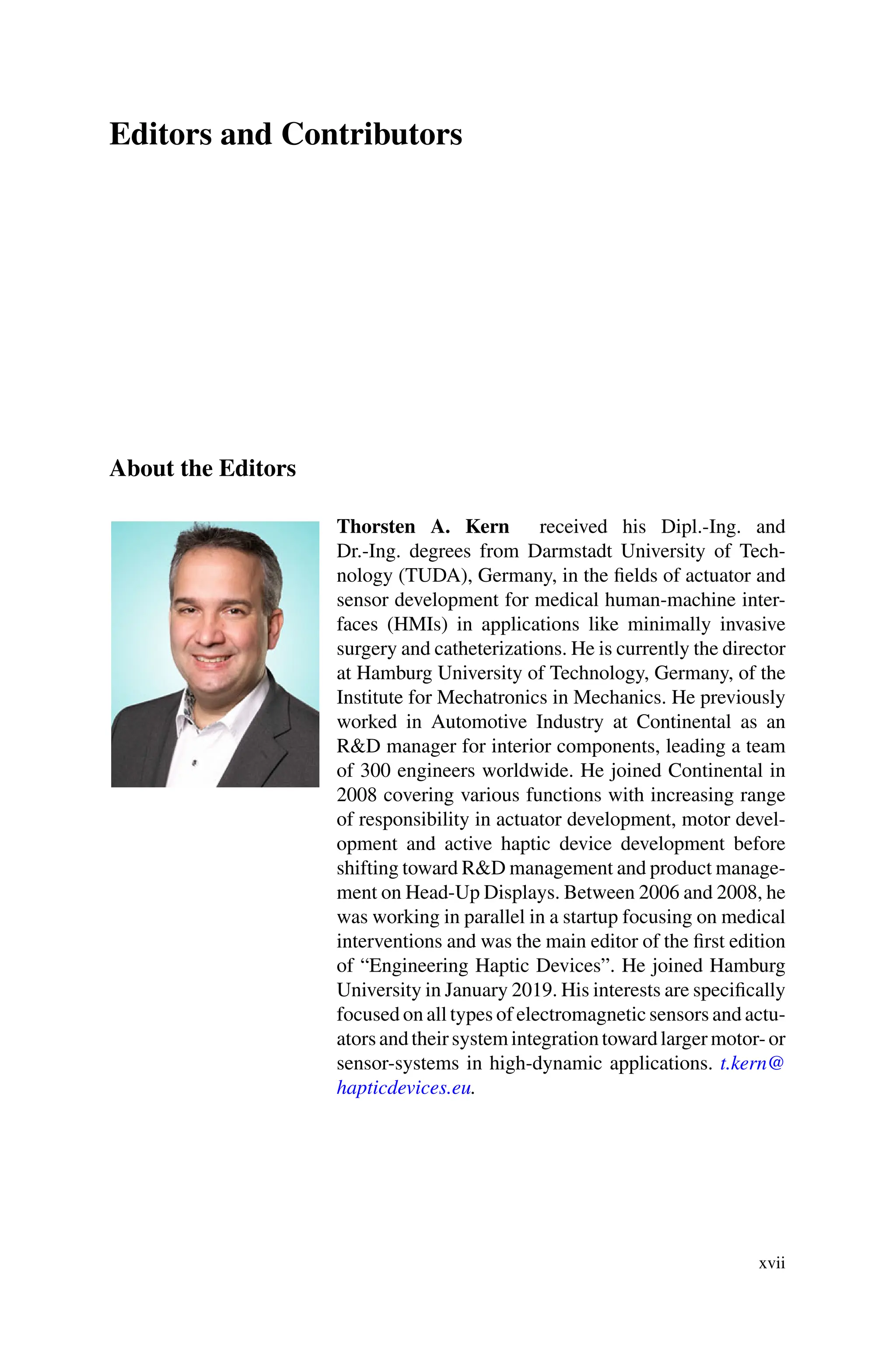
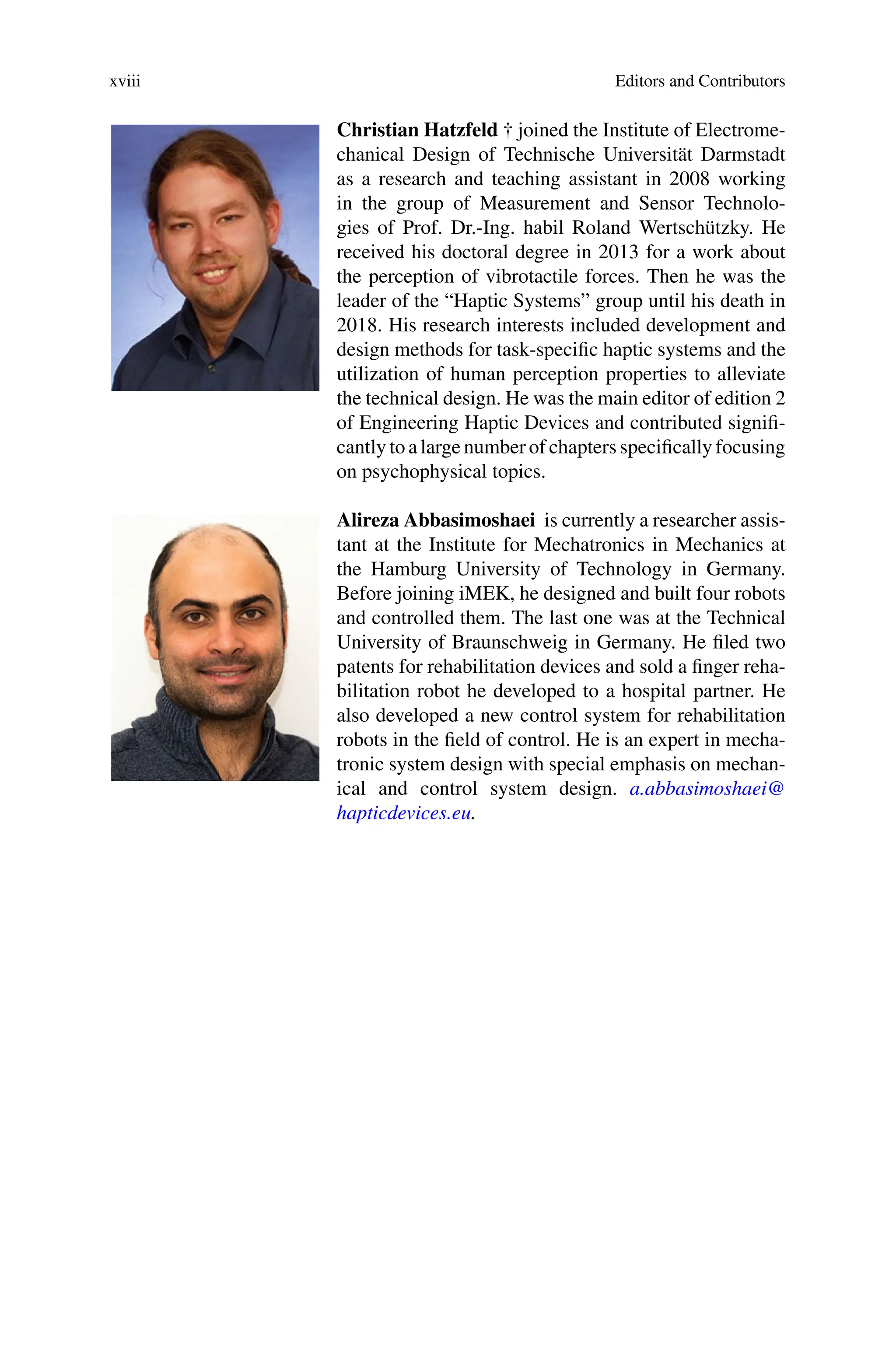
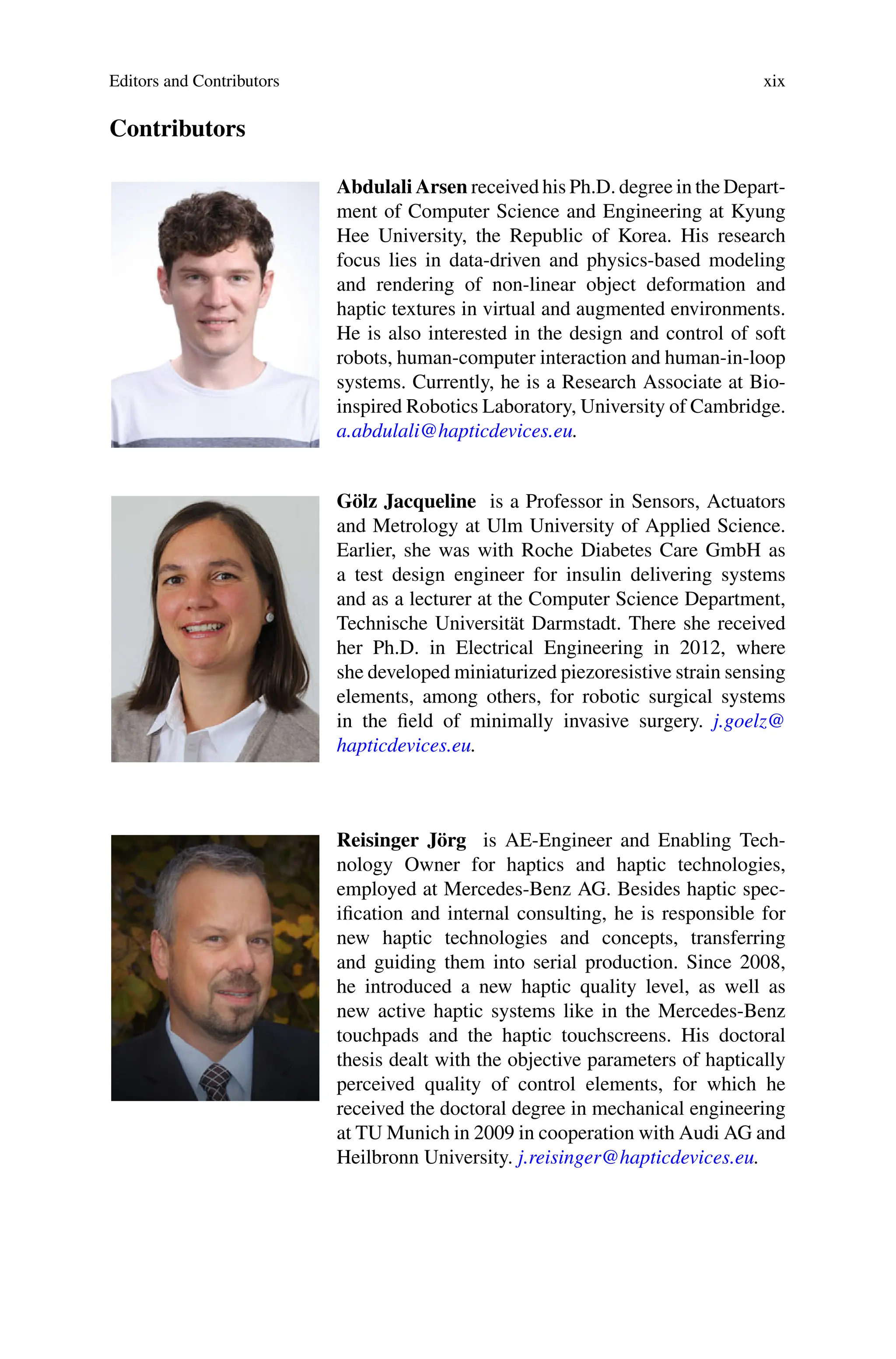
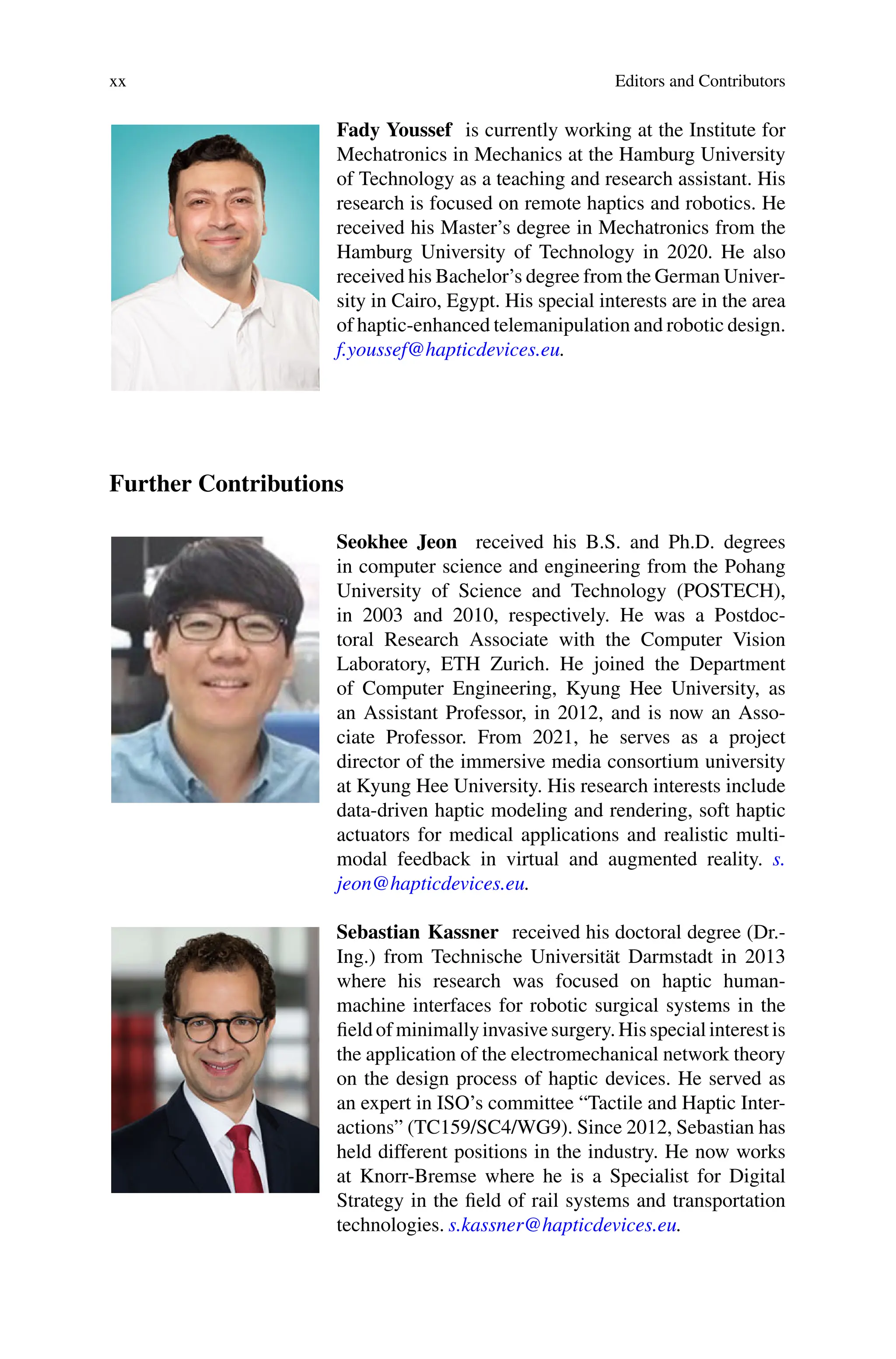

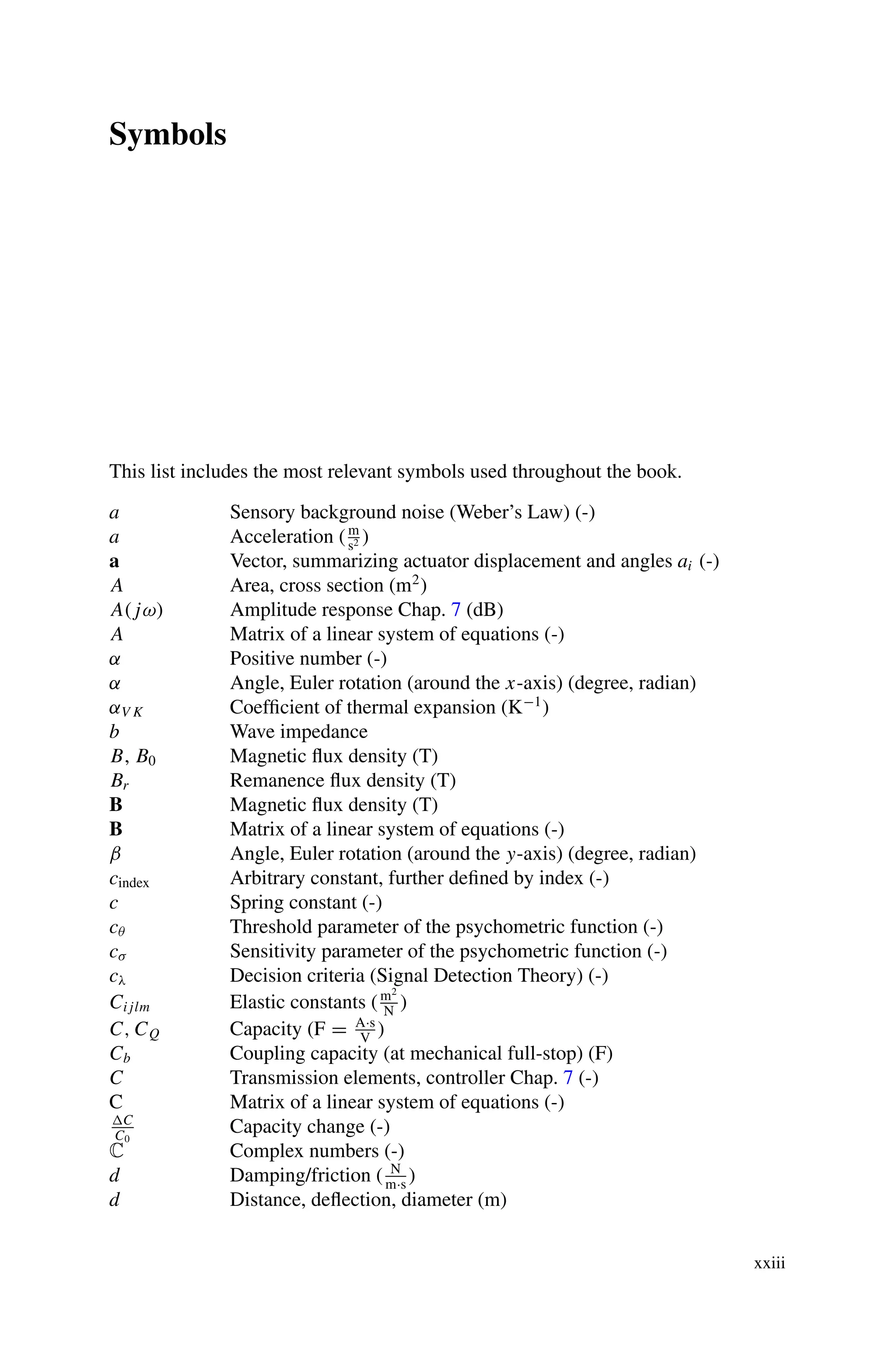
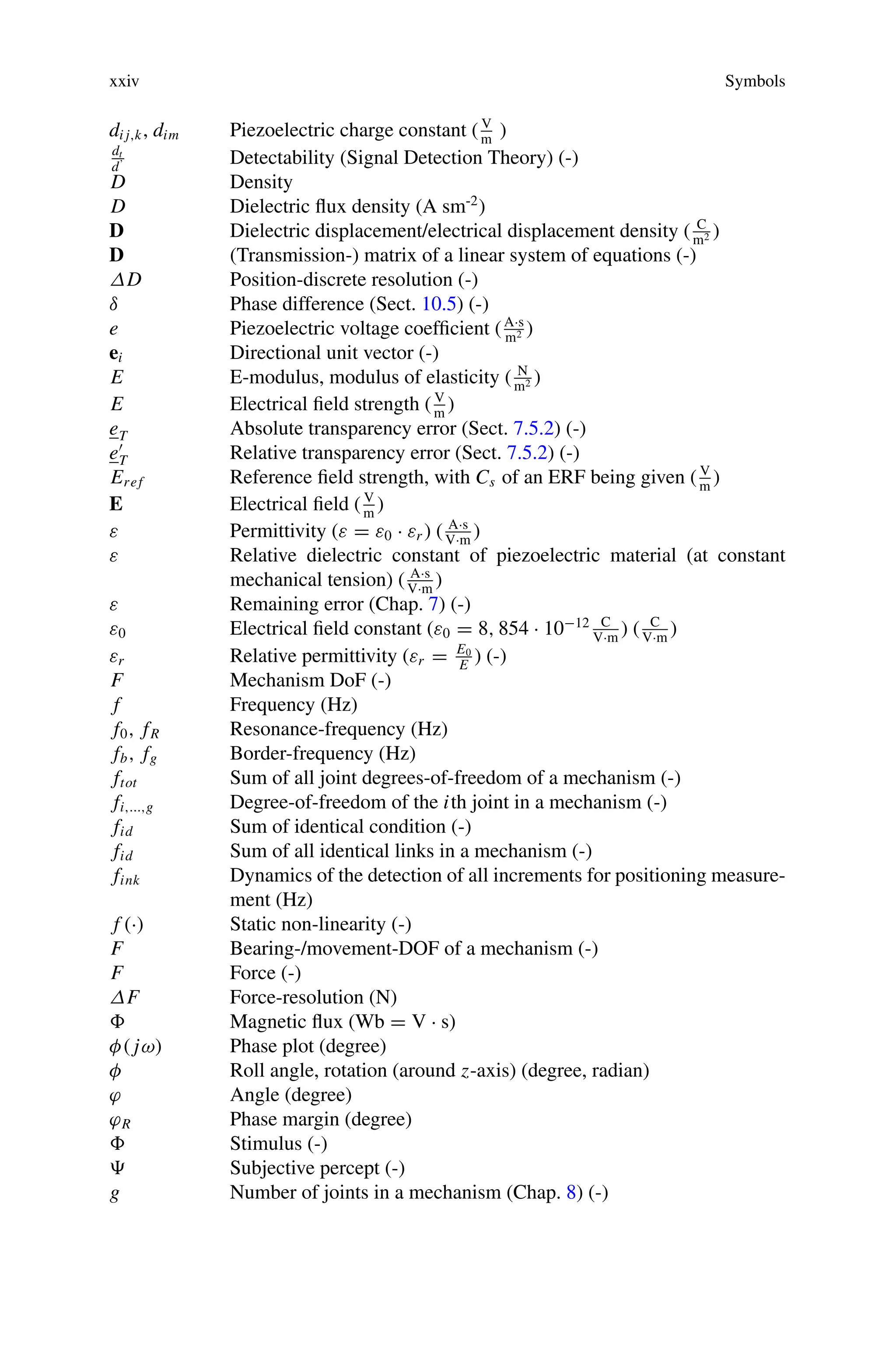
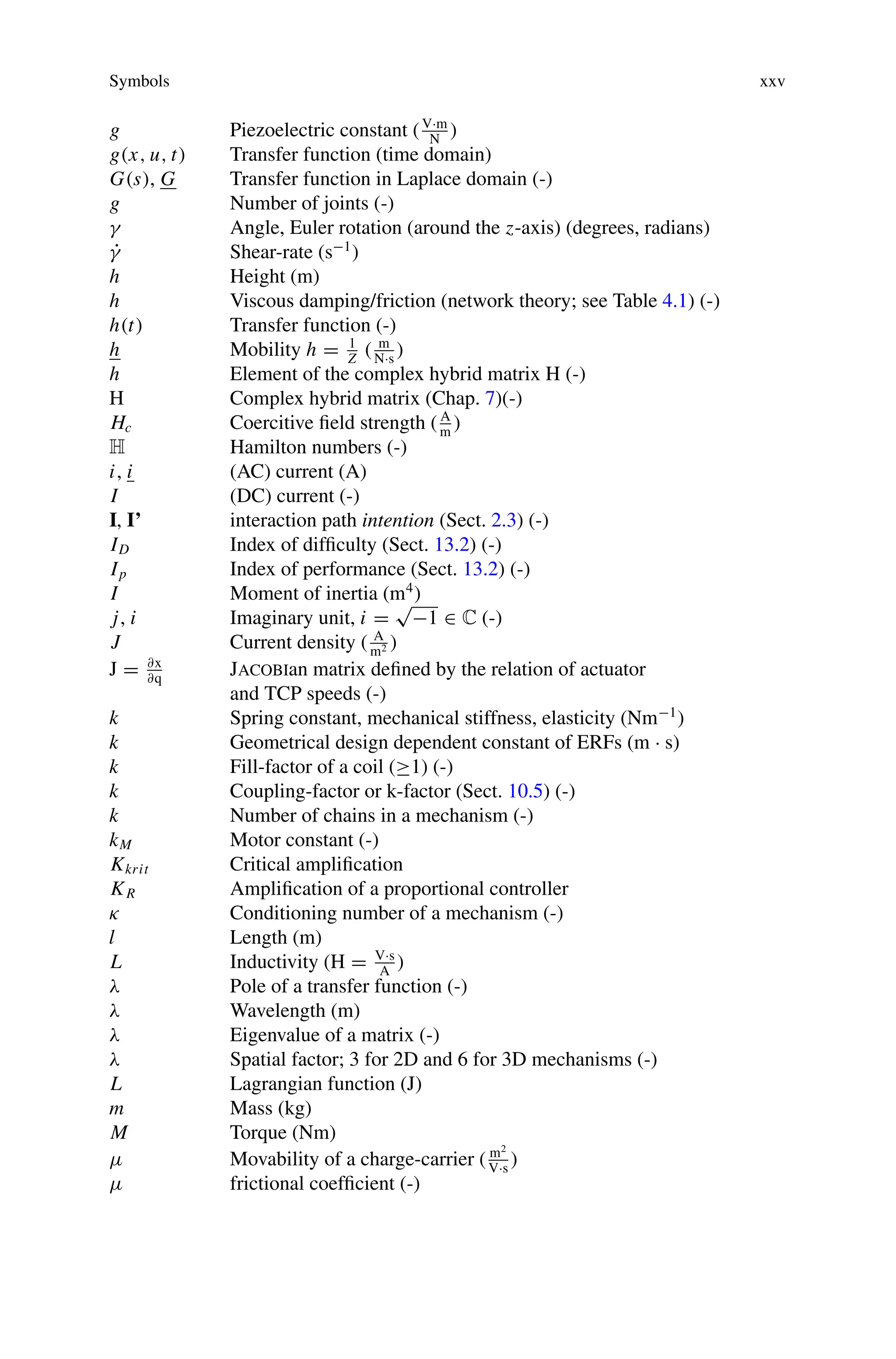
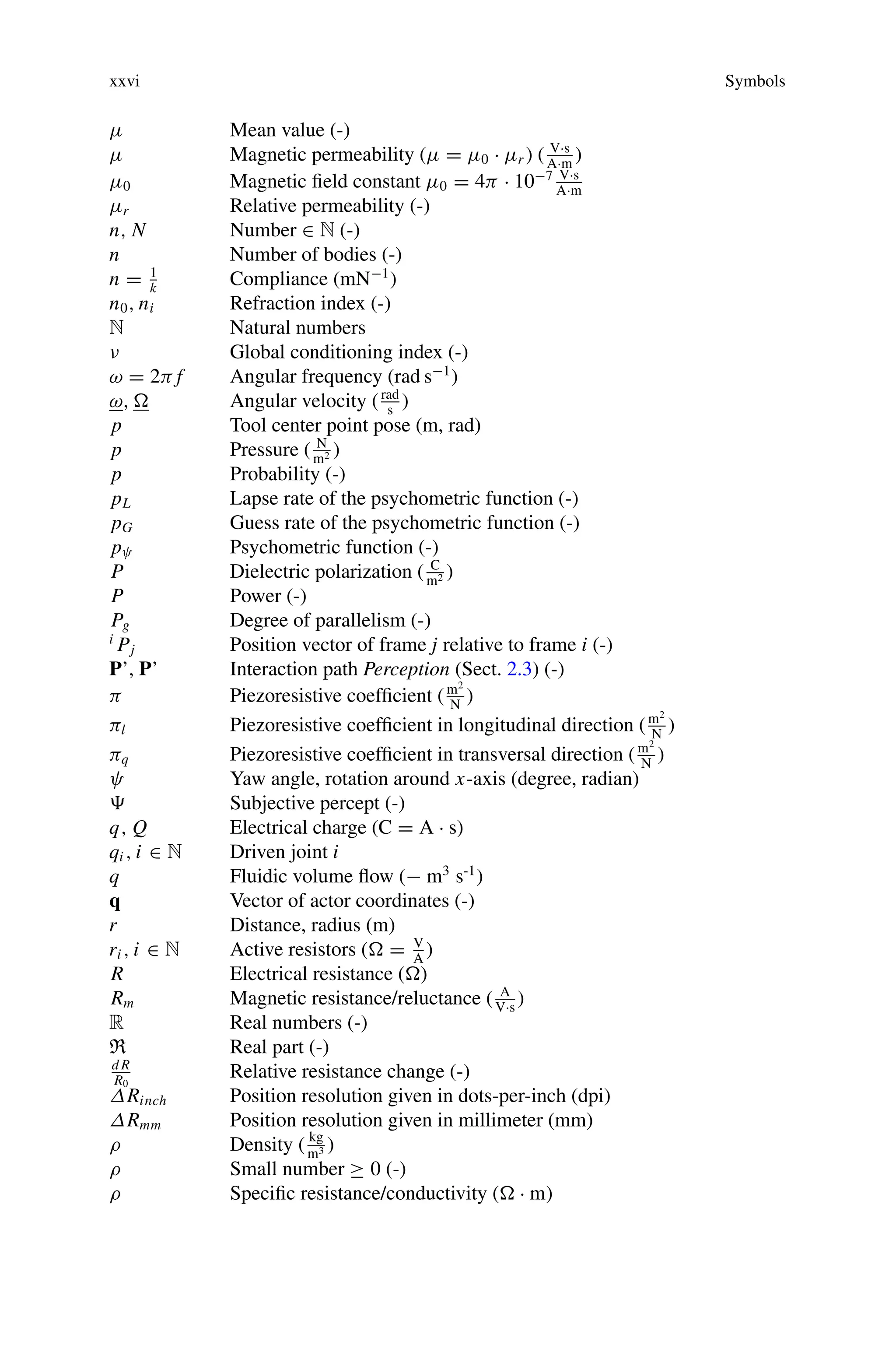
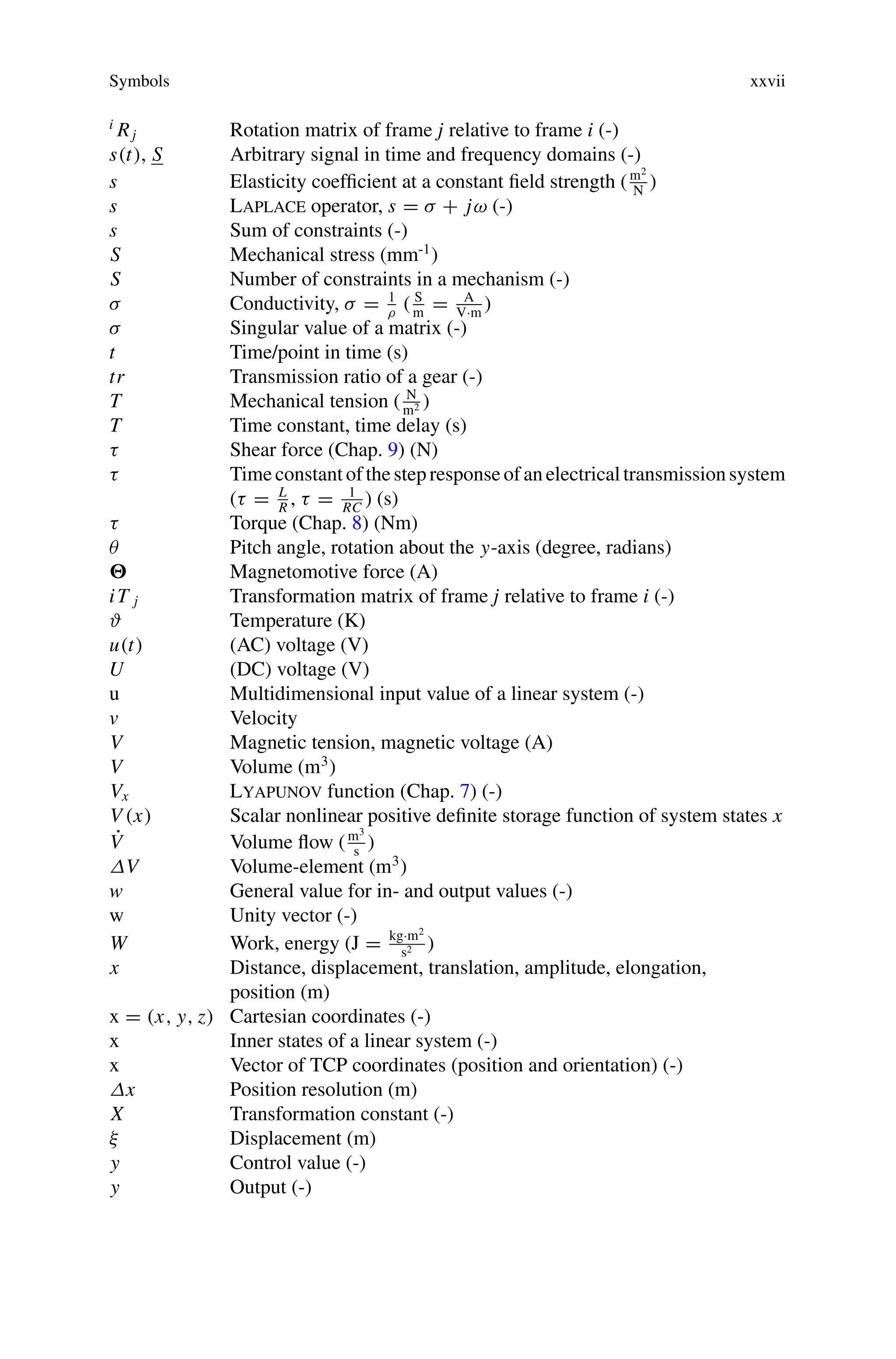



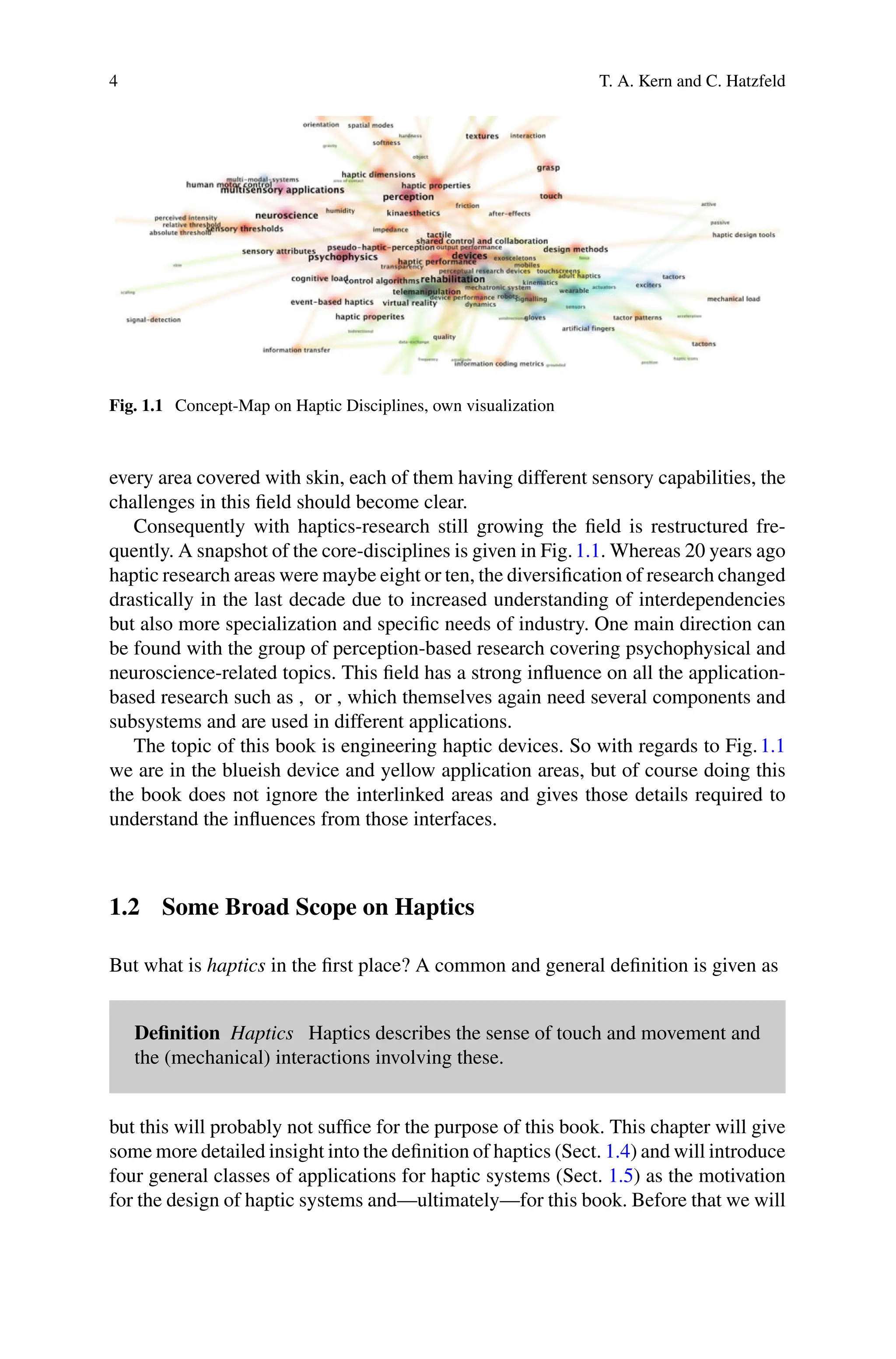
![1 Motivation and Application of Haptic Systems 5
have a short summary of the philosophical and social aspects of this human sense
(Sect. 1.3). These topics will not be addressed any further in this book, but should
be kept in mind by every engineer working on haptics.
1.3 Philosophical and Social Aspects
An engineer tends to describe haptics primarily in terms of forces, elongations,
frequencies, mechanical tensions and shear-forces. This of course makes sense and
is important for the technical design process. However haptics starts before that.
Haptic perception ranges from minor interactions in everyday life, e.g., drinking from
a glass or writing this text, to a means of social communication, e.g. shaking hands
or giving someone a pat on the shoulder, and very personal and private interpersonal
experiences. Touch has a conscious, but also a very relevant unconscious component
as demonstrated e.g. by a study of Crusco et al. [1] showing a tip to a waitress
being on average 10% higher with the customer being slightly touched. This touch
is known as the Midas Touch and is surprisingly independent of gender and age on
both sides. This section looks at the spectrum and influence of haptics on humans
beyond technological descriptions. It is also a hint for the development engineer to
deal responsibly and consciously with the possibilities of outwitting the haptic sense.
1.3.1 Haptics as a Physical Being’s Boundary
Haptics is derived from the Greek term “haptios” and describes “something which
can be touched”. In fact the consciousness about and understanding of the haptic
sense has changed many times in the history of humanity. Aristoteles puts the
sense of touch in the last place when naming the five senses:
1. sight
2. hearing
3. smell
4. taste
5. touch
Neverthelessheatteststhissenseahighimportanceconcerningitsindispensability
as early as 350 B.C. [2]:
Some classes of animals have all the senses, some only certain of them, others only
one, the most indispensable, touch.
The social estimation of the sense of touch experienced all imaginable phases. Fre-
quently it was afflicted with the blemish of squalor, as lust is transmitted by it [3]:
Sight differs from touch by its virginity, such as hearing differs from smell and
taste: and in the same way their lust-sensation differs](https://image.slidesharecdn.com/23607832-250515034449-1e0e3565/75/Engineering-Haptic-Devices-3rd-Edition-Thorsten-A-Kern-Christian-Hatzfeld-36-2048.jpg)
![6 T. A. Kern and C. Hatzfeld
It was also called the sense of excess [4]. In a general subdivision between lower and
higher senses, touch was almost constantly ranged within the lower class. In western
civilization the church once stigmatized this sense as forbidden due to the pleasure
which can be gained by it. However, in the 18th century the public opinion changed
and Kant is cited with the following statement [5]:
This sense is the only one with an immediate exterior perception; due to this it is
the most important and the most teaching one, but also the roughest. Without this
sensing organ we would be able to grasp our physical shape, whose perception the
other two first class senses (sight and hearing) have to be referred to, to generate
some knowledge from experience.
Kant thus emphasizes the central function of the sense of touch. It is capable of
teaching the spatial perception of our environment. Only touch enables us to feel and
classify impressions collected with the help of other senses, put them into context
and understand spatial concepts. Although stereoscopic vision and hearing develop
early, the first-time interpretation of what we see and hear, requires the connection
between both impressions perceived independently and information about distances
between objects. This can only be provided by a sense, which can bridge the space
between a being and an object. Such a sense is the sense of touch. The skin, being a
part of this sense, covers a human’s complete surface and defines his or her physical
boundary, the physical being.
1.3.2 Formation of the Sense of Touch
As shown in the prior section, the sense of touch has numerous functions. The knowl-
edge of these function enables the engineer to formulate demands on the technical
system. It is helpful to consider the whole range of purposes the haptic sense serves.
However, at this point we do not yet choose an approach by measuring its character-
istics, but observe the properties of objects discriminated by it.
The sense of touch is not only specialized on the perception of the physical bound-
aries of the body, as said before, but also on the analysis of immediate surroundings
including the contained objects and their properties. Human beings and their prede-
cessors had to be able to discriminate e.g. the structure of fruits and leaves by touch,
in order to identify their ripeness or whether they were eatable or not, like e.g. a
furry berry among smooth ones. The haptic sense enables us to identify a potentially
harming structure, like e.g. a spiny seed, and to be careful when touching it, in order
to obtain its content despite its dangerous needles.
For this reason, the sense of touch has been optimized for the perception and
discrimination of surface properties like e.g. roughness. Surface properties may range
from smooth ceramic like or lacquered surfaces with structural widths in the area of
some µm, to somewhat structured surfaces like coated tables and rough surfaces like
coarsely woven cord textiles with mesh apertures in the range of several millimeters.
Humans developed a very typical way how to interact with theses surfaces enabling](https://image.slidesharecdn.com/23607832-250515034449-1e0e3565/75/Engineering-Haptic-Devices-3rd-Edition-Thorsten-A-Kern-Christian-Hatzfeld-37-2048.jpg)
![1 Motivation and Application of Haptic Systems 7
Fig. 1.2 Illustration for the
interaction of movements,
normal forces on the finger
pad and frictional coupling
them to draw conclusions based on the underlying perception mechanism. A human
being moves his or her finger along the surface (Fig. 1.2), allowing shear forces to be
coupled to the skin. The level of the shear forces is dependent on the quality of the
frictional coupling between the object surface and the skin. It is a summary of the
tangential elasticity of the skin depending on the normal pre-load resulting from the
touch Fnorm and the velocity vexplr of the movement and the quality of the coupling
factor μ.
Everyone who has ever designed a technical frictional coupling mechanism knows
that without additional structures or adhesive materials viscous friction between two
surfaces can hardly reach a factor of μr ≥ 0.1. Nevertheless nature, in order to be able
to couple shear force more efficiently into the skin, has “invented” a special structure
at the most important body-part for touching and exploration: the fingerprint. The
epidermal ridges couple shearing forces efficiently to the skin, as by the bars a
bending moment is transmitted into its upper layers. Additionally these bars allow
form closures within structural widths of similar size, which means nothing else
but canting between the object handled and the hand’s skin. At first glance this is a
surprising function of this structure. When one looks again, it just reminds you of
the fact that nature does not introduce any structure without a deeper purpose.
Two practical facts result from this knowledge: First of all the understanding of
shear-forces’ coupling to the skin has come into focus of current research [6] and has
resulted in an improvement of the design process of tactile devices. Secondly, this
knowledge can be applied to improve the measuring accuracy of commercial force
sensors by building ridge-like structures [7].
Another aspect of the haptic sense and probably a evolutionary advantage is
the ability to use tools. Certain mechanoreceptors in the skin (see Sect. 2.1 for
more details) detect high-frequency vibrations that occur when handling a (stiff)
tool. Detection of this high-frequency vibrations allows to identify different surface
properties and to detect contact situations and collisions [8].](https://image.slidesharecdn.com/23607832-250515034449-1e0e3565/75/Engineering-Haptic-Devices-3rd-Edition-Thorsten-A-Kern-Christian-Hatzfeld-38-2048.jpg)
![8 T. A. Kern and C. Hatzfeld
1.3.3 Touchable Art and Haptic Aesthetics
Especially in the 20th century, art deals with the sense of touch and plays with its
meaning. Drastically the furry-cup (Fig. 1.3) makes you aware of the significance
of haptic texture for the perception of surfaces and surface structures. Whereas the
general form of the cup remains visible and recognizable, the originally plane ceramic
surface is covered by fur.
In 1968, the “Pad- and Touch-Cinema” (Fig. 1.4) allowed visitors to touch Valie
Export’s naked skin for 12 s through a box being covered by a curtain all the time.
According to the artist this was the only valid approach to experience sexuality
without the aspect of voyeurism [9]. These are just a few examples of how art and
artists played with the various aspects of haptic perception.
As with virtual worlds and surroundings, also haptic interaction has characteristics
of artistry. In 2004, Ishii from MIT Media Laboratory and Iwata from the University
of Tsukuba demonstrate startling exhibits of “tangible user interfaces” based on
bottles opened to “release” music.
And meanwhile, the human-triggered touch is extended to devices touching back.
With Marc Teyssier exploring very actively the limits of what is socially accept-
able or not in the unexplored field between art and robotics (Fig. 1.5).
Despite the artistic aspect of such installations, recent research evaluates new
interaction possibilities for → Human-Computer-Interaction (HCI)1
based on such
concepts:
Fig. 1.3 Meret Oppenheim: furry-cup, 1936 [9, 10], DIGITAL IMAGE c
2022, The Museum
of Modern Art/Scala, Florence
1 Please note that entries in the glossary and abbreviations are denoted by a → throughout the book.](https://image.slidesharecdn.com/23607832-250515034449-1e0e3565/75/Engineering-Haptic-Devices-3rd-Edition-Thorsten-A-Kern-Christian-Hatzfeld-39-2048.jpg)
![1 Motivation and Application of Haptic Systems 9
Fig. 1.4 Valie Export TAPP und TASTKINO, 1968, b/w—photography c
Valie Export,
Bildrecht Wien, 2022, photo c
Werner Schulz, courtesy Valie Export, http://80.64.129.152:
8080/share.cgi?ssid=0vdjJr7
Fig. 1.5 MobiLimb project with a device touching back [11], c
2022 Marc Teyssier, used with
permission
• In [12], picture frames are used as tangible objects to initiate a video call to relatives
and friends, when placed on a defined space on a special table cloth.
• With Touché, Disney Research presents a capacitive sensing principle to use
almost every object as a touch input device [13]. It is intended to push the devel-
opment of immersive computers that disappear in objects.
• And even for everyday-objects touch-enhanced functions can be built-in and
demonstrated, e.g. by the company Playtronica focusses on touch-enhancing
everyday objects by an interpretation of capacitance into midi-signals and synth-
music (Fig. 1.6).](https://image.slidesharecdn.com/23607832-250515034449-1e0e3565/75/Engineering-Haptic-Devices-3rd-Edition-Thorsten-A-Kern-Christian-Hatzfeld-40-2048.jpg)
![10 T. A. Kern and C. Hatzfeld
Fig. 1.6 Playtronica
product playtron and Touch
ME with capacitive
measurement and
midi-sound generation based
on touch-intensity, c
2022
Daria Malysheva, used
with permission
In technical applications, the personal feeling of haptic aesthetics is a distinguish-
ing factor. Car manufactures work on objective quality schemes for the perceived
quality of interfaces [14, 15] with the target to create a touchable brand identity,
there are whole companies claiming to “make percepts measurable” [16] and design-
ers provide toolkits to evaluate characteristics of knobs and switches [17, 18] and
meanwhile even design-packages are proposed and commercialized to evaluate typ-
ical vibrational feedbacks [19]. However, the underlying mechanisms of the assess-
ment of haptic aesthetics are not fully understood. While the general approach of all
studies is basically the same, using multidimensional scaling and regression algo-
rithms to combine subjective assessments and objective measurements [20], details
on perceptional dimensions are subject to ongoing research [21] and sophisticated
data-models [22].
Carbon and Jakesch published a comprehensive approach based on object
properties and the assessment of familiarities [23]. This topic still remains a fasci-
nating field of research for interdisciplinary teams from engineering and psychology
and is applied to regular product design [24].
1.4 Technical Definitions of Haptics
To use the haptic sense in a technical manner, some agreements about terms and
concepts have to be made. This section deals with some general definitions and
classifications of haptic interactions and haptic perception and is the basis for the
following Chap. 2, which will dig deeper into topics of perception and interaction.](https://image.slidesharecdn.com/23607832-250515034449-1e0e3565/75/Engineering-Haptic-Devices-3rd-Edition-Thorsten-A-Kern-Christian-Hatzfeld-41-2048.jpg)
![1 Motivation and Application of Haptic Systems 11
1.4.1 Definitions of Haptic Interactions
The haptic system empowers humans to interact with real or virtual environments
by means of mechanical, sensory, motor and cognitive abilities [25]. An interaction
consists out of one or more operations, that can be generally classified into motion
control and perception [26]. The operations in these classes are called primitives,
since they cannot be divided and further classified.
The perception class includes the primitives detection, discrimination, identifi-
cation and scaling of haptic information [27]. The analysis of these primitives is
conducted by the scientific discipline called → psychophysics. To further describe
the primitives of the description class, the term → stimulus has to be defined:
Definition Stimulus (pl. stimuli) Excitation or signal that is used in a
psychophysical procedure. It is normally denoted with the symbol Φ. The
term is also used in other contexts, when a (haptic) signal without further
specification is presented to a user.
Typical stimuli in haptics are forces, vibrations, stiffnesses, or objects with specific
properties. With this definition, we can have a closer look at the perception primitives,
since each single primitive can only be applied to certain haptic stimuli, as explained
below.
Detection The detection primitive describes, how the presence of a stimulus is
detected by a human respectively a user. Depending on the interaction conditions,
stimuli can be detected or not detected. This depends not only on the sensory
organs involved (see Sect. 2.1) but also on the neural processing. Only if a stimulus
is detected, the other perception primitives can be applied.
Discrimination If more than one stimulus is present and detected, the primitive
discrimination describes how information are perceived, that are included in dif-
ferent properties of the signal (like frequency or amplitude of a vibration) or an
object (like hardness, texture, mass).
Identification As well as the discrimination primitive, also the identification prim-
itive is based on more than one present and detected stimuli. These stimuli are
however not compared to each other, but with practical or abstract knowledge to
allow a classification of the information contained in the stimuli. An example for
such a task is the identification of geometric properties of objects like size and
global form.
Scaling Scaling is the fourth primitive of perception as generally described by
psychophysicists. This primitive describes the behavior of scales when properties
of stimuli and objects are rated [28]. While scaling is only of secondary meaning
for the description of interactions, it can provide useful information about signal
magnitudes in the design process.](https://image.slidesharecdn.com/23607832-250515034449-1e0e3565/75/Engineering-Haptic-Devices-3rd-Edition-Thorsten-A-Kern-Christian-Hatzfeld-42-2048.jpg)
![12 T. A. Kern and C. Hatzfeld
The motor control class can be divided in different operations as well. In this
class, the primitives travel, selection and modification exist [29]. They can be better
explained, if they are linked to general interaction tasks [29, 30]:
Travel The movement or travel of limbs, the whole body or virtual substitutes
(avatar) is used to search for or reach a destination or an object, to explore
(unknown) environments or to change the position of oneself. Changing of a
movement already in progress is included in this primitive.
Selection Especially in virtual environments, marking and/or selection of an object
or a function is a vital primitive. It allows for a direct interaction in this environ-
ments in the first place.
Modification The modification primitive is based on a selection of a function or
an object. It describes a change in orientation, position or other properties of an
object as well as the combination of more than one object to a single one.
When using motor control primitives, not only the operation itself but the aim of
the operation have to be considered for an accurate description of an interaction. If,
for example, a computer is operated with a mouse as an input device and an icon
on the screen is selected, this interaction could be described as a travel primitive or
as a selection primitive. A closer look will probably reveal, that the travel primitive
is used to reach an object on the screen. This object is selected in a following step.
If this interaction should be executed with a new kind of haptic device, the travel
primitive is probably considered subordinate to the selection primitive.
Based on these two classes of interaction primitives, Samur introduces a →
taxonomy of haptic interaction [31]. It is given in Fig. 1.7 and allows the classification
of haptic interaction. A classification of a haptic interaction is useful for the design
of new haptic systems: Requirements can be derived more easily (see Chap. 5),
analogies can be identified and used in the design of system components and the
evaluation is alleviated (see Chap. 13).
Next to the analysis of haptic interaction based on interaction primitives, some
more psychophysically motivated approaches exist:
• Lederman and Klatzky propose a classification of haptic interaction primi-
tives in two operation classes: Identification (The What-System) and Localization
(The Where-System) [32].
• Hollins proposes a distinction of primitives based on the spatial and temporal
resolution of perception (and the combinations thereof) on the one side and and a
class of “haptic” interactions on the other side [33]. Latter correspond roughly to
the above mentioned motion control primitives.
The application of the taxonomy of haptic interactions as given in Fig. 1.7 to the
development of task-specific haptic systems seems to be much more straightforward
as the application of the approaches by Lederman and Klatzky and Hollins as
stated in the above listing. Therefore these are not pursued any further in this book.](https://image.slidesharecdn.com/23607832-250515034449-1e0e3565/75/Engineering-Haptic-Devices-3rd-Edition-Thorsten-A-Kern-Christian-Hatzfeld-43-2048.jpg)
![1 Motivation and Application of Haptic Systems 13
Fig. 1.7 Taxonomy of haptic interaction. Figure based on [27, 31]
Fig. 1.8 Taxonomy of
haptic perception as defined
in [30]
1.4.2 Taxonomy of Haptic Perception
Up till now, one of the main taxonomies in haptic literature has not been addressed:
The classification based on → kinaesthetic and → tactile perception properties. It
is physiological based and defines perception solely on the location of the sensory
receptors. It is defined in the standard ISO9241-910 [30] and given in Fig. 1.8.](https://image.slidesharecdn.com/23607832-250515034449-1e0e3565/75/Engineering-Haptic-Devices-3rd-Edition-Thorsten-A-Kern-Christian-Hatzfeld-44-2048.jpg)
![14 T. A. Kern and C. Hatzfeld
With this definition, tactile perception is based on all → cutaneous receptors.
These include not only mechanical receptors, but also receptors for temperature,
chemicals (i.e. taste) and pain. Compared to the perception of temperature and pain,
mechanical interaction is on the one side much more feasible for task-specific haptic
systems in terms of usability and generality, on the other side it is technically much
more demanding because of the complexity of the mechanoreceptors and the inher-
ited dynamics. Therefore this book will lay its focus on mechanical perception and
interaction.
For processes leading to the perception pain the authors point to special literature
[34] dealing with that topic, since an application of pain stimuli in a haptic system
for everyday use seems not to be likely. The perception of temperature and possible
applications are given for example in [35, 36]. Whereas some technical applica-
tions of thermal displays are known [37–39], these seem to be minor to mechanical
interaction in terms of information transfer and dynamics. Therefore, temperature is
primarily considered as an influencing factor on the mechanical perception capabil-
ities and discussed more detailed in Sect. 2.1.2.
With the confinement on mechanical stimuli, we can define kinaesthetic and tactile
perception as follows:
Definition kinaesthetic kinaesthetic perception describes the perception of
the operational state of the human locomotor system, particularly joint posi-
tions, limb alignment, body orientation and muscle tension. For kinaesthetic
perception, there are dedicated sensory receptors in muscles, tendons and joints
as detailed in Sect. 2.1. Regarding the taxonomy of haptic interactions, kinaes-
thetic sensing is primarily involved the motion control primitives, since signals
from kinaesthetic receptors are needed in the biological control loop for the
positioning of limbs.
Definition tactile Tactile perception describes the perception based on sen-
sory receptors located in the human skin. Compared to kinaesthetic receptors,
they exhibit much larger dynamics and are primarily involved in the perception
primitives of haptic interaction.
While originally the terms tactile and kinaesthetic are strictly defined by the loca-
tion and the functions of the sensory receptors, they are used in a more general
way recently. While the root of the word kinesthesia is linked to the description of
movement, the term kinaesthetic is also used to describe static conditions nowadays
[40]. Sometimes, kinaesthetic is only used for the perception of properties of limbs,
while the term proprioception is used for properties regarding the whole body [41].
This differentiation is neglected further in this book because of its minor technical](https://image.slidesharecdn.com/23607832-250515034449-1e0e3565/75/Engineering-Haptic-Devices-3rd-Edition-Thorsten-A-Kern-Christian-Hatzfeld-45-2048.jpg)
![1 Motivation and Application of Haptic Systems 15
importance. The term tactile often describes any kind of sensor or actuator with a
spatial resolution, regardless if it is used in an application addressing tactile percep-
tion as defined above. While these examples are only of minor importance for the
design of haptic systems, the following usage of the terms is an important adaption of
the definitions: Primarily based on the dynamic properties of tactile and kinaesthetic
perception, the term definition is extended to haptic interactions in general nowa-
days. The reader may note that the following description is not accurate in terms
of temporal sequence of the cited works, but focuses on the works with relevant
contributions to the present use of the terms kinaesthetic and tactile.
Based on the works of Shimoga, the dynamics of kinaesthetic perception are
set equal to the motion capabilities of the locomotor system [42]. The dynamics of
tactile perception are bordered at about 1 . . . 2 kHz for practical reasons. Higher
frequencies can be perceived [43, 44], but it is questioned, whether they have sig-
nificant contribution to perception [45, p. 3]. As further explained in Sect. 2.4.3, this
limitation is technically reasonable and necessary for the design of the electrome-
chanical parts of haptic systems. Figure 1.9 shows this dynamic consideration of
haptic interaction based on characteristic values from [44, 46, 47].
To extend this dynamic model of perception to a more general definition of inter-
actions, Daniel and McAree propose a bidirectional, asymmetric model with a
low-frequency (30Hz) channel for the exchange of energy and a high-frequency
channel for the exchange of information [48] with general implications on the design
of haptic interfaces. The mapping based on dynamic properties is meaningful to a
greater extend, since users can be considered as mechanical passive systems for fre-
quencies above the dynamics of the active movement capabilities of the locomotion
system[49].ThiswillbeexplainedinmoredetailinChap.3.Altogether,theseaspects
(dynamics of perception and movement capabilities, exchange paths of energy and
information and the modelling of the user as active and passive load to a system)
lead to the nowadays widely accepted model for the partition of haptic interaction in
low-frequency kinaesthetic interaction and high-frequency tactile perception.
Both taxonomies of haptic interaction as seen in Fig. 1.7 and haptic perception as
seen in Fig. 1.8 and extended in Fig. 1.9 are relevant sources for standard vocabulary
in haptic system design. This is needed in the design of haptic systems, since it will
simplify and standardize descriptions of haptic interactions. These are necessary to
describe the intended functions of a task-specific haptic system and will be described
more detailed in Sect. 5.2. Further definitions and concepts about haptic interaction
and perception are given in Chap. 2 in more detail. In the next part of this chapter,
possible applications for haptic systems that will become part of the human haptic
interaction with systems and environments are presented.](https://image.slidesharecdn.com/23607832-250515034449-1e0e3565/75/Engineering-Haptic-Devices-3rd-Edition-Thorsten-A-Kern-Christian-Hatzfeld-46-2048.jpg)
![16 T. A. Kern and C. Hatzfeld
Fig. 1.9 Kinaesthetic and tactile haptic interaction. Figure is based on data from [44, 46, 47]
1.5 Application Areas of Haptic Systems
Haptic systems can be found in a multitude of applications. In this section, four
general application areas are identified. Benefits and technical challenges of haptic
systems in this areas are given. In the latter Sect. 2.3, these application areas are
combined with a general model of human-system-environment interaction, leading
to an interaction-based definition of basic system structures.](https://image.slidesharecdn.com/23607832-250515034449-1e0e3565/75/Engineering-Haptic-Devices-3rd-Edition-Thorsten-A-Kern-Christian-Hatzfeld-47-2048.jpg)
![1 Motivation and Application of Haptic Systems 17
1.5.1 Telepresence, Teleaction and Assistive Systems
Did you ever think about touching a lion in a zoo’s cage?
With a → telepresence and teleaction (TPTA)-system you could do just that
without exposing yourself to risks, since they provide the possibility to interact
mechanically with remote environments (We neglect the case of the lion feeling
disturbed by the fondling...).
In a strict definition of TPTA-systems there is no direct mechanical coupling
between operator and manipulated environment, but only via the TPTA-system. Thus
the transmission of haptic signals is possible in the first place, since the mechanical
interaction is converted to other domains (mainly electrical) and can be transmitted
more easily. They are often equipped with additional multimodal features, mainly
a one-directional visual channel displaying the environment to the operator of the
TPTA-system.
Examples include systems for underwater-assembly, when visual cues are useless
because of dispersed particles in the water [50], scaled support of micro- and nano-
positioning [51, 52] and surgical applications [53, 54]. The use of TPTA-systems
shortens task completion time, and minimizes errors and handling forces compared
to systems without a haptic feedback [55]. In surgical applications new combinations
of insofar incompatible techniques are possible, for example palpation in minimal
invasive surgery. Studies also show an safety increase for patients [56]. In recent
years especially the strong increase in band with in any networked application is
driving imagination on what could be done. Antonakoglou et al. [57] did a
very nice overview paper in the context of the availability of 5G. But despite aerial
or space applications, the input-device stays in focus for an efficient operation [58].
Most TPTA-Systems knwon are used for research applications. Figure 1.10 shows
an approach by Quanser, supplying a haptic interface and a robot manipulator arm.
Basedonthiscombination,versatilebilateralteleoperationscenarioscanbedesigned,
as for example neuroArm, a teleoperation system for neurological interventions
[59]. Example interventions include the removal of brain tumors, that require high
position accuracy and real-time integration of → Magnetic Resonance Imaging
(MRI) images.
The development of TPTA-systems is technically most challenging. This is caused
by the unknown properties of the environment, having an influence on the system
stability, the required high accuracy of sensors and actuators to present artifact-free
haptic impressions and the data transmission over long distances with additional
aspects of packeted transmission, (packet-)losses and latency.
A special type of TPTA-systems are so-called → comanipulators, that are mainly
used in medical applications [53]. Despite the mechanical interaction over the TPTA-
system, additional environment manipulation (and feedback) can be exerted by parts
of the system (a detailed definition based on the description of the interaction can be
found in Sect. 2.3). Examples for such comanipulators are INKOMAN and HapCath
developed at the Institute for Electromechanical Design.](https://image.slidesharecdn.com/23607832-250515034449-1e0e3565/75/Engineering-Haptic-Devices-3rd-Edition-Thorsten-A-Kern-Christian-Hatzfeld-48-2048.jpg)
![18 T. A. Kern and C. Hatzfeld
Fig. 1.10 Versatile
teleoperation by Quanser:
HD2 haptic interface with
7DoF of haptic feedback and
Denso Open
Architecture robot with
6DoF. Image courtesy by
Quanser, Markham, Ontario,
CA., used with permissions
The HapCath-system that adds haptic feedback to cardiovascular interventions is
presented in detail as an example in Sect. 14.2. Figure 1.11 displays the INKOMAN
instrument, which is the result of the joint research project SOMIT- FUSION funded
by the German Ministry of Education and Research. It is an extension of a laparo-
scopic instrument with a parallel kinematic structure [60], that provides additional
→ degrees of freedom (DOF) of an universal tool platform [61]. This allows minimal
invasive interventions at previously unreachable regions of the liver. By integrating
a multi-component force sensor in the tool platform [62] interaction forces between
instrument and liver can be displayed to the user [63]. This allows techniques like pal-
pation to identify vessels or cancerous tissue. With the general form of a laparoscopic
instrument, additional interaction forces can be exerted by the surgeon by moving
the complete instrument, it is therefore classified as a comanipulation system.
TPTA systems are mainly focus of research activities, probably since there are
only small markets with a high potential for this kind of systems. An exception
are medical applications, where non-directly coupled instruments promise higher
safety and efficient usage, for example by avoiding collisions between different
instruments or lowering contact and grip forces [56, 64]. Also automated procedures
like knot tying can be accelerated and conducted more reliable [65]. However, the
distinction between a haptic TPTA-system and a robotic system for medical use is
quite a thin line: The aforementioned functions do not require haptic feedback. This
explainsthelargenumberofexistingmedicalroboticsystemsinresearchandindustry
[66, 67], dominated by the well-known Da Vinci by Intuitive Surgical Operations
Inc.. This system was developed for urological and gyneological interventions and
incorporates a handling console with three-dimensional view of the operation area
and a considerable number of instruments, that are directed by the surgeon on the
console and actuated with cable drives [68]. There is no haptic feedback for this](https://image.slidesharecdn.com/23607832-250515034449-1e0e3565/75/Engineering-Haptic-Devices-3rd-Edition-Thorsten-A-Kern-Christian-Hatzfeld-49-2048.jpg)
![1 Motivation and Application of Haptic Systems 19
Fig. 1.11 INKOMAN—intracorporal manipulator for minimal invasive abdomen interventions
with increased flexibility. The figure shows the handheld instrument with a haptic display based
on a delta kinematic structure. The parallel kinematic structure used to move the tool platform is
driven by ultrasonic traveling wave motors. Figure adapted from [63]
Fig. 1.12 Da Vinci SP
surgical system for single
port access, c
2022 Intuitive
Surgical Operations, Inc.,
used with permission
system preinstalled, although there are promising extensions available as discussed
in Sect. 2.4.4. Just recently, the system is extended to single-port entry, which further
reduces the liaisons of the intervention and allows a quick exchange of tools used
during the procedure (Fig. 1.12).
For consumer application, Holland Haptics sold a product called Frebble
intended to convey the feeling of holding someones hand over the internet. This
was as well an interesting hardware concept as a low-cost teleoperation device.
Also practical magnetic resonance imaging studies into the hand neural control
revealed significant progress, but the harsh MRI environments are a challenge for
devices capable of delivering a large variety of stimuli. This work focused on present-
ing an fMRI-compatible haptic interface to find the neural mechanisms for precision
grasp control. The interface is placed at the scanner bore, and it is controlled through
a shielded electromagnetic actuation system. It is located at the scanner bed end
and uses a high stiffness cable. Performance evaluation showed up to 94 N render-
able forces and structural stiffness of 3.3 N/mm, and at least 19 Hz position control
bandwidth.](https://image.slidesharecdn.com/23607832-250515034449-1e0e3565/75/Engineering-Haptic-Devices-3rd-Edition-Thorsten-A-Kern-Christian-Hatzfeld-50-2048.jpg)
![20 T. A. Kern and C. Hatzfeld
Inthissystem,twoclosed-loopcabletransmissionsactuatethetwoDOF,whichare
for each finger. It consists of aluminum profiles that hold redirection modules. Cables
are passing through a length and tension adjustment mechanism. The guiding pulleys
are combined with low friction polymer/glass ball bearings. They are fixed on an
aluminum bar rigidly attached to the scanner bedside. Fixing the cables to the capstan
prevents slippage. Due to the transmission friction, cable wear is important, and for
making better interaction with operators, the cable should be easily exchangeable in
a breakdown during an fMRI study.
1.5.2 Virtual Environments
The second main application area for haptic systems is interaction with virtual envi-
ronments. Since this is quite a large field of applications, we will have a closer look
on different areas, where interaction with generated situations is used in a wider
extent.
Medical Training A large number of systems is designed to provide medical train-
ing without jeopardizing a real patient [69]. In addition to haptic feedback, this
systems generally provide also visual and acoustic feedback to generate a realistic
impression of the simulated procedure. You can find systems to train the diagnosis
of joint lesions [70] and simulators for endoscopic, laparoscopic and intravascular
interventions [31]. Figure 1.13 shows an example of such a surgical simulator.
Surgeons trained on simulators show a better task performance in several studies
[71, 72]. In addition simulators can be used very early in medical training, since
they do not put patients at risk and have a higher availability.
Industrial Design In industrial design applications, virtual environments are used
to simulate assembly operations and subjective evaluation of prototypes. Although
there are much less applications than in medical training, this area pushes tech-
nology development: Some requirements can only be met with new concepts such
as admittance systems and form displays. One of these is the Haptic Strip, that
consists of a bend- and twistable surface that can be additionally positioned in
6DoF in space [73]. It is shown in Fig. 1.14 and can be used to display large-scale
forms of new designs without having to manufacture a prototype.
Multimodal Information Displays Since the haptic sense was developed to ana-
lyze objects and the environment, similar application with a high demand of
intuitive access to information can be found in literature. Haptic systems are used
to display large amount of information in biology and chemistry [74, Chap. 9]
and are also used as means for the synthesis of complex molecules [75]. For
this application, the human ability to detect patterns (in visual representations) is
used for a coarse positioning of synthesis partners, whereas micro positioning is
supported by haptic representation of the intermolecular forces.
Another example for multimodal display of information was recently presented
by Microsoft Research [76]. The TouchMover is an actuated screen with haptic](https://image.slidesharecdn.com/23607832-250515034449-1e0e3565/75/Engineering-Haptic-Devices-3rd-Edition-Thorsten-A-Kern-Christian-Hatzfeld-51-2048.jpg)
![1 Motivation and Application of Haptic Systems 21
Fig. 1.13 Laparoscopic
simulator LAP Mentor III
The system was designed to
simulate interventions in the
abdomen. Picture courtesy of
Simbionix USA, Cleveland,
OH, USA., used with
permission
feedback that can be used to display object and material properties or to intuitively
access volumetric data like for example → MRI scans. Figure 1.15 shows this
application of the system. Annotations are marked visually and haptically with a
detent, allowing for intuitive access and collaboration.
Consumer Electronics For the integration of haptic feedback in computer games,
Novint Technologies, Int. presented the Falcon haptic interface in 2006. It is
based on a delta parallel kinematic structure and distinguishes itself through a
very competitive price tag at around 500$. This device is also used in several
research projects like for example [77], because of the low price and the sup-
port in several → application programming interface (API). Looking from the
202xth perspective, complex haptic enhanced input devices did not perform well
in consumer electronics. The main area where they still persists are in gamepad or
game-controller-applications but reduced to a function of pure vibrotactile feed-
back, Sony’s Dual-Sense Technology recently again increased the complexity
and combined a vibration actuator with a motor-actuated and adaptable trigger.
The future will show whether this is a revival of kinaesthetic feedback in consumer
electronics.
But there are other areas. To provide a more intense gaming experience, hap-
tic systems conveying low-frequency acoustic signals Butt Kicker by The
Guitammer Company exist (Fig. 1.16). The system delivers low-frequency sig-
nals increasing the immersion. To allow for the touch of fabric over the inter-
net, the Haptex project developed rendering algorithms as well as interface
hardware [78].](https://image.slidesharecdn.com/23607832-250515034449-1e0e3565/75/Engineering-Haptic-Devices-3rd-Edition-Thorsten-A-Kern-Christian-Hatzfeld-52-2048.jpg)
![22 T. A. Kern and C. Hatzfeld
a) b)
Fig. 1.14 The Haptic Strip system. The strip is mounted on two HapticMaster admittance type
interfaces. Capacitive sensors on the strip surface sense the user’s touch. Figure is based on [73]
c
Springer Nature, all rights reserved
Fig. 1.15 TouchMover with user exploring MRI data. Picture courtesy of Microsoft Research,
Redmond, WA, USA., used with permission
Compared to the design of TPTA-Systems the development of haptic interfaces
for interactions with virtual environments seems to be slightly less complex, since
more knowledge about the interaction environment is present in the design process.
However, new aspects like derivation and allocation of the environment data arise
with this applications. Because of the wider spread of such systems, cost efficiency
has to be taken into account.](https://image.slidesharecdn.com/23607832-250515034449-1e0e3565/75/Engineering-Haptic-Devices-3rd-Edition-Thorsten-A-Kern-Christian-Hatzfeld-53-2048.jpg)
![1 Motivation and Application of Haptic Systems 23
Fig. 1.16 Electrodynamic actuator ButtKicker for generating low-frequency oscillations on a
gaming seat, c
2022 The Guitammer Company, used with permission
1.5.3 Non-invasive Medical Applications
Based on specific values of haptic perception diagnosis of certain illnesses and dys-
functions can be made. Certain types of eating disorders [79, 80] and diabetic neu-
ropathy [38] are accompanied with diminished haptic perception capabilities. They
can therefore be diagnosed with a measurement of perception or motor exertion
parameters and comparison with the population mean. Next to diagnosis, haptic per-
ception parameters can be used as a progress indicator in stroke [81] and limb [82]
rehabilitation, too.
For these purposes cost-efficient systems with robust and efficient measurement
protocols are needed. Because feedback from the user can be received with any
means, development is easier than the development of TPTA- or VR-systems. These
systems are foci of several research groups, up till now there is no system for com-
prehensive use in the market.
1.5.4 Communication
The fourth and by numbers largest application area of haptic systems is basic com-
munications. The most prominent example is probably on your desk or in your
pocket—the vibration function of your phone. Compared to communication based
on visual and acoustic signals, haptics give the opportunity to convey information in
a discrete way and offer the possibility of a spatial resolution. Communication via
the haptic sense tends to be very intuitive, since feedback arises at the point the user
is interacting with. A simple example is a switch, that will give a haptic feedback
when pressed.
Therefore, haptics are an attractive communication channel in demanding envi-
ronments, for example when driving a car. Several studies show that haptic com-](https://image.slidesharecdn.com/23607832-250515034449-1e0e3565/75/Engineering-Haptic-Devices-3rd-Edition-Thorsten-A-Kern-Christian-Hatzfeld-54-2048.jpg)

















![HAPTIC_TECHNOLOGY[1].pptx](https://cdn.slidesharecdn.com/ss_thumbnails/haptictechnology1-221123114420-d6c7e987-thumbnail.jpg?width=640&height=640&fit=bounds)


