1). The group members working on the topic of Orthographic Shapes are Riddhi.N. Patel, Ankita .D. Panjwani, Nirmita Gandhi, Hitaxi Patel, Rajvi Dolariya, and Hem. They are guided by Prof. Binta Mam and Prof. Roshni Mam.
2). Orthographic projection is a method of representing a 3D object in 2D by projecting parallel lines orthogonally onto the projection plane from the object. This results in each plane of the scene appearing in an affine transformation on the viewing surface.
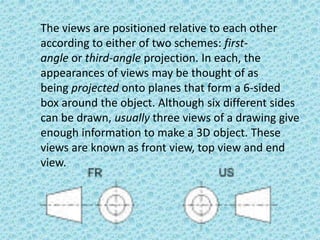
3). Orthographic views are positioned relative to each other according to first-angle or


![Introduction
• Orthographic projection (or orthogonal projection) is a
means of representing a three-dimensional object in two
dimensions. It is a form of parallel projection, where all the
projection lines are orthogonal to the projection
plane,[1] resulting in every plane of the scene appearing
in affine transformation on the viewing surface. A lens
providing an orthographic projection is known as
an (object-space) telecentric lens.
• The term orthographic is also sometimes reserved
specifically for depictions of objects where the axis or plane
of the object is also parallel with the projection plane,[1] as
in multiview orthographic projections.](https://image.slidesharecdn.com/16063010709204637192658-171227172936/85/Engineering-graphics-3-320.jpg)


![ppt on IC [Integrated Circuit]](https://cdn.slidesharecdn.com/ss_thumbnails/1-171227170055-thumbnail.jpg?width=640&height=640&fit=bounds)


