STEAM BOILERSSTEAM BOILERS
PREPARED BY:PREPARED BY:
RIDDHI N PATEL VRUNDA PUROHITRIDDHI N PATEL VRUNDA PUROHIT
[160630107092] [160630107088][160630107092] [160630107088]
GUIDED BYGUIDED BY
Prof. Roshani MamProf. Roshani Mam
DefinitionDefinition
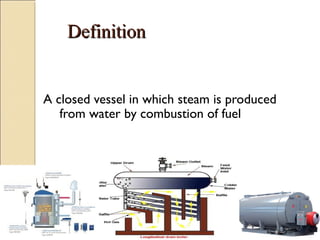
A closed vessel in which steam is produced
from water by combustion of fuel
Classification of boilersClassification of boilers
Horizontal, vertical or inclined
Fire tube and water tube
Externally fired and internally fired
Forced circulation and natural
circulation
High pressure and low pressure
Stationary and portable
Single tube and multi tube
HorizontalHorizontal,, verticalvertical oror inclinedinclined
If the axis of the boiler is horizontal,
vertical or inclined then it is called
horizontal, vertical or inclined boiler
respectively
Fire tube and water tubeFire tube and water tube
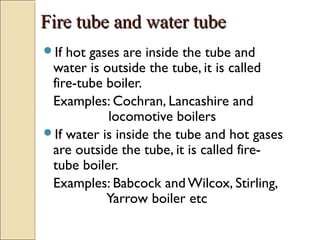
If hot gases are inside the tube and
water is outside the tube, it is called
fire-tube boiler.
Examples: Cochran, Lancashire and
locomotive boilers
If water is inside the tube and hot gases
are outside the tube, it is called fire-
tube boiler.
Examples: Babcock and Wilcox, Stirling,
Yarrow boiler etc
Externally fired and internally firedExternally fired and internally fired
The boiler is known as externally fired
if the fire is outside the shell.
Examples: Babcock and Wilcox, Stirling
The boiler is known as internally fired
if the furnace is located inside the
boiler shell.
Examples: Cochran, Lancashire
Forced circulation and naturalForced circulation and natural
circulationcirculation
In forced circulation type of boilers, the
circulation of water is done by a forced
pump
Examples:Velox, Lamont, Benson boiler
In natural circulation type of boilers,
circulation of water in the boiler takes place
due to natural convection currents
produced by the application of heat
Examples: Lancashire, Babcock and Wilcox
High pressure and low pressureHigh pressure and low pressure
The boilers which produce steam at
pressures of 80 bar and above are called
high pressure boilers
Examples: Babcock and Wilcox,Velox,
Lamont, Benson boilers
The boilers which produce steam at
pressure below 80 bar are called low
pressure boilers
Examples: Cochran, Cornish, Lancashire
and locomotive boilers
Stationary and portableStationary and portable
Stationary boilers are used for power
plant-steam, for central station utility
power plants, for plant process steam
etc
Mobile or portable boilers include
locomotive type, and other small unit
for temporary use at sites
Single tube and multi tubeSingle tube and multi tube
The fire tube boilers are classified as
single tube or multi-tube boilers,
depending upon whether the fire tube
is one or more than one
Examples of single tube boilers are
Cornish and simple vertical boiler
PurposePurpose of boilersof boilers
For generating power in steam engines
or steam turbines
In textile industries for sizing and
bleaching
For heating the buildings in cold
weather and for producing hot water
for hot water supply
Boiler termsBoiler terms
• Shell: Consists of one or more steel plates
bent into a cylindrical form and riveted or
welded together. The shell ends are closed
with end plates
• Setting: The primary function of setting is
to confine heat to the boiler and form a
passage for gases. It is made of brick work
and may form the wall of the furnace and
combustion chamber
Grate: it is a platform in the furnace upon
which fuel is burnt
Furnace: it is the chamber formed by the
space above the grate and below the boiler
shell, in which combustion takes place.
Water space and steam space: the
volume of the shell that is occupied by the
water is termed as water space while the
entire shell volume less the water and tubes is
called steam space
Mountings: The items which are used for
safety of boiler are called mountings
Accessories: The items which are used for
increasing the boiler efficiency are called
accessories
Water level: The level at which water
stands in the boiler is called water level
Refractory: insulation material used for
lining combustion chamber
Foaming: Formation of steam bubbles on
the surface of boiler water due to high surface
tension of water
Scale: A deposit of medium due to extreme
hardness occurring on the water heating
surfaces of boiler because of an undesirable
condition in the boiler water
Blowing off: The removal of mud and other
impurities of water from the lowest part of
the boiler. Accomplished with the help of
blow off cock or valve
Lagging: Insulation wrapped on the outside
of the boiler shell or steam piping
1). SIMPLE VERTICAL1). SIMPLE VERTICAL
BOILERBOILER
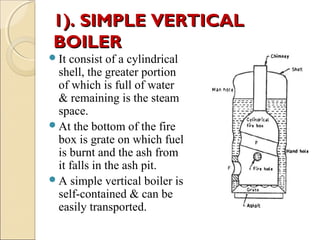
It consist of a cylindrical
shell, the greater portion
of which is full of water
& remaining is the steam
space.
At the bottom of the fire
box is grate on which fuel
is burnt and the ash from
it falls in the ash pit.
A simple vertical boiler is
self-contained & can be
easily transported.
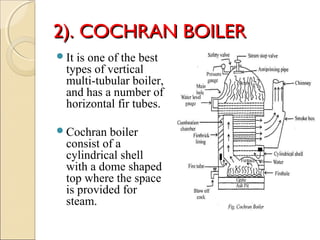
2). COCHRAN BOILER2). COCHRAN BOILER
It is one of the best
types of vertical
multi-tubular boiler,
and has a number of
horizontal fir tubes.
Cochran boiler
consist of a
cylindrical shell
with a dome shaped
top where the space
is provided for
steam.
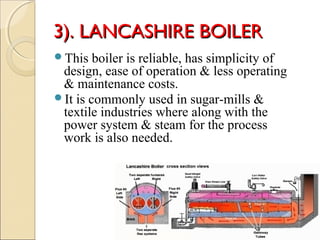
3). LANCASHIRE BOILER3). LANCASHIRE BOILER
This boiler is reliable, has simplicity of
design, ease of operation & less operating
& maintenance costs.
It is commonly used in sugar-mills &
textile industries where along with the
power system & steam for the process
work is also needed.
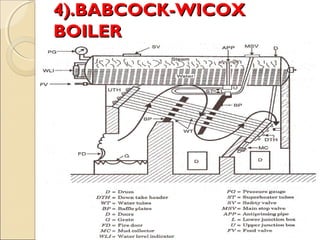
4).BABCOCK-WICOX4).BABCOCK-WICOX
BOILERBOILER
Mountings:
1.Pressure gauge
2.Water level indicator
3.Safety valve - to prevent pressure not increase above
design pressure(spring controlled)
4.Fusible plug - when shell temp. increases above
particular level it melts by creating opening through which
pressurized water falls on grate extinguishing fire.
5.Blow off cock – when opened steam pushes water at
bottom to remove slurries, salted contaminants, dust etc
6. Stem stop valve – regulate steam supply outside
boiler
7. Feed check valve – high pressure feed water is
supplied to boiler through this valve, prevent backflow
of steam through the valve.
Boiler accessoriesBoiler accessories
Feed pumps: Used to deliver feed
water to the boiler. It is desirable that
the quantity of water supplied should be
at least equal to that evaporated and
supplied to the engine
Two types of which are commonly used
as feed pumps are (1) reciprocating pump
(2) rotary pump
InjectorInjector
• Function of injector is to feed water into the
boiler
• It is commonly employed for vertical and
locomotive boilers and does not find its
application in large capacity high pressure boilers
• Also used where the space is not available for
the installation of feed pump
EconomizerEconomizer
Is a device in which the waste heat of the flue
gases is utilized for heating the feed water
Economizers are of two types
Independent type
Integral type
Air Pre-heaterAir Pre-heater
The function of the air pre-heater is to increase the
temperature of air before it enters the furnace.
It is placed after the economizer.
 Flue gases pass through the economizer and then
to the air preheater
Degree of preheating depends on
Type of fuel
Type of fuel burning equipment, and
Rating at which the boiler and furnace are
operated
Types of air preheatersTypes of air preheaters
I. Tubular type
II. Plate type
III. Storage type
Super heaterSuper heater
The function of a super heater is to increase
the temperature of the steam above its
saturation point
The super heater is very important accessory
of a boiler and can be used both on fire tube
and water – tube boilers.
• Advantages of super heated steam
Steam consumption of the engine or turbine is
reduced
Erosion of turbine blade is eliminated
Efficiency of the steam plant is increased
Losses due to condensation in the cylinders and
the steam pipes are reduced.
Steam separatorSteam separator
The function of a steam separator is to
remove the entrained water particles
from the steam conveyed to the steam
engine or turbine.
It is installed as close to the steam engine
as possible on the main steam pipe from
the boiler
According to principle of operation the steam
separators are classified as follows
Impact or baffle type
Reverse current type
Centrifugal type
Boilers IN EME

Boilers IN EME

  • 1.
    STEAM BOILERSSTEAM BOILERS PREPAREDBY:PREPARED BY: RIDDHI N PATEL VRUNDA PUROHITRIDDHI N PATEL VRUNDA PUROHIT [160630107092] [160630107088][160630107092] [160630107088] GUIDED BYGUIDED BY Prof. Roshani MamProf. Roshani Mam
  • 2.
    DefinitionDefinition A closed vesselin which steam is produced from water by combustion of fuel
  • 3.
    Classification of boilersClassificationof boilers Horizontal, vertical or inclined Fire tube and water tube Externally fired and internally fired Forced circulation and natural circulation High pressure and low pressure Stationary and portable Single tube and multi tube
  • 4.
    HorizontalHorizontal,, verticalvertical ororinclinedinclined If the axis of the boiler is horizontal, vertical or inclined then it is called horizontal, vertical or inclined boiler respectively
  • 5.
    Fire tube andwater tubeFire tube and water tube If hot gases are inside the tube and water is outside the tube, it is called fire-tube boiler. Examples: Cochran, Lancashire and locomotive boilers If water is inside the tube and hot gases are outside the tube, it is called fire- tube boiler. Examples: Babcock and Wilcox, Stirling, Yarrow boiler etc
  • 6.
    Externally fired andinternally firedExternally fired and internally fired The boiler is known as externally fired if the fire is outside the shell. Examples: Babcock and Wilcox, Stirling The boiler is known as internally fired if the furnace is located inside the boiler shell. Examples: Cochran, Lancashire
  • 7.
    Forced circulation andnaturalForced circulation and natural circulationcirculation In forced circulation type of boilers, the circulation of water is done by a forced pump Examples:Velox, Lamont, Benson boiler In natural circulation type of boilers, circulation of water in the boiler takes place due to natural convection currents produced by the application of heat Examples: Lancashire, Babcock and Wilcox
  • 8.
    High pressure andlow pressureHigh pressure and low pressure The boilers which produce steam at pressures of 80 bar and above are called high pressure boilers Examples: Babcock and Wilcox,Velox, Lamont, Benson boilers The boilers which produce steam at pressure below 80 bar are called low pressure boilers Examples: Cochran, Cornish, Lancashire and locomotive boilers
  • 9.
    Stationary and portableStationaryand portable Stationary boilers are used for power plant-steam, for central station utility power plants, for plant process steam etc Mobile or portable boilers include locomotive type, and other small unit for temporary use at sites
  • 10.
    Single tube andmulti tubeSingle tube and multi tube The fire tube boilers are classified as single tube or multi-tube boilers, depending upon whether the fire tube is one or more than one Examples of single tube boilers are Cornish and simple vertical boiler
  • 11.
    PurposePurpose of boilersofboilers For generating power in steam engines or steam turbines In textile industries for sizing and bleaching For heating the buildings in cold weather and for producing hot water for hot water supply
  • 12.
    Boiler termsBoiler terms •Shell: Consists of one or more steel plates bent into a cylindrical form and riveted or welded together. The shell ends are closed with end plates • Setting: The primary function of setting is to confine heat to the boiler and form a passage for gases. It is made of brick work and may form the wall of the furnace and combustion chamber
  • 13.
    Grate: it isa platform in the furnace upon which fuel is burnt Furnace: it is the chamber formed by the space above the grate and below the boiler shell, in which combustion takes place. Water space and steam space: the volume of the shell that is occupied by the water is termed as water space while the entire shell volume less the water and tubes is called steam space
  • 14.
    Mountings: The itemswhich are used for safety of boiler are called mountings Accessories: The items which are used for increasing the boiler efficiency are called accessories Water level: The level at which water stands in the boiler is called water level
  • 15.
    Refractory: insulation materialused for lining combustion chamber Foaming: Formation of steam bubbles on the surface of boiler water due to high surface tension of water
  • 16.
    Scale: A depositof medium due to extreme hardness occurring on the water heating surfaces of boiler because of an undesirable condition in the boiler water Blowing off: The removal of mud and other impurities of water from the lowest part of the boiler. Accomplished with the help of blow off cock or valve Lagging: Insulation wrapped on the outside of the boiler shell or steam piping
  • 17.
    1). SIMPLE VERTICAL1).SIMPLE VERTICAL BOILERBOILER It consist of a cylindrical shell, the greater portion of which is full of water & remaining is the steam space. At the bottom of the fire box is grate on which fuel is burnt and the ash from it falls in the ash pit. A simple vertical boiler is self-contained & can be easily transported.
  • 18.
    2). COCHRAN BOILER2).COCHRAN BOILER It is one of the best types of vertical multi-tubular boiler, and has a number of horizontal fir tubes. Cochran boiler consist of a cylindrical shell with a dome shaped top where the space is provided for steam.
  • 19.
    3). LANCASHIRE BOILER3).LANCASHIRE BOILER This boiler is reliable, has simplicity of design, ease of operation & less operating & maintenance costs. It is commonly used in sugar-mills & textile industries where along with the power system & steam for the process work is also needed.
  • 20.
  • 21.
    Mountings: 1.Pressure gauge 2.Water levelindicator 3.Safety valve - to prevent pressure not increase above design pressure(spring controlled) 4.Fusible plug - when shell temp. increases above particular level it melts by creating opening through which pressurized water falls on grate extinguishing fire. 5.Blow off cock – when opened steam pushes water at bottom to remove slurries, salted contaminants, dust etc
  • 22.
    6. Stem stopvalve – regulate steam supply outside boiler 7. Feed check valve – high pressure feed water is supplied to boiler through this valve, prevent backflow of steam through the valve.
  • 23.
    Boiler accessoriesBoiler accessories Feedpumps: Used to deliver feed water to the boiler. It is desirable that the quantity of water supplied should be at least equal to that evaporated and supplied to the engine Two types of which are commonly used as feed pumps are (1) reciprocating pump (2) rotary pump
  • 24.
    InjectorInjector • Function ofinjector is to feed water into the boiler • It is commonly employed for vertical and locomotive boilers and does not find its application in large capacity high pressure boilers • Also used where the space is not available for the installation of feed pump
  • 25.
    EconomizerEconomizer Is a devicein which the waste heat of the flue gases is utilized for heating the feed water Economizers are of two types Independent type Integral type
  • 26.
    Air Pre-heaterAir Pre-heater Thefunction of the air pre-heater is to increase the temperature of air before it enters the furnace. It is placed after the economizer.  Flue gases pass through the economizer and then to the air preheater Degree of preheating depends on Type of fuel Type of fuel burning equipment, and Rating at which the boiler and furnace are operated
  • 27.
    Types of airpreheatersTypes of air preheaters I. Tubular type II. Plate type III. Storage type
  • 28.
    Super heaterSuper heater Thefunction of a super heater is to increase the temperature of the steam above its saturation point The super heater is very important accessory of a boiler and can be used both on fire tube and water – tube boilers.
  • 29.
    • Advantages ofsuper heated steam Steam consumption of the engine or turbine is reduced Erosion of turbine blade is eliminated Efficiency of the steam plant is increased Losses due to condensation in the cylinders and the steam pipes are reduced.
  • 30.
    Steam separatorSteam separator Thefunction of a steam separator is to remove the entrained water particles from the steam conveyed to the steam engine or turbine. It is installed as close to the steam engine as possible on the main steam pipe from the boiler
  • 31.
    According to principleof operation the steam separators are classified as follows Impact or baffle type Reverse current type Centrifugal type